




MHT CET 2024 May 4 Shift 2 PCM Question Paper is available for download here. Maharashtra State CET Cell conducted MHT CET 2024 PCM Exam on May 4 in Shift 2 from 2 PM to 5 PM in CBT mode.
The MHT CET 2024 PCM question paper includes the following:
- The MHT CET 2024 PCM Question Paper consists of 150 multiple-choice questions (MCQs) totalling 200 marks divided into 3 sections: Physics, Chemistry, and Mathematics, with 50 questions in each subject.
- Physics and Chemistry questions carry 1 mark each while Mathematics questions carry 2 marks each.
- There is no negative marking for incorrect answers.
MHT CET 2024 May 4 Shift 2 PCM Question Paper with Solution PDF
| CD PDF | CD PDF with Solutions |
|---|---|
| Download Collegedunia PDF 0.85 MB | - |
Also Check:
MHT CET 2024 May 4 Shift 2 PCM Questions with Solutions
Physics (Q1 - Q50)
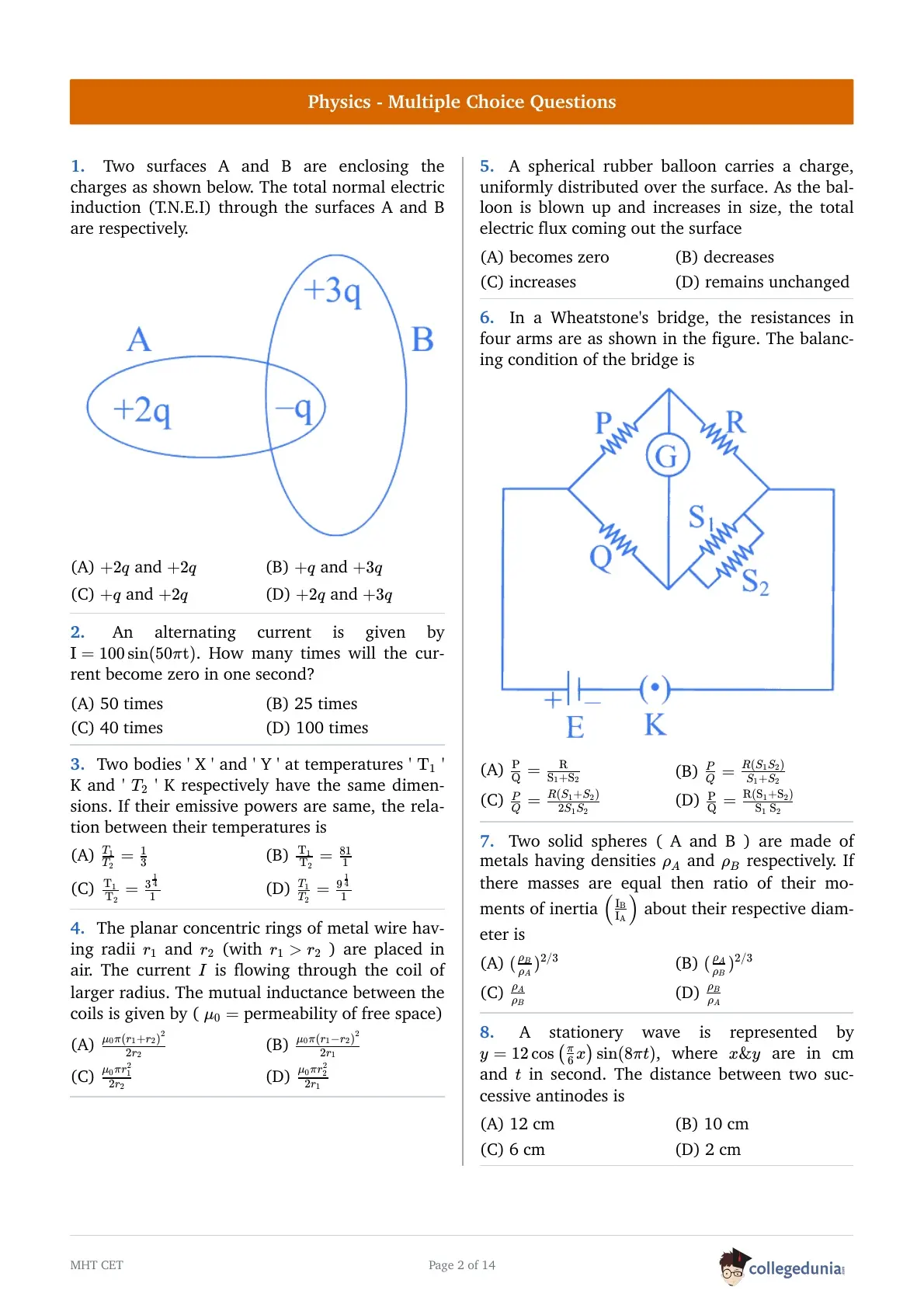
Two surfaces A and B are enclosing the charges as shown below. The total normal electric induction (T.N.E.I) through the surfaces A and B are respectively.

An alternating current is given by \(I = 100 \sin(50\pi t)\). How many times will the current become zero in one second?
The planar concentric rings of metal wire having radii \(r_1\) and \(r_2\) (with \(r_1>r_2\) ) are placed in air. The current \(I\) is flowing through the coil of larger radius. The mutual inductance between the coils is given by ( \(\mu_0=\) permeability of free space)
A spherical rubber balloon carries a charge, uniformly distributed over the surface. As the balloon is blown up and increases in size, the total electric flux coming out the surface
In a Wheatstone's bridge, the resistances in four arms are as shown in the figure. The balancing condition of the bridge is

Two solid spheres ( A and B ) are made of metals having densities \(\rho_A\) and \(\rho_B\) respectively. If there masses are equal then ratio of their moments of inertia \(\left(\frac{\mathrm{I}_{\mathrm{B}}}{\mathrm{I}_{\mathrm{A}}}\right)\) about their respective diameter is
A stationery wave is represented by \(y=12 \cos \left(\frac{\pi}{6} x\right) \sin (8 \pi t)\), where \(x \& y\) are in cm and \(t\) in second. The distance between two successive antinodes is
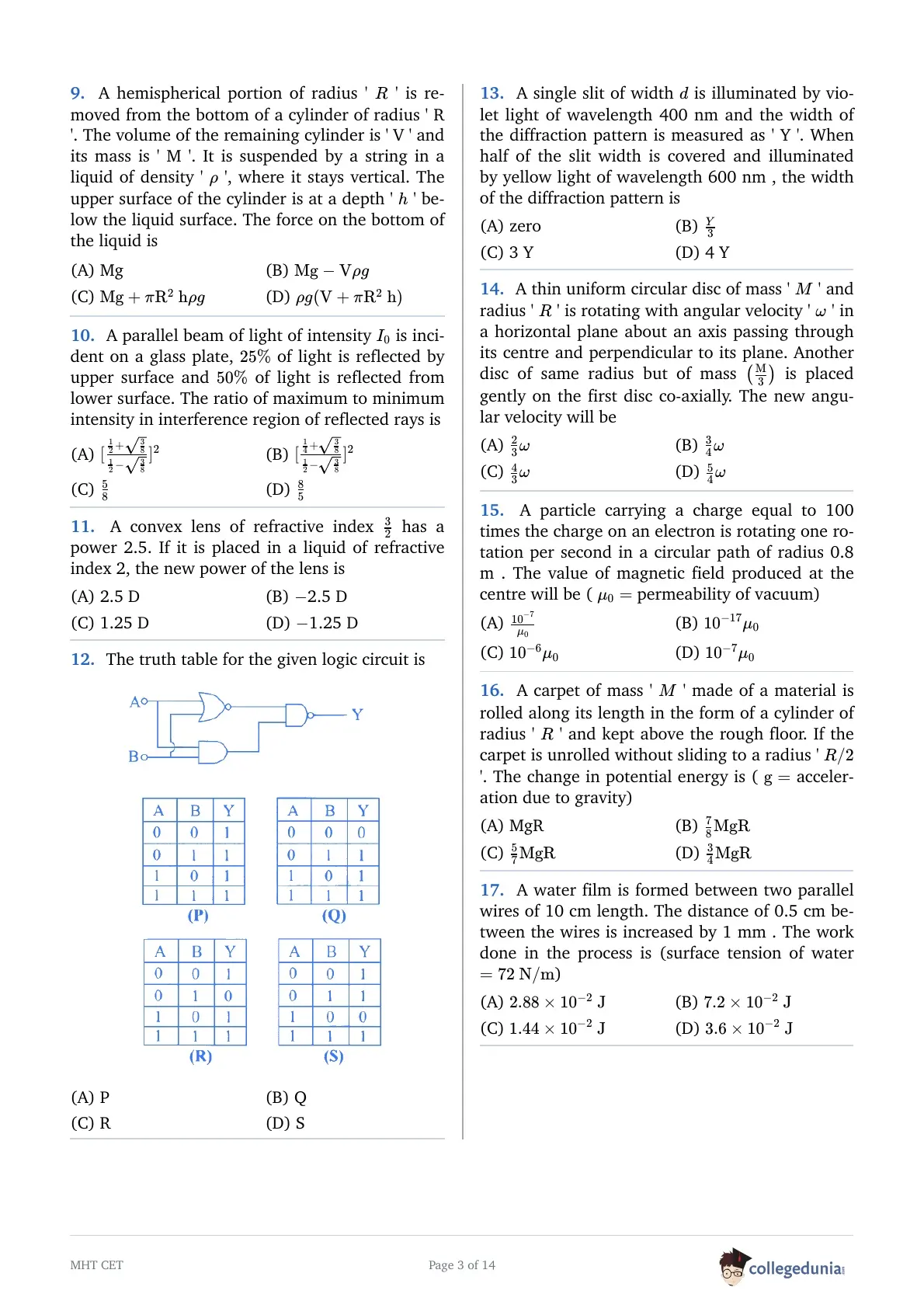
A hemispherical portion of radius ' \(R\) ' is removed from the bottom of a cylinder of radius ' R '. The volume of the remaining cylinder is ' V ' and its mass is ' M '. It is suspended by a string in a liquid of density ' \(\rho\) ', where it stays vertical. The upper surface of the cylinder is at a depth ' \(h\) ' below the liquid surface. The force on the bottom of the liquid is
A parallel beam of light of intensity \(I_0\) is incident on a glass plate, \(25 \%\) of light is reflected by upper surface and \(50 \%\) of light is reflected from lower surface. The ratio of maximum to minimum intensity in interference region of reflected rays is
A convex lens of refractive index \(\frac{3}{2}\) has a power 2.5. If it is placed in a liquid of refractive index 2, the new power of the lens is

A single slit of width \(d\) is illuminated by violet light of wavelength 400 nm and the width of the diffraction pattern is measured as ' Y '. When half of the slit width is covered and illuminated by yellow light of wavelength 600 nm , the width of the diffraction pattern is
A thin uniform circular disc of mass ' \(M\) ' and radius ' \(R\) ' is rotating with angular velocity ' \(\omega\) ' in a horizontal plane about an axis passing through its centre and perpendicular to its plane. Another disc of same radius but of mass \(\left(\frac{\mathrm{M}}{3}\right)\) is placed gently on the first disc co-axially. The new angular velocity will be
A particle carrying a charge equal to 100 times the charge on an electron is rotating one rotation per second in a circular path of radius 0.8 m . The value of magnetic field produced at the centre will be ( \(\mu_0=\) permeability of vacuum)
A carpet of mass ' \(M\) ' made of a material is rolled along its length in the form of a cylinder of radius ' \(R\) ' and kept above the rough floor. If the carpet is unrolled without sliding to a radius ' \(R / 2\) '. The change in potential energy is ( \(\mathrm{g}=\) acceleration due to gravity)
A water film is formed between two parallel wires of 10 cm length. The distance of 0.5 cm between the wires is increased by 1 mm . The work done in the process is (surface tension of water \(=72 \mathrm{~N} / \mathrm{m}\))
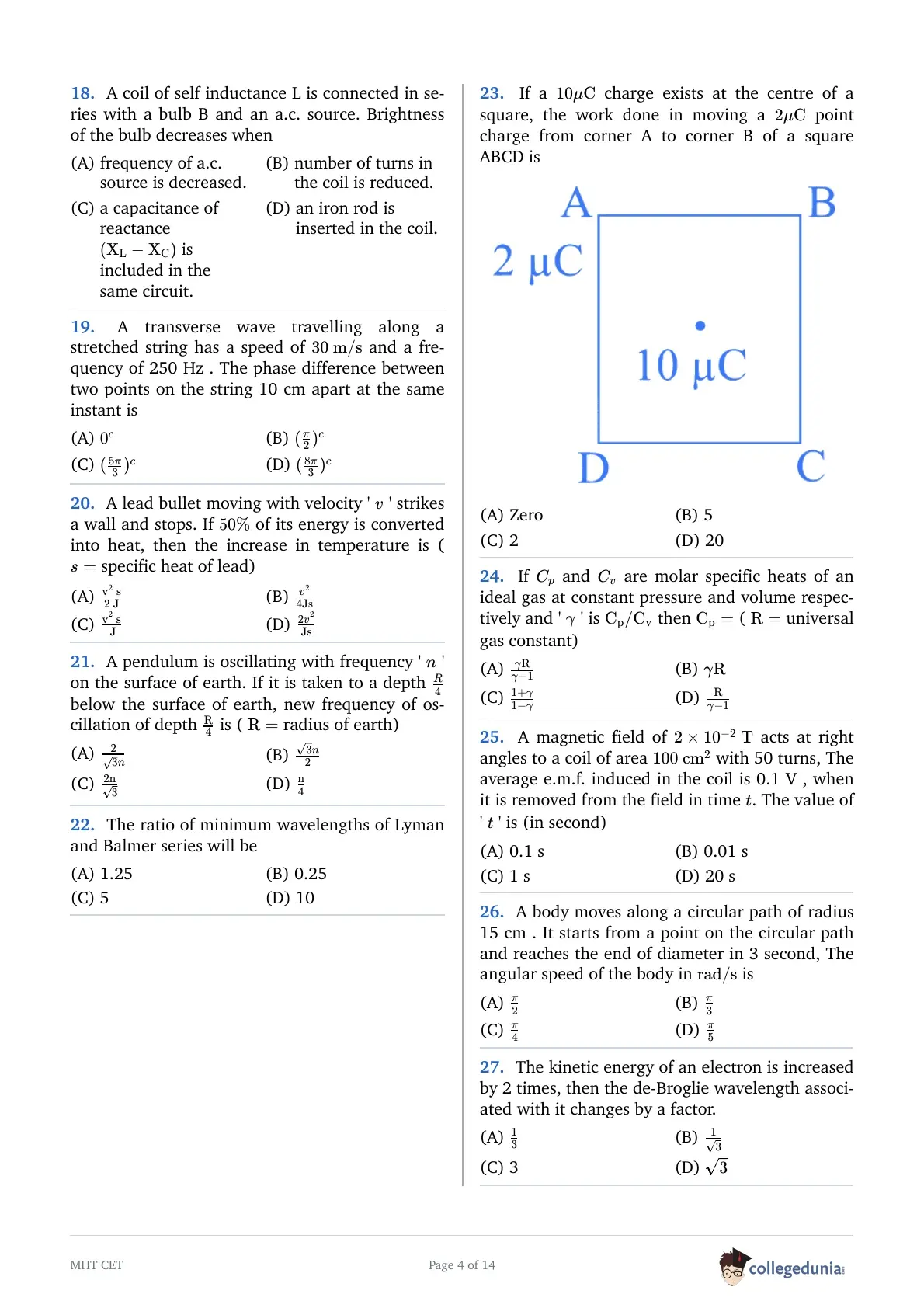
A coil of self inductance L is connected in series with a bulb B and an a.c. source. Brightness of the bulb decreases when
A transverse wave travelling along a stretched string has a speed of \(30 \mathrm{~m} / \mathrm{s}\) and a frequency of 250 Hz . The phase difference between two points on the string 10 cm apart at the same instant is
A lead bullet moving with velocity ' \(v\) ' strikes a wall and stops. If \(50 \%\) of its energy is converted into heat, then the increase in temperature is ( \(s=\) specific heat of lead)
A pendulum is oscillating with frequency ' \(n\) ' on the surface of earth. If it is taken to a depth \(\frac{R}{4}\) below the surface of earth, new frequency of oscillation of depth \(\frac{\mathrm{R}}{4}\) is ( \(\mathrm{R}=\) radius of earth)
If a \(10 \mu \mathrm{C}\) charge exists at the centre of a square, the work done in moving a \(2 \mu \mathrm{C}\) point charge from corner A to corner B of a square ABCD is

If \(C_p\) and \(C_v\) are molar specific heats of an ideal gas at constant pressure and volume respectively and ' \(\gamma\) ' is \(\mathrm{C}_{\mathrm{p}} / \mathrm{C}_{\mathrm{v}}\) then \(\mathrm{C}_{\mathrm{p}}=\) ( \(\mathrm{R}=\) universal gas constant)
A magnetic field of \(2 \times 10^{-2} \mathrm{~T}\) acts at right angles to a coil of area \(100 \mathrm{~cm}^2\) with 50 turns, The average e.m.f. induced in the coil is 0.1 V , when it is removed from the field in time \(t\). The value of ' \(t\) ' is (in second)
A body moves along a circular path of radius 15 cm . It starts from a point on the circular path and reaches the end of diameter in 3 second, The angular speed of the body in \(\mathrm{rad} / \mathrm{s}\) is
The kinetic energy of an electron is increased by 2 times, then the de-Broglie wavelength associated with it changes by a factor.
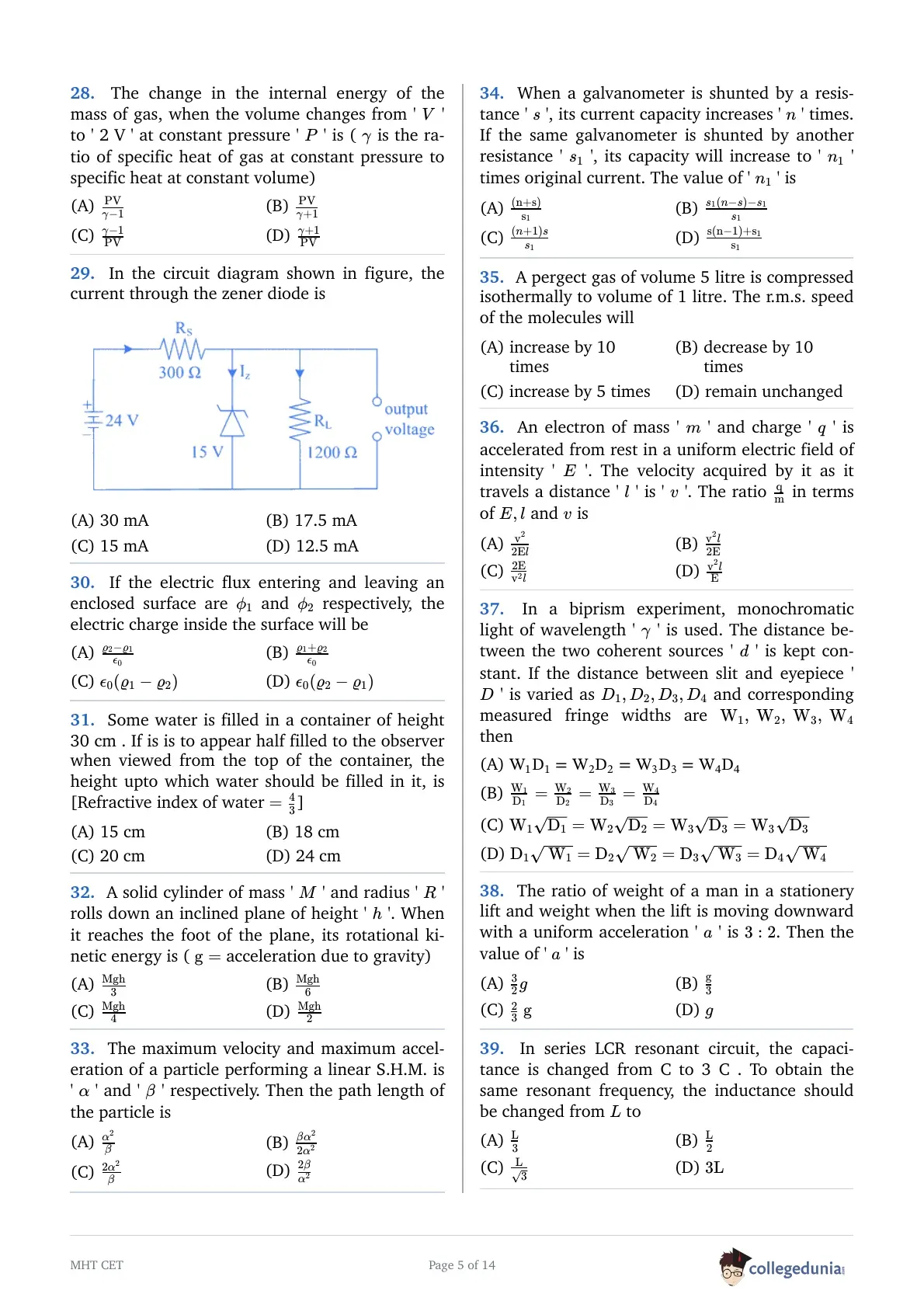
The change in the internal energy of the mass of gas, when the volume changes from ' \(V\) ' to ' 2 V ' at constant pressure ' \(P\) ' is ( \(\gamma\) is the ratio of specific heat of gas at constant pressure to specific heat at constant volume)
In the circuit diagram shown in figure, the current through the zener diode is

If the electric flux entering and leaving an enclosed surface are \(\phi_1\) and \(\phi_2\) respectively, the electric charge inside the surface will be
Some water is filled in a container of height 30 cm . If is is to appear half filled to the observer when viewed from the top of the container, the height upto which water should be filled in it, is [Refractive index of water \(=\frac{4}{3}\)]
A solid cylinder of mass ' \(M\) ' and radius ' \(R\) ' rolls down an inclined plane of height ' \(h\) '. When it reaches the foot of the plane, its rotational kinetic energy is ( \(\mathrm{g}=\) acceleration due to gravity)
The maximum velocity and maximum acceleration of a particle performing a linear S.H.M. is ' \(\alpha\) ' and ' \(\beta\) ' respectively. Then the path length of the particle is
When a galvanometer is shunted by a resistance ' \(s\) ', its current capacity increases ' \(n\) ' times. If the same galvanometer is shunted by another resistance ' \(s_1\) ', its capacity will increase to ' \(n_1\) ' times original current. The value of ' \(n_1\) ' is
A pergect gas of volume 5 litre is compressed isothermally to volume of 1 litre. The r.m.s. speed of the molecules will
An electron of mass ' \(m\) ' and charge ' \(q\) ' is accelerated from rest in a uniform electric field of intensity ' \(E\) '. The velocity acquired by it as it travels a distance ' \(l\) ' is ' \(v\) '. The ratio \(\frac{\mathrm{q}}{\mathrm{m}}\) in terms of \(E, l\) and \(v\) is
In a biprism experiment, monochromatic light of wavelength ' \(\gamma\) ' is used. The distance between the two coherent sources ' \(d\) ' is kept constant. If the distance between slit and eyepiece ' \(D\) ' is varied as \(D_1, D_2, D_3, D_4\) and corresponding measured fringe widths are \(\mathrm{W}_1, \mathrm{~W}_2, \mathrm{~W}_3, \mathrm{~W}_4\) then
The ratio of weight of a man in a stationery lift and weight when the lift is moving downward with a uniform acceleration ' \(a\) ' is \(3: 2\). Then the value of ' \(a\) ' is
In series LCR resonant circuit, the capacitance is changed from C to 3 C . To obtain the same resonant frequency, the inductance should be changed from \(L\) to
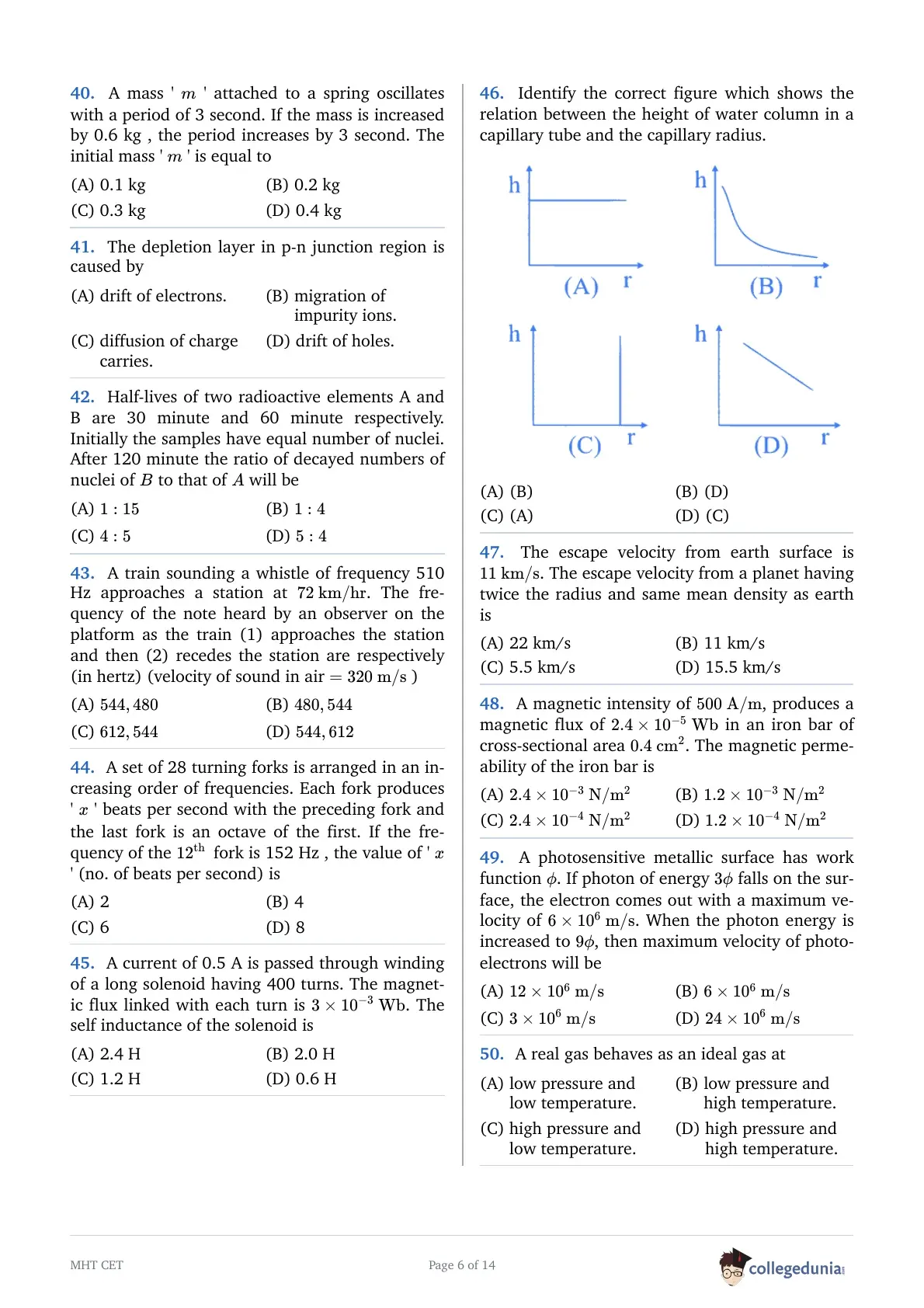
A mass ' \(m\) ' attached to a spring oscillates with a period of 3 second. If the mass is increased by 0.6 kg , the period increases by 3 second. The initial mass ' \(m\) ' is equal to
Half-lives of two radioactive elements A and B are 30 minute and 60 minute respectively. Initially the samples have equal number of nuclei. After 120 minute the ratio of decayed numbers of nuclei of \(B\) to that of \(A\) will be
A train sounding a whistle of frequency 510 Hz approaches a station at \(72 \mathrm{~km} / \mathrm{hr}\). The frequency of the note heard by an observer on the platform as the train (1) approaches the station and then (2) recedes the station are respectively (in hertz) (velocity of sound in air \(=320 \mathrm{~m} / \mathrm{s}\) )
A set of 28 turning forks is arranged in an increasing order of frequencies. Each fork produces ' \(x\) ' beats per second with the preceding fork and the last fork is an octave of the first. If the frequency of the \(12^{\text {th }}\) fork is 152 Hz , the value of ' \(x\) ' (no. of beats per second) is
A current of 0.5 A is passed through winding of a long solenoid having 400 turns. The magnetic flux linked with each turn is \(3 \times 10^{-3} \mathrm{~Wb}\). The self inductance of the solenoid is
The escape velocity from earth surface is \(11 \mathrm{~km} / \mathrm{s}\). The escape velocity from a planet having twice the radius and same mean density as earth is
A magnetic intensity of \(500 \mathrm{~A} / \mathrm{m}\), produces a magnetic flux of \(2.4 \times 10^{-5} \mathrm{~Wb}\) in an iron bar of cross-sectional area \(0.4 \mathrm{~cm}^2\). The magnetic permeability of the iron bar is
A photosensitive metallic surface has work function \(\phi\). If photon of energy \(3 \phi\) falls on the surface, the electron comes out with a maximum velocity of \(6 \times 10^6 \mathrm{~m} / \mathrm{s}\). When the photon energy is increased to \(9 \phi\), then maximum velocity of photoelectrons will be
Chemistry (Q51 - Q100)

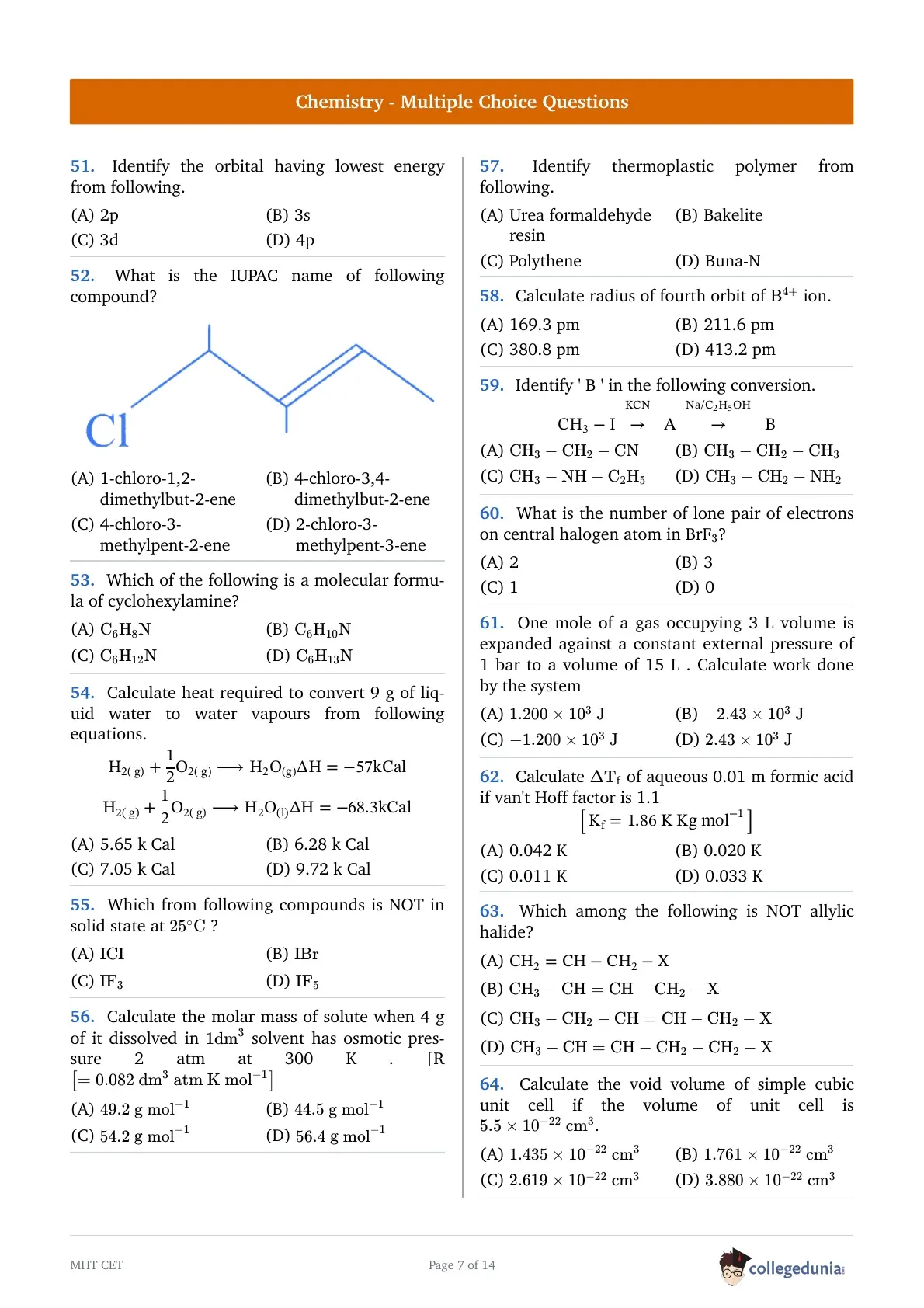
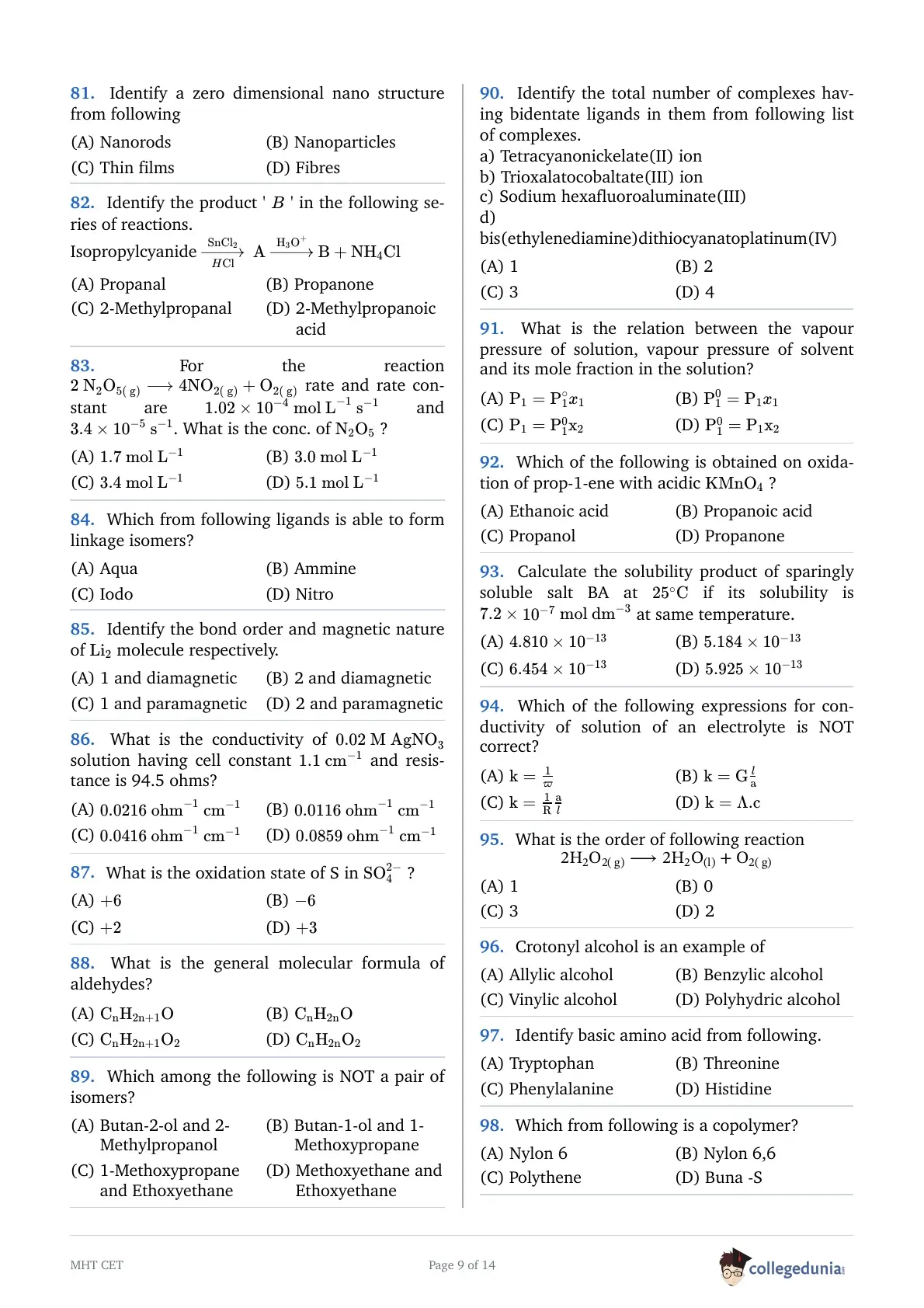
Calculate heat required to convert 9 g of liquid water to water vapours from following equations.
\[\begin{aligned} & \mathrm{H}_{2(\mathrm{~g})}+\frac{1}{2} \mathrm{O}_{2(\mathrm{~g})} \longrightarrow \mathrm{H}_2 \mathrm{O}_{(\mathrm{g})} \Delta \mathrm{H}=-57 \mathrm{kCal} \\ & \mathrm{H}_{2(\mathrm{~g})}+\frac{1}{2} \mathrm{O}_{2(\mathrm{~g})} \longrightarrow \mathrm{H}_2 \mathrm{O}_{(\mathrm{l})} \Delta \mathrm{H}=-68.3 \mathrm{kCal} \end{aligned}\]
Which from following compounds is NOT in solid state at \(25^{\circ} \mathrm{C}\) ?
Calculate the molar mass of solute when 4 g of it dissolved in \(1 \mathrm{dm}^3\) solvent has osmotic pressure 2 atm at 300 K . [R \(\left[=0.082 \mathrm{~dm}^3 \mathrm{~atm} \mathrm{~K} \mathrm{~mol}^{-1}\right]\)
Identify ' B ' in the following conversion.
\[\mathrm{CH}_3-\mathrm{I} \xrightarrow{\mathrm{KCN}} \mathrm{~A} \xrightarrow{\mathrm{Na} / \mathrm{C}_2 \mathrm{H}_5 \mathrm{OH}} \mathrm{~B}\]
What is the number of lone pair of electrons on central halogen atom in BrF\(_3\)?
One mole of a gas occupying 3 L volume is expanded against a constant external pressure of 1 bar to a volume of 15 L . Calculate work done by the system
Calculate \(\Delta \mathrm{T}_{\mathrm{f}}\) of aqueous 0.01 m formic acid if van't Hoff factor is 1.1
\[\left[\mathrm{K}_{\mathrm{f}}=1.86 \mathrm{~K} \mathrm{~Kg} \mathrm{~mol}^{-1}\right]\]
Calculate the void volume of simple cubic unit cell if the volume of unit cell is \(5.5 \times 10^{-22} \mathrm{~cm}^3\).
Calculate number of moles present in \(9.10 \times 10^{-2} \mathrm{~kg}\) of water.
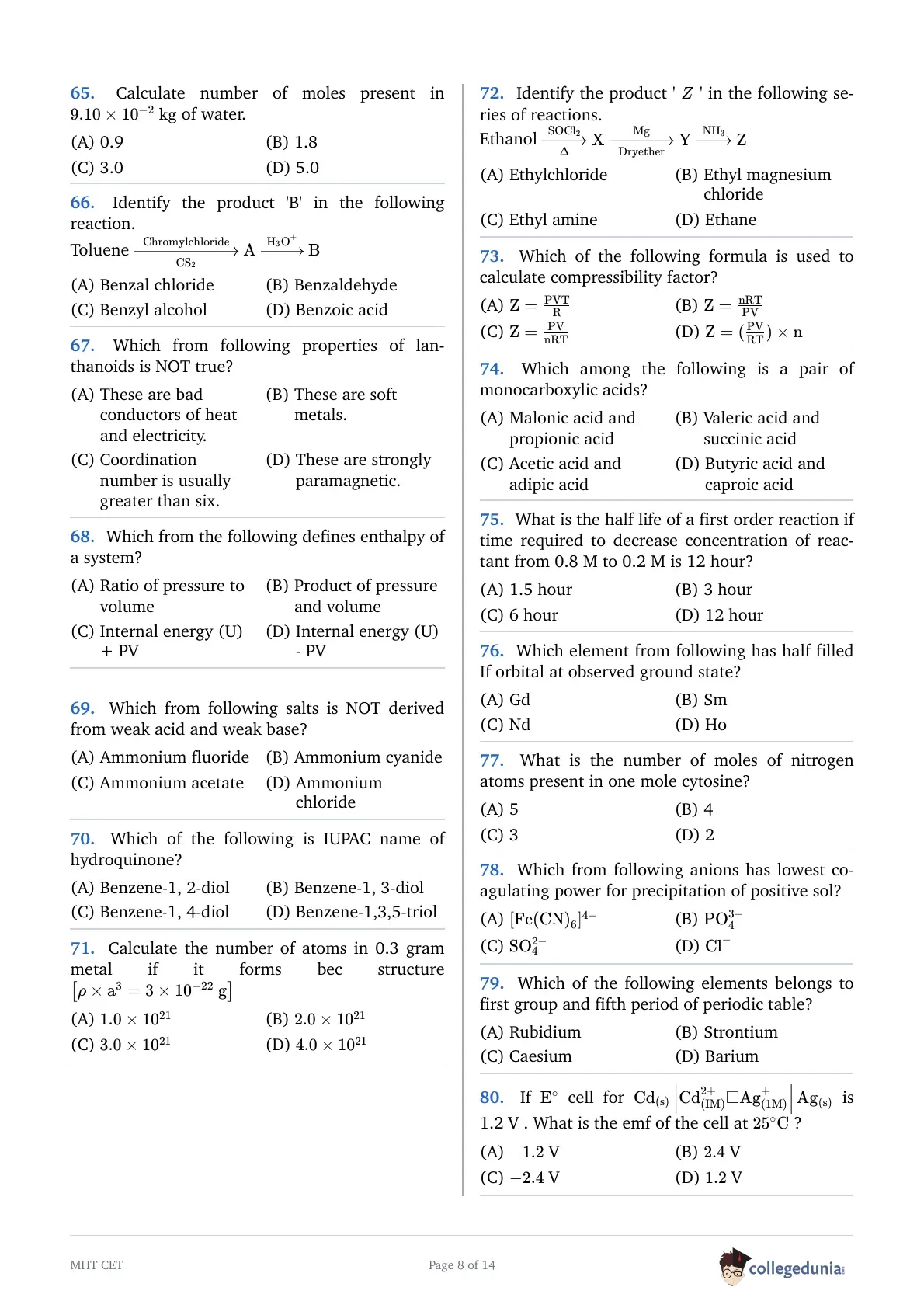
Identify the product 'B' in the following reaction.
Toluene \(\xrightarrow[\mathrm{CS}_2]{\text { Chromylchloride }} \mathrm{A} \xrightarrow{\mathrm{H}_3 \mathrm{O}^{+}} \mathrm{B}\)
Which from following salts is NOT derived from weak acid and weak base?
Calculate the number of atoms in 0.3 gram metal if it forms bec structure \(\left[\rho \times \mathrm{a}^3=3 \times 10^{-22} \mathrm{~g}\right]\)
Identify the product ' \(Z\) ' in the following series of reactions.
Ethanol \(\xrightarrow[\Delta]{\mathrm{SOCl}_2} \mathrm{X} \xrightarrow[\text { Dryether }]{\mathrm{Mg}} \mathrm{Y} \xrightarrow{\mathrm{NH}_3} \mathrm{Z}\)
Which of the following formula is used to calculate compressibility factor?
What is the half life of a first order reaction if time required to decrease concentration of reactant from 0.8 M to 0.2 M is 12 hour?
Which element from following has half filled If orbital at observed ground state?
What is the number of moles of nitrogen atoms present in one mole cytosine?
Which from following anions has lowest coagulating power for precipitation of positive sol?
Which of the following elements belongs to first group and fifth period of periodic table?
If \(\mathrm{E}^{\circ}\) cell for \(\mathrm{Cd}_{(\mathrm{s})}\left|\mathrm{Cd}_{(\mathrm{IM})}^{2+} \square \mathrm{Ag}_{(1 \mathrm{M})}^{+}\right| \mathrm{Ag}_{(\mathrm{s})}\) is 1.2 V . What is the emf of the cell at \(25^{\circ} \mathrm{C}\) ?
Identify the product ' \(B\) ' in the following series of reactions.
Isopropylcyanide \(\xrightarrow[H \mathrm{Cl}]{\mathrm{SnCl}_2} \mathrm{~A} \xrightarrow{\mathrm{H}_3 \mathrm{O}^{+}} \mathrm{B}+\mathrm{NH}_4 \mathrm{Cl}\)
For the reaction \(2 \mathrm{~N}_2 \mathrm{O}_{5(\mathrm{~g})} \longrightarrow 4 \mathrm{NO}_{2(\mathrm{~g})}+\mathrm{O}_{2(\mathrm{~g})}\) rate and rate constant are \(1.02 \times 10^{-4} \mathrm{~mol} \mathrm{~L}^{-1} \mathrm{~s}^{-1}\) and \(3.4 \times 10^{-5} \mathrm{~s}^{-1}\). What is the conc. of \(\mathrm{N}_2 \mathrm{O}_5\) ?
Identify the bond order and magnetic nature of \(\mathrm{Li}_2\) molecule respectively.
What is the conductivity of \(0.02 \mathrm{~M} \mathrm{~AgNO}_3\) solution having cell constant \(1.1 \mathrm{~cm}^{-1}\) and resistance is 94.5 ohms?
Identify the total number of complexes having bidentate ligands in them from following list of complexes.
a) Tetracyanonickelate(II) ion
b) Trioxalatocobaltate(III) ion
c) Sodium hexafluoroaluminate(III)
d) bis(ethylenediamine)dithiocyanatoplatinum(IV)
What is the relation between the vapour pressure of solution, vapour pressure of solvent and its mole fraction in the solution?
Which of the following is obtained on oxidation of prop-1-ene with acidic \(\mathrm{KMnO}_4\) ?
Calculate the solubility product of sparingly soluble salt BA at \(25^{\circ} \mathrm{C}\) if its solubility is \(7.2 \times 10^{-7} \mathrm{~mol} \mathrm{~dm}^{-3}\) at same temperature.
Which of the following expressions for conductivity of solution of an electrolyte is NOT correct?
What is the order of following reaction
\[2 \mathrm{H}_2 \mathrm{O}_{2(\mathrm{~g})} \longrightarrow 2 \mathrm{H}_2 \mathrm{O}_{(\mathrm{l})}+\mathrm{O}_{2(\mathrm{~g})}\]
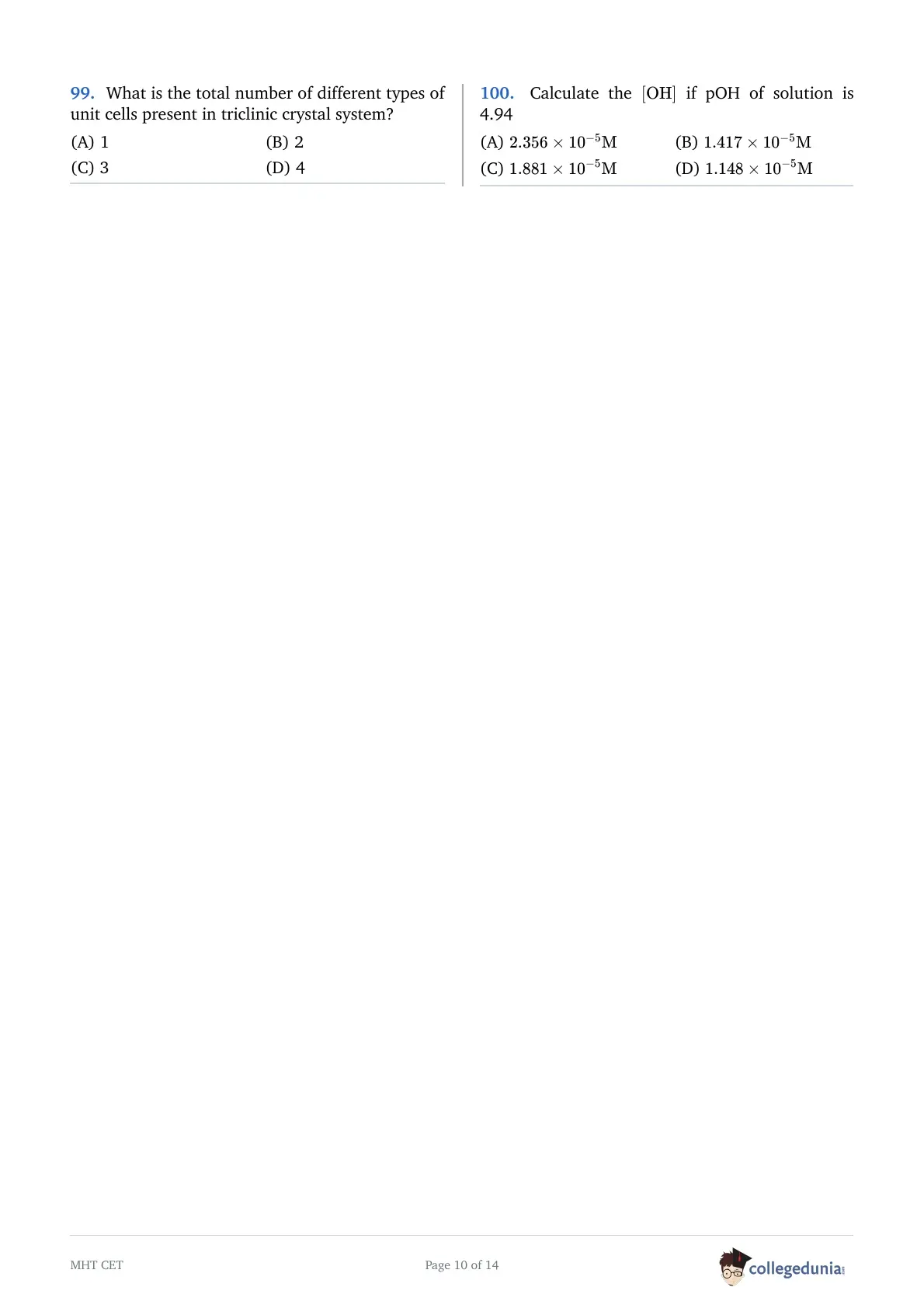
What is the total number of different types of unit cells present in triclinic crystal system?
Mathematics (Q101 - Q150)
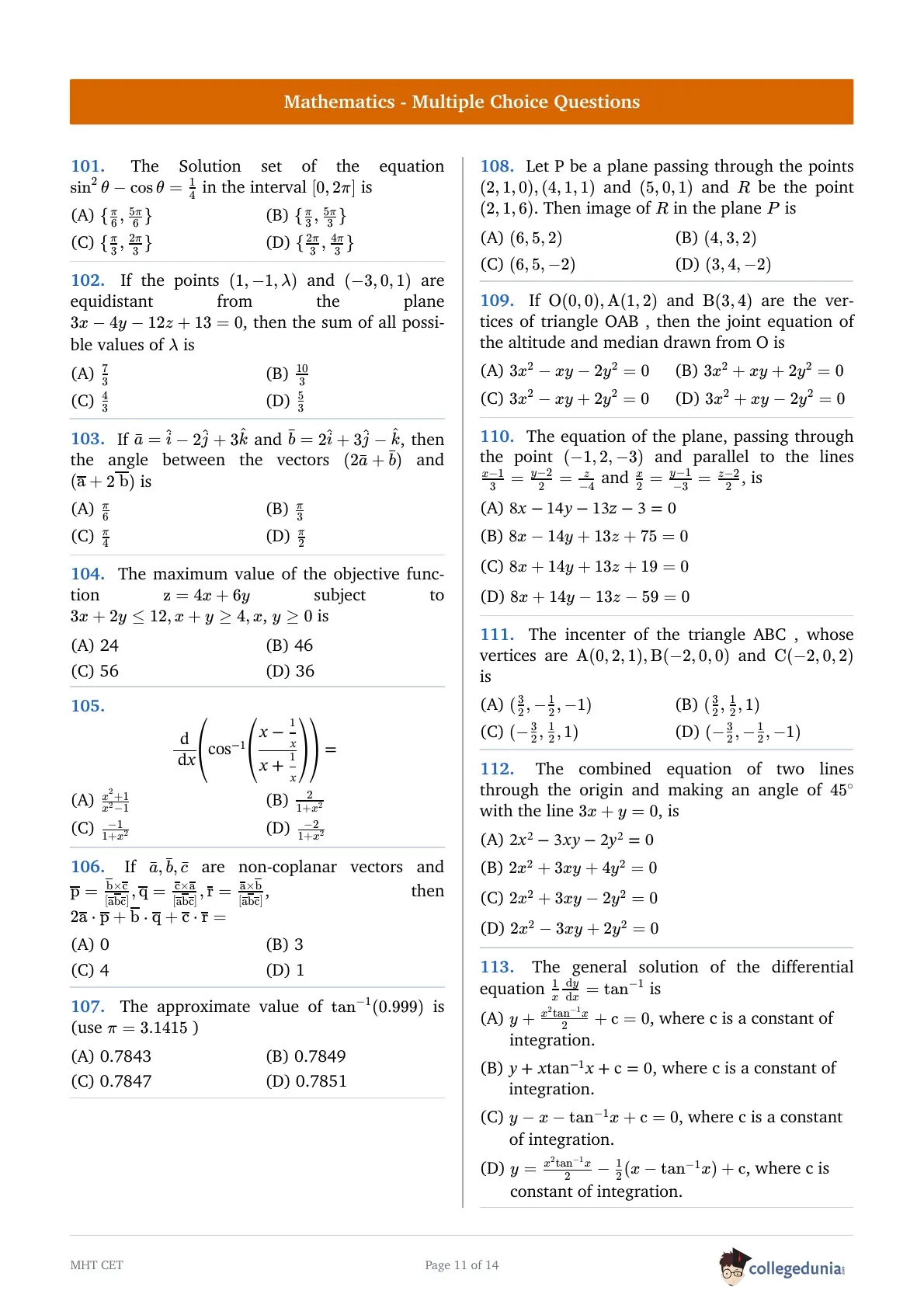
The Solution set of the equation \(\sin ^2 \theta-\cos \theta=\frac{1}{4}\) in the interval \([0,2 \pi]\) is
If the points \((1,-1, \lambda)\) and \((-3,0,1)\) are equidistant from the plane \(3 x-4 y-12 z+13=0\), then the sum of all possible values of \(\lambda\) is
If \(\bar{a}=\hat{i}-2 \hat{j}+3 \hat{k}\) and \(\bar{b}=2 \hat{i}+3 \hat{j}-\hat{k}\), then the angle between the vectors \((2 \bar{a}+\bar{b})\) and \((\overline{\mathrm{a}}+2 \overline{\mathrm{~b}})\) is
The maximum value of the objective function \(\mathrm{z}=4 x+6 y\) subject to \(3 x+2 y \leq 12, x+y \geq 4, x\), \(y \geq 0\) is
\[\frac{\mathrm{d}}{\mathrm{~d} x}\left(\cos ^{-1}\left(\frac{x-\frac{1}{x}}{x+\frac{1}{x}}\right)\right)=\]
If \(\bar{a}, \bar{b}, \bar{c}\) are non-coplanar vectors and \(\overline{\mathrm{p}}=\frac{\overline{\mathrm{b}} \times \overline{\mathrm{c}}}{[\overline{\mathrm{a}} \overline{\mathrm{b}} \overline{\mathrm{c}}]}, \overline{\mathrm{q}}=\frac{\overline{\mathrm{c}} \times \overline{\mathrm{a}}}{[\overline{\mathrm{a}} \overline{\mathrm{b}} \overline{\mathrm{c}}]}, \overline{\mathrm{r}}=\frac{\overline{\mathrm{a}} \times \overline{\mathrm{b}}}{[\overline{\mathrm{a}} \overline{\mathrm{b}} \overline{\mathrm{c}}]}\), then \(2 \overline{\mathrm{a}} \cdot \overline{\mathrm{p}}+\overline{\mathrm{b}} \cdot \overline{\mathrm{q}}+\overline{\mathrm{c}} \cdot \overline{\mathrm{r}}=\)
The approximate value of \(\tan ^{-1}(0.999)\) is (use \(\pi=3.1415\) )
Let P be a plane passing through the points \((2,1,0),(4,1,1)\) and \((5,0,1)\) and \(R\) be the point \((2,1,6)\). Then image of \(R\) in the plane \(P\) is
If \(\mathrm{O}(0,0), \mathrm{A}(1,2)\) and \(\mathrm{B}(3,4)\) are the vertices of triangle OAB , then the joint equation of the altitude and median drawn from O is
The equation of the plane, passing through the point \((-1,2,-3)\) and parallel to the lines \(\frac{x-1}{3}=\frac{y-2}{2}=\frac{z}{-4}\) and \(\frac{x}{2}=\frac{y-1}{-3}=\frac{z-2}{2}\), is
The incenter of the triangle ABC , whose vertices are \(\mathrm{A}(0,2,1), \mathrm{B}(-2,0,0)\) and \(\mathrm{C}(-2,0,2)\) is
The combined equation of two lines through the origin and making an angle of \(45^{\circ}\) with the line \(3 x+y=0\), is
The area (in square units) in the first quadrant bounded by the curve \(y=x^2+2\) and the lines \(y=x+1, x=0\) and \(x=3\), is
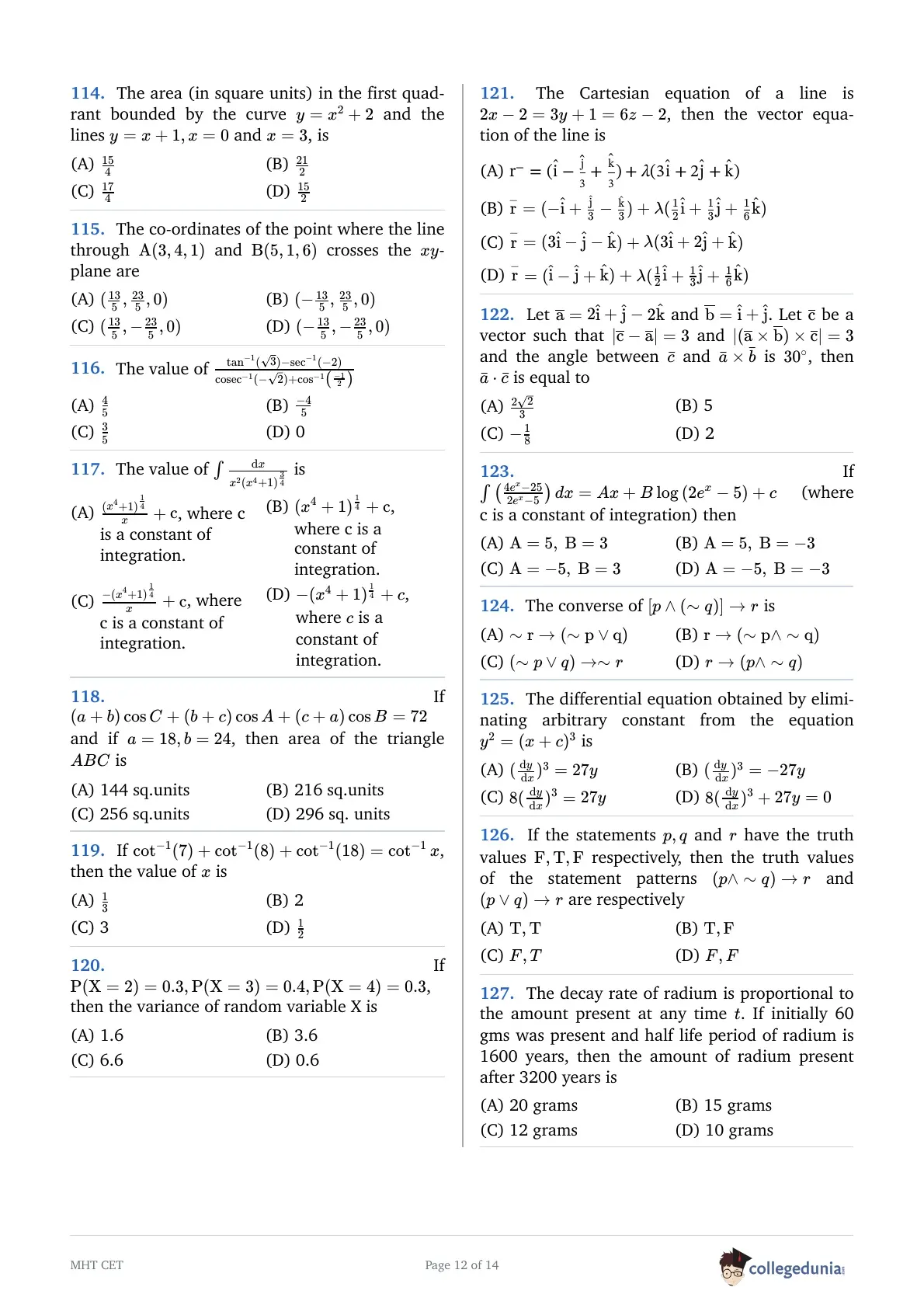
The co-ordinates of the point where the line through \(\mathrm{A}(3,4,1)\) and \(\mathrm{B}(5,1,6)\) crosses the \(x y\)-plane are
The value of \(\frac{\tan ^{-1}(\sqrt{3})-\sec ^{-1}(-2)}{\operatorname{cosec}^{-1}(-\sqrt{2})+\cos ^{-1}\left(\frac{-1}{2}\right)}\)
The value of \(\int \frac{\mathrm{d} x}{x^2\left(x^4+1\right)^{\frac{3}{4}}}\) is
If \((a+b) \cos C+(b+c) \cos A+(c+a) \cos B=72\) and if \(a=18, b=24\), then area of the triangle \(A B C\) is
If \(\cot ^{-1}(7)+\cot ^{-1}(8)+\cot ^{-1}(18)=\cot ^{-1} x\), then the value of \(x\) is
If \(\mathrm{P}(\mathrm{X}=2)=0.3, \mathrm{P}(\mathrm{X}=3)=0.4, \mathrm{P}(\mathrm{X}=4)=0.3\), then the variance of random variable X is
The Cartesian equation of a line is \(2 x-2=3 y+1=6 z-2\), then the vector equation of the line is
Let \(\overline{\mathrm{a}}=2 \hat{\mathrm{i}}+\hat{\mathrm{j}}-2 \hat{\mathrm{k}}\) and \(\overline{\mathrm{b}}=\hat{\mathrm{i}}+\hat{\mathrm{j}}\). Let \(\overline{\mathrm{c}}\) be a vector such that \(|\overline{\mathrm{c}}-\overline{\mathrm{a}}|=3\) and \(|(\overline{\mathrm{a}} \times \overline{\mathrm{b}}) \times \overline{\mathrm{c}}|=3\) and the angle between \(\bar{c}\) and \(\bar{a} \times \bar{b}\) is \(30^{\circ}\), then \(\bar{a} \cdot \bar{c}\) is equal to
If \(\int\left(\frac{4 e^x-25}{2 e^x-5}\right) d x=A x+B \log \left(2 e^x-5\right)+c \quad\) (where c is a constant of integration) then
The differential equation obtained by eliminating arbitrary constant from the equation \(y^2=(x+c)^3\) is
If the statements \(p, q\) and \(r\) have the truth values \(\mathrm{F}, \mathrm{T}, \mathrm{F}\) respectively, then the truth values of the statement patterns \((p \wedge \sim q) \rightarrow r\) and \((p \vee q) \rightarrow r\) are respectively
The decay rate of radium is proportional to the amount present at any time \(t\). If initially 60 gms was present and half life period of radium is 1600 years, then the amount of radium present after 3200 years is
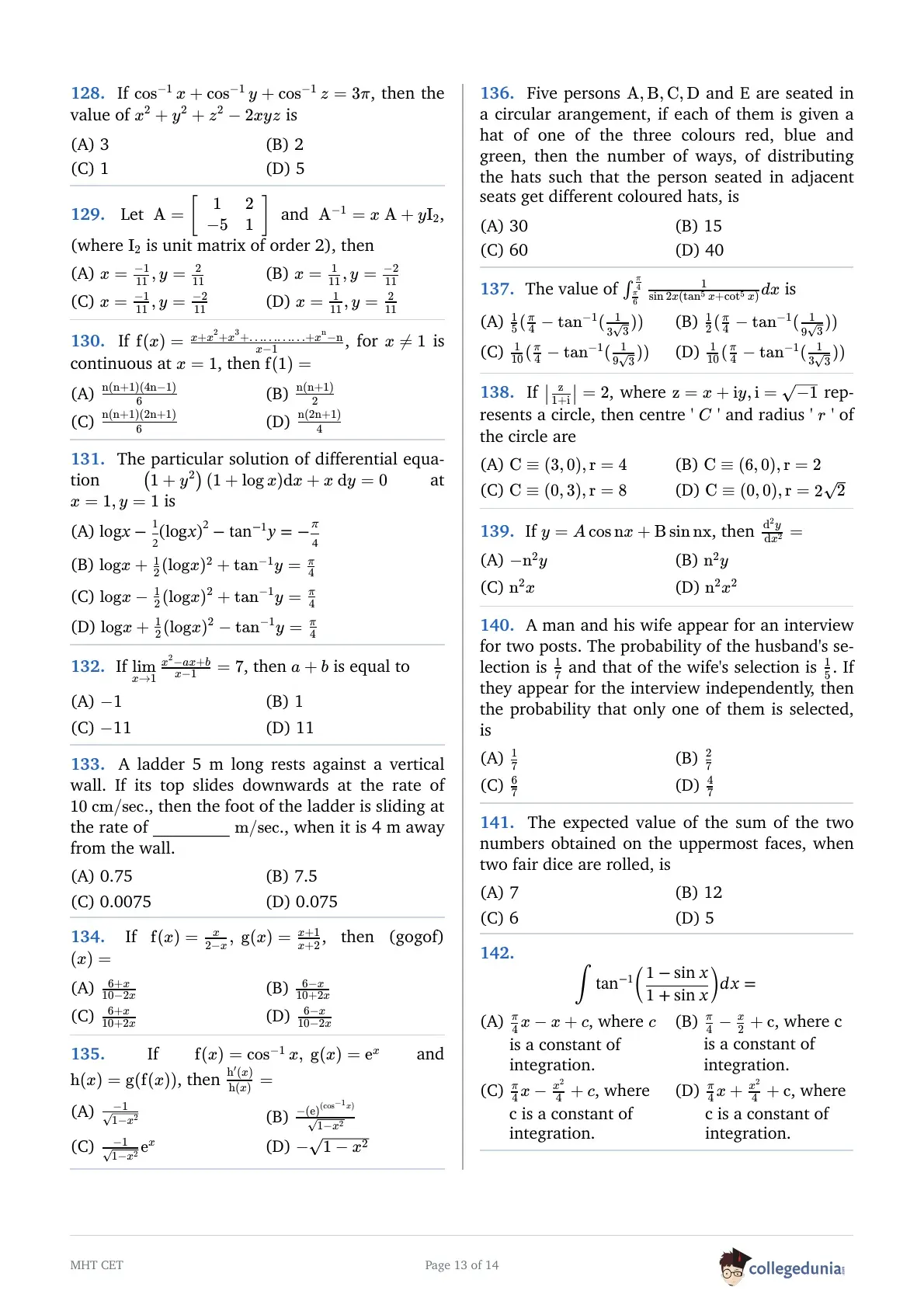
If \(\cos ^{-1} x+\cos ^{-1} y+\cos ^{-1} z=3 \pi\), then the value of \(x^2+y^2+z^2-2 x y z\) is
Let \(\mathrm{A}=\left[\begin{array}{cc}1 & 2 \\ -5 & 1\end{array}\right]\) and \(\mathrm{A}^{-1}=x \mathrm{~A}+y \mathrm{I}_2\), (where \(\mathrm{I}_2\) is unit matrix of order 2), then
If \(\mathrm{f}(x)=\frac{x+x^2+x^3+\ldots \ldots \ldots \ldots+x^{\mathrm{n}}-\mathrm{n}}{x-1}\), for \(x \neq 1\) is continuous at \(x=1\), then \(\mathrm{f}(1)=\)
The particular solution of differential equation \(\left(1+y^2\right)(1+\log x) \mathrm{d} x+x \mathrm{~d} y=0\) at \(x=1, y=1\) is
If \(\lim _\limits{x \rightarrow 1} \frac{x^2-a x+b}{x-1}=7\), then \(a+b\) is equal to
A ladder 5 m long rests against a vertical wall. If its top slides downwards at the rate of \(10 \mathrm{~cm} / \mathrm{sec}\)., then the foot of the ladder is sliding at the rate of _________ \(\mathrm{m} / \mathrm{sec}\)., when it is 4 m away from the wall.
If \(\mathrm{f}(x)=\frac{x}{2-x}, \mathrm{~g}(x)=\frac{x+1}{x+2}\), then (gogof) \((x)=\)
If \(\mathrm{f}(x)=\cos ^{-1} x, \mathrm{~g}(x)=\mathrm{e}^x\) and \(\mathrm{h}(x)=\mathrm{g}(\mathrm{f}(x))\), then \(\frac{\mathrm{h}^{\prime}(x)}{\mathrm{h}(x)}=\)
Five persons \(\mathrm{A}, \mathrm{B}, \mathrm{C}, \mathrm{D}\) and E are seated in a circular arangement, if each of them is given a hat of one of the three colours red, blue and green, then the number of ways, of distributing the hats such that the person seated in adjacent seats get different coloured hats, is
The value of \(\int_{\frac{\pi}{6}}^{\frac{\pi}{4}} \frac{1}{\sin 2 x\left(\tan ^5 x+\cot ^5 x\right)} d x\) is
If \(\left|\frac{\mathrm{z}}{1+\mathrm{i}}\right|=2\), where \(\mathrm{z}=x+\mathrm{i} y, \mathrm{i}=\sqrt{-1}\) represents a circle, then centre ' \(C\) ' and radius ' \(r\) ' of the circle are
If \(y=A \cos \mathrm{n} x+\mathrm{B} \sin \mathrm{nx}\), then \(\frac{\mathrm{d}^2 y}{\mathrm{~d} x^2}=\)
A man and his wife appear for an interview for two posts. The probability of the husband's selection is \(\frac{1}{7}\) and that of the wife's selection is \(\frac{1}{5}\). If they appear for the interview independently, then the probability that only one of them is selected, is
The expected value of the sum of the two numbers obtained on the uppermost faces, when two fair dice are rolled, is
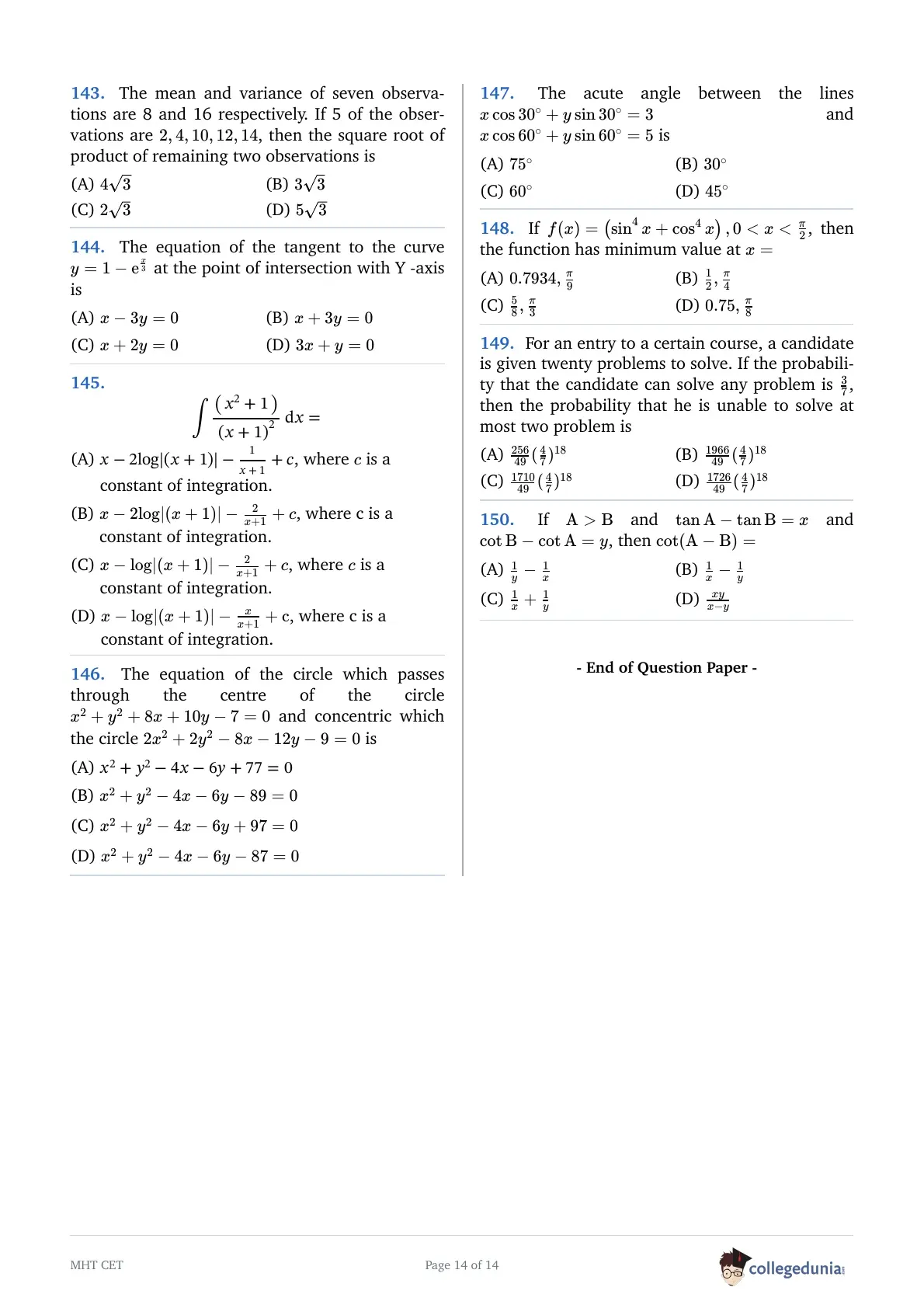
The mean and variance of seven observations are 8 and 16 respectively. If 5 of the observations are \(2,4,10,12,14\), then the square root of product of remaining two observations is
The equation of the tangent to the curve \(y=1-\mathrm{e}^{\frac{x}{3}}\) at the point of intersection with Y -axis is
The equation of the circle which passes through the centre of the circle \(x^2+y^2+8 x+10 y-7=0\) and concentric which the circle \(2 x^2+2 y^2-8 x-12 y-9=0\) is
The acute angle between the lines \(x \cos 30^{\circ}+y \sin 30^{\circ}=3\) and \(x \cos 60^{\circ}+y \sin 60^{\circ}=5\) is
If \(\mathrm{A}>\mathrm{B}\) and \(\tan \mathrm{A}-\tan \mathrm{B}=x\) and \(\cot \mathrm{B}-\cot \mathrm{A}=y\), then \(\cot (\mathrm{A}-\mathrm{B})=\)
MHT CET 2024 PCM Exam Pattern and Marking Scheme
| Parameter | Details |
|---|---|
| Conducting Body | Maharashtra Common Entrance Test Cell (Maharashtra CET Cell) |
| Exam Mode | Online (Computer-Based Test) |
| Duration | 180 minutes (3 hours) |
| Groups / Subjects | PCM (Physics, Chemistry, Mathematics) for Engineering |
| Total Questions |
150 |
| Total Marks | 200 |
| Question Type | Multiple Choice Questions (MCQs) |
| Marks Distribution |
|
| Negative Marking | No |
| Syllabus Weightage |
|



Comments