




MHT CET 2025 April 20 Shift 1 PCM Question Paper is available for download here. Maharashtra State CET Cell conducted MHT CET 2025 PCM Exam on April 20 in Shift 1 from 9 AM to 12 PM in CBT mode.
The MHT CET 2025 PCM question paper includes the following:
- The MHT CET 2025 PCM Question Paper consists of 150 multiple-choice questions (MCQs) totalling 200 marks divided into 3 sections: Physics, Chemistry, and Mathematics, with 50 questions in each subject.
- Physics and Chemistry questions carry 1 mark each while Mathematics questions carry 2 marks each.
- There is no negative marking for incorrect answers.
MHT CET 2025 April 20 Shift 1 PCM Question Paper with Solution PDF
| CD PDF | CD PDF with Solutions |
|---|---|
| Download Collegedunia PDF 0.86 MB | - |
Also Check:
MHT CET 2025 April 20 Shift 1 PCM Questions with Solutions
Physics (Q1 - Q50)
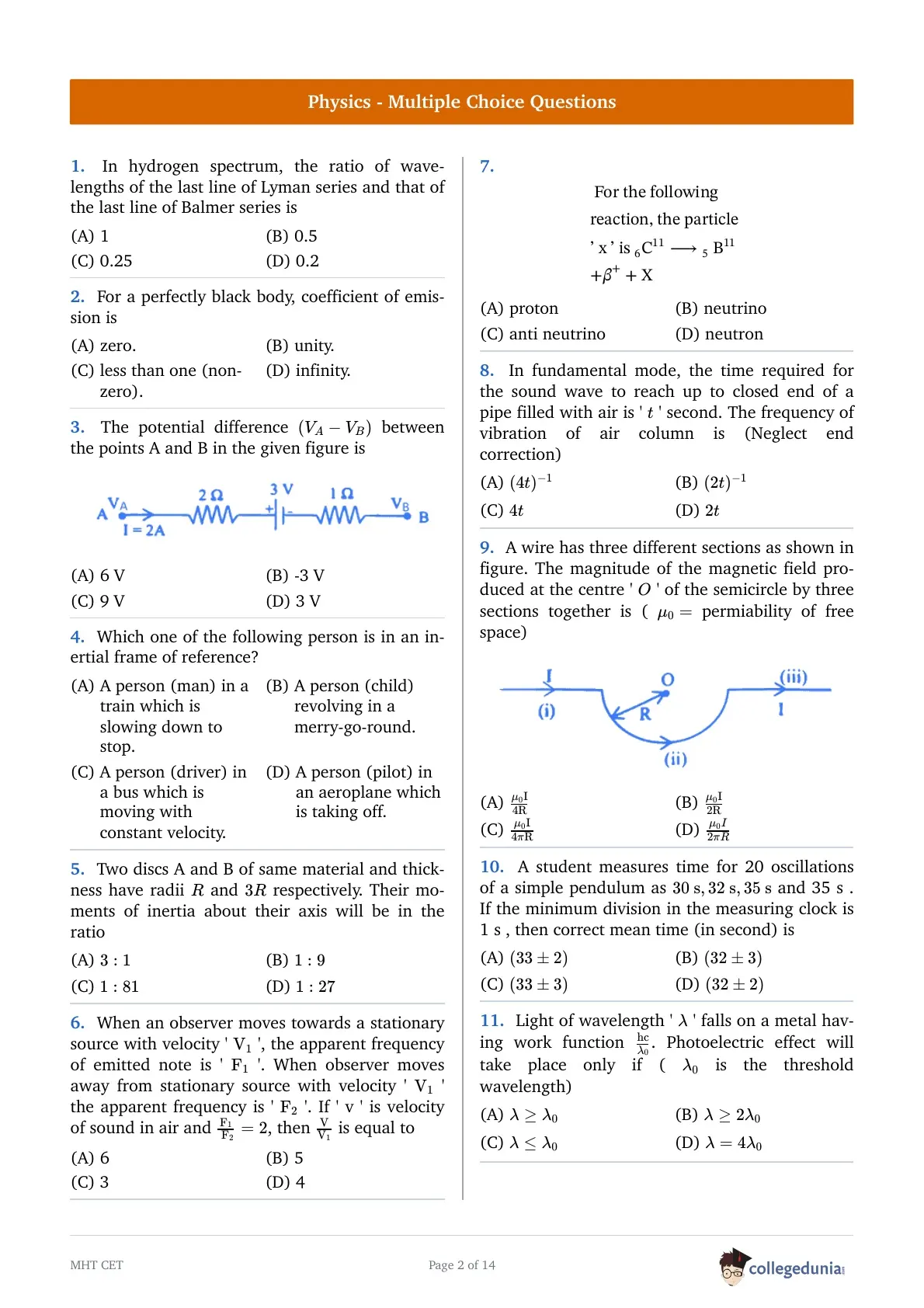
In hydrogen spectrum, the ratio of wavelengths of the last line of Lyman series and that of the last line of Balmer series is
For a perfectly black body, coefficient of emission is
The potential difference \((V_A - V_B)\) between the points A and B in the given figure is

Which one of the following person is in an inertial frame of reference?
Two discs A and B of same material and thickness have radii \(R\) and \(3R\) respectively. Their moments of inertia about their axis will be in the ratio
When an observer moves towards a stationary source with velocity '\(V_1\)', the apparent frequency of emitted note is '\(F_1\)'. When observer moves away from stationary source with velocity '\(V_1\)' the apparent frequency is '\(F_2\)'. If '\(v\)' is velocity of sound in air and \(\frac{F_1}{F_2} = 2\), then \(\frac{v}{V_1}\) is equal to
For the following reaction, the particle ' x ' is \({}_6\text{C}^{11} \longrightarrow {}_5\text{B}^{11} + \beta^+ + \text{X}\)
In fundamental mode, the time required for the sound wave to reach up to closed end of a pipe filled with air is '\(t\)' second. The frequency of vibration of air column is (Neglect end correction)
A wire has three different sections as shown in figure. The magnitude of the magnetic field produced at the centre '\(O\)' of the semicircle by three sections together is ( \(\mu_0 =\) permiability of free space)

A student measures time for 20 oscillations of a simple pendulum as \(30\text{ s}, 32\text{ s}, 35\text{ s}\) and \(35\text{ s}\) . If the minimum division in the measuring clock is \(1\text{ s}\) , then correct mean time (in second) is
Light of wavelength ' \(\lambda\) ' falls on a metal having work function \(\frac{\text{hc}{\lambda_0}\). Photoelectric effect will take place only if ( \(\lambda_0\) is the threshold wavelength)}
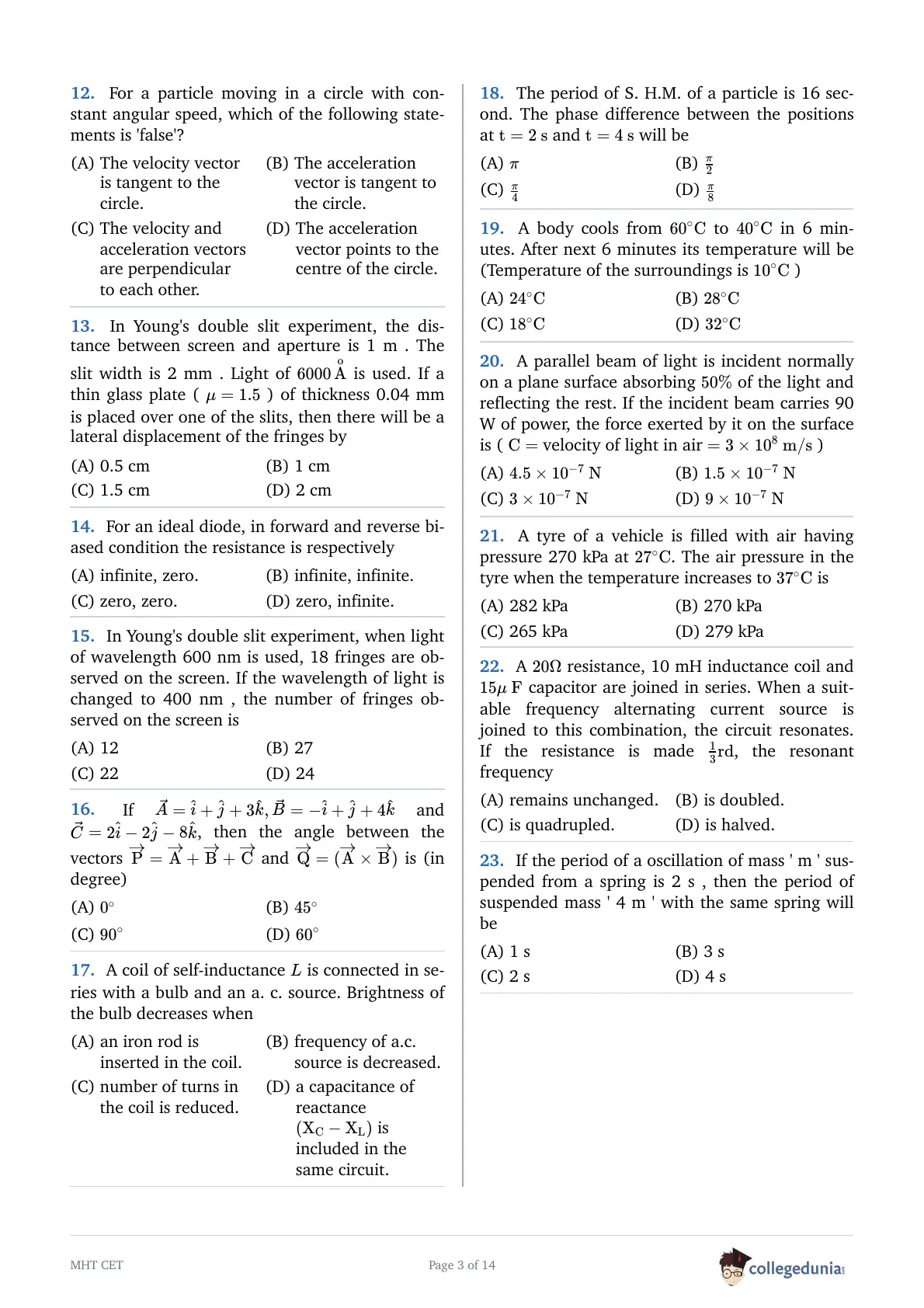
For a particle moving in a circle with constant angular speed, which of the following statements is 'false'?
In Young's double slit experiment, the distance between screen and aperture is \(1\text{ m}\) . The slit width is \(2\text{ mm}\) . Light of \(6000\text{ \AA}\) is used. If a thin glass plate ( \(\mu = 1.5\) ) of thickness \(0.04\text{ mm}\) is placed over one of the slits, then there will be a lateral displacement of the fringes by}
For an ideal diode, in forward and reverse biased condition the resistance is respectively
In Young's double slit experiment, when light of wavelength \(600\text{ nm}\) is used, 18 fringes are observed on the screen. If the wavelength of light is changed to \(400\text{ nm}\) , the number of fringes observed on the screen is
If \(\vec{A} = \hat{i} + \hat{j} + 3\hat{k}\), \(\vec{B} = -\hat{i} + \hat{j} + 4\hat{k}\) and \(\vec{C} = 2\hat{i} - 2\hat{j} - 8\hat{k}\), then the angle between the vectors \(\vec{P} = \vec{A} + \vec{B} + \vec{C}\) and \(\vec{Q} = (\vec{A} \times \vec{B})\) is (in degree)}
A coil of self-inductance \(L\) is connected in series with a bulb and an a. c. source. Brightness of the bulb decreases when
The period of S. H.M. of a particle is 16 second. The phase difference between the positions at \(\text{t} = 2\text{ s}\) and \(\text{t} = 4\text{ s}\) will be}
A body cools from \(60^\circ\text{C}\) to \(40^\circ\text{C}\) in 6 minutes. After next 6 minutes its temperature will be (Temperature of the surroundings is \(10^\circ\text{C}\) )}
A parallel beam of light is incident normally on a plane surface absorbing 50% of the light and reflecting the rest. If the incident beam carries \(90\text{ W}\) of power, the force exerted by it on the surface is ( \(\text{C} =\) velocity of light in air \(= 3 \times 10^8\text{ m/s}\) )}
A tyre of a vehicle is filled with air having pressure \(270\text{ kPa}\) at \(27^\circ\text{C}\) . The air pressure in the tyre when the temperature increases to \(37^\circ\text{C}\) is
A \(20\Omega\) resistance, \(10\text{ mH}\) inductance coil and \(15\mu\text{F}\) capacitor are joined in series. When a suitable frequency alternating current source is joined to this combination, the circuit resonates. If the resistance is made \(\frac{1}{3}\text{rd}\), the resonant frequency}
If the period of a oscillation of mass ' m ' suspended from a spring is \(2\text{ s}\) , then the period of suspended mass ' 4 m ' with the same spring will be}
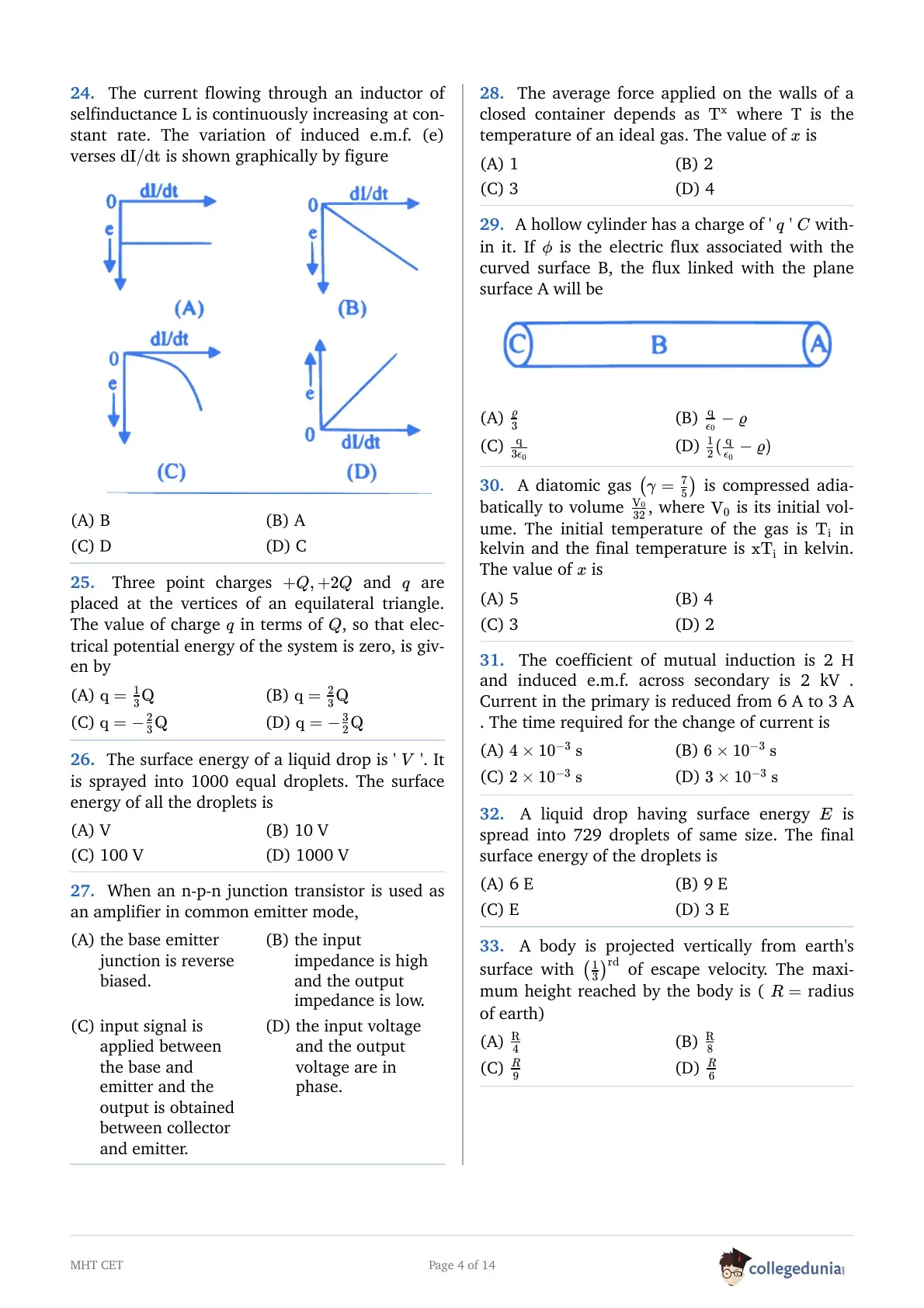
The current flowing through an inductor of self-inductance L is continuously increasing at constant rate. The variation of induced e.m.f. (e) verses \(\text{dI}/\text{dt}\) is shown graphically by figure}

Three point charges \(+Q, +2Q\) and \(q\) are placed at the vertices of an equilateral triangle. The value of charge \(q\) in terms of \(Q\), so that electrical potential energy of the system is zero, is given by
The surface energy of a liquid drop is ' \(V\) '. It is sprayed into 1000 equal droplets. The surface energy of all the droplets is
When an n-p-n junction transistor is used as an amplifier in common emitter mode,
The average force applied on the walls of a closed container depends as \(\text{T}^\text{x}\) where T is the temperature of an ideal gas. The value of \(x\) is
A hollow cylinder has a charge of ' \(q\) ' \(C\) within it. If \(\phi\) is the electric flux associated with the curved surface B, the flux linked with the plane surface A will be

A diatomic gas \(\left(\gamma = \frac{7}{5}\right)\) is compressed adiabatically to volume \(\frac{\text{V}_0}{32}\) , where \(\text{V}_0\) is its initial volume. The initial temperature of the gas is \(\text{T}_\text{i}\) in kelvin and the final temperature is \(\text{x}\text{T}_\text{i}\) in kelvin. The value of \(x\) is
The coefficient of mutual induction is \(2\text{ H}\) and induced e.m.f. across secondary is \(2\text{ kV}\) . Current in the primary is reduced from \(6\text{ A}\) to \(3\text{ A}\) . The time required for the change of current is
A liquid drop having surface energy \(E\) is spread into 729 droplets of same size. The final surface energy of the droplets is
A body is projected vertically from Earth's surface with \( \left(\frac{1}{3}\right)^{\text{rd}} \) of the escape velocity. The maximum height reached by the body is (\( R \) = radius of Earth).
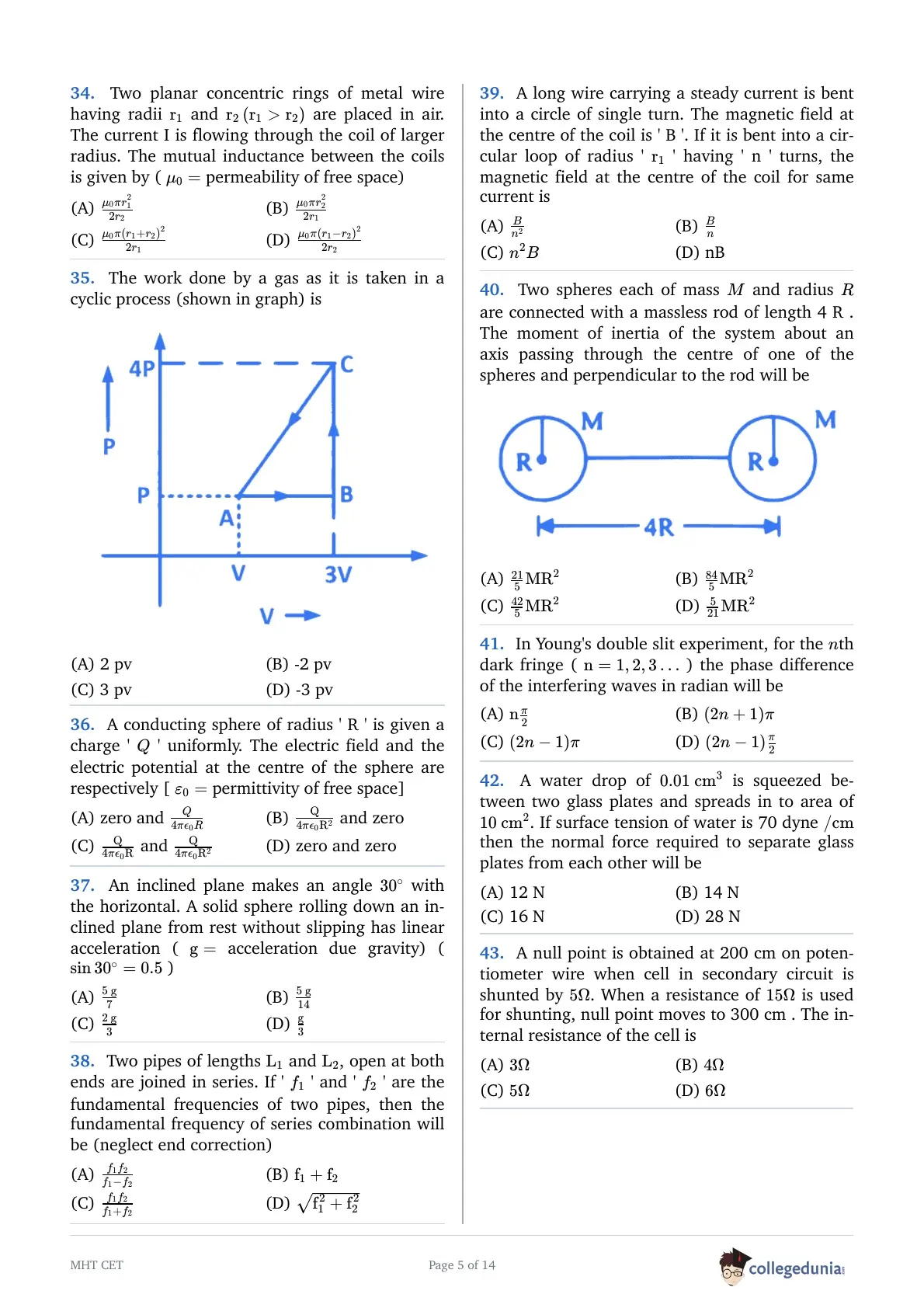
Two planar concentric rings of metal wire having radii \(\text{r}_1\) and \(\text{r}_2\) ( \(\text{r}_1 > \text{r}_2\) ) are placed in air. The current \(\text{I}\) is flowing through the coil of larger radius. The mutual inductance between the coils is given by ( \(\mu_0 =\) permeability of free space)}
A conducting sphere of radius ' \(\text{R}\) ' is given a charge ' \(Q\) ' uniformly. The electric field and the electric potential at the centre of the sphere are respectively [ \(\varepsilon_0 =\) permittivity of free space]}
An inclined plane makes an angle \(30^\circ\) with the horizontal. A solid sphere rolling down an inclined plane from rest without slipping has linear acceleration ( \(\text{g} =\) acceleration due gravity) ( \(\sin 30^\circ = 0.5\) )
Two pipes of lengths \(\text{L}_1\) and \(\text{L}_2\), open at both ends are joined in series. If ' \(f_1\) ' and ' \(f_2\) ' are the fundamental frequencies of two pipes, then the fundamental frequency of series combination will be (neglect end correction)}
A long wire carrying a steady current is bent into a circle of single turn. The magnetic field at the centre of the coil is ' \(\text{B}\) '. If it is bent into a circular loop of radius ' \(\text{r}_1\) ' having ' \(\text{n}\) ' turns, the magnetic field at the centre of the coil for same current is
Two spheres each of mass \(M\) and radius \(R\) are connected with a massless rod of length \(4 R\) . The moment of inertia of the system about an axis passing through the centre of one of the spheres and perpendicular to the rod will be

In Young's double slit experiment, for the \(n\)th dark fringe (\(n = 1, 2, 3\dots\)) the phase difference of the interfering waves in radian will be
A water drop of \(0.01\text{ cm}^3\) is squeezed between two glass plates and spreads in to area of \(10\text{ cm}^2\) . If surface tension of water is \(70\text{ dyne /cm}\) then the normal force required to separate glass plates from each other will be}
A null point is obtained at \(200\text{ cm}\) on potentiometer wire when cell in secondary circuit is shunted by \(5\Omega\). When a resistance of \(15\Omega\) is used for shunting, null point moves to \(300\text{ cm}\) . The internal resistance of the cell is
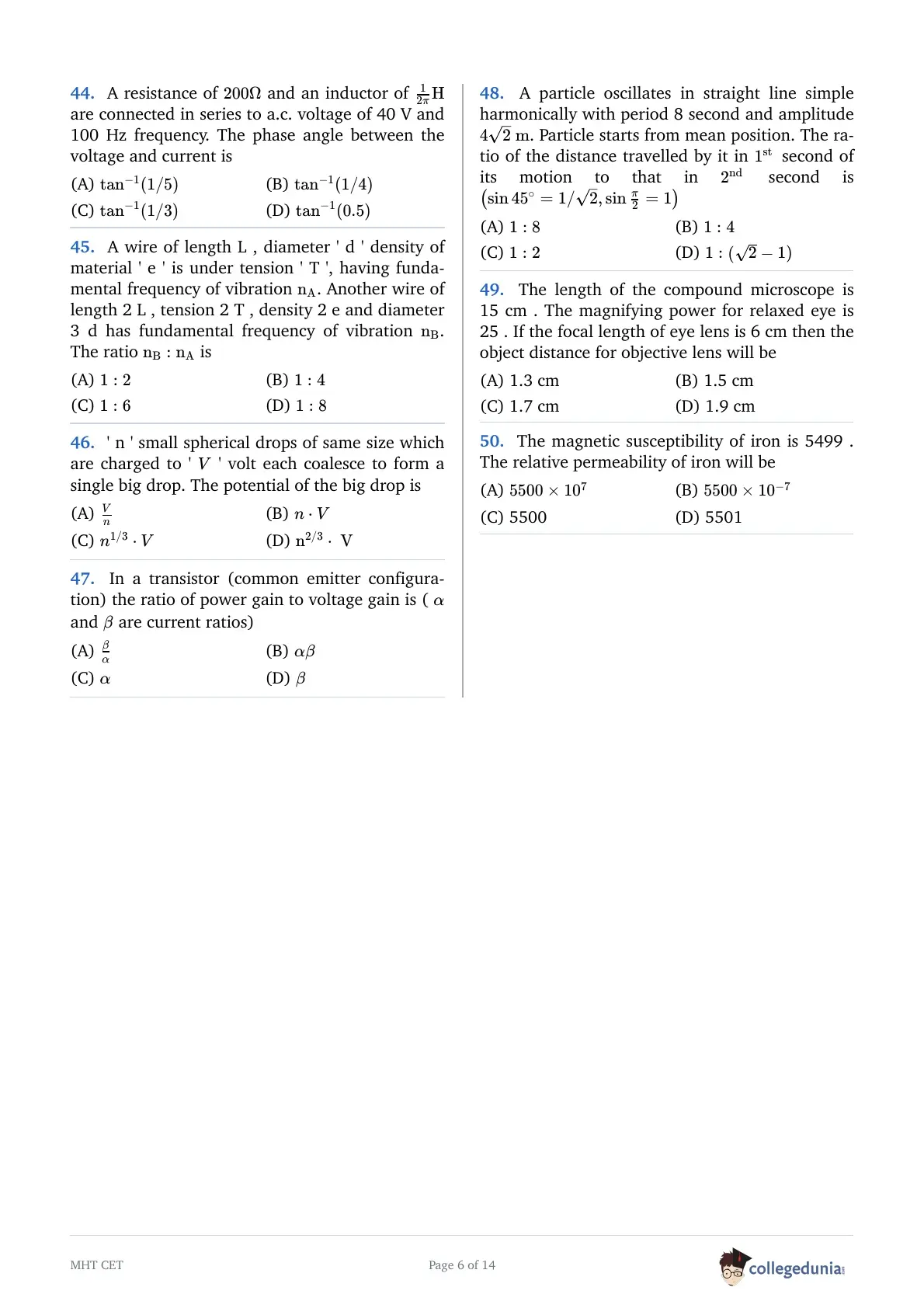
A resistance of \(200\Omega\) and an inductor of \(\frac{1}{2\pi}\text{ H}\) are connected in series to a.c. voltage of \(40\text{ V}\) and \(100\text{ Hz}\) frequency. The phase angle between the voltage and current is
A wire of length L , diameter ' d ' density of material ' e ' is under tension ' T ', having fundamental frequency of vibration \(\text{n}_\text{A}\). Another wire of length 2 L , tension 2 T , density 2 e and diameter 3 d has fundamental frequency of vibration \(\text{n}_\text{B}\). The ratio \(\text{n}_\text{B} : \text{n}_\text{A}\) is
' n ' small spherical drops of same size which are charged to ' \(V\) ' volt each coalesce to form a single big drop. The potential of the big drop is
In a transistor (common emitter configuration) the ratio of power gain to voltage gain is ( \(\alpha\) and \(\beta\) are current ratios)
A particle oscillates in straight line simple harmonically with period 8 second and amplitude \(4\sqrt{2}\text{ m}\). Particle starts from mean position. The ratio of the distance travelled by it in \(1^{\text{st}}\) second of its motion to that in \(2^{\text{nd}}\) second is \(\left(\sin 45^\circ = 1/\sqrt{2}, \sin\frac{\pi}{2} = 1\right)\)}
The length of the compound microscope is \(15\text{ cm}\) . The magnifying power for relaxed eye is 25 . If the focal length of eye lens is \(6\text{ cm}\) then the object distance for objective lens will be}
The magnetic susceptibility of iron is 5499 . The relative permeability of iron will be
Chemistry (Q51 - Q100)
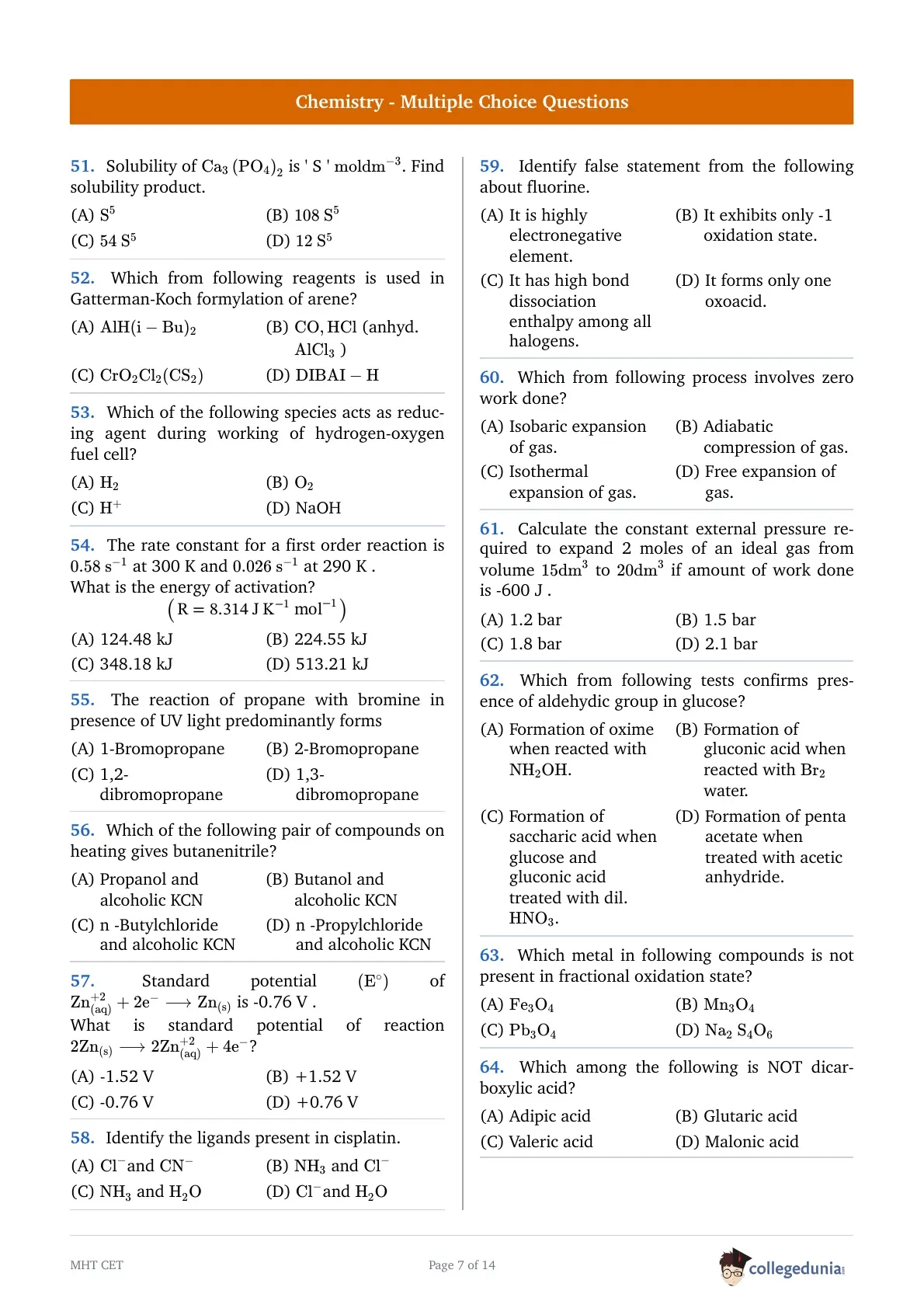
Solubility of \(\text{Ca}_3(\text{PO}_4)_2\) is ' S ' \(\text{moldm}^{-3}\). Find solubility product.
Which from following reagents is used in Gatterman-Koch formylation of arene?
Which of the following species acts as reducing agent during working of hydrogen-oxygen fuel cell?
The rate constant for a first order reaction is \(0.58 \text{ s}^{-1}\) at \(300 \text{ K}\) and \(0.026 \text{ s}^{-1}\) at \(290 \text{ K}\) . What is the energy of activation? \(\left(\text{R} = 8.314 \text{ J K}^{-1} \text{ mol}^{-1}\right)\)}
The reaction of propane with bromine in presence of UV light predominantly forms
Which of the following pair of compounds on heating gives butanenitrile?
Standard potential (\(\text{E}^\circ\)) of \(\text{Zn}^{+2}_{(\text{aq})} + 2\text{e}^- \longrightarrow \text{Zn}_{(\text{s})}\) is -0.76 V . What is standard potential of reaction \(2\text{Zn}_{(\text{s})} \longrightarrow 2\text{Zn}^{+2}_{(\text{aq})} + 4\text{e}^-\)?
Identify the ligands present in cisplatin.
Identify false statement from the following about fluorine.
Which from following process involves zero work done?
Calculate the constant external pressure required to expand 2 moles of an ideal gas from volume \(15\text{dm}^3\) to \(20\text{dm}^3\) if amount of work done is -600 J .
Which from following tests confirms presence of aldehydic group in glucose?
Which metal in following compounds is not present in fractional oxidation state?
Which among the following is NOT dicarboxylic acid?
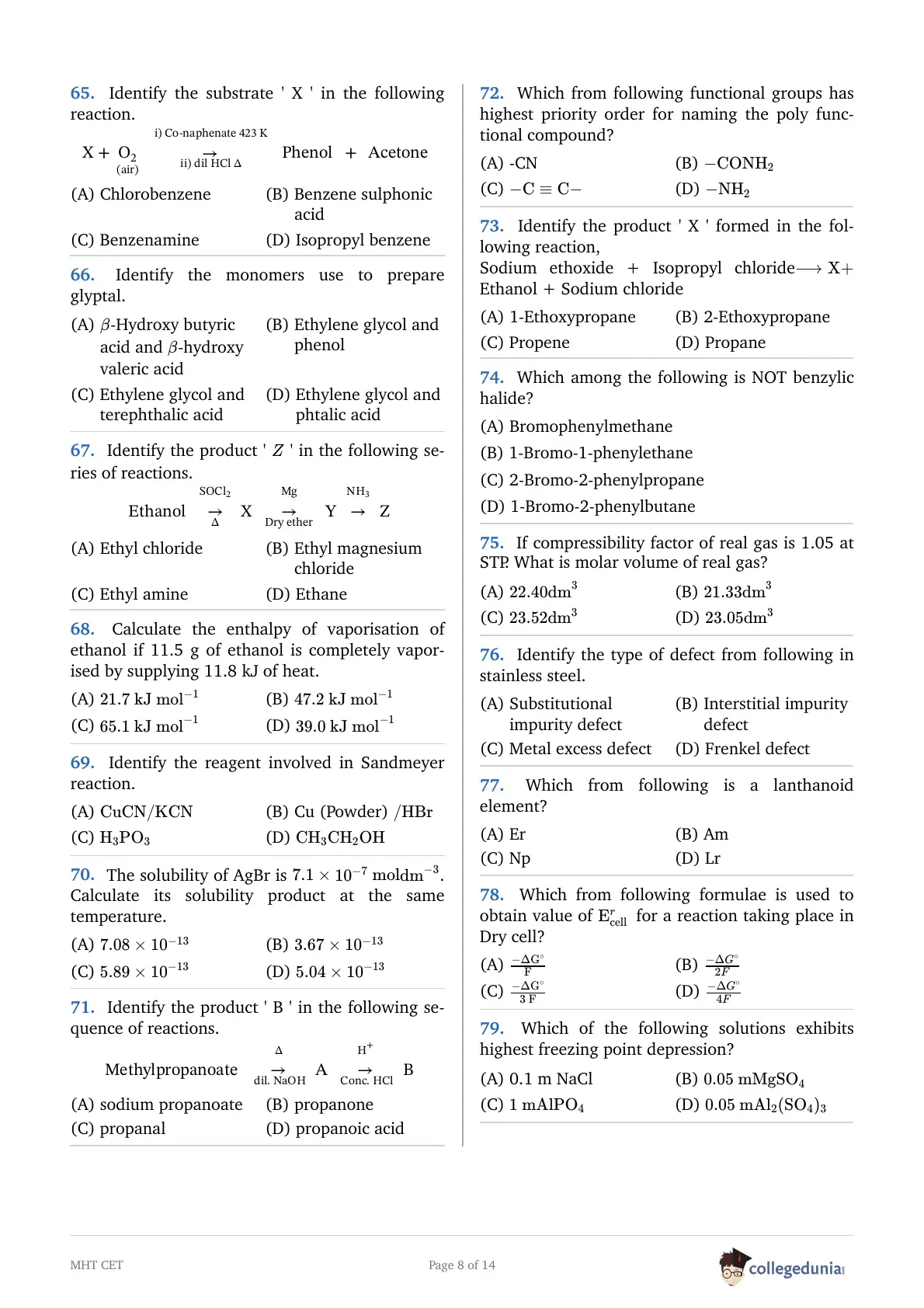
Identify the substrate ' X ' in the following reaction. \(\text{X} + \underset{(\text{air})}{\text{O}_2} \xrightarrow[\text{ii) dil HCl } \Delta]{\text{i) Co-naphenate } 423 \text{ K}} \text{Phenol} + \text{Acetone}\)
Identify the monomers use to prepare glyptal.
Identify the product ' Z ' in the following series of reactions. \(\text{Ethanol} \xrightarrow[\Delta]{\text{SOCl}_2} \text{X} \xrightarrow[\text{Dry ether}]{\text{Mg}} \text{Y} \xrightarrow{\text{NH}_3} \text{Z}\)
Calculate the enthalpy of vaporisation of ethanol if 11.5 g of ethanol is completely vaporised by supplying 11.8 kJ of heat.
Identify the reagent involved in Sandmeyer reaction.
The solubility of AgBr is \(7.1 \times 10^{-7} \text{ moldm}^{-3}\). Calculate its solubility product at the same temperature.
Identify the product ' B ' in the following sequence of reactions.
\(\text{Methylpropanoate} \xrightarrow[\text{dil. NaOH}]{\Delta} \text{A} \xrightarrow[\text{Conc. HCl}]{\text{H}^+} \text{B}\)
Which from following functional groups has highest priority order for naming the poly functional compound?
Identify the product ' X ' formed in the following reaction,
\(\text{Sodium ethoxide} + \text{Isopropyl chloride} \longrightarrow \text{X} + \text{Ethanol} + \text{Sodium chloride}\)
Which among the following is NOT benzylic halide?
If compressibility factor of real gas is 1.05 at STP. What is molar volume of real gas?
Which from following is a lanthanoid element?
Which from following formulae is used to obtain value of \(\text{E}^\circ_{\text{cell}}\) for a reaction taking place in Dry cell?
Which of the following solutions exhibits highest freezing point depression?
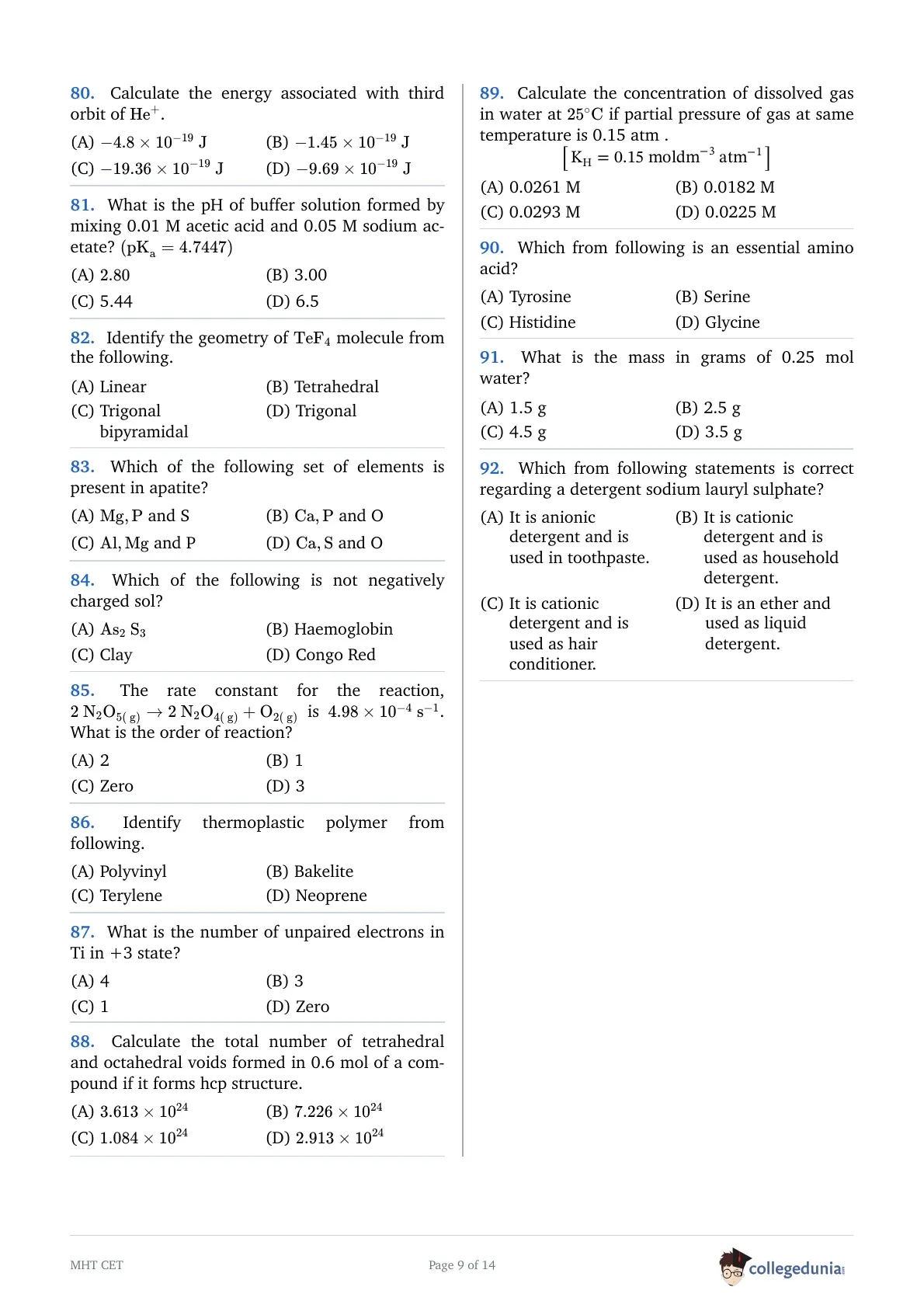
Calculate the energy associated with third orbit of \(\text{He}^+\).
What is the pH of buffer solution formed by mixing 0.01 M acetic acid and 0.05 M sodium acetate? \((\text{pK}_\text{a} = 4.7447)\)
Identify the geometry of \(\text{TeF}_4\) molecule from the following.
Which of the following set of elements is present in apatite?
Which of the following is not negatively charged sol?
The rate constant for the reaction, \(2\text{N}_2\text{O}_{5(\text{g})} \longrightarrow 2\text{N}_2\text{O}_{4(\text{g})} + \text{O}_{2(\text{g})}\) is \(4.98 \times 10^{-4} \text{ s}^{-1}\) . What is the order of reaction?
Identify thermoplastic polymer from following.
What is the number of unpaired electrons in Ti in +3 state?
Calculate the total number of tetrahedral and octahedral voids formed in 0.6 mol of a compound if it forms hcp structure.
Calculate the concentration of dissolved gas in water at \(25^\circ\text{C}\) if partial pressure of gas at same temperature is 0.15 atm . \([\text{K}_\text{H} = 0.15 \text{ moldm}^{-3} \text{atm}^{-1}]\)}
Which from following is an essential amino acid?
What is the mass in grams of \(0.25 \text{ mol}\) water?
Which from following statements is correct regarding a detergent sodium lauryl sulphate?


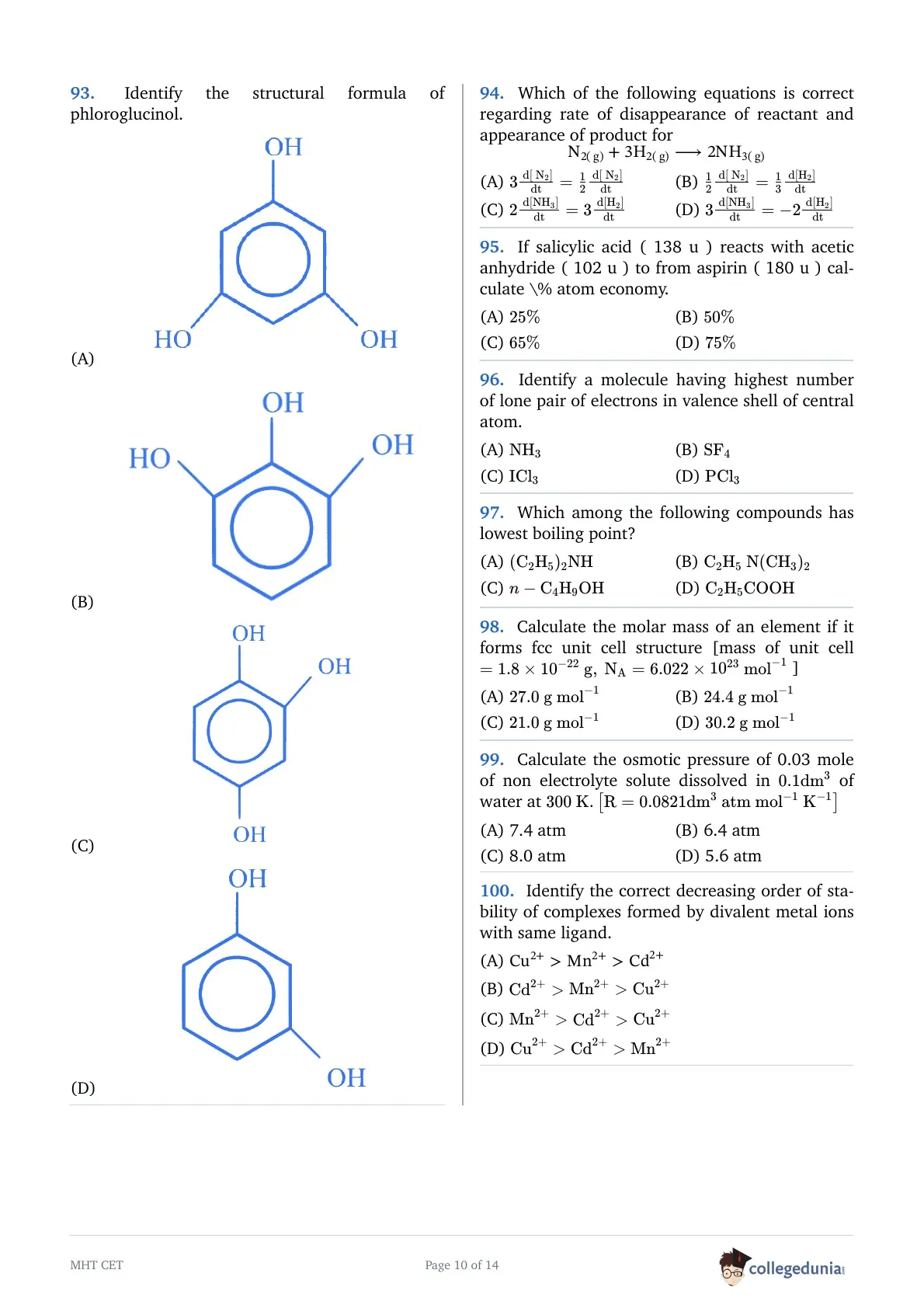
Which of the following equations is correct regarding rate of disappearance of reactant and appearance of product for \(\text{N}_{2(\text{g})} + 3\text{H}_{2(\text{g})} \longrightarrow 2\text{NH}_{3(\text{g})}\)}
If salicylic acid ( \(138 \text{ u}\) ) reacts with acetic anhydride ( \(102 \text{ u}\) ) to from aspirin ( \(180 \text{ u}\) ) calculate % atom economy.
Identify a molecule having highest number of lone pair of electrons in valence shell of central atom.
Which among the following compounds has lowest boiling point?
Calculate the molar mass of an element if it forms fcc unit cell structure [mass of unit cell \(= 1.8 \times 10^{-22} \text{ g}\), \(\text{N}_\text{A} = 6.022 \times 10^{23} \text{ mol}^{-1}\)]
Calculate the osmotic pressure of 0.03 mole of non electrolyte solute dissolved in \(0.1\text{dm}^3\) of water at \(300 \text{ K}\). \([\text{R} = 0.082\text{dm}^3 \text{ atm mol}^{-1} \text{ K}^{-1}]\)}
Mathematics (Q101 - Q150)
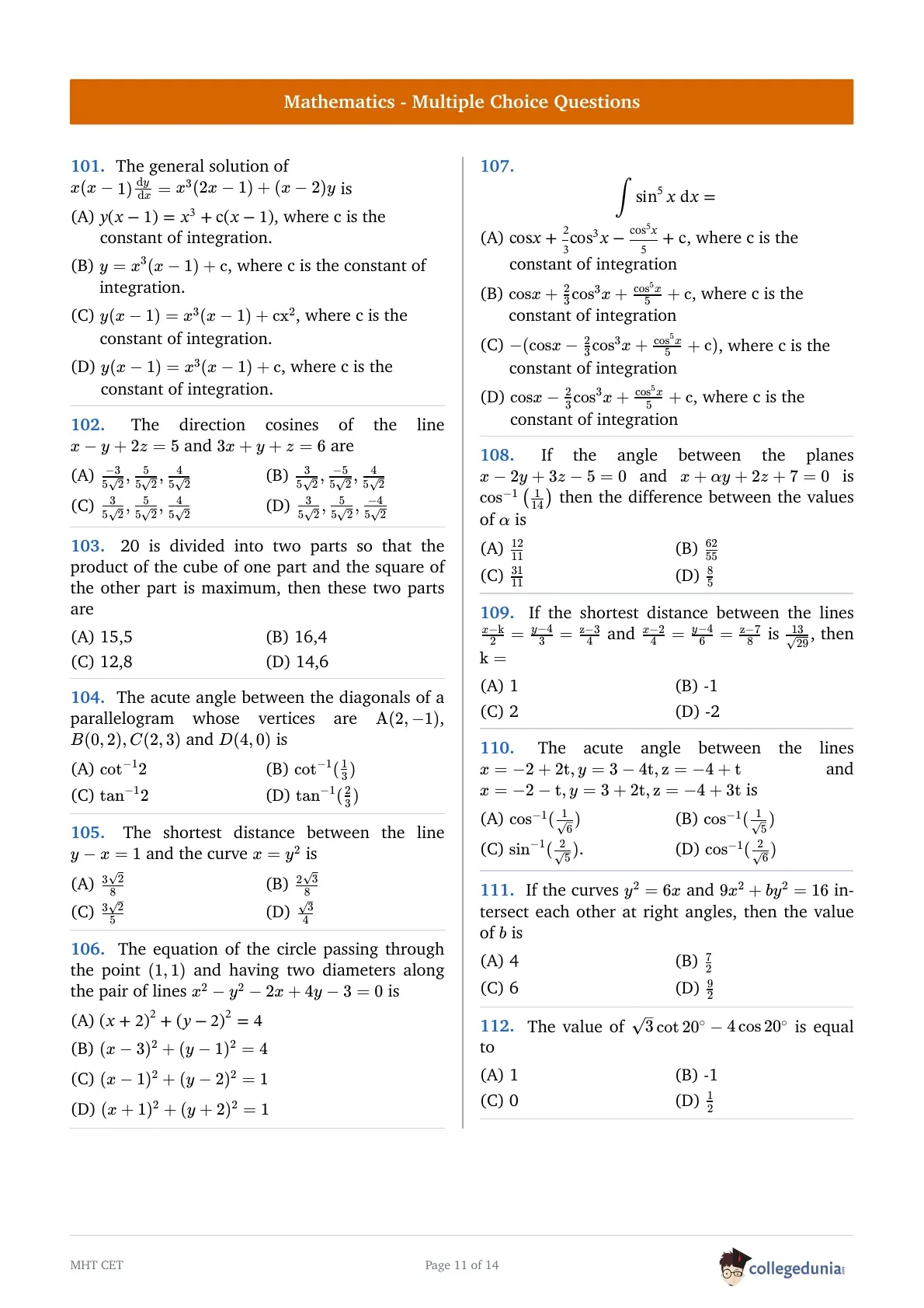
The general solution of \(x(x - 1)\frac{dy}{dx} = x^3(2x - 1) + (x - 2)y\) is
The direction cosines of the line \(x - y + 2z = 5\) and \(3x + y + z = 6\) are
20 is divided into two parts so that the product of the cube of one part and the square of the other part is maximum, then these two parts are
The acute angle between the diagonals of a parallelogram whose vertices are A(2, -1), B(0, 2), C(2, 3) and D(4, 0) is
The shortest distance between the line \(y - x = 1\) and the curve \(x = y^2\) is
The equation of the circle passing through the point \((1, 1)\) and having two diameters along the pair of lines \(x^2 - y^2 - 2x + 4y - 3 = 0\) is
\(\int \sin^5 x \,dx =\)
If the angle between the planes \(x - 2y + 3z - 5 = 0\) and \(x + \alpha y + 2z + 7 = 0\) is \(\cos^{-1}\left(\frac{1}{14}\right)\), then the difference between the values of \(\alpha\) is
If the shortest distance between the lines \(\frac{x - k}{2} = \frac{y - 4}{3} = \frac{z - 3}{4}\) and \(\frac{x - 2}{4} = \frac{y - 4}{6} = \frac{z - 7}{8}\) is \(\frac{13}{\sqrt{29}}\), then \(k =\)}
The acute angle between the lines \(x = -2 + 2t, y = 3 - 4t, z = -4 + t\) and \(x = -2 - t, y = 3 + 2t, z = -4 + 3t\) is
If the curves \(y^2 = 6x\) and \(9x^2 + by^2 = 16\) intersect each other at right angles, then the value of \(b\) is
The value of \(\sqrt{3} \cot 20^\circ - 4 \cos 20^\circ\) is equal to}
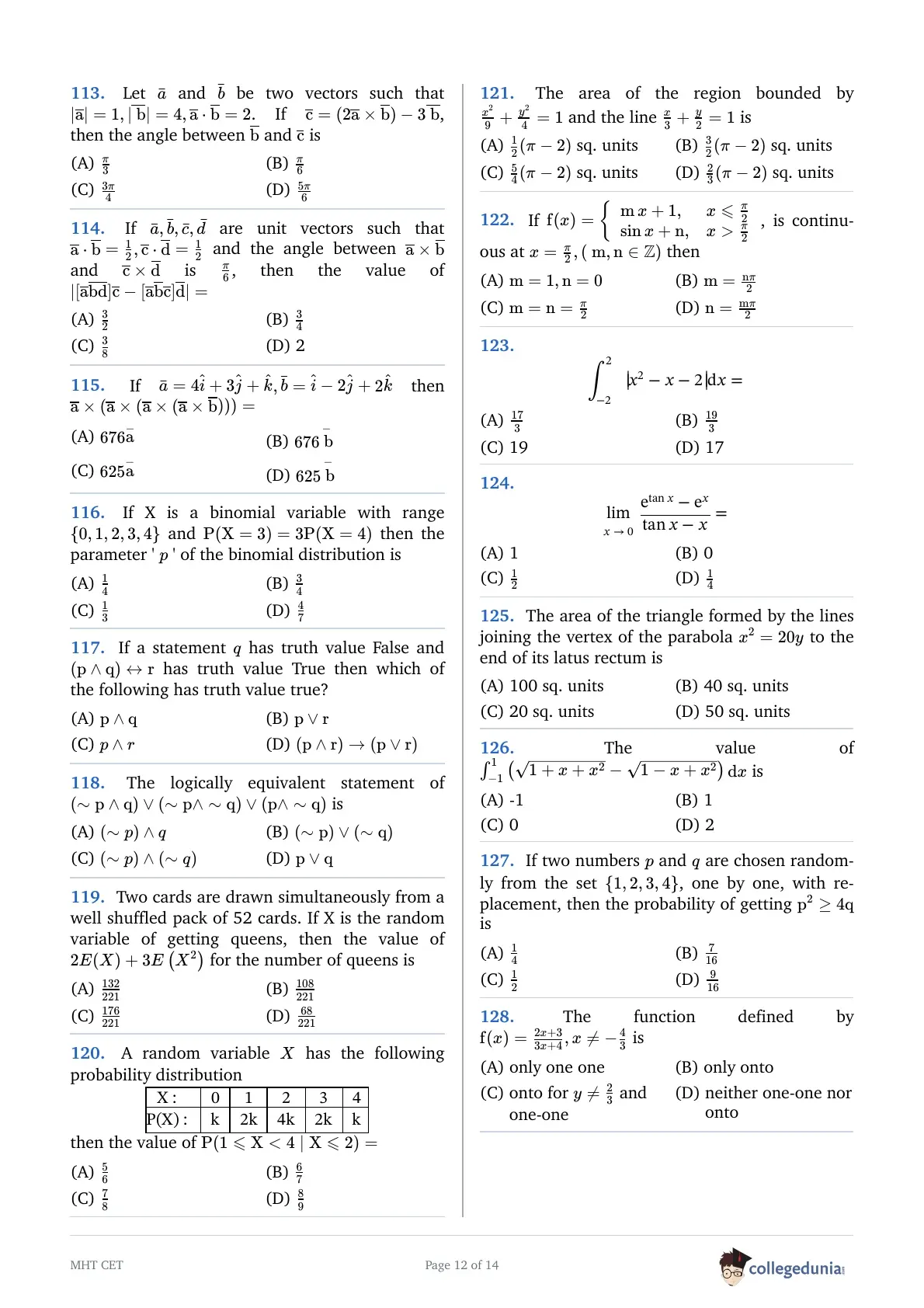
Let \(\bar{a}\) and \(\bar{b}\) be two vectors such that \(|\bar{a}| = 1\), \(|\bar{b}| = 4\), \(\bar{a} \cdot \bar{b} = 2\). If \(\bar{c} = (2\bar{a} \times \bar{b}) - 3\bar{b}\), then the angle between \(\bar{b}\) and \(\bar{c}\) is
If \(\bar{a}, \bar{b}, \bar{c}, \bar{d}\) are unit vectors such that \(\bar{a} \cdot \bar{b} = \frac{1}{2}\), \(\bar{c} \cdot \bar{d} = \frac{1}{2}\) and the angle between \(\bar{a} \times \bar{b}\) and \(\bar{c} \times \bar{d}\) is \(\frac{\pi}{6}\), then the value of \(|[\bar{a} \bar{b} \bar{d}] \bar{c} - [\bar{a} \bar{b} \bar{c}] \bar{d}| =\)}
If \(\bar{a} = 4\hat{i} + 3\hat{j} + \hat{k}, \bar{b} = \hat{i} - 2\hat{j} + 2\hat{k}\) then \(\bar{a} \times (\bar{a} \times (\bar{a} \times (\bar{a} \times \bar{b}))) =\)}
If X is a binomial variable with range \(\{0,1,2,3,4\}\) and \(\mathrm{P}(\mathrm{X}=3)=3 \mathrm{P}(\mathrm{X}=4)\) then the parameter ' \(p\) ' of the binomial distribution is
If a statement \(q\) has truth value False and \((p \land q) \leftrightarrow r\) has truth value True then which of the following has truth value true?
The logically equivalent statement of \((\sim \mathrm{p} \wedge \mathrm{q}) \vee(\sim \mathrm{p} \wedge \sim \mathrm{q}) \vee(\mathrm{p} \wedge \sim \mathrm{q})\) is
Two cards are drawn simultaneously from a well shuffled pack of 52 cards. If X is the random variable of getting queens, then the value of \(2 E(X) + 3 E(X^2)\) for the number of queens is
The area of the region bounded by \(\frac{x^2}{9} + \frac{y^2}{4} = 1\) and the line \(\frac{x}{3} + \frac{y}{2} = 1\) is
If \(f(x) = \begin{cases} mx + 1, & x \le \frac{\pi}{2} \\ \sin x + n, & x > \frac{\pi}{2} \end{cases}\) is continuous at \(x = \frac{\pi}{2}, (m, n \in \mathbb{Z})\) then}
\(\lim_{x \to 0} \frac{e^{\tan x} - e^x}{\tan x - x} =\)}
The area of the triangle formed by the lines joining the vertex of the parabola \(x^2 = 20y\) to the end of its latus rectum is
The value of \(\int_{-1}^{1} (\sqrt{1 + x + x^2} - \sqrt{1 - x + x^2}) dx\) is
If two numbers \(p\) and \(q\) are chosen randomly from the set \(\{1, 2, 3, 4\}\), one by one, with replacement, then the probability of getting \(p^2 \ge 4q\) is
The function defined by \(f(x) = \frac{2x+3}{3x+4}, x \neq -\frac{4}{3}\) is
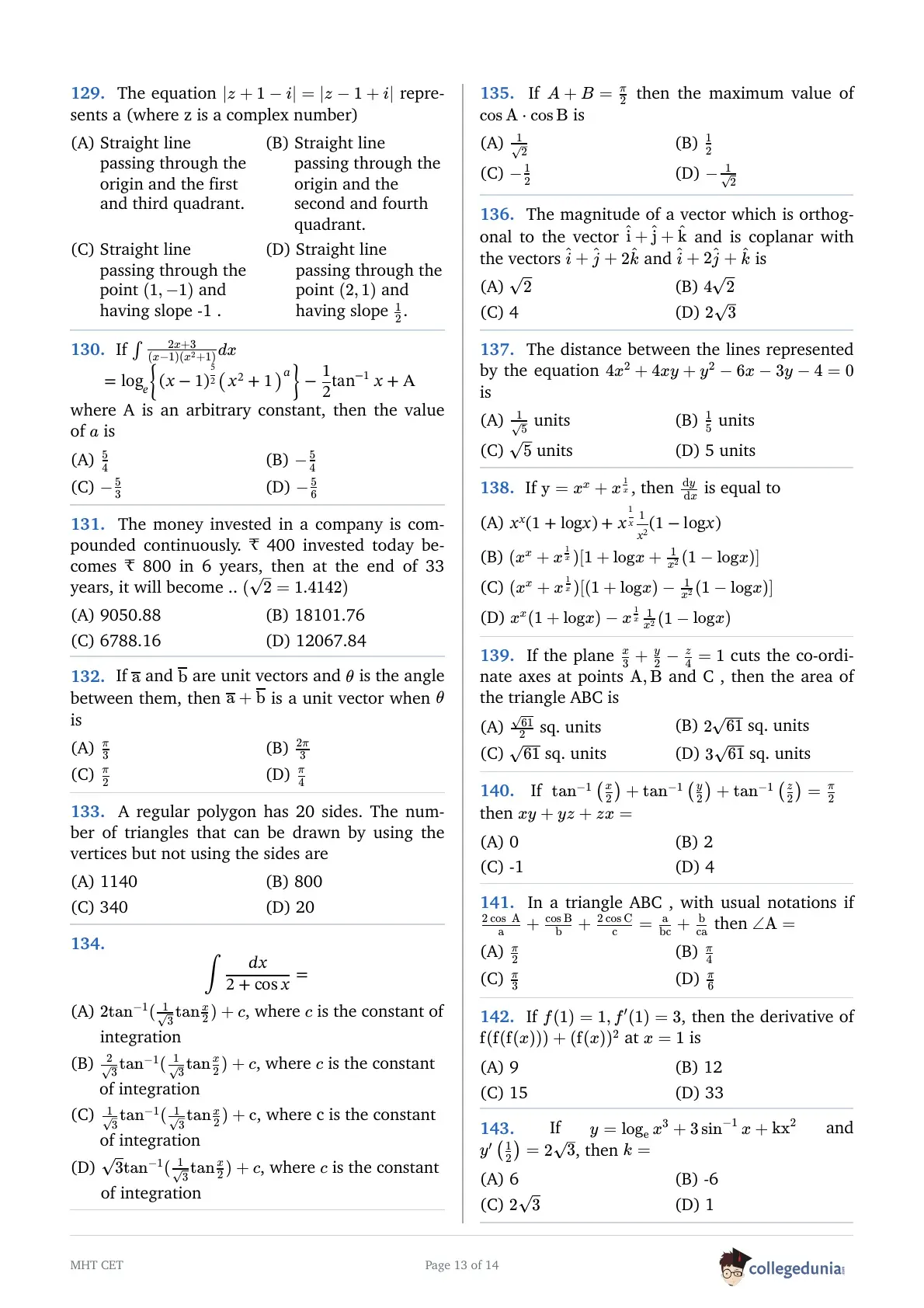
The equation \(|z + 1 - i| = |z - 1 + i|\) represents a (where z is a complex number)
If \(\int \frac{2x+3}{(x-1)(x^2+1)} dx = \log_e \left\{ (x - 1)^{\frac{5}{2}} (x^2 + 1)^a \right\} - \frac{1}{2} \tan^{-1} x + A\) where A is an arbitrary constant, then the value of \(a\) is
The money invested in a company is compounded continuously. Rs. 400 invested today becomes Rs. 800 in 6 years, then at the end of 33 years, it will become .. (\(\sqrt{2} = 1.4142\))
If \(\bar{a}\) and \(\bar{b}\) are unit vectors and \(\theta\) is the angle between them, then \(\bar{a} + \bar{b}\) is a unit vector when \(\theta\) is
A regular polygon has 20 sides. The number of triangles that can be drawn by using the vertices but not using the sides are
If \(A + B = \frac{\pi}{2}\) then the maximum value of \(\cos A \cdot \cos B\) is
The distance between the lines represented by the equation \(4x^2 + 4xy + y^2 - 6x - 3y - 4 = 0\) is
If \(y = x^x + x^{\frac{1}{x}}\), then \(\frac{dy}{dx}\) is equal to}
If the plane \(\frac{x}{3} + \frac{y}{2} - \frac{z}{4} = 1\) cuts the co-ordinate axes at points A, B and C, then the area of the triangle ABC is
If \(\tan^{-1}\left(\frac{x}{2}\right) + \tan^{-1}\left(\frac{y}{2}\right) + \tan^{-1}\left(\frac{z}{2}\right) = \frac{\pi}{2}\) then \(xy + yz + zx =\)}
In a triangle ABC, with usual notations if \(\frac{2\cos A}{a} + \frac{\cos B}{b} + \frac{2\cos C}{c} = \frac{a}{bc} + \frac{b}{ca}\) then \(\angle A =\)}
If \(f(1) = 1, f'(1) = 3\), then the derivative of \(f(f(f(x))) + (f(x))^2\) at \(x = 1\) is
If \(y = \log_e x^3 + 3 \sin^{-1} x + kx^2\) and \(y'\left(\frac{1}{2}\right) = 2\sqrt{3}\), then \(k =\)}
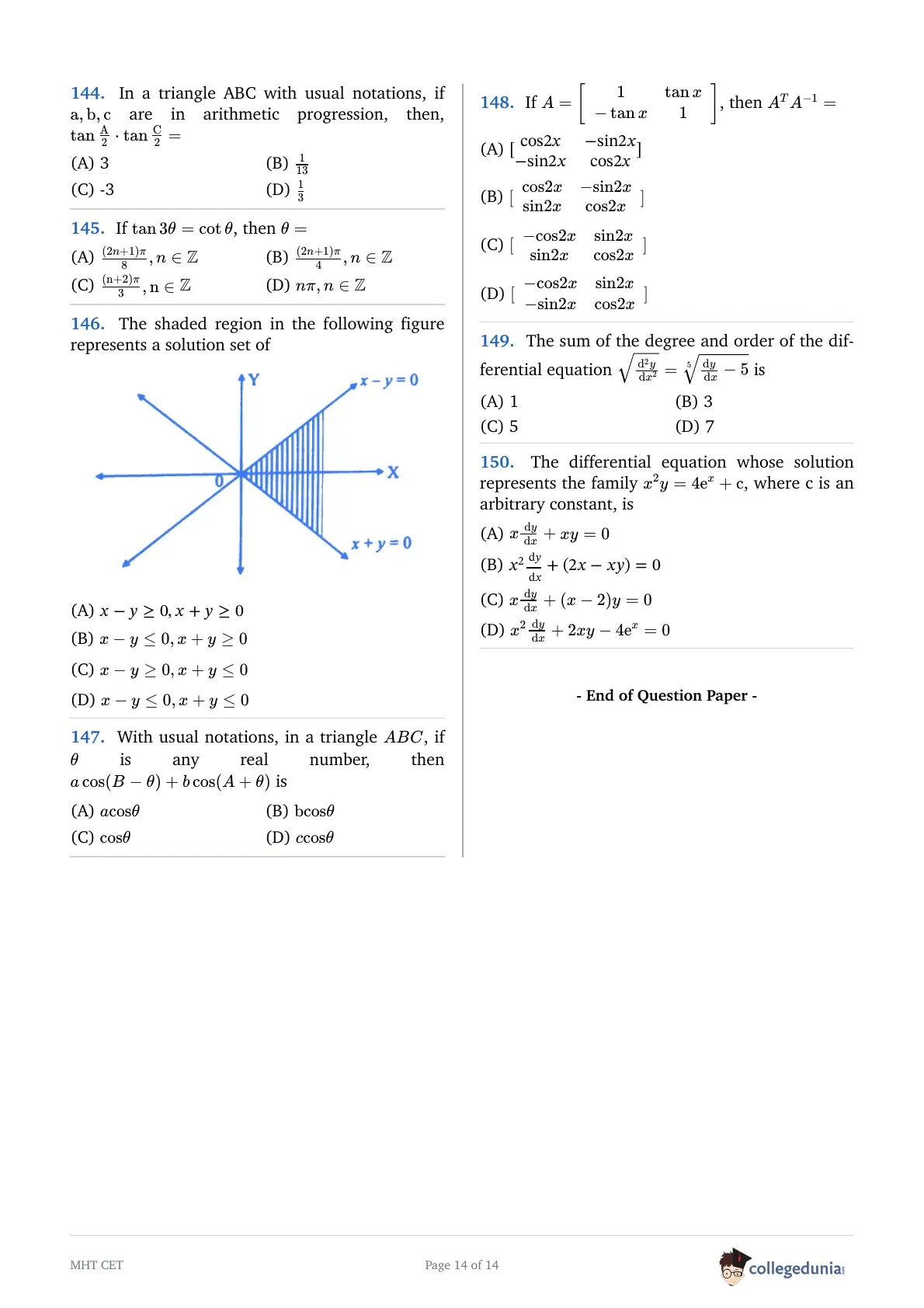
In a triangle ABC with usual notations, if a, b, c are in arithmetic progression, then, \(\tan \frac{A}{2} \cdot \tan \frac{C}{2} =\)}
If \(\tan 3\theta = \cot \theta\), then \(\theta =\)
With usual notations, in a triangle \(ABC\), if \(\theta\) is any real number, then \(a \cos(B - \theta) + b \cos(A + \theta)\) is
If \(A = \begin{bmatrix} 1 & \tan x \\ -\tan x & 1 \end{bmatrix}\), then \(A^T A^{-1} =\)}
The sum of the degree and order of the differential equation \(\sqrt{\frac{d^2y}{dx^2}} = \sqrt[5]{\frac{dy}{dx}} - 5\) is
The differential equation whose solution represents the family \(x^2 y=4 \mathrm{e}^x+\mathrm{c}\), where c is an arbitrary constant, is
MHT CET 2025 PCM Exam Pattern and Marking Scheme
| Parameter | Details |
|---|---|
| Conducting Body | Maharashtra Common Entrance Test Cell (Maharashtra CET Cell) |
| Exam Mode | Online (Computer-Based Test) |
| Duration | 180 minutes (3 hours) |
| Groups / Subjects | PCM (Physics, Chemistry, Mathematics) for Engineering |
| Total Questions |
150 |
| Total Marks | 200 |
| Question Type | Multiple Choice Questions (MCQs) |
| Marks Distribution |
|
| Negative Marking | No |
| Syllabus Weightage |
|



Comments