




MHT CET 2026 April 13 Shift 2 PCM Question Paper is available for download here. Maharashtra State CET Cell conducted MHT CET 2026 PCM Exam on April 13 in Shift 2 from 2 PM to 5 PM in CBT mode.
- The MHT CET 2026 PCM Question Paper consists of 150 multiple-choice questions (MCQs) totalling 200 marks divided into 3 sections: Physics, Chemistry, and Mathematics, with 50 questions in each subject.
- Physics and Chemistry questions carry 1 mark each while Mathematics questions carry 2 marks each.
- There is no negative marking for incorrect answers.
Download MHT CET 2026 April 13 Shift 2 PCM Question Paper with Solutions PDF from the links provided below.
MHT CET 2026 April 13 Shift 2 PCM Question Paper PDF Download
| MHT CET 2026 April 13 Shift 2 Question Paper | Download PDF | Check Solution |
















MHT CET 2026 April 13 Shift 2 PCM Questions with Solutions
Physics Section (Questions 1 to 50)
The length of a cylinder is measured with a meter rod having least count \(0.1\) cm. Its diameter is measured with vernier calipers having least count \(0.01\) cm. Length of cylinder is \(8.0\) cm and radius is \(4.0\) cm. Find the percentage error in the calculated value of the volume.
Calculate the values of \(a\) and \(b\) if vectors \(a\hat{i}+b\hat{j} = \hat{n}\) and \((\hat{i}+\hat{j})\) are perpendicular to each other
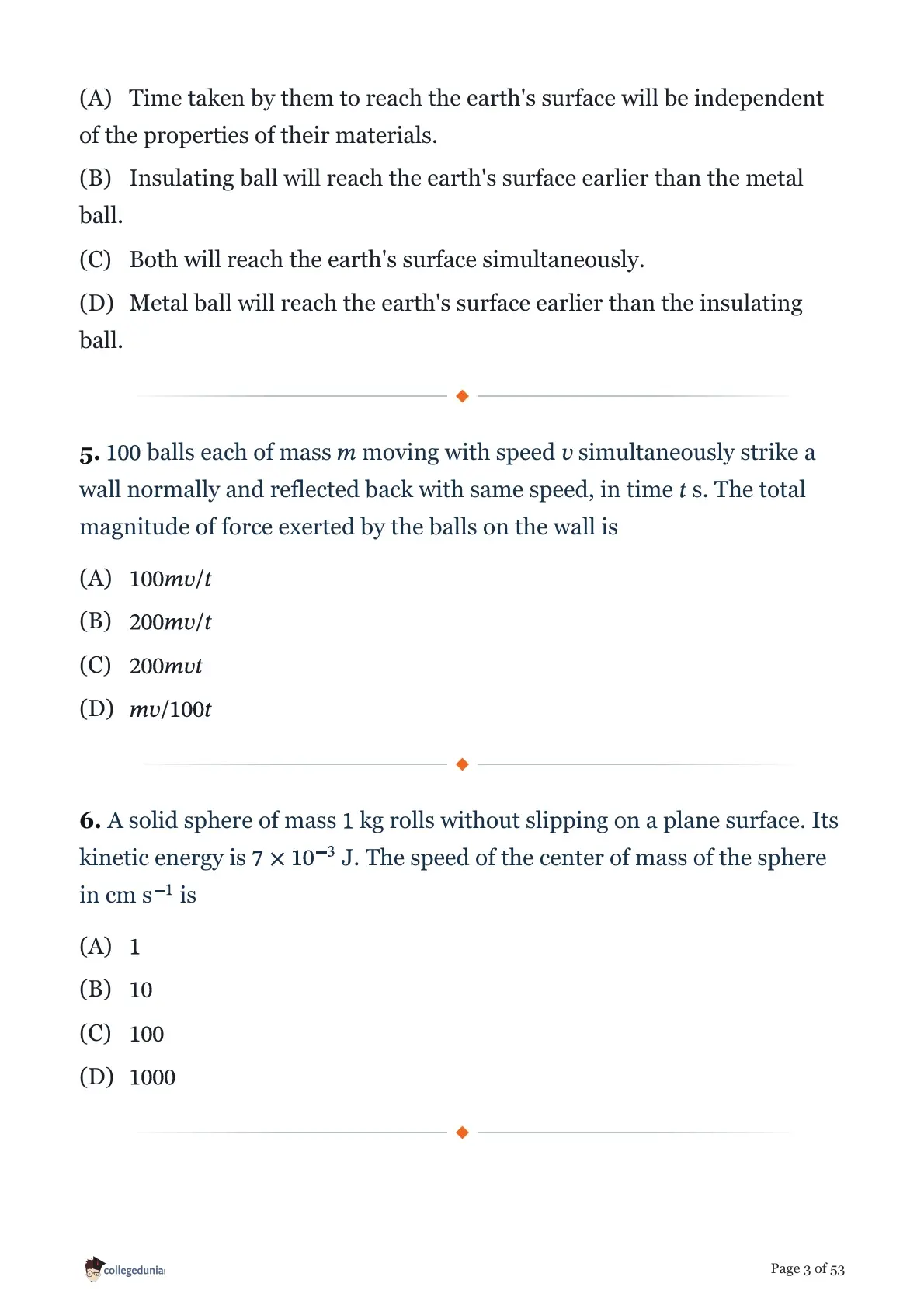
The velocity time graph of a body moving in a straight line is shown in a figure. The ratio of displacement to distance travelled by the body in time \(0\) to \(10\) s is

Spherical insulating ball and a spherical metallic ball of same size and mass are dropped from the same height. Choose the correct statement out of the following {Assume negligible air friction}
\(100\) balls each of mass \(m\) moving with speed \(v\) simultaneously strike a wall normally and reflected back with same speed, in time \(t\) s. The total magnitude of force exerted by the balls on the wall is
A solid sphere of mass \(1\) kg rolls without slipping on a plane surface. Its kinetic energy is \(7\times 10^{-3}\) J. The speed of the center of mass of the sphere in cm s\(^{-1}\) is
Moment of inertia of a disc of mass \(M\) and radius 'R' about any of its diameter is \(MR^2/4\). The moment of inertia of this disc about an axis normal to the disc and passing through a point on its edge will be, \((x/2)MR^2\). The value of \(x\) is
A thin uniform rod of length \(2\) m cross-sectional area 'A' and density 'd' is rotated about an axis passing through the centre and perpendicular to its length with angular velocity \(ω\). If the value of \(ω\) in terms of its rotational kinetic energy \(E\) is \((αE/Ad)^{1/2}\), then the value of \(α\) is
If earth has a mass nine times and radius twice to the planet P. Then \(\frac{v_e}{3}\sqrt{x}\) ms\(^{-1}\) will be the minimum velocity required by a rocket to pull out of gravitational force of P, where \(v_e\) is escape velocity on earth. The value of \(x\) is
Determine the ratio of surface energy of \(1\) large drop to \(1\) small drop, if \(1000\) small drops combined to form \(1\) large drop.
A spherical drop of liquid splits into \(1000\) identical spherical drops. If \(u_i\) is the surface energy of the original drop and \(u_f\) is the total surface energy of the resulting drops, the (ignoring evaporation). \(u_f/u_i = (10/x)\). Then value of \(x\) is
The surface of water in a water tank of cross-section area \(750\) cm\(^2\) on the top of a house is \(h\) m above the tap level. The speed of water coming out through the tap of cross-section area \(500\) mm\(^2\) is \(30\) cm/s. At that instant, \(dh/dt\) is \(y\times 10^{-3}\) m/s. The value of \(y\) will be
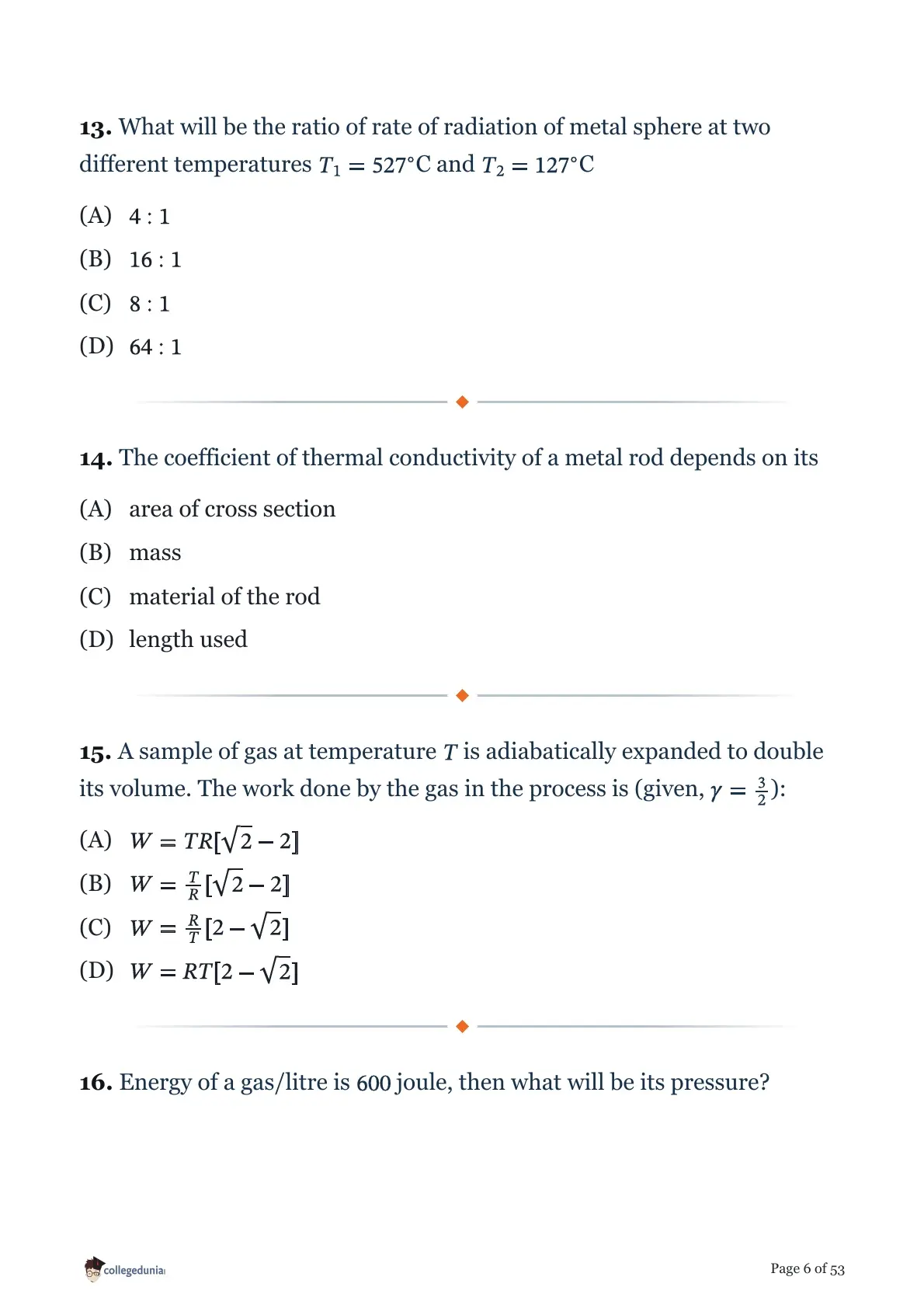
What will be the ratio of rate of radiation of metal sphere at two different temperatures \(T_1 = 527^{\circ}\)C and \(T_2 = 127^{\circ}\)C
The coefficient of thermal conductivity of a metal rod depends on its
A sample of gas at temperature \(T\) is adiabatically expanded to double its volume. The work done by the gas in the process is (given, \(γ = \frac{3}{2}\)):
Energy of a gas/litre is \(600\) joule, then what will be its pressure?
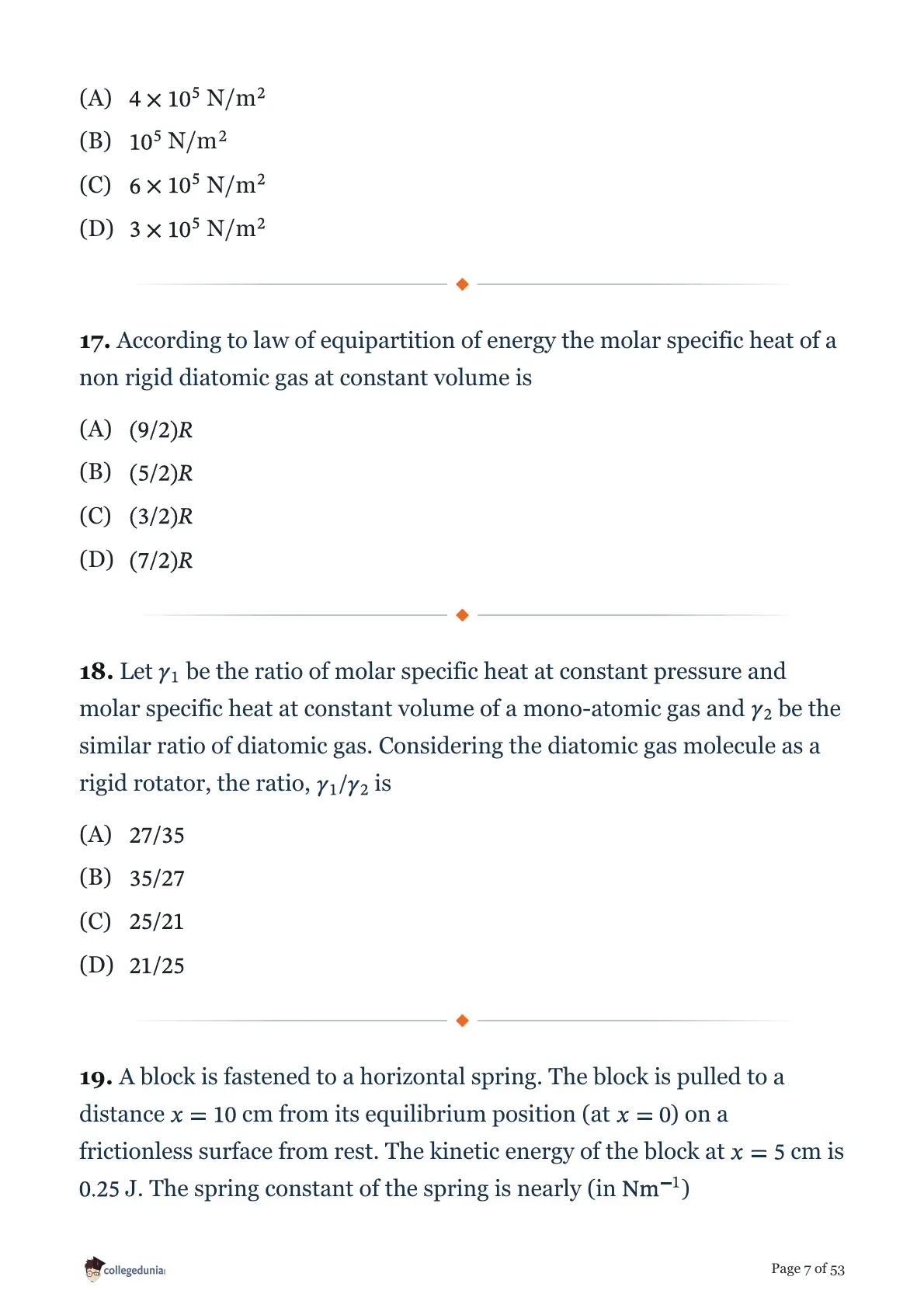
According to law of equipartition of energy the molar specific heat of a non rigid diatomic gas at constant volume is
Let \(γ_1\) be the ratio of molar specific heat at constant pressure and molar specific heat at constant volume of a mono-atomic gas and \(γ_2\) be the similar ratio of diatomic gas. Considering the diatomic gas molecule as a rigid rotator, the ratio, \(γ_1/γ_2\) is
A block is fastened to a horizontal spring. The block is pulled to a distance \(x = 10\) cm from its equilibrium position (at \(x = 0\)) on a frictionless surface from rest. The kinetic energy of the block at \(x = 5\) cm is \(0.25\) J. The spring constant of the spring is nearly (in \(\text{Nm}^{-1}\))
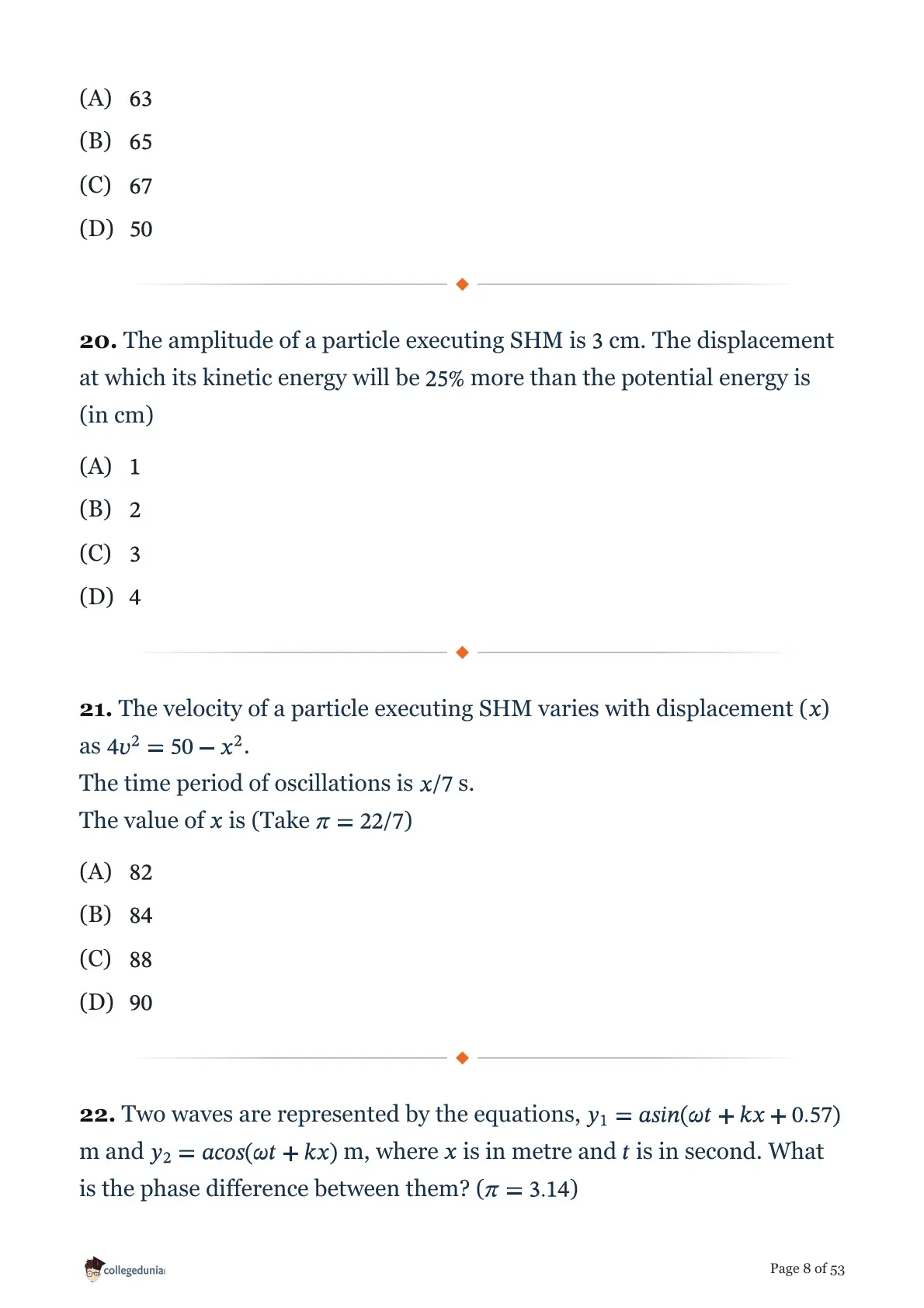
The amplitude of a particle executing SHM is \(3\) cm. The displacement at which its kinetic energy will be \(25\%\) more than the potential energy is (in cm)
The velocity of a particle executing SHM varies with displacement (\(x\)) as \(4v^2 = 50-x^2\).
The time period of oscillations is \(x/7\) s.
The value of \(x\) is (Take \(π = 22/7\))
Two waves are represented by the equations, \(y_1 = asin(ωt+kx+0.57)\) m and \(y_2 = acos(ωt+kx)\) m, where \(x\) is in metre and \(t\) is in second. What is the phase difference between them? (\(π = 3.14\))
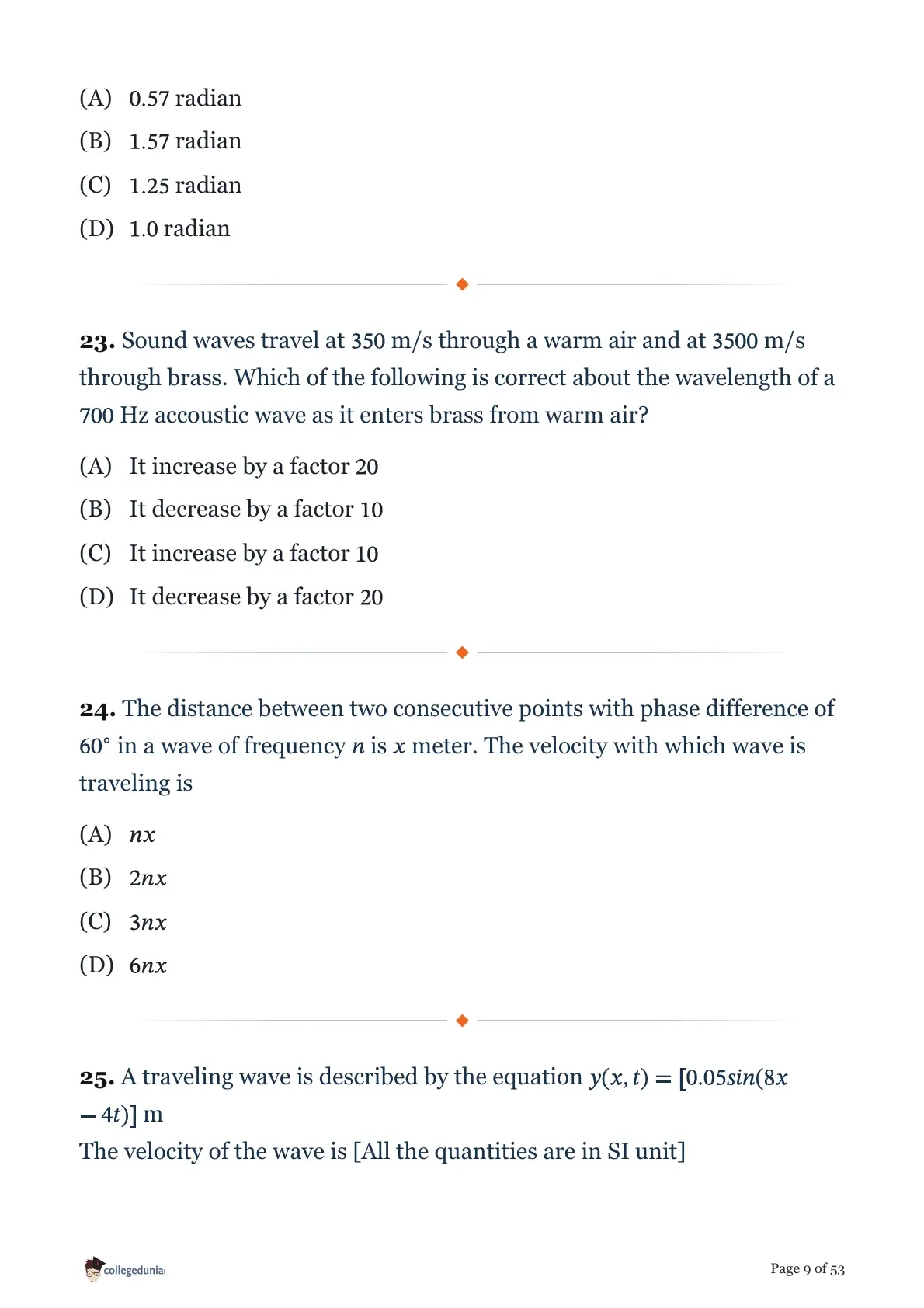
Sound waves travel at \(350\) m/s through a warm air and at \(3500\) m/s through brass. Which of the following is correct about the wavelength of a \(700\) Hz accoustic wave as it enters brass from warm air?
The distance between two consecutive points with phase difference of \(60^{\circ}\) in a wave of frequency \(n\) is \(x\) meter. The velocity with which wave is traveling is
A traveling wave is described by the equation \(y(x,t) = [0.05sin(8x-4t)]\) m
The velocity of the wave is [All the quantities are in SI unit]
The electric potential at the center of two concentric half rings of radii \(R_1\) and \(R_2\), having same linear charge density \(λ\) is (\(ε_0\) = permittivity of free space)

If two charges \(q_1\) and \(q_2\) are separated with distance 'd' and placed in a medium of dielectric constant \(K\). What will be the equivalent distance between charges in air for the same electrostatic force?
Two isolated metallic spheres of radii \(R\) and \(2R\) are charged such that both have the same charge density \(σ\). The spheres are then connected by a thin conducting wire. If the new charge density of the larger sphere is \(σ_1\). The ratio \(σ_1\) to \(σ\) is
A parallel plate capacitor with air between the plate has a capacitance of \(15\) pF. The separation between the plates becomes twice and the space between them is filled with a medium of dielectric constant \(3.5\). Then the capacitance becomes \(x/4\) pF.
The value of \(x\) is
Resistances are joint as shown in the figure. In the balanced condition, the current \(I\) drawn from the battery is

In an experiment to find emf of a cell using potentiometer, the length of null point for a cell of emf \(1.5\) V is found to be \(60\) cm. If this cell is replaced by another cell of emf \(E\), the length of null point increases by \(40\) cm. The value of \(E\) is \(x/10\) V.
The value of \(x\) is
A charged particle \(q\) is accelerated by a potential difference of \(V\) enters a region of uniform magnetic field of induction \(B\) at right angles to the direction of the field. The charged particle completes semi circle of the radius \(r\) inside the magnetic field. The mass of the charged particle is (all quantities are in SI units)
Two long straight wires are arranged parallel to each other and are kept \(20\) cm apart in vacuum. They carry currents of \(2\) A and \(4\) A respectively in the same direction. What will be the magnetic force on a length of \(10\) cm of either wire?
(\(μ_0 = 4π\times 10^{-7}\) SI units)
A rod with a circular cross-section area \(2\) cm\(^2\) and length \(40\) cm is wound uniformly with \(400\) turns of an insulated wire. If a current \(0.4\) A flows in the wire winding, the total magnetic flux produced inside the winding is \(4π\times 10^{-6}\) Wb. The relative permeability of the rod is
(Given permeability of vacuum \(μ_0 = 4π\times 10^{-7}\) N m A\(^{-2}\))
The magnetic moments associated with two closely wound circular coils a and b of radius \(r\) and \(2r\) respectively are equal if (where \(N_a\), \(I_a\) and \(N_b\), \(I_b\) are number of turns and current in A and B respectively)
A conducting loop of radius \(10/[π]^{1/2}\) cm is placed perpendicular to a uniform magnetic field \(0.5\) T. The magnetic field is decreased to zero in \(0.5\) s at a steady rate. The induced emf in the circular loop at \(0.25\) s is
In the circuit shown, the ratio of the quality factor and the band width is
(Given: band width = R/L)

An inductor of \(0.5\) mH, a capacitor of \(20\) \(μ\)F and resistance \(20\,\Omega\) are connected in series with a \(220\) V ac source. If the current is in phase with the emf, the amplitude of current of the circuit is \([x]^{1/2}\) A. The value of \(x\) is
In a series LR circuit with \(X_L = R\). Power factor is \(P_1\). If a capacitor of capacitance \(C\) with \(X_c = X_L\) is added to the circuit the power factor becomes \(P_2\). The ratio of \(P_1\) to \(P_2\) will be :
When a beam of white light is allowed to pass through convex lens parallel to principle axis, the different colors of light converge at different point on the principle axis after refraction. This is called
In Young's double slit experiment, following figure shows that \(Q\) is the position of second bright fringe on the right side of point \(O\). \(P\) is the eleventh bright fringe on the other side measured from point \(Q\). If the wavelength of light used is \(6000\) Å, then what will be the value of \(S_1B\)?

'n' polarizing sheets are arranged such that each makes an angle \(45^{\circ}\) with the preceding sheet. An unpolarized light of intensity \(I\) is incident into this arrangement. The output intensity is found to be \(I/64\). The value of \(n\) will be
In Young's double slit experiment, two slits \(S_1\) and \(S_2\) are 'd' distance apart and the separation from slits to screen is \(D\). Now if two transparent slabs of equal thickness \(0.1\) mm but refractive index \(1.51\) and \(1.55\) are introduced in the path of beam (\(λ = 4000\) Å) from \(S_1\) and \(S_2\) respectively. The central bright fringe spot will shift by ___ number of fringes.
The threshold frequency of metal is \(f_0\). When the light of frequency \(2f_0\) is incident on the metal plate, the maximum velocity of photoelectron is \(v_1\). When the frequency of incident radiation is increased to \(5f_0\) the maximum velocity of photoelectrons emitted is \(v_2\). The ratio \(v_1\) to \(v_2\) is
An electron accelerated through a potential difference \(V_1\) has a de-Broglie wavelength of \(λ\). When the potential is changed to \(V_2\), its de-Broglie wavelength increases to \(2λ\). The value of \((V_1/V_2)\) is equal to
The wavelength of the radiation emitted is \(λ_0\) when an electron jumps from the second excited state to the first excited state of hydrogen atom. If the electron jumps from the third excited state to the second orbit of the hydrogen atom, the wavelength of the radiation emitted will be \((20λ_0/x)\). The value of \(x\) is
For hydrogen atom, \(λ_1\) and \(λ_2\) are the wavelengths corresponding to the transitions \(1\) and \(2\) respectively as shown in figure. The ratio of \(λ_1\) and \(λ_2\) is \(x/32\). The value of \(x\) is

A pure silicon crystal at temperature \(300\) K has electron and hole concentration (\(n_i\)) \(10^{16}\) per m\(^3\) each and \(10^{21}\) phosphorus atoms (\(n_e\)) are added per cubic metre. The new hole concentration in silicon crystal is
If transistor having \(α = 0.9\), is used in CE configuration, then for a change of \(0.4\) mA in base current, what will be the change in collector current?
Choose the correct statement about Zener diode:
Chemistry Section (Questions 51 to 100)
\(1\) g of \(\text{H}_2\) contains the same number of molecules as in
If the energy of an electron in the first Bohr orbit of the H-atom is \(-2.18\times 10^{-18}\) J then the energy of the electron in the second orbit will be
In the compound \(^1\text{CH}_2 = ^2\text{CH}-^3\text{CH}_2-^4\text{CH}_2-^5\text{C}\equiv ^6\text{CH}\), The \(C_2-C_3\) bond is of type
A gas occupies a volume of \(0.35\) dm\(^3\) at \(290\) K and \(2\) atm. Pressure. Calculate the volume of gas at STP.
The enthalpy of combustion of cyclohexane, cyclohexene and \(\text{H}_2\) are respectively \(-3920,-3800\) and \(-241\) KJ mol\(^{-1}\). The enthalpy of hydrogenation of cyclohexene is
A gas expands from a volume of \(1\) dm\(^3\) to \(1.25\) dm\(^3\) under a pressure of \(1\) bar. Find the change in internal energy if \(150\) J of heat is supplied to the system.
In which of the following processes the internal energy of system remain constant?
Match List I with List II
| List I (Buffers) | List II (Applications) |
|---|---|
| (A) \(\text{HCO}_3^{-1}+\text{H}_2\text{CO}_3\) | (I) Maintain the pH of blood forms \(7.36\) to \(7.42\) |
| (B) Phosphates | (II) In Medicine |
| (C) Sodium Citrate | (III) In Qualitative analysis of basic radicals |
| (D) \(\text{NH}_4\text{Cl}+\text{NH}_4\text{OH}\) | (IV) In fertilizers |
Choose the correct answer from the options given below:
Find the pH of a solution formed by mixing equal volume of solution of \(0.1\) M sodium propionate and \(0.1\) molar propionic acid.
(Given The dissociation constant of propionic acid is \(1.3\times 10^{-5}\))
What is the concentration of hydrogen ion in the solution when the concentration of hydroxyl ion is \(0.08\) mol / dm\(^3\) at \(298\) K ?
What is oxidation state of oxygen in \(\text{OF}_2\) and in \(\text{KO}_2\) respectively?
Which of the following ions are responsible for hardness of water?
Identify the elements of alkali metals and alkaline earth metals respectively having highest 1st ionization enthalpy.
What is the nature of \(\text{Al}_2\text{O}_3\)?
Which of the following is correct decreasing order of acidic strength for the compounds listed below?
I: p-chlorophenol, II: p-Cresol, III: p-nitrophenol, IV: p-methoxyphenol.
Among the following, the most stable carbocation is
What is the product of decarboxylation of anhydrous sodium benzoate?
An ionic compound is formed by elements X and Y. Element Y forms a face-centered cubic (FCC) lattice, and element X occupies one-third of the tetrahedral voids. What is the formula of the compound?
A metal crystallizes to form simple cubic unit cell. Calculate the void volume of unit cell. [\(a = 3.36\times 10^{-8}\) cm]
Which from following ionic crystals exhibits Frenkel defect?
An aqueous solution has an osmotic pressure of \(4.92\) atm at \(300\) K.
Calculate the molarity of the solution.
(\(R = 0.082\) L atm mol\(^{-1}\) K\(^{-1}\))
A solution is prepared by dissolving \(68\) g sucrose in \(1\) kg water. Calculate the vapour pressure of solution at \(298\) K. [vapour pressure of water at \(298\) K = \(18\) mm of Hg & mole fraction of solvent = \(0.9964\)]
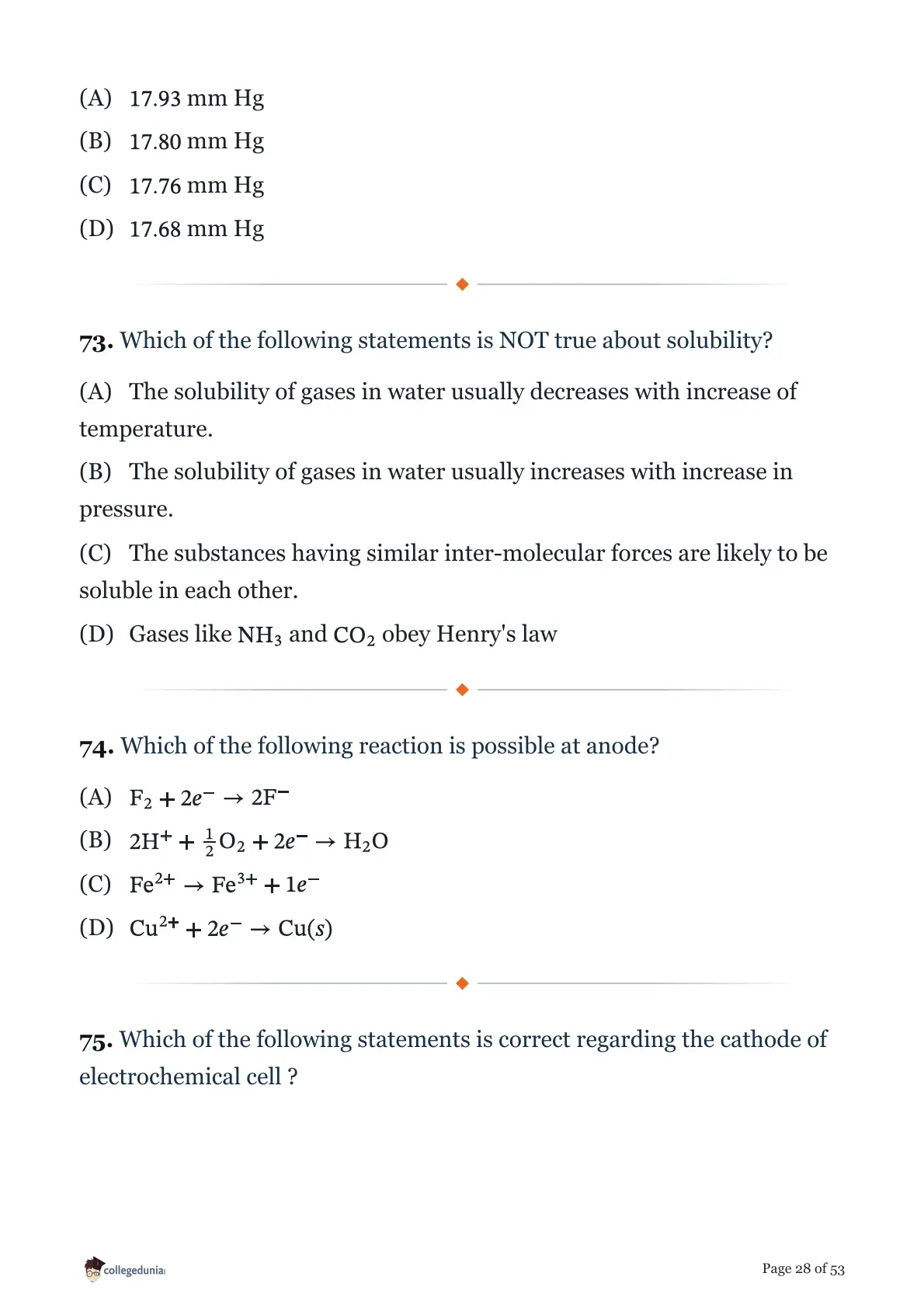
Which of the following statements is NOT true about solubility?
Which of the following reaction is possible at anode?
Which of the following statements is correct regarding the cathode of electrochemical cell ?
Which of the following solutions will have the highest electrical conductivity?
A first order reaction takes \(16\) minutes for it's \(50\%\) completion. What fraction that would react in \(32\) minutes from the beginning?
The half-life of a first-order reaction is \(20\) minutes. What is the rate constant (in min\(^{-1}\)) for this reaction?
The rate constant of a reaction is \(k = 3.28\times 10^{-4}\) s\(^{-1}\). Find the order of the reaction.
Which of the following is a water-in-oil type of emulsion?
What is O-O bond length in ozone ?
Which of the following ions exhibit same value of spin only magnetic moment?
(A). \(\text{Ti}^{3+}\)
(B). \(\text{Cr}^{3+}\)
(C). \(\text{Mn}^{2+}\)
(D). \(\text{Fe}^{3+}\)
(E). \(\text{Sc}^{3+}\)
Choose the most appropriate answer from the options given below.
Which of the following cations in their oxidation states forms colored compounds ?
Which of the following statements is correct with respect to \([\text{Mn(CN)}_6]^{3-}\) ?
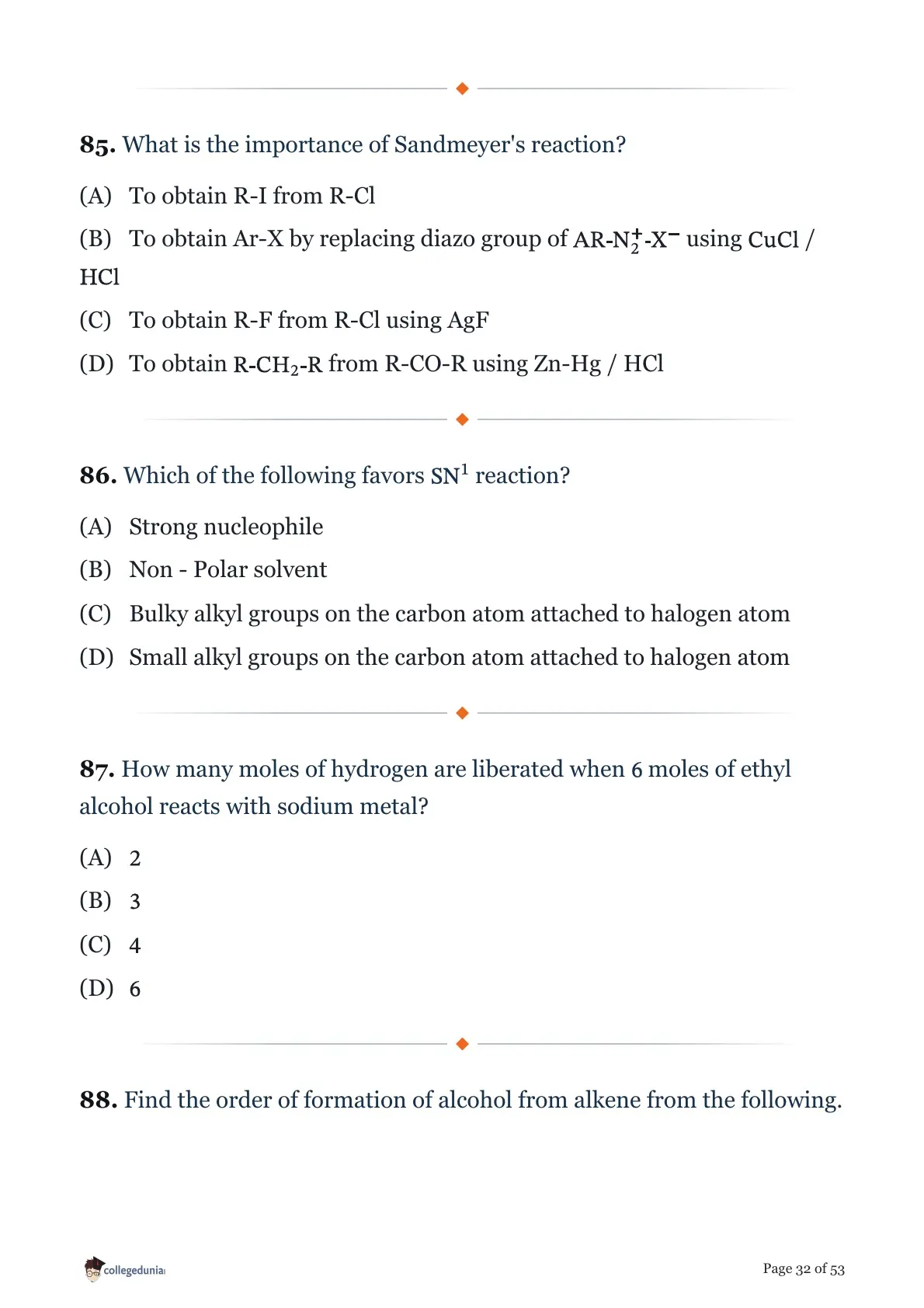
What is the importance of Sandmeyer's reaction?
Which of the following favors \(\text{SN}^1\) reaction?
How many moles of hydrogen are liberated when \(6\) moles of ethyl alcohol reacts with sodium metal?
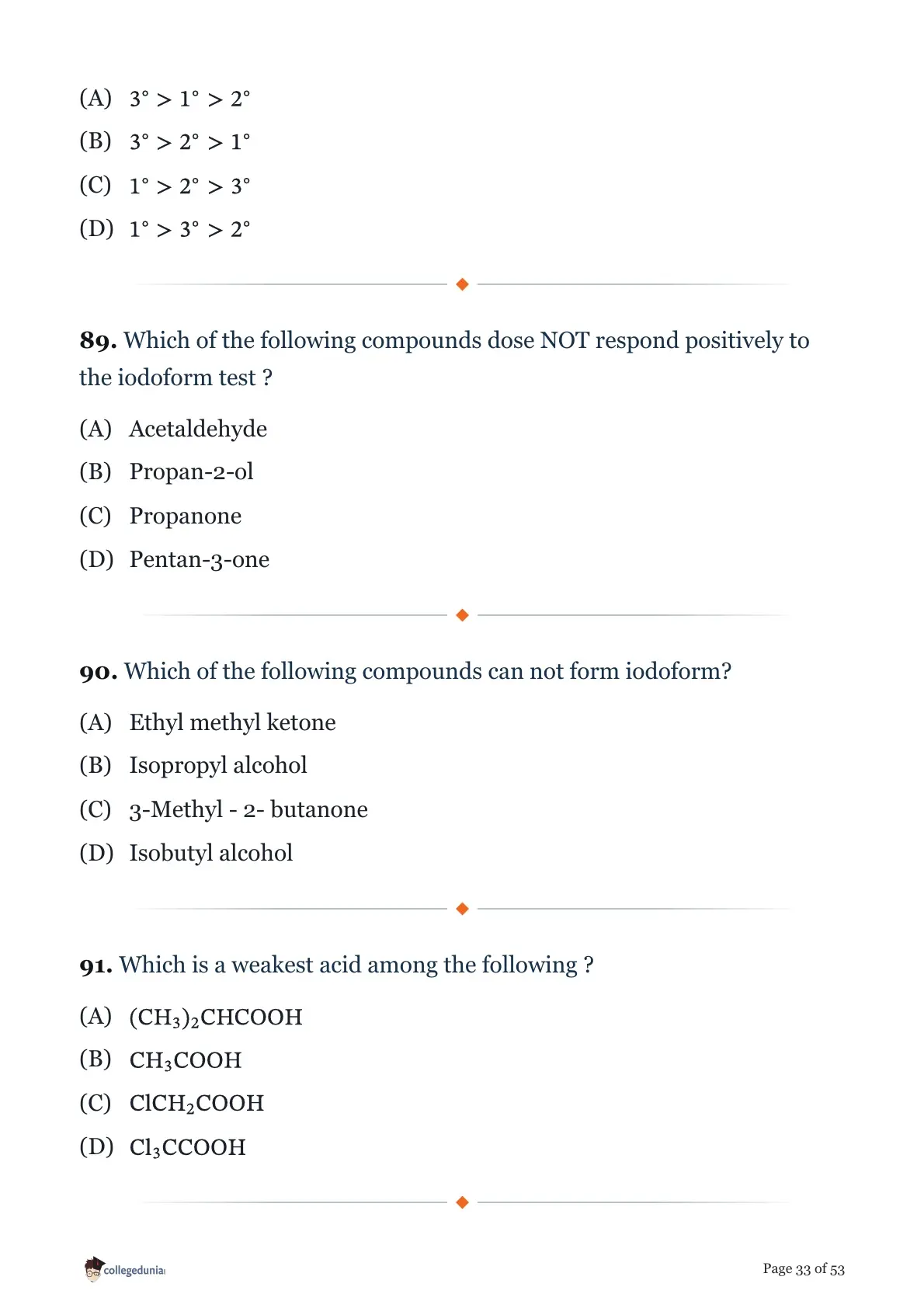
Find the order of formation of alcohol from alkene from the following.
Which of the following compounds dose NOT respond positively to the iodoform test ?
Which of the following compounds can not form iodoform?
Which is a weakest acid among the following ?
Which of the following amines is not obtained by Gabriel phthalimide synthesis?
What type of amine is Iso propyl amine ?
What is the correct sequence of the complementary strand for the given portion of a DNA molecule:- 5' - G A C G T A C -3' ?
Which of the following compounds forms starch on polymerization?
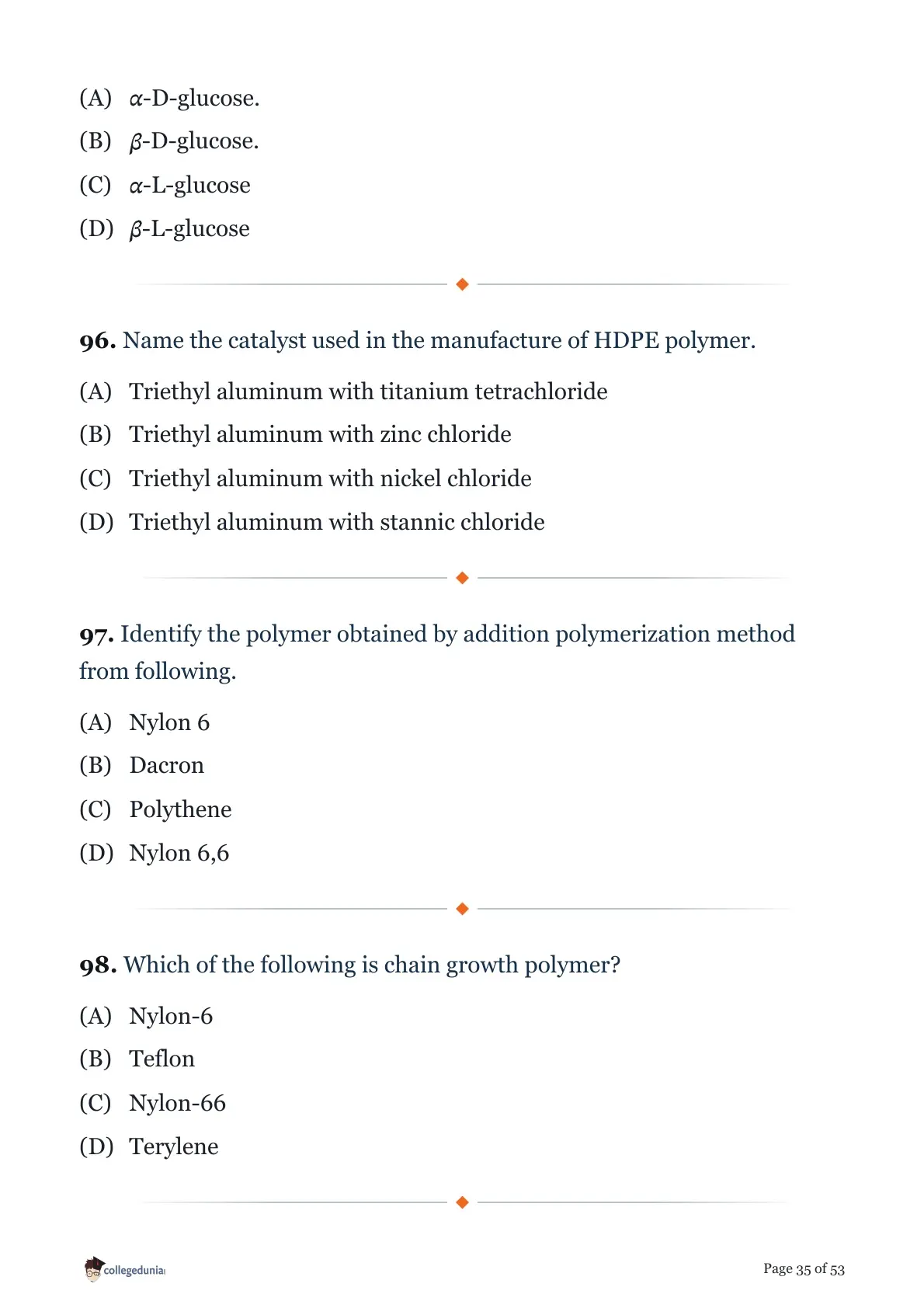
Name the catalyst used in the manufacture of HDPE polymer.
Identify the polymer obtained by addition polymerization method from following.
Which of the following is chain growth polymer?
Identify the use of Formalin from the followings.
Identify the term used for drugs that reduce or relieve pain without causing loss of consciousness.
Mathematics Section (Questions 101 to 150)
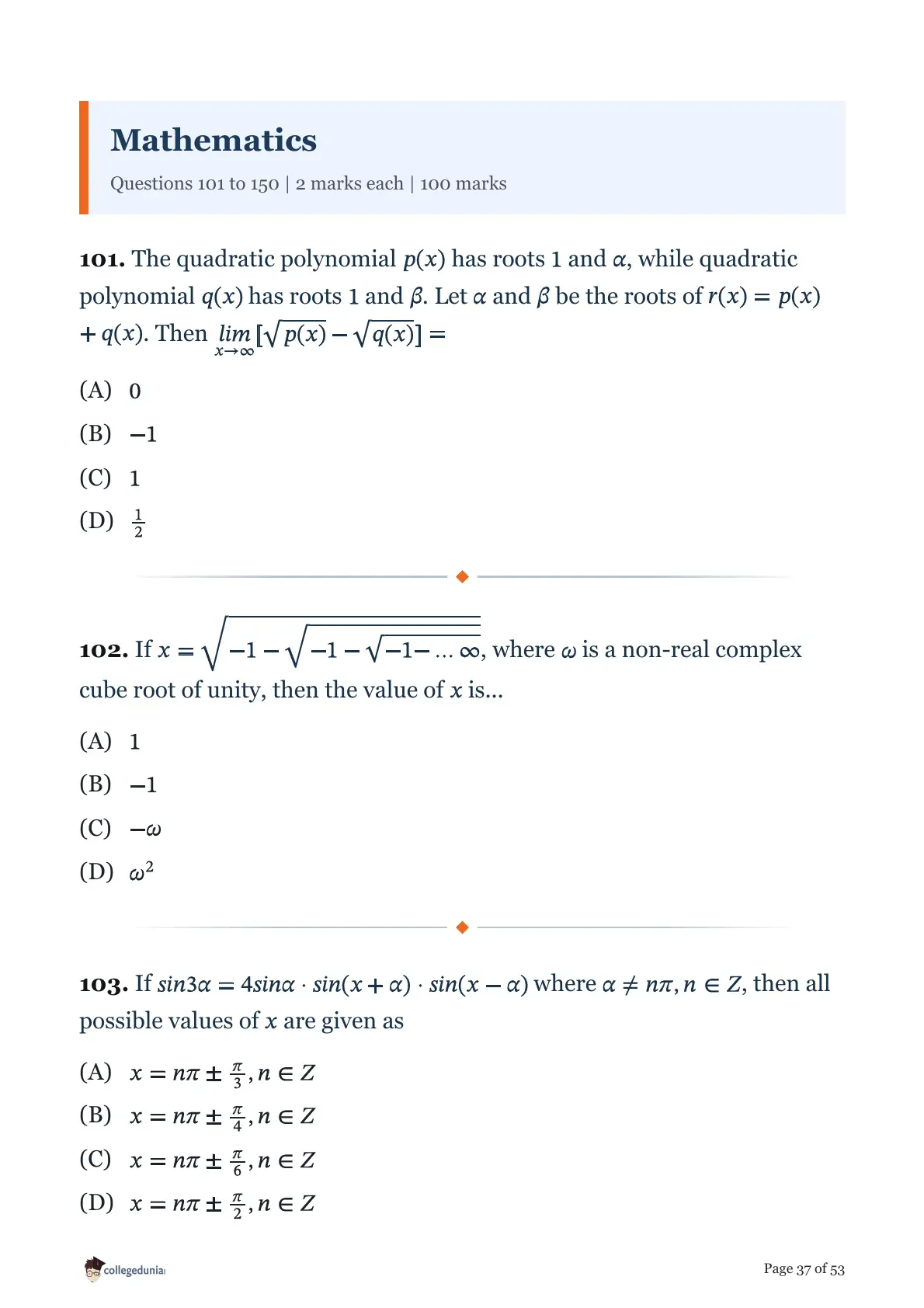
The quadratic polynomial \(p(x)\) has roots \(1\) and \(α\), while quadratic polynomial \(q(x)\) has roots \(1\) and \(β\). Let \(α\) and \(β\) be the roots of \(r(x) = p(x)+q(x)\). Then \(\underset{x\rightarrow \infty }{lim}[\sqrt{p(x)}-\sqrt{q(x)}] =\)
If \(x = \sqrt{-1-\sqrt{-1-\sqrt{-1-\ldots \infty }}}\), where \(ω\) is a non-real complex cube root of unity, then the value of \(x\) is...
If \(sin3α = 4sinα\cdot sin(x+α)\cdot sin(x-α)\) where \(α\neq nπ,n\in Z\), then all possible values of \(x\) are given as
If \(cos(θ-α) = a\) and \(sin(θ-β) = b\), then the value of \(cos^2(α-β)+2absin(α-β)+cos^2(θ-α)\) is...
The general solution of \(cosθ-sinθ = 1\) is
The equation of the straight line passing through the point \((-5,3)\) such that the portion of the line intercepted between the axes is divided by the point in the ratio \(4:3\) (from the X-axis to the Y-axis) is...
If the equation \(kx^2-5xy+6y^2+x-3y = 0\) represents a pair of straight lines, then the co-ordinates of their point of intersection are
The pair of straight lines represented by the equation \(\sqrt{3}x^2-4xy+\sqrt{3}y^2 = 0\) are
The equation of the circle concentric with circle \(x^2+y^2-6x+7 = 0\) and which touches the line \(x+y+3 = 0\) is ....
The distance of the focus of the parabola \(y^2 = 16x\) from its directrix is...
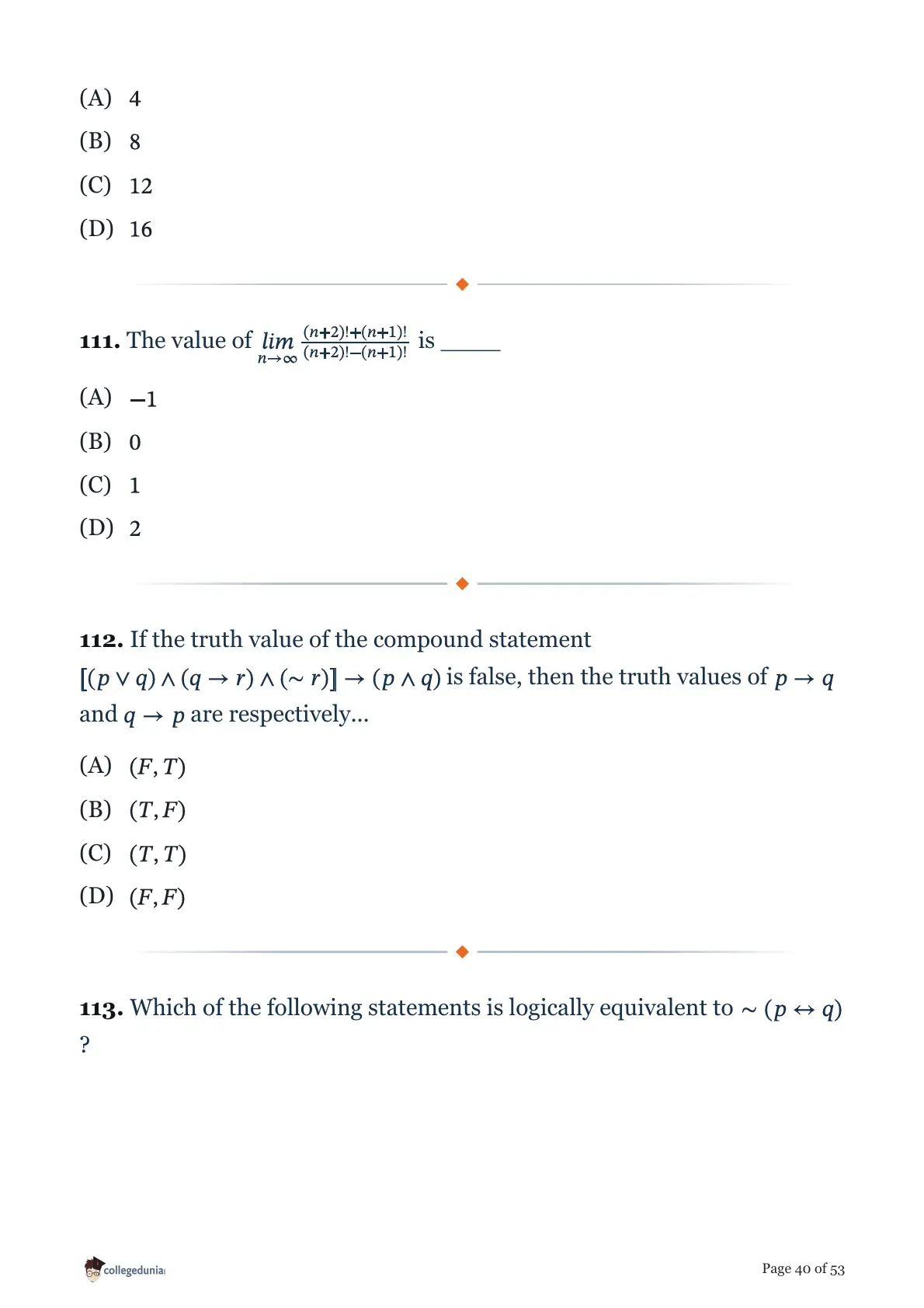
The value of \(\underset{n\rightarrow \infty }{lim}\frac{(n+2)!+(n+1)!}{(n+2)!-(n+1)!}\) is ____
If the truth value of the compound statement
\([(p∨q)∧(q\rightarrow r)∧(\sim r)]\rightarrow (p∧q)\) is false, then the truth values of \(p\rightarrow q\) and \(q\rightarrow p\) are respectively...
Which of the following statements is logically equivalent to \(\sim (p\leftrightarrow q)\) ?
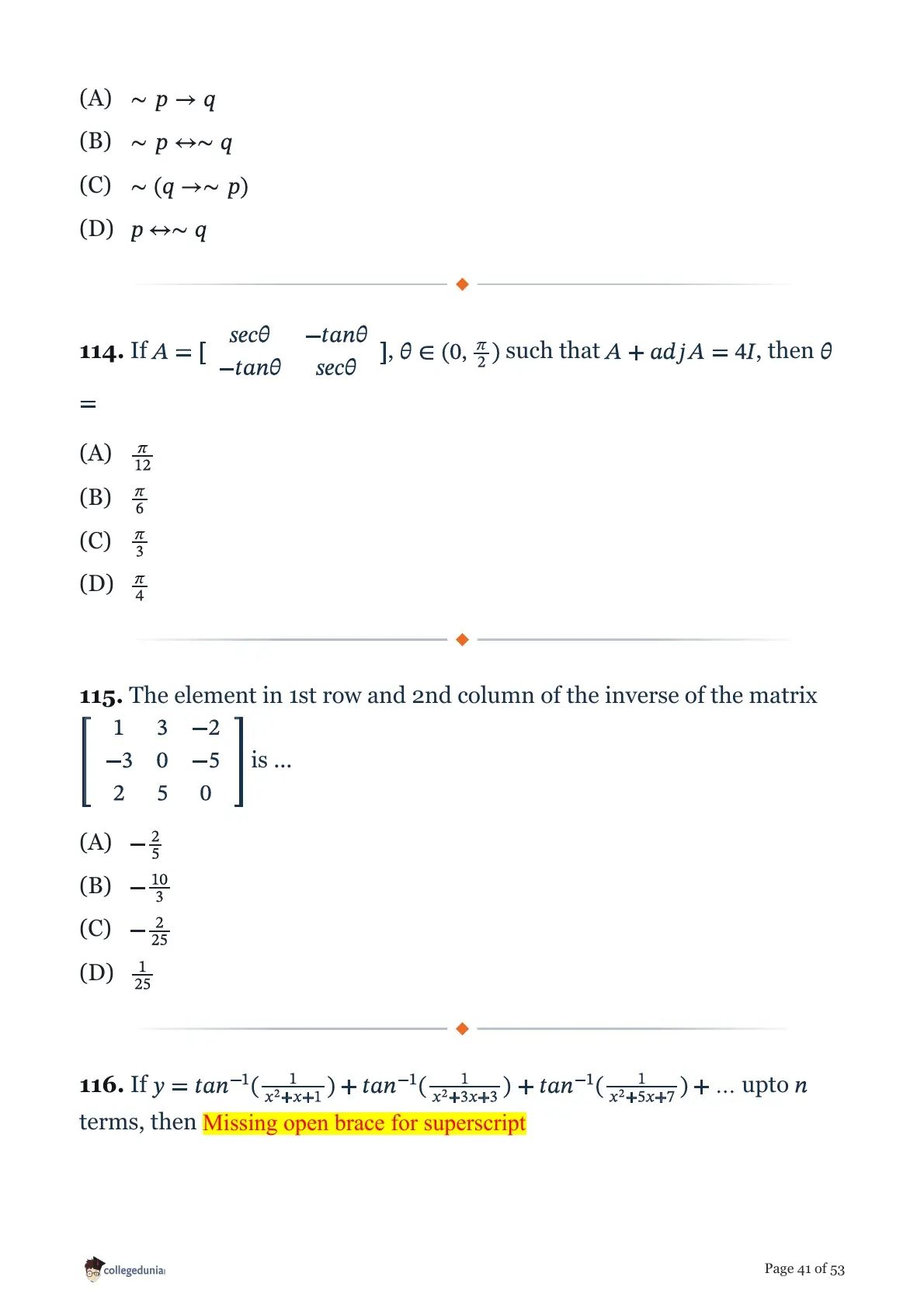
If \(A = [\begin{array}{cc}secθ & -tanθ \\ -tanθ & secθ\end{array}]\), \(θ\in (0,\frac{π}{2})\) such that \(A+adj\,A = 4I\), then \(θ =\)
The element in 1st row and 2nd column of the inverse of the matrix \(\left[ \begin{array}{ccc}1 & 3 & -2 \\ -3 & 0 & -5 \\ 2 & 5 & 0\end{array} \right]\) is ...
If \(y = tan^{-1}(\frac{1}{x^2+x+1})+tan^{-1}(\frac{1}{x^2+3x+3})+tan^{-1}(\frac{1}{x^2+5x+7})+\ldots\) upto \(n\) terms, then \(y^'(0) =\)
Let \(f(x) = (sin^{-1}x)^2+(cos^{-1}x)^2\) be a real-valued function defined on its domain. Then the sum of the greatest and the least values of \(f(x)\) is
The value of \(\frac{tan^{-1}(1)+cos^{-1}(\frac{1}{2})+sin^{-1}(\frac{1}{2})}{tan^{-1}(\sqrt{3})-sec^{-1}(-2)}\) is equal to
If \(g(x)\) is the inverse function of \(f(x)\), where \(f(x) = \frac{5x+3}{4x-1}\), then \(g(1) =\)
If \(f(x)\) is continuous at \(x = 0\), where \(f(x) = \frac{8^x-2^x}{k^x-1}\), for \(x\neq 0\) and \(f(0) = 2\), then the value of \(k\) is ...
\(\frac{d}{dx}[sin^2\{cot^{-1}\sqrt{\frac{1-x}{1+x}}\}] =\) ...
If \(f(x) = \sqrt{x^2+1},g(x) = \frac{x+1}{x^2+1},h(x) = 2x-3\), then \(f^'(h^'(g^'(x))) =\)
If \(\sqrt{y+x}+\sqrt{y-x} = c\) such that \(\frac{dy}{dx} = f(x)-\sqrt{[f(x)]^2-1}\), then \(f(x) =\) ____
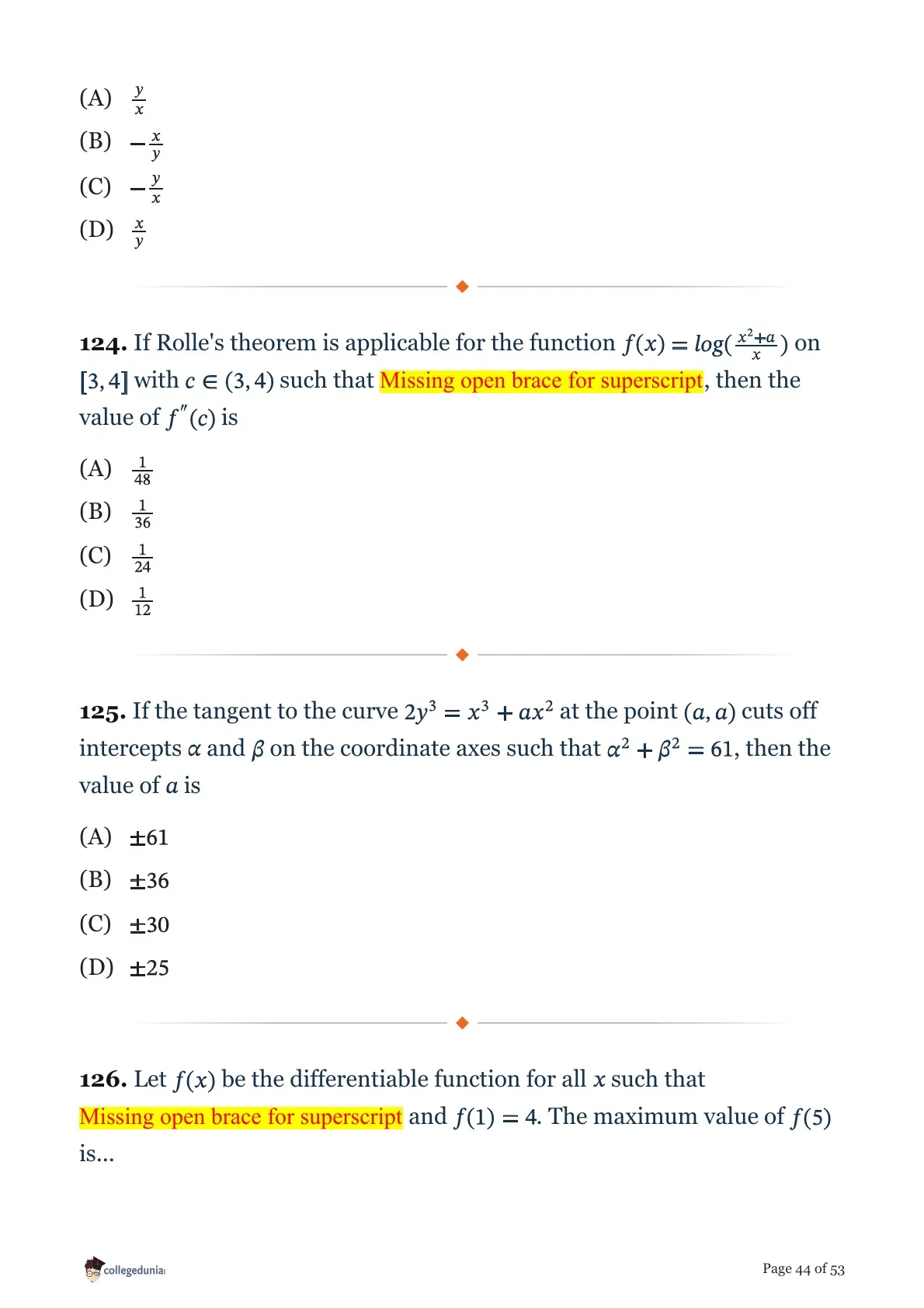
If Rolle's theorem is applicable for the function \(f(x) = log(\frac{x^2+a}{x})\) on \([3,4]\) with \(c\in (3,4)\) such that \(f^'(c) = 0\), then the value of \(f^{''}(c)\) is
If the tangent to the curve \(2y^3 = x^3+ax^2\) at the point \((a,a)\) cuts off intercepts \(α\) and \(β\) on the coordinate axes such that \(α^2+β^2 = 61\), then the value of \(a\) is
Let \(f(x)\) be the differentiable function for all \(x\) such that \(f^'(x)\leq 5\) and \(f(1) = 4\). The maximum value of \(f(5)\) is...
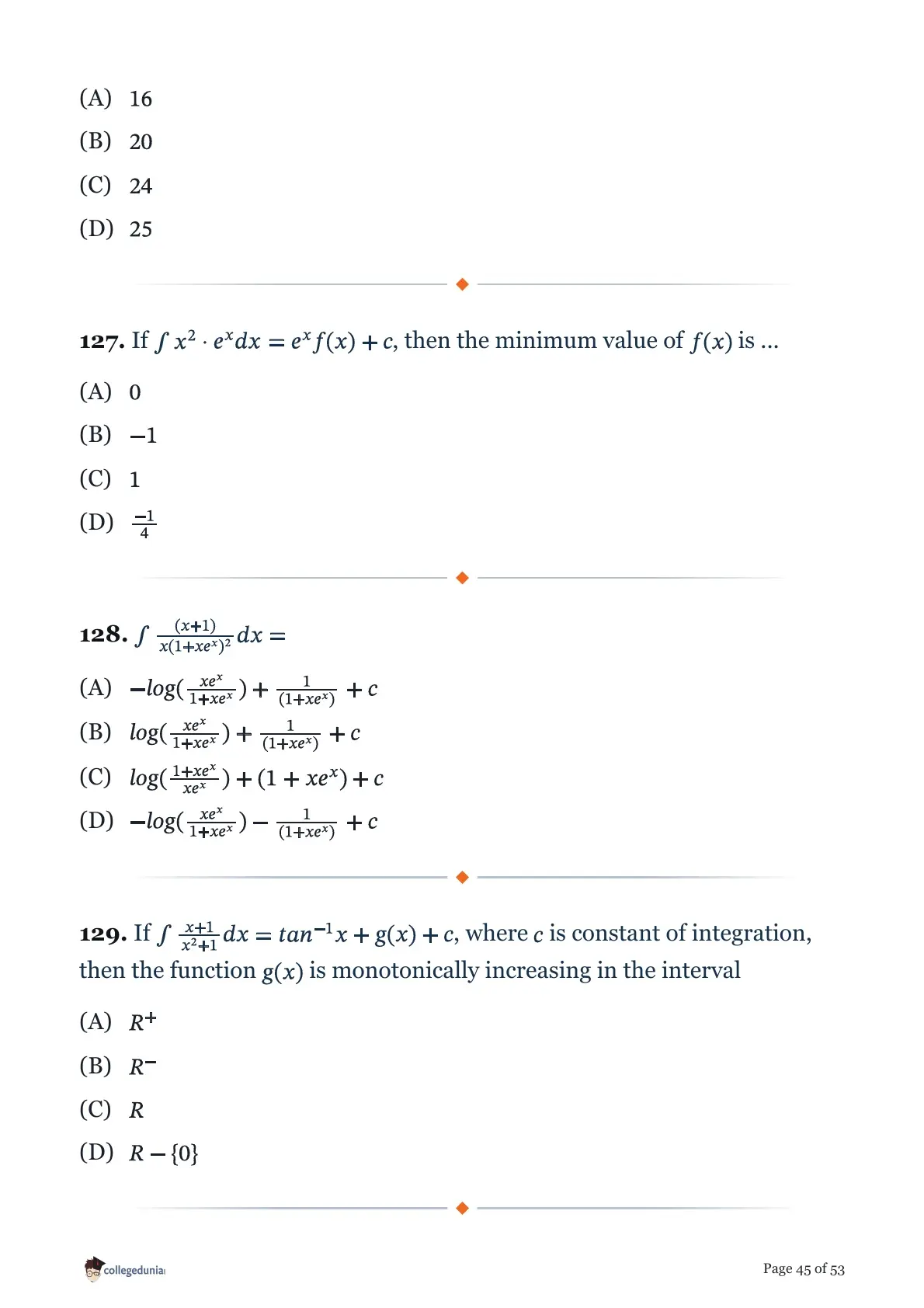
If \(\int x^2\cdot e^xdx = e^xf(x)+c\), then the minimum value of \(f(x)\) is ...
\(\int \frac{(x+1)}{x(1+xe^x)^2}dx =\)
If \(\int \frac{x+1}{x^2+1}dx = tan^{-1}x+g(x)+c\), where \(c\) is constant of integration, then the function \(g(x)\) is monotonically increasing in the interval
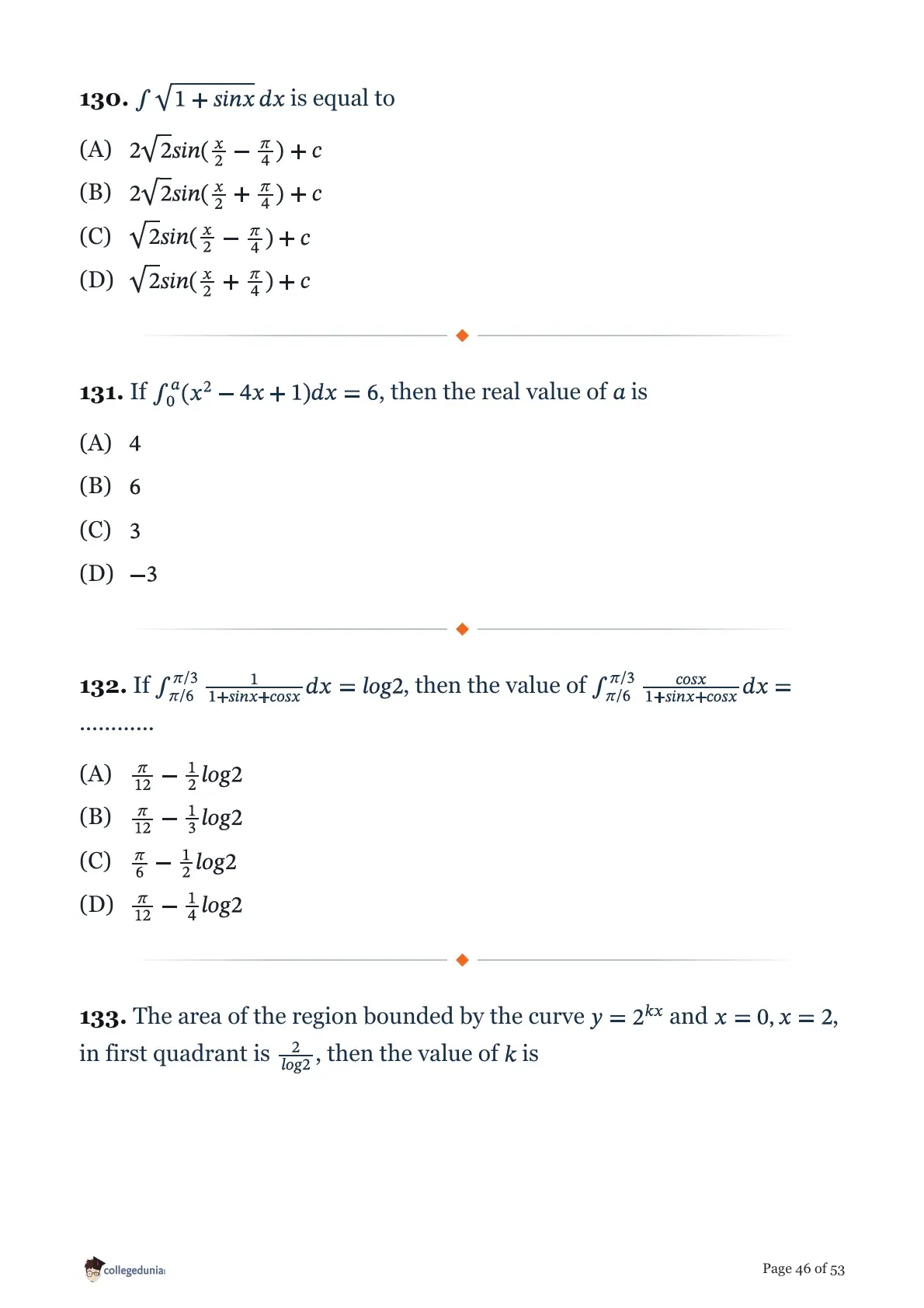
\(\int \sqrt{1+sinx}\,dx\) is equal to
If \(\int _0^a(x^2-4x+1)dx = 6\), then the real value of \(a\) is
If \(\int _{π/6}^{π/3}\frac{1}{1+sinx+cosx}dx = log2\), then the value of \(\int _{π/6}^{π/3}\frac{cosx}{1+sinx+cosx}dx =\) ............
The area of the region bounded by the curve \(y = 2^{kx}\) and \(x = 0,x = 2\), in first quadrant is \(\frac{2}{log2}\), then the value of \(k\) is
The area of the region bounded by the curve \(y = x^3\) and the lines \(y = 8\) and \(x = 0\) is ... square units.
The differential equation of \(3y = \sqrt[3]{x+c}\) is
The general solution of the differential equation \((x+y)\frac{dy}{dx} = 1\) is
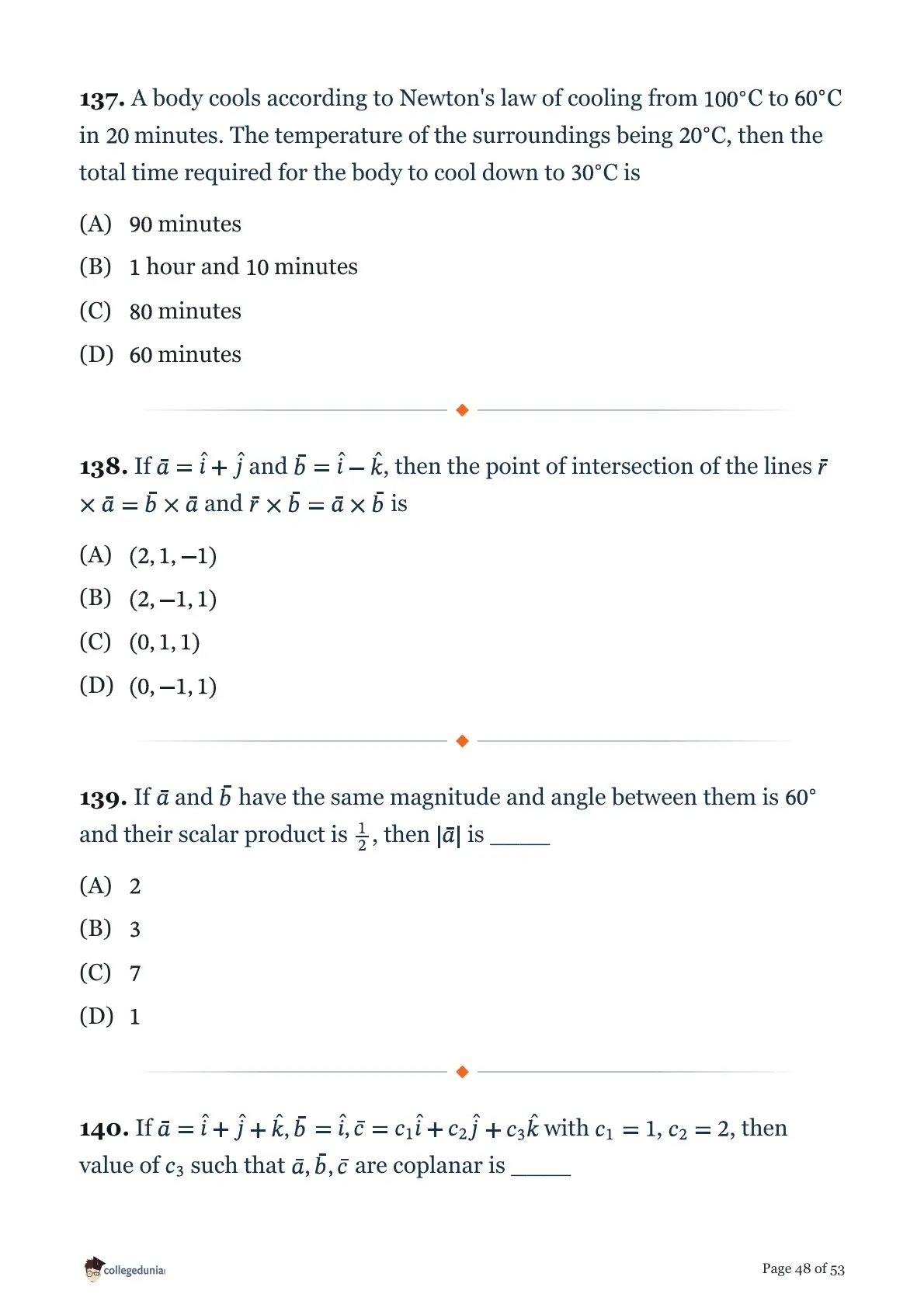
A body cools according to Newton's law of cooling from \(100^{\circ}\)C to \(60^{\circ}\)C in \(20\) minutes. The temperature of the surroundings being \(20^{\circ}\)C, then the total time required for the body to cool down to \(30^{\circ}\)C is
If \(\overset{̄}{a} = \hat{i}+\hat{j}\) and \(\overset{̄}{b} = \hat{i}-\hat{k}\), then the point of intersection of the lines \(\overset{̄}{r}\times \overset{̄}{a} = \overset{̄}{b}\times \overset{̄}{a}\) and \(\overset{̄}{r}\times \overset{̄}{b} = \overset{̄}{a}\times \overset{̄}{b}\) is
If \(\overset{̄}{a}\) and \(\overset{̄}{b}\) have the same magnitude and angle between them is \(60^{\circ}\) and their scalar product is \(\frac{1}{2}\), then \(|\overset{̄}{a}|\) is ____
If \(\overset{̄}{a} = \hat{i}+\hat{j}+\hat{k},\overset{̄}{b} = \hat{i},\overset{̄}{c} = c_1\hat{i}+c_2\hat{j}+c_3\hat{k}\) with \(c_1 = 1\), \(c_2 = 2\), then value of \(c_3\) such that \(\overset{̄}{a},\overset{̄}{b},\overset{̄}{c}\) are coplanar is ____
If \(\overset{̄}{a},\overset{̄}{b}\) and \(\overset{̄}{c}\) are non-coplanar unit vectors such that the angle between any two of them is \(60^{\circ}\), and the vector \(\overset{̄}{d} = x\overset{̄}{a}+y\overset{̄}{b}+z\overset{̄}{c}\) is perpendicular to both \(\overset{̄}{a}\) and \(\overset{̄}{b}\), then the value of \(\frac{(x+y)}{z}\) is
If \(\overset{̄}{a},\overset{̄}{b},\overset{̄}{c}\) are three non zero and non-coplanar vectors such that \(\overset{̄}{a}\times (\overset{̄}{b}\times \overset{̄}{c}) = \frac{\overset{̄}{b}}{2}\), then the angle between \(\overset{̄}{a}\) and \(\overset{̄}{b}\) is ...
The vector equation of the plane which is at a distance of \(5\) units from the origin and normal to the vector \(2\hat{i}+\hat{j}-2\hat{k}\) is
The equation of a line passing through a point \((4,-2,3)\) and perpendicular to the XZ-plane is....
The equation of the plane passing through the intersection of planes \(2x-y+z = 3\), \(4x-3y+5z = -9\) and parallel to the line \(\frac{x+1}{2} = \frac{y+3}{4} = \frac{z-3}{5}\) is...
If a line makes angles \(α,β,γ\) with the coordinate axes, then the sum of values of \(sin^2α+sin^2β+sin^2γ\) and \(cos2α+cos2β+cos2γ\) is ...
The difference between the maximum value and minimum value of the objective function \(z = 3x+5y\) of a linear programming problem subject to constraints \(5x+10y\leq 50\), \(x+y\geq 1\), \(y\leq 4\) and \(x\geq 0,y\geq 0\) is \(3λ\). Then the value of \(λ\) is
In a multiple-choice examination, there are \(10\) questions with one correct option out of \(4\) options for each question. A student gets \(4\) marks for each correct answer and \(1\) mark is deducted for each incorrect answer. The probability that a student, guessing randomly on every question, scores \(30\) marks in this exam is...
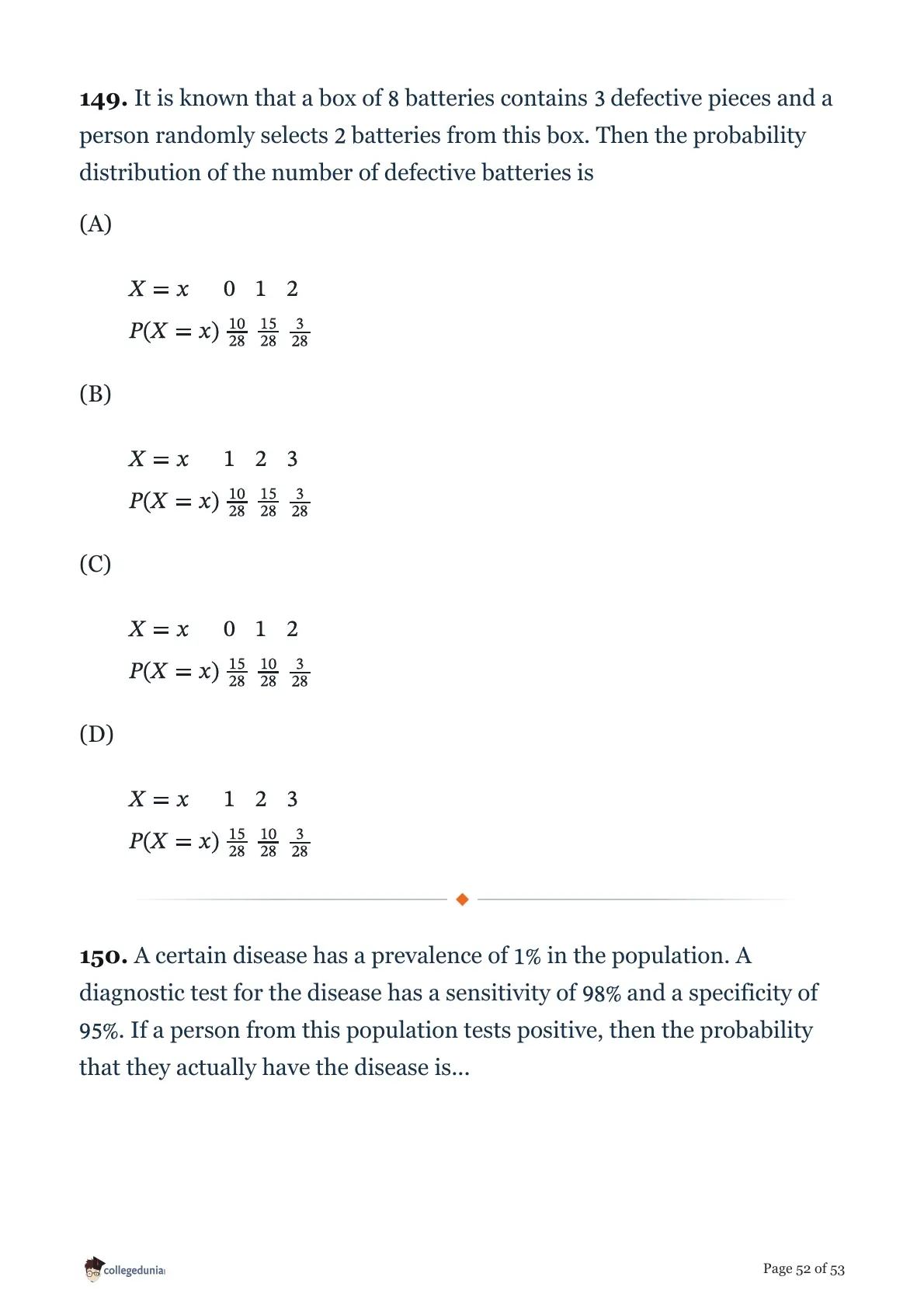
It is known that a box of \(8\) batteries contains \(3\) defective pieces and a person randomly selects \(2\) batteries from this box. Then the probability distribution of the number of defective batteries is
A certain disease has a prevalence of \(1\%\) in the population. A diagnostic test for the disease has a sensitivity of \(98\%\) and a specificity of \(95\%\). If a person from this population tests positive, then the probability that they actually have the disease is...
MHT CET PCM Exam Pattern 2026
| Parameter | Details |
|---|---|
| Conducting Body | Maharashtra Common Entrance Test Cell (Maharashtra CET Cell) |
| Exam Mode | Online (Computer-Based Test) |
| Duration | 180 minutes (3 hours) |
| Groups / Subjects | PCM (Physics, Chemistry, Mathematics) for Engineering |
| Total Questions |
150 |
| Total Marks | 200 |
| Question Type | Multiple Choice Questions (MCQs) |
| Marks Distribution |
|
| Negative Marking | No |
| Syllabus Weightage |
|



Comments