




MHT CET 2026 April 15 Shift 1 PCM Question Paper is available for download here. Maharashtra State CET Cell conducted MHT CET 2026 PCM Exam on April 15 in Shift 1 from 9 AM to 12 PM in CBT mode.
- The MHT CET 2026 PCM Question Paper consists of 150 multiple-choice questions (MCQs) totalling 200 marks divided into 3 sections: Physics, Chemistry, and Mathematics, with 50 questions in each subject.
- Physics and Chemistry questions carry 1 mark each while Mathematics questions carry 2 marks each.
- There is no negative marking for incorrect answers.
Also Check: Expected Percentile for MHT CET 2026 April 15 Shift 1
Download MHT CET 2026 April 15 Shift 1 PCM Question Paper with Solutions PDF from the links provided below. Based on initial student reaction, MHT CET 2026 April 15 Shift 1 was of easy to moderate level.
MHT CET 2026 April 15 Shift 1 PCM Question Paper PDF Download (Memory-Based)
| MHT CET 2026 April 15 Shift 1 Question Paper | Download PDF | Check Solution |















MHT CET 2026 April 15 Shift 1 PCM Questions with Solutions
Physics Section (Questions 1 to 50)
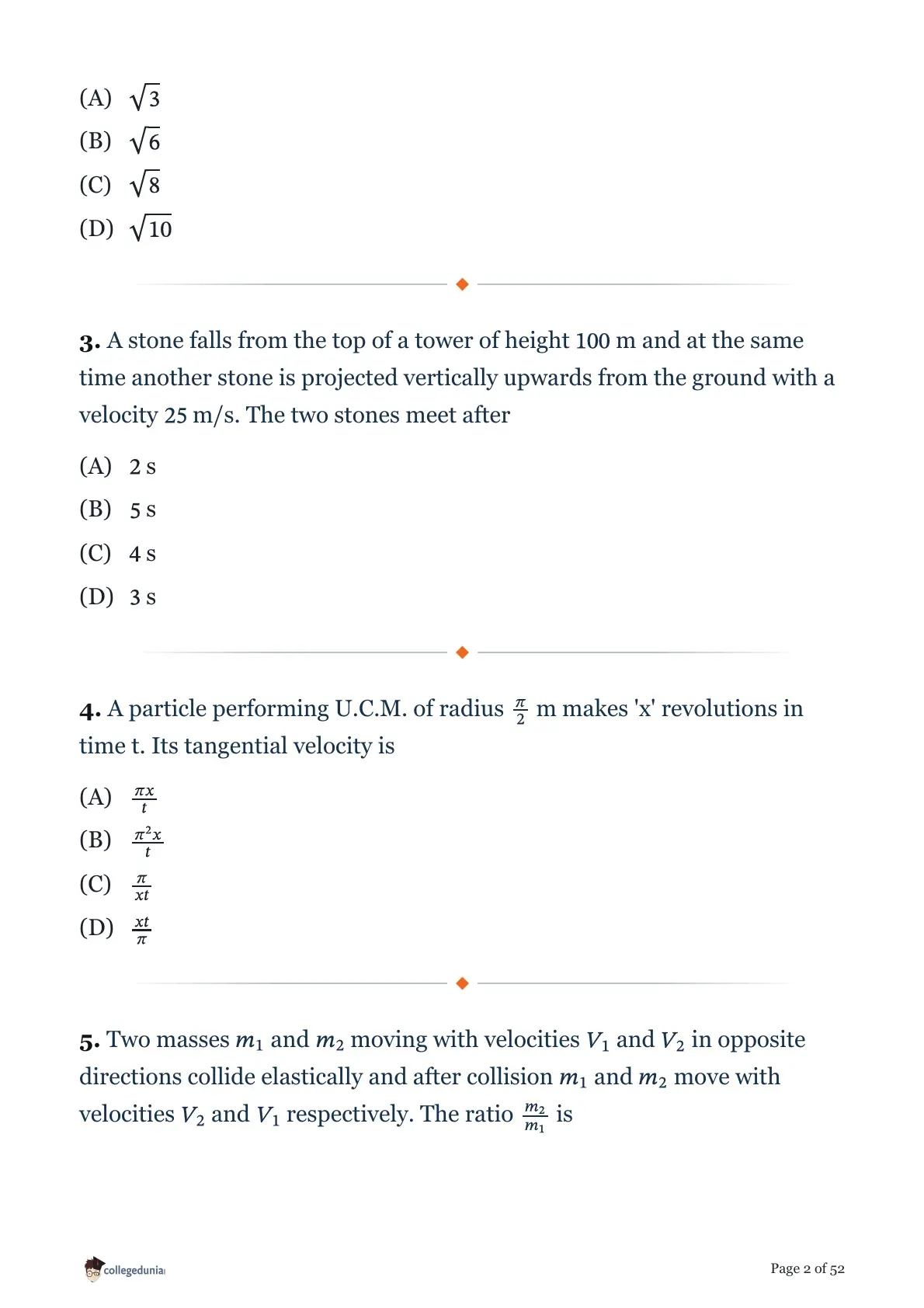
The length of rod is measured by meter scale having least count \(0.1\) cm and diameter is measured by vernier callipers having least count \(0.01\) cm. Length of rod is \(5.0\) cm and radius \(2.0\) cm. The percentage error in the calculated value of the volume is
A vector \(\overset{⃗}{A}\) when added to the sum of the vectors \((\hat{i}-2\hat{j}+2\hat{k})\) and \((-2\hat{i}+\hat{j}-\hat{k})\) gives a unit vector along Y axis. The magnitude of vector \(\overset{⃗}{A}\) is
A stone falls from the top of a tower of height \(100\) m and at the same time another stone is projected vertically upwards from the ground with a velocity \(25\) m/s. The two stones meet after
A particle performing U.C.M. of radius \(\frac{π}{2}\) m makes 'x' revolutions in time t. Its tangential velocity is
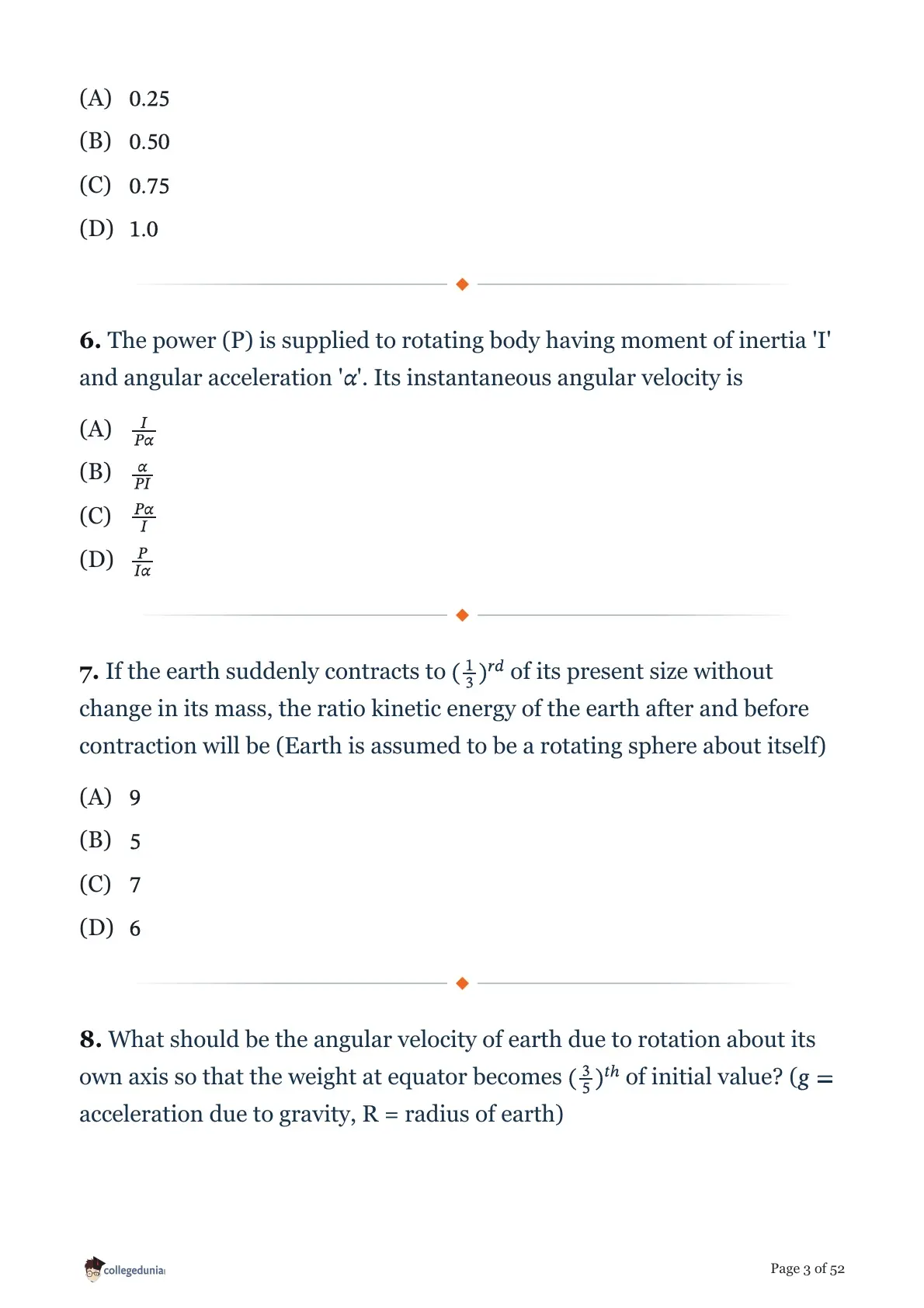
Two masses \(m_1\) and \(m_2\) moving with velocities \(V_1\) and \(V_2\) in opposite directions collide elastically and after collision \(m_1\) and \(m_2\) move with velocities \(V_2\) and \(V_1\) respectively. The ratio \(\frac{m_2}{m_1}\) is
The power (P) is supplied to rotating body having moment of inertia 'I' and angular acceleration '\(α\)'. Its instantaneous angular velocity is
If the earth suddenly contracts to \((\frac{1}{3})^{rd}\) of its present size without change in its mass, the ratio kinetic energy of the earth after and before contraction will be (Earth is assumed to be a rotating sphere about itself)
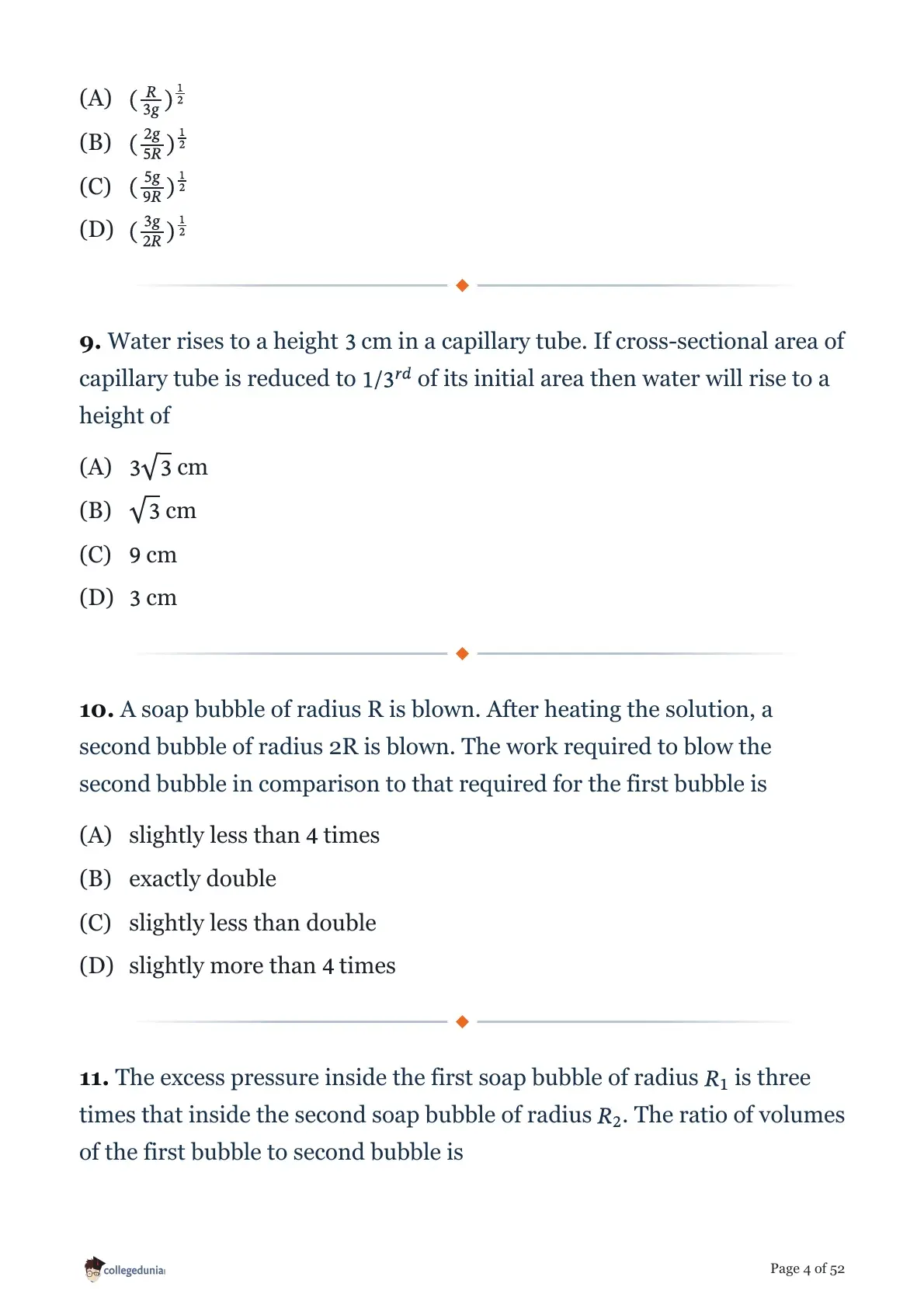
What should be the angular velocity of earth due to rotation about its own axis so that the weight at equator becomes \((\frac{3}{5})^{th}\) of initial value? (\(g =\) acceleration due to gravity, R = radius of earth)
Water rises to a height \(3\) cm in a capillary tube. If cross-sectional area of capillary tube is reduced to \(1/3^{rd}\) of its initial area then water will rise to a height of
A soap bubble of radius R is blown. After heating the solution, a second bubble of radius 2R is blown. The work required to blow the second bubble in comparison to that required for the first bubble is
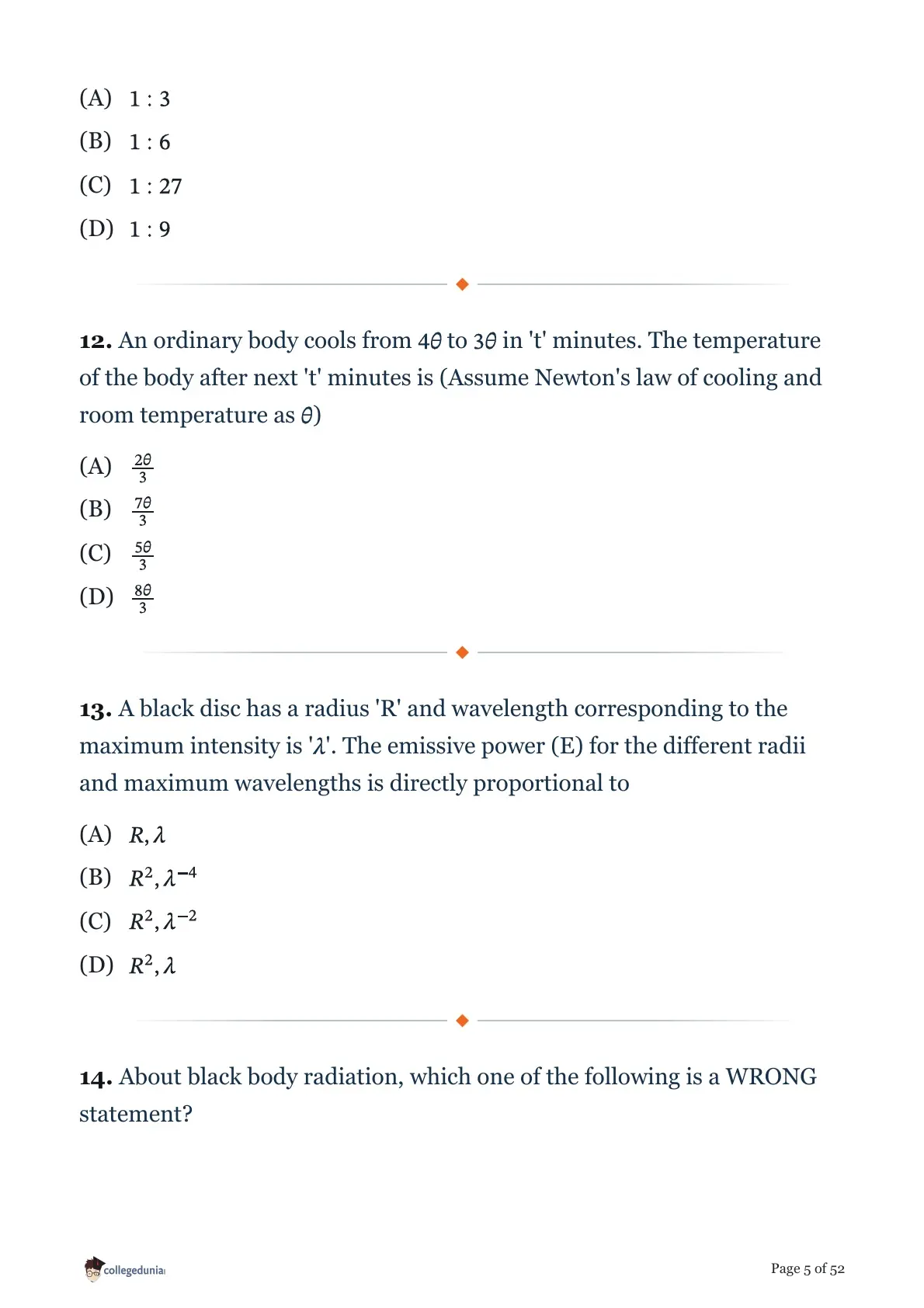
The excess pressure inside the first soap bubble of radius \(R_1\) is three times that inside the second soap bubble of radius \(R_2\). The ratio of volumes of the first bubble to second bubble is
An ordinary body cools from \(4θ\) to \(3θ\) in 't' minutes. The temperature of the body after next 't' minutes is (Assume Newton's law of cooling and room temperature as \(θ\))
A black disc has a radius 'R' and wavelength corresponding to the maximum intensity is '\(λ\)'. The emissive power (E) for the different radii and maximum wavelengths is directly proportional to
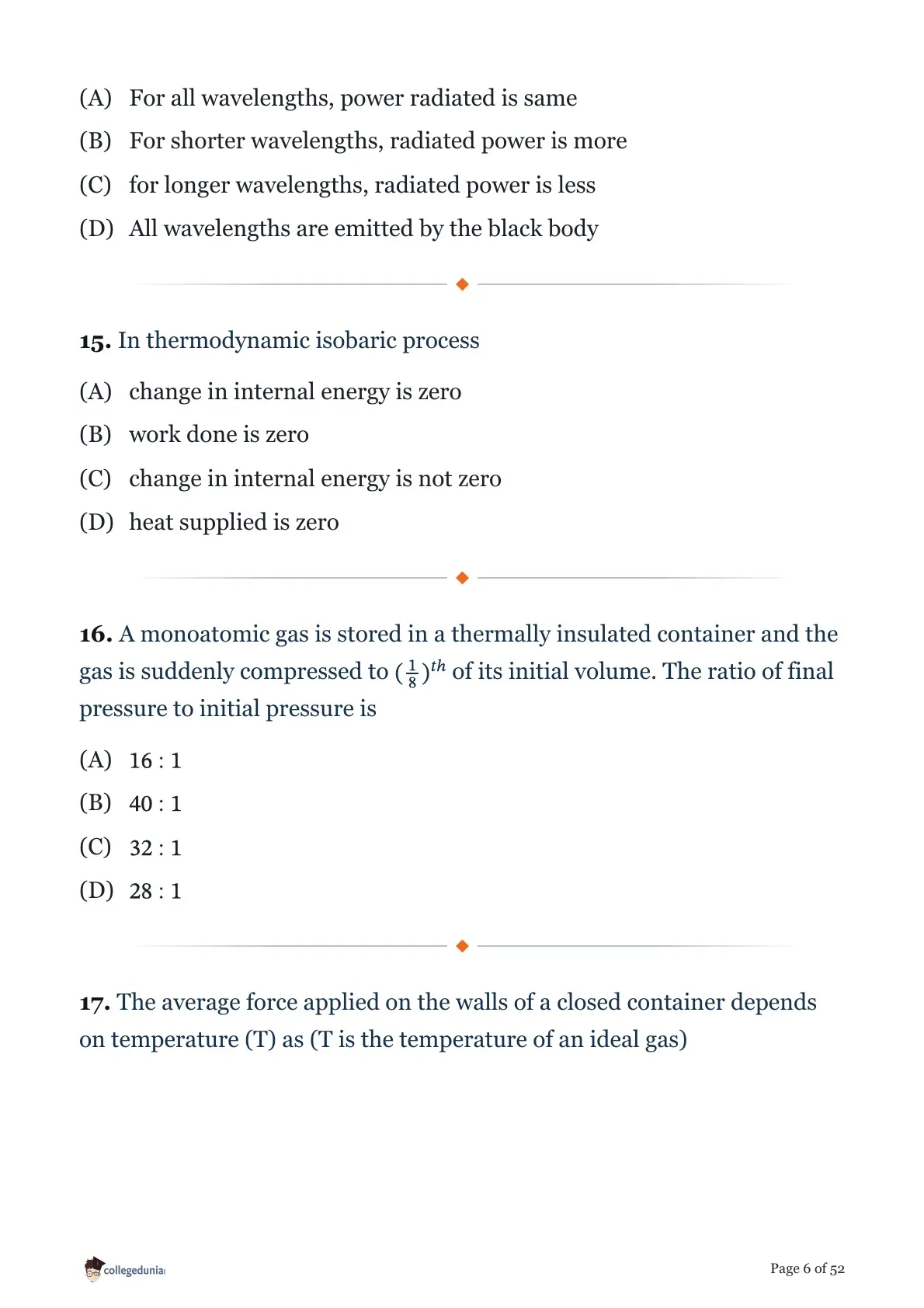
About black body radiation, which one of the following is a WRONG statement?
In thermodynamic isobaric process
A monoatomic gas is stored in a thermally insulated container and the gas is suddenly compressed to \((\frac{1}{8})^{th}\) of its initial volume. The ratio of final pressure to initial pressure is
The average force applied on the walls of a closed container depends on temperature (T) as (T is the temperature of an ideal gas)
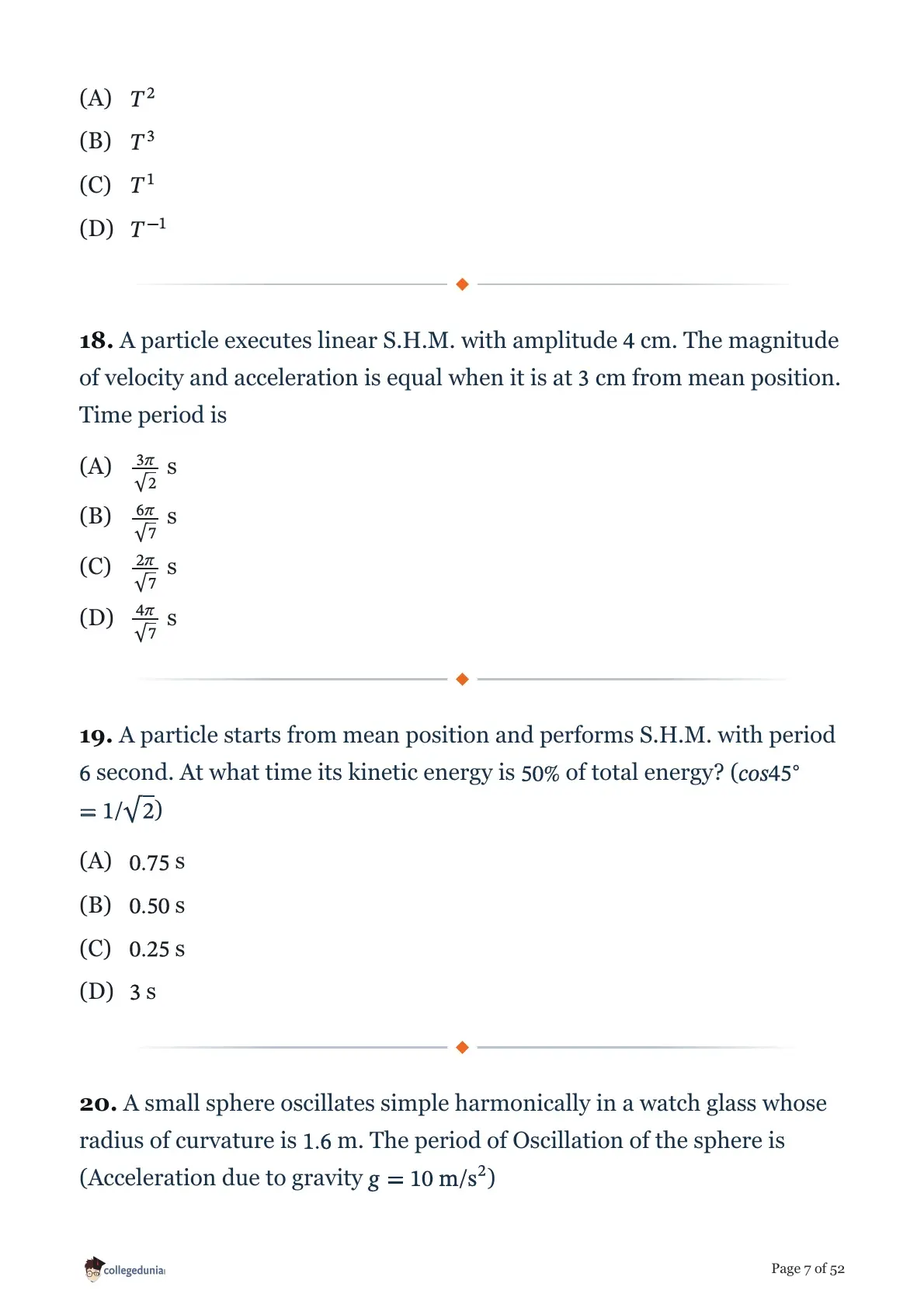
A particle executes linear S.H.M. with amplitude \(4\) cm. The magnitude of velocity and acceleration is equal when it is at \(3\) cm from mean position. Time period is
A particle starts from mean position and performs S.H.M. with period \(6\) second. At what time its kinetic energy is \(50\%\) of total energy? (\(cos45^{\circ} = 1/\sqrt{2}\))
A small sphere oscillates simple harmonically in a watch glass whose radius of curvature is \(1.6\) m. The period of Oscillation of the sphere is (Acceleration due to gravity \(g = 10\text{ m/s}^2\))
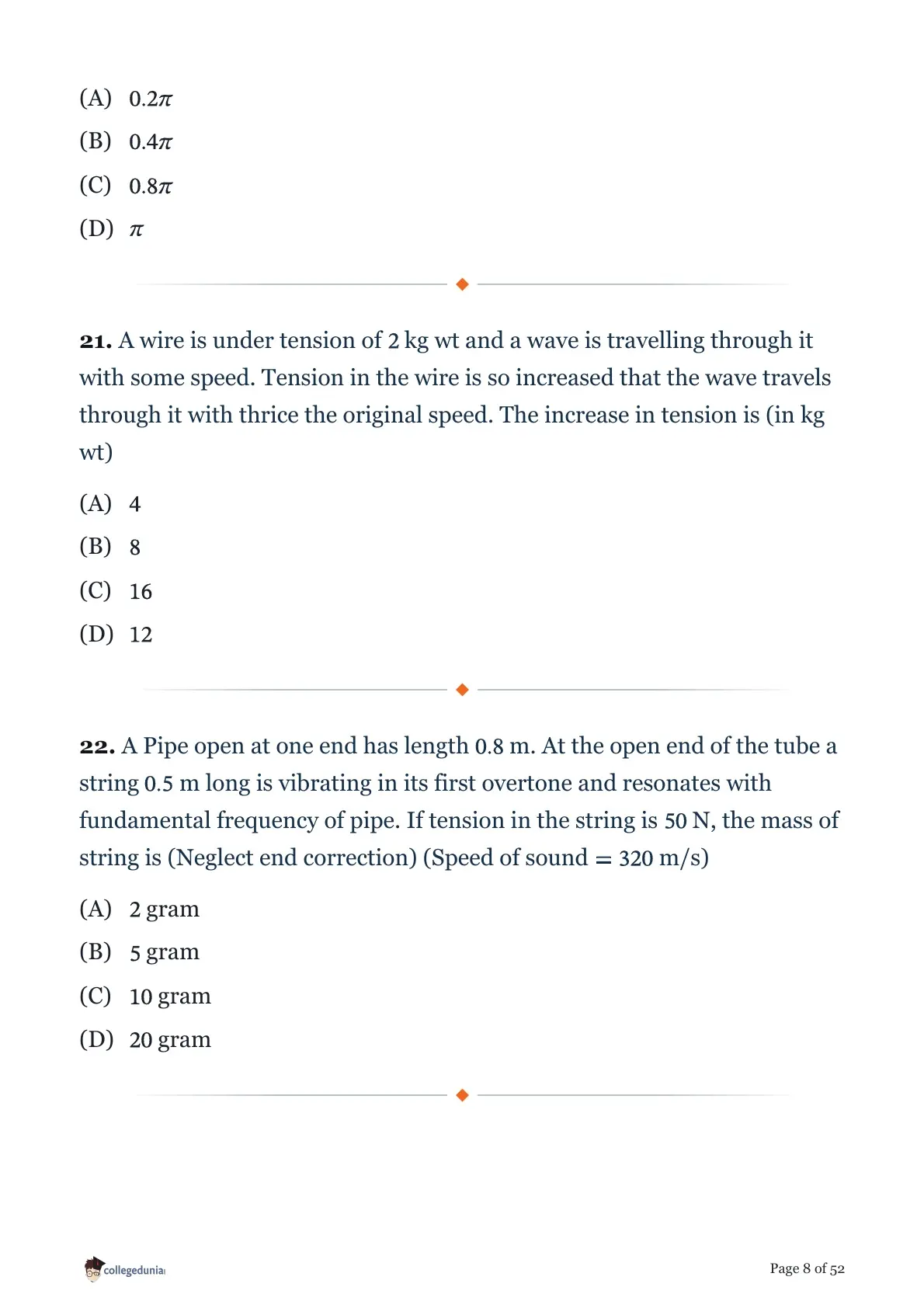
A wire is under tension of \(2\) kg wt and a wave is travelling through it with some speed. Tension in the wire is so increased that the wave travels through it with thrice the original speed. The increase in tension is (in kg wt)
A Pipe open at one end has length \(0.8\) m. At the open end of the tube a string \(0.5\) m long is vibrating in its first overtone and resonates with fundamental frequency of pipe. If tension in the string is \(50\) N, the mass of string is (Neglect end correction) (Speed of sound \(= 320\) m/s)
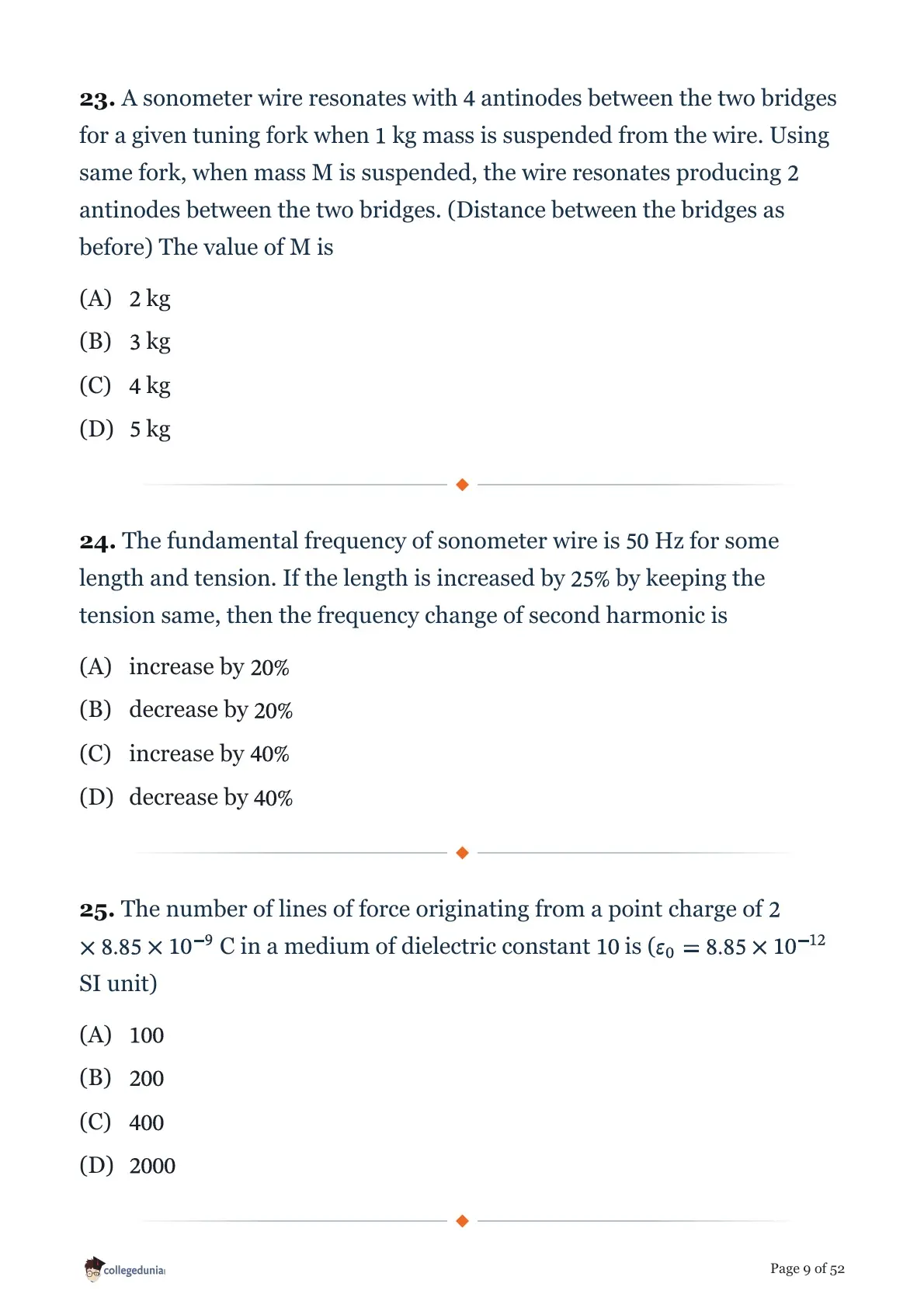
A sonometer wire resonates with \(4\) antinodes between the two bridges for a given tuning fork when \(1\) kg mass is suspended from the wire. Using same fork, when mass M is suspended, the wire resonates producing \(2\) antinodes between the two bridges. (Distance between the bridges as before) The value of M is
The fundamental frequency of sonometer wire is \(50\) Hz for some length and tension. If the length is increased by \(25\%\) by keeping the tension same, then the frequency change of second harmonic is
The number of lines of force originating from a point charge of \(2\times 8.85\times 10^{-9}\) C in a medium of dielectric constant \(10\) is (\(ε_0 = 8.85\times 10^{-12}\) SI unit)
The potential difference that must be applied across the parallel and series combination of three identical capacitors such that the energy stored in them becomes the same. The ratio of potential difference in parallel to series combination is
The function of a dielectric in a capacitor is to
Four capacitors are connected to a battery as shown in figure. The ratio of charges on capacitors \(C_2\) and \(C_4\) is

When a resistance of \(200\,\Omega\) is connected in series with a galvanometer of resistance G, its range is V. To triple its range, a resistance of \(2000\,\Omega\) is connected in series. The value of G is
If a galvanometer is shunted by \((\frac{1}{n-1})^{th}\) of the value of its resistance, then the fraction of the total current passing through the galvanometer is
The product of magnetic susceptibility (\(χ\)) and absolute temperature (T) is constant for a
A circular coil of 'N' turns and diameter 'd' carries current 'I'. It is unwound and rewound to make another coil of diameter '2d', current 'I' remaining the Same. The ratio of magnetic moments of the new coil to the original coil is
Lorentz magnetic force is acting on a particle of charge \(q\) moving with velocity \(\overset{⃗}{V}\) in magnetic field \(\overset{⃗}{B}\). The work done by this force on the charged particle is
A coil of 'n' turns and resistance \(R\,\Omega\) is connected in series with a resistance \(R/4\). The combination is moved for time 't' second through flux \(\Phi _1\) to \(\Phi _2\). The induced current in the circuit is
The coefficient of mutual induction is \(3\)H and induced e.m.f. across secondary is \(4\) kV. Current in primary is reduced from \(7\)A to \(2\)A. The time required for the change of current is
A bar magnet falls from a height 'h' through a metal pipe, its acceleration after coming out of pipe is
A series LCR circuit is connected to an a.c. source of \(220\) V, \(50\) Hz. The circuit contains a resistance \(R = 80\,\Omega\), an inductor of inductive reactance \(70\,\Omega\) and capacitor of capacitive reactance \(130\,\Omega\). The power factor of the circuit is \(\frac{x}{10}\). The value of x is
Determine the frequency for which a \(10\,μ\text{F}\) capacitor has a reactance of \(2\times 10^{-3}\,\Omega\).
A coil has inductive reactance \(3\) H. The ratio of its reactance when it is first connected to an a.c. source and then to d.c. source is
An equiconvex lens of focal length F is cut in to two equal parts along the vertical axis. The focal length of each part will be
A ray of light travels from air to water to glass and again from glass to air. Refractive index of water with respect to air is 'x', glass with respect to water is 'y' and air with respect to glass is 'z'. Which one of the following is correct?
When the distance of separation between the slit and screen is doubled, the angular separation between fringes in single slit diffraction pattern experiment
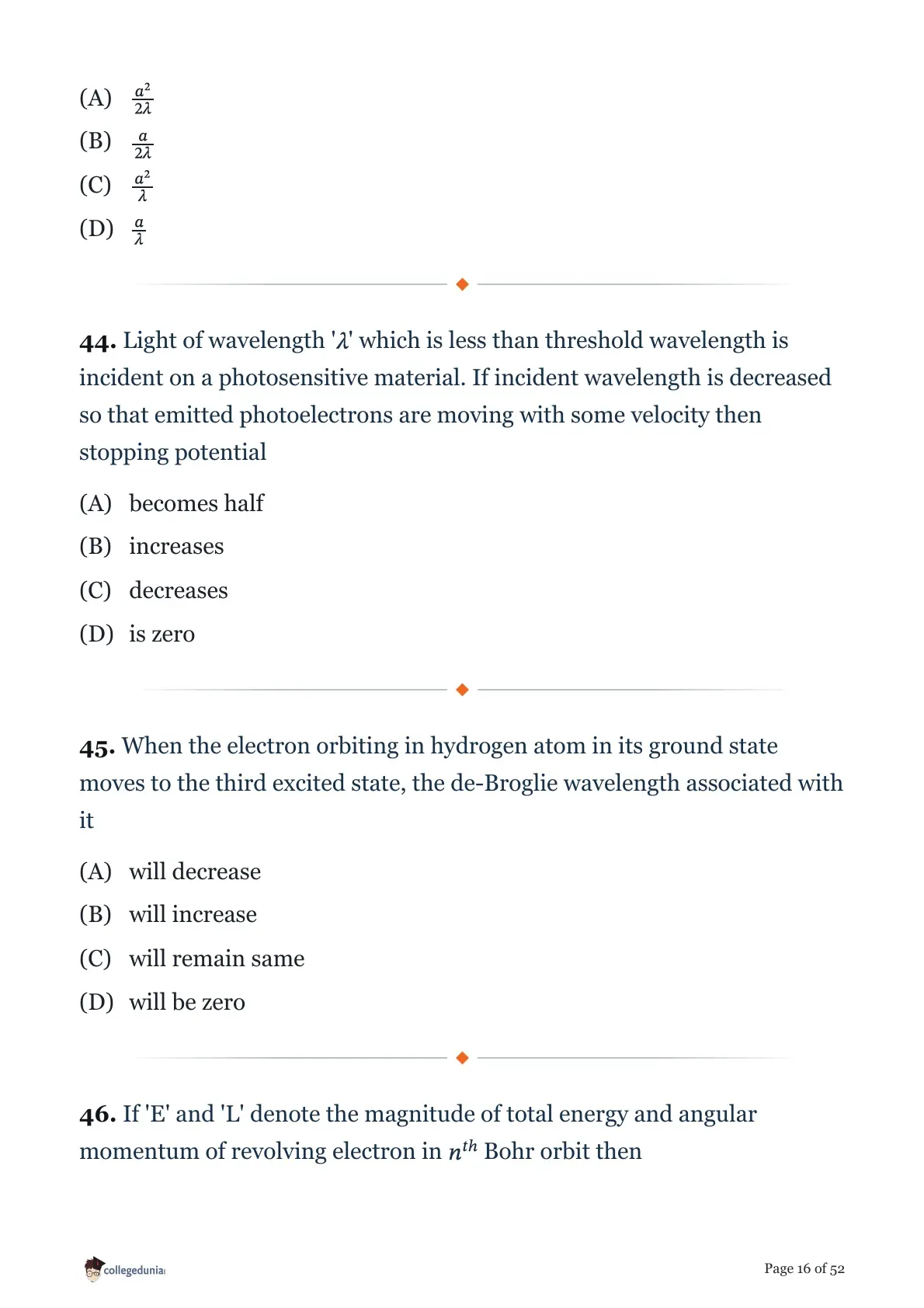
Light of wavelength \(λ\) is incident on a single slit of width 'a' and the distance between slit and screen is D. In diffraction pattern, if slit width is equal to the width of the central maximum then D is equal to
Light of wavelength '\(λ\)' which is less than threshold wavelength is incident on a photosensitive material. If incident wavelength is decreased so that emitted photoelectrons are moving with some velocity then stopping potential
When the electron orbiting in hydrogen atom in its ground state moves to the third excited state, the de-Broglie wavelength associated with it
If 'E' and 'L' denote the magnitude of total energy and angular momentum of revolving electron in \(n^{th}\) Bohr orbit then
Two different radioactive elements with half lives \(T_1\) and \(T_2\) have undecayed atoms \(N_1\) and \(N_2\) respectively, present at a given instant. The ratio of their activities at this instant is
Photodiode is a device
For a p-n junction diode, breakdown voltage occurs when
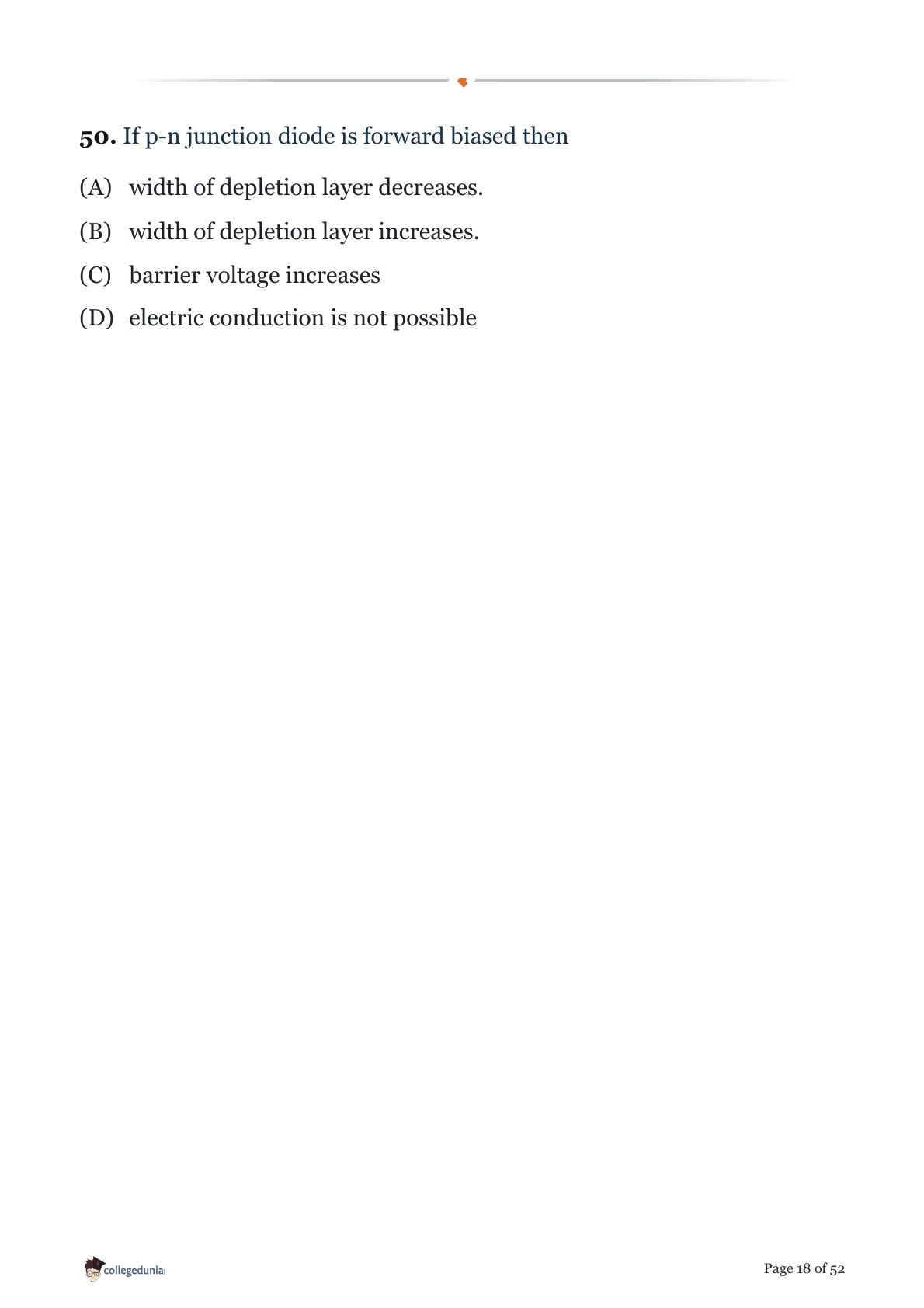
If p-n junction diode is forward biased then
Chemistry Section (Questions 51 to 100)
What is the approximate mass of the precipitate formed when \(50\) mL of \(16.9\%\) solution of \(\text{AgNO}_3\) is mixed with \(50\) mL of \(7.45\%\) KCl solution? (Molar mass of \(\text{AgNO}_3 = 169\) g/mol, KCl \(= 74.5\) g/mol, AgCl \(= 143.3\) g/mol)
Calculate the de Broglie wavelength of an electron in the first Bohr orbit of a hydrogen atom if the velocity of an electron in the first orbit is \(2.2\times 10^6\text{ ms}^{-1}\). [mass of electron \(= 9.1\times 10^{-31}\) kg, plank's constant (h) \(= 6.626\times 10^{-34}\) J s]
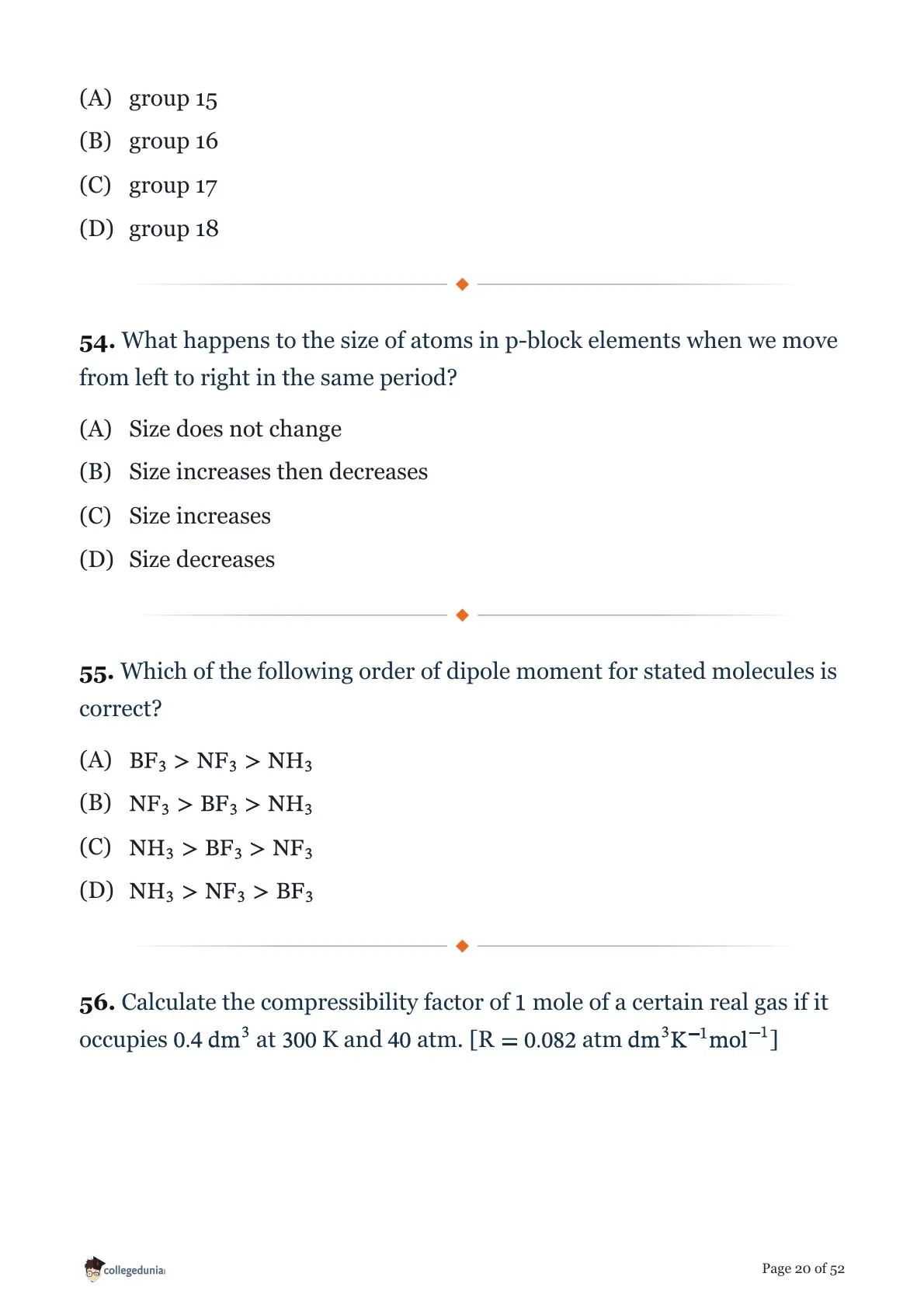
Which group elements have the smallest atomic radii in their respective periods?
What happens to the size of atoms in p-block elements when we move from left to right in the same period?
Which of the following order of dipole moment for stated molecules is correct?
Calculate the compressibility factor of \(1\) mole of a certain real gas if it occupies \(0.4\text{ dm}^3\) at \(300\) K and \(40\) atm. [R \(= 0.082\) atm \(\text{dm}^3\text{K}^{-1}\text{mol}^{-1}\)]
\(\text{C}_2\text{H}_5\text{OH}(l)+3\text{O}_2(g)\rightarrow 2\text{CO}_2(g)+3\text{H}_2\text{O}(l)\)
The value of enthalpy change (\(\Delta H\)) for above reaction at \(27\,^{\circ}\text{C}\) is \(-1366.5\) kJ \(\text{mol}^{-1}\). Then value of internal energy change for the same reaction at this temperature will be
Which of the following processes has \(\Delta S\) negative?
Which of the following properties of a system depends upon the amount of matter and path?
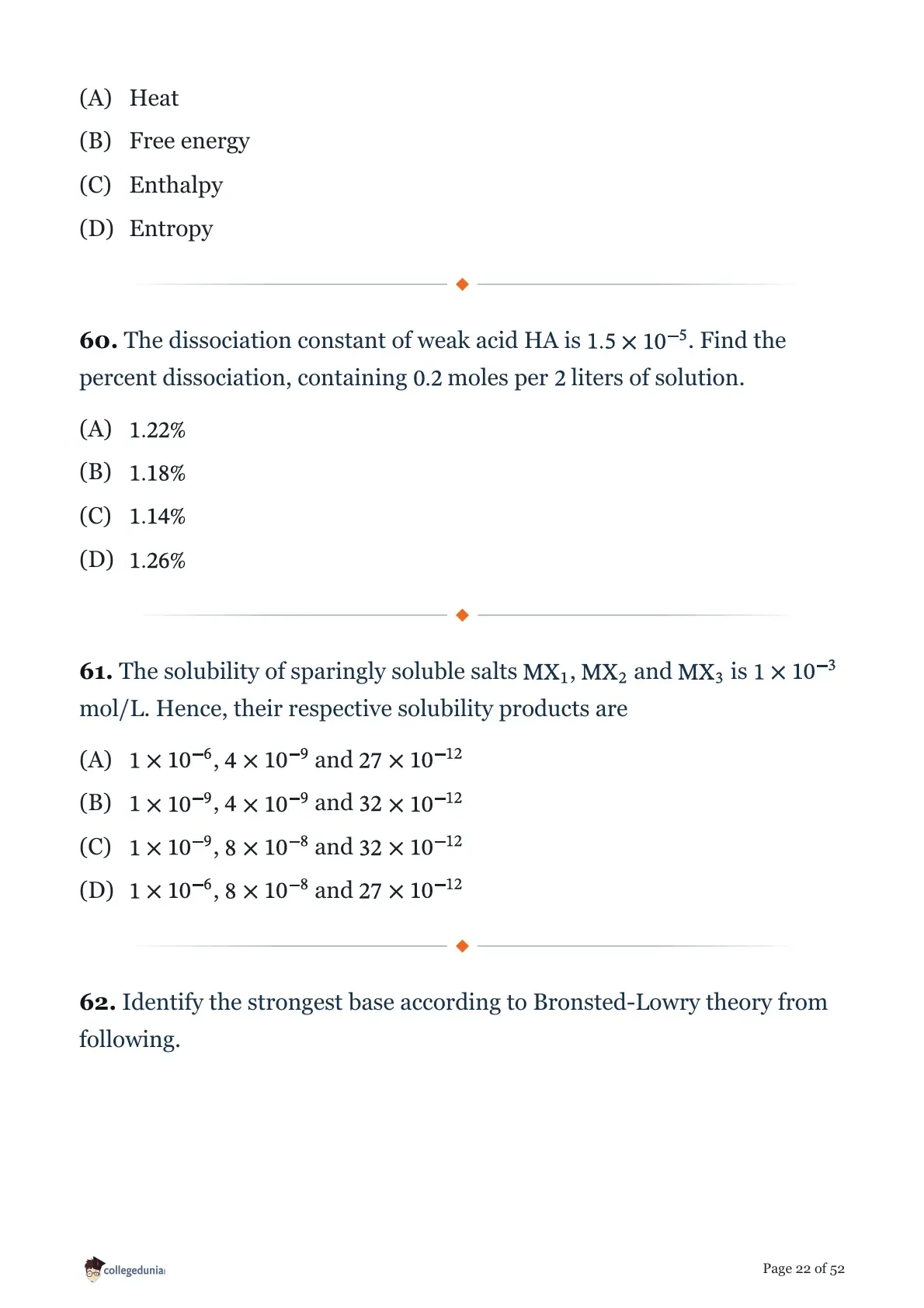
The dissociation constant of weak acid HA is \(1.5\times 10^{-5}\). Find the percent dissociation, containing \(0.2\) moles per \(2\) liters of solution.
The solubility of sparingly soluble salts \(\text{MX}_1\), \(\text{MX}_2\) and \(\text{MX}_3\) is \(1\times 10^{-3}\) mol/L. Hence, their respective solubility products are
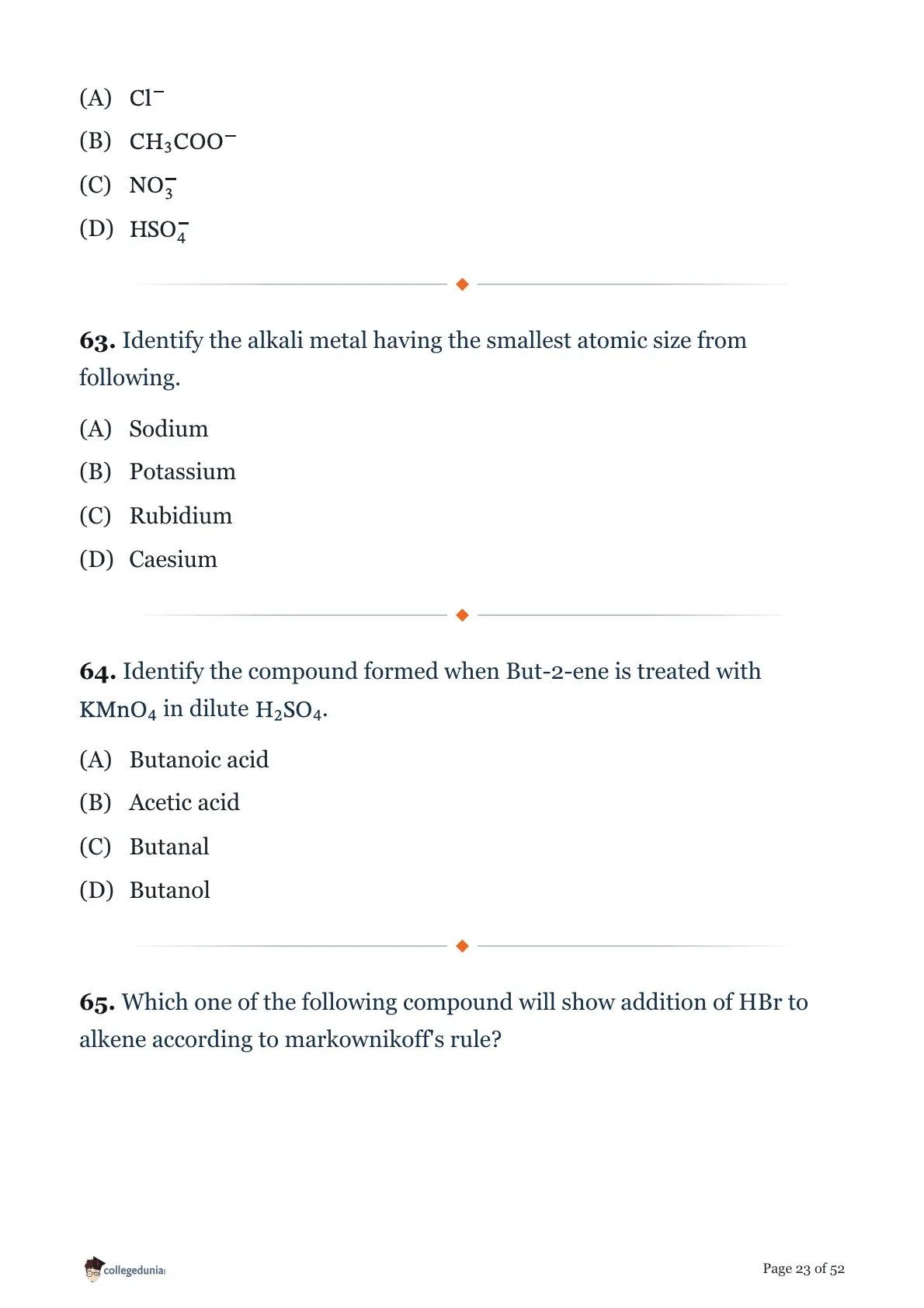
Identify the strongest base according to Bronsted-Lowry theory from following.
Identify the alkali metal having the smallest atomic size from following.
Identify the compound formed when But-2-ene is treated with \(\text{KMnO}_4\) in dilute \(\text{H}_2\text{SO}_4\).
Which one of the following compound will show addition of HBr to alkene according to markownikoff's rule?
When a mixture of two different alkyl halides reacts with metallic sodium in dry ether, the formation of a possible number of alkanes are-
Identify the product of reforming reaction of n-hexane in the presence of \(\text{V}_2\text{O}_5\) over alumina.
An element crystallises in fcc unit cell with cell edge length of \(3.608\times 10^{-8}\) cm, the density of element is \(8.92\text{ gcm}^{-3}\). Calculate the atomic mass of element (\(\text{N}_A = 6.022\times 10^{23}\)).
Calculate the number of unit cells present in \(1\) g metal if the product of the density of metal and the volume of unit cell is \(2.5\times 10^{-22}\) g.
Which of the following is NOT a characteristic of Schottky defect?
Calculate the van't Hoff factor of a centimolar solution of potassium ferrocyanide if it is \(60\%\) dissociated at \(300\) K.
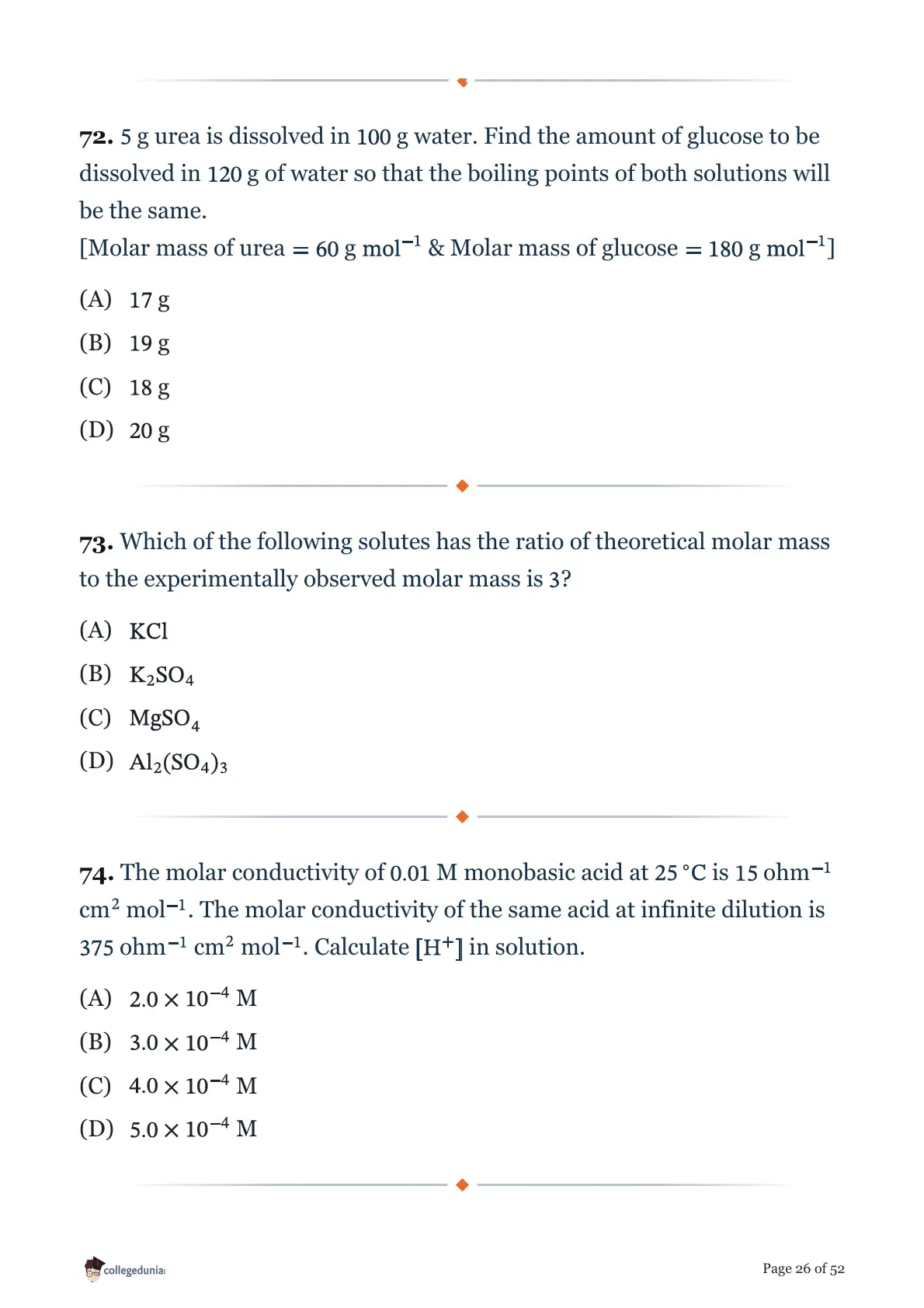
\(5\) g urea is dissolved in \(100\) g water. Find the amount of glucose to be dissolved in \(120\) g of water so that the boiling points of both solutions will be the same.
[Molar mass of urea \(= 60\) g \(\text{mol}^{-1}\) & Molar mass of glucose \(= 180\) g \(\text{mol}^{-1}\)]
Which of the following solutes has the ratio of theoretical molar mass to the experimentally observed molar mass is \(3\)?
The molar conductivity of \(0.01\) M monobasic acid at \(25\,^{\circ}\text{C}\) is \(15\) ohm\(^{-1}\) cm\(^2\) mol\(^{-1}\). The molar conductivity of the same acid at infinite dilution is \(375\) ohm\(^{-1}\) cm\(^2\) mol\(^{-1}\). Calculate \([\text{H}^+]\) in solution.
Which from following statements regarding mercury battery is NOT true?
The molar conductivity of \(0.04\) M \(\text{AB}_2\) type salt solution at \(300\) K is \(200\,\Omega ^{-1}\text{cm}^2\text{mol}^{-1}\). Find the conductivity.
The time required for \(90\%\) completion of a certain first order reaction is \(1\) hour. Calculate the time required for \(99.9\%\) completion of the same reaction.
The rate of the reaction \(2A+3B\rightarrow 2C+D\) is \(6\times 10^{-4}\text{ mol dm}^{-3}\text{ s}^{-1}\), when \([A] = [B] = 0.3\text{ mol dm}^{-3}\). If the reaction is of first order for A and zeroth order for B, then find the rate constant.
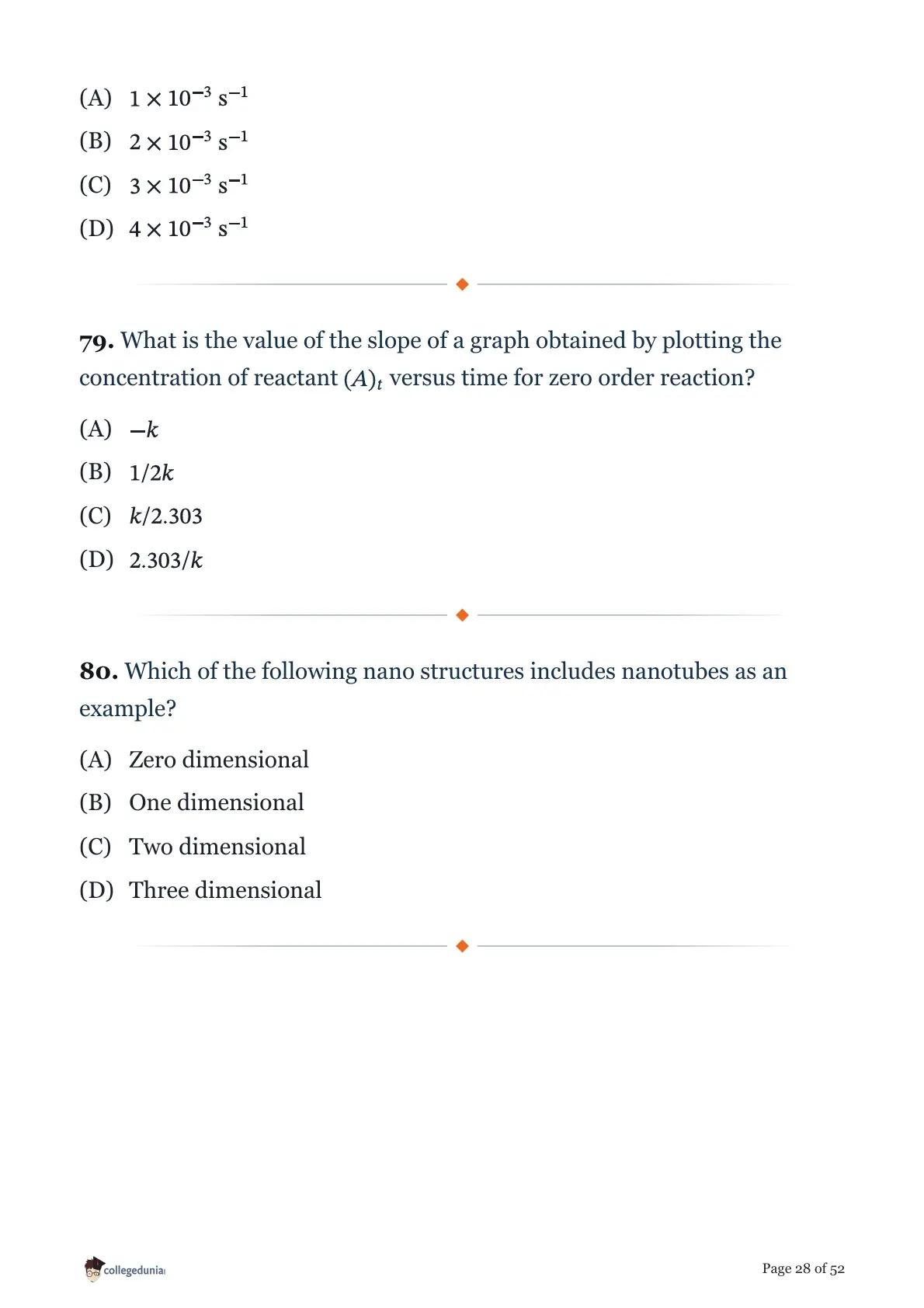
What is the value of the slope of a graph obtained by plotting the concentration of reactant \((A)_t\) versus time for zero order reaction?
Which of the following nano structures includes nanotubes as an example?
Match List I with List II
| List I | List II |
|---|---|
| (A). Brownian Motion | (I). Removal of impurities from the colloidal sols using a semipermeable membrane. |
| (B). Tyndall Effect | (II). Movement of colloidal particles under the influence of an electric field. |
| (C). Electrophoresis | (III). Random movement of colloidal particles due to kinetic energy. |
| (D). Dialysis | (IV). Scattering of light by colloidal particles |
Identify the factor responsible for the greater range of oxidation states in actinoids.
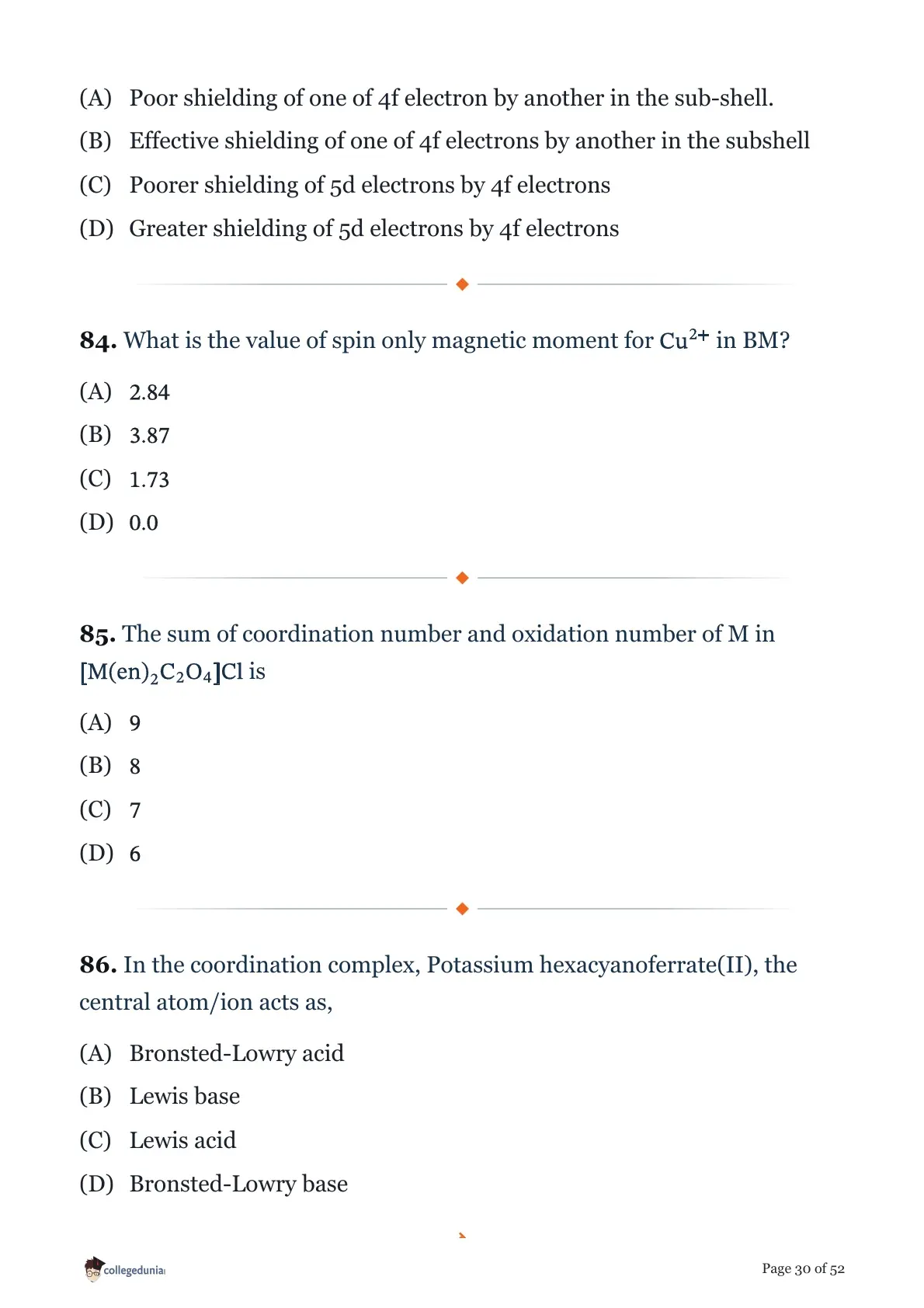
Which of the following factors may be regarded as the main cause of lanthanide contraction?
What is the value of spin only magnetic moment for \(\text{Cu}^{2+}\) in BM?
The sum of coordination number and oxidation number of M in \([\text{M(en)}_2\text{C}_2\text{O}_4]\text{Cl}\) is
In the coordination complex, Potassium hexacyanoferrate(II), the central atom/ion acts as,
Which of the following halogen derivative forms a poisonous phosgene, when come in contact with air and light?
What is the general molecular formula of alkyl halides?
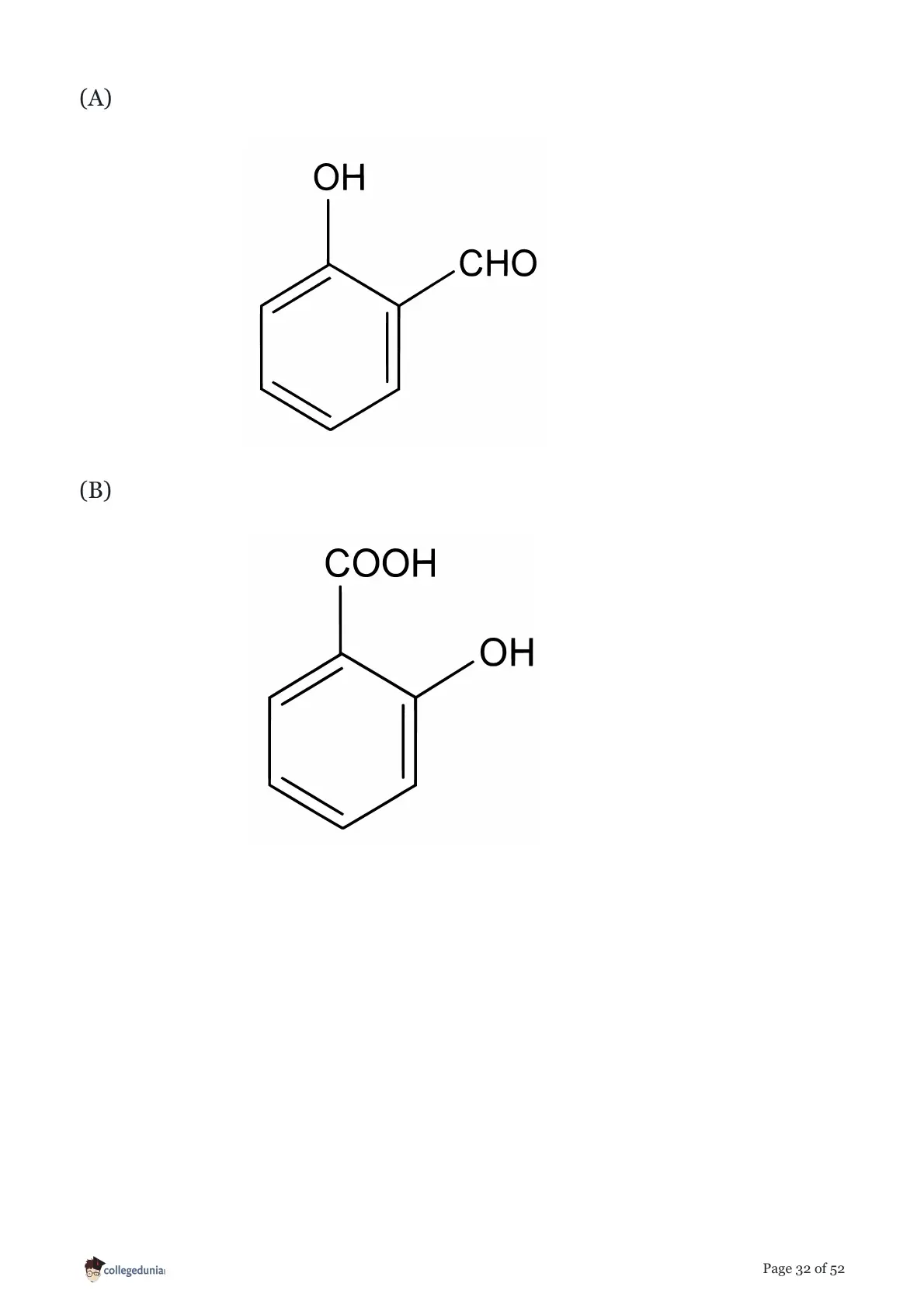
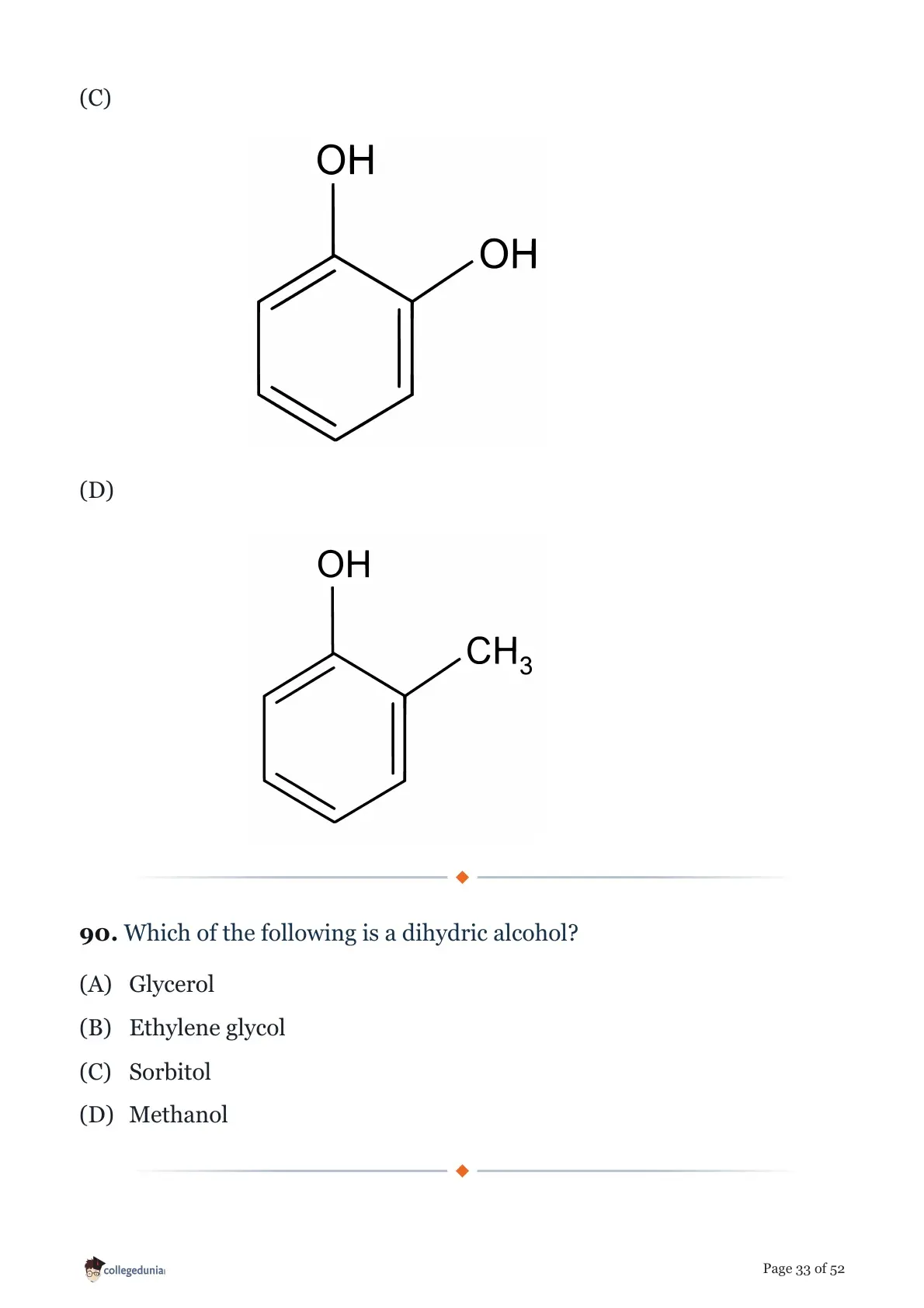
In the following sequence of the reaction, the final product "C" is-

- (A)
![]()
- (B)
![]()
- (C)
![]()
- (D)
![]()


Which of the following is a dihydric alcohol?
What happens when phenol reacts with bromine water?
Which of the following statements is true regarding Cannizzaro reaction?
Aldehydes are more reactive than ketone towards nucleophilic attack because of?
Identify the product 'B' in the following reaction
\(\text{CH}_3-\text{I}\overset{\text{KCN}\,}{\rightarrow }\text{A}\overset{\text{Na/C}_2\text{H}_5\text{OH}\,}{\rightarrow }\text{B}\)
Identify Hinsberg's reagent from following.
Which component of DNA carries genetic information?
Which of the following is confirmed by the reaction of glucose with hydroxylamine?
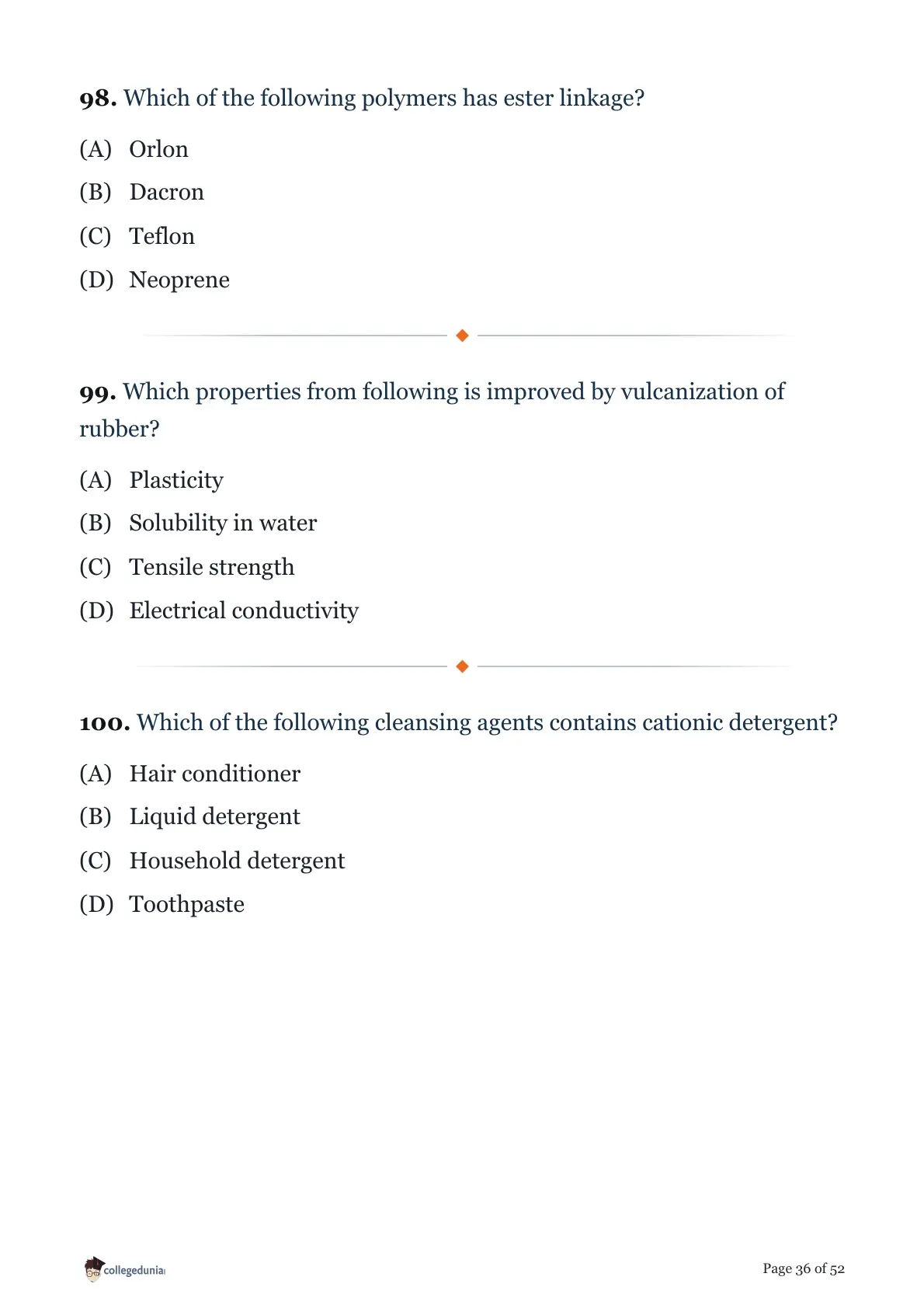
Which of the following polymers has ester linkage?
Which properties from following is improved by vulcanization of rubber?
Which of the following cleansing agents contains cationic detergent?
Mathematics Section (Questions 101 to 150)
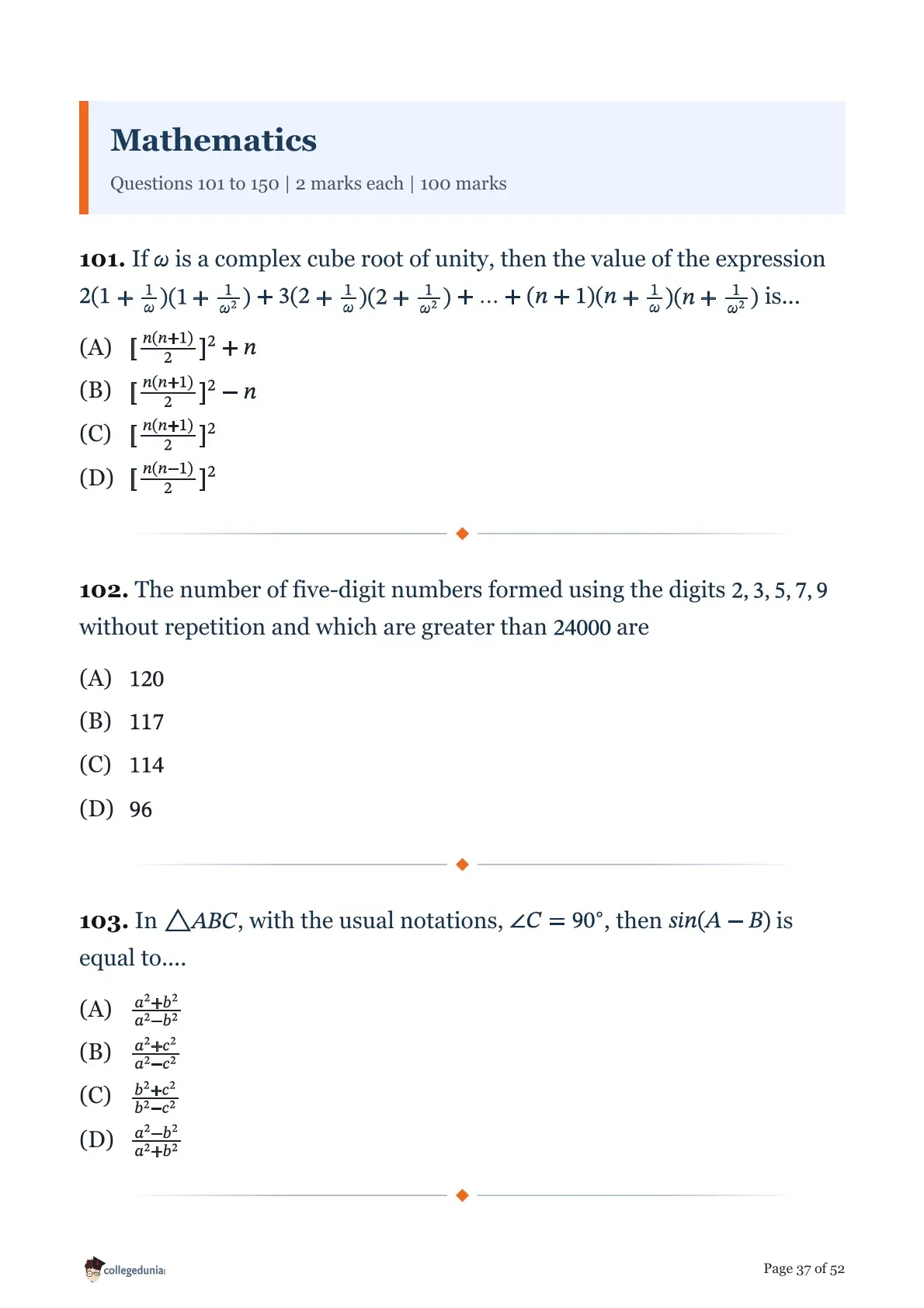
If \(ω\) is a complex cube root of unity, then the value of the expression \(2(1+\frac{1}{ω})(1+\frac{1}{ω^2})+3(2+\frac{1}{ω})(2+\frac{1}{ω^2})+\ldots +(n+1)(n+\frac{1}{ω})(n+\frac{1}{ω^2})\) is...
The number of five-digit numbers formed using the digits \(2,3,5,7,9\) without repetition and which are greater than \(24000\) are
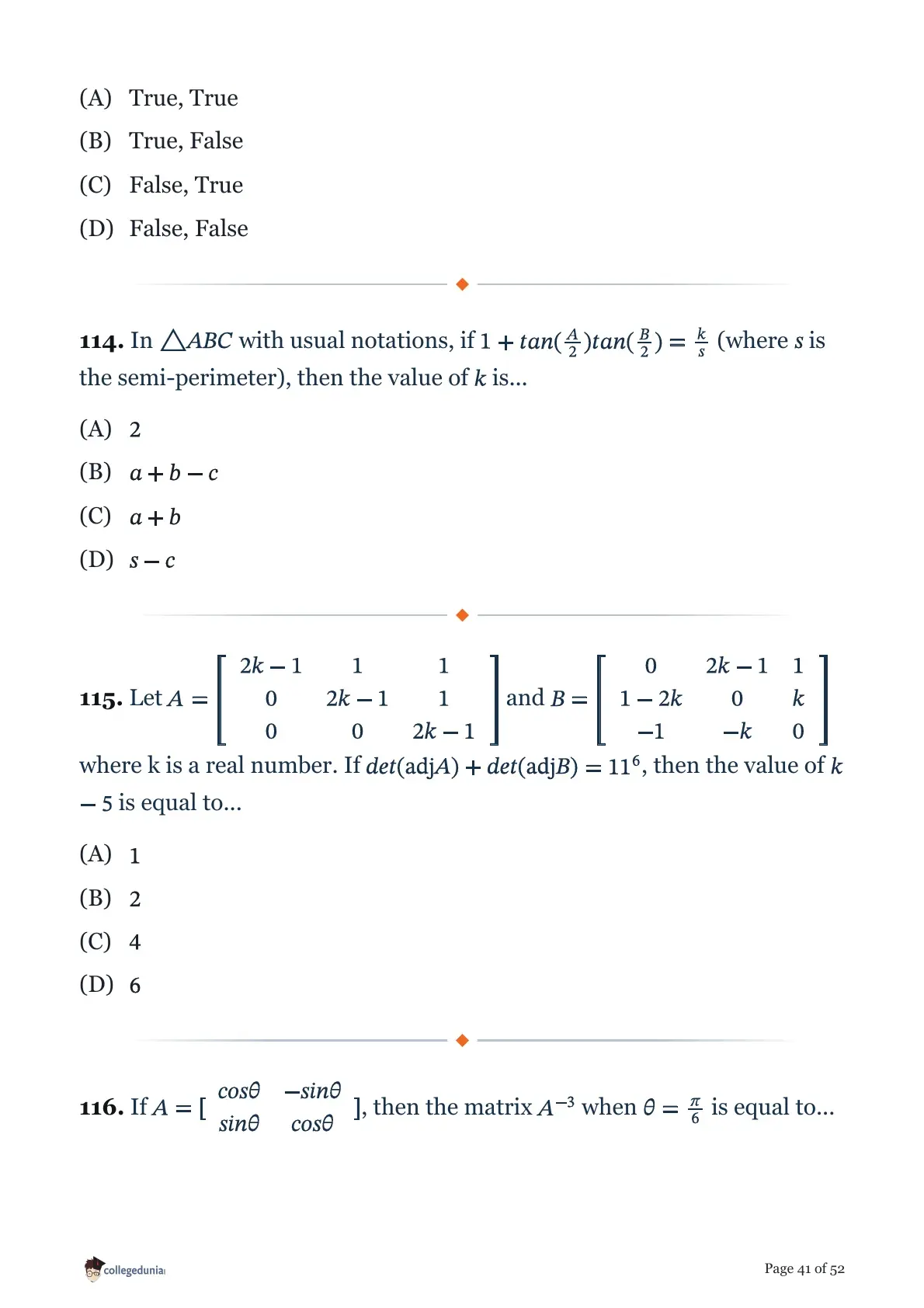
In \(△ABC\), with the usual notations, \(\angle C = 90^{\circ}\), then \(sin(A-B)\) is equal to....
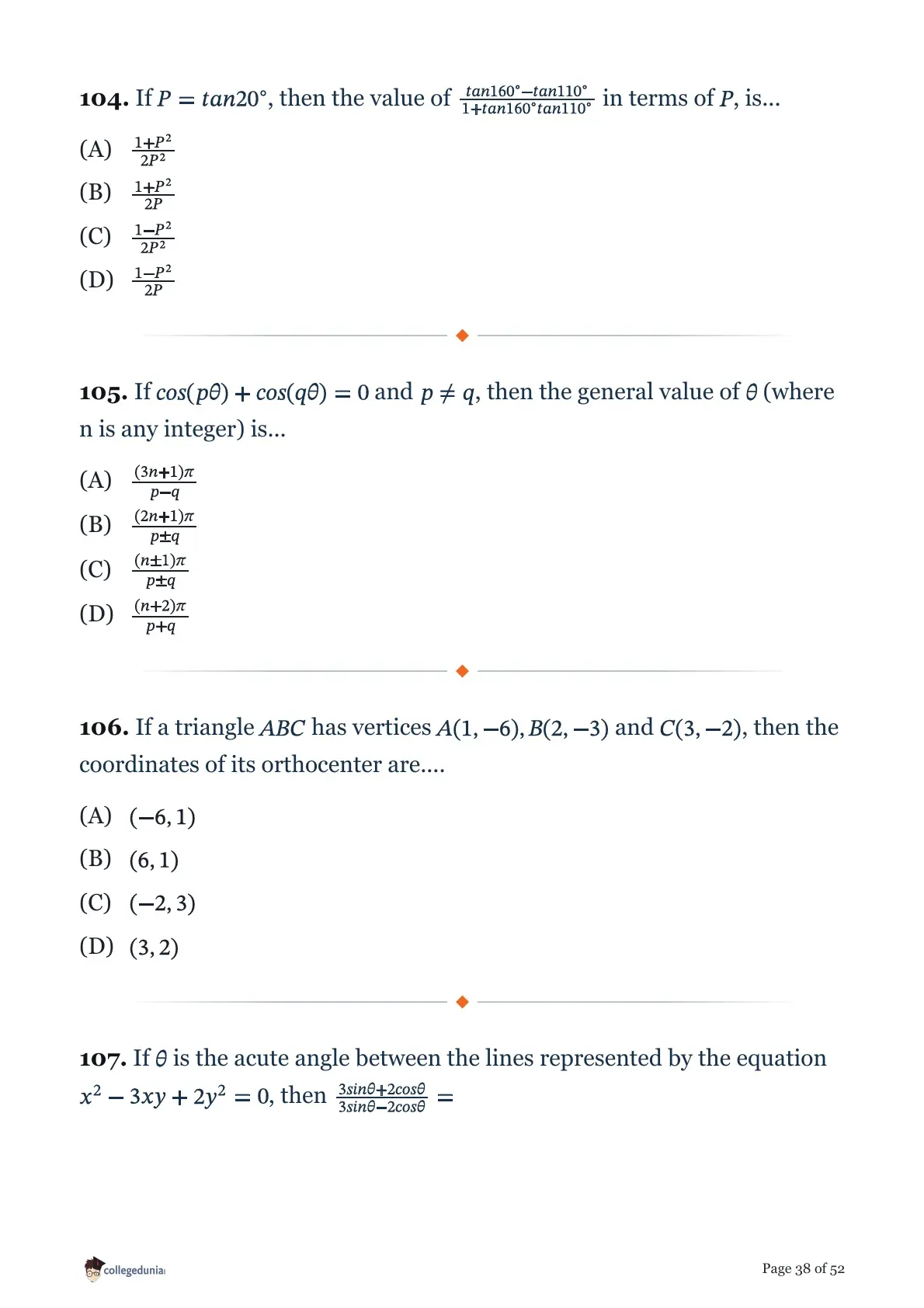
If \(P = tan20^{\circ}\), then the value of \(\frac{tan160^{\circ}-tan110^{\circ}}{1+tan160^{\circ}tan110^{\circ}}\) in terms of \(P\), is...
If \(cos(pθ)+cos(qθ) = 0\) and \(p\neq q\), then the general value of \(θ\) (where n is any integer) is...
If a triangle \(ABC\) has vertices \(A(1,-6),B(2,-3)\) and \(C(3,-2)\), then the coordinates of its orthocenter are....
If \(θ\) is the acute angle between the lines represented by the equation \(x^2-3xy+2y^2 = 0\), then \(\frac{3sinθ+2cosθ}{3sinθ-2cosθ} =\)
The triangle formed by the lines \(2x^2-3xy-2y^2 = 0\) and \(3x-y = 7\) is...
The centre and radius of the circle \((a+1)x^2+3y^2-6x+9y+a+4 = 0\) are respectively ...
If the line \(4x+3y = 7\) touches the hyperbola \(x^2-y^2 = 7\), then the sum of the co-ordinates of the point of contact is...
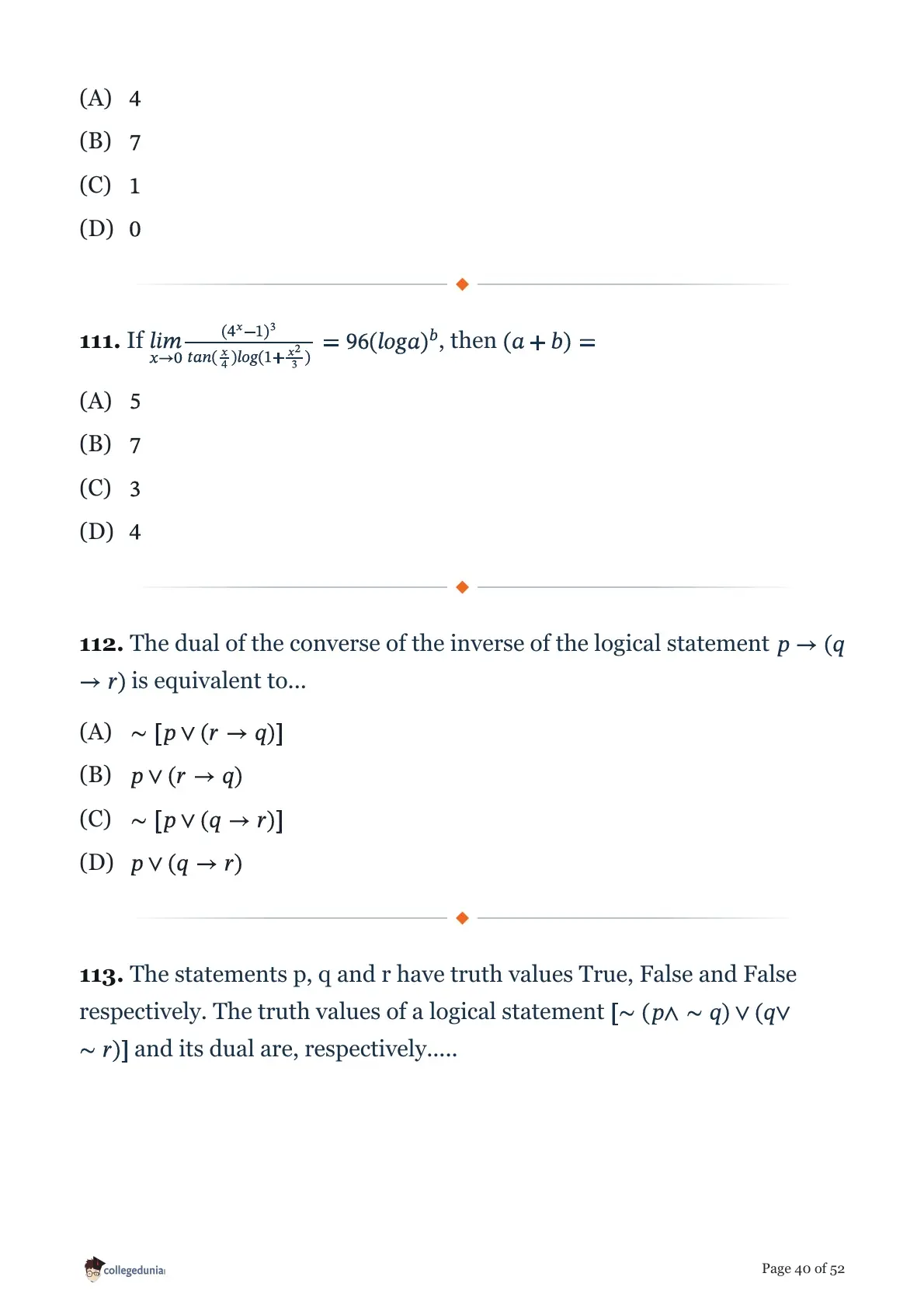
If \(\underset{x\rightarrow 0}{lim}\frac{(4^x-1)^3}{tan(\frac{x}{4})log(1+\frac{x^2}{3})} = 96(loga)^b\), then \((a+b) =\)
The dual of the converse of the inverse of the logical statement \(p\rightarrow (q\rightarrow r)\) is equivalent to...
The statements p, q and r have truth values True, False and False respectively. The truth values of a logical statement \([\sim (p∧\sim q)∨(q∨\sim r)]\) and its dual are, respectively.....
In \(△ABC\) with usual notations, if \(1+tan(\frac{A}{2})tan(\frac{B}{2}) = \frac{k}{s}\) (where \(s\) is the semi-perimeter), then the value of \(k\) is...
Let \(A = \left[ \begin{array}{ccc}2k-1 & 1 & 1 \\ 0 & 2k-1 & 1 \\ 0 & 0 & 2k-1\end{array} \right]\) and \(B = \left[ \begin{array}{ccc}0 & 2k-1 & 1 \\ 1-2k & 0 & k \\ -1 & -k & 0\end{array} \right]\) where k is a real number. If \(det(\text{adj}A)+det(\text{adj}B) = 11^6\), then the value of \(k-5\) is equal to...
If \(A = [\begin{array}{cc}cosθ & -sinθ \\ sinθ & cosθ\end{array}]\), then the matrix \(A^{-3}\) when \(θ = \frac{π}{6}\) is equal to...
If \(tan^{-1}[\frac{\sqrt{5-2\sqrt{6}}}{1+\sqrt{6}}] = \frac{π}{3}-tan^{-1}(k)\), then \(sec^{-1}(k) = ...\)
If \(f(x-y)+f(x+y) = 2f(x)f(y)\) for all \(x,y\in R\), then \(f(x)\) is .....
If the function f is continuous at \(x = 1\), where \(f(x) = \frac{1+cos(πx)}{π(1-x)^2}\), for \(x\neq 1\), then the value of \(f(1)\) is....
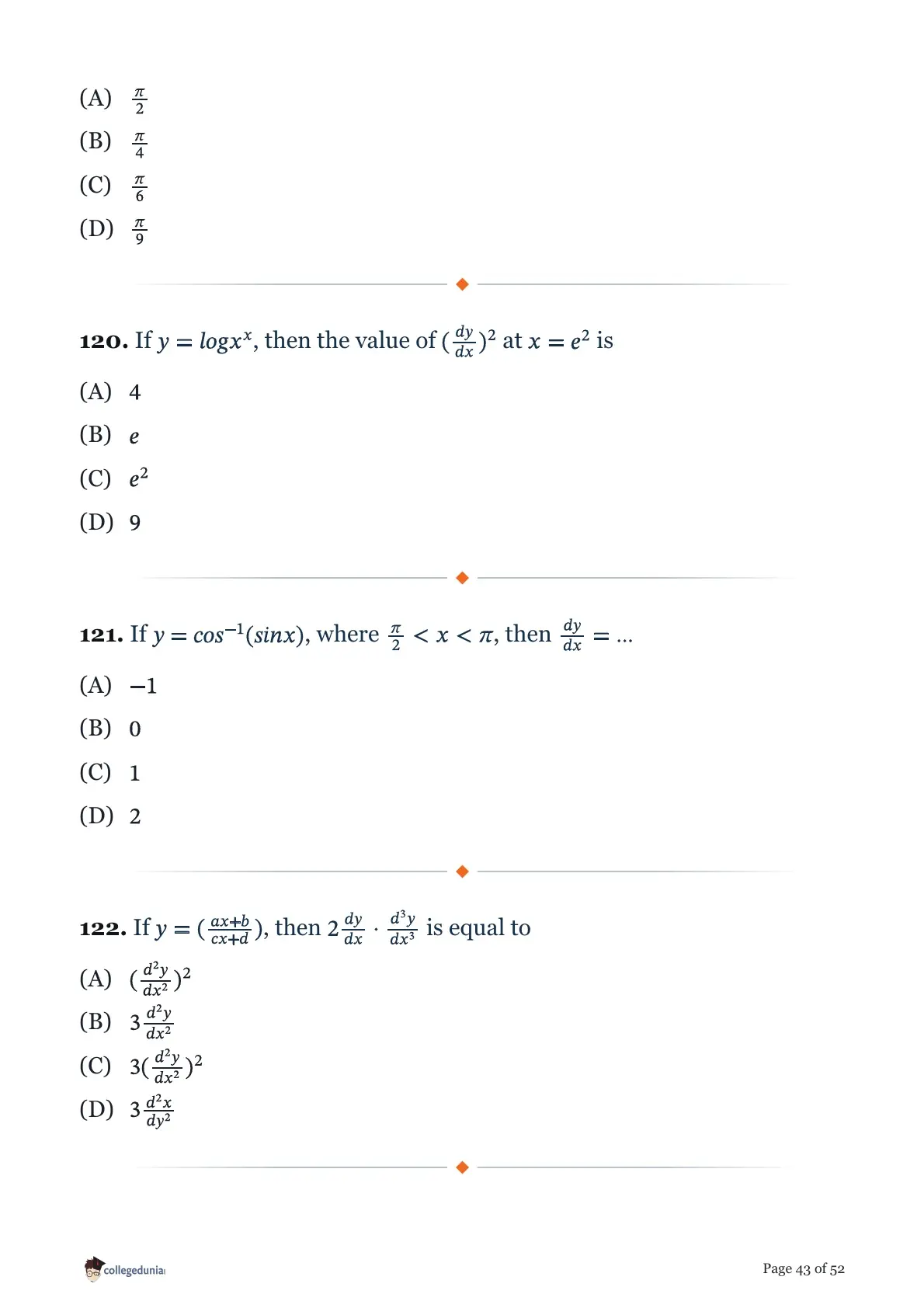
If \(y = logx^x\), then the value of \((\frac{dy}{dx})^2\) at \(x = e^2\) is
If \(y = cos^{-1}(sinx)\), where \(\frac{π}{2} < x < π\), then \(\frac{dy}{dx} = ...\)
If \(y = (\frac{ax+b}{cx+d})\), then \(2\frac{dy}{dx}\cdot \frac{d^3y}{dx^3}\) is equal to
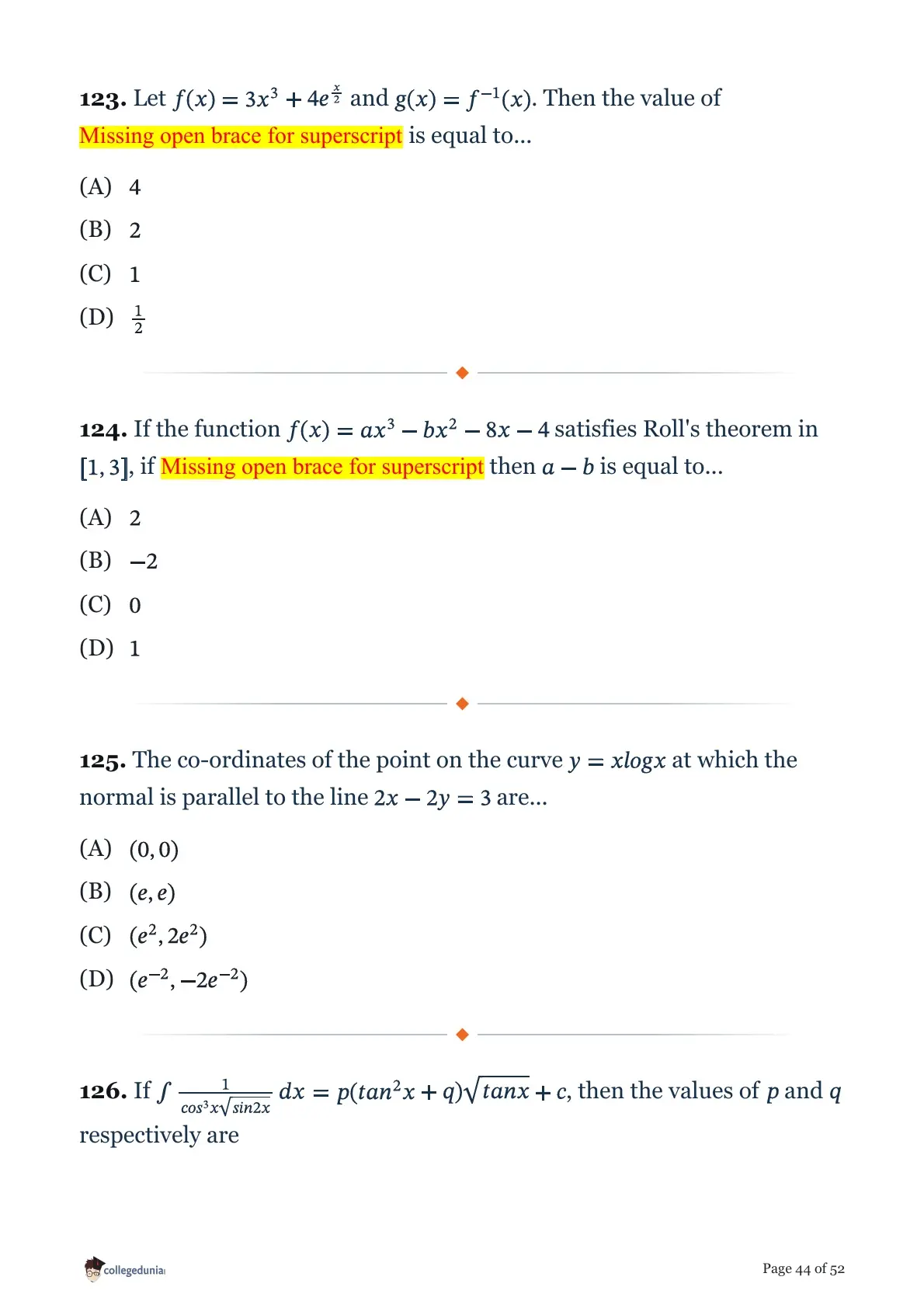
Let \(f(x) = 3x^3+4e^{\frac{x}{2}}\) and \(g(x) = f^{-1}(x)\). Then the value of \(g^'(4)\) is equal to...
If the function \(f(x) = ax^3-bx^2-8x-4\) satisfies Roll's theorem in \([1,3]\), if \(f^'(2) = 0\) then \(a-b\) is equal to...
The co-ordinates of the point on the curve \(y = xlogx\) at which the normal is parallel to the line \(2x-2y = 3\) are...
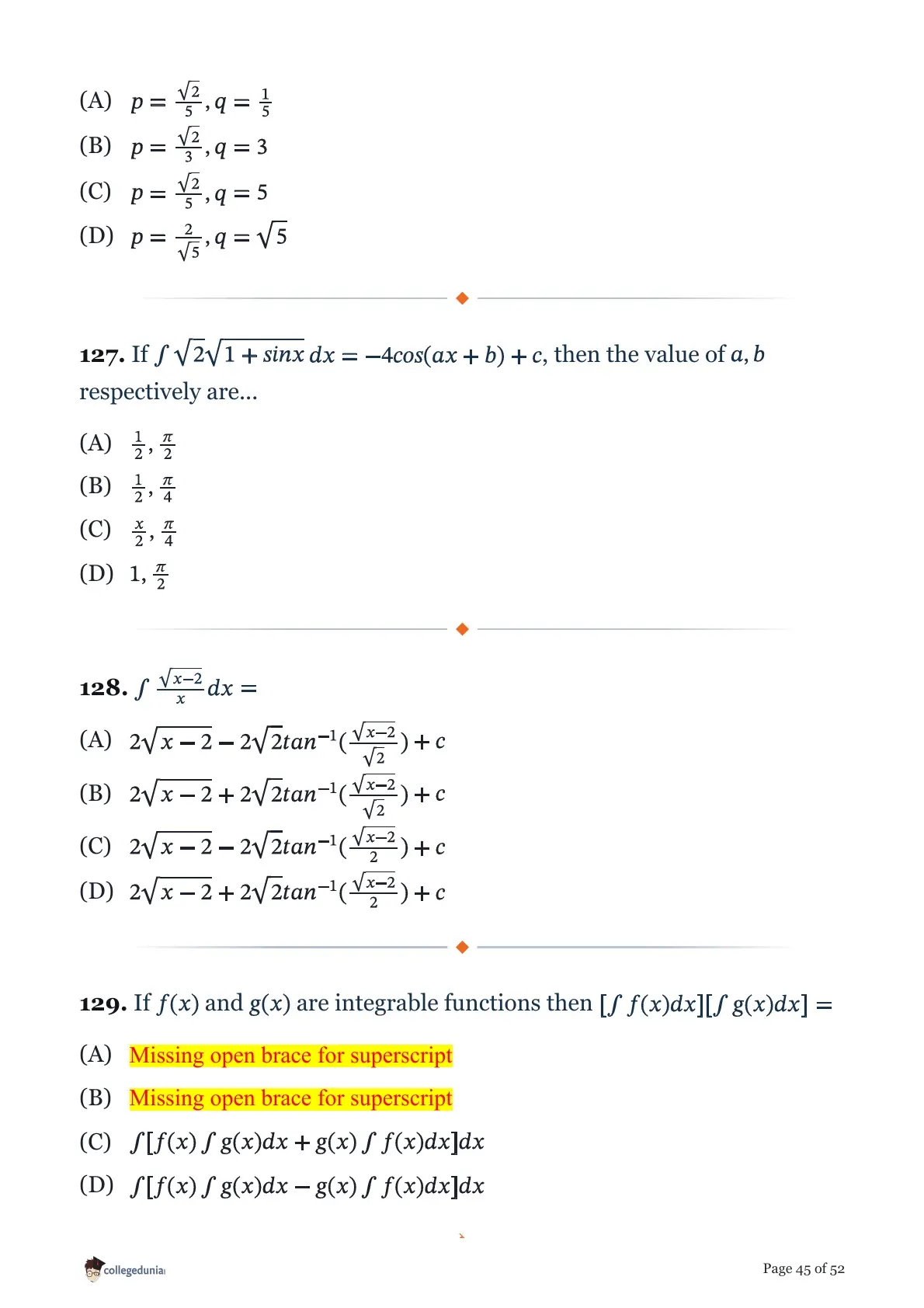
If \(\int \frac{1}{cos^3x\sqrt{sin2x}}\,dx = p(tan^2x+q)\sqrt{tanx}+c\), then the values of \(p\) and \(q\) respectively are
If \(\int \sqrt{2}\sqrt{1+sinx}\,dx = -4cos(ax+b)+c\), then the value of \(a,b\) respectively are...
\(\int \frac{\sqrt{x-2}}{x}dx =\)
If \(f(x)\) and \(g(x)\) are integrable functions then \([\int f(x)dx][\int g(x)dx] =\)
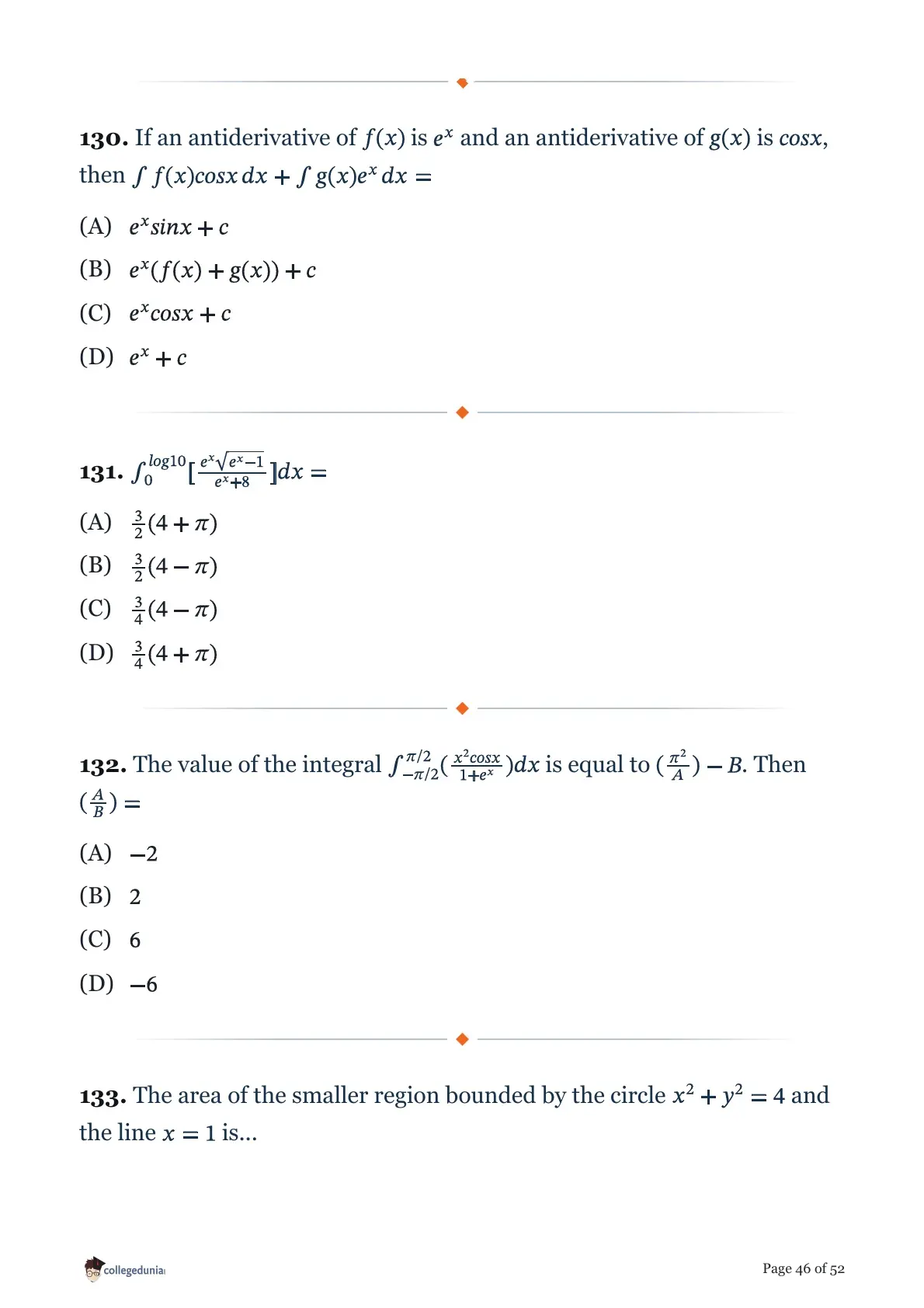
If an antiderivative of \(f(x)\) is \(e^x\) and an antiderivative of \(g(x)\) is \(cosx\), then \(\int f(x)cosx\,dx+\int g(x)e^x\,dx =\)
\(\int _0^{log10}[\frac{e^x\sqrt{e^x-1}}{e^x+8}]dx =\)
The value of the integral \(\int _{-π/2}^{π/2}(\frac{x^2cosx}{1+e^x})dx\) is equal to \((\frac{π^2}{A})-B\). Then \((\frac{A}{B}) =\)
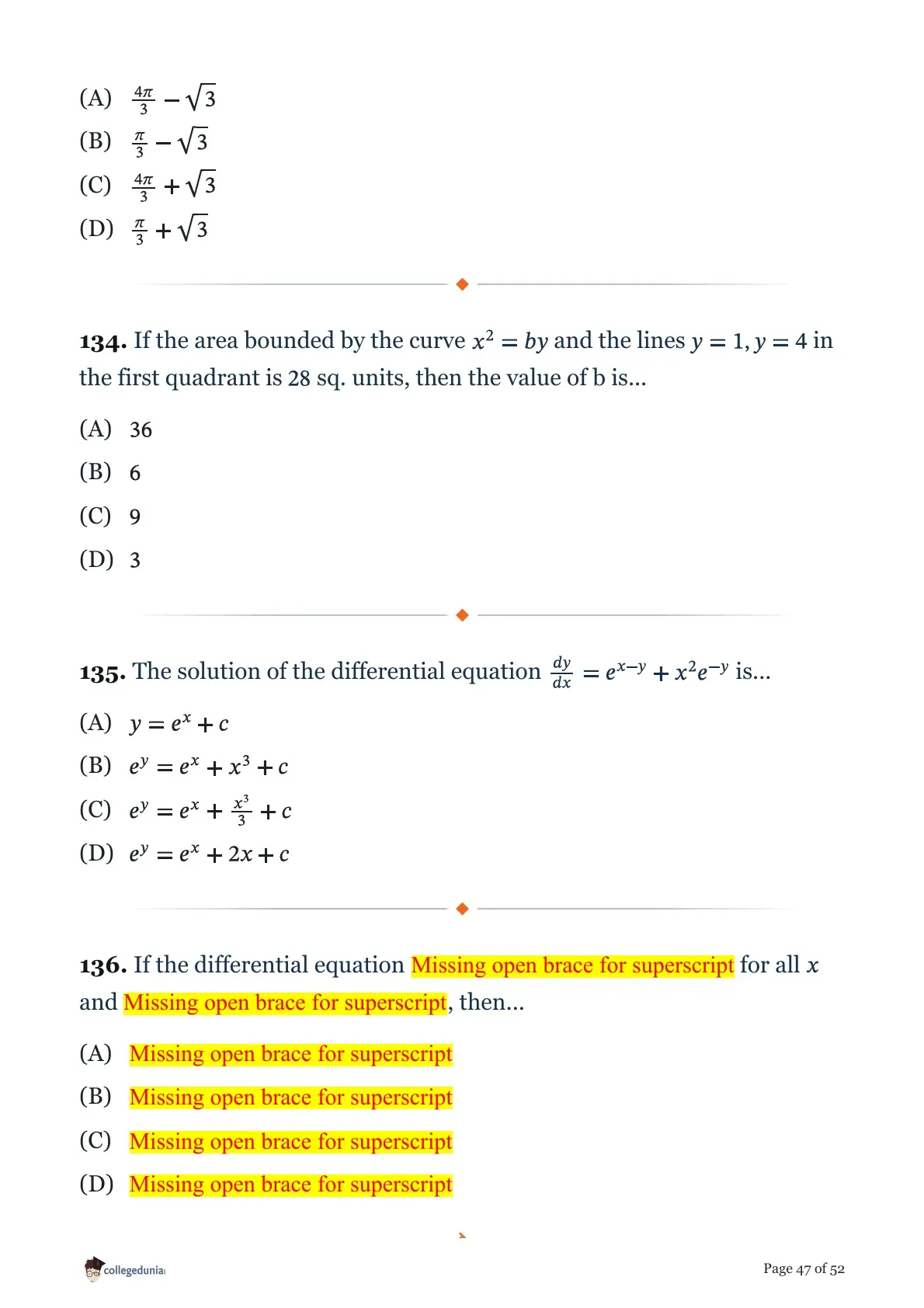
The area of the smaller region bounded by the circle \(x^2+y^2 = 4\) and the line \(x = 1\) is...
If the area bounded by the curve \(x^2 = by\) and the lines \(y = 1,y = 4\) in the first quadrant is \(28\) sq. units, then the value of b is...
The solution of the differential equation \(\frac{dy}{dx} = e^{x-y}+x^2e^{-y}\) is...
If the differential equation \(\begin{array}{cc}f(x) & f^'(x) \\ f^'(x) & f^{''}(x)\end{array} = 0\) for all \(x\) and \(f(0) = 1,f^'(0) = 2\), then...
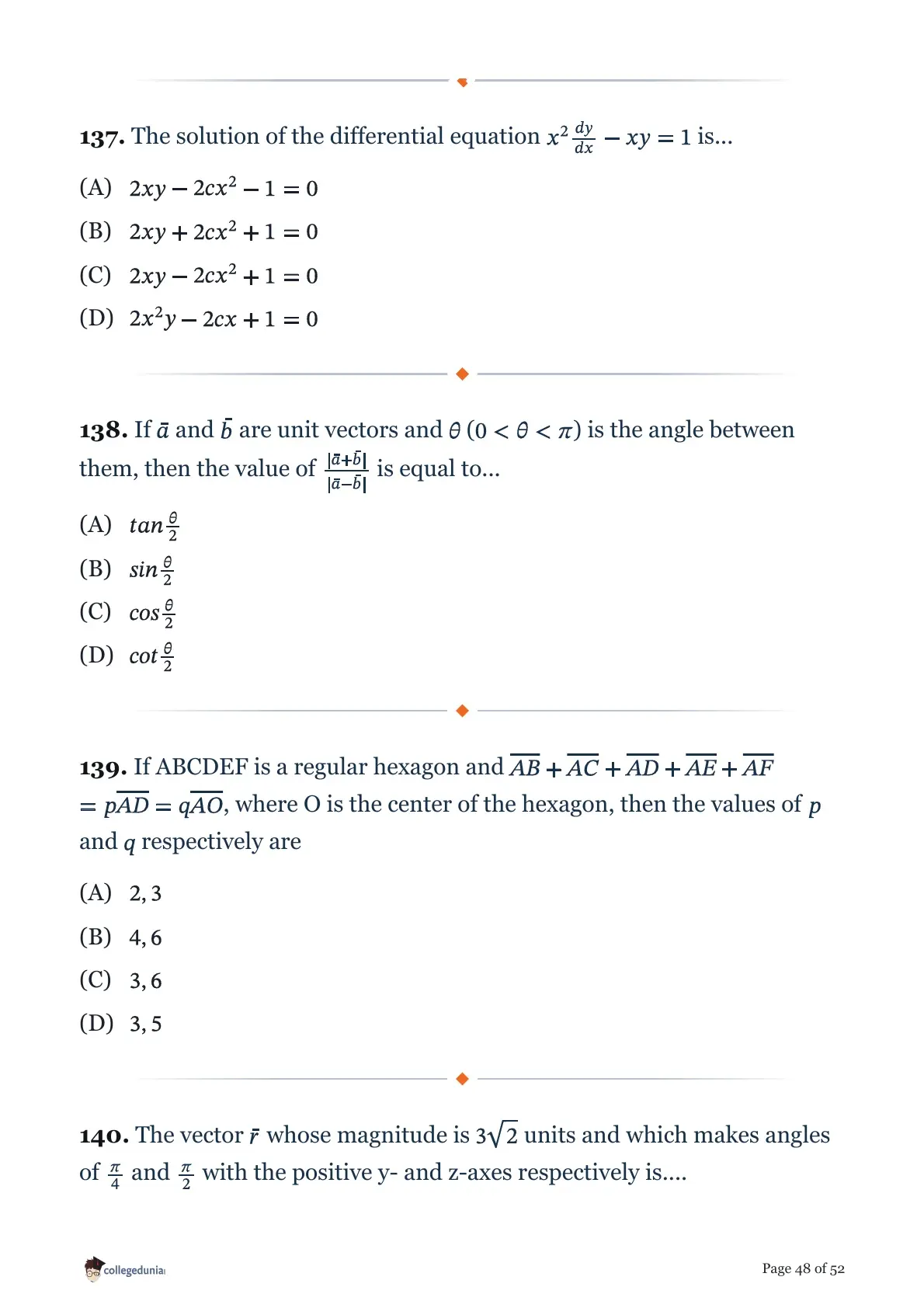
The solution of the differential equation \(x^2\frac{dy}{dx}-xy = 1\) is...
If \(\overset{̄}{a}\) and \(\overset{̄}{b}\) are unit vectors and \(θ\) (\(0 < θ < π\)) is the angle between them, then the value of \(\frac{|\overset{̄}{a}+\overset{̄}{b}|}{|\overset{̄}{a}-\overset{̄}{b}|}\) is equal to...
If ABCDEF is a regular hexagon and \(\overline{AB}+\overline{AC}+\overline{AD}+\overline{AE}+\overline{AF} = p\overline{AD} = q\overline{AO}\), where O is the center of the hexagon, then the values of \(p\) and \(q\) respectively are
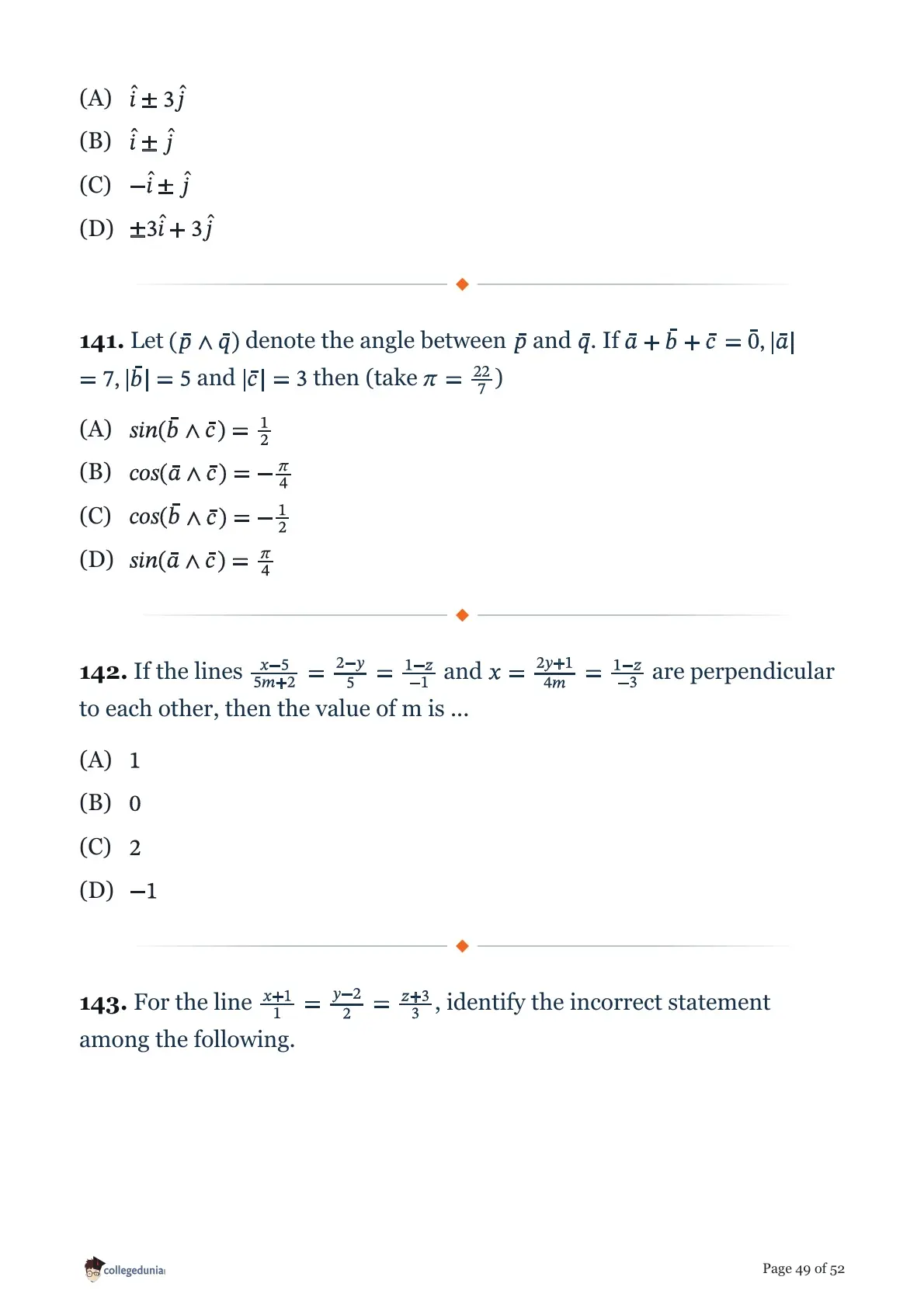
The vector \(\overset{̄}{r}\) whose magnitude is \(3\sqrt{2}\) units and which makes angles of \(\frac{π}{4}\) and \(\frac{π}{2}\) with the positive y- and z-axes respectively is....
Let \((\overset{̄}{p}∧\overset{̄}{q})\) denote the angle between \(\overset{̄}{p}\) and \(\overset{̄}{q}\). If \(\overset{̄}{a}+\overset{̄}{b}+\overset{̄}{c} = \overset{̄}{0},|\overset{̄}{a}| = 7,|\overset{̄}{b}| = 5\) and \(|\overset{̄}{c}| = 3\) then (take \(π = \frac{22}{7}\))
If the lines \(\frac{x-5}{5m+2} = \frac{2-y}{5} = \frac{1-z}{-1}\) and \(x = \frac{2y+1}{4m} = \frac{1-z}{-3}\) are perpendicular to each other, then the value of m is ...
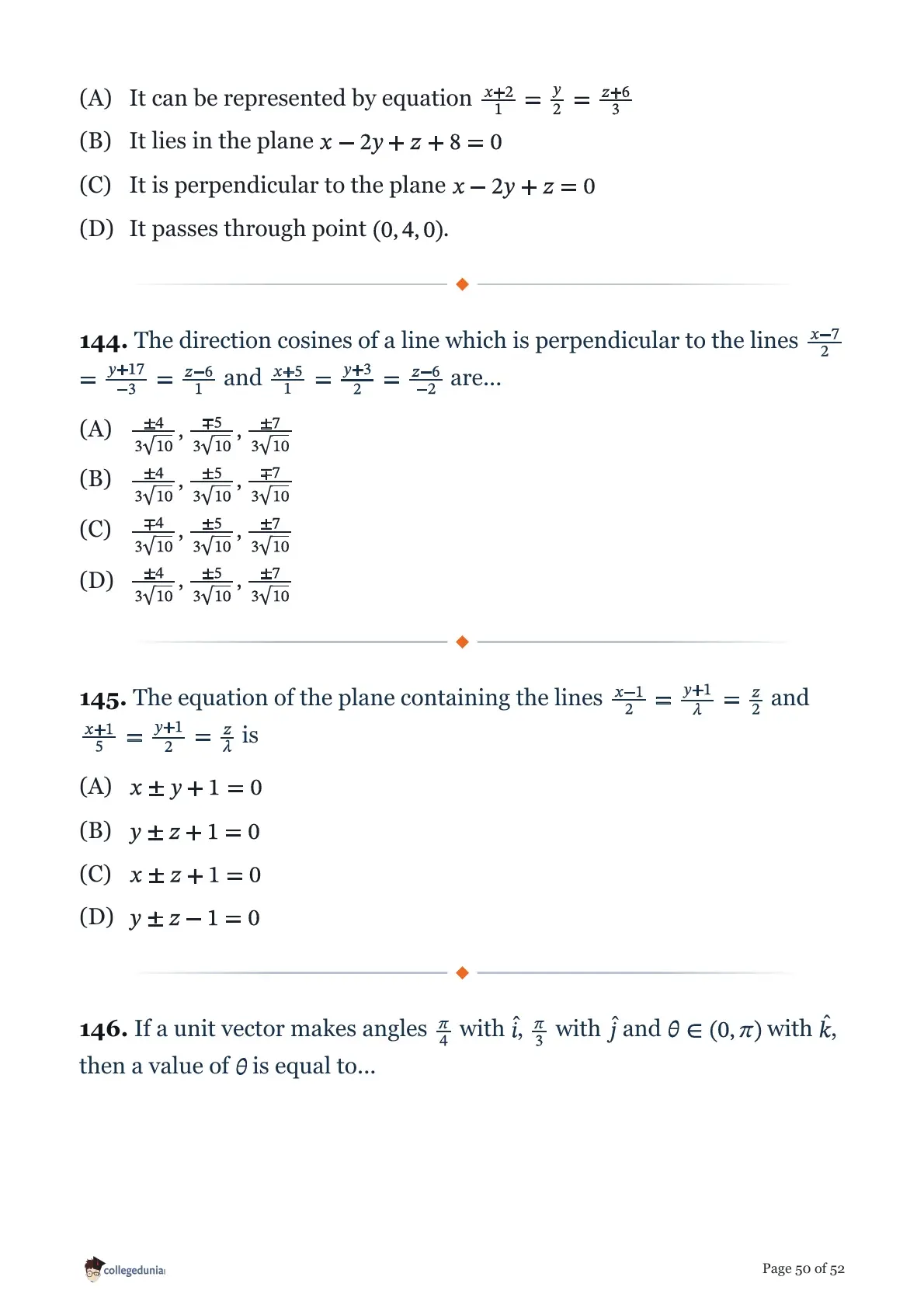
For the line \(\frac{x+1}{1} = \frac{y-2}{2} = \frac{z+3}{3}\), identify the incorrect statement among the following.
The direction cosines of a line which is perpendicular to the lines \(\frac{x-7}{2} = \frac{y+17}{-3} = \frac{z-6}{1}\) and \(\frac{x+5}{1} = \frac{y+3}{2} = \frac{z-6}{-2}\) are...
The equation of the plane containing the lines \(\frac{x-1}{2} = \frac{y+1}{λ} = \frac{z}{2}\) and \(\frac{x+1}{5} = \frac{y+1}{2} = \frac{z}{λ}\) is
If a unit vector makes angles \(\frac{π}{4}\) with \(\hat{i}\), \(\frac{π}{3}\) with \(\hat{j}\) and \(θ\in (0,π)\) with \(\hat{k}\), then a value of \(θ\) is equal to...
The minimum value of \(Z = 3x+y\), subject to the constraints \(2x+3y\leq 6,x+y\geq 1,x\geq 0,y\geq 0\) is....
The centers for disease control have determined that when a person is given a vaccine, the probability that the person will develop immunity to a virus is \(0.8\). If \(8\) people are given this vaccine, then the probability that exactly \(4\) will develop immunity is...
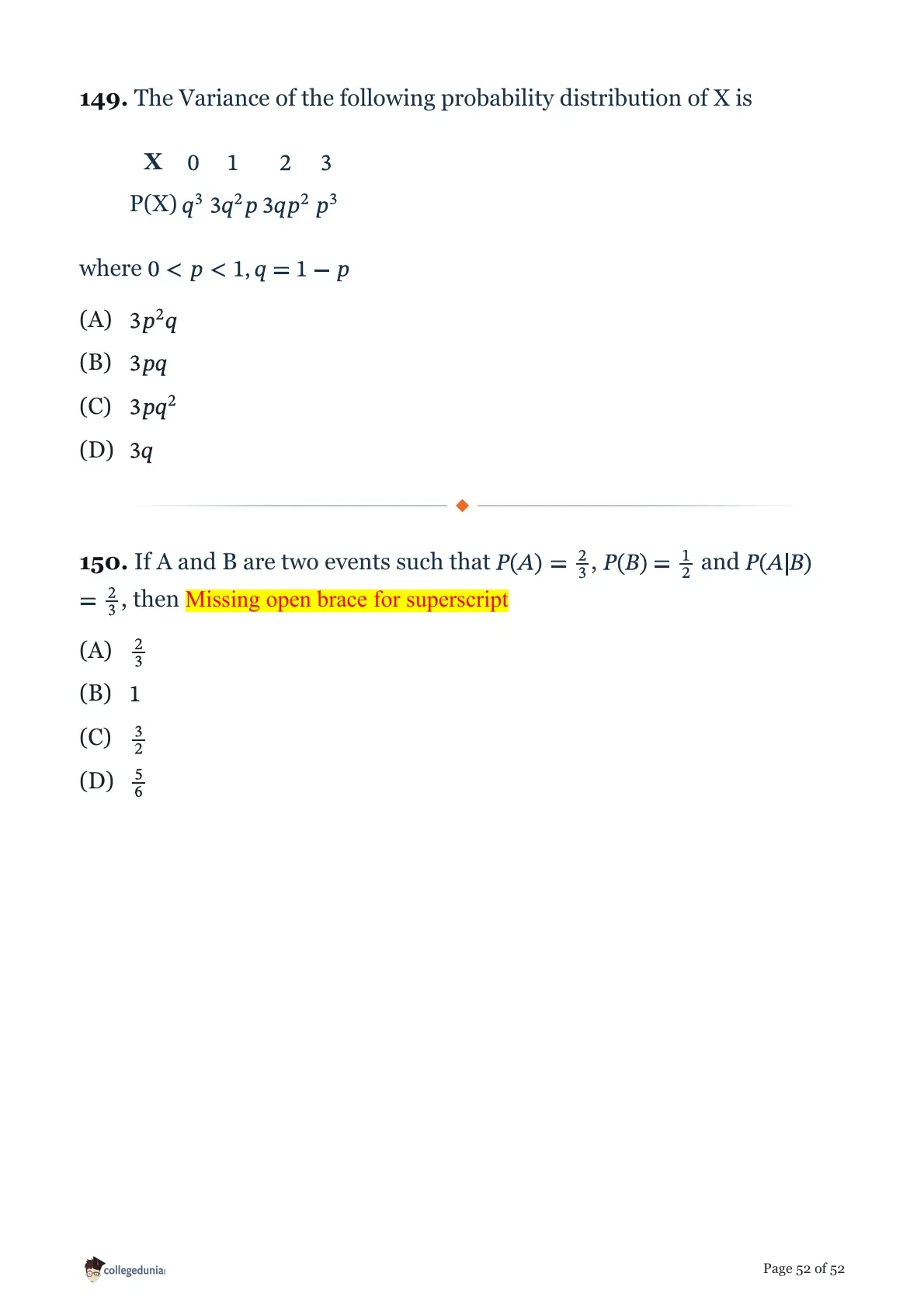
The Variance of the following probability distribution of X is
| X | \(0\) | \(1\) | \(2\) | \(3\) |
|---|---|---|---|---|
| P(X) | \(q^3\) | \(3q^2p\) | \(3qp^2\) | \(p^3\) |
If A and B are two events such that \(P(A) = \frac{2}{3}\), \(P(B) = \frac{1}{2}\) and \(P(A|B) = \frac{2}{3}\), then \(P(A^'\cup B)+P(A\cup B^') =\)
MHT CET PCM Exam Pattern 2026
| Parameter | Details |
|---|---|
| Conducting Body | Maharashtra Common Entrance Test Cell (Maharashtra CET Cell) |
| Exam Mode | Online (Computer-Based Test) |
| Duration | 180 minutes (3 hours) |
| Groups / Subjects | PCM (Physics, Chemistry, Mathematics) for Engineering |
| Total Questions |
150 |
| Total Marks | 200 |
| Question Type | Multiple Choice Questions (MCQs) |
| Marks Distribution |
|
| Negative Marking | No |
| Syllabus Weightage |
|



Comments