MHT CET 2026 April 15 Shift 2 PCM Question Paper will be available for download here. Maharashtra State CET Cell is conducting MHT CET 2026 PCM Exam on April 15 in Shift 2 from 2 PM to 5 PM in CBT mode.

  • The MHT CET 2026 PCM Question Paper consists of 150 multiple-choice questions (MCQs) totalling 200 marks divided into 3 sections: Physics, Chemistry, and Mathematics, with 50 questions in each subject.
  • Physics and Chemistry questions carry 1 mark each, while Mathematics questions carry 2 marks each.
  • There is no negative marking for incorrect answers.

Download MHT CET 2026 April 15 Shift 2 PCM Question Paper with Solutions PDF from the links provided below.

MHT CET 2026 April 15 Shift 2 PCM Question Paper PDF Download

MHT CET 2026 April 15 Shift 2 Question Paper Download PDF Check Solution


MHT CET 2026 April 15 Shift 2 PCM Question Paper page 1

MHT CET 2026 April 15 Shift 2 PCM Question Paper page 2

MHT CET 2026 April 15 Shift 2 PCM Question Paper page 3

MHT CET 2026 April 15 Shift 2 PCM Question Paper page 4

MHT CET 2026 April 15 Shift 2 PCM Question Paper page 5

MHT CET 2026 April 15 Shift 2 PCM Question Paper page 6

MHT CET 2026 April 15 Shift 2 PCM Question Paper page 7

MHT CET 2026 April 15 Shift 2 PCM Question Paper page 8

MHT CET 2026 April 15 Shift 2 PCM Question Paper page 9

MHT CET 2026 April 15 Shift 2 PCM Question Paper page 10

MHT CET 2026 April 15 Shift 2 PCM Question Paper page 11

MHT CET 2026 April 15 Shift 2 PCM Question Paper page 12

MHT CET 2026 April 15 Shift 2 PCM Question Paper page 13

MHT CET 2026 April 15 Shift 2 PCM Question Paper page 14

MHT CET 2026 April 15 Shift 2 PCM Question Paper page 15

MHT CET 2026 April 15 Shift 2 PCM Question Paper page 16

MHT CET 2026 April 15 Shift 2 PCM Question Paper page 17

MHT CET 2026 April 15 Shift 2 PCM Question Paper page 18

MHT CET 2026 April 15 Shift 2 PCM Question Paper page 19

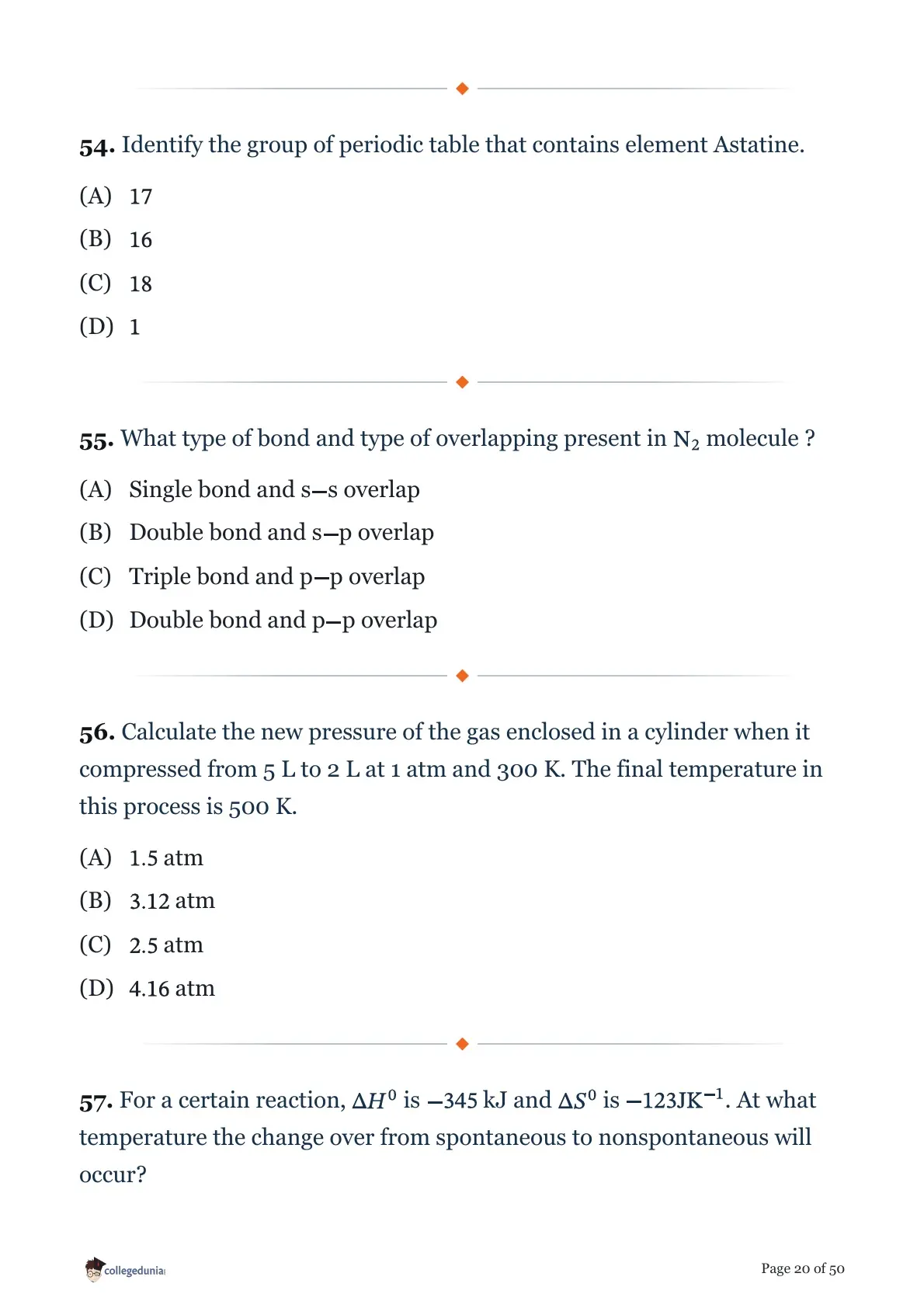
MHT CET 2026 April 15 Shift 2 PCM Question Paper page 20

MHT CET 2026 April 15 Shift 2 PCM Question Paper page 21

MHT CET 2026 April 15 Shift 2 PCM Question Paper page 22

MHT CET 2026 April 15 Shift 2 PCM Question Paper page 23

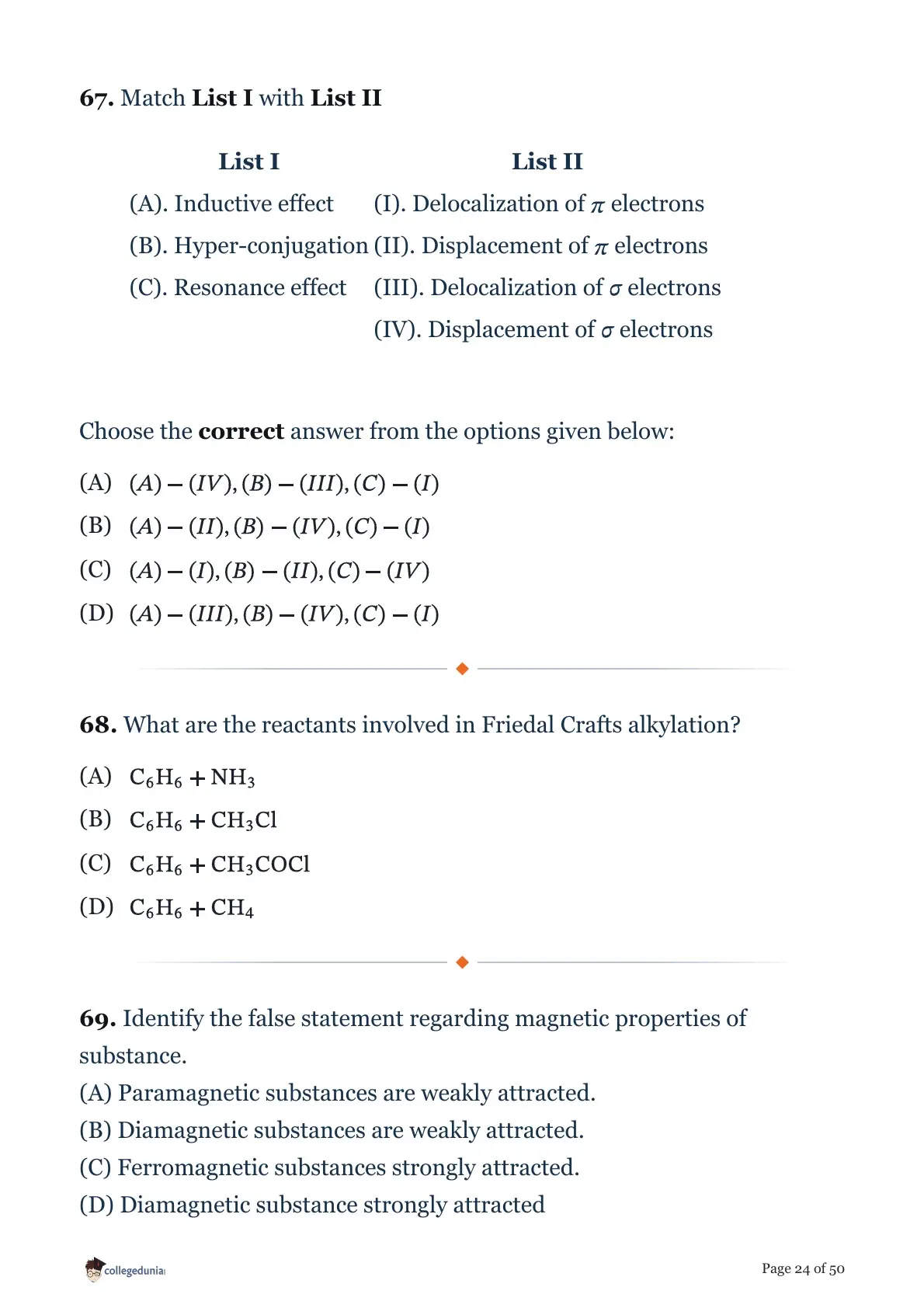
MHT CET 2026 April 15 Shift 2 PCM Question Paper page 24

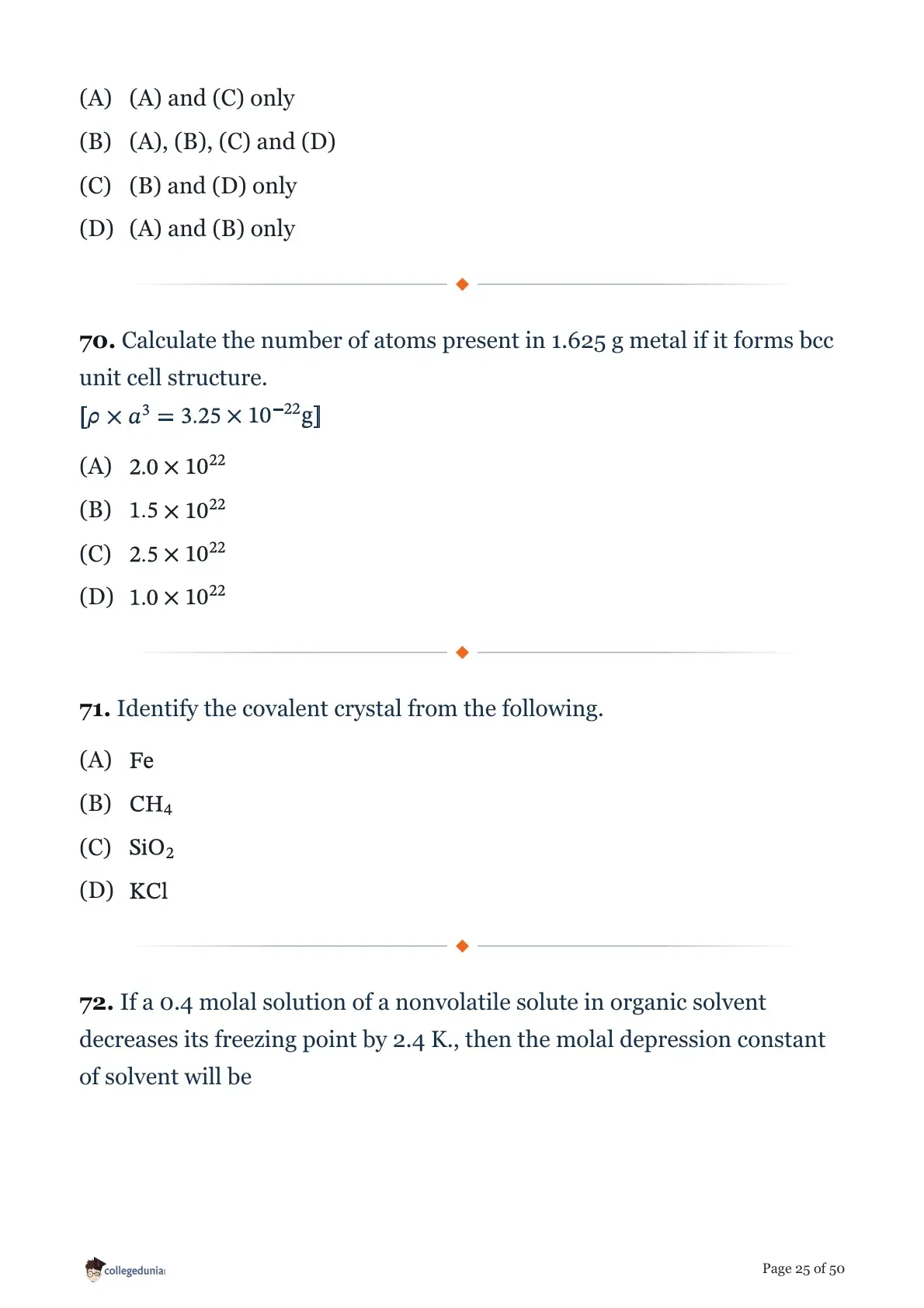
MHT CET 2026 April 15 Shift 2 PCM Question Paper page 25

MHT CET 2026 April 15 Shift 2 PCM Question Paper page 26

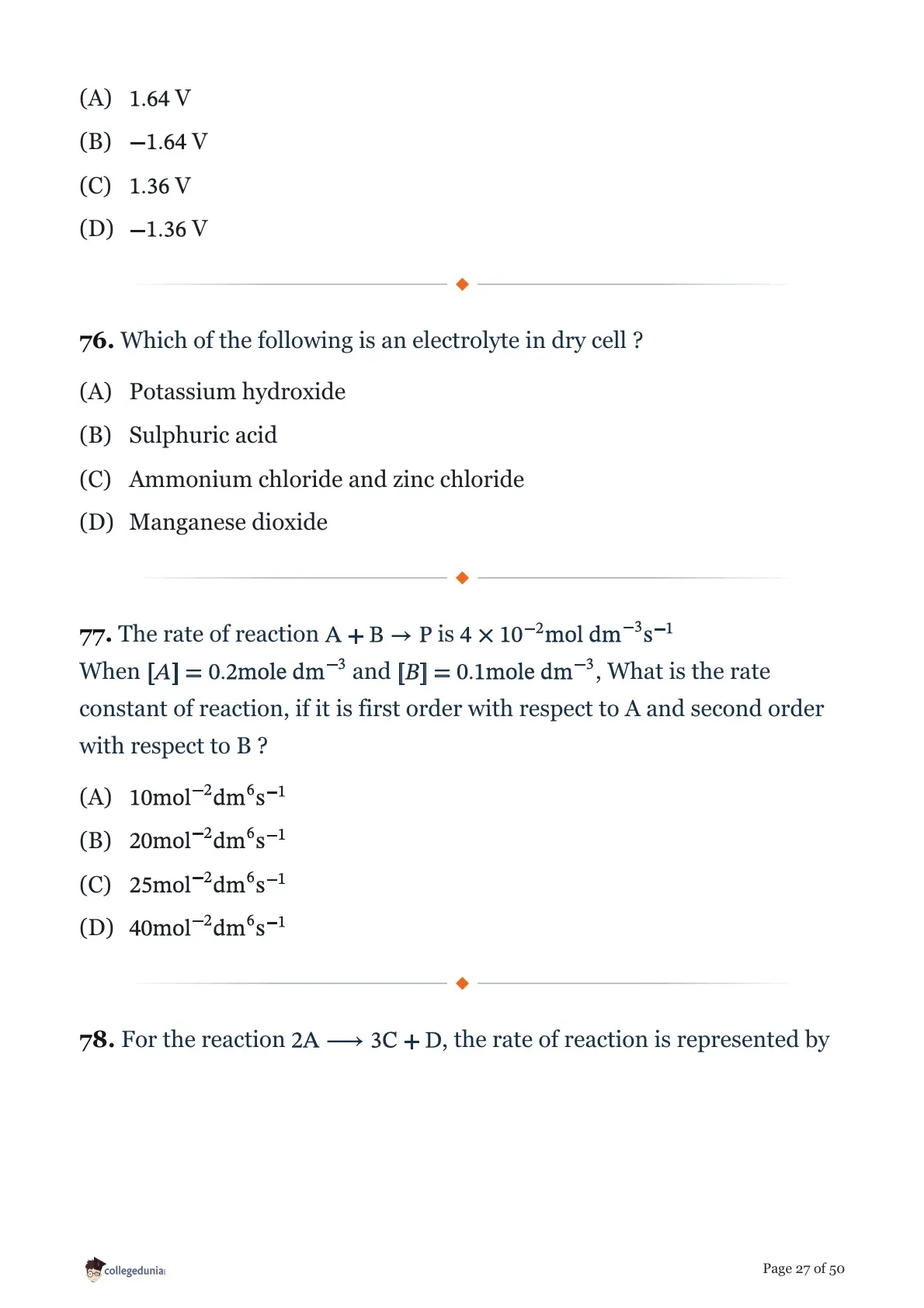
MHT CET 2026 April 15 Shift 2 PCM Question Paper page 27

MHT CET 2026 April 15 Shift 2 PCM Question Paper page 28

MHT CET 2026 April 15 Shift 2 PCM Question Paper page 29

MHT CET 2026 April 15 Shift 2 PCM Question Paper page 30

MHT CET 2026 April 15 Shift 2 PCM Question Paper page 31

MHT CET 2026 April 15 Shift 2 PCM Question Paper page 32

MHT CET 2026 April 15 Shift 2 PCM Question Paper page 33

MHT CET 2026 April 15 Shift 2 PCM Question Paper page 34

MHT CET 2026 April 15 Shift 2 PCM Question Paper page 35

MHT CET 2026 April 15 Shift 2 PCM Question Paper page 36

MHT CET 2026 April 15 Shift 2 PCM Question Paper page 37

MHT CET 2026 April 15 Shift 2 PCM Question Paper page 38

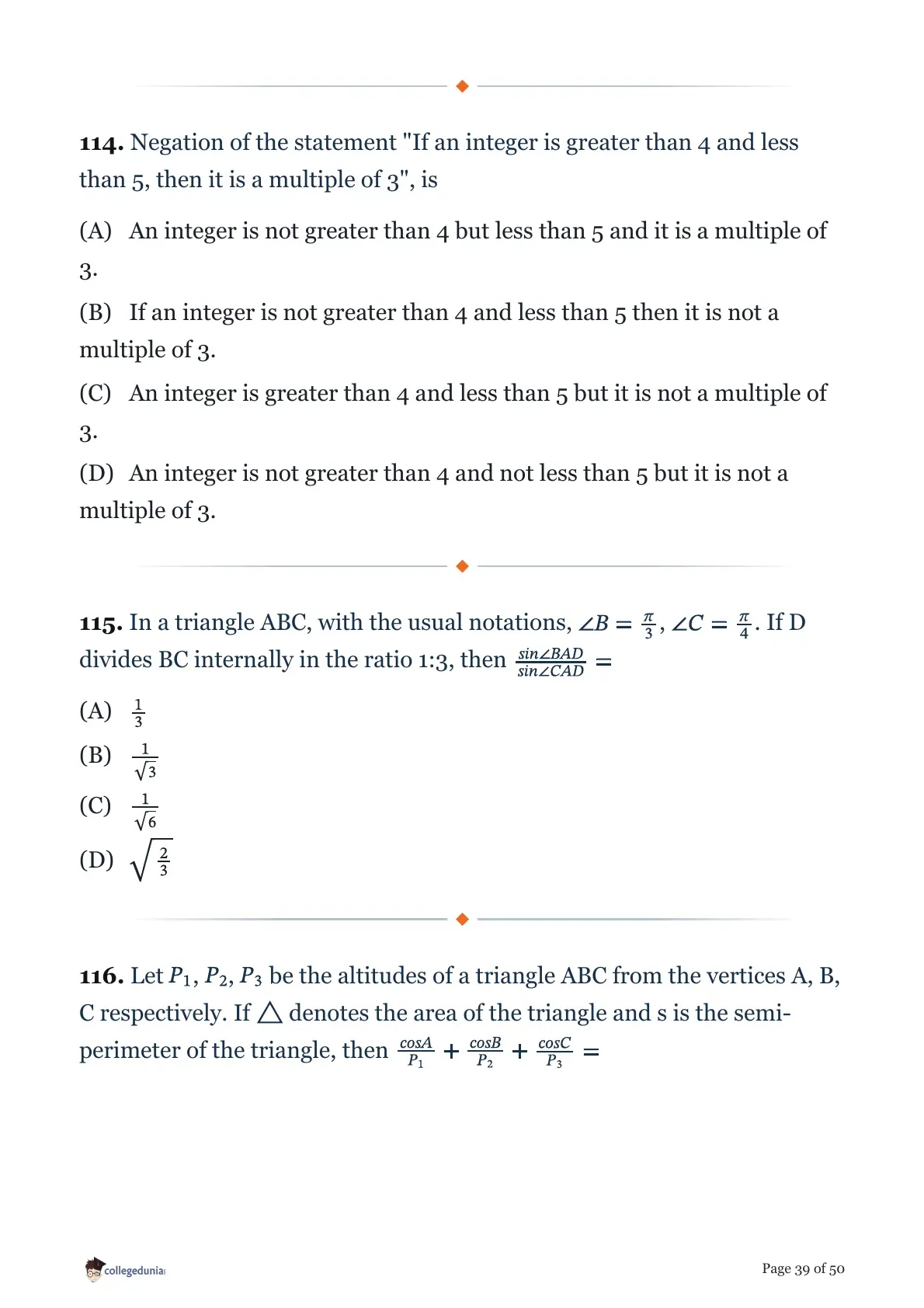
MHT CET 2026 April 15 Shift 2 PCM Question Paper page 39

MHT CET 2026 April 15 Shift 2 PCM Question Paper page 40

MHT CET 2026 April 15 Shift 2 PCM Question Paper page 41

MHT CET 2026 April 15 Shift 2 PCM Question Paper page 42

MHT CET 2026 April 15 Shift 2 PCM Question Paper page 43

MHT CET 2026 April 15 Shift 2 PCM Question Paper page 44

MHT CET 2026 April 15 Shift 2 PCM Question Paper page 45

MHT CET 2026 April 15 Shift 2 PCM Question Paper page 46

MHT CET 2026 April 15 Shift 2 PCM Question Paper page 47

MHT CET 2026 April 15 Shift 2 PCM Question Paper page 48

MHT CET 2026 April 15 Shift 2 PCM Question Paper page 49

MHT CET 2026 April 15 Shift 2 PCM Question Paper page 50

MHT CET 2026 April 15 Shift 2 Question Paper

MHT CET 2026 April 15 Shift 2 PCM Questions with Solutions

Physics Section (Questions 1 to 50)

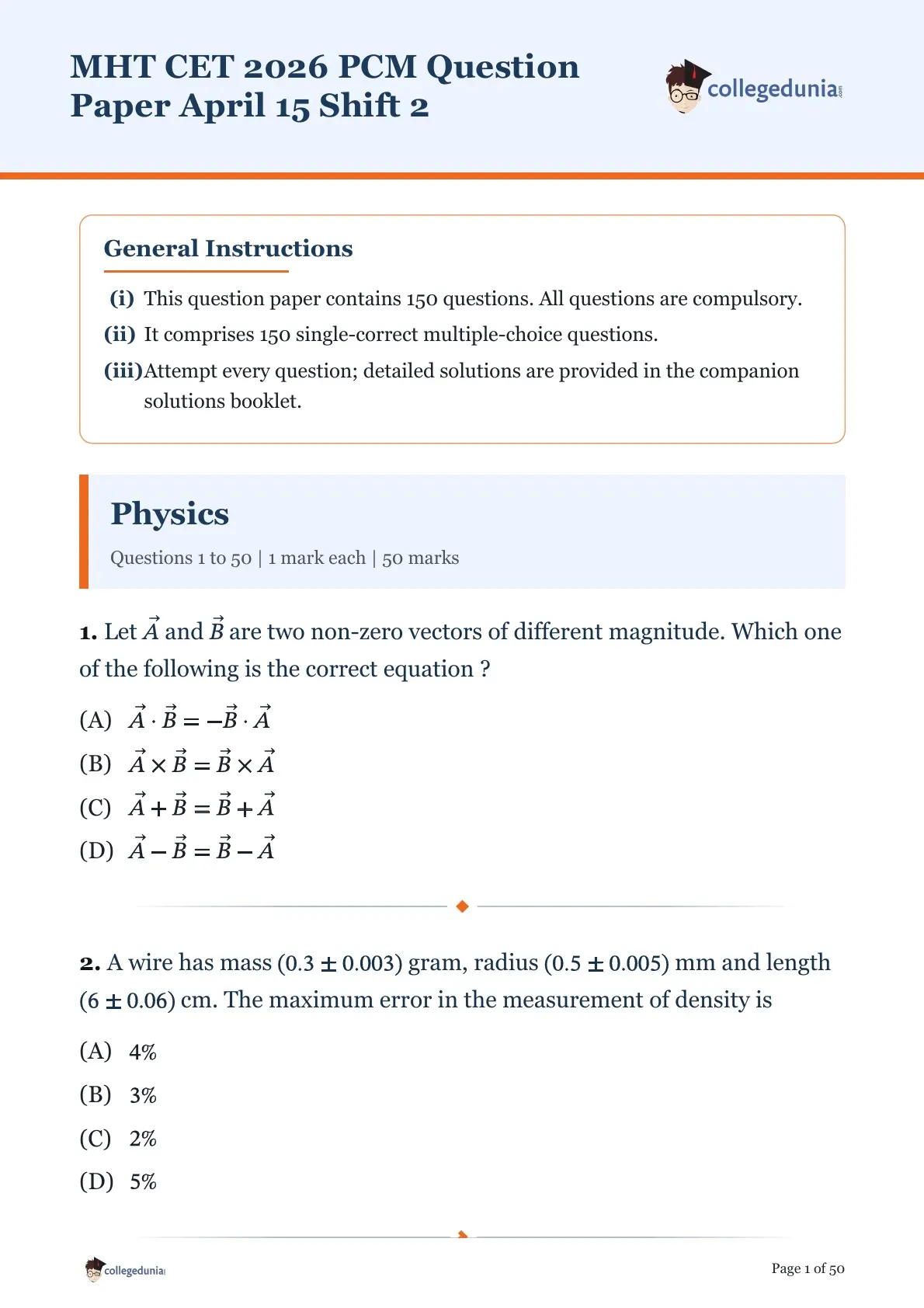
Question 1:

Let \(\overset{⃗}{A}\) and \(\overset{⃗}{B}\) are two non-zero vectors of different magnitude. Which one of the following is the correct equation ?

  • (A) \(\overset{⃗}{A}\cdot \overset{⃗}{B} = -\overset{⃗}{B}\cdot \overset{⃗}{A}\)
  • (B) \(\overset{⃗}{A}\times \overset{⃗}{B} = \overset{⃗}{B}\times \overset{⃗}{A}\)
  • (C) \(\overset{⃗}{A}+\overset{⃗}{B} = \overset{⃗}{B}+\overset{⃗}{A}\)
  • (D) \(\overset{⃗}{A}-\overset{⃗}{B} = \overset{⃗}{B}-\overset{⃗}{A}\)

Question 2:

A wire has mass \((0.3\pm 0.003)\) gram, radius \((0.5\pm 0.005)\) mm and length \((6\pm 0.06)\) cm. The maximum error in the measurement of density is

  • (A) \(4\%\)
  • (B) \(3\%\)
  • (C) \(2\%\)
  • (D) \(5\%\)

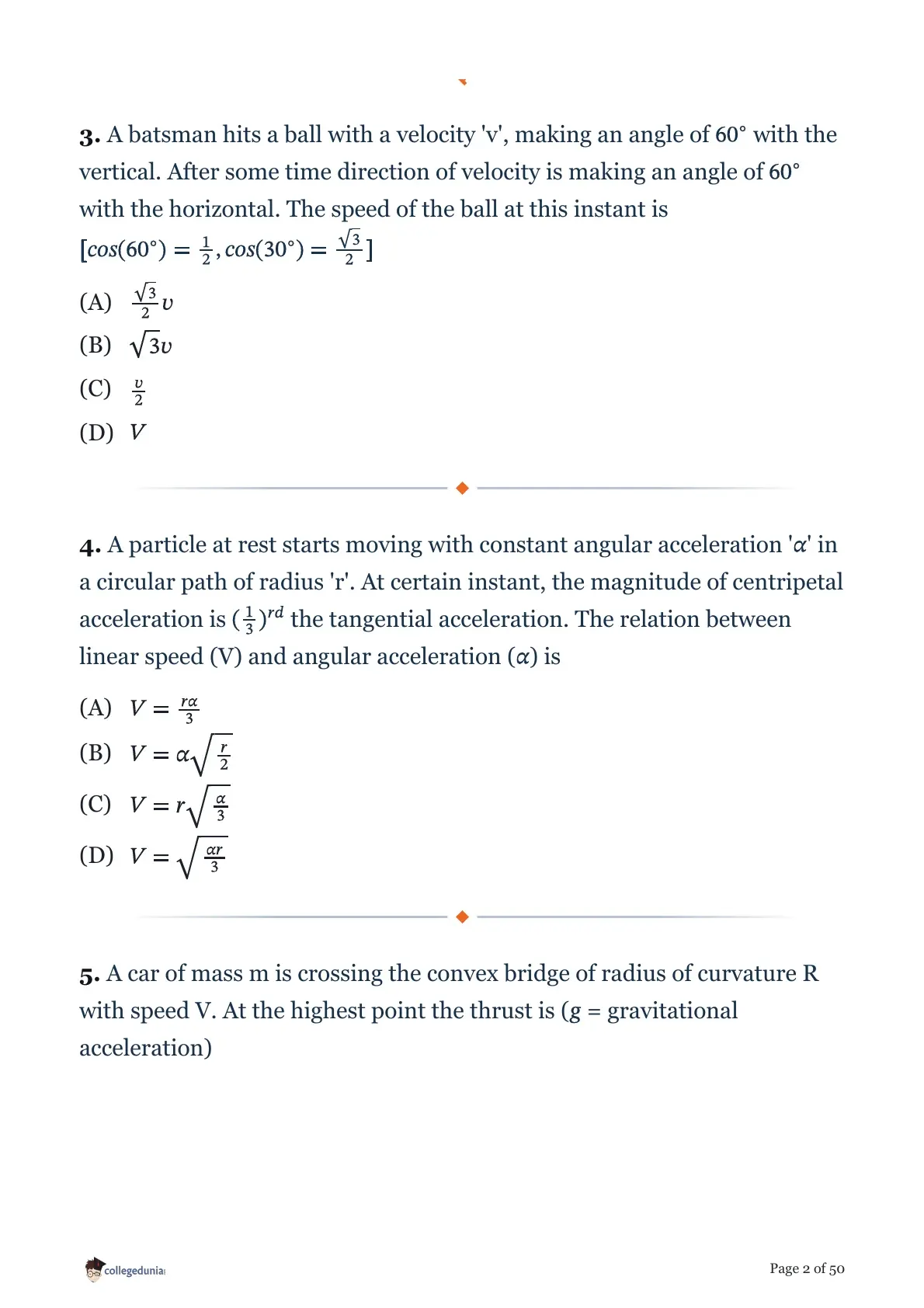
Question 3:

A batsman hits a ball with a velocity 'v', making an angle of \(60^{\circ}\) with the vertical. After some time direction of velocity is making an angle of \(60^{\circ}\) with the horizontal. The speed of the ball at this instant is
\([cos(60^{\circ}) = \frac{1}{2},cos(30^{\circ}) = \frac{\sqrt{3}}{2}]\)

  • (A) \(\frac{\sqrt{3}}{2}v\)
  • (B) \(\sqrt{3}v\)
  • (C) \(\frac{v}{2}\)
  • (D) \(V\)

Question 4:

A particle at rest starts moving with constant angular acceleration '\(α\)' in a circular path of radius 'r'. At certain instant, the magnitude of centripetal acceleration is \((\frac{1}{3})^{rd}\) the tangential acceleration. The relation between linear speed (V) and angular acceleration (\(α\)) is

  • (A) \(V = \frac{rα}{3}\)
  • (B) \(V = α\sqrt{\frac{r}{2}}\)
  • (C) \(V = r\sqrt{\frac{α}{3}}\)
  • (D) \(V = \sqrt{\frac{αr}{3}}\)

Question 5:

A car of mass m is crossing the convex bridge of radius of curvature R with speed V. At the highest point the thrust is (\(g\) = gravitational acceleration)

  • (A) \(mg\)
  • (B) \(\frac{mv^2}{R}\)
  • (C) \(mg-\frac{mv^2}{R}\)
  • (D) \(mg+\frac{mv^2}{R}\)

Question 6:

A bucket containing water is revolved in vertical circle of radius r. To prevent the water from falling down, the period of revolution required is (\(g\) = gravitational acceleration)

  • (A) \(2π\sqrt{\frac{g}{r}}\)
  • (B) \(2π\sqrt{\frac{r}{g}}\)
  • (C) \(2π\sqrt{rg}\)
  • (D) \(\frac{\sqrt{rg}}{2π}\)

Question 7:

In case of perfectly elastic collision,

  • (A) the total kinetic energy before collision is equal to the total kinetic energy after collision.
  • (B) the total kinetic energy before collision is less than total kinetic energy after collision.
  • (C) the total kinetic energy before collision is greater than the total kinetic energy after collision.
  • (D) coefficient of restitution is equal to zero.

Question 8:

The distance of the two planets A and B from the sun are '\(r_A\)' and '\(r_B\)' respectively such that \(r_B = 100\,r_A\). The ratio of the speed of planet A to that of planet B is (both the planets are revolving around the sun)

  • (A) \(\frac{1}{\sqrt{10}}\)
  • (B) \(\sqrt{10}\)
  • (C) \(10\)
  • (D) \(10\sqrt{10}\)

Question 9:

A square frame of each side L is dipped in a soap solution and taken out, the force acting on the film formed is ( T = surface tension of soap solution)

  • (A) \(4\,TL\)
  • (B) \(8\,TL\)
  • (C) \(12\,TL\)
  • (D) \(16\,TL\)

Question 10:

Three liquids have same surface tension and densities \(ρ_1\), \(ρ_2\) and \(ρ_3\) (\(ρ_1 < ρ_2 < ρ_3\)). In three identical capillaries rise of liquid is same. The corresponding angle of contact \(θ_1\), \(θ_2\) and \(θ_3\) are related as

  • (A) \(θ_1 < θ_2 < θ_3\)
  • (B) \(θ_1 > θ_2 > θ_3\)
  • (C) \(θ_1 = θ_2 = θ_3\)
  • (D) \(θ_1 > θ_2 < θ_3\)

Question 11:

The excess pressure inside the first soap bubble of radius \(R_1\) is three times that inside the second soap bubble of radius \(R_2\). The ratio of volumes of the first to second bubble is

  • (A) \(1:27\)
  • (B) \(1:18\)
  • (C) \(1:9\)
  • (D) \(1:3\)

Question 12:

The ratio of the thermal conductivity of two rods of different materials is 6:5. The two rods of same area of cross section and same thermal resistance will have the length in the ratio

  • (A) \(5:6\)
  • (B) \(6:5\)
  • (C) \(1:3\)
  • (D) \(3:1\)

Question 13:

A black rectangular surface of area A emits energy E per second at \(127^{\circ}\)C. If length and breadth is reduced to half of initial value and temperature is raised to \(527^{\circ}\)C then energy emitted becomes

  • (A) \(E\)
  • (B) \(2E\)
  • (C) \(4E\)
  • (D) \(8E\)

Question 14:

The energy spectrum of a black body exhibits a maximum around a wavelength \(λ\). The temperature of a black body is now changed such that the energy is maximum at wavelength \(2λ/3\). The power radiated by the black body will now increase by a factor of

  • (A) \(\frac{256}{81}\)
  • (B) \(\frac{81}{16}\)
  • (C) \(\frac{162}{41}\)
  • (D) \(\frac{16}{81}\)

Question 15:

In a cyclic process, work done by the system is

  • (A) zero.
  • (B) equal to the heat given to system.
  • (C) more than the heat given to system.
  • (D) independent of heat given to system.

Question 16:

The average translational kinetic energy of a molecule in a gas is \(E_1\). The kinetic energy of the electron (e) accelerated from rest through potential difference 'V' volt is \(E_2\). The temperature at which \(E_1 = E_2\) possible is (N = number of molecules, R = gas constant)

  • (A) \(\frac{eVN}{2R}\)
  • (B) \(\frac{2eVN}{3R}\)
  • (C) \(\frac{eVN}{R}\)
  • (D) \(\frac{3eVN}{4R}\)

Question 17:

An ideal gas is expanded adiabatically. How many times has the gas to be expanded to reduce the r.m.s. speed of molecules 3 times ? (\(γ = 1.5\))

  • (A) \(32\) times
  • (B) \(16\) times
  • (C) \(8\) times
  • (D) \(81\) times

Question 18:

A body of mass \(0.4\) kg performs simple harmonic motion. It experiences a restoring force of \(0.4\) N when its displacement from the mean position is 4 cm. The force constant and magnitude of acceleration respectively are

  • (A) \(5 \text{N/}_{\text{m}},0.5 \text{m/}_{\text{s}^2}\)
  • (B) \(10 \text{N/}_{\text{m}},1 \text{m/}_{\text{s}^2}\)
  • (C) \(15 \text{N/}_{\text{m}},1.5 \text{m/}_{\text{s}^2}\)
  • (D) \(20 \text{N/}_{\text{m}},2 \text{m/}_{\text{s}^2}\)

Question 19:

The minimum phase difference between two simple harmonic motions is
\(x_1 = \frac{1}{\sqrt{2}}sinωt+\frac{1}{\sqrt{2}}cosωt\)
\(x_2 = sinωt+cosωt\)     \([sin\frac{π}{4} = cos\frac{π}{4} = \frac{1}{\sqrt{2}}]\)

  • (A) zero
  • (B) \(\frac{π^C}{3}\)
  • (C) \(\frac{π^C}{4}\)
  • (D) \(\frac{π^C}{5}\)

Question 20:

A pendulum clock is running slow, In order to correct it, we should

  • (A) reduce the amplitude of oscillation.
  • (B) reduce the mass of the bob.
  • (C) reduce the length of pendulum.
  • (D) increase the length of pendulum.

Question 21:

A simple harmonic progressive wave is represented by \(y = Asin(120πt+3x)\). The distance between two points on the wave at a phase difference of \(\frac{π}{3}\) radian is

  • (A) \(\frac{π}{6}\) m
  • (B) \(\frac{π}{9}\) m
  • (C) \(\frac{2π}{9}\) m
  • (D) \(\frac{π}{18}\) m

Question 22:

A pipe open at both ends has a fundamental frequency 'f' in air. The pipe is dipped in water, so that \(\frac{2}{3}^{rd}\) length of pipe is in water, Now the fundamental frequency of the air column is

  • (A) \(\frac{1}{2}f\)
  • (B) \(\frac{3}{2}f\)
  • (C) \(\frac{5}{2}f\)
  • (D) \(\frac{7}{2}f\)

Question 23:

To increase the frequency of transverse oscillations of a stretched string by 40%, the tension must be increased by

  • (A) \(100\%\)
  • (B) \(40\%\)
  • (C) \(96\%\)
  • (D) \(140\%\)

Question 24:

When open pipe is closed from one end then second overtone of closed pipe is higher in frequency by 100 Hz than first overtone of open pipe. The fundamental frequency of open end pipe will be (Neglect end correction)

  • (A) \(200\) Hz
  • (B) \(300\) Hz
  • (C) \(100\) Hz
  • (D) \(400\) Hz

Question 25:

For a uniformly charged plane sheet, the variation of electric field (E) with distance (d) is correctly shown graphically in graph

  • (A) A
  • (B) B
  • (C) C
  • (D) D

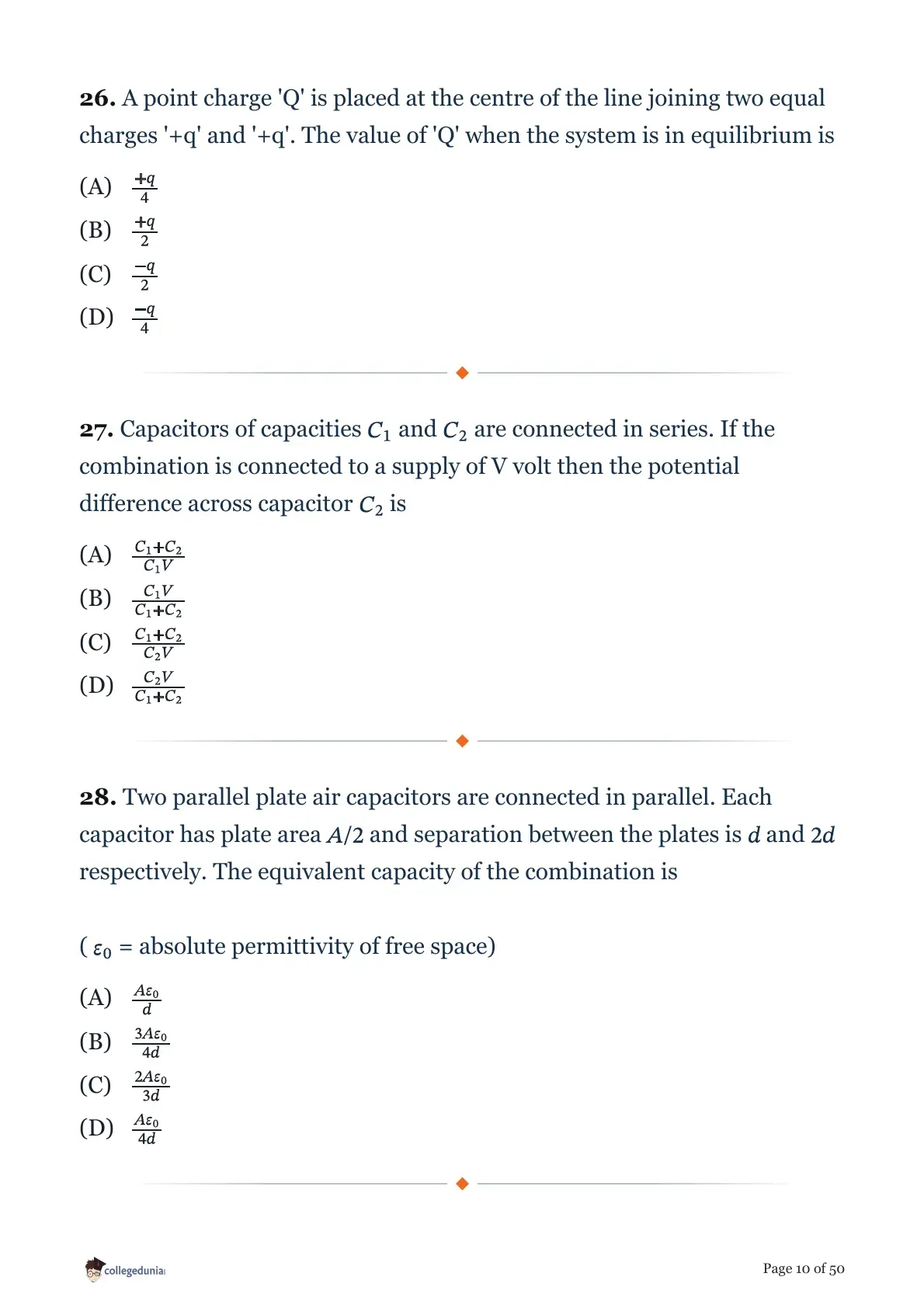
Question 26:

A point charge 'Q' is placed at the centre of the line joining two equal charges '+q' and '+q'. The value of 'Q' when the system is in equilibrium is

  • (A) \(\frac{+q}{4}\)
  • (B) \(\frac{+q}{2}\)
  • (C) \(\frac{-q}{2}\)
  • (D) \(\frac{-q}{4}\)

Question 27:

Capacitors of capacities \(C_1\) and \(C_2\) are connected in series. If the combination is connected to a supply of V volt then the potential difference across capacitor \(C_2\) is

  • (A) \(\frac{C_1+C_2}{C_1V}\)
  • (B) \(\frac{C_1V}{C_1+C_2}\)
  • (C) \(\frac{C_1+C_2}{C_2V}\)
  • (D) \(\frac{C_2V}{C_1+C_2}\)

Question 28:

Two parallel plate air capacitors are connected in parallel. Each capacitor has plate area \(A/2\) and separation between the plates is \(d\) and \(2d\) respectively. The equivalent capacity of the combination is

( \(ε_0\) = absolute permittivity of free space)

  • (A) \(\frac{Aε_0}{d}\)
  • (B) \(\frac{3Aε_0}{4d}\)
  • (C) \(\frac{2Aε_0}{3d}\)
  • (D) \(\frac{Aε_0}{4d}\)

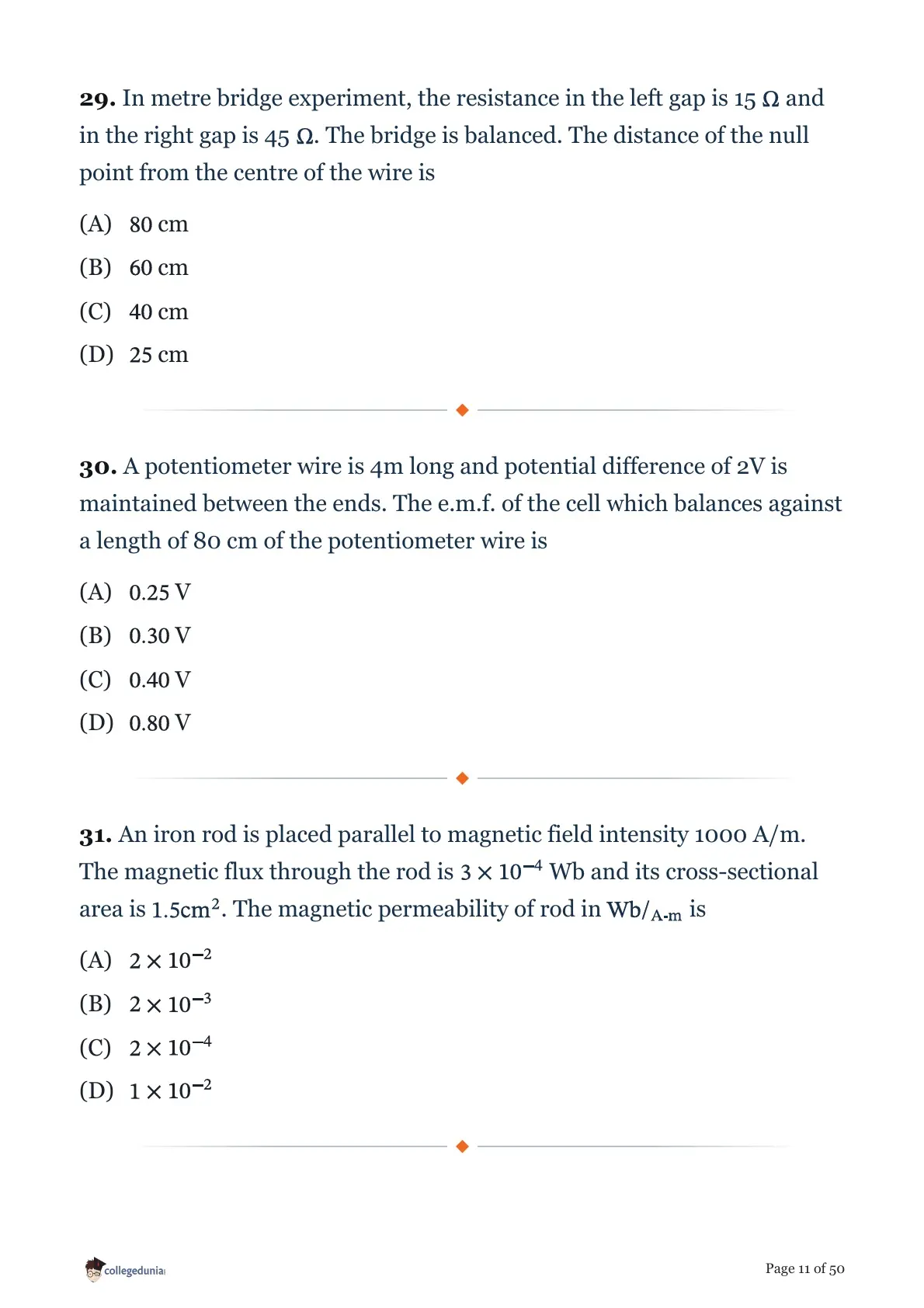
Question 29:

In metre bridge experiment, the resistance in the left gap is 15 \(\Omega\) and in the right gap is 45 \(\Omega\). The bridge is balanced. The distance of the null point from the centre of the wire is

  • (A) \(80\) cm
  • (B) \(60\) cm
  • (C) \(40\) cm
  • (D) \(25\) cm

Question 30:

A potentiometer wire is 4m long and potential difference of 2V is maintained between the ends. The e.m.f. of the cell which balances against a length of 80 cm of the potentiometer wire is

  • (A) \(0.25\) V
  • (B) \(0.30\) V
  • (C) \(0.40\) V
  • (D) \(0.80\) V

Question 31:

An iron rod is placed parallel to magnetic field intensity 1000 A/m. The magnetic flux through the rod is \(3\times 10^{-4}\) Wb and its cross-sectional area is \(1.5 \text{cm}^2\). The magnetic permeability of rod in \(\text{Wb/}_{\text{A-m}}\) is

  • (A) \(2\times 10^{-2}\)
  • (B) \(2\times 10^{-3}\)
  • (C) \(2\times 10^{-4}\)
  • (D) \(1\times 10^{-2}\)

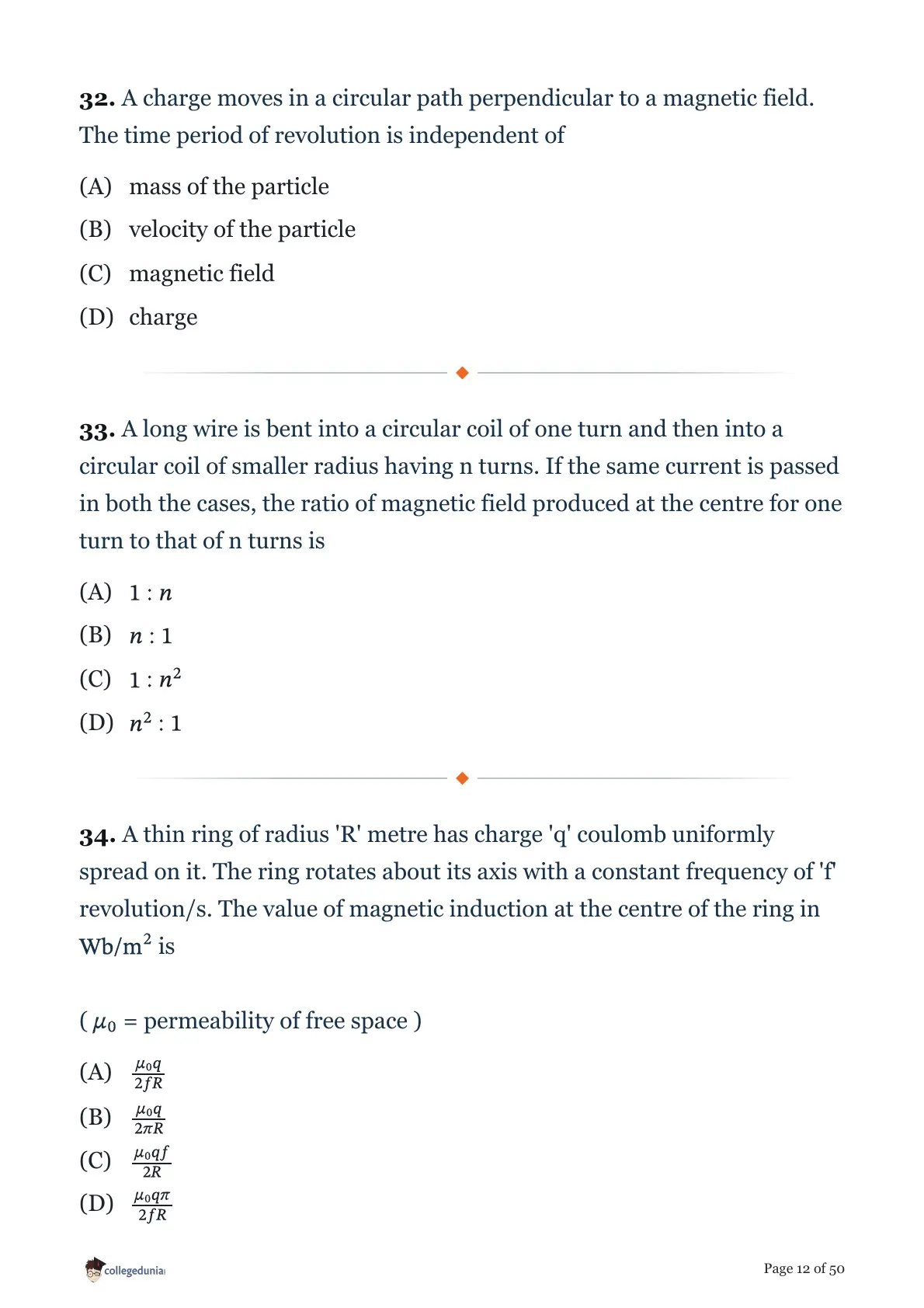
Question 32:

A charge moves in a circular path perpendicular to a magnetic field. The time period of revolution is independent of

  • (A) mass of the particle
  • (B) velocity of the particle
  • (C) magnetic field
  • (D) charge

Question 33:

A long wire is bent into a circular coil of one turn and then into a circular coil of smaller radius having n turns. If the same current is passed in both the cases, the ratio of magnetic field produced at the centre for one turn to that of n turns is

  • (A) \(1:n\)
  • (B) \(n:1\)
  • (C) \(1:n^2\)
  • (D) \(n^2:1\)

Question 34:

A thin ring of radius 'R' metre has charge 'q' coulomb uniformly spread on it. The ring rotates about its axis with a constant frequency of 'f' revolution/s. The value of magnetic induction at the centre of the ring in \(\text{Wb/m}^2\) is

( \(μ_0\) = permeability of free space )

  • (A) \(\frac{μ_0q}{2fR}\)
  • (B) \(\frac{μ_0q}{2πR}\)
  • (C) \(\frac{μ_0qf}{2R}\)
  • (D) \(\frac{μ_0qπ}{2fR}\)

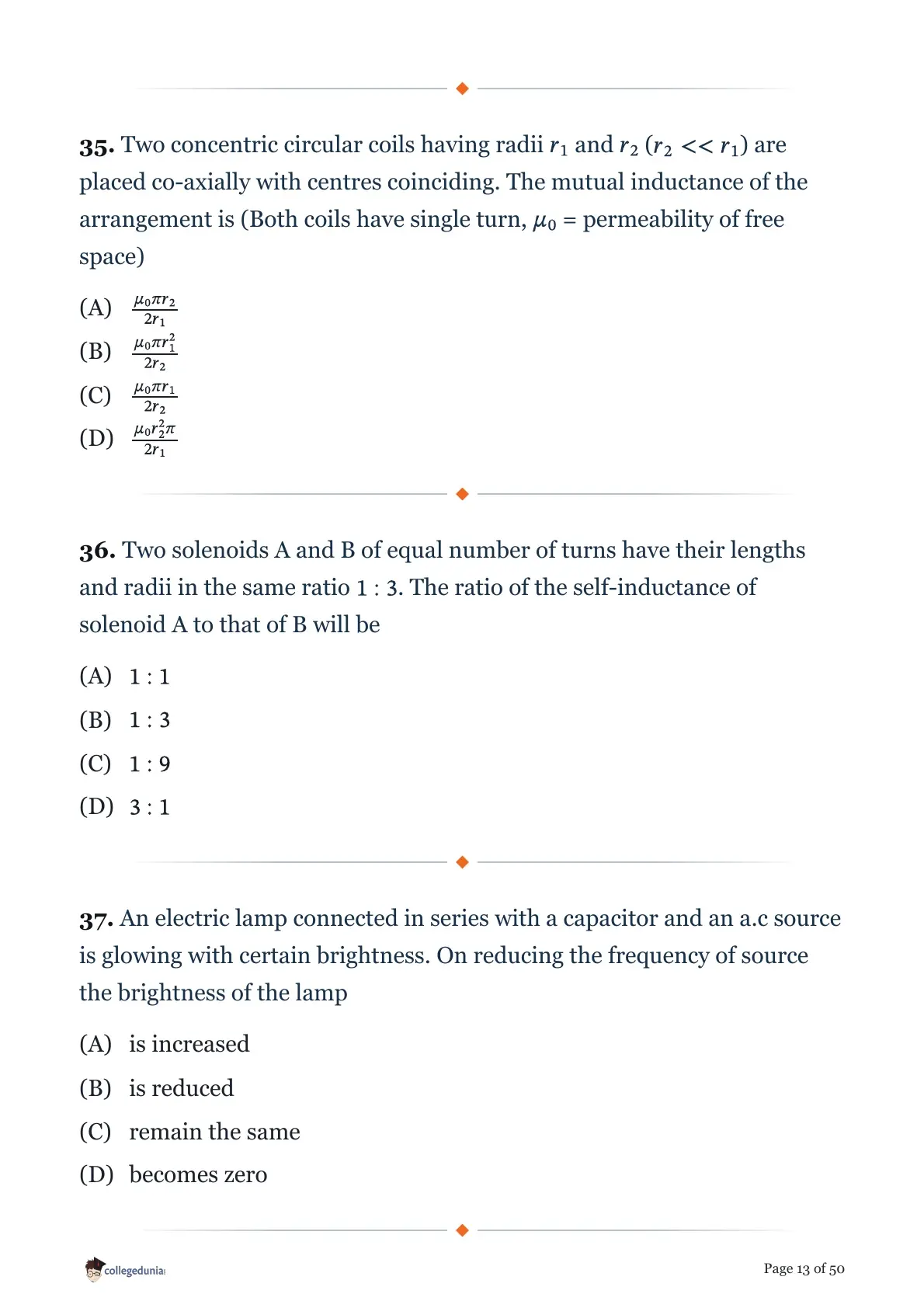
Question 35:

Two concentric circular coils having radii \(r_1\) and \(r_2\) (\(r_2<<r_1\)) are placed co-axially with centres coinciding. The mutual inductance of the arrangement is (Both coils have single turn, \(μ_0\) = permeability of free space)

  • (A) \(\frac{μ_0πr_2}{2r_1}\)
  • (B) \(\frac{μ_0πr_1^2}{2r_2}\)
  • (C) \(\frac{μ_0πr_1}{2r_2}\)
  • (D) \(\frac{μ_0r_2^2π}{2r_1}\)

Question 36:

Two solenoids A and B of equal number of turns have their lengths and radii in the same ratio \(1:3\). The ratio of the self-inductance of solenoid A to that of B will be

  • (A) \(1:1\)
  • (B) \(1:3\)
  • (C) \(1:9\)
  • (D) \(3:1\)

Question 37:

An electric lamp connected in series with a capacitor and an a.c source is glowing with certain brightness. On reducing the frequency of source the brightness of the lamp

  • (A) is increased
  • (B) is reduced
  • (C) remain the same
  • (D) becomes zero

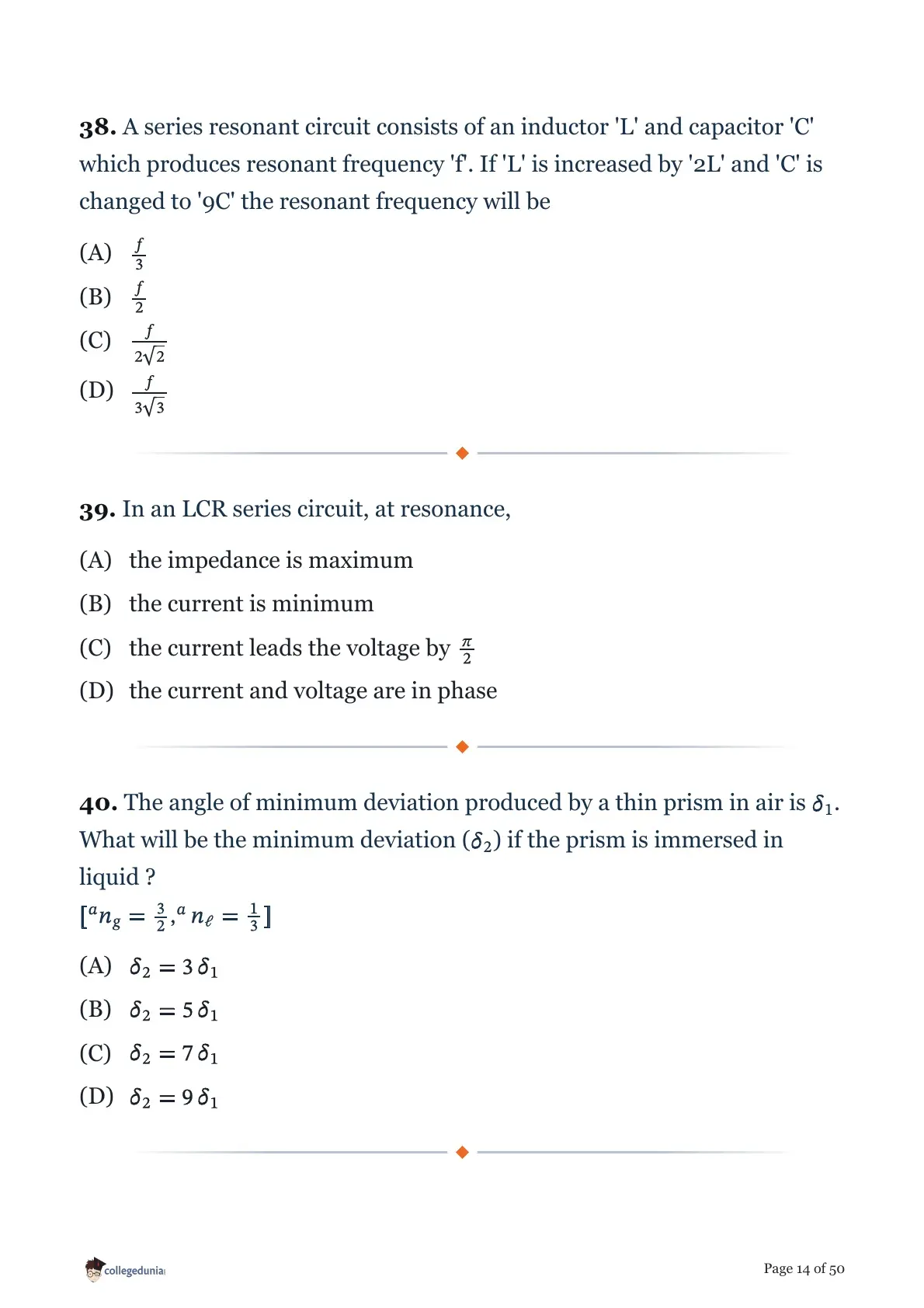
Question 38:

A series resonant circuit consists of an inductor 'L' and capacitor 'C' which produces resonant frequency 'f'. If 'L' is increased by '2L' and 'C' is changed to '9C' the resonant frequency will be

  • (A) \(\frac{f}{3}\)
  • (B) \(\frac{f}{2}\)
  • (C) \(\frac{f}{2\sqrt{2}}\)
  • (D) \(\frac{f}{3\sqrt{3}}\)

Question 39:

In an LCR series circuit, at resonance,

  • (A) the impedance is maximum
  • (B) the current is minimum
  • (C) the current leads the voltage by \(\frac{π}{2}\)
  • (D) the current and voltage are in phase

Question 40:

The angle of minimum deviation produced by a thin prism in air is \(δ_1\). What will be the minimum deviation (\(δ_2\)) if the prism is immersed in liquid ?
\([^an_g = \frac{3}{2}, ^an_{\ell} = \frac{1}{3}]\)

  • (A) \(δ_2 = 3\,δ_1\)
  • (B) \(δ_2 = 5\,δ_1\)
  • (C) \(δ_2 = 7\,δ_1\)
  • (D) \(δ_2 = 9\,δ_1\)

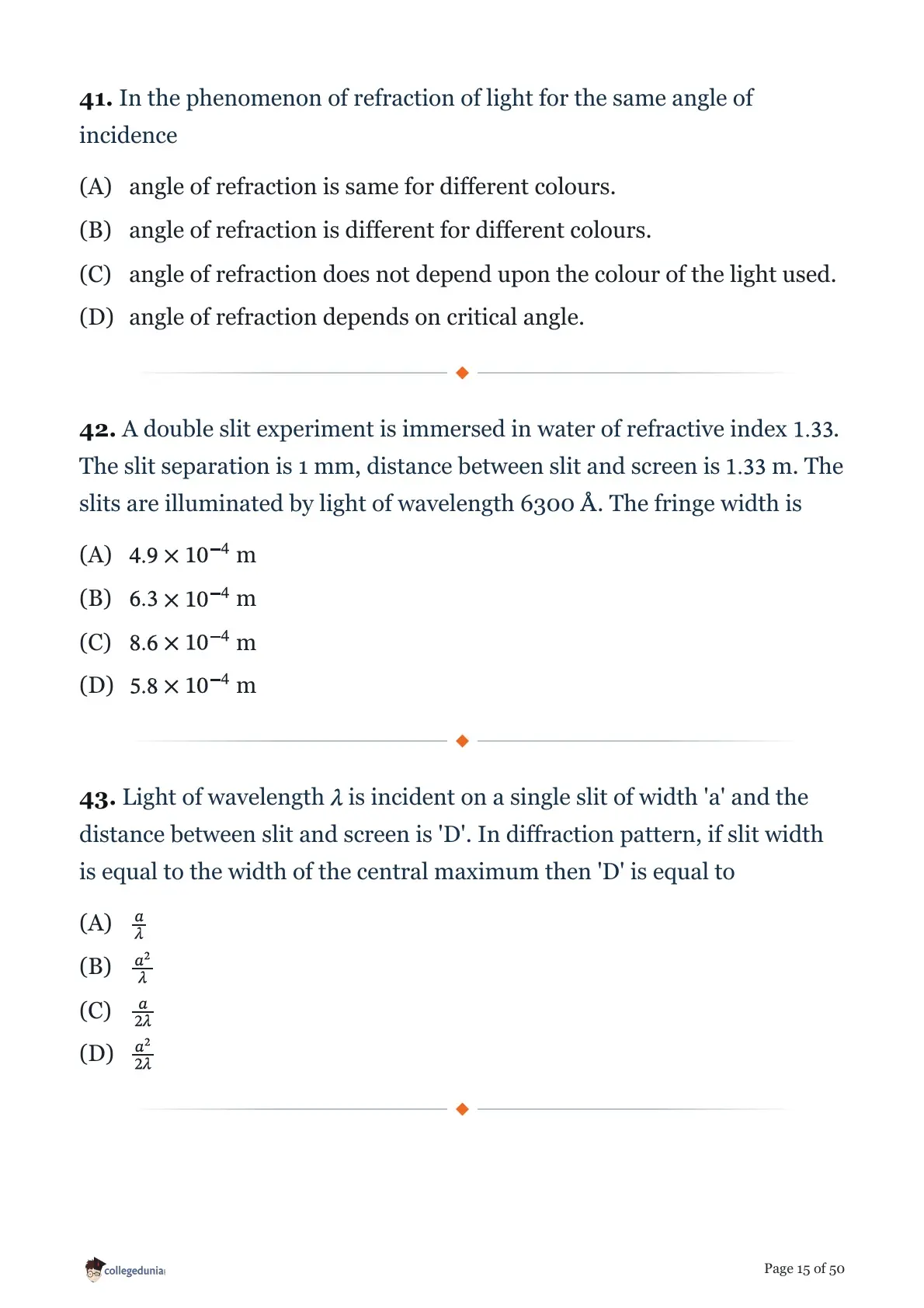
Question 41:

In the phenomenon of refraction of light for the same angle of incidence

  • (A) angle of refraction is same for different colours.
  • (B) angle of refraction is different for different colours.
  • (C) angle of refraction does not depend upon the colour of the light used.
  • (D) angle of refraction depends on critical angle.

Question 42:

A double slit experiment is immersed in water of refractive index \(1.33\). The slit separation is 1 mm, distance between slit and screen is \(1.33\) m. The slits are illuminated by light of wavelength 6300 \(\text{Å}\). The fringe width is

  • (A) \(4.9\times 10^{-4}\) m
  • (B) \(6.3\times 10^{-4}\) m
  • (C) \(8.6\times 10^{-4}\) m
  • (D) \(5.8\times 10^{-4}\) m

Question 43:

Light of wavelength \(λ\) is incident on a single slit of width 'a' and the distance between slit and screen is 'D'. In diffraction pattern, if slit width is equal to the width of the central maximum then 'D' is equal to

  • (A) \(\frac{a}{λ}\)
  • (B) \(\frac{a^2}{λ}\)
  • (C) \(\frac{a}{2λ}\)
  • (D) \(\frac{a^2}{2λ}\)

Question 44:

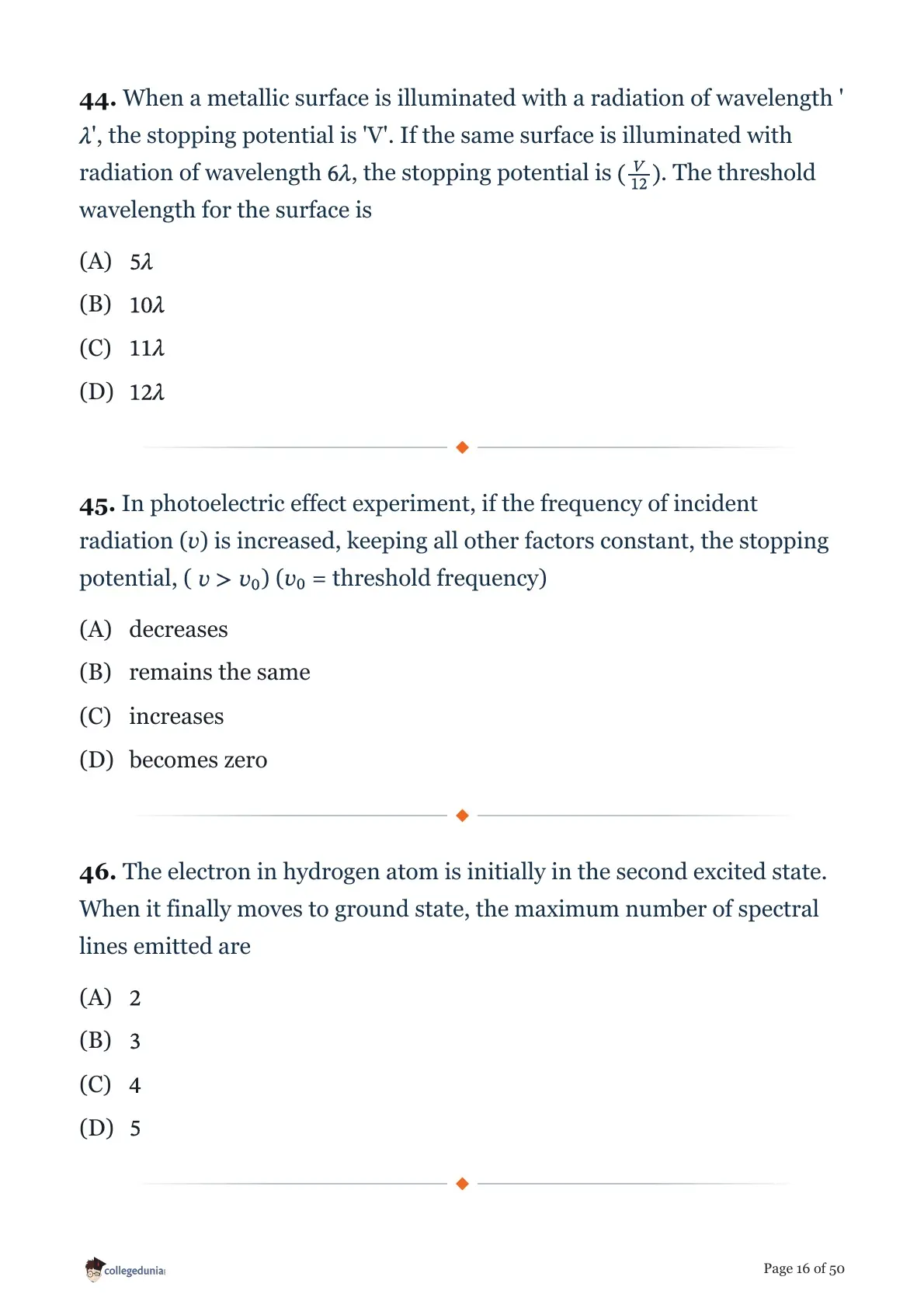
When a metallic surface is illuminated with a radiation of wavelength '\(λ\)', the stopping potential is 'V'. If the same surface is illuminated with radiation of wavelength \(6λ\), the stopping potential is \((\frac{V}{12})\). The threshold wavelength for the surface is

  • (A) \(5λ\)
  • (B) \(10λ\)
  • (C) \(11λ\)
  • (D) \(12λ\)

Question 45:

In photoelectric effect experiment, if the frequency of incident radiation (\(v\)) is increased, keeping all other factors constant, the stopping potential, ( \(v > v_0\)) (\(v_0\) = threshold frequency)

  • (A) decreases
  • (B) remains the same
  • (C) increases
  • (D) becomes zero

Question 46:

The electron in hydrogen atom is initially in the second excited state. When it finally moves to ground state, the maximum number of spectral lines emitted are

  • (A) \(2\)
  • (B) \(3\)
  • (C) \(4\)
  • (D) \(5\)

Question 47:

In the hydrogen atom, radii of the first four Bohr orbits are related as

  • (A) \(1:2:3:4\)
  • (B) \(\frac{1}{2}:\frac{1}{3}:\frac{1}{4}\)
  • (C) \(1:4:9:16\)
  • (D) \(\frac{1}{4}:\frac{1}{9}:\frac{1}{16}\)

Question 48:

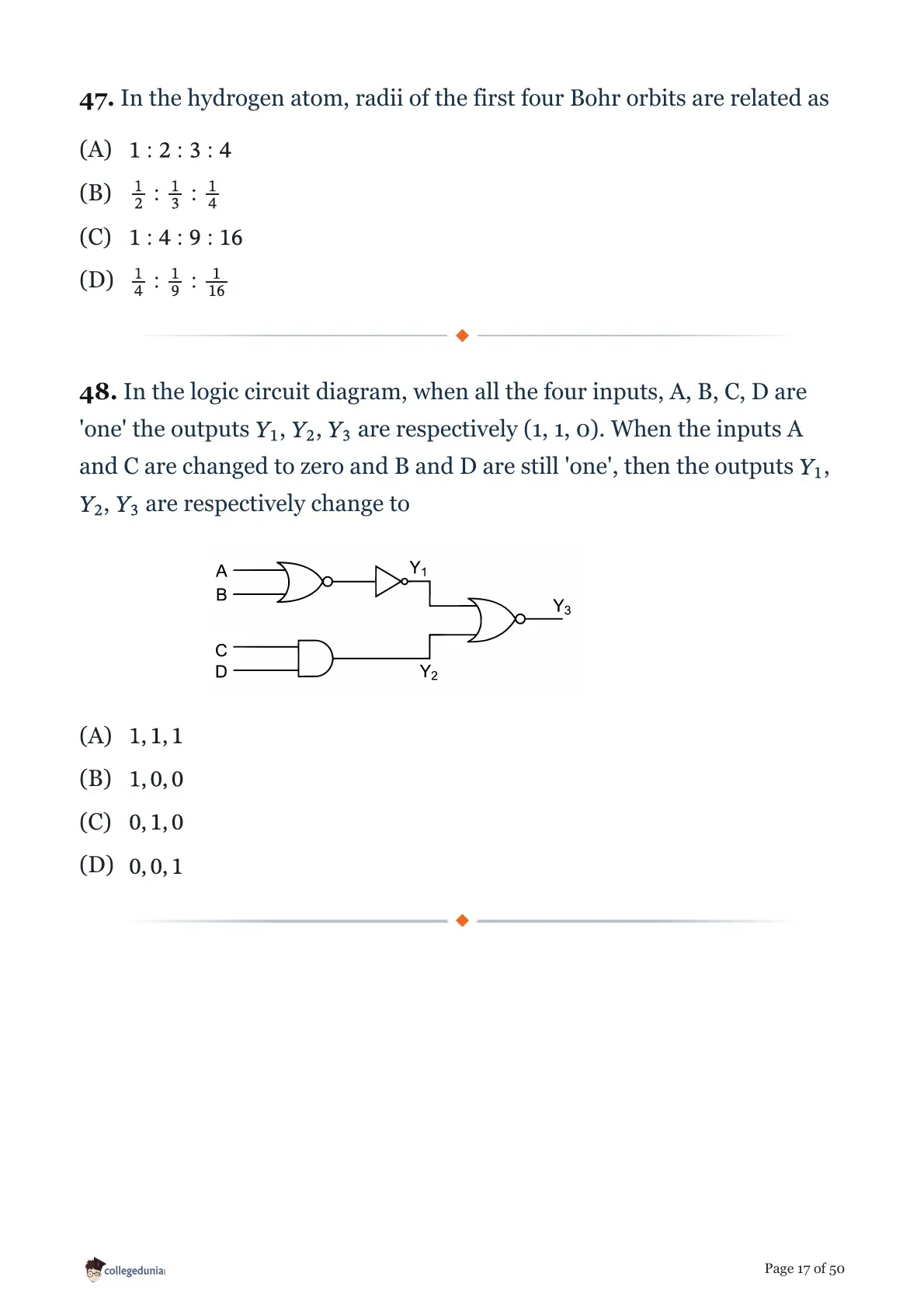
In the logic circuit diagram, when all the four inputs, A, B, C, D are 'one' the outputs \(Y_1\), \(Y_2\), \(Y_3\) are respectively (1, 1, 0). When the inputs A and C are changed to zero and B and D are still 'one', then the outputs \(Y_1\), \(Y_2\), \(Y_3\) are respectively change to

  • (A) \(1,1,1\)
  • (B) \(1,0,0\)
  • (C) \(0,1,0\)
  • (D) \(0,0,1\)

Question 49:

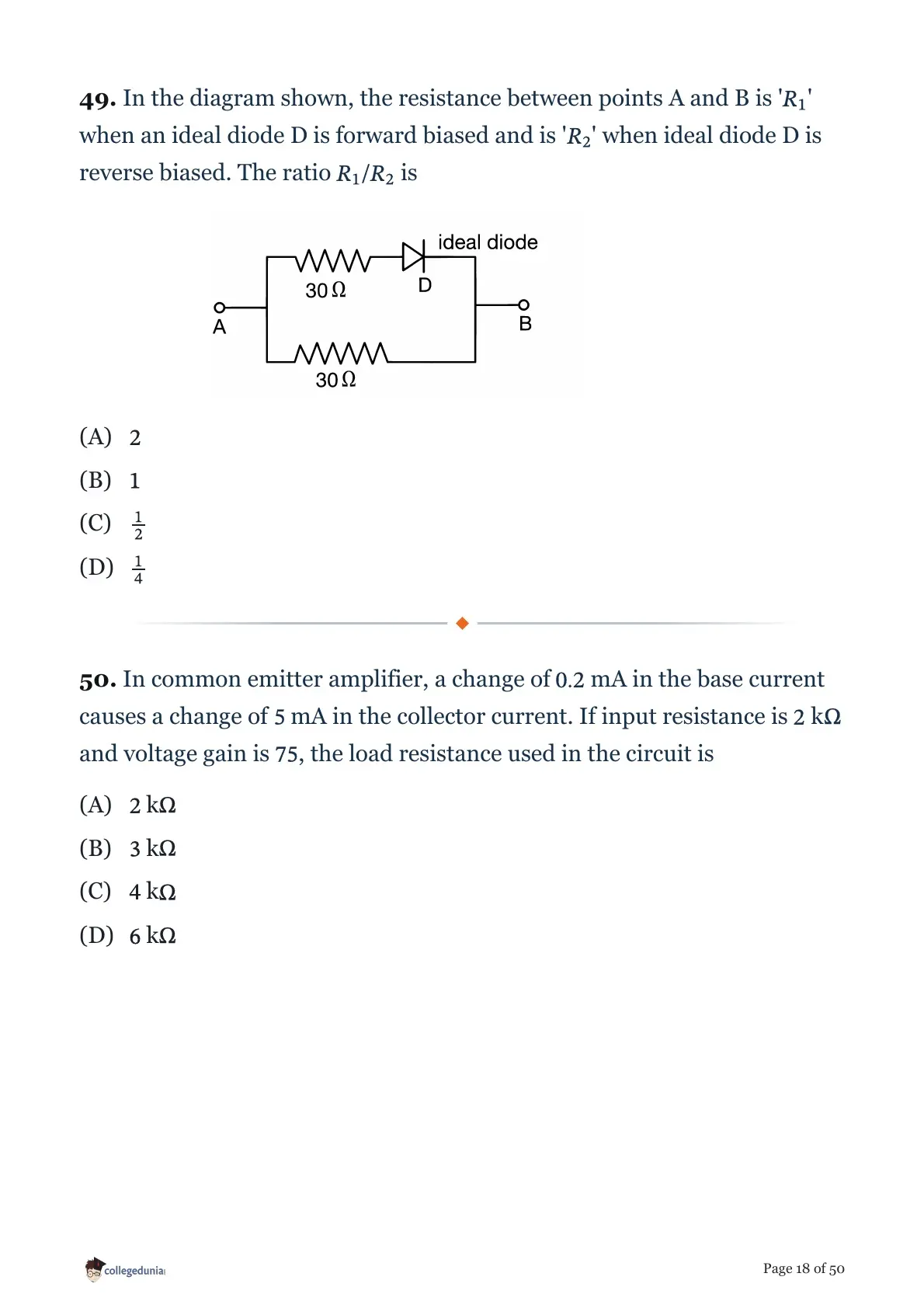
In the diagram shown, the resistance between points A and B is '\(R_1\)' when an ideal diode D is forward biased and is '\(R_2\)' when ideal diode D is reverse biased. The ratio \(R_1/R_2\) is

  • (A) \(2\)
  • (B) \(1\)
  • (C) \(\frac{1}{2}\)
  • (D) \(\frac{1}{4}\)

Question 50:

In common emitter amplifier, a change of \(0.2\) mA in the base current causes a change of \(5\) mA in the collector current. If input resistance is \(2\) k\(\Omega\) and voltage gain is \(75\), the load resistance used in the circuit is

  • (A) \(2\) k\(\Omega\)
  • (B) \(3\) k\(\Omega\)
  • (C) \(4\) k\(\Omega\)
  • (D) \(6\) k\(\Omega\)

Chemistry Section (Questions 51 to 100)


Question 51:

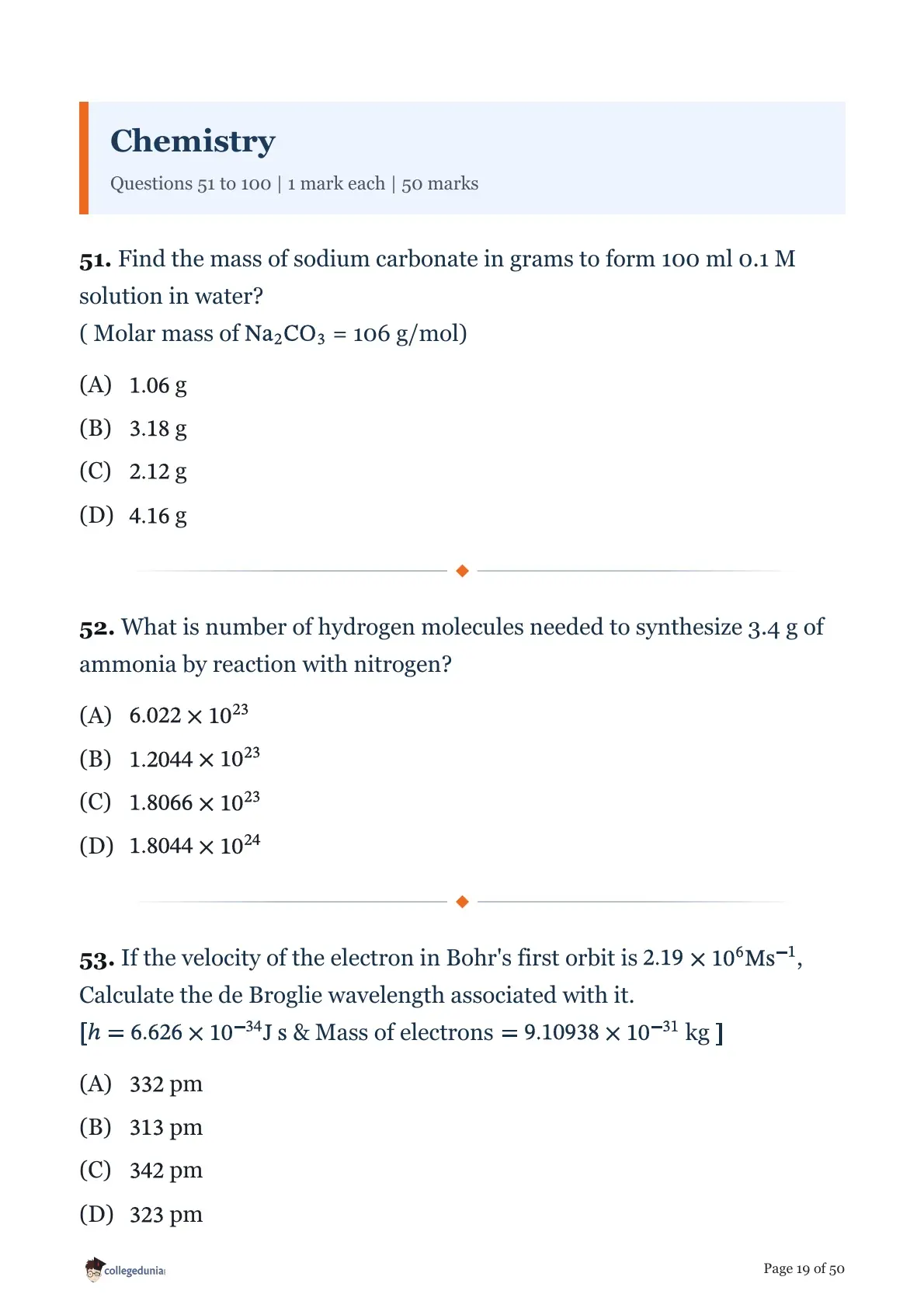
Find the mass of sodium carbonate in grams to form 100 ml 0.1 M solution in water?
( Molar mass of \(\text{Na}_2\text{CO}_3\) = 106 g/mol)

  • (A) \(1.06\) g
  • (B) \(3.18\) g
  • (C) \(2.12\) g
  • (D) \(4.16\) g

Question 52:

What is number of hydrogen molecules needed to synthesize 3.4 g of ammonia by reaction with nitrogen?

  • (A) \(6.022\times 10^{23}\)
  • (B) \(1.2044\times 10^{23}\)
  • (C) \(1.8066\times 10^{23}\)
  • (D) \(1.8044\times 10^{24}\)

Question 53:

If the velocity of the electron in Bohr's first orbit is \(2.19\times 10^6 \text{Ms}^{-1}\), Calculate the de Broglie wavelength associated with it.
\([h = 6.626\times 10^{-34} \text{J s}\) & Mass of electrons \(= 9.10938\times 10^{-31}\) kg \(]\)

  • (A) \(332\) pm
  • (B) \(313\) pm
  • (C) \(342\) pm
  • (D) \(323\) pm

Question 54:

Identify the group of periodic table that contains element Astatine.

  • (A) \(17\)
  • (B) \(16\)
  • (C) \(18\)
  • (D) \(1\)

Question 55:

What type of bond and type of overlapping present in \(\text{N}_2\) molecule ?

  • (A) Single bond and s\(-\)s overlap
  • (B) Double bond and s\(-\)p overlap
  • (C) Triple bond and p\(-\)p overlap
  • (D) Double bond and p\(-\)p overlap

Question 56:

Calculate the new pressure of the gas enclosed in a cylinder when it compressed from 5 L to 2 L at 1 atm and 300 K. The final temperature in this process is 500 K.

  • (A) \(1.5\) atm
  • (B) \(3.12\) atm
  • (C) \(2.5\) atm
  • (D) \(4.16\) atm

Question 57:

For a certain reaction, \(\Delta H^0\) is \(-345\) kJ and \(\Delta S^0\) is \(-123 \text{JK}^{-1}\). At what temperature the change over from spontaneous to nonspontaneous will occur?

  • (A) \(1052\) K
  • (B) \(1956\) K
  • (C) \(2568\) K
  • (D) \(2805\) K

Question 58:

For a reaction to be spontaneous at all temperatures, the values of enthalpy change and entropy change should be

  • (A) \(\Delta H > 0\) and \(\Delta S > 0\)
  • (B) \(\Delta H < 0\) and \(\Delta S > 0\)
  • (C) \(\Delta H < 0\) and \(\Delta S < 0\)
  • (D) \(\Delta H > 0\) and \(\Delta S < 0\)

Question 59:

Find \(\Delta n\) when 1 mol of each \(\text{NH}_{3(g)}\) and \(\text{HCl}_{(g)}\), reacts to form solid \(\text{NH}_4\text{Cl}\).

  • (A) \(1\)
  • (B) \(-2\)
  • (C) \(-1\)
  • (D) \(-3\)

Question 60:

What is the solubility product of binary sparingly soluble salt BA if 100 mL saturated solution of salt consist \(10^{-4}\) moles at room temperature?

  • (A) \(1\times 10^{-4}\)
  • (B) \(1\times 10^{-6}\)
  • (C) \(1\times 10^{-8}\)
  • (D) \(1\times 10^{-10}\)

Question 61:

Calculate pOH of 0.001M HCl solution.

  • (A) \(11\)
  • (B) \(10\)
  • (C) \(12\)
  • (D) \(3\)

Question 62:

Identify from following the conjugate base of \([\text{Zn}(\text{H}_2\text{O})_4]^{2+}\)

  • (A) \([\text{Zn}(\text{H}_2\text{O})_4]^{2-}\,\text{NH}_3\)
  • (B) \([\text{Zn}(\text{H}_2\text{O})_3]^{2-}\)
  • (C) \([\text{Zn}(\text{H}_2\text{O})_3\text{OH}]^+\)
  • (D) \([\text{Zn}(\text{H}_2\text{O})\text{H}]^{3+}\)

Question 63:

For the following redox reaction, find the correct statement.
\(\text{Sn}^{2+}+2\text{Fe}^{3+}\rightarrow \text{Sn}^{4+}+2\text{Fe}^{2+}\)

  • (A) \(\text{Sn}^{2+}\) is undergoing oxidation.
  • (B) \(\text{Fe}^{3+}\) is undergoing oxidation.
  • (C) It is not a redox reaction.
  • (D) Both \(\text{Sn}^{2+}\) and \(\text{Fe}^{3+}\) are oxidized.

Question 64:

Which of the following is the most abundant element in universe?

  • (A) \(\text{H}\)
  • (B) \(\text{O}\)
  • (C) \(\text{Ne}\)
  • (D) \(\text{C}\)

Question 65:

What is the correct IUPAC name for a molecule that has two amino groups in opposing (para) locations around a benzene ring?

  • (A) Benzenediamine
  • (B) Benzene-1,4-diamine
  • (C) p-Aminoaniline
  • (D) 4-Aminobenzenamine

Question 66:

What is IUPAC name of the compound \(\text{CH}_3\text{CH=CHCH=CHCOOH}\) ?

  • (A) Hexanedioc acid
  • (B) Hexa-2,4-dienoic acid
  • (C) Penta-1,3-dienoic acid
  • (D) Pentenedioc acid

Question 67:

Match List I with List II

List IList II
(A). Inductive effect(I). Delocalization of \(π\) electrons
(B). Hyper-conjugation(II). Displacement of \(π\) electrons
(C). Resonance effect(III). Delocalization of \(σ\) electrons
(IV). Displacement of \(σ\) electrons

Choose the correct answer from the options given below:

  • (A) \((A)-(IV),(B)-(III),(C)-(I)\)
  • (B) \((A)-(II),(B)-(IV),(C)-(I)\)
  • (C) \((A)-(I),(B)-(II),(C)-(IV)\)
  • (D) \((A)-(III),(B)-(IV),(C)-(I)\)

Question 68:

What are the reactants involved in Friedal Crafts alkylation?

  • (A) \(\text{C}_6\text{H}_6+\text{NH}_3\)
  • (B) \(\text{C}_6\text{H}_6+\text{CH}_3\text{Cl}\)
  • (C) \(\text{C}_6\text{H}_6+\text{CH}_3\text{COCl}\)
  • (D) \(\text{C}_6\text{H}_6+\text{CH}_4\)

Question 69:

Identify the false statement regarding magnetic properties of substance.
(A) Paramagnetic substances are weakly attracted.
(B) Diamagnetic substances are weakly attracted.
(C) Ferromagnetic substances strongly attracted.
(D) Diamagnetic substance strongly attracted

  • (A) (A) and (C) only
  • (B) (A), (B), (C) and (D)
  • (C) (B) and (D) only
  • (D) (A) and (B) only

Question 70:

Calculate the number of atoms present in 1.625 g metal if it forms bcc unit cell structure.
\([ρ\times a^3 = 3.25\times 10^{-22} \text{g}]\)

  • (A) \(2.0\times 10^{22}\)
  • (B) \(1.5\times 10^{22}\)
  • (C) \(2.5\times 10^{22}\)
  • (D) \(1.0\times 10^{22}\)

Question 71:

Identify the covalent crystal from the following.

  • (A) \(\text{Fe}\)
  • (B) \(\text{CH}_4\)
  • (C) \(\text{SiO}_2\)
  • (D) \(\text{KCl}\)

Question 72:

If a 0.4 molal solution of a nonvolatile solute in organic solvent decreases its freezing point by 2.4 K., then the molal depression constant of solvent will be

  • (A) \(3.0 \text{K kg mol}^{-1}\)
  • (B) \(4.0 \text{K kg mol}^{-1}\)
  • (C) \(5.0 \text{K kg mol}^{-1}\)
  • (D) \(6.0 \text{K kg mol}^{-1}\)

Question 73:

Which of the following colligative properties is useful to determine the molar masses of proteins, polymers or colloids, with the greatest precision?

  • (A) Elevation in boiling point
  • (B) Depression in freezing point
  • (C) Osmotic pressure
  • (D) Relative lowering of vapour pressure

Question 74:

Calculate the concentration of silver nitrate solution if molar conductivity and conductivity of silver nitrate at \(25^{\circ}\)C are respectively 120 ohm\(^{-1}\) cm\(^2\) mol\(^{-1}\) and 0.0024 ohm\(^{-1}\) cm\(^{-1}\).

  • (A) \(0.01\) M
  • (B) \(0.02\) M
  • (C) \(0.03\) M
  • (D) \(0.04\) M

Question 75:

The \(E_{\text{cell}}^0\) of \(\text{Al}_{(s)}|\text{Al}^{3+}(1\text{M})||\text{Pb}^{2+}(1\text{M})|\text{Pb}_{(s)}\) cell is 1.5 V if \(E_{\text{Pb}}^0\) is \(-0.14\) V then \(E_{\text{Al}}^0\) will be

  • (A) \(1.64\) V
  • (B) \(-1.64\) V
  • (C) \(1.36\) V
  • (D) \(-1.36\) V

Question 76:

Which of the following is an electrolyte in dry cell ?

  • (A) Potassium hydroxide
  • (B) Sulphuric acid
  • (C) Ammonium chloride and zinc chloride
  • (D) Manganese dioxide

Question 77:

The rate of reaction \(\text{A}+\text{B}\rightarrow \text{P}\) is \(4\times 10^{-2} \text{mol dm}^{-3} \text{s}^{-1}\)
When \([A] = 0.2 \text{mole dm}^{-3}\) and \([B] = 0.1 \text{mole dm}^{-3}\), What is the rate constant of reaction, if it is first order with respect to A and second order with respect to B ?

  • (A) \(10 \text{mol}^{-2}\text{dm}^6 \text{s}^{-1}\)
  • (B) \(20 \text{mol}^{-2}\text{dm}^6 \text{s}^{-1}\)
  • (C) \(25 \text{mol}^{-2}\text{dm}^6 \text{s}^{-1}\)
  • (D) \(40 \text{mol}^{-2}\text{dm}^6 \text{s}^{-1}\)

Question 78:

For the reaction \(2\text{A}⟶3\text{C}+\text{D}\), the rate of reaction is represented by

  • (A) \(-\text{d}[A]/\text{dt} = -\text{d}[D]/\text{dt}\)
  • (B) \(-\text{d}[C]/\text{dt} = -2\text{d}[A]/\text{dt}\)
  • (C) \(-\text{d}[A]/\text{dt} = -\text{d}[D]/\text{dt}\)
  • (D) \(-\frac{1}{2}\frac{\text{d}[A]}{\text{dt}} = +\frac{1}{3}\frac{\text{d}[C]}{\text{dt}}\)

Question 79:

Which of the following is applicable to thin film?

  • (A) One dimensional nanostructure
  • (B) Zero dimensional nanostructure
  • (C) Two dimensional nanostructure
  • (D) Three dimensional nanostructure

Question 80:

What is the role of catalyst in catalytic reaction ?

  • (A) It decreases the enthalpy of reaction.
  • (B) It increases the enthalpy of reaction.
  • (C) It decreases the energy of activation of reaction.
  • (D) It increases the energy of activation of reaction.

Question 81:

Which of the following exhibits the minimum coagulating power for precipitating of positively charged ferric oxide sol ?

  • (A) \(\text{KNO}_3\)
  • (B) \(\text{K}_2\text{SO}_4\)
  • (C) \(\text{K}_3\text{PO}_4\)
  • (D) \(\text{K}_4\text{Fe(CN)}_6\)

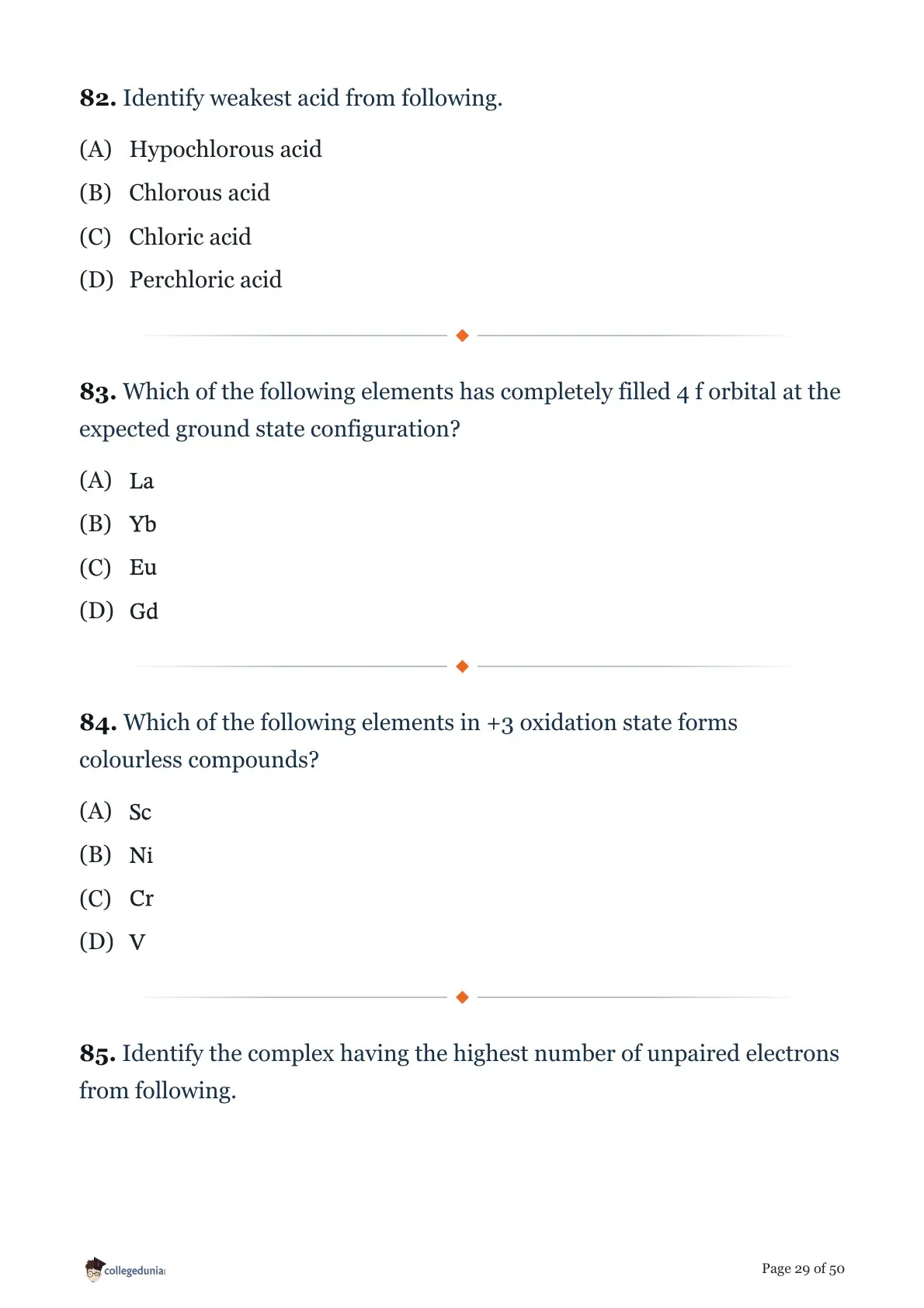
Question 82:

Identify weakest acid from following.

  • (A) Hypochlorous acid
  • (B) Chlorous acid
  • (C) Chloric acid
  • (D) Perchloric acid

Question 83:

Which of the following elements has completely filled 4 f orbital at the expected ground state configuration?

  • (A) \(\text{La}\)
  • (B) \(\text{Yb}\)
  • (C) \(\text{Eu}\)
  • (D) \(\text{Gd}\)

Question 84:

Which of the following elements in +3 oxidation state forms colourless compounds?

  • (A) \(\text{Sc}\)
  • (B) \(\text{Ni}\)
  • (C) \(\text{Cr}\)
  • (D) \(\text{V}\)

Question 85:

Identify the complex having the highest number of unpaired electrons from following.

  • (A) \([\text{Co(NH}_3)_6]^{3+}\)
  • (B) \([\text{CoF}_6]^{3-}\)
  • (C) \([\text{NiCl}_4]^{2-}\)
  • (D) \([\text{Ni(CN)}_4]^{2-}\)

Question 86:

Which of the following ligands splits d orbitals to maximum level?

  • (A) \(\text{CN}^-\)
  • (B) \(\text{H}_2\text{O}\)
  • (C) \(\text{Cl}^-\)
  • (D) \(\text{NH}_3\)

Question 87:

Which of the following is used as solvent for Grignard reagent?

  • (A) Alcohol
  • (B) Ether
  • (C) Phenol
  • (D) Ketone

Question 88:

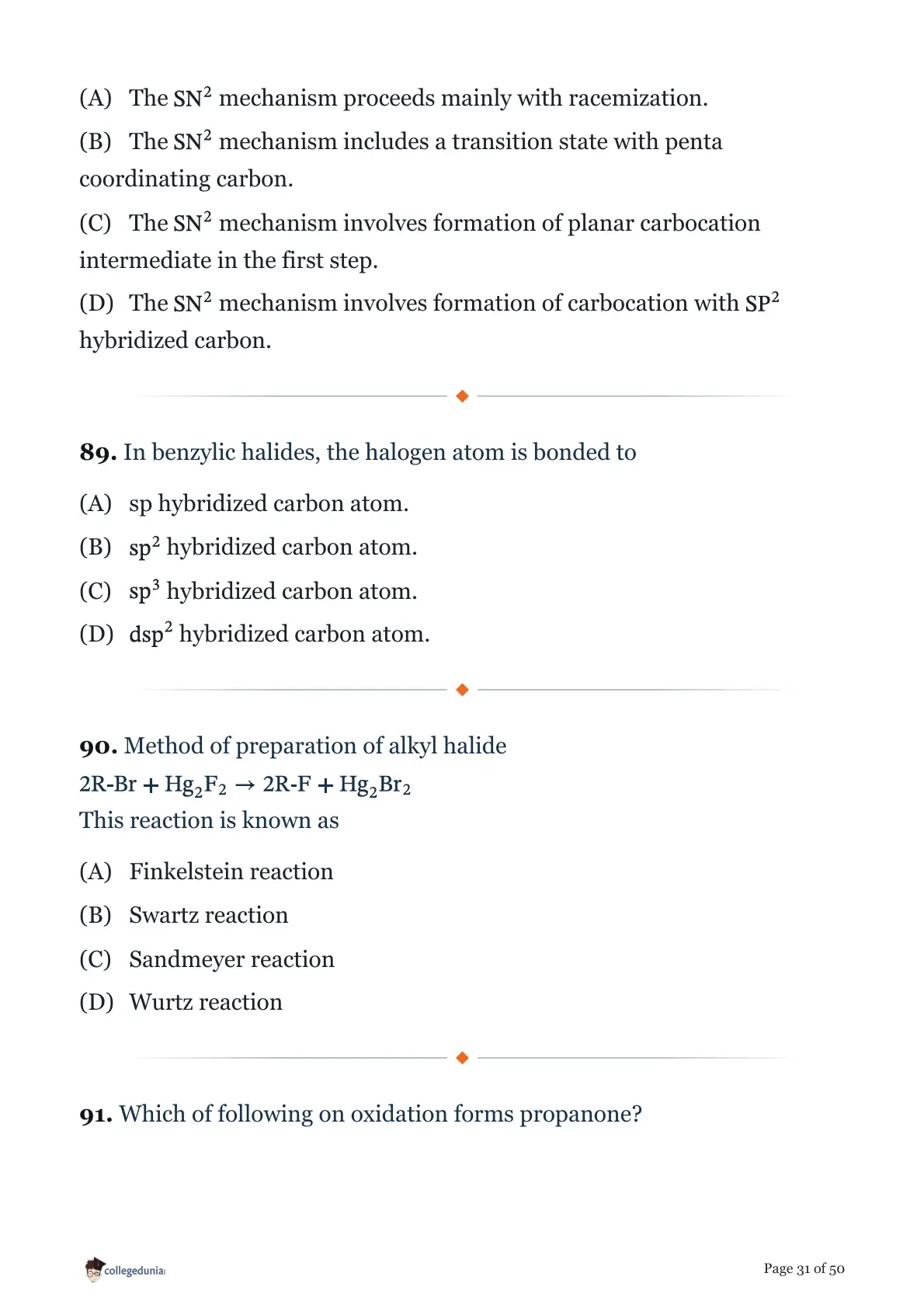
Which of the following is a correct feature of the \(\text{SN}^2\) mechanism?

  • (A) The \(\text{SN}^2\) mechanism proceeds mainly with racemization.
  • (B) The \(\text{SN}^2\) mechanism includes a transition state with penta coordinating carbon.
  • (C) The \(\text{SN}^2\) mechanism involves formation of planar carbocation intermediate in the first step.
  • (D) The \(\text{SN}^2\) mechanism involves formation of carbocation with \(\text{SP}^2\) hybridized carbon.

Question 89:

In benzylic halides, the halogen atom is bonded to

  • (A) sp hybridized carbon atom.
  • (B) \(\text{sp}^2\) hybridized carbon atom.
  • (C) \(\text{sp}^3\) hybridized carbon atom.
  • (D) \(\text{dsp}^2\) hybridized carbon atom.

Question 90:

Method of preparation of alkyl halide
\(2\text{R-Br}+\text{Hg}_2\text{F}_2\rightarrow 2\text{R-F}+\text{Hg}_2\text{Br}_2\)
This reaction is known as

  • (A) Finkelstein reaction
  • (B) Swartz reaction
  • (C) Sandmeyer reaction
  • (D) Wurtz reaction

Question 91:

Which of following on oxidation forms propanone?

  • (A) 1-Propanol
  • (B) 2-Propanol
  • (C) 2-Butanol
  • (D) 2- methylbutan-1-ol

Question 92:

Identify the name of reaction when phenol reacts with chloroform in aqueous NaOH.

  • (A) Kolbe's reaction
  • (B) Reimer-Tiemann reaction
  • (C) Williamson synthesis
  • (D) Friedel-Crafts acylation

Question 93:

Which of the following compounds is obtained by Williamson synthesis ?

  • (A) only simple ethers
  • (B) only mixed ethers
  • (C) simple and mixed ethers.
  • (D) esters

Question 94:

Which of the following is the strongest carboxylic acid?

  • (A) \(\text{CH}_3\text{COOH}\)
  • (B) \(\text{HCOOH}\)
  • (C) \(\text{CH}_3\text{CH}_2\text{-COOH}\)
  • (D) \(\text{ClCH}_2\text{COOH}\)

Question 95:

Which of the following amines is not represented by formula \(\text{C}_3\text{H}_9\text{N}\) ?

  • (A) \(1^{\circ}\) amine
  • (B) \(2^{\circ}\) amine
  • (C) \(3^{\circ}\) amine
  • (D) quaternary ammonium salt

Question 96:

Which of the following statements are correct?
A) \(α\) - amino acids present in protein is L- amino acid.
B) Amino acids contain \(\text{NH}_2\) as well as COOH group.
C) Number of amino group and carboxylic group are same in amino acids always.
D) Tryosine was firstly obtained from cheese.
Choose the correct alternatives from below:

  • (A) A and B only
  • (B) A, B and C only
  • (C) B, C and D only
  • (D) A, B and D only

Question 97:

During denaturation, which level of protein structure remains unchanged?

  • (A) primary
  • (B) secondary
  • (C) tertiary
  • (D) quaternary

Question 98:

Identify the natural source of ascorbic acid from following.

  • (A) Citrus fruits
  • (B) Cinnamon
  • (C) Turmeric
  • (D) Clove

Question 99:

Identify the monomers used to prepare bakelite from the following.

  • (A) phenol , chloroform
  • (B) formaldehyde , NaOH
  • (C) phenol , methanal
  • (D) aniline , urea

Question 100:

Which among the following is NOT a polyester polymer ?

  • (A) Glyptal
  • (B) Novolac
  • (C) PHBV
  • (D) Dacron

Mathematics Section (Questions 101 to 150)


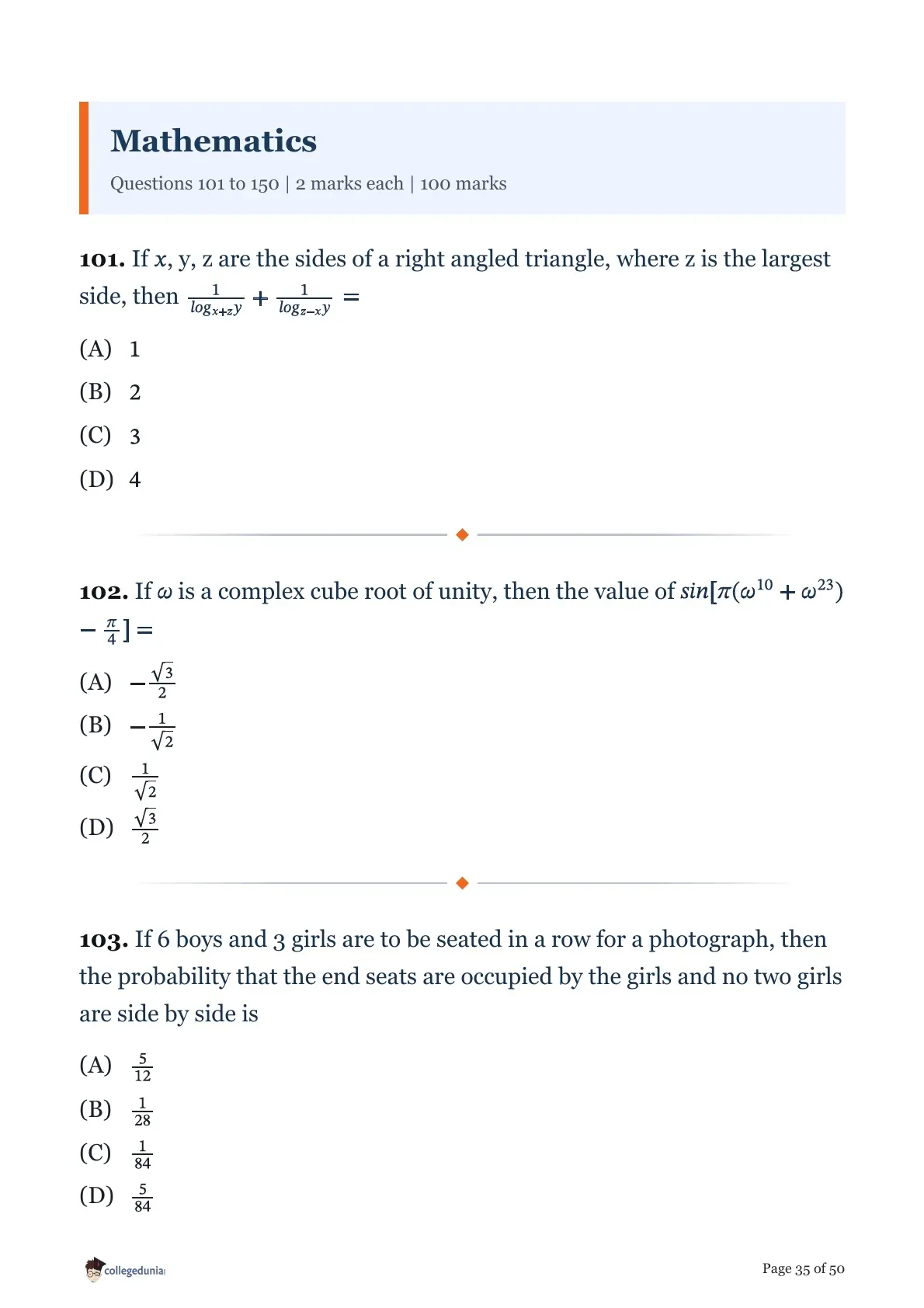
Question 101:

If \(x\), y, z are the sides of a right angled triangle, where z is the largest side, then \(\frac{1}{log_{x+z}y}+\frac{1}{log_{z-x}y} =\)

  • (A) \(1\)
  • (B) \(2\)
  • (C) \(3\)
  • (D) \(4\)

Question 102:

If \(ω\) is a complex cube root of unity, then the value of \(sin[π(ω^{10}+ω^{23})-\frac{π}{4}] =\)

  • (A) \(-\frac{\sqrt{3}}{2}\)
  • (B) \(-\frac{1}{\sqrt{2}}\)
  • (C) \(\frac{1}{\sqrt{2}}\)
  • (D) \(\frac{\sqrt{3}}{2}\)

Question 103:

If 6 boys and 3 girls are to be seated in a row for a photograph, then the probability that the end seats are occupied by the girls and no two girls are side by side is

  • (A) \(\frac{5}{12}\)
  • (B) \(\frac{1}{28}\)
  • (C) \(\frac{1}{84}\)
  • (D) \(\frac{5}{84}\)

Question 104:

A bag contains 23 balls, of which 7 are identical. The number of ways of selecting 12 balls from the bag is....

  • (A) \(^{18}C_6+^{18}C_8\)
  • (B) \(^{18}C_7+^{19}C_8\)
  • (C) \(^{16}C_8+^{18}C_{15}\)
  • (D) \(^{16}C_8+^{18}C_9\)

Question 105:

The approximate value of \((0.007)^{\frac{1}{3}}\) is

  • (A) \(\frac{21}{120}\)
  • (B) \(\frac{23}{120}\)
  • (C) \(\frac{29}{120}\)
  • (D) \(\frac{31}{120}\)

Question 106:

If \(33θ = π\), then the value of \(cosθcos2θcos4θcos8θcos16θ\) is

  • (A) \(\frac{1}{16}\)
  • (B) \(\frac{1}{32}\)
  • (C) \(\frac{1}{64}\)
  • (D) \(\frac{-1}{32}\)

Question 107:

If \(sec4θ-sec2θ = 2\), then \(θ =\)

  • (A) \(nπ+\frac{π}{8},\frac{nπ}{5}+\frac{π}{6},n\in Z\)
  • (B) \(nπ+\frac{π}{6},\frac{nπ}{5}+\frac{π}{8},n\in Z\)
  • (C) \(nπ+\frac{π}{2},\frac{nπ}{5}+\frac{π}{10},n\in Z\)
  • (D) \(nπ+\frac{π}{3},nπ+\frac{π}{10},n\in Z\)

Question 108:

The equation of the line passing through the point of intersection of the lines \(x+2y+6 = 0\) and \(2x-y = 2\) and making an intercept 5 on the y-axis is

  • (A) \(39x+2y-10 = 0\)
  • (B) \(39x-2y+10 = 0\)
  • (C) \(x+4y-20 = 0\)
  • (D) \(x-4y+20 = 0\)

Question 109:

The line \(x+y = 3\) intersects the pair of straight lines \(x^2-3xy+y^2 = 0\) at points A and B. Then the co-ordinates of the mid-point of AB are

  • (A) \((\frac{5}{2},\frac{3}{2})\)
  • (B) \((\frac{1}{2},\frac{1}{2})\)
  • (C) \((-\frac{3}{2},\frac{1}{2})\)
  • (D) \((\frac{3}{2},\frac{3}{2})\)

Question 110:

The angle between the tangents drawn from the origin to the circle \((x-7)^2+(y+1)^2 = 25\) is

  • (A) \(45^{\circ}\)
  • (B) \(90^{\circ}\)
  • (C) \(60^{\circ}\)
  • (D) \(30^{\circ}\)

Question 111:

The equation of the common tangent touching the circle \((x-3)^2+y^2 = 9\) and the parabola \(y^2 = 4x\) above the X-axis is

  • (A) \(\sqrt{3}y = 3x+1\)
  • (B) \(\sqrt{3}y = -(x+3)\)
  • (C) \(\sqrt{3}y = x+3\)
  • (D) \(\sqrt{3}y = -(3x+1)\)

Question 112:

If \(\underset{x\rightarrow \infty }{lim}\frac{(2x-1)^{19}\cdot (3x+2)^{11}}{(6x-5)^{30}} = 2^a\cdot 3^b\), then \(a+b =\)

  • (A) \(-30\)
  • (B) \(-11\)
  • (C) \(-19\)
  • (D) \(30\)

Question 113:

The dual of the statement pattern \((p∧\sim q)⟶(q∧\sim p)\) is equivalent to

  • (A) \(\sim (p\rightarrow q)∧(q\rightarrow p)\)
  • (B) \((p\rightarrow q)∧\sim (q\rightarrow p)\)
  • (C) \((\sim p\rightarrow q)∧(q\rightarrow p)\)
  • (D) \((q\rightarrow p)∨(\sim p\rightarrow \sim q)\)

Question 114:

Negation of the statement "If an integer is greater than 4 and less than 5, then it is a multiple of 3", is

  • (A) An integer is not greater than 4 but less than 5 and it is a multiple of 3.
  • (B) If an integer is not greater than 4 and less than 5 then it is not a multiple of 3.
  • (C) An integer is greater than 4 and less than 5 but it is not a multiple of 3.
  • (D) An integer is not greater than 4 and not less than 5 but it is not a multiple of 3.

Question 115:

In a triangle ABC, with the usual notations, \(\angle B = \frac{π}{3}\), \(\angle C = \frac{π}{4}\). If D divides BC internally in the ratio 1:3, then \(\frac{sin\angle BAD}{sin\angle CAD} =\)

  • (A) \(\frac{1}{3}\)
  • (B) \(\frac{1}{\sqrt{3}}\)
  • (C) \(\frac{1}{\sqrt{6}}\)
  • (D) \(\sqrt{\frac{2}{3}}\)

Question 116:

Let \(P_1\), \(P_2\), \(P_3\) be the altitudes of a triangle ABC from the vertices A, B, C respectively. If \(△\) denotes the area of the triangle and s is the semi-perimeter of the triangle, then \(\frac{cosA}{P_1}+\frac{cosB}{P_2}+\frac{cosC}{P_3} =\)

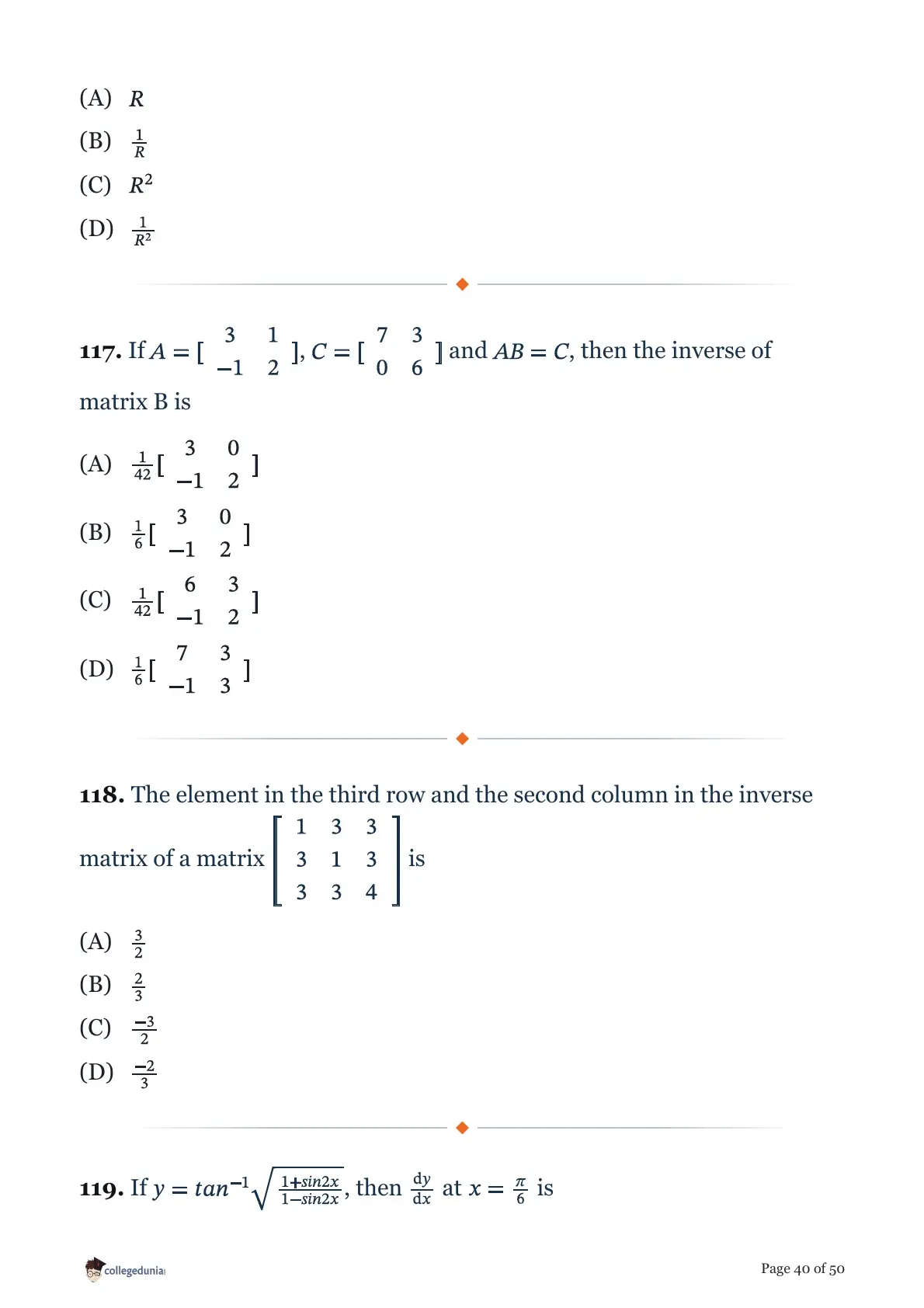
  • (A) \(R\)
  • (B) \(\frac{1}{R}\)
  • (C) \(R^2\)
  • (D) \(\frac{1}{R^2}\)

Question 117:

If \(A = [\begin{array}{cc}3 & 1 \\ -1 & 2\end{array}]\), \(C = [\begin{array}{cc}7 & 3 \\ 0 & 6\end{array}]\) and \(AB = C\), then the inverse of matrix B is

  • (A) \(\frac{1}{42}[\begin{array}{cc}3 & 0 \\ -1 & 2\end{array}]\)
  • (B) \(\frac{1}{6}[\begin{array}{cc}3 & 0 \\ -1 & 2\end{array}]\)
  • (C) \(\frac{1}{42}[\begin{array}{cc}6 & 3 \\ -1 & 2\end{array}]\)
  • (D) \(\frac{1}{6}[\begin{array}{cc}7 & 3 \\ -1 & 3\end{array}]\)

Question 118:

The element in the third row and the second column in the inverse matrix of a matrix \(\left[ \begin{array}{ccc}1 & 3 & 3 \\ 3 & 1 & 3 \\ 3 & 3 & 4\end{array} \right]\) is

  • (A) \(\frac{3}{2}\)
  • (B) \(\frac{2}{3}\)
  • (C) \(\frac{-3}{2}\)
  • (D) \(\frac{-2}{3}\)

Question 119:

If \(y = tan^{-1}\sqrt{\frac{1+sin2x}{1-sin2x}}\), then \(\frac{\text{d}y}{\text{d}x}\) at \(x = \frac{π}{6}\) is

  • (A) \(0\)
  • (B) \(1\)
  • (C) \(\frac{1}{2}\)
  • (D) \(\frac{\sqrt{3}}{2}\)

Question 120:

The value of \(tan^{-1}(\frac{cos(\frac{19π}{4})-1}{sin(\frac{π}{4})})\) is equal to

  • (A) \(-\frac{π}{4}\)
  • (B) \(-\frac{5π}{12}\)
  • (C) \(-\frac{3π}{8}\)
  • (D) \(-\frac{4π}{9}\)

Question 121:

The value of f(0) so that the function \(f(x) = \frac{(256-8x)^{\frac{1}{4}}-4}{16-4(64+3x)^{\frac{1}{3}}}\), \(x\neq 0\) is continuous at \(x = 0\), is

  • (A) \(-\frac{1}{8}\)
  • (B) \(\frac{1}{8}\)
  • (C) \(\frac{1}{64}\)
  • (D) \(8\)

Question 122:

The derivative of \(sin(log(\frac{x+3}{x}))\) is

  • (A) \(\frac{3}{x+3}cos(log(\frac{x+3}{x}))\)
  • (B) \(\frac{3}{x(x+3)}cos(log(\frac{x+3}{x}))\)
  • (C) \(\frac{-3}{x(x+3)}cos(log(\frac{x+3}{x}))\)
  • (D) \(\frac{-1}{x(x+3)}cos(log(\frac{x+3}{x}))\)

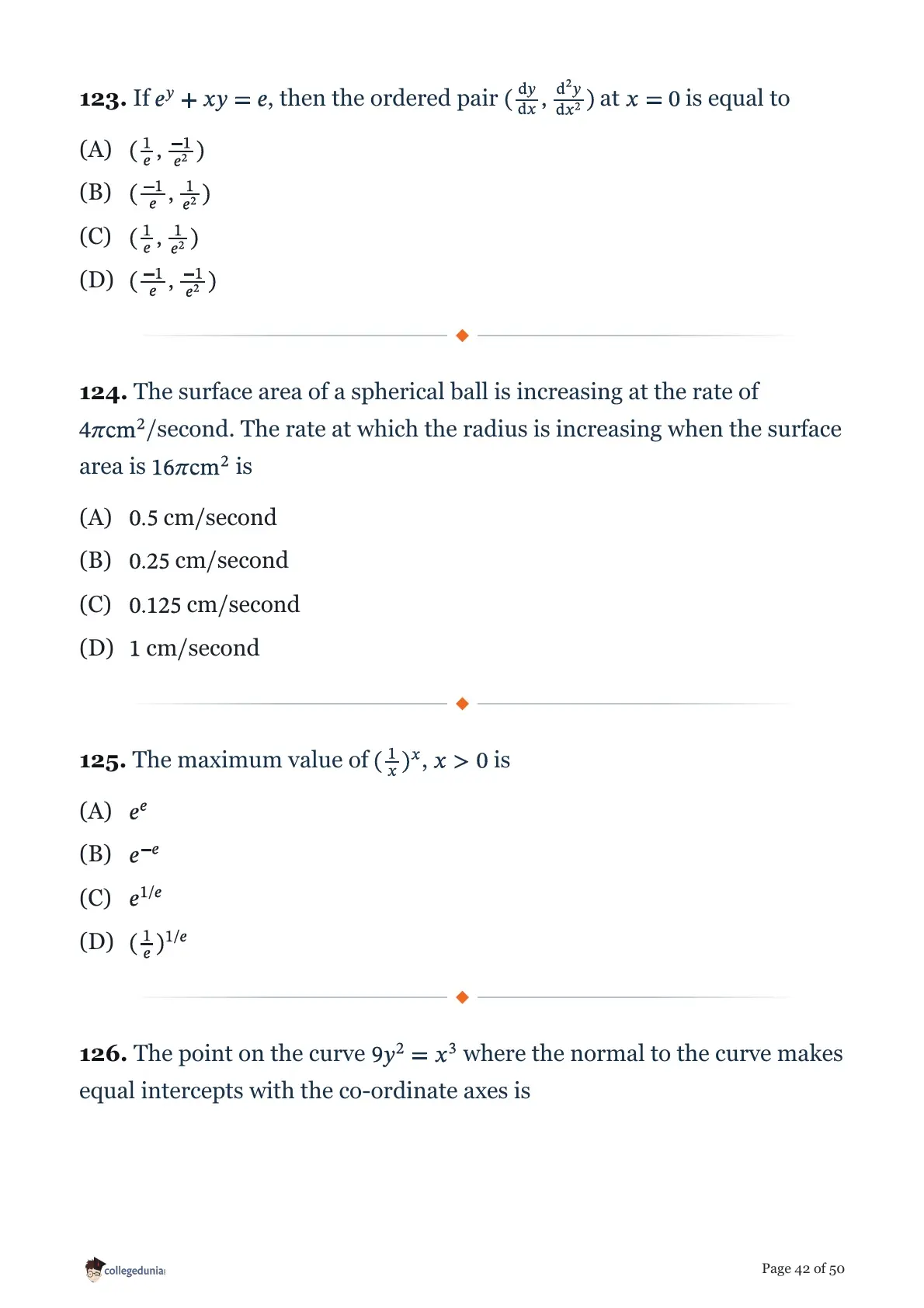
Question 123:

If \(e^y+xy = e\), then the ordered pair \((\frac{\text{d}y}{\text{d}x},\frac{\text{d}^2y}{\text{d}x^2})\) at \(x = 0\) is equal to

  • (A) \((\frac{1}{e},\frac{-1}{e^2})\)
  • (B) \((\frac{-1}{e},\frac{1}{e^2})\)
  • (C) \((\frac{1}{e},\frac{1}{e^2})\)
  • (D) \((\frac{-1}{e},\frac{-1}{e^2})\)

Question 124:

The surface area of a spherical ball is increasing at the rate of \(4π \text{cm}^2\)/second. The rate at which the radius is increasing when the surface area is \(16π \text{cm}^2\) is

  • (A) \(0.5\) cm/second
  • (B) \(0.25\) cm/second
  • (C) \(0.125\) cm/second
  • (D) \(1\) cm/second

Question 125:

The maximum value of \((\frac{1}{x})^x\), \(x > 0\) is

  • (A) \(e^e\)
  • (B) \(e^{-e}\)
  • (C) \(e^{1/e}\)
  • (D) \((\frac{1}{e})^{1/e}\)

Question 126:

The point on the curve \(9y^2 = x^3\) where the normal to the curve makes equal intercepts with the co-ordinate axes is

  • (A) \((-4,\frac{8}{3})\)
  • (B) \((4,\frac{8}{3})\)
  • (C) \((-4,\frac{-8}{3})\)
  • (D) \((-4,\frac{3}{8})\)

Question 127:

A spherical mothball has initial radius 3 cm. Due to evaporation, the radius of the ball reduces to 1 cm in 4 months. In how many months would the mothball evaporate completely if the volume is lost at a rate proportional to the surface area ?

  • (A) \(6\) months
  • (B) \(8\) months
  • (C) \(10\) months
  • (D) \(12\) months

Question 128:

\(\int \frac{x^2\,\text{d}x}{(x^2+2)(x^2+5)} =\)

  • (A) \(-(\frac{\sqrt{2}}{3}tan^{-1}\frac{x}{\sqrt{2}}+\frac{\sqrt{5}}{3}tan^{-1}\frac{x}{\sqrt{5}})+c\), where c is the constant of integration
  • (B) \((\frac{\sqrt{2}}{3}tan^{-1}\frac{x}{\sqrt{2}}+\frac{\sqrt{5}}{3}tan^{-1}\frac{x}{\sqrt{5}})+c\), where c is the constant of integration
  • (C) \(\frac{\sqrt{2}}{3}tan^{-1}(\frac{x}{\sqrt{2}})-\frac{\sqrt{5}}{3}tan^{-1}(\frac{x}{\sqrt{5}})+c\), where c is the constant of integration
  • (D) \(-\frac{\sqrt{2}}{3}tan^{-1}(\frac{x}{\sqrt{2}})+\frac{\sqrt{5}}{3}tan^{-1}(\frac{x}{\sqrt{5}})+c\), where c is the constant of integration

Question 129:

The value of \(\int \frac{sin^6x+cos^6x}{sin^2x\cdot cos^2x}\,\text{d}x\) is

  • (A) \(cotx+cot^2x+c\), where c is the constant of integration
  • (B) \(tanx-cotx-3x+c\), where c is the constant of integration
  • (C) \(2sin^5x+2cos^5x+c\), where c is the constant of integration
  • (D) \(sin^3x+2cos^3x+c\), where c is the constant of integration

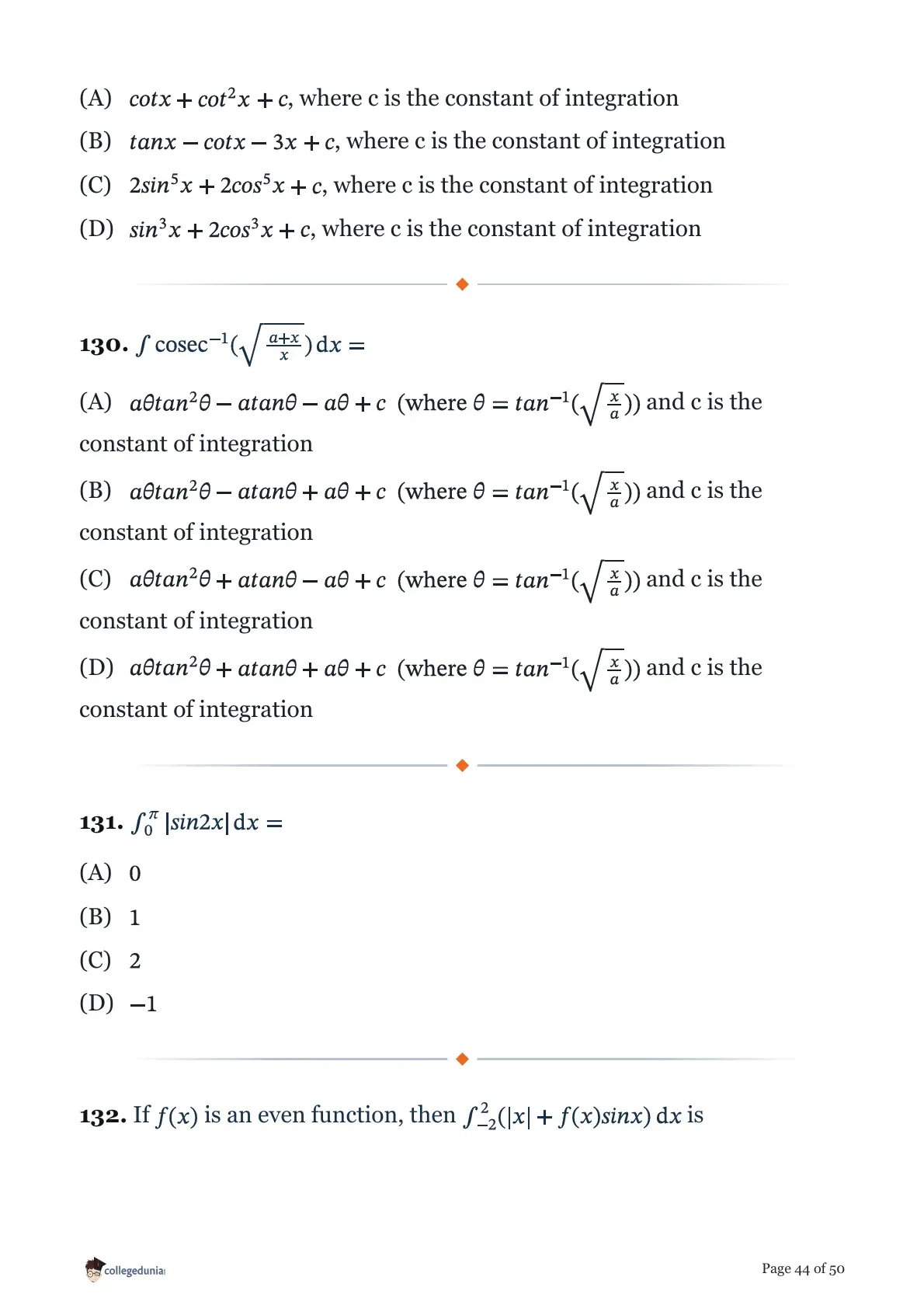
Question 130:

\(\int \text{cosec}^{-1}(\sqrt{\frac{a+x}{x}})\,\text{d}x =\)

  • (A) \(aθtan^2θ-atanθ-aθ+c\)  \((\text{where }θ = tan^{-1}(\sqrt{\frac{x}{a}}))\) and c is the constant of integration
  • (B) \(aθtan^2θ-atanθ+aθ+c\)  \((\text{where }θ = tan^{-1}(\sqrt{\frac{x}{a}}))\) and c is the constant of integration
  • (C) \(aθtan^2θ+atanθ-aθ+c\)  \((\text{where }θ = tan^{-1}(\sqrt{\frac{x}{a}}))\) and c is the constant of integration
  • (D) \(aθtan^2θ+atanθ+aθ+c\)  \((\text{where }θ = tan^{-1}(\sqrt{\frac{x}{a}}))\) and c is the constant of integration

Question 131:

\(\int _0^π|sin2x|\,\text{d}x =\)

  • (A) \(0\)
  • (B) \(1\)
  • (C) \(2\)
  • (D) \(-1\)

Question 132:

If \(f(x)\) is an even function, then \(\int _{-2}^2(|x|+f(x)sinx)\,\text{d}x\) is

  • (A) \(2\)
  • (B) \(4\)
  • (C) \(6\)
  • (D) \(8\)

Question 133:

The area of the region bounded by the curves \(y = |x-4|\), \(x = 3\) and \(x = 5\), and the X-axis is

  • (A) \(5\) sq. units
  • (B) \(3\) sq. units
  • (C) \(6\) sq. units
  • (D) \(1\) sq. unit

Question 134:

The solution of \(\frac{\text{d}y}{\text{d}x} = sin(x+y)+cos(x+y)\) is

  • (A) \(log[1+tan(\frac{x+y}{2})] = y+c\), where c is the constant of integration
  • (B) \(log[1-tan(\frac{x+y}{2})] = y+c\), where c is the constant of integration
  • (C) \(log[1+tan(\frac{x+y}{2})] = x+c\), where c is the constant of integration
  • (D) \(log[1-tan(\frac{x+y}{2})] = x+c\), where c is the constant of integration

Question 135:

The order and degree of the differential equation \(3-(\frac{\text{d}^3y}{\text{d}x^3})^{\frac{7}{3}} = (\frac{\text{d}y}{\text{d}x})^5\) are respectively

  • (A) \(3,7\)
  • (B) \(7,3\)
  • (C) \(5,7\)
  • (D) \(3,5\)

Question 136:

The solution of the differential equation \(e^{-x}(y+1)\text{d}y+(cos^2x-sin2x)y\,\text{d}x = 0\), given that \(y = 1\) when \(x = 0\) is

  • (A) \(logy+\frac{1}{y}+e^xcos^2x = 1\)
  • (B) \(logy+y+e^xcos^2x = 2\)
  • (C) \((y+1)+e^xcos^2x = 2\)
  • (D) \(log(y+\frac{1}{y})+e^xcos^2x = 1\)

Question 137:

A unit vector coplanar with \(\hat{i}+\hat{j}+2\hat{k}\) and \(\hat{i}+2\hat{j}+\hat{k}\) and perpendicular to \(\hat{i}+\hat{j}+\hat{k}\) is

  • (A) \(\pm \frac{1}{\sqrt{3}}(\hat{i}+\hat{j}+\hat{k})\)
  • (B) \(\pm \frac{1}{\sqrt{3}}(\hat{i}-\hat{j}+\hat{k})\)
  • (C) \(\pm \frac{1}{\sqrt{2}}(\hat{j}-\hat{k})\)
  • (D) \(\pm \frac{1}{\sqrt{2}}(\hat{j}+\hat{k})\)

Question 138:

If \(\overset{⃗}{a}+\overset{⃗}{b}+\overset{⃗}{c} = \overset{⃗}{0}\), \(|\overset{⃗}{a}| = |\overset{⃗}{b}| = |\overset{⃗}{c}| = 3\) and \(θ\) is the angle between \(\overset{⃗}{b}\) and \(\overset{⃗}{c}\) then \(tan^2θ+cot^2θ =\)
  • (A) \(\frac{2}{3}\)
  • (B) \(\frac{5}{3}\)
  • (C) \(\frac{8}{3}\)
  • (D) \(\frac{10}{3}\)

Question 139:

The altitude of the parallelopiped, whose coterminous edges are the vectors \(\overset{⃗}{a} = \hat{i}+\hat{j}+\hat{k}\), \(\overset{⃗}{b} = 2\hat{i}+4\hat{j}-\hat{k}\), \(\overset{⃗}{c} = \hat{i}+\hat{j}+3\hat{k}\), where \(\overset{⃗}{a}\), \(\overset{⃗}{b}\) are the sides of the base of parallelopiped, is

  • (A) \(\frac{2\sqrt{2}}{\sqrt{19}}\) units
  • (B) \(\frac{\sqrt{2}}{\sqrt{19}}\) units
  • (C) \(\frac{\sqrt{19}}{\sqrt{2}}\) units
  • (D) \(\frac{\sqrt{19}}{2\sqrt{2}}\) units

Question 140:

Let ABCD be a quadrilateral with \(\overline{AB} = \overset{⃗}{a}\), \(\overline{AD} = \overset{⃗}{b}\) and \(\overline{AC} = 3\overset{⃗}{a}+2\overset{⃗}{b}\). If its area is \(α\) times the area of the parallelogram with AB, AD as adjacent sides, then the value of \(α\) is equal to

  • (A) \(\frac{3}{2}\)
  • (B) \(\frac{5}{2}\)
  • (C) \(\frac{1}{2}\)
  • (D) \(1\)

Question 141:

Let \(\overset{⃗}{a} = \hat{i}+2\hat{j}-2\hat{k}\) and \(\overset{⃗}{b} = \hat{i}-\hat{j}+\hat{k}\). If \(\overset{⃗}{c}\) is a vector such that \(\overset{⃗}{a}\cdot \overset{⃗}{c} = |\overset{⃗}{c}|\), \(|\overset{⃗}{c}-\overset{⃗}{a}| = 2\sqrt{2}\) and the angle between \(\overset{⃗}{a}\times \overset{⃗}{b}\) and \(\overset{⃗}{c}\) is \(60^{\circ}\), then \(|(\overset{⃗}{a}\times \overset{⃗}{b})\times \overset{⃗}{c}|\) is equal to

  • (A) \(\frac{3\sqrt{3}}{2}\)
  • (B) \(\sqrt{\frac{3}{2}}\)
  • (C) \(3\sqrt{\frac{3}{2}}\)
  • (D) \(\frac{9\sqrt{3}}{2}\)

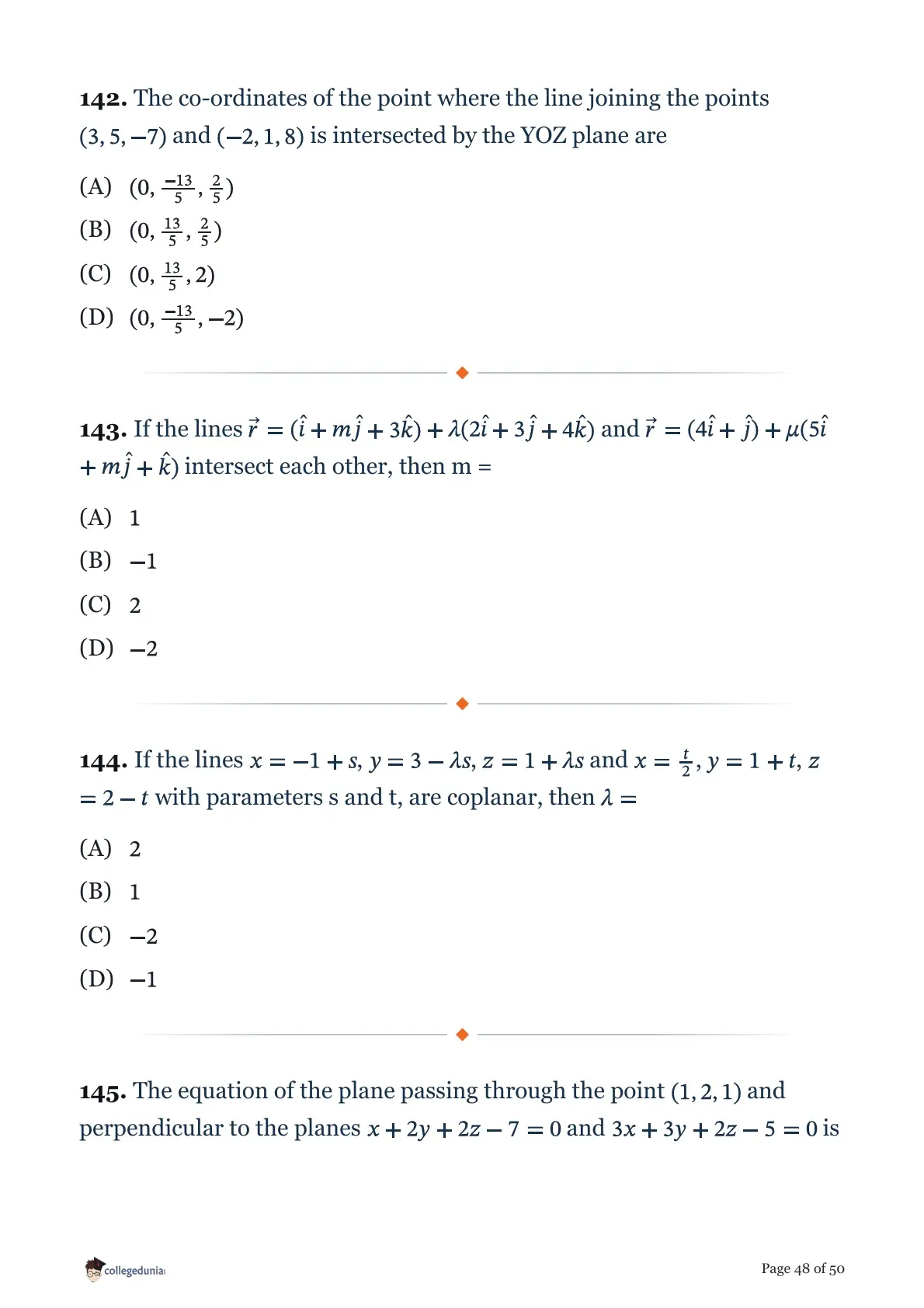
Question 142:

The co-ordinates of the point where the line joining the points \((3,5,-7)\) and \((-2,1,8)\) is intersected by the YOZ plane are

  • (A) \((0,\frac{-13}{5},\frac{2}{5})\)
  • (B) \((0,\frac{13}{5},\frac{2}{5})\)
  • (C) \((0,\frac{13}{5},2)\)
  • (D) \((0,\frac{-13}{5},-2)\)

Question 143:

If the lines \(\overset{⃗}{r} = (\hat{i}+m\hat{j}+3\hat{k})+λ(2\hat{i}+3\hat{j}+4\hat{k})\) and \(\overset{⃗}{r} = (4\hat{i}+\hat{j})+μ(5\hat{i}+m\hat{j}+\hat{k})\) intersect each other, then m =

  • (A) \(1\)
  • (B) \(-1\)
  • (C) \(2\)
  • (D) \(-2\)

Question 144:

If the lines \(x = -1+s\), \(y = 3-λs\), \(z = 1+λs\) and \(x = \frac{t}{2}\), \(y = 1+t\), \(z = 2-t\) with parameters s and t, are coplanar, then \(λ =\)

  • (A) \(2\)
  • (B) \(1\)
  • (C) \(-2\)
  • (D) \(-1\)

Question 145:

The equation of the plane passing through the point \((1,2,1)\) and perpendicular to the planes \(x+2y+2z-7 = 0\) and \(3x+3y+2z-5 = 0\) is

  • (A) \(2x+y-2z-2 = 0\)
  • (B) \(2x-4y+3z+3 = 0\)
  • (C) \(2x+4y-5z-5 = 0\)
  • (D) \(x+4y-6z-3 = 0\)

Question 146:

The distance of the point \((1,0,-3)\) from the plane \(x-y-z = 9\) measured parallel to the line \(\frac{x-2}{2} = \frac{y+2}{3} = \frac{z-6}{-6}\) is

  • (A) \(5\) units
  • (B) \(7\) units
  • (C) \(6\) units
  • (D) \(8\) units

Question 147:

The difference between the maximum and minimum values of the objective function \(Z = 3x+5y\), subject to the constraints \(x+3y\leq 60\), \(x+y\geq 10\), \(x-y\leq 0\), \(x,y\geq 0\) is

  • (A) \(50\)
  • (B) \(60\)
  • (C) \(70\)
  • (D) \(80\)

Question 148:

For the following probability distribution, the standard deviation of the random variable X is

X234
p(X=\(x\))0.20.50.3

  • (A) \(0.5\)
  • (B) \(0.6\)
  • (C) \(0.61\)
  • (D) \(0.7\)

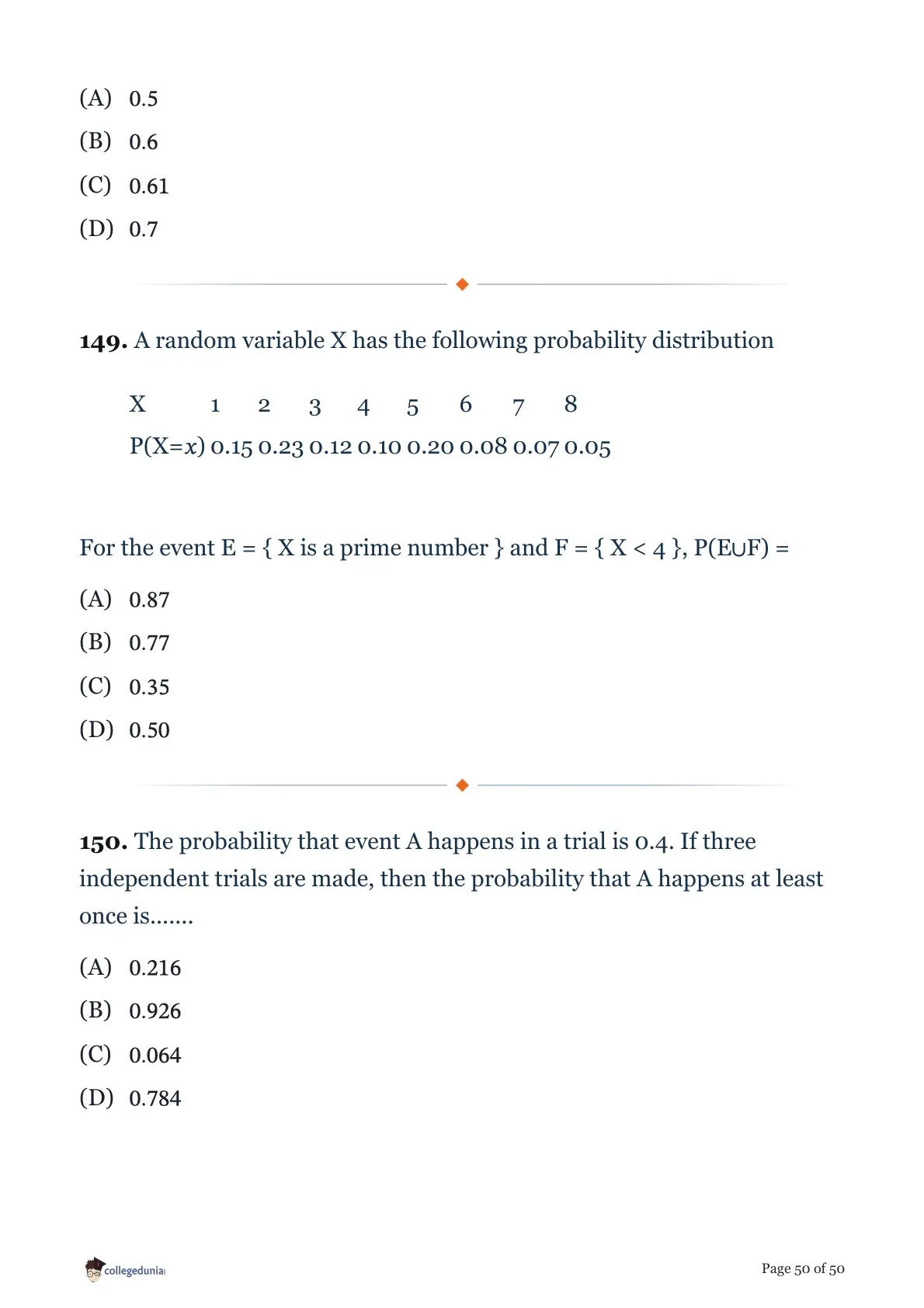
Question 149:

A random variable X has the following probability distribution

X12345678
P(X=\(x\))0.150.230.120.100.200.080.070.05

For the event E = { X is a prime number } and F = { X < 4 }, P(E\(\cup\)F) =

  • (A) \(0.87\)
  • (B) \(0.77\)
  • (C) \(0.35\)
  • (D) \(0.50\)

Question 150:

The probability that event A happens in a trial is 0.4. If three independent trials are made, then the probability that A happens at least once is.......

  • (A) \(0.216\)
  • (B) \(0.926\)
  • (C) \(0.064\)
  • (D) \(0.784\)

MHT CET PCM Exam Pattern 2026

MHT-CET 2026 Exam Strategy