




MHT CET 2026 April 17 Shift 1 PCM Question Paper is available for download here. Maharashtra State CET Cell conducted MHT CET 2026 PCM Exam on April 17 in Shift 1 from 9 AM to 12 PM in CBT mode.
- The MHT CET 2026 PCM Question Paper consists of 150 multiple-choice questions (MCQs) totalling 200 marks divided into 3 sections: Physics, Chemistry, and Mathematics, with 50 questions in each subject.
- Physics and Chemistry questions carry 1 mark each while Mathematics questions carry 2 marks each.
- There is no negative marking for incorrect answers.
Also Check: MHT CET 2026 April 17 Shift 1 Expected Marks vs Percentile
Download MHT CET 2026 April 17 Shift 1 PCM Question Paper with Solutions PDF from the links provided below. Based on initial student reactions, MHT CET 2026 April 17 Shift 1 PCM Paper was of moderate level.
MHT CET 2026 April 17 Shift 1 PCM Question Paper PDF Download
| MHT CET 2026 April 17 Shift 1 Question Paper | Download PDF | Check Solution |
MHT CET 2026 April 17 Shift 1 PCM Questions with Solutions
Physics Section (Questions 1 to 50)
Resultant of two vectors \(\overset{⃗}{P}\) and \(\overset{⃗}{Q}\) is of magnitude A. If \(\overset{⃗}{Q}\) is reversed, then the resultant is of magnitude B. The value of \(A^2+B^2\) is
Mass and volume of a body are found to be \((6.00\pm 0.03)\) kg and \((2.00\pm 0.02)\) \(\text{m}^3\) respectively. Then the density of a body is
Two balls A and B are projected at an angle of \(45^{\circ}\) and \(60^{\circ}\) respectively, so that the maximum heights reached are same for both. The ratio of initial velocity of projection of ball A to that for ball B is
\((sin30^{\circ} = cos60^{\circ} = \frac{1}{2}, sin45^{\circ} = cos45^{\circ} = \frac{1}{\sqrt{2}}, sin60^{\circ} = cos30^{\circ} = \frac{\sqrt{3}}{2})\)
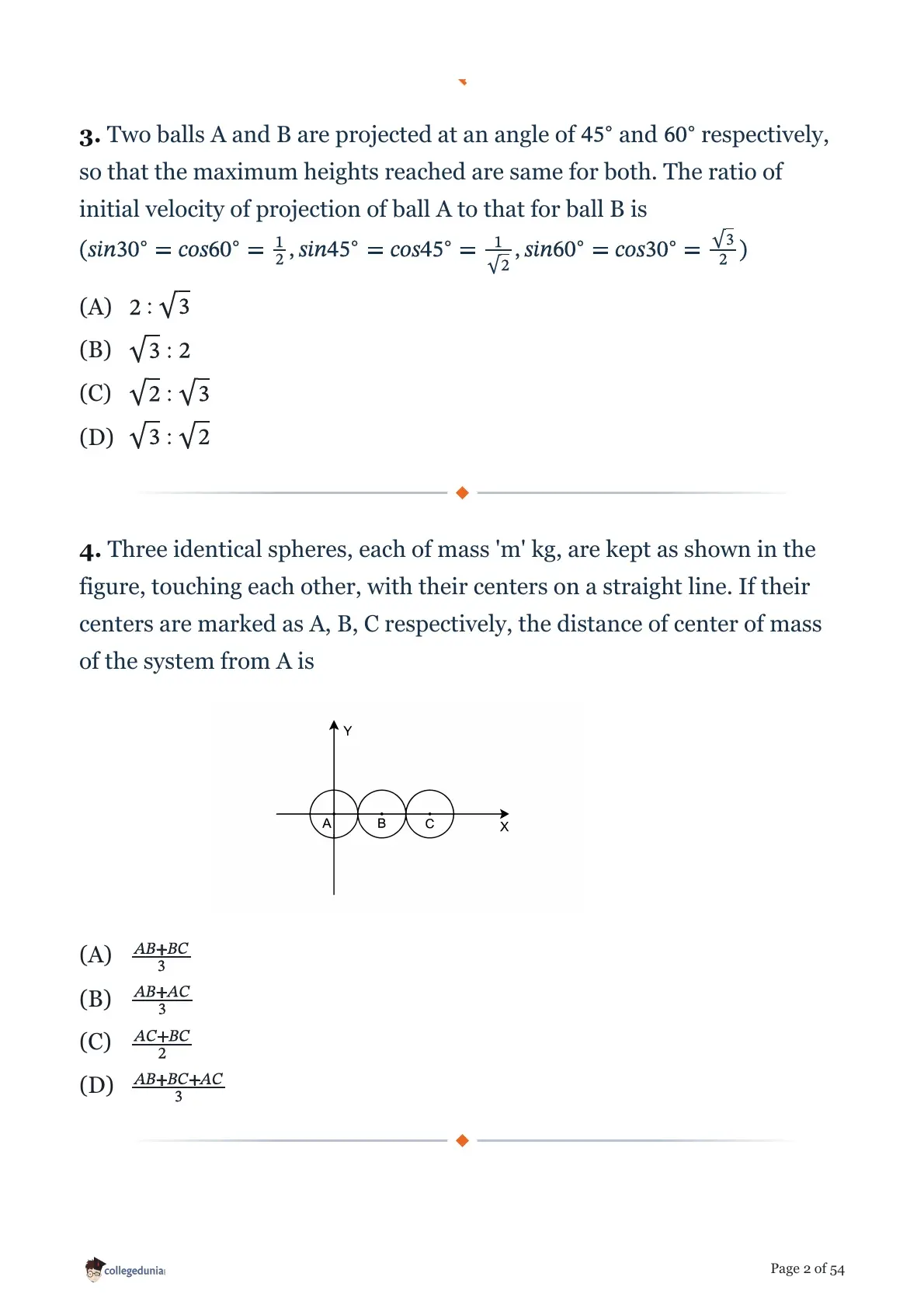
Three identical spheres, each of mass 'm' kg, are kept as shown in the figure, touching each other, with their centers on a straight line. If their centers are marked as A, B, C respectively, the distance of center of mass of the system from A is

Four point masses m, 2m, 3m and 4m are kept at the corners A, B, C and D respectively of a square ABCD of side '\(b\)'. The moment of inertia of the system about an axis perpendicular to the plane of the square and passing through the point D is
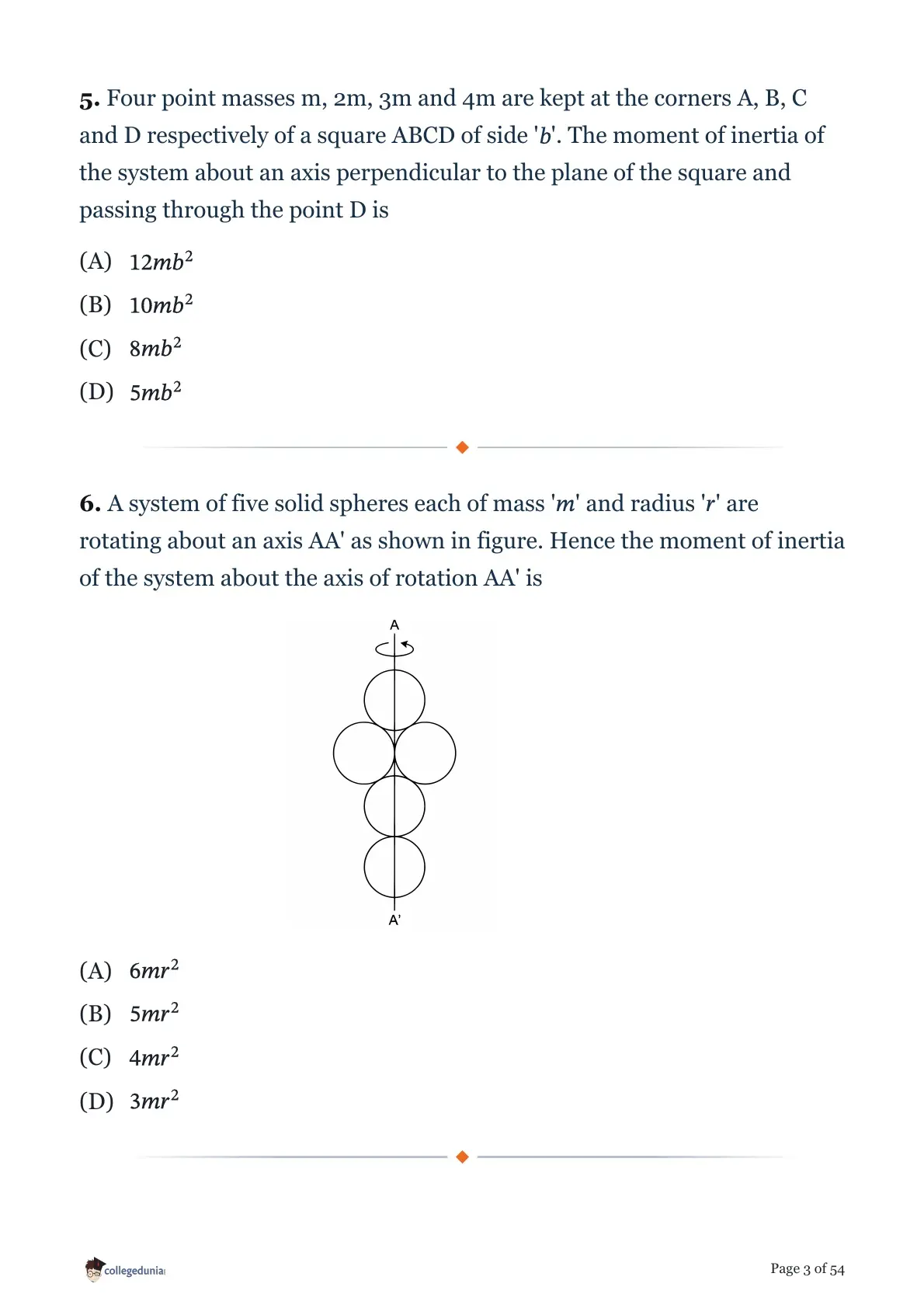
A system of five solid spheres each of mass '\(m\)' and radius '\(r\)' are rotating about an axis AA' as shown in figure. Hence the moment of inertia of the system about the axis of rotation AA' is

Two bodies A and B have moment of inertia \(I_A\) and \(I_B\), and angular momenta \(L_A\) and \(L_B\) respectively. Both of them have same kinetic energy of rotation. So the ratio \(L_A\) to \(L_B\) is
The speed with which the earth would have to rotate about its axis so that a person on the equator would weigh \(\frac{3}{5}\)th as much as at present is (\(g\) = gravitational acceleration, \(R\) = equatorial radius of the earth.)
The excess pressure inside a spherical water drop A is four times that of another water drop B. Then, the ratio of the mass of water drop A to that of drop B is
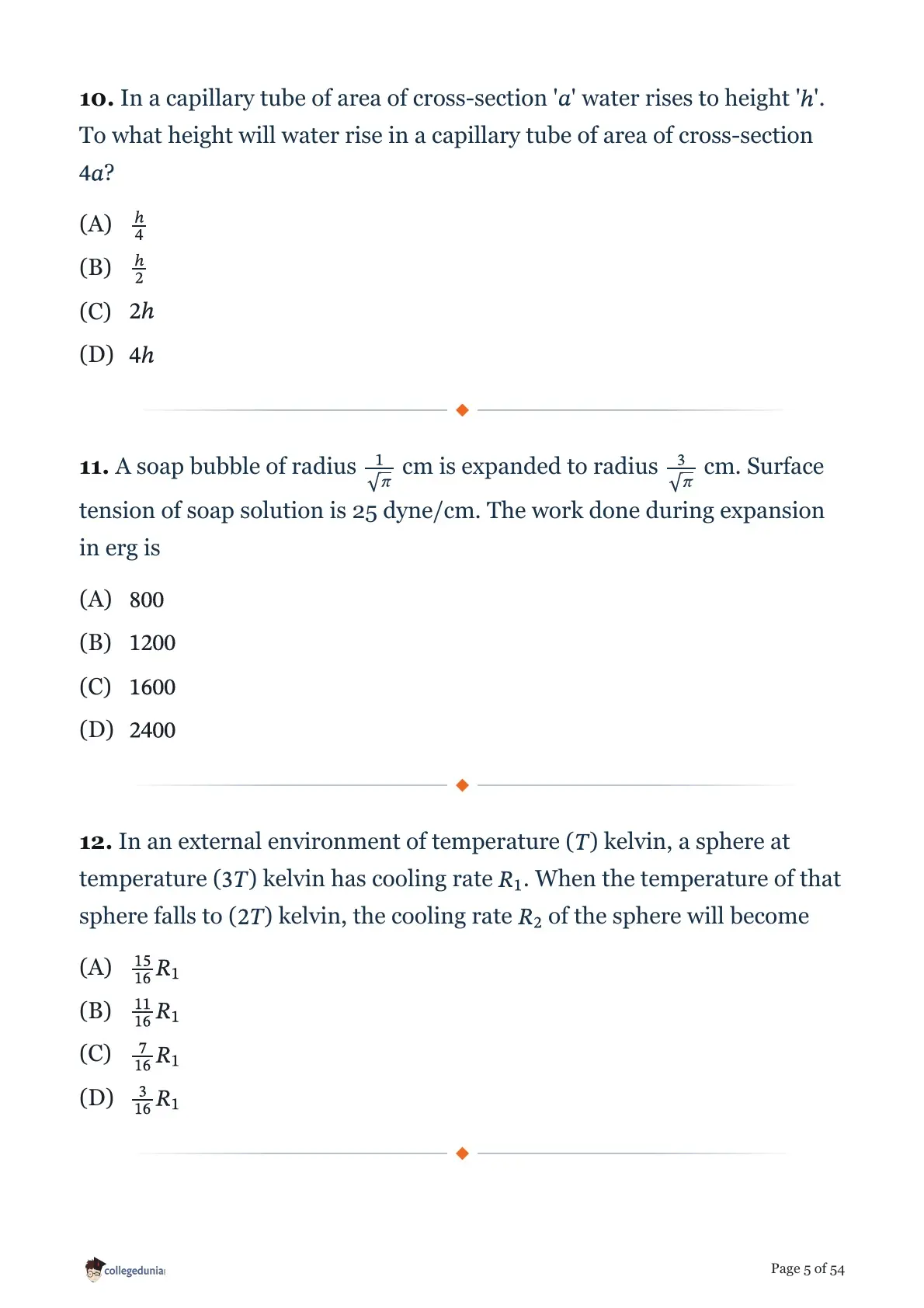
In a capillary tube of area of cross-section '\(a\)' water rises to height '\(h\)'. To what height will water rise in a capillary tube of area of cross-section \(4a\)?
A soap bubble of radius \(\frac{1}{\sqrt{π}}\) cm is expanded to radius \(\frac{3}{\sqrt{π}}\) cm. Surface tension of soap solution is 25 dyne/cm. The work done during expansion in erg is
In an external environment of temperature (\(T\)) kelvin, a sphere at temperature (\(3T\)) kelvin has cooling rate \(R_1\). When the temperature of that sphere falls to (\(2T\)) kelvin, the cooling rate \(R_2\) of the sphere will become
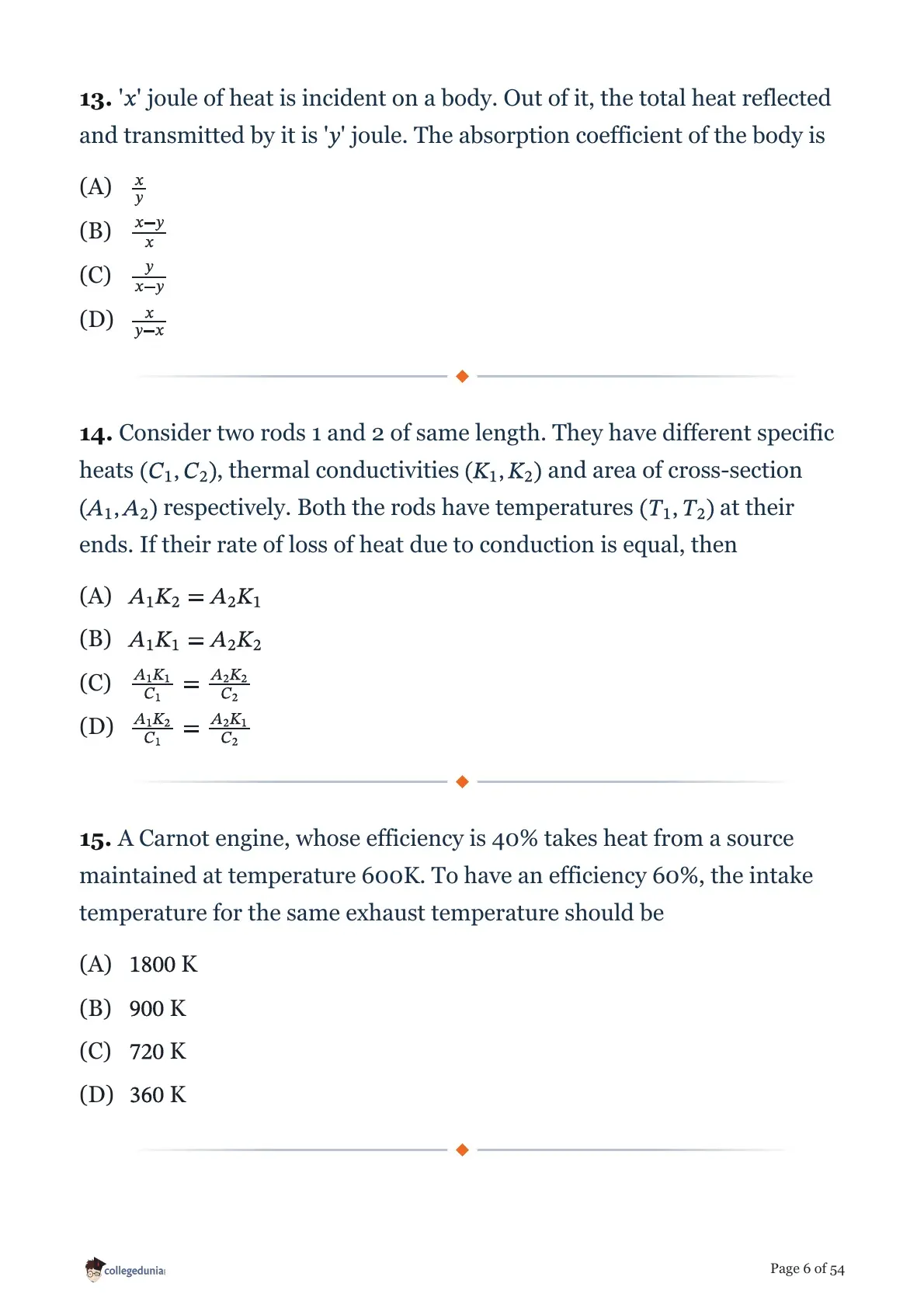
'\(x\)' joule of heat is incident on a body. Out of it, the total heat reflected and transmitted by it is '\(y\)' joule. The absorption coefficient of the body is
Consider two rods 1 and 2 of same length. They have different specific heats \((C_1,C_2)\), thermal conductivities \((K_1,K_2)\) and area of cross-section \((A_1,A_2)\) respectively. Both the rods have temperatures \((T_1,T_2)\) at their ends. If their rate of loss of heat due to conduction is equal, then
A Carnot engine, whose efficiency is 40% takes heat from a source maintained at temperature 600K. To have an efficiency 60%, the intake temperature for the same exhaust temperature should be
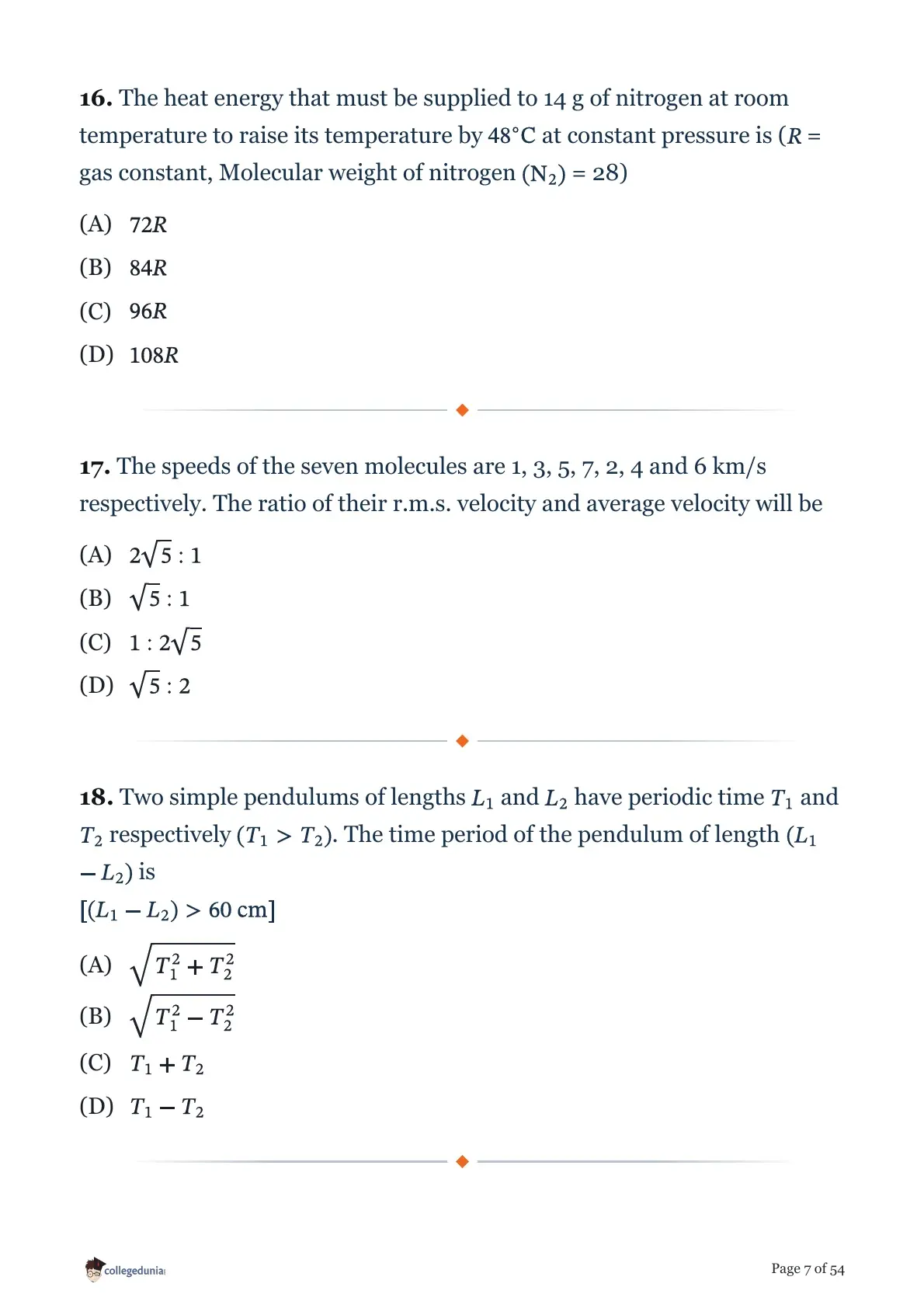
The heat energy that must be supplied to 14 g of nitrogen at room temperature to raise its temperature by \(48 ^{\circ}\text{C}\) at constant pressure is (\(R\) = gas constant, Molecular weight of nitrogen \((\text{N}_2)\) = 28)
The speeds of the seven molecules are 1, 3, 5, 7, 2, 4 and 6 km/s respectively. The ratio of their r.m.s. velocity and average velocity will be
Two simple pendulums of lengths \(L_1\) and \(L_2\) have periodic time \(T_1\) and \(T_2\) respectively \((T_1 > T_2)\). The time period of the pendulum of length \((L_1-L_2)\) is
\([(L_1-L_2) > 60\text{ cm}]\)
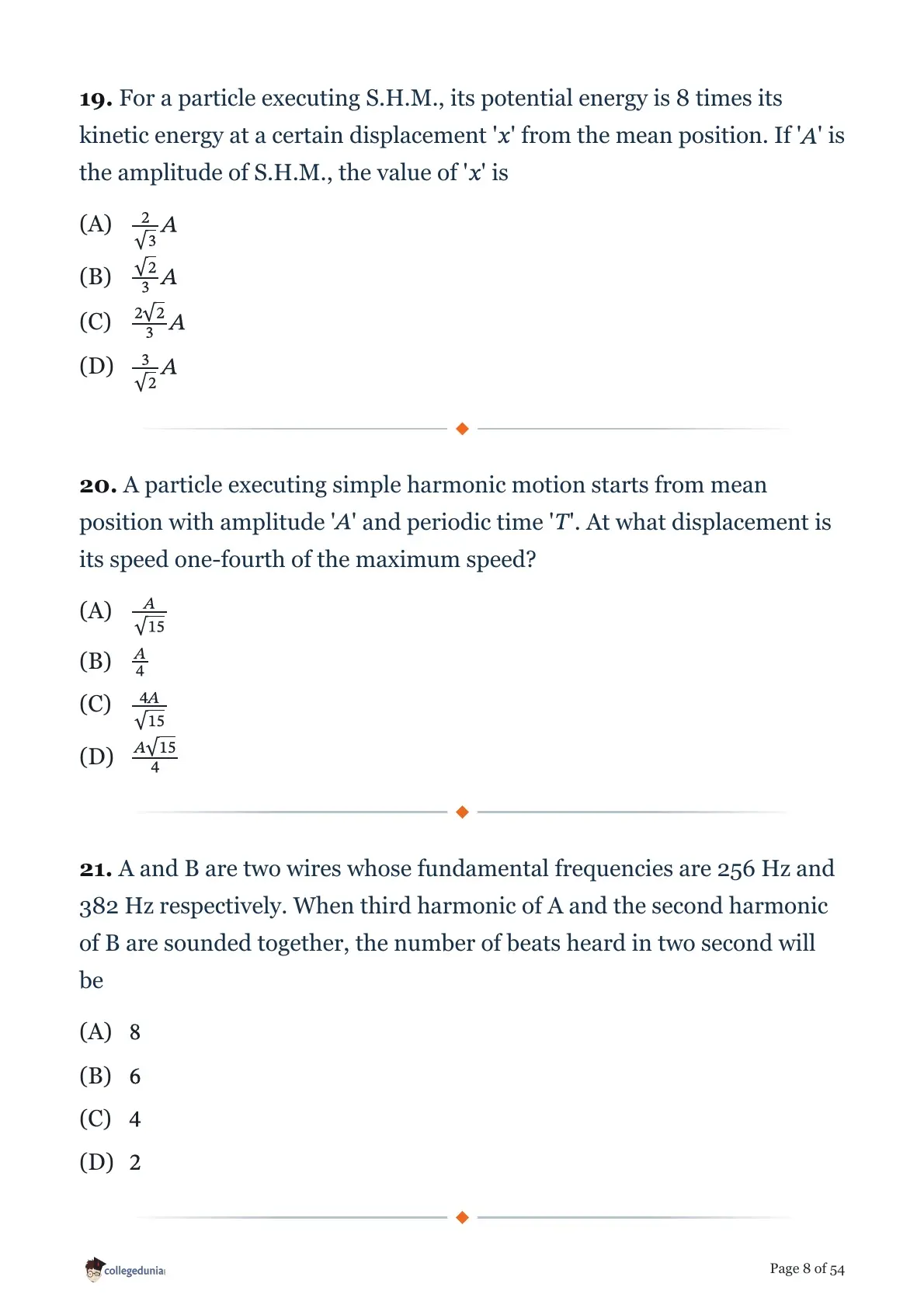
For a particle executing S.H.M., its potential energy is 8 times its kinetic energy at a certain displacement '\(x\)' from the mean position. If '\(A\)' is the amplitude of S.H.M., the value of '\(x\)' is
A particle executing simple harmonic motion starts from mean position with amplitude '\(A\)' and periodic time '\(T\)'. At what displacement is its speed one-fourth of the maximum speed?
A and B are two wires whose fundamental frequencies are 256 Hz and 382 Hz respectively. When third harmonic of A and the second harmonic of B are sounded together, the number of beats heard in two second will be
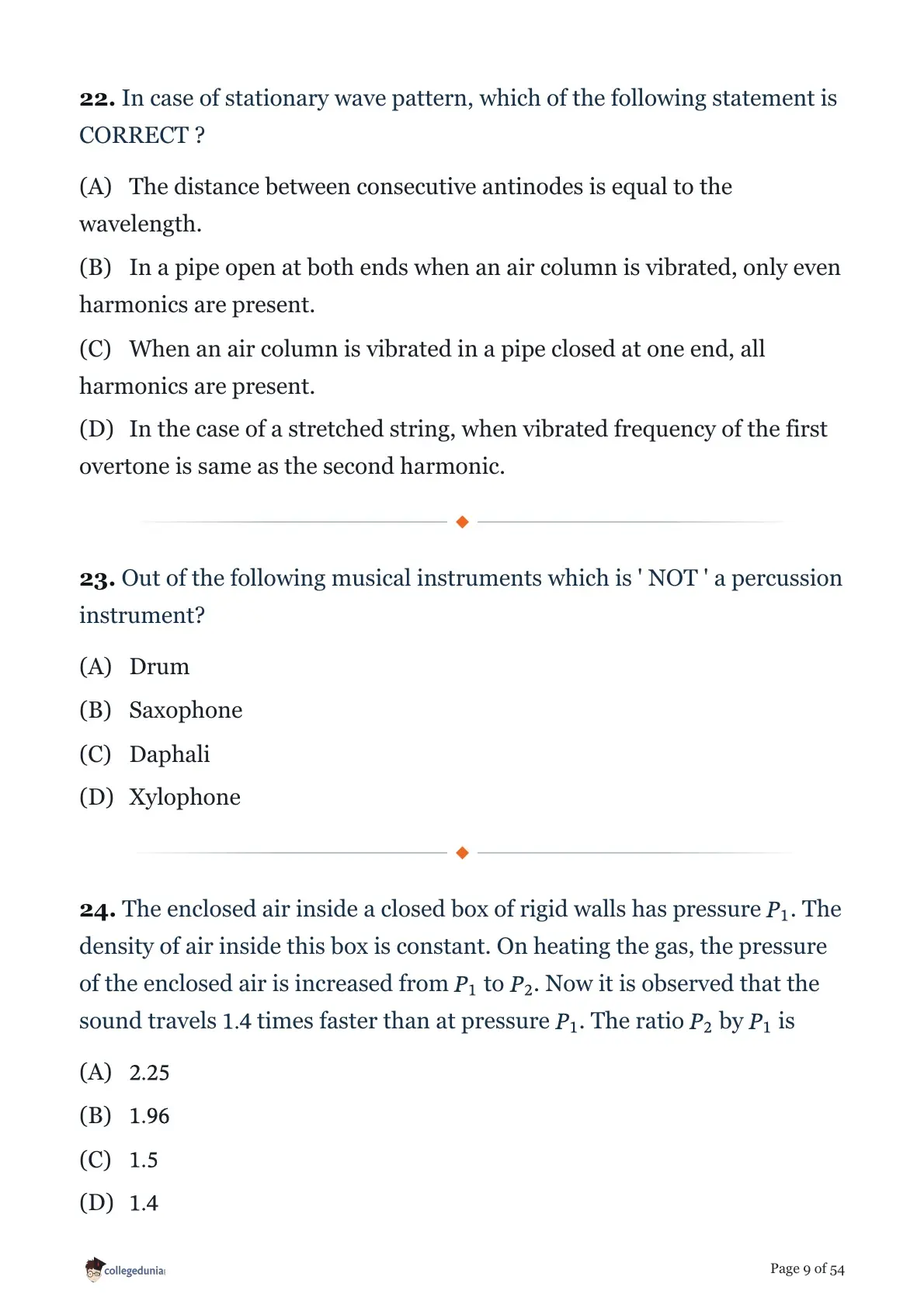
In case of stationary wave pattern, which of the following statement is CORRECT ?
Out of the following musical instruments which is ' NOT ' a percussion instrument?
The enclosed air inside a closed box of rigid walls has pressure \(P_1\). The density of air inside this box is constant. On heating the gas, the pressure of the enclosed air is increased from \(P_1\) to \(P_2\). Now it is observed that the sound travels \(1.4\) times faster than at pressure \(P_1\). The ratio \(P_2\) by \(P_1\) is
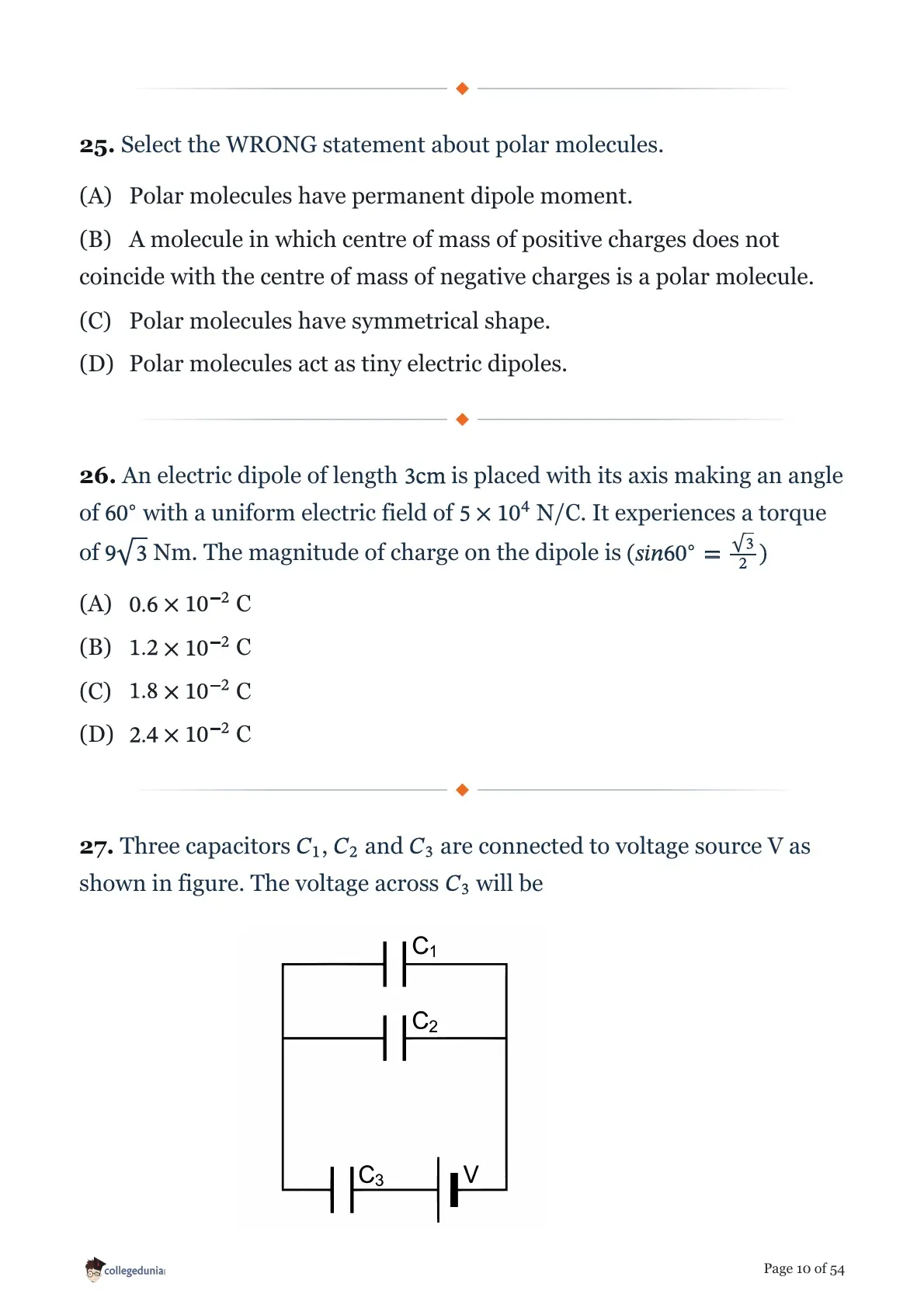
Select the WRONG statement about polar molecules.
An electric dipole of length \(3\text{cm}\) is placed with its axis making an angle of \(60^{\circ}\) with a uniform electric field of \(5\times 10^4\) N/C. It experiences a torque of \(9\sqrt{3}\) Nm. The magnitude of charge on the dipole is \((sin60^{\circ} = \frac{\sqrt{3}}{2})\)
Three capacitors \(C_1\), \(C_2\) and \(C_3\) are connected to voltage source V as shown in figure. The voltage across \(C_3\) will be

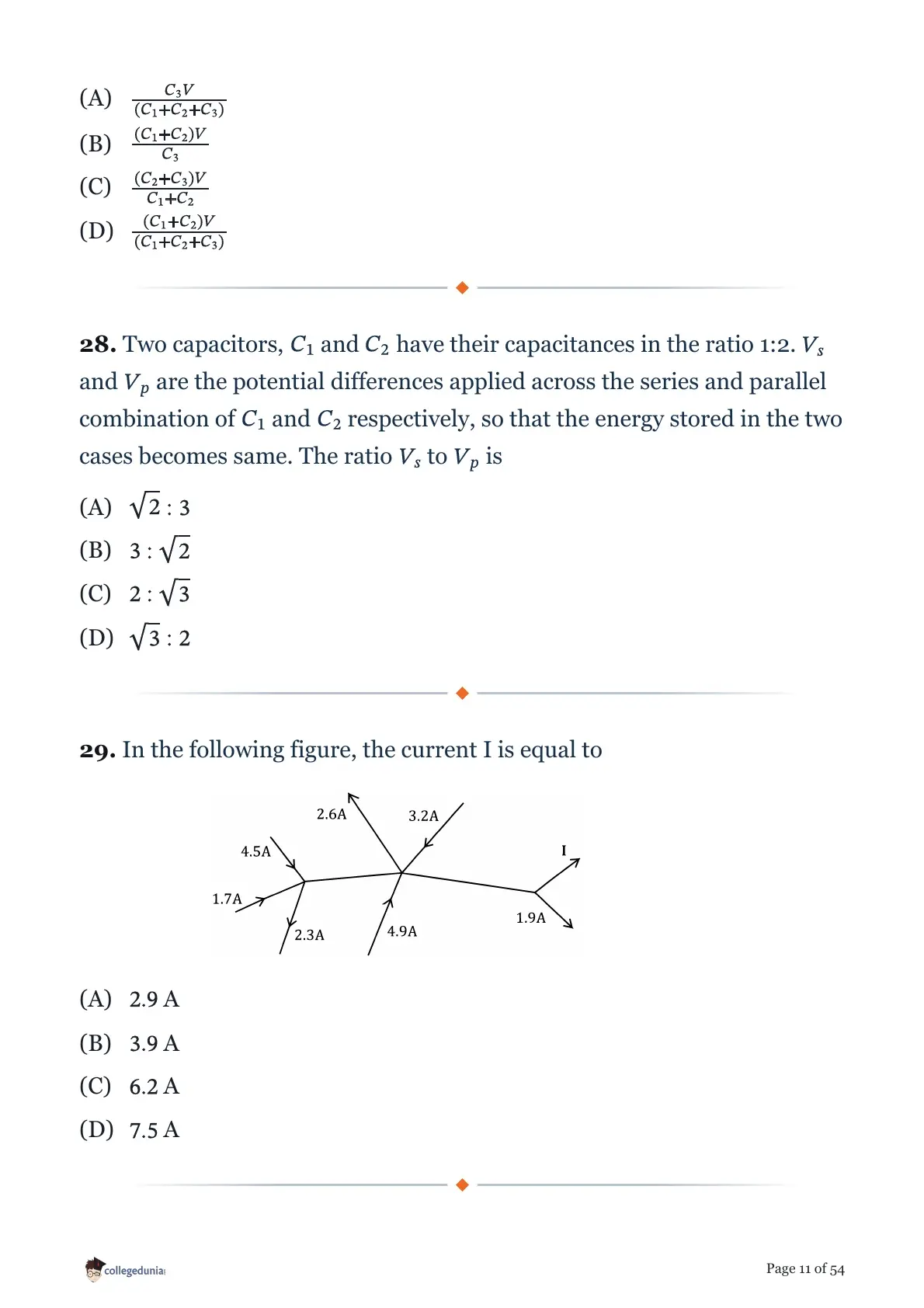
Two capacitors, \(C_1\) and \(C_2\) have their capacitances in the ratio 1:2. \(V_s\) and \(V_p\) are the potential differences applied across the series and parallel combination of \(C_1\) and \(C_2\) respectively, so that the energy stored in the two cases becomes same. The ratio \(V_s\) to \(V_p\) is

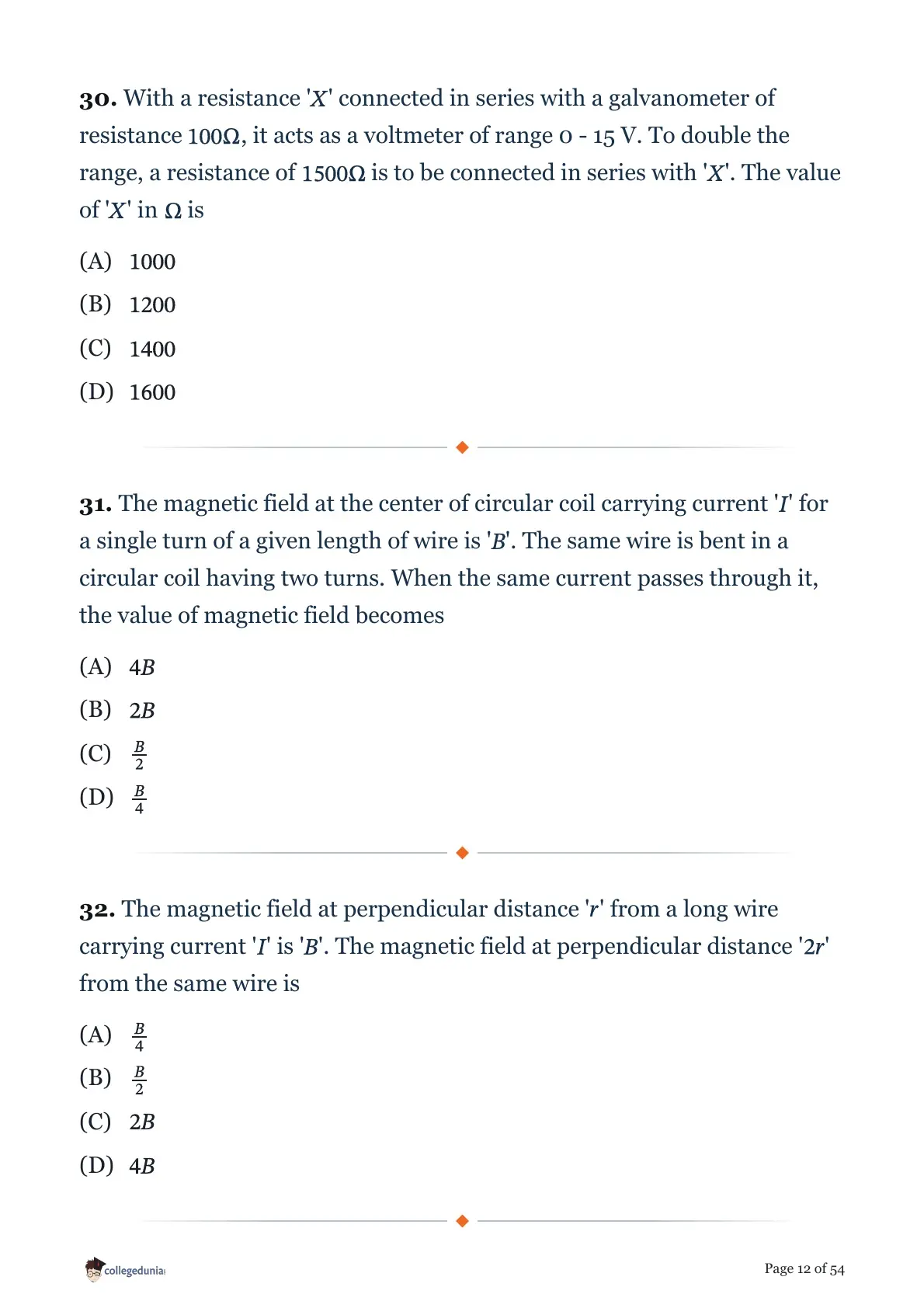
With a resistance '\(X\)' connected in series with a galvanometer of resistance \(100 \Omega\), it acts as a voltmeter of range 0 - 15 V. To double the range, a resistance of \(1500 \Omega\) is to be connected in series with '\(X\)'. The value of '\(X\)' in \(\Omega\) is
The magnetic field at the center of circular coil carrying current '\(I\)' for a single turn of a given length of wire is '\(B\)'. The same wire is bent in a circular coil having two turns. When the same current passes through it, the value of magnetic field becomes
The magnetic field at perpendicular distance '\(r\)' from a long wire carrying current '\(I\)' is '\(B\)'. The magnetic field at perpendicular distance '\(2r\)' from the same wire is
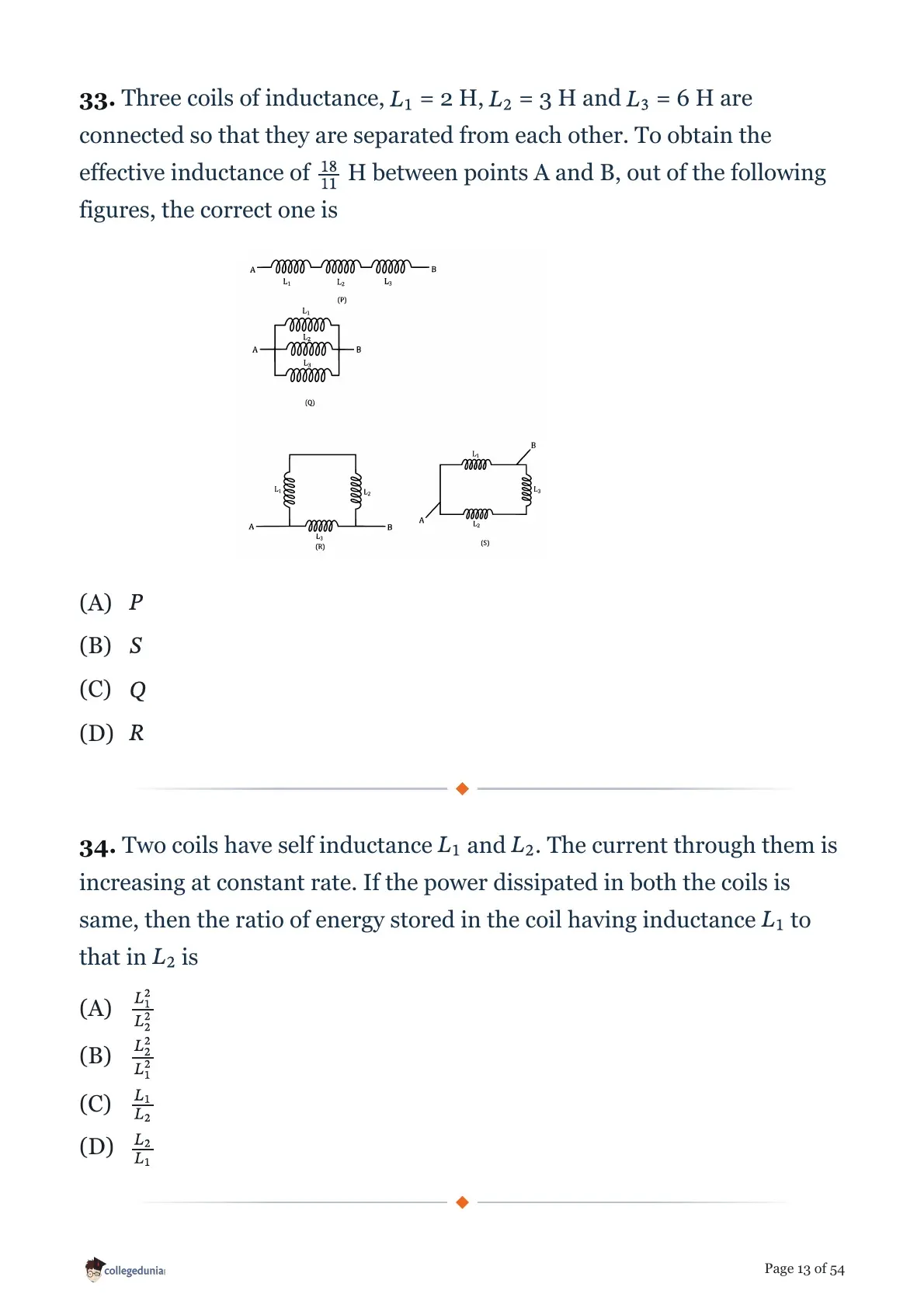
Three coils of inductance, \(L_1\) = 2 H, \(L_2\) = 3 H and \(L_3\) = 6 H are connected so that they are separated from each other. To obtain the effective inductance of \(\frac{18}{11}\) H between points A and B, out of the following figures, the correct one is

Two coils have self inductance \(L_1\) and \(L_2\). The current through them is increasing at constant rate. If the power dissipated in both the coils is same, then the ratio of energy stored in the coil having inductance \(L_1\) to that in \(L_2\) is
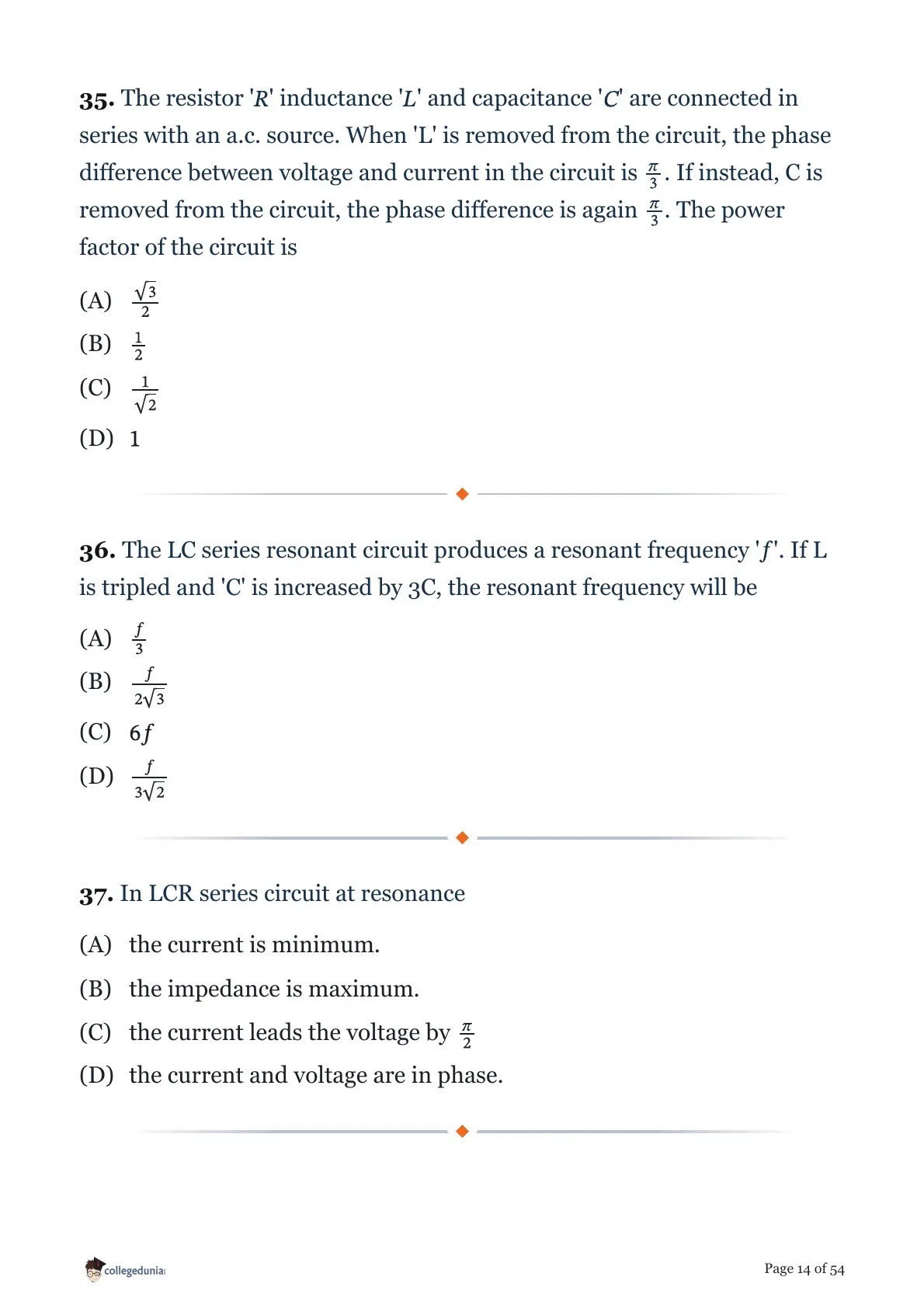
The resistor '\(R\)' inductance '\(L\)' and capacitance '\(C\)' are connected in series with an a.c. source. When 'L' is removed from the circuit, the phase difference between voltage and current in the circuit is \(\frac{π}{3}\). If instead, C is removed from the circuit, the phase difference is again \(\frac{π}{3}\). The power factor of the circuit is
The LC series resonant circuit produces a resonant frequency '\(f\)'. If L is tripled and 'C' is increased by 3C, the resonant frequency will be
In LCR series circuit at resonance
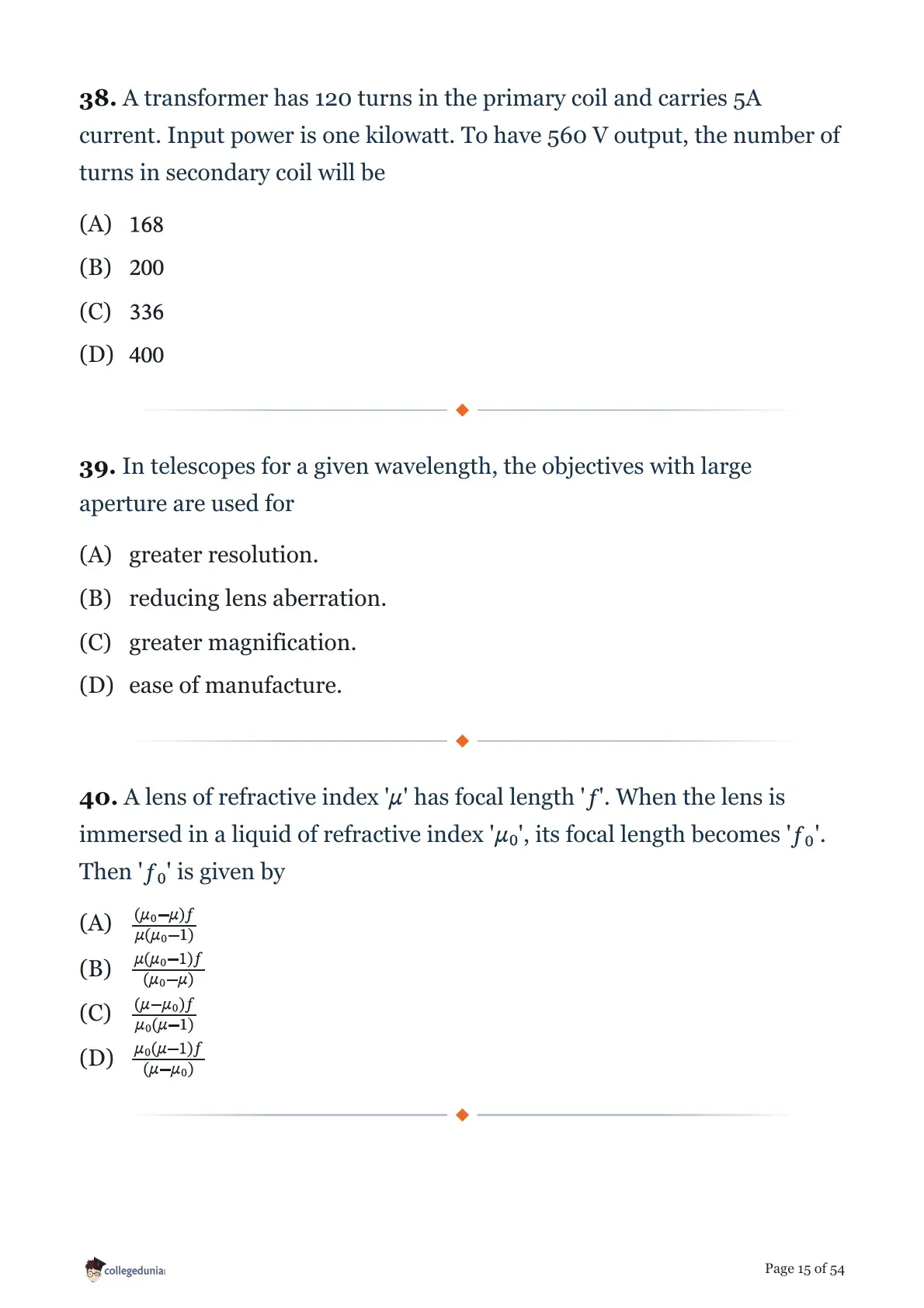
A transformer has 120 turns in the primary coil and carries 5A current. Input power is one kilowatt. To have 560 V output, the number of turns in secondary coil will be
In telescopes for a given wavelength, the objectives with large aperture are used for
A lens of refractive index '\(μ\)' has focal length '\(f\)'. When the lens is immersed in a liquid of refractive index '\(μ_0\)', its focal length becomes '\(f_0\)'. Then '\(f_0\)' is given by
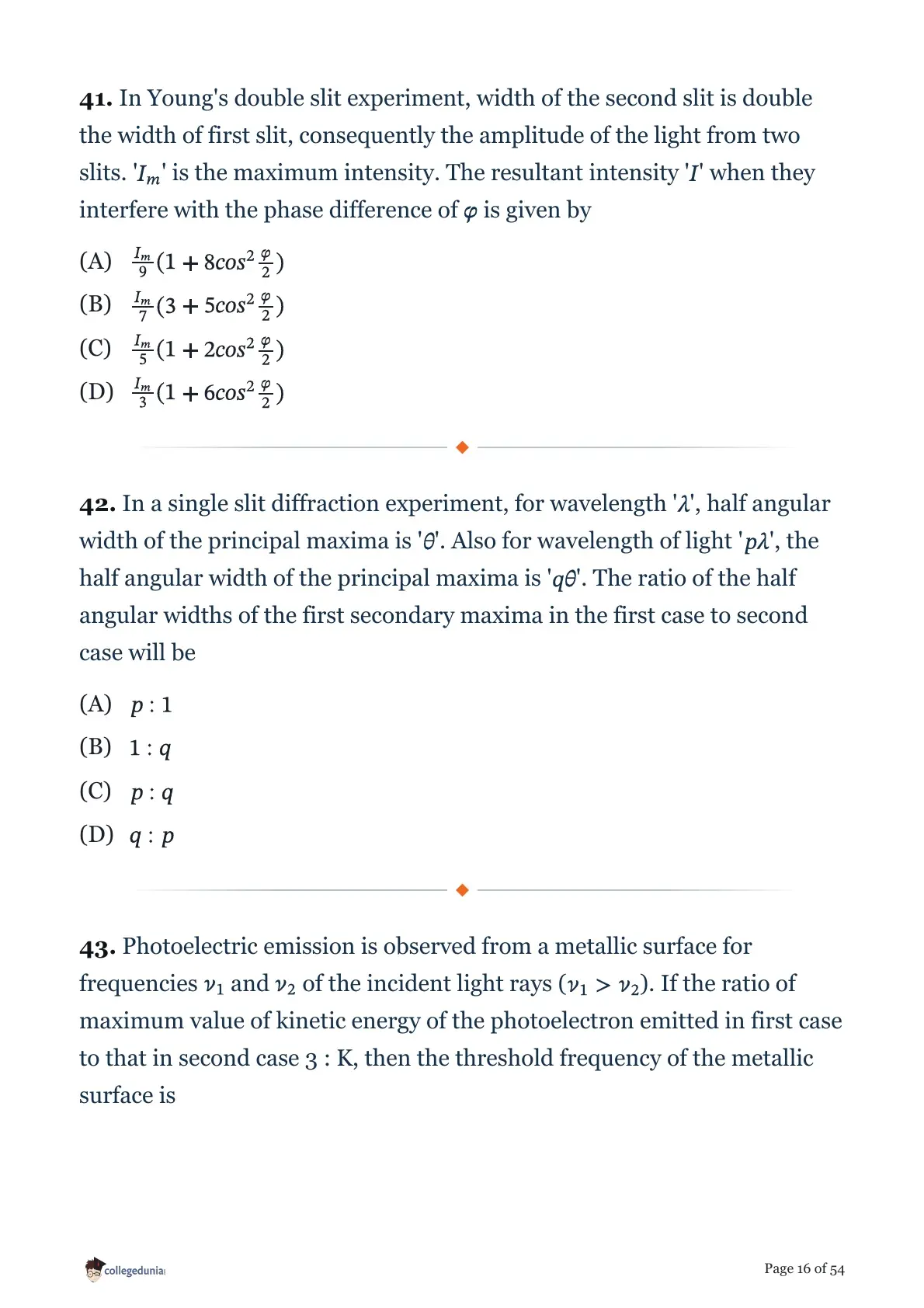
In Young's double slit experiment, width of the second slit is double the width of first slit, consequently the amplitude of the light from two slits. '\(I_m\)' is the maximum intensity. The resultant intensity '\(I\)' when they interfere with the phase difference of \(φ\) is given by
In a single slit diffraction experiment, for wavelength '\(λ\)', half angular width of the principal maxima is '\(θ\)'. Also for wavelength of light '\(pλ\)', the half angular width of the principal maxima is '\(qθ\)'. The ratio of the half angular widths of the first secondary maxima in the first case to second case will be
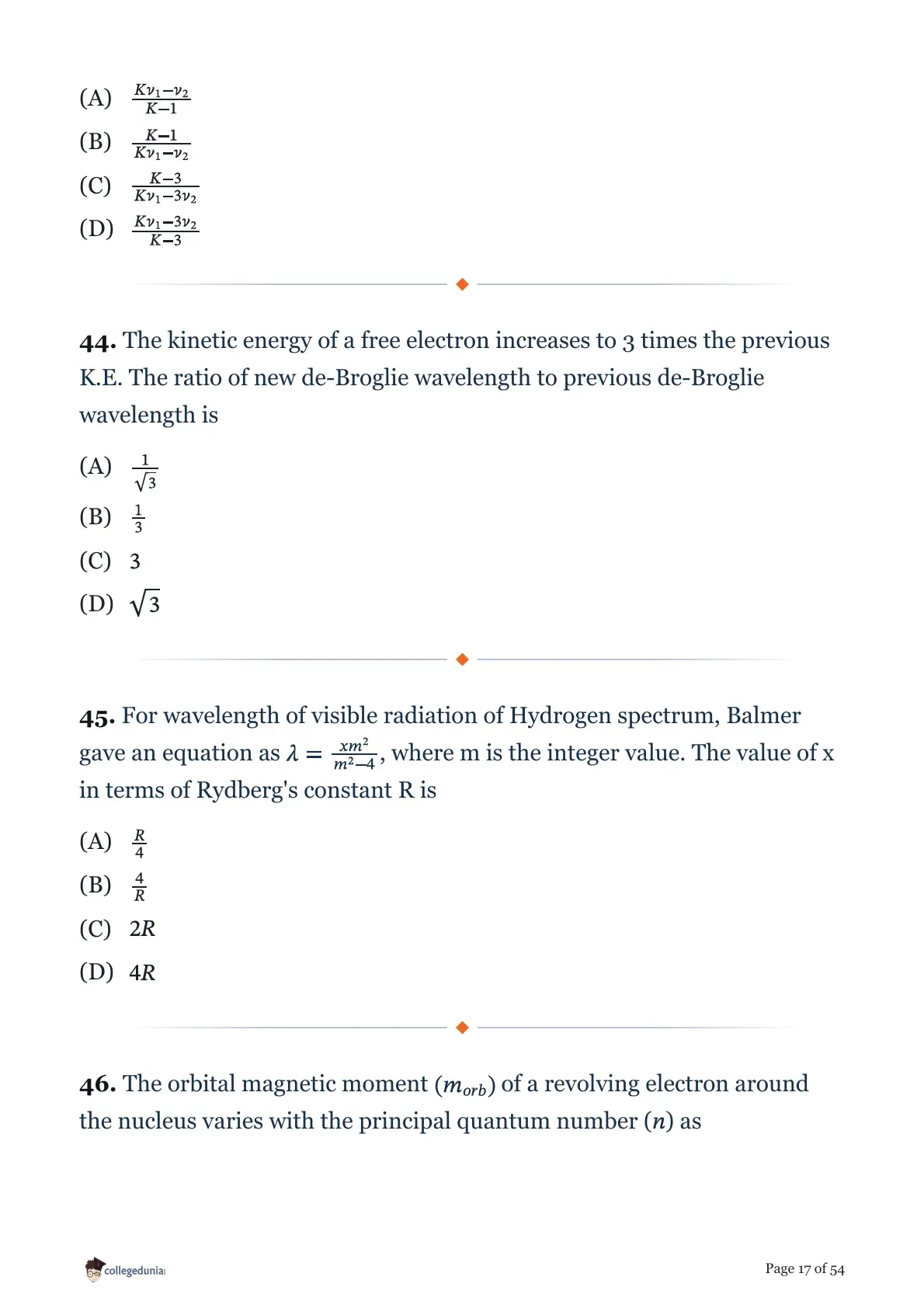
Photoelectric emission is observed from a metallic surface for frequencies \(ν_1\) and \(ν_2\) of the incident light rays (\(ν_1 > ν_2\)). If the ratio of maximum value of kinetic energy of the photoelectron emitted in first case to that in second case 3 : K, then the threshold frequency of the metallic surface is
The kinetic energy of a free electron increases to 3 times the previous K.E. The ratio of new de-Broglie wavelength to previous de-Broglie wavelength is
For wavelength of visible radiation of Hydrogen spectrum, Balmer gave an equation as \(λ = \frac{xm^2}{m^2-4}\), where m is the integer value. The value of x in terms of Rydberg's constant R is
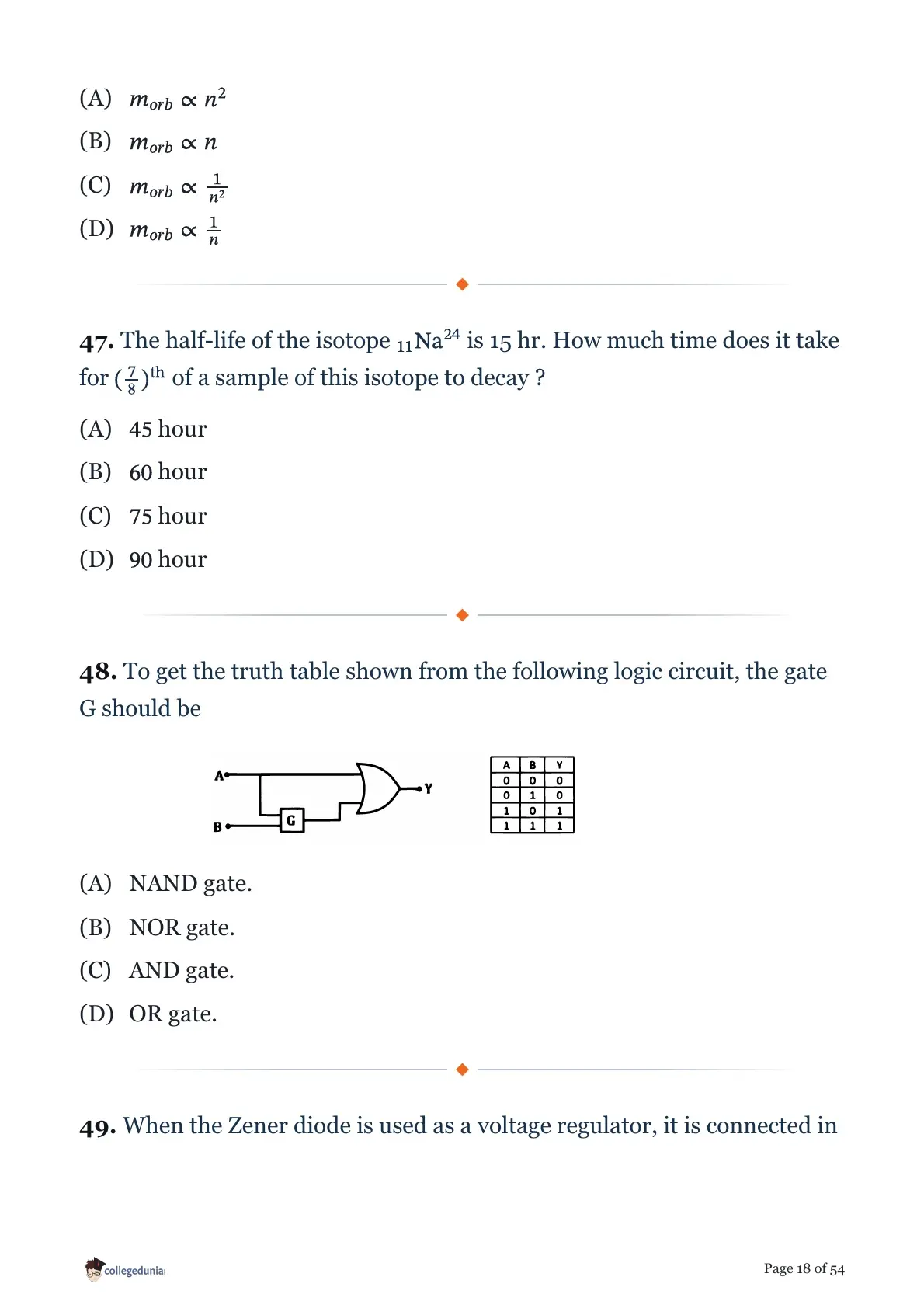
The orbital magnetic moment \((m_{orb})\) of a revolving electron around the nucleus varies with the principal quantum number (\(n\)) as
The half-life of the isotope \(_{11}\text{Na}^{24}\) is 15 hr. How much time does it take for \((\frac{7}{8})^{\text{th}}\) of a sample of this isotope to decay ?
To get the truth table shown from the following logic circuit, the gate G should be

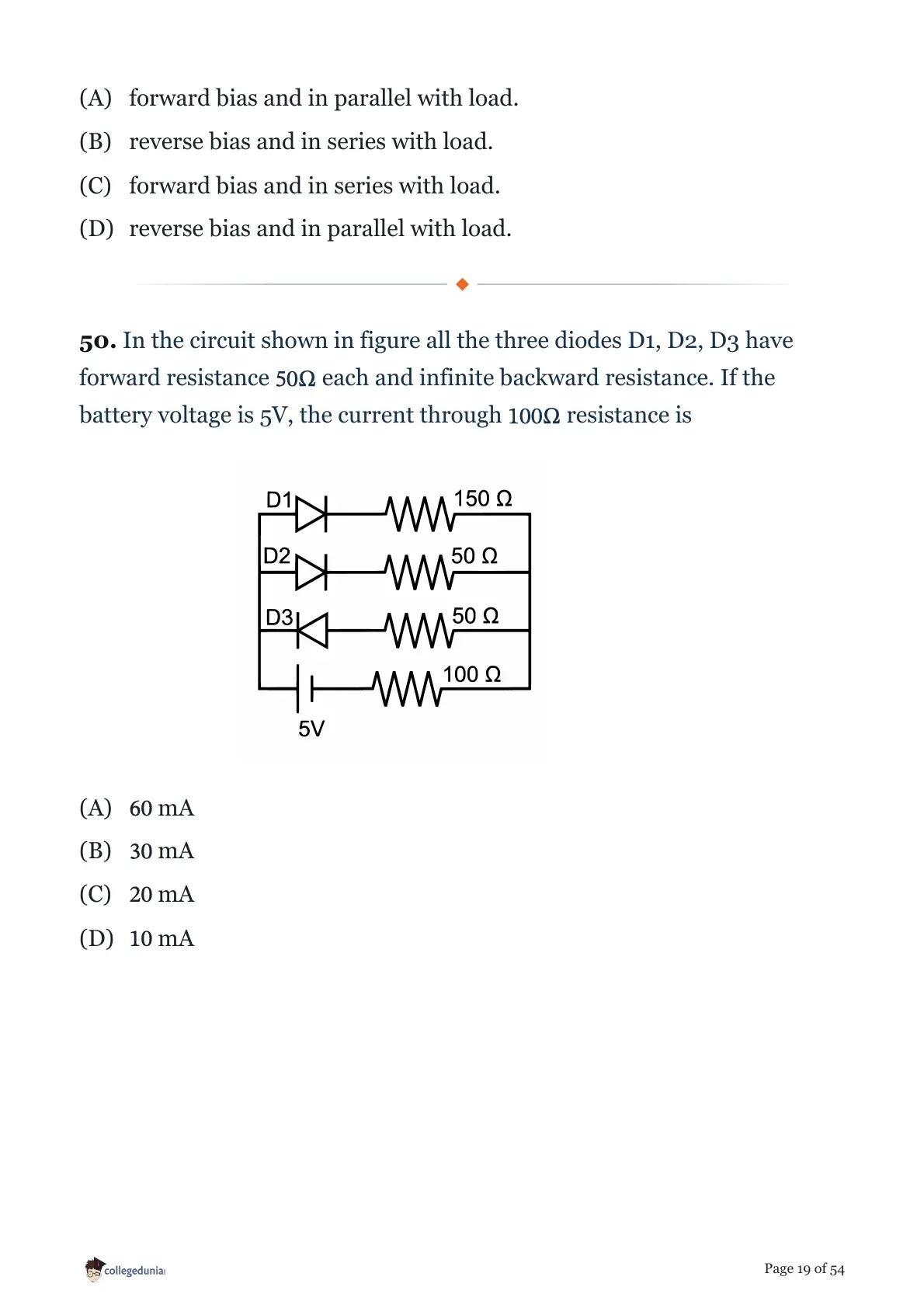
When the Zener diode is used as a voltage regulator, it is connected in
In the circuit shown in figure all the three diodes D1, D2, D3 have forward resistance \(50 \Omega\) each and infinite backward resistance. If the battery voltage is 5V, the current through \(100 \Omega\) resistance is

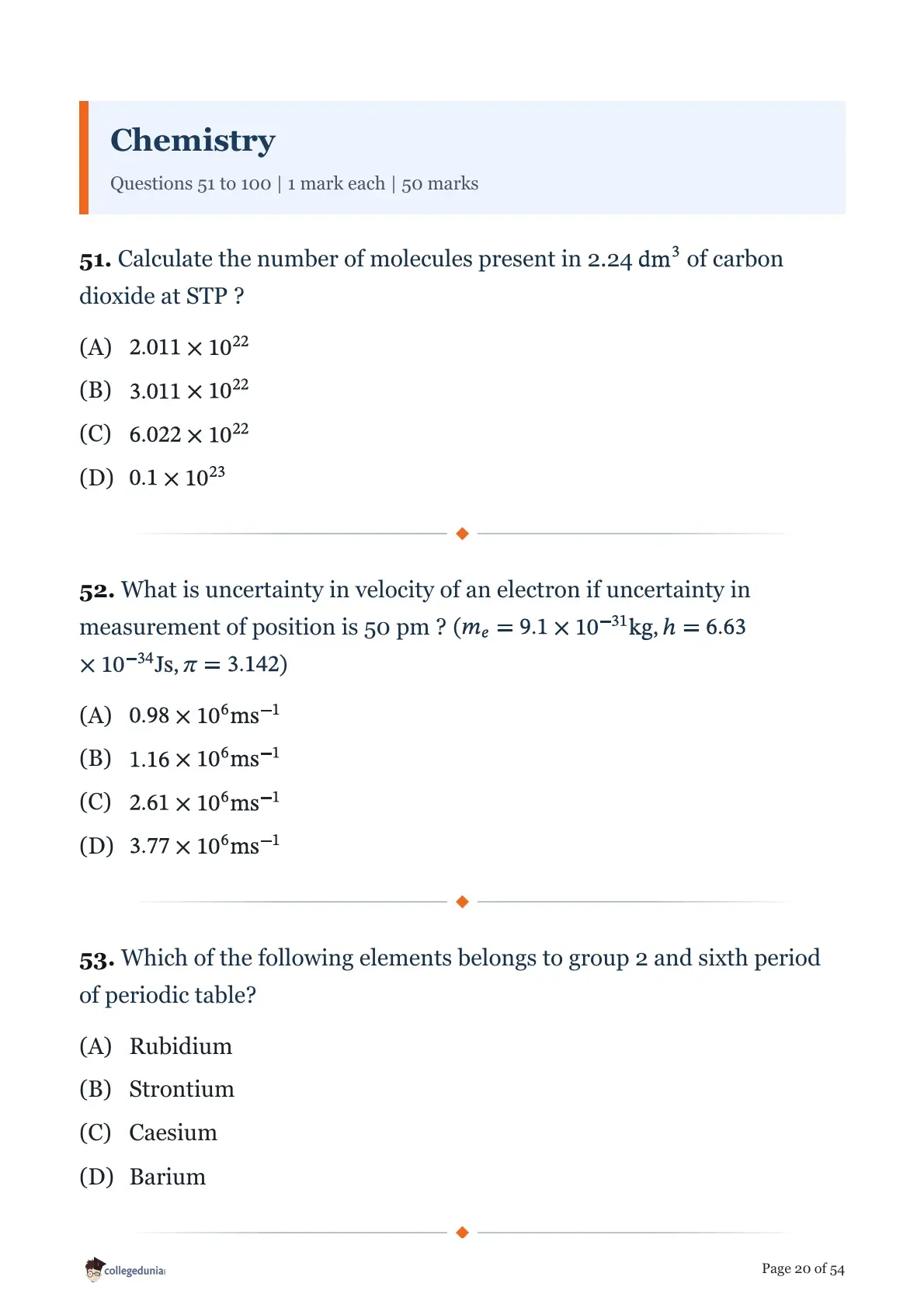
Chemistry Section (Questions 51 to 100)
Calculate the number of molecules present in 2.24 \(\text{dm}^3\) of carbon dioxide at STP ?
What is uncertainty in velocity of an electron if uncertainty in measurement of position is 50 pm ? \((m_e = 9.1\times 10^{-31}\text{kg}, h = 6.63\times 10^{-34}\text{Js}, π = 3.142)\)
Which of the following elements belongs to group 2 and sixth period of periodic table?
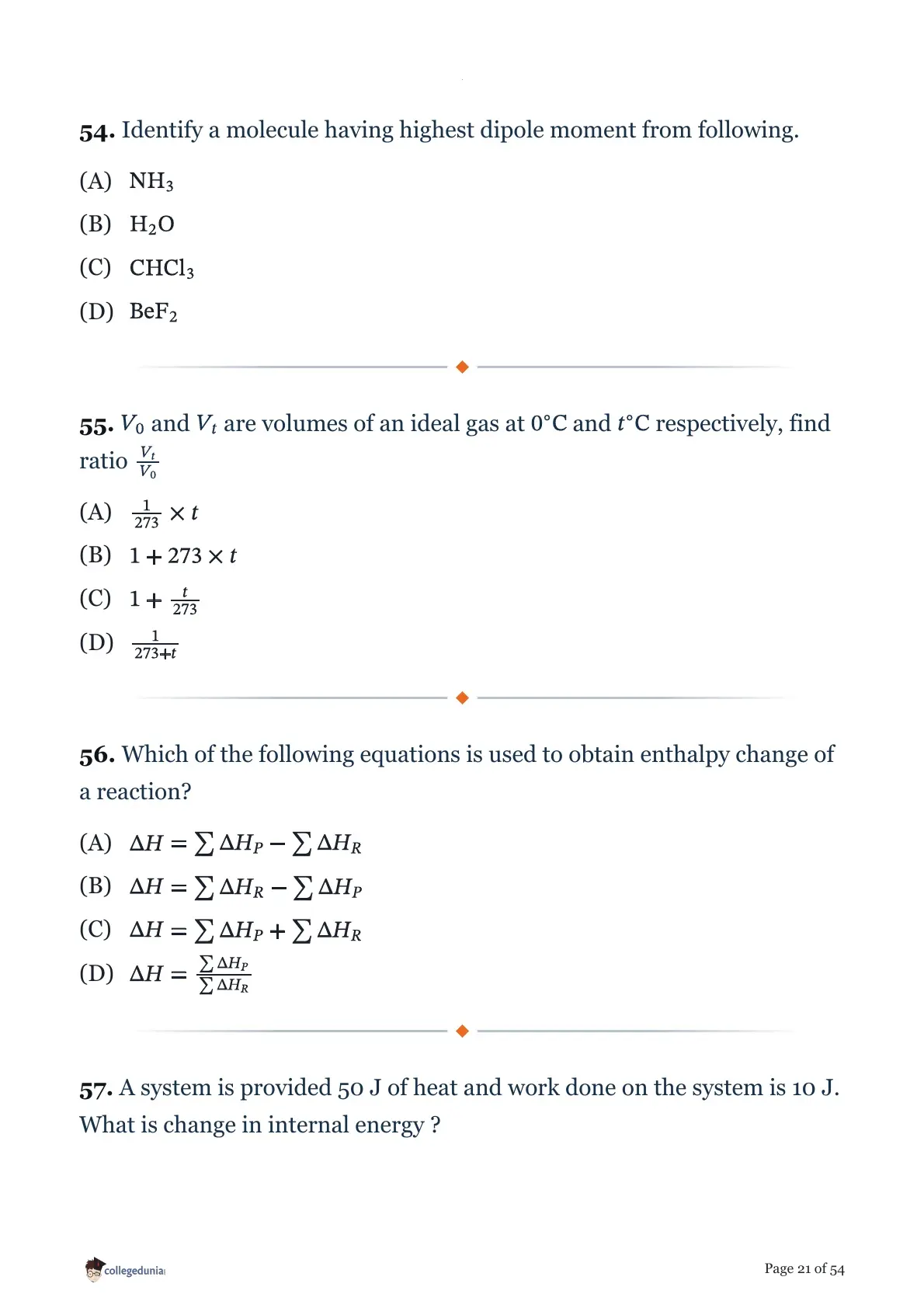
Identify a molecule having highest dipole moment from following.
\(V_0\) and \(V_t\) are volumes of an ideal gas at \(0 ^{\circ}\text{C}\) and \(t ^{\circ}\text{C}\) respectively, find ratio \(\frac{V_t}{V_0}\)
Which of the following equations is used to obtain enthalpy change of a reaction?
A system is provided 50 J of heat and work done on the system is 10 J. What is change in internal energy ?
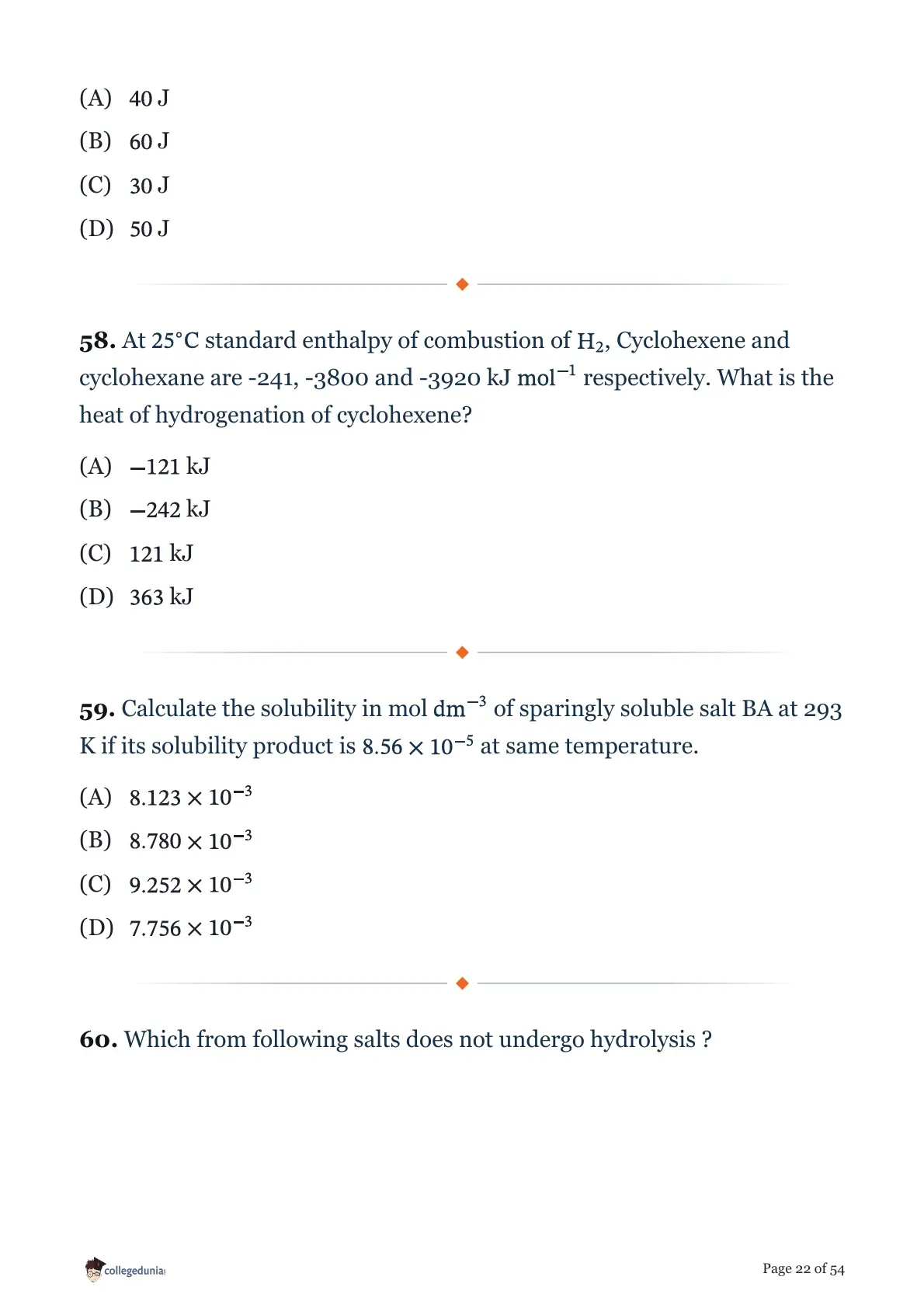
At \(25 ^{\circ}\text{C}\) standard enthalpy of combustion of \(\text{H}_2\), Cyclohexene and cyclohexane are -241, -3800 and -3920 kJ \(\text{mol}^{-1}\) respectively. What is the heat of hydrogenation of cyclohexene?
Calculate the solubility in mol \(\text{dm}^{-3}\) of sparingly soluble salt BA at 293 K if its solubility product is \(8.56\times 10^{-5}\) at same temperature.
Which from following salts does not undergo hydrolysis ?
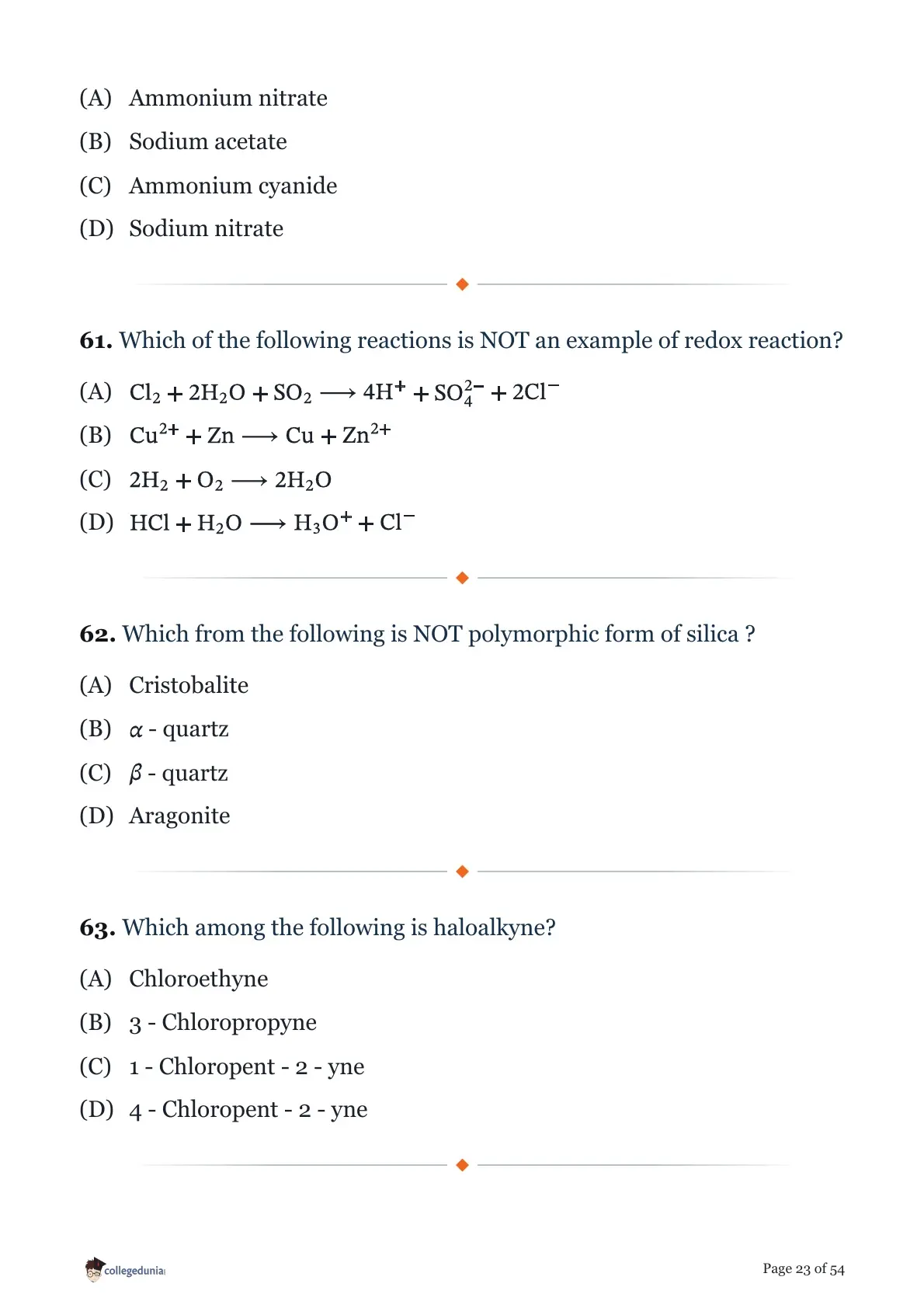
Which of the following reactions is NOT an example of redox reaction?
Which from the following is NOT polymorphic form of silica ?
Which among the following is haloalkyne?
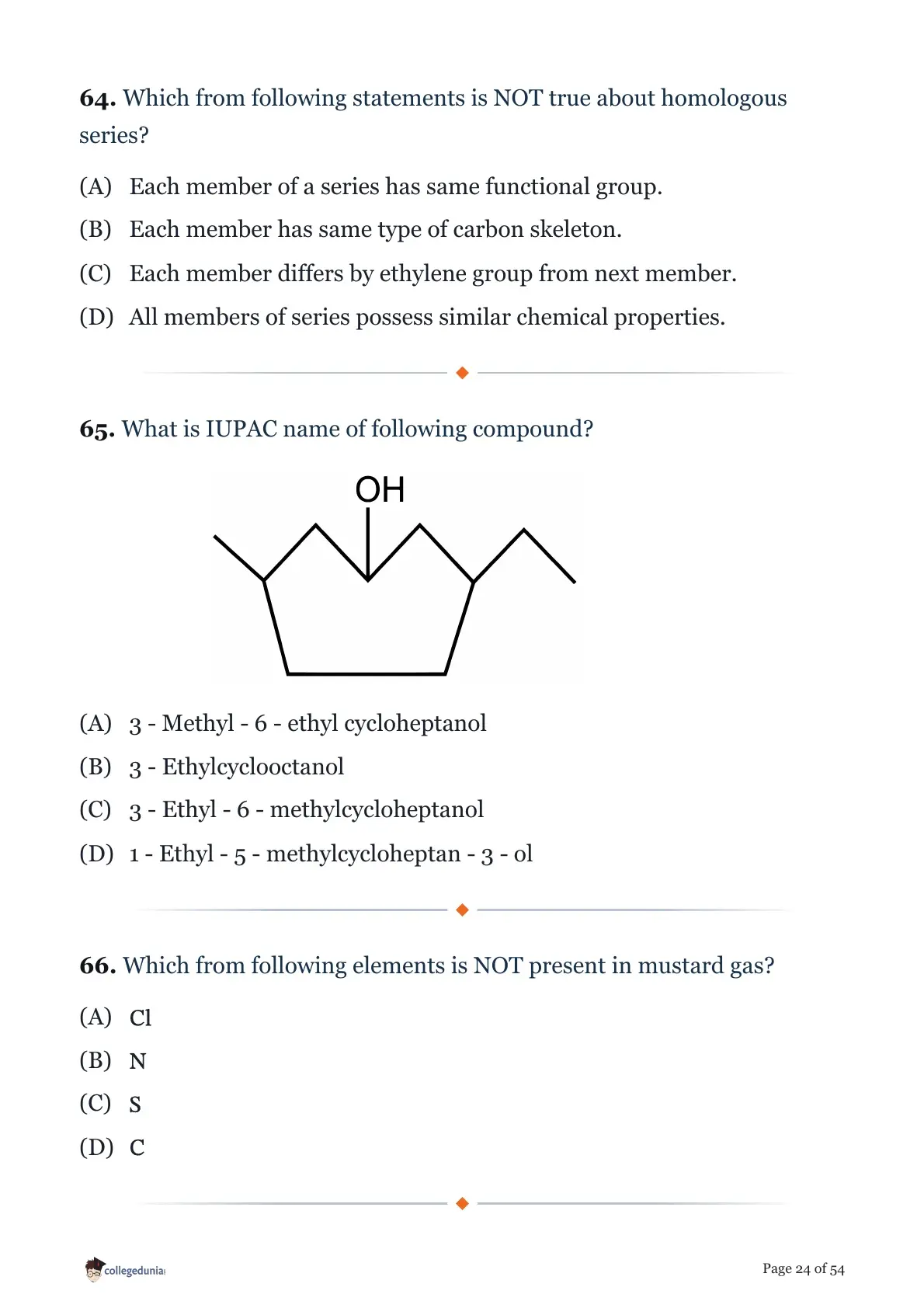
Which from following statements is NOT true about homologous series?

Which from following elements is NOT present in mustard gas?
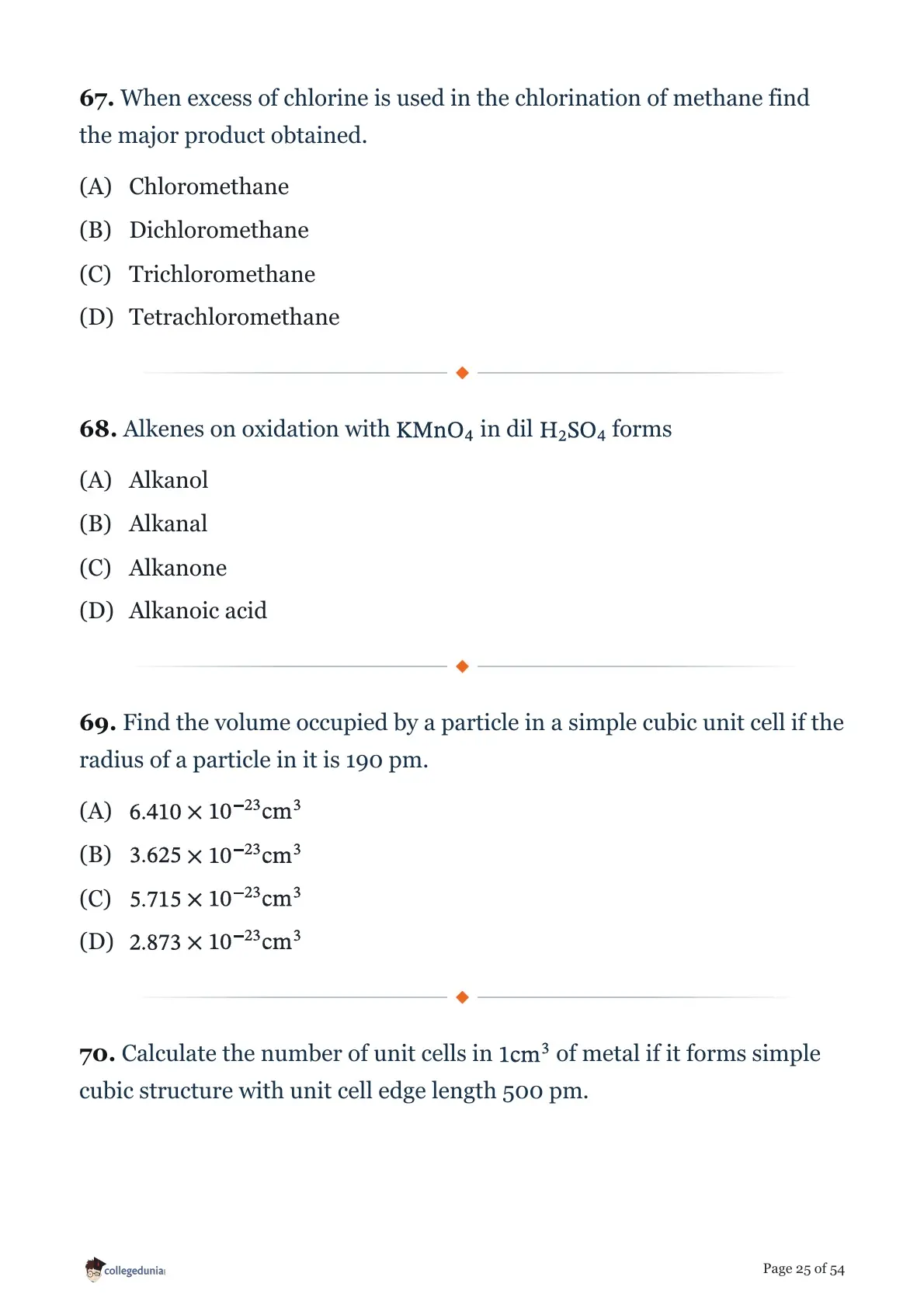
When excess of chlorine is used in the chlorination of methane find the major product obtained.
Alkenes on oxidation with \(\text{KMnO}_4\) in dil \(\text{H}_2\text{SO}_4\) forms
Find the volume occupied by a particle in a simple cubic unit cell if the radius of a particle in it is 190 pm.
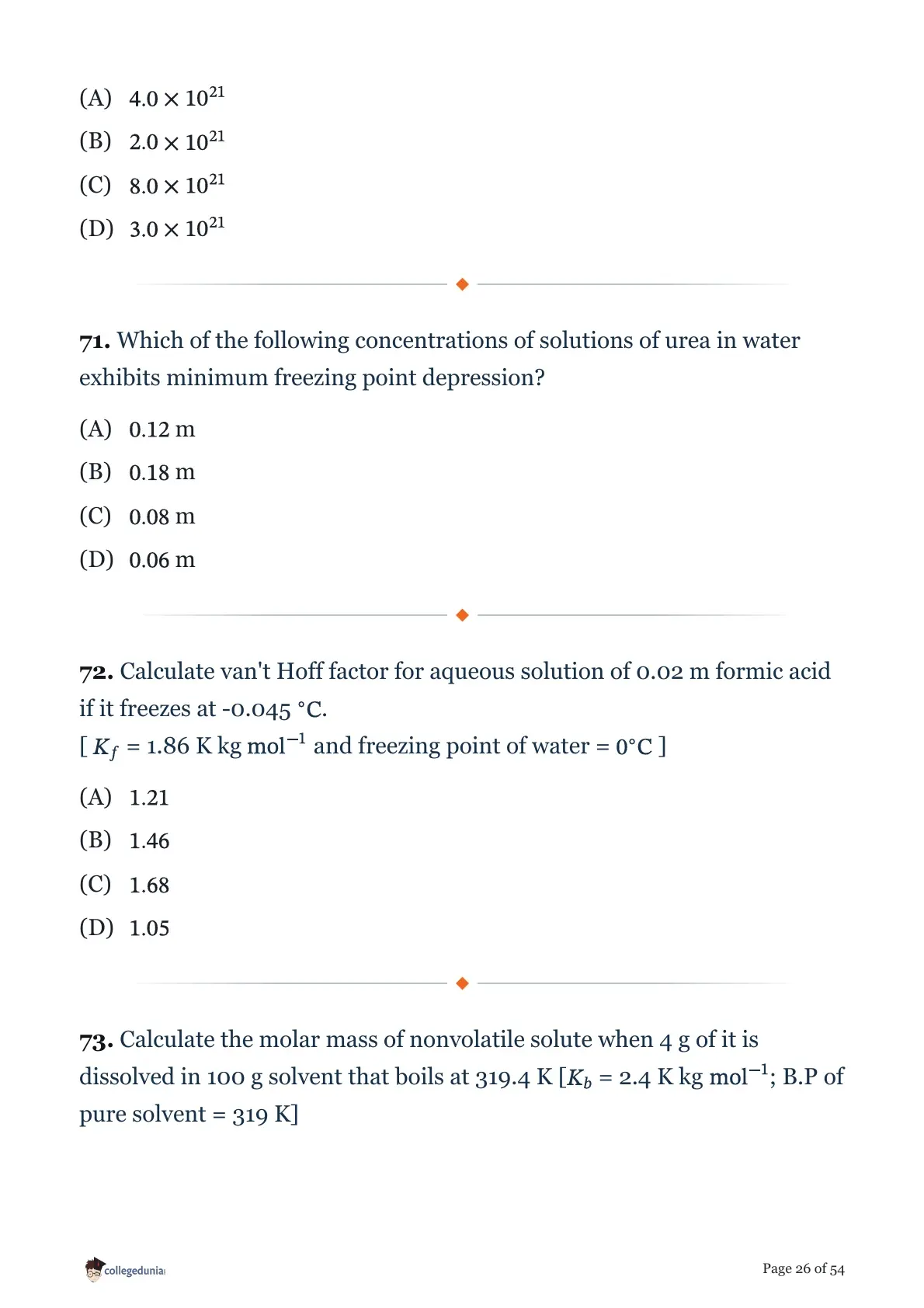
Calculate the number of unit cells in \(1\text{cm}^3\) of metal if it forms simple cubic structure with unit cell edge length 500 pm.
Which of the following concentrations of solutions of urea in water exhibits minimum freezing point depression?
Calculate van't Hoff factor for aqueous solution of 0.02 m formic acid if it freezes at -0.045 \(^{\circ}\text{C}\).
[ \(K_f\) = 1.86 K kg \(\text{mol}^{-1}\) and freezing point of water = \(0 ^{\circ}\text{C}\) ]
Calculate the molar mass of nonvolatile solute when 4 g of it is dissolved in 100 g solvent that boils at 319.4 K [\(K_b\) = 2.4 K kg \(\text{mol}^{-1}\); B.P of pure solvent = 319 K]
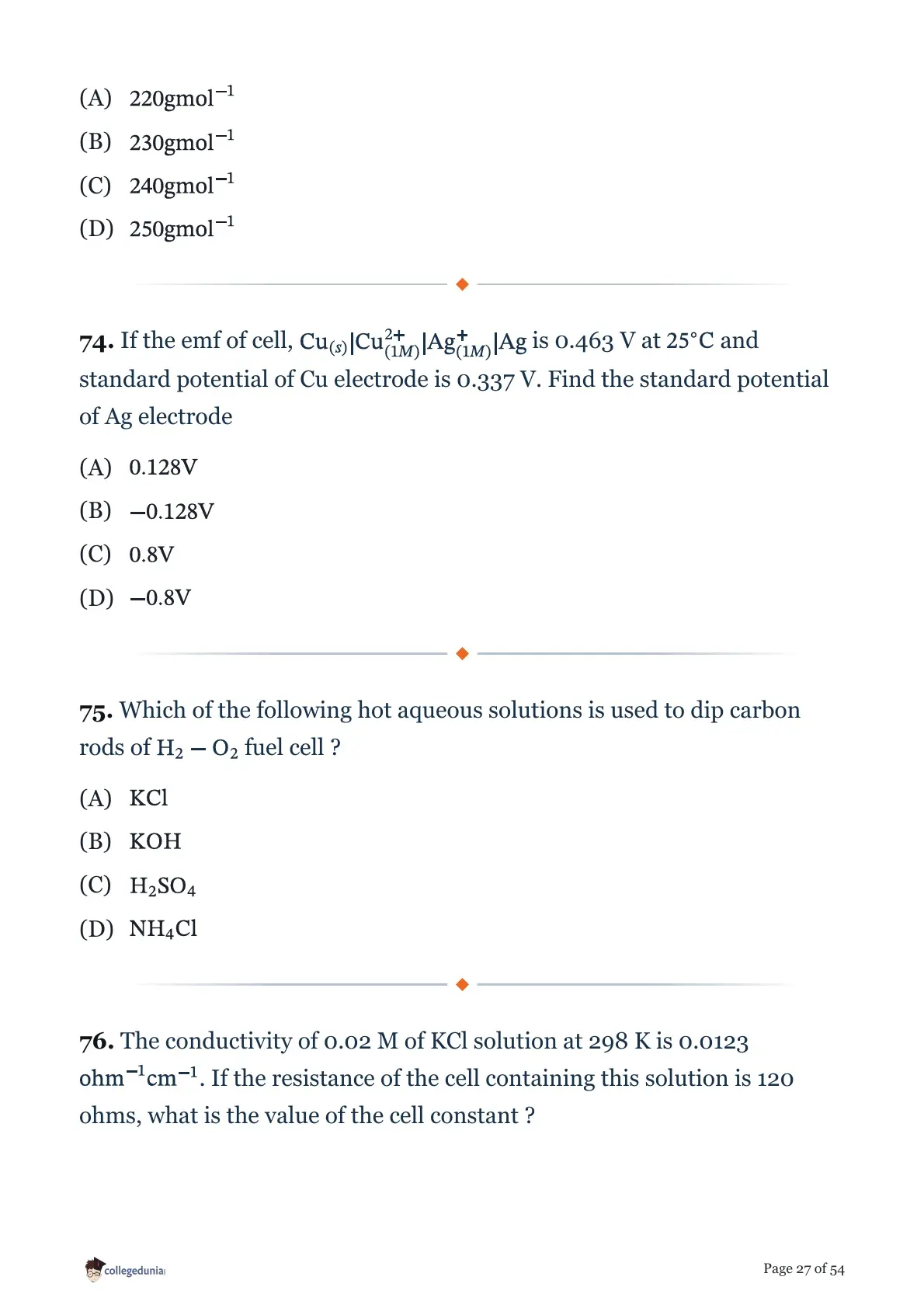
If the emf of cell, \(\text{Cu}_{(s)}|\text{Cu}_{(1M)}^{2+}|\text{Ag}_{(1M)}^+|\text{Ag}\) is 0.463 V at \(25 ^{\circ}\text{C}\) and standard potential of Cu electrode is 0.337 V. Find the standard potential of Ag electrode
Which of the following hot aqueous solutions is used to dip carbon rods of \(\text{H}_2-\text{O}_2\) fuel cell ?
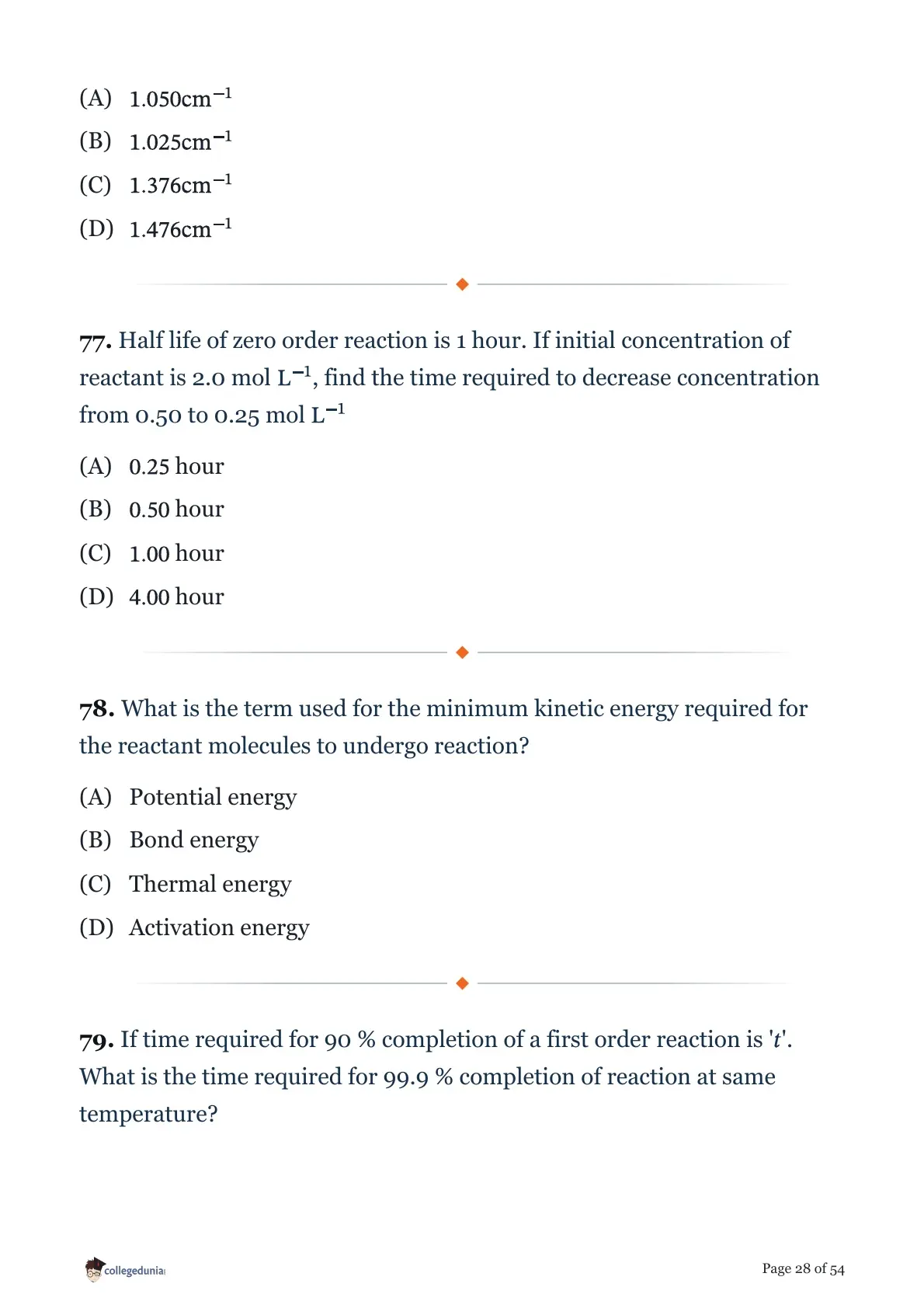
The conductivity of 0.02 M of KCl solution at 298 K is 0.0123 \(\text{ohm}^{-1} \text{cm}^{-1}\). If the resistance of the cell containing this solution is 120 ohms, what is the value of the cell constant ?
Half life of zero order reaction is 1 hour. If initial concentration of reactant is 2.0 mol \(\text{L}^{-1}\), find the time required to decrease concentration from 0.50 to 0.25 mol \(\text{L}^{-1}\)
What is the term used for the minimum kinetic energy required for the reactant molecules to undergo reaction?
If time required for 90 % completion of a first order reaction is '\(t\)'. What is the time required for 99.9 % completion of reaction at same temperature?
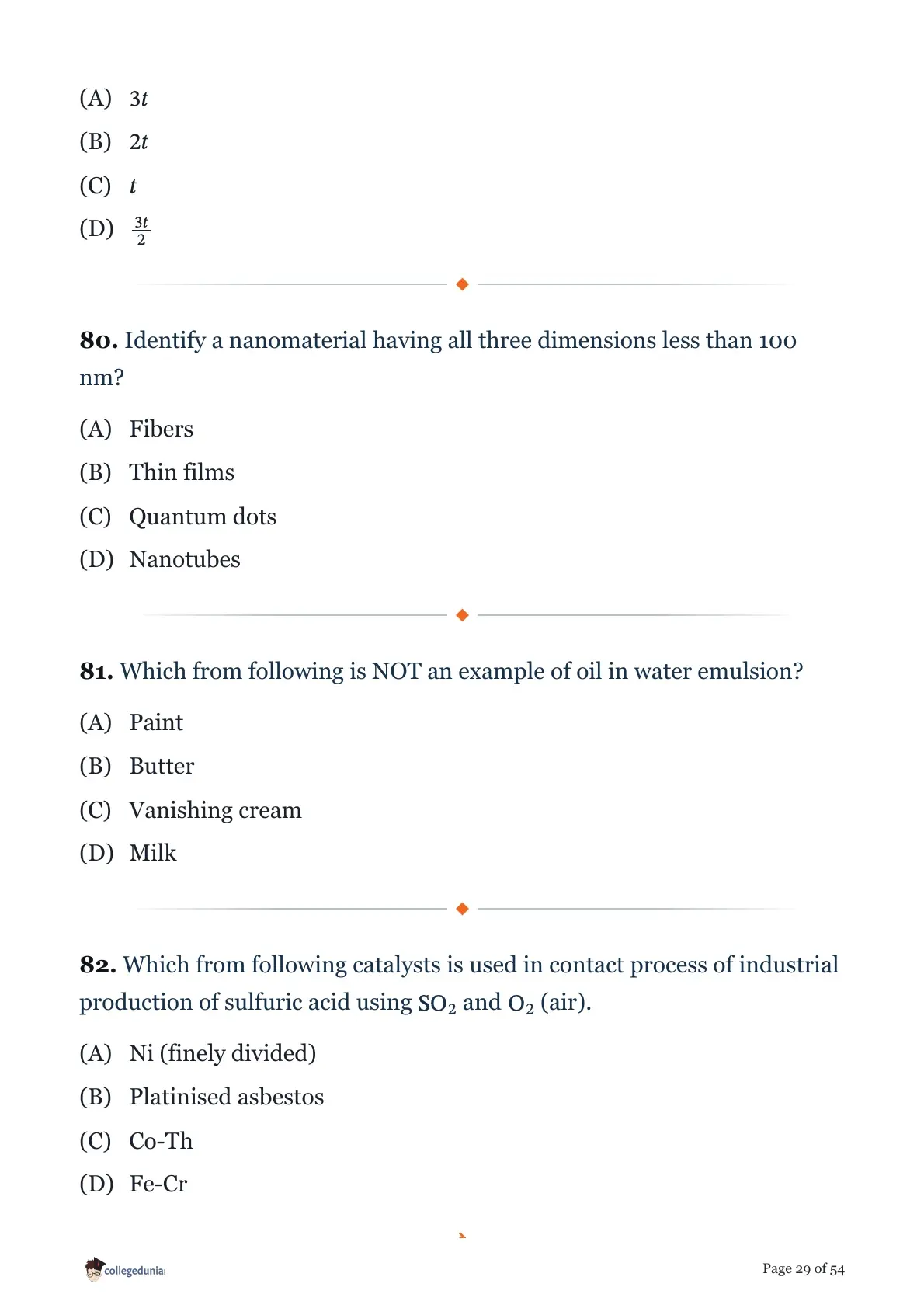
Identify a nanomaterial having all three dimensions less than 100 nm?
Which from following is NOT an example of oil in water emulsion?
Which from following catalysts is used in contact process of industrial production of sulfuric acid using \(\text{SO}_2\) and \(\text{O}_2\) (air).
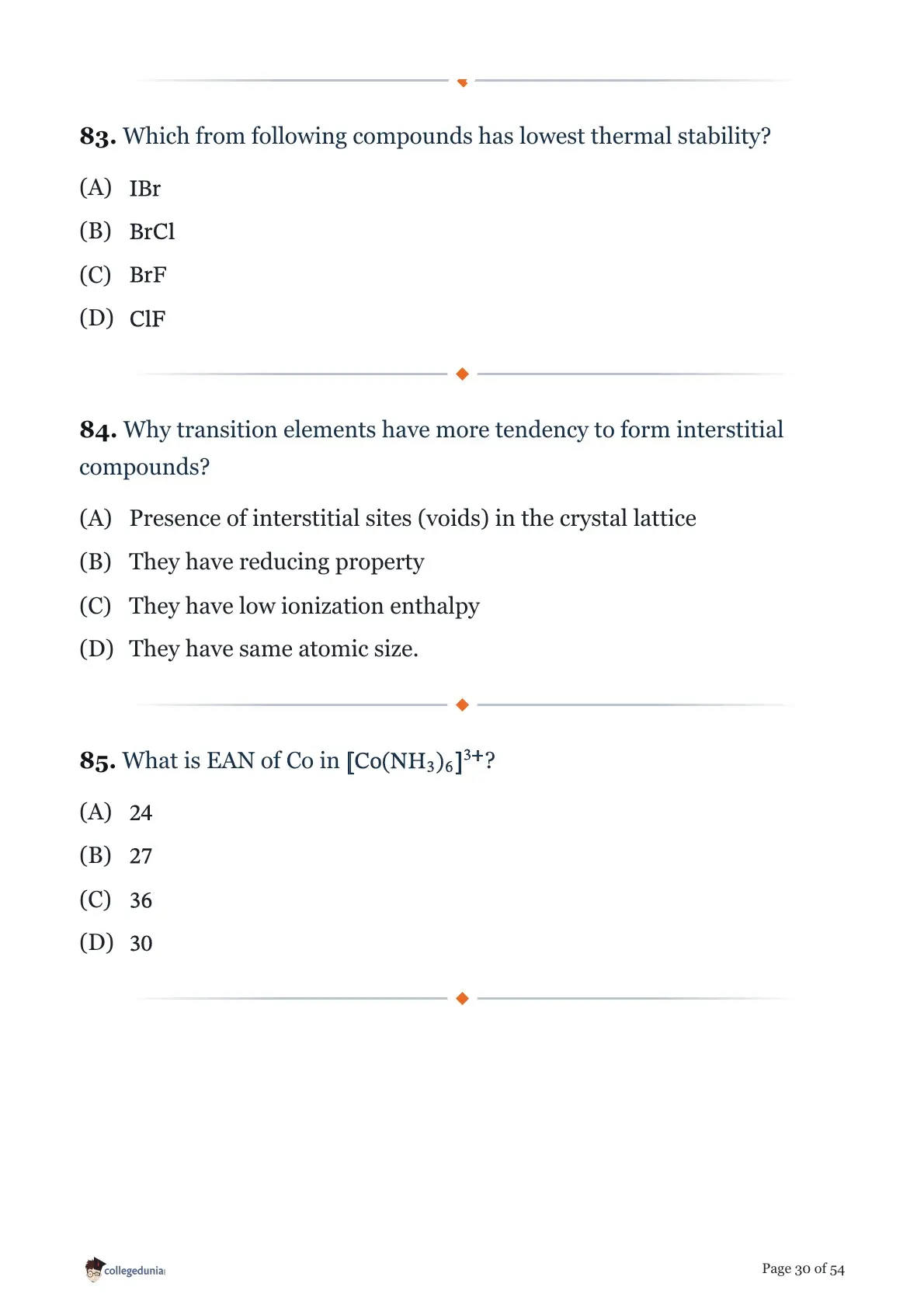
Which from following compounds has lowest thermal stability?
Why transition elements have more tendency to form interstitial compounds?
What is EAN of Co in \([\text{Co}(\text{NH}_3)_6]^{3+}\)?
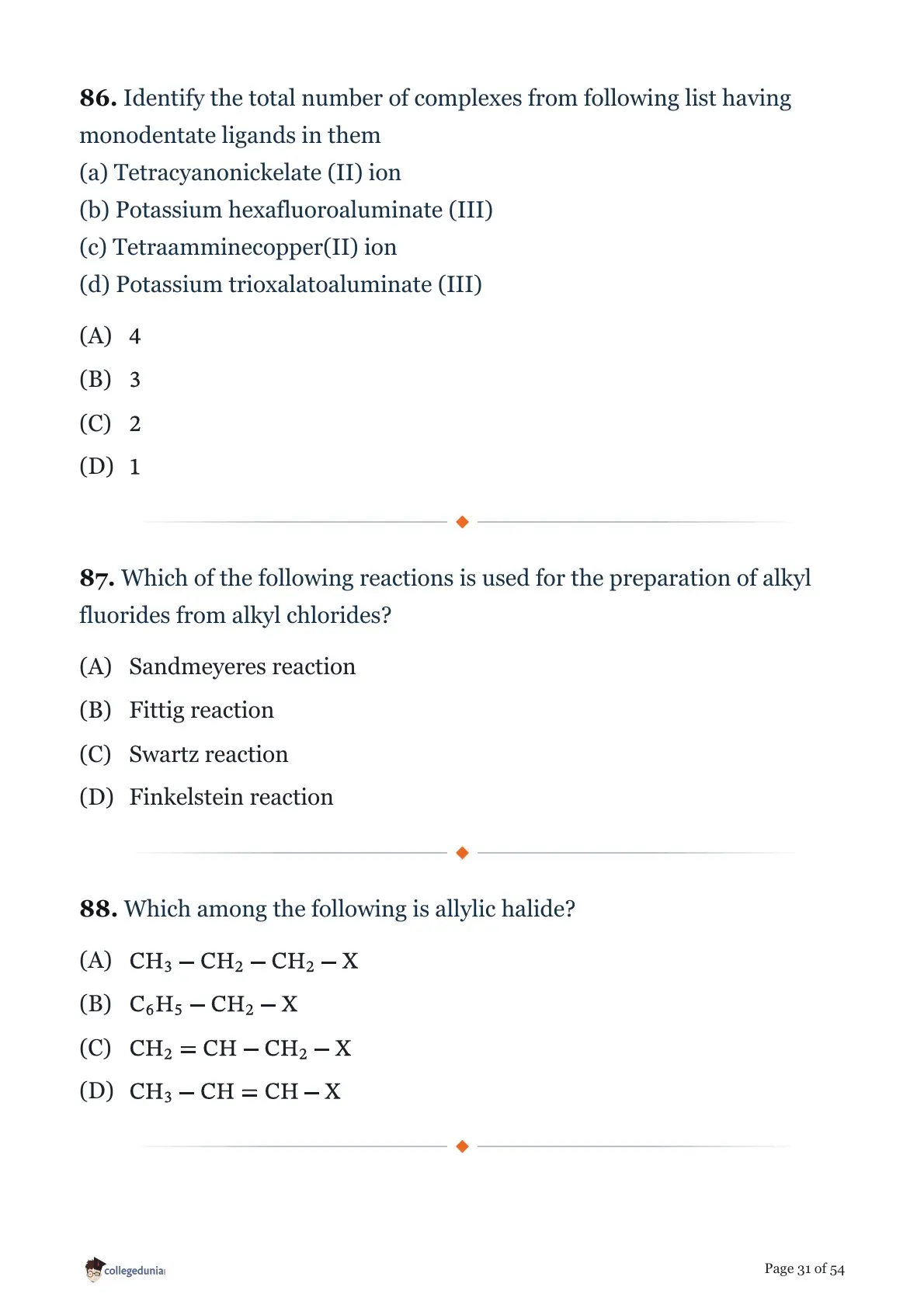
Identify the total number of complexes from following list having monodentate ligands in them
(a) Tetracyanonickelate (II) ion
(b) Potassium hexafluoroaluminate (III)
(c) Tetraamminecopper(II) ion
(d) Potassium trioxalatoaluminate (III)
Which of the following reactions is used for the preparation of alkyl fluorides from alkyl chlorides?
Which among the following is allylic halide?
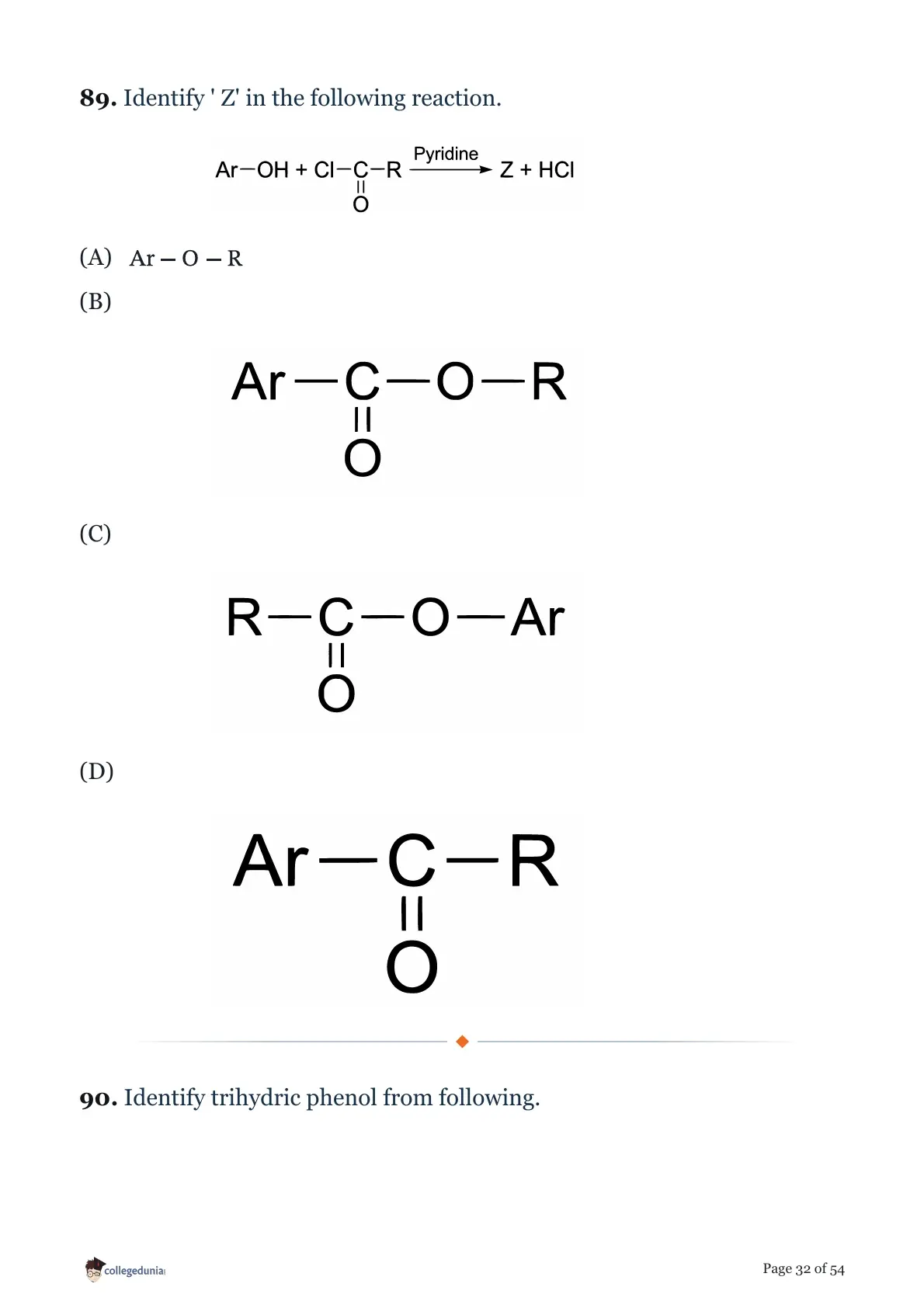
Identify ' Z' in the following reaction.

- (A) \(\text{Ar}-\text{O}-\text{R}\)
- (B)
![]()
- (C)
![]()
- (D)
![]()


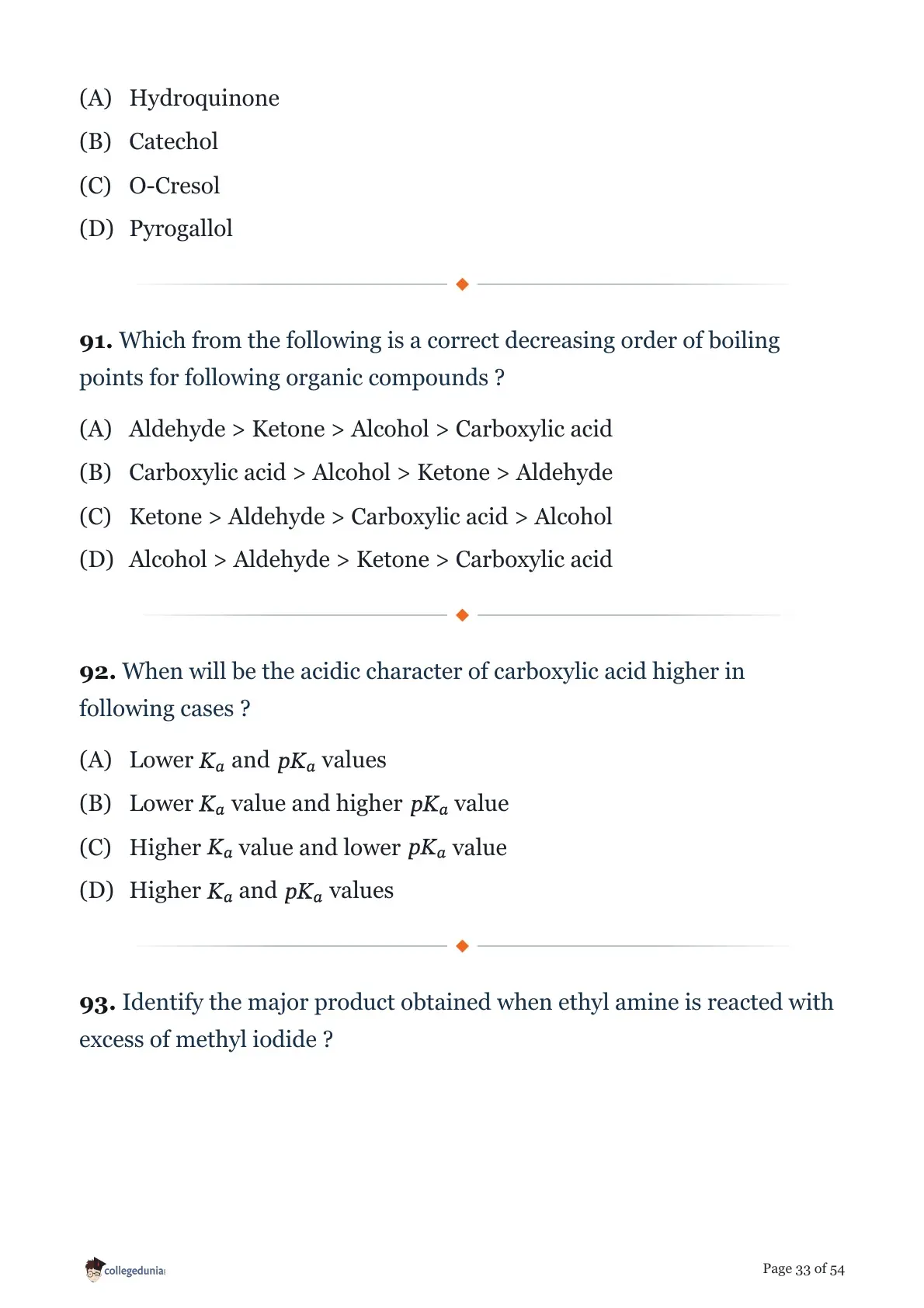
Identify trihydric phenol from following.
Which from the following is a correct decreasing order of boiling points for following organic compounds ?
When will be the acidic character of carboxylic acid higher in following cases ?
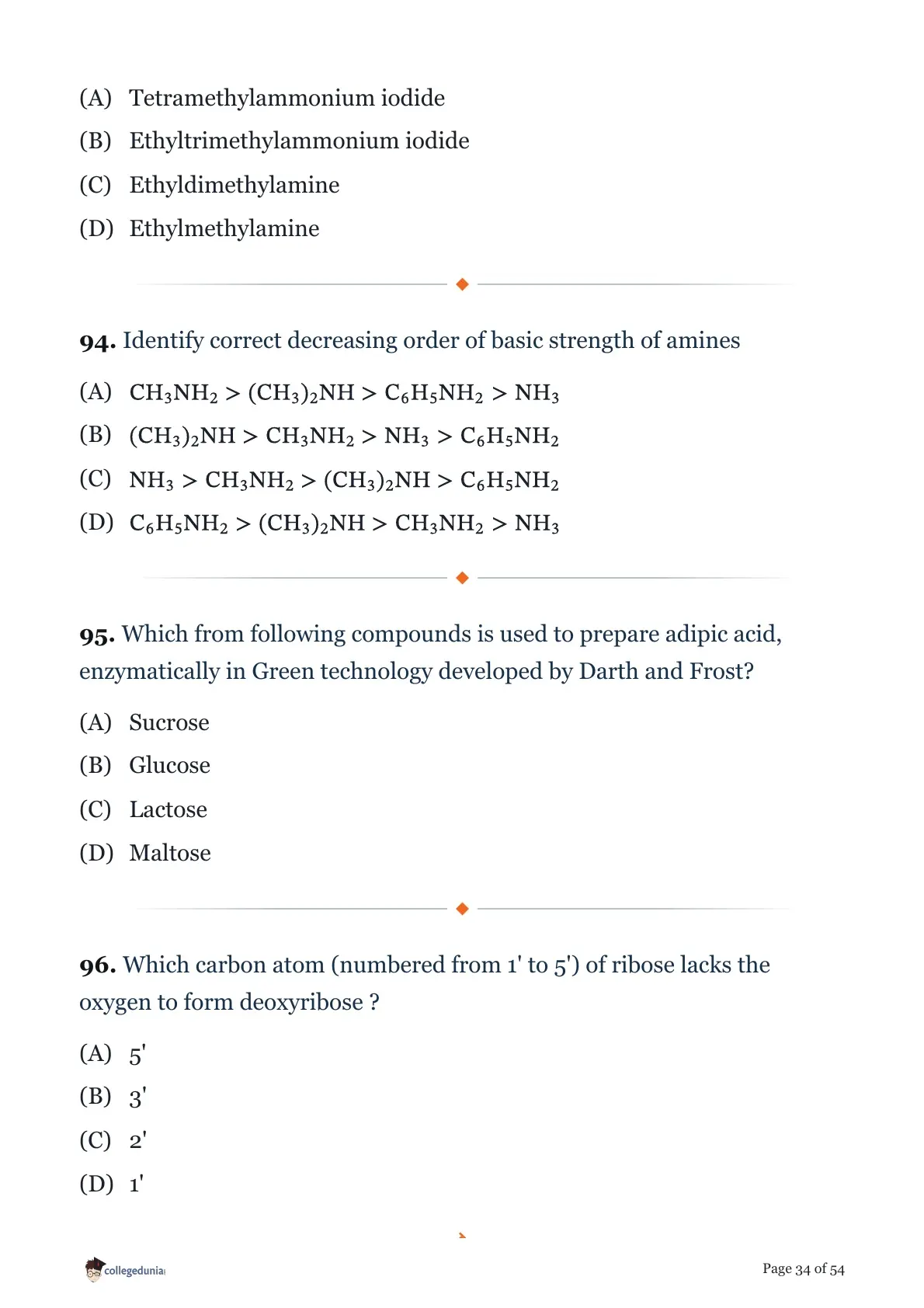
Identify the major product obtained when ethyl amine is reacted with excess of methyl iodide ?
Identify correct decreasing order of basic strength of amines
Which from following compounds is used to prepare adipic acid, enzymatically in Green technology developed by Darth and Frost?
Which carbon atom (numbered from 1' to 5') of ribose lacks the oxygen to form deoxyribose ?
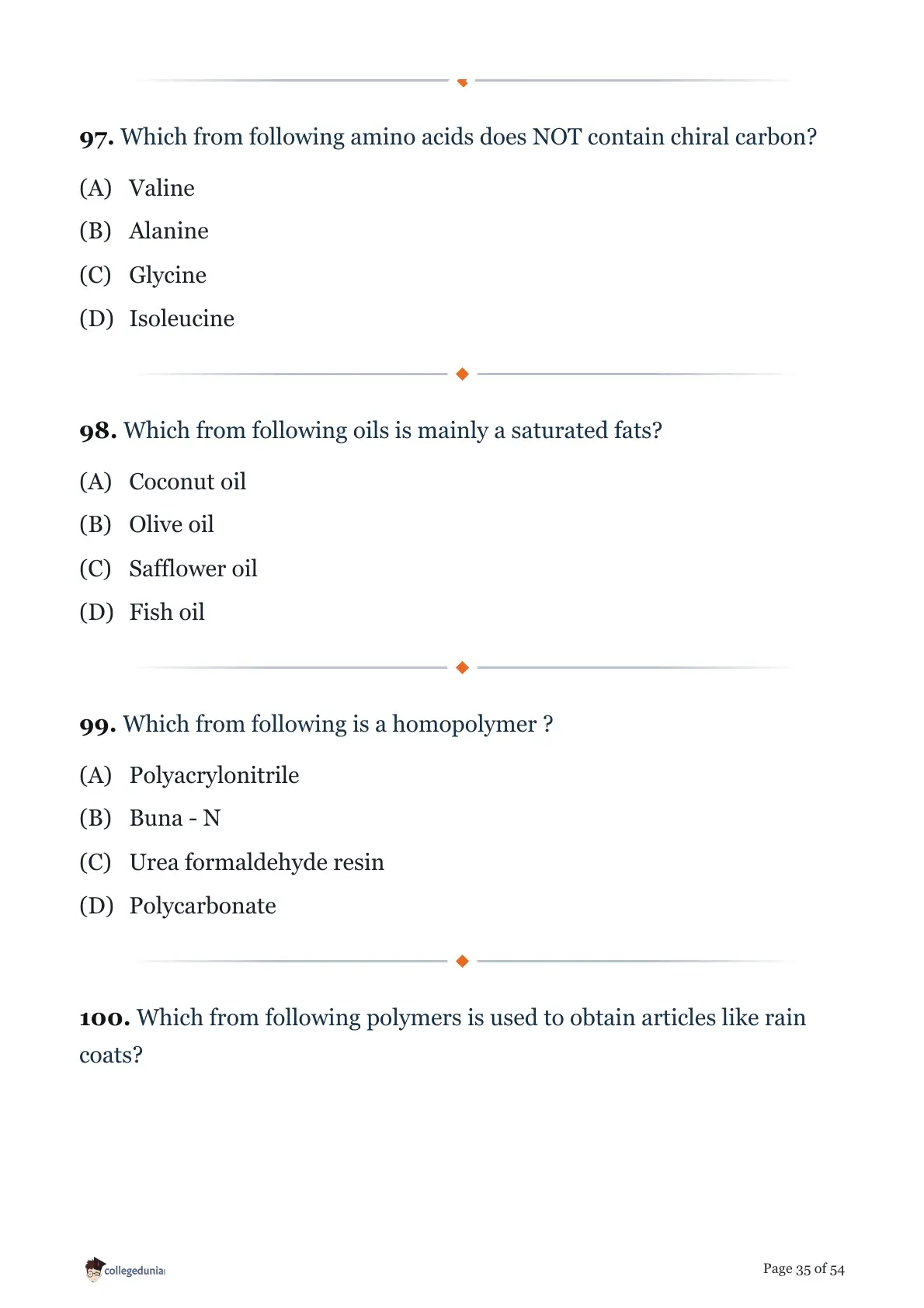
Which from following amino acids does NOT contain chiral carbon?
Which from following oils is mainly a saturated fats?
Which from following is a homopolymer ?
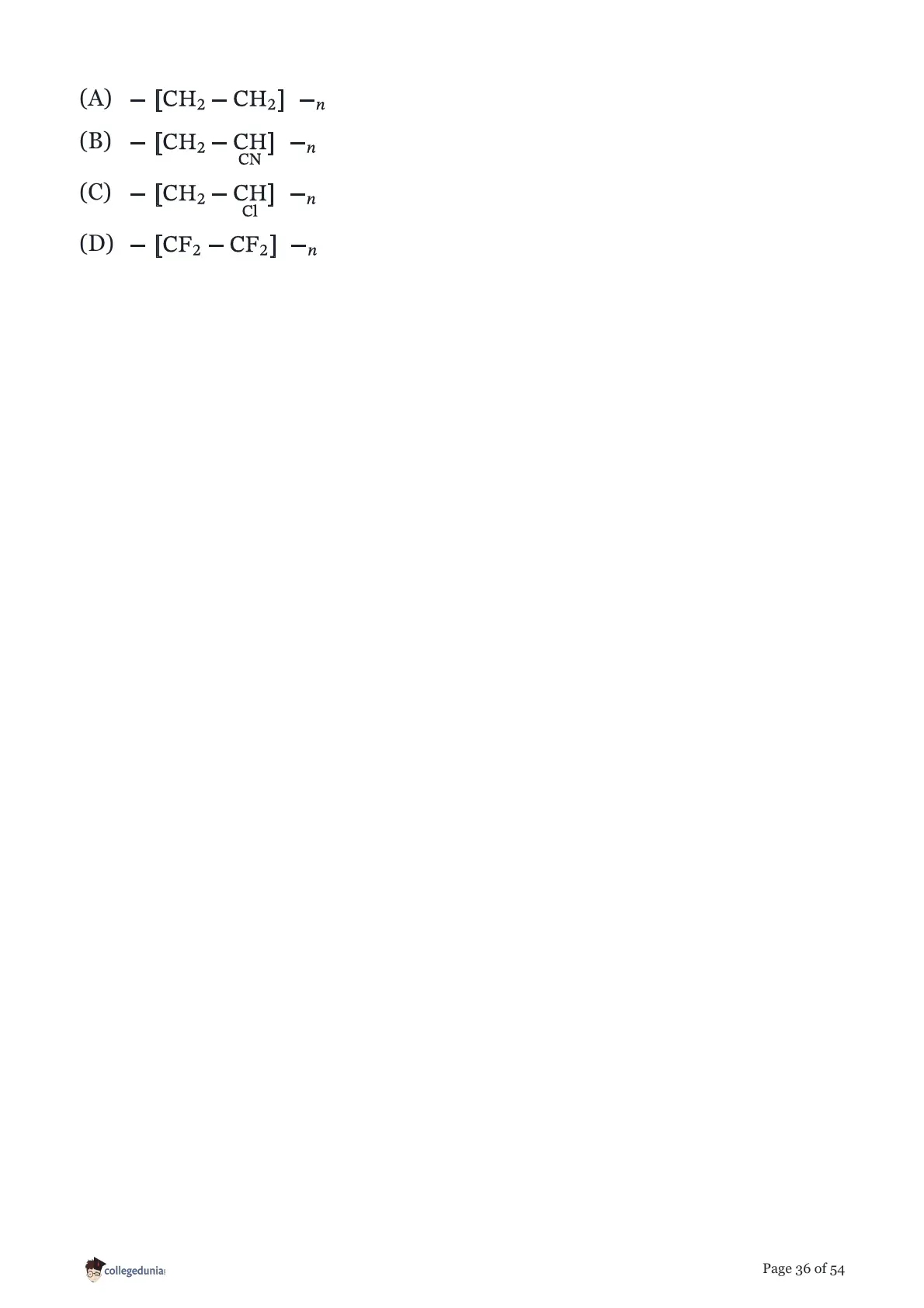
Which from following polymers is used to obtain articles like rain coats?
Mathematics Section (Questions 101 to 150)
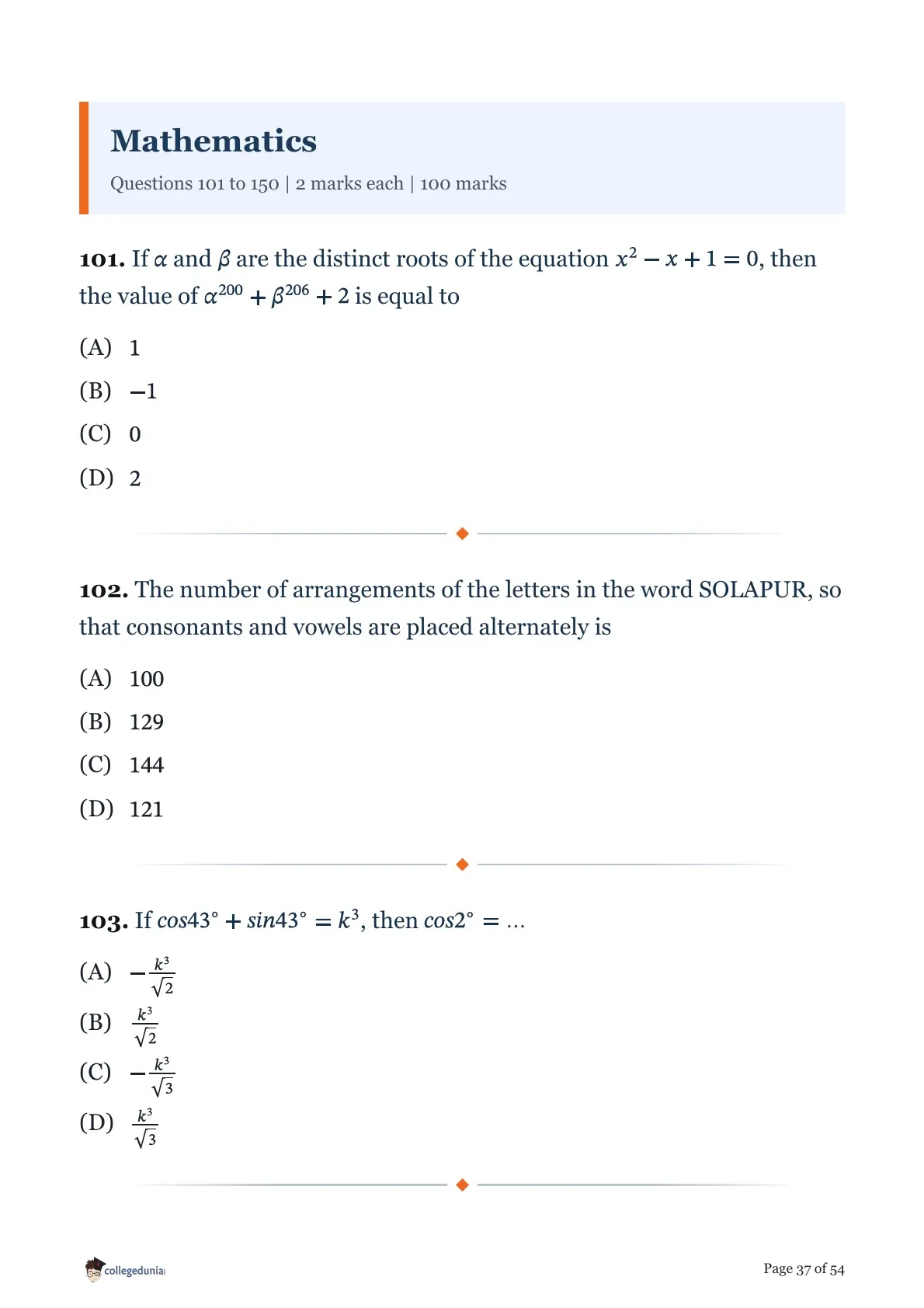
If \(α\) and \(β\) are the distinct roots of the equation \(x^2-x+1 = 0\), then the value of \(α^{200}+β^{206}+2\) is equal to
The number of arrangements of the letters in the word SOLAPUR, so that consonants and vowels are placed alternately is
If \(cos43^{\circ}+sin43^{\circ} = k^3\), then \(cos2^{\circ} = \ldots\)
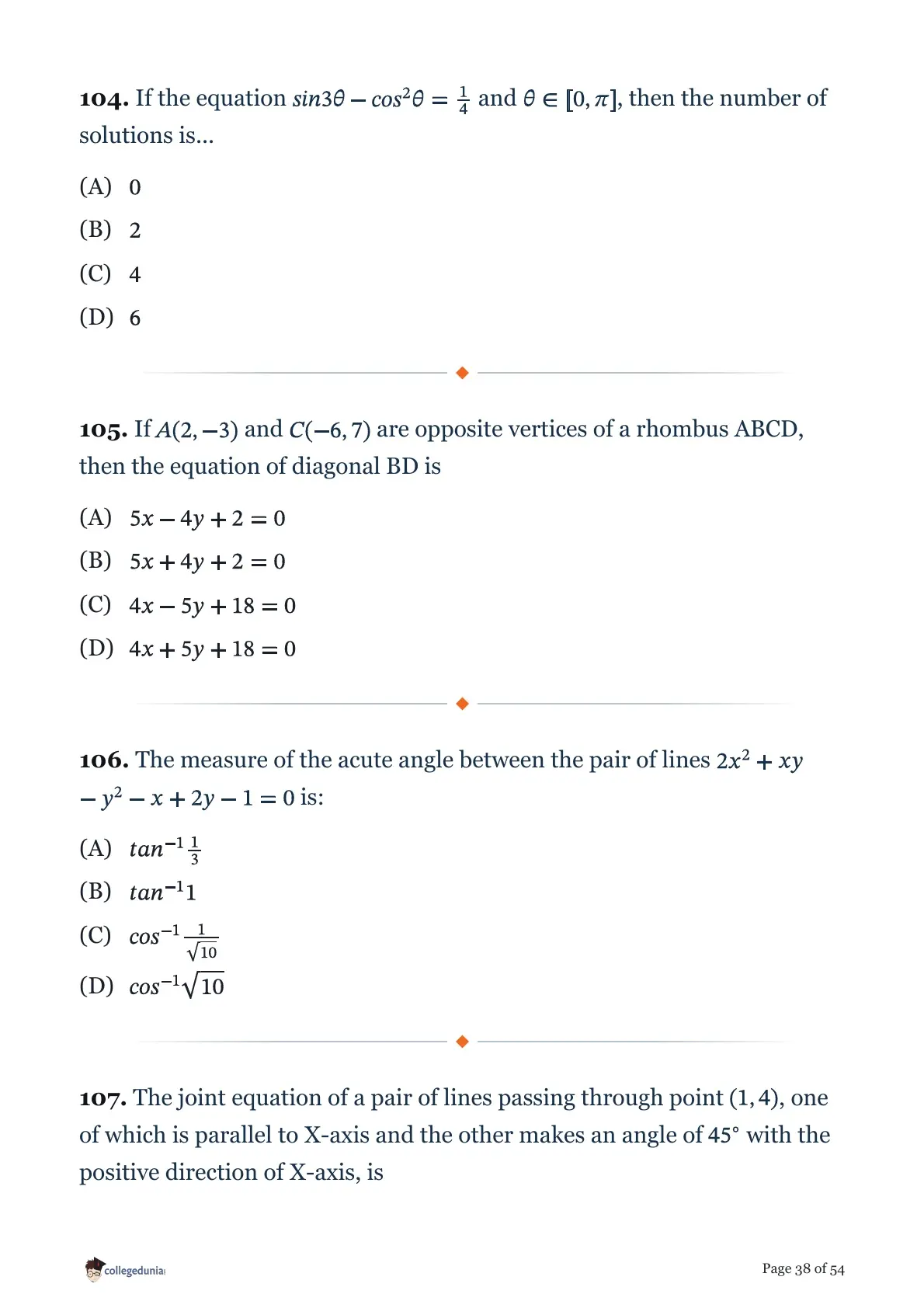
If the equation \(sin3θ-cos^2θ = \frac{1}{4}\) and \(θ\in [0,π]\), then the number of solutions is...
If \(A(2,-3)\) and \(C(-6,7)\) are opposite vertices of a rhombus ABCD, then the equation of diagonal BD is
The measure of the acute angle between the pair of lines \(2x^2+xy-y^2-x+2y-1 = 0\) is:
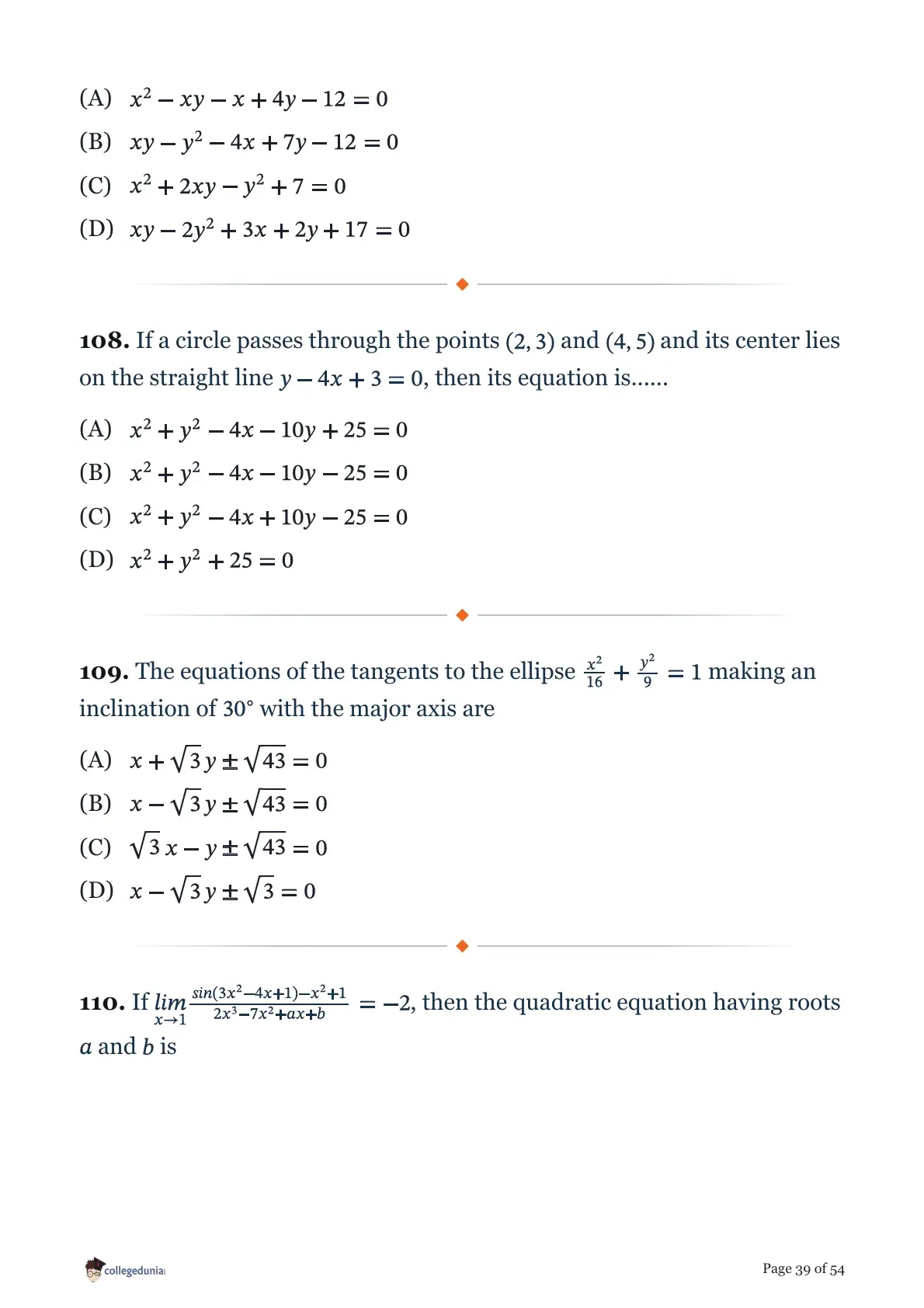
The joint equation of a pair of lines passing through point \((1,4)\), one of which is parallel to X-axis and the other makes an angle of \(45^{\circ}\) with the positive direction of X-axis, is
If a circle passes through the points \((2,3)\) and \((4,5)\) and its center lies on the straight line \(y-4x+3 = 0\), then its equation is......
The equations of the tangents to the ellipse \(\frac{x^2}{16}+\frac{y^2}{9} = 1\) making an inclination of \(30^{\circ}\) with the major axis are
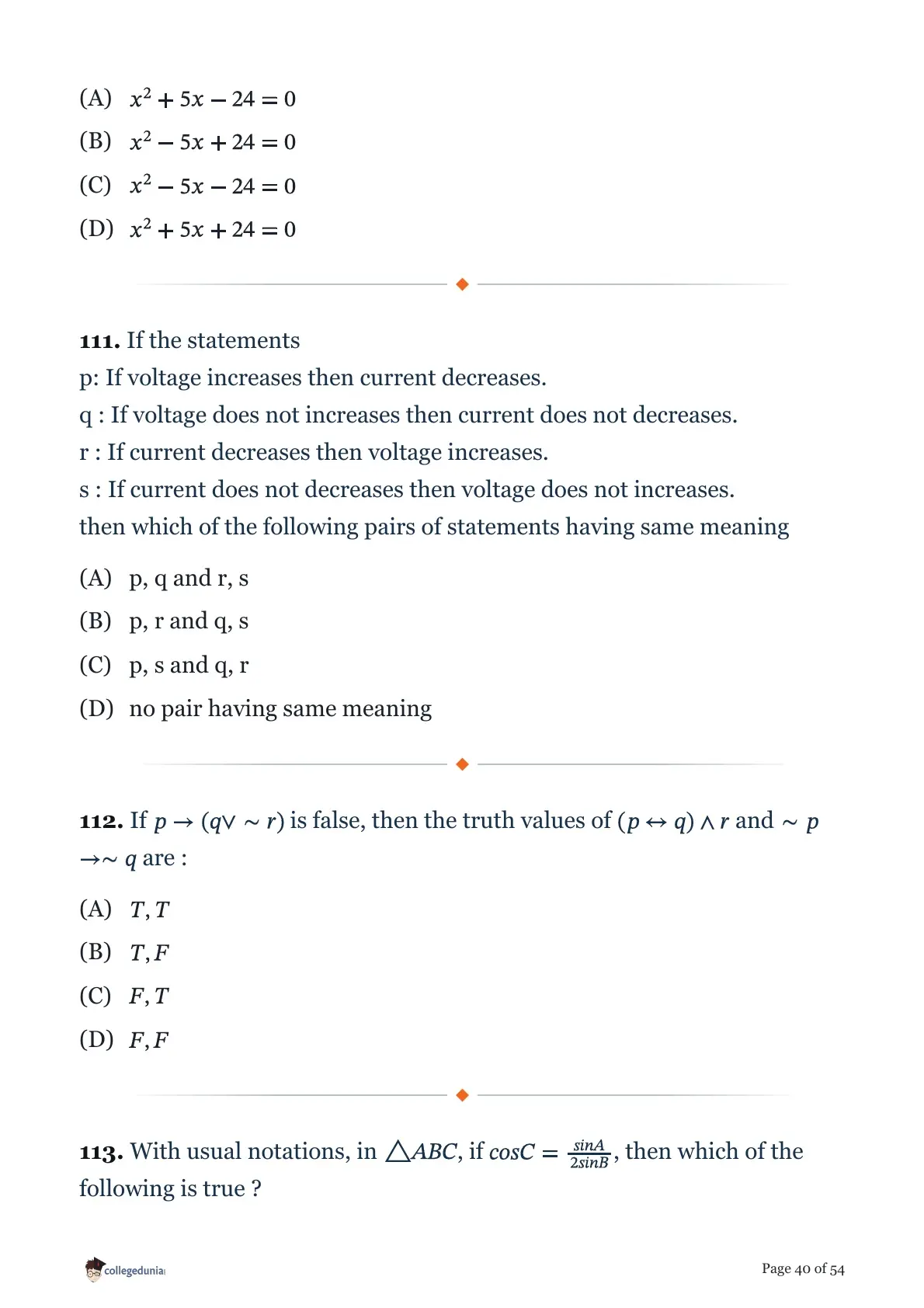
If \(\underset{x\rightarrow 1}{lim}\frac{sin(3x^2-4x+1)-x^2+1}{2x^3-7x^2+ax+b} = -2\), then the quadratic equation having roots \(a\) and \(b\) is
If the statements
p: If voltage increases then current decreases.
q : If voltage does not increases then current does not decreases.
r : If current decreases then voltage increases.
s : If current does not decreases then voltage does not increases.
then which of the following pairs of statements having same meaning
If \(p\rightarrow (q∨\sim r)\) is false, then the truth values of \((p\leftrightarrow q)∧r\) and \(\sim p\rightarrow \sim q\) are :
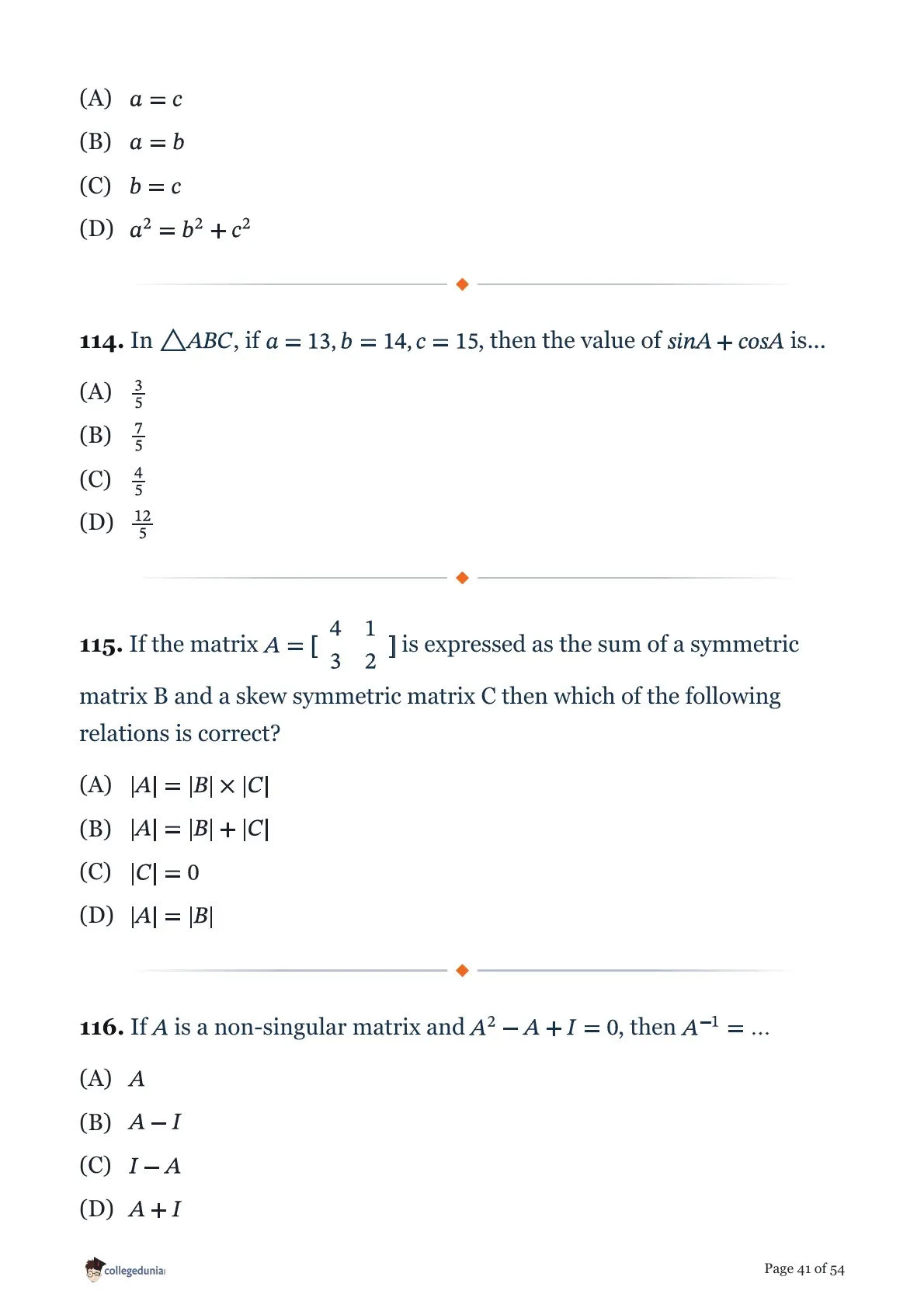
With usual notations, in \(△ABC\), if \(cosC = \frac{sinA}{2sinB}\), then which of the following is true ?
In \(△ABC\), if \(a = 13,b = 14,c = 15\), then the value of \(sinA+cosA\) is...
If the matrix \(A = [\begin{array}{cc}4 & 1 \\ 3 & 2\end{array}]\) is expressed as the sum of a symmetric matrix B and a skew symmetric matrix C then which of the following relations is correct?
If \(A\) is a non-singular matrix and \(A^2-A+I = 0\), then \(A^{-1} = \ldots\)
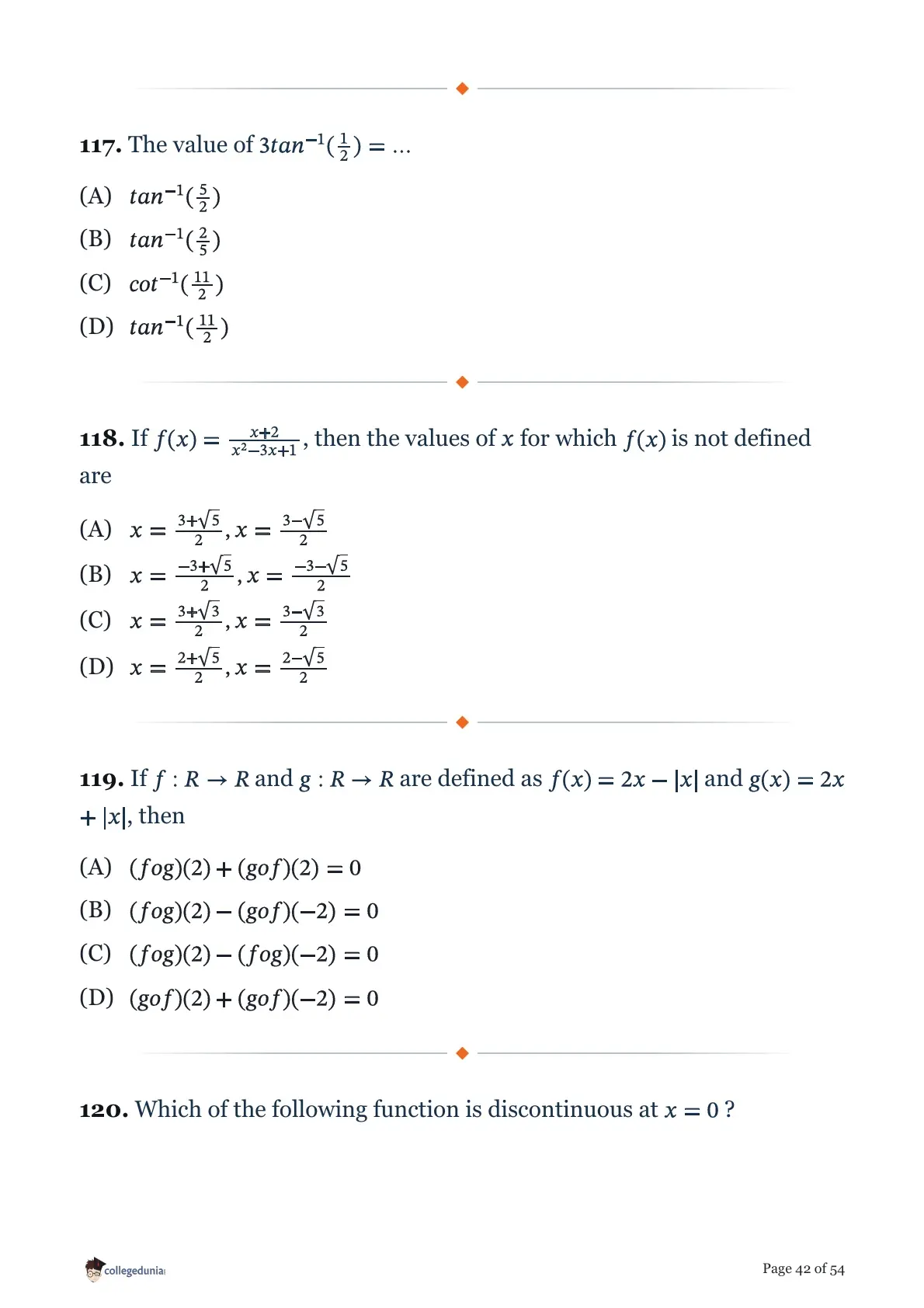
The value of \(3tan^{-1}(\frac{1}{2}) = \ldots\)
If \(f(x) = \frac{x+2}{x^2-3x+1}\), then the values of \(x\) for which \(f(x)\) is not defined are
If \(f:R\rightarrow R\) and \(g:R\rightarrow R\) are defined as \(f(x) = 2x-|x|\) and \(g(x) = 2x+|x|\), then
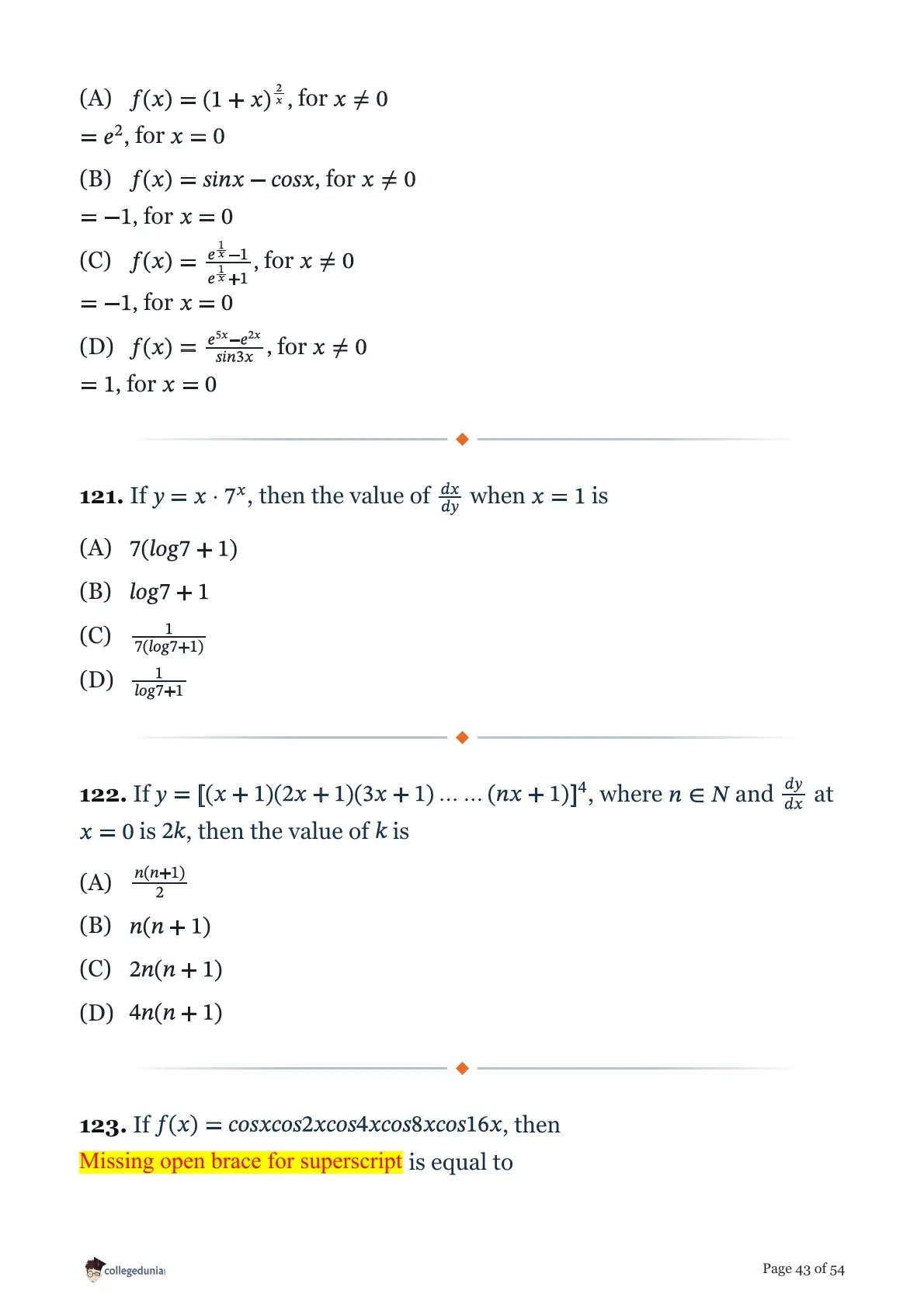
Which of the following function is discontinuous at \(x = 0\) ?
If \(y = x\cdot 7^x\), then the value of \(\frac{dx}{dy}\) when \(x = 1\) is
If \(y = [(x+1)(2x+1)(3x+1)\ldots \ldots (nx+1)]^4\), where \(n\in N\) and \(\frac{dy}{dx}\) at \(x = 0\) is \(2k\), then the value of \(k\) is
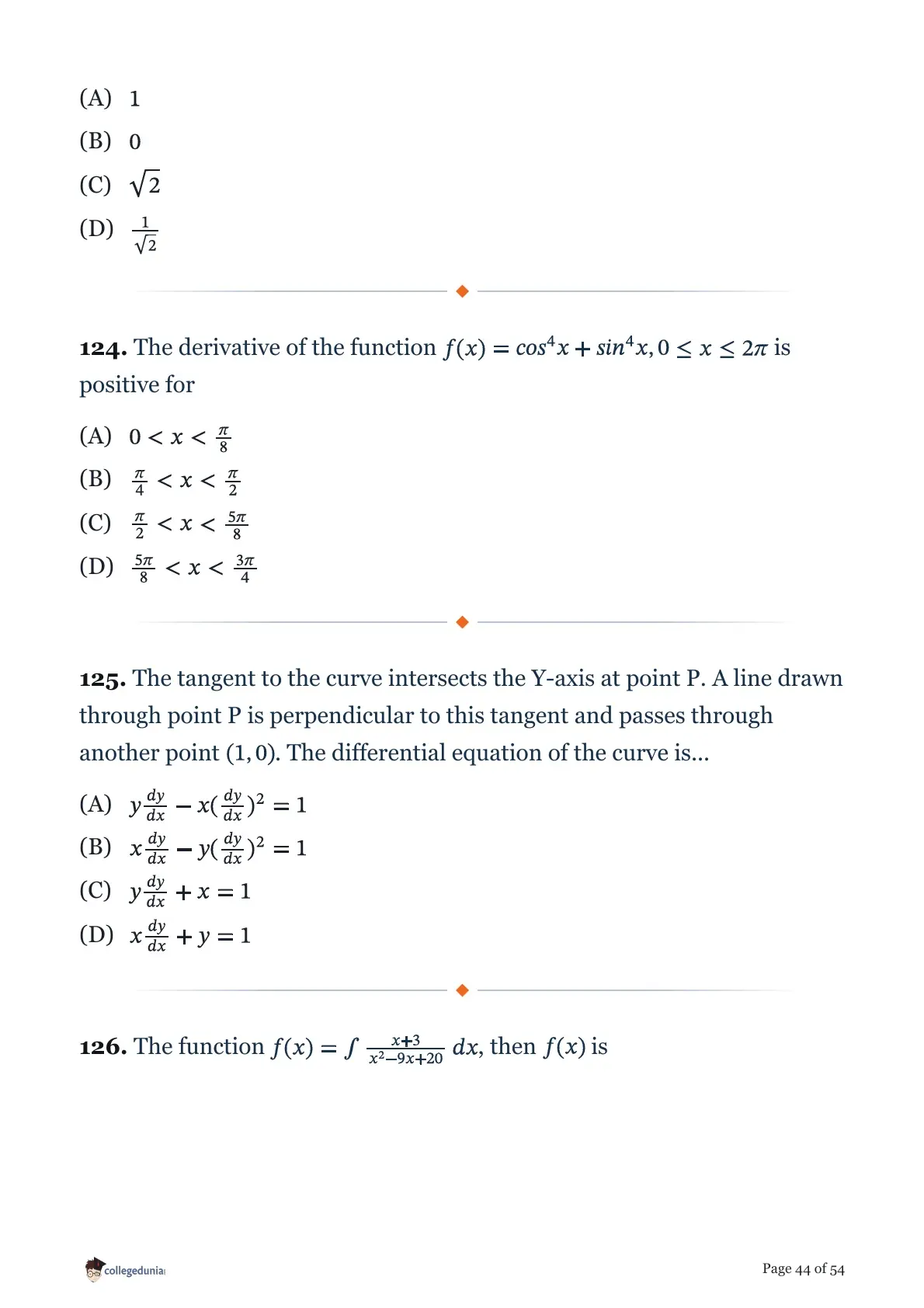
If \(f(x) = cosxcos2xcos4xcos8xcos16x\), then \(f^'(\frac{π}{4})\) is equal to
The derivative of the function \(f(x) = cos^4x+sin^4x, 0\leq x\leq 2π\) is positive for
The tangent to the curve intersects the Y-axis at point P. A line drawn through point P is perpendicular to this tangent and passes through another point \((1,0)\). The differential equation of the curve is...
The function \(f(x) = \int \frac{x+3}{x^2-9x+20}\,dx\), then \(f(x)\) is
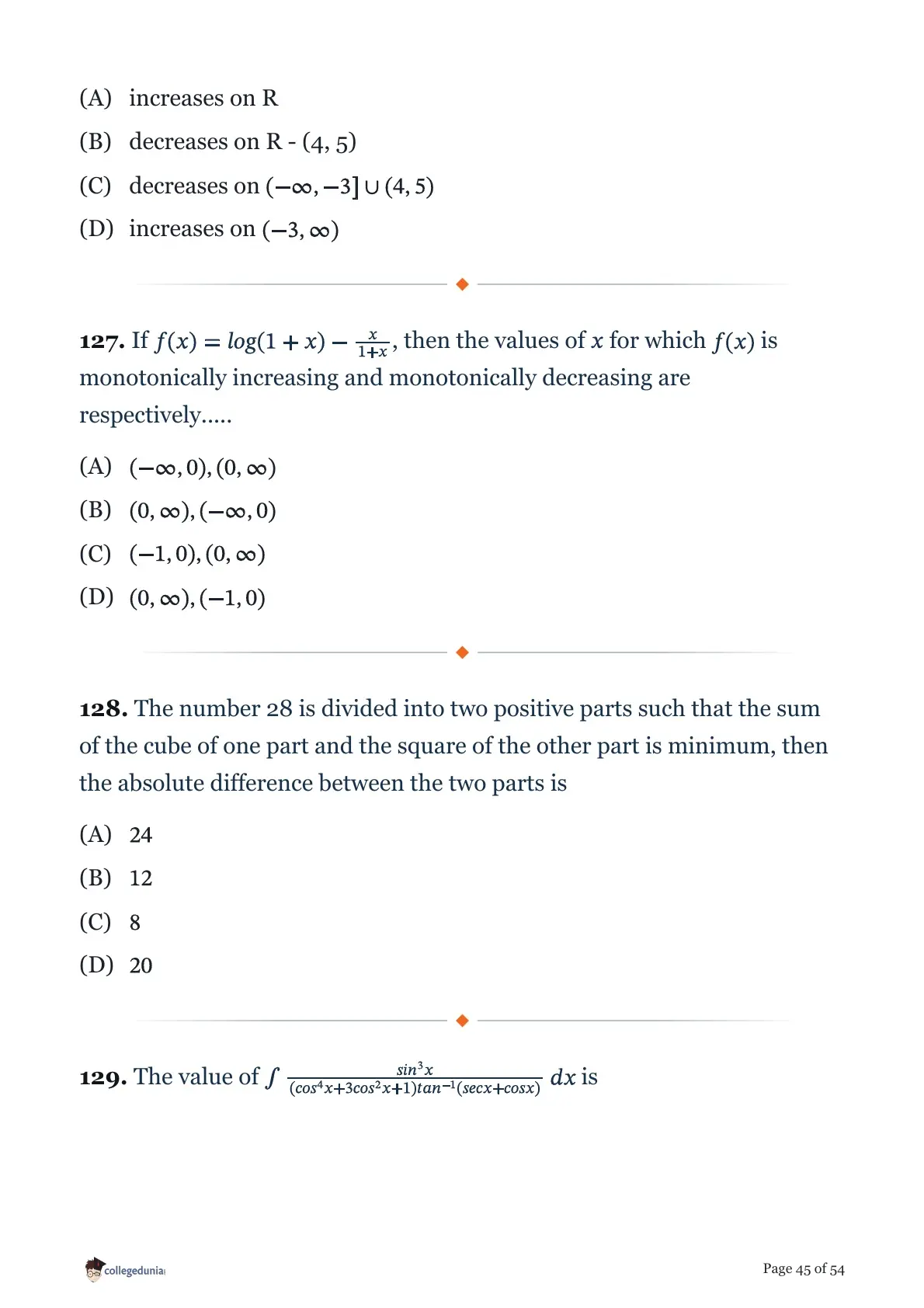
If \(f(x) = log(1+x)-\frac{x}{1+x}\), then the values of \(x\) for which \(f(x)\) is monotonically increasing and monotonically decreasing are respectively.....
The number 28 is divided into two positive parts such that the sum of the cube of one part and the square of the other part is minimum, then the absolute difference between the two parts is
The value of \(\int \frac{sin^3x}{(cos^4x+3cos^2x+1)tan^{-1}(secx+cosx)}\,dx\) is
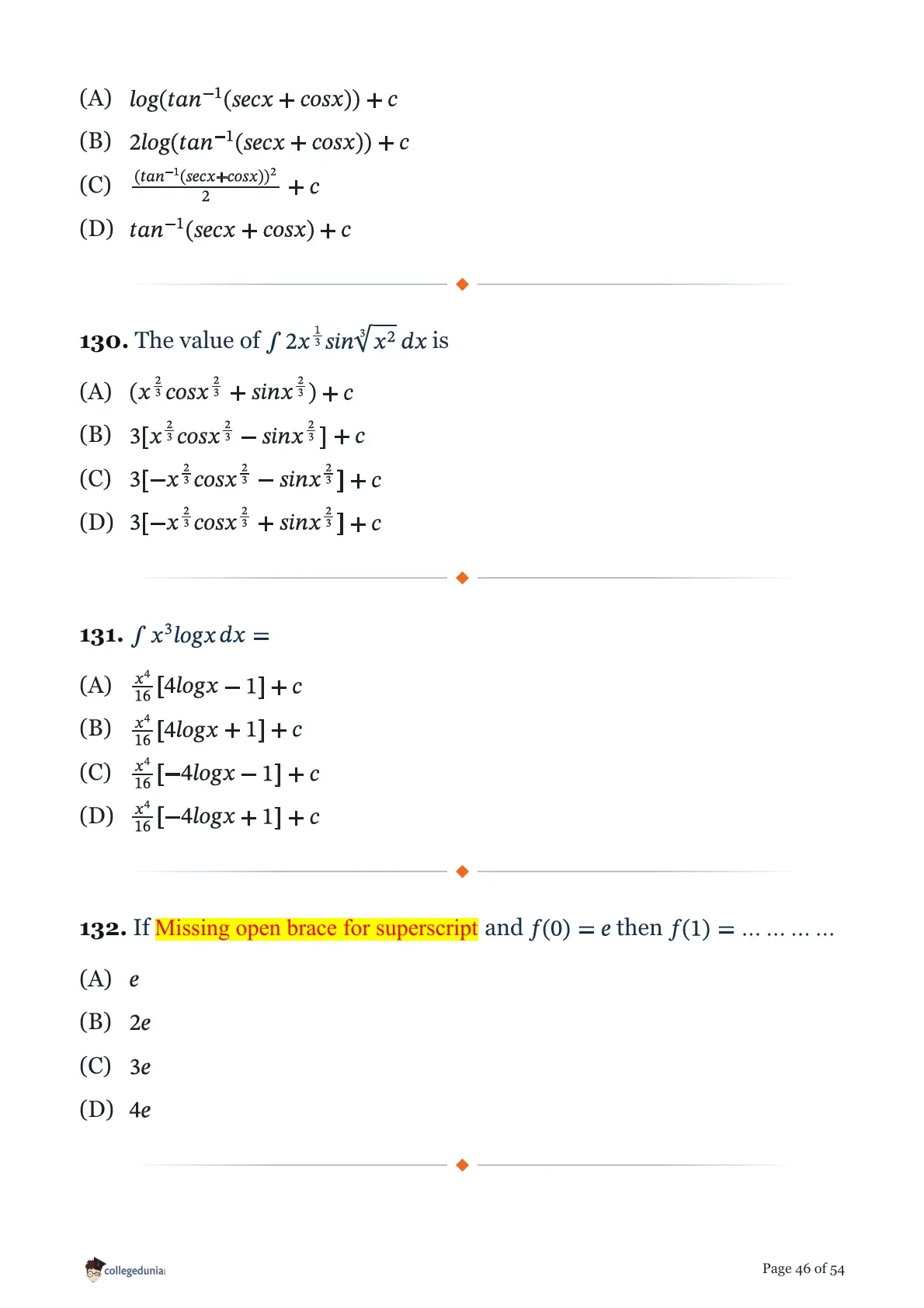
The value of \(\int 2x^{\frac{1}{3}}sin\sqrt[3]{x^2}\,dx\) is
\(\int x^3logx\,dx =\)
If \(f^'(x) = \frac{(\sqrt{x}+1)e^{\sqrt{x}}}{\sqrt{x}}\) and \(f(0) = e\) then \(f(1) = \ldots \ldots \ldots \ldots\)
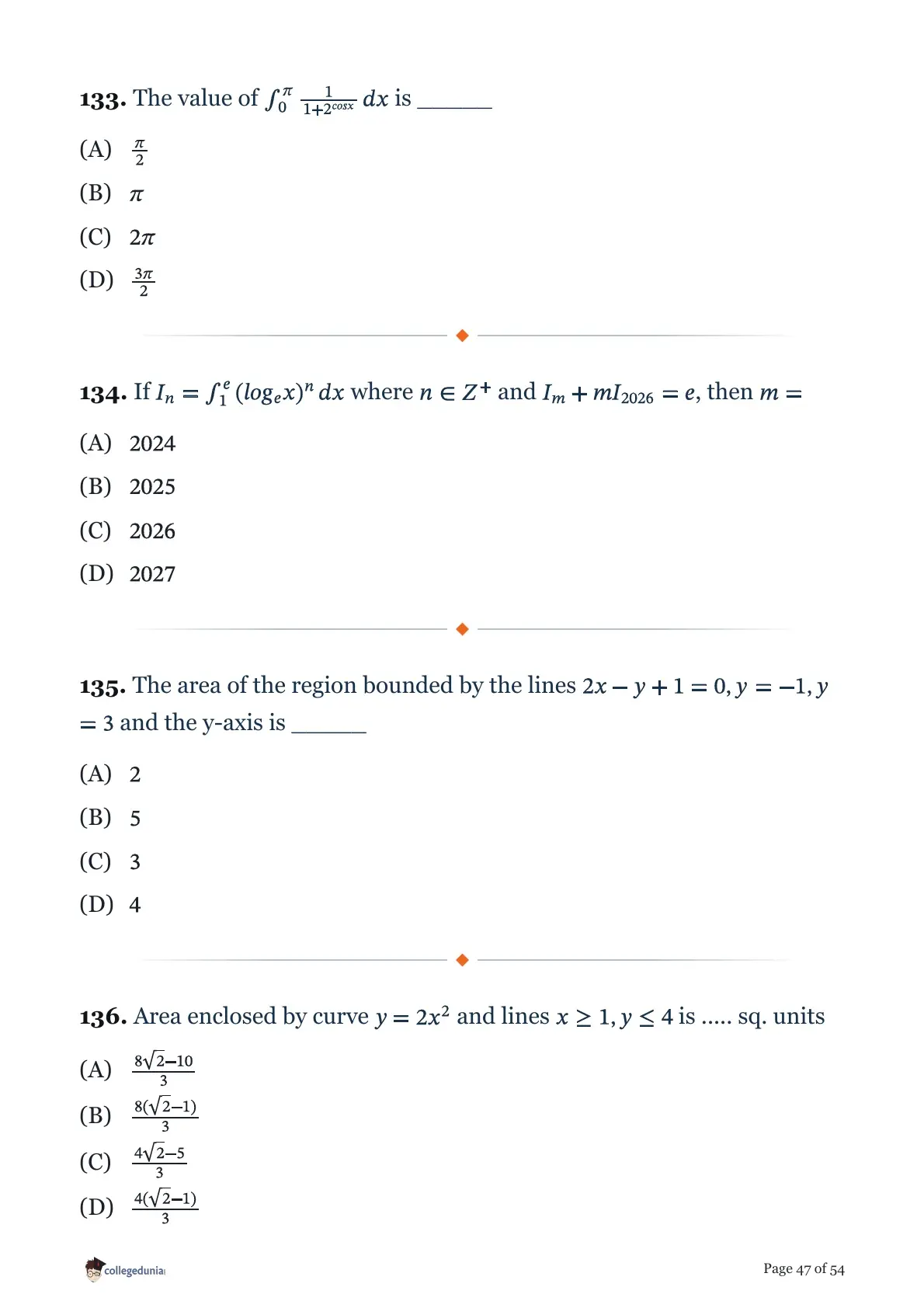
The value of \(\int _0^π\frac{1}{1+2^{cosx}}\,dx\) is _____
If \(I_n = \int _1^e(log_ex)^n\,dx\) where \(n\in Z^+\) and \(I_m+mI_{2026} = e\), then \(m =\)
The area of the region bounded by the lines \(2x-y+1 = 0, y = -1, y = 3\) and the y-axis is _____
Area enclosed by curve \(y = 2x^2\) and lines \(x\geq 1, y\leq 4\) is ..... sq. units
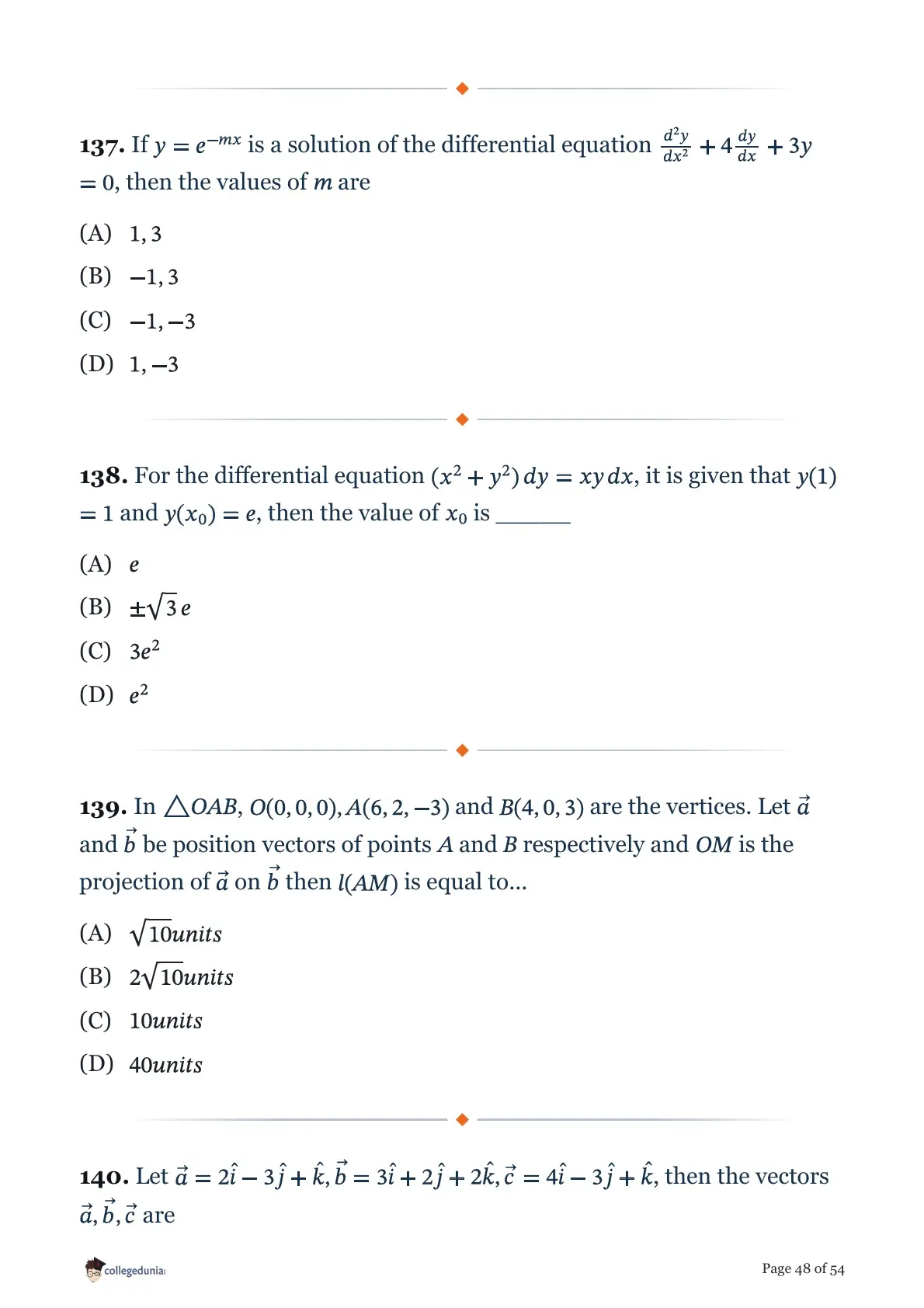
If \(y = e^{-mx}\) is a solution of the differential equation \(\frac{d^2y}{dx^2}+4\frac{dy}{dx}+3y = 0\), then the values of \(m\) are
For the differential equation \((x^2+y^2)\,dy = xy\,dx\), it is given that \(y(1) = 1\) and \(y(x_0) = e\), then the value of \(x_0\) is _____
In \(△OAB\), \(O(0,0,0), A(6,2,-3)\) and \(B(4,0,3)\) are the vertices. Let \(\overset{⃗}{a}\) and \(\overset{⃗}{b}\) be position vectors of points \(A\) and \(B\) respectively and \(OM\) is the projection of \(\overset{⃗}{a}\) on \(\overset{⃗}{b}\) then \(l(AM)\) is equal to...
Let \(\overset{⃗}{a} = 2\hat{i}-3\hat{j}+\hat{k}, \overset{⃗}{b} = 3\hat{i}+2\hat{j}+2\hat{k}, \overset{⃗}{c} = 4\hat{i}-3\hat{j}+\hat{k}\), then the vectors \(\overset{⃗}{a}, \overset{⃗}{b}, \overset{⃗}{c}\) are
Let \(\overset{̄}{a} = (a_1\hat{i}+a_2\hat{j}+a_3\hat{k}), \overset{̄}{b} = (b_1\hat{i}+b_2\hat{j}+b_3\hat{k}), \overset{̄}{c} = (c_1\hat{i}+c_2\hat{j}+c_3\hat{k})\) be three non-zero vectors such that \(\overset{̄}{a}\) is a unit vector perpendicular to both \(\overset{̄}{b}\) and \(\overset{̄}{c}\). If the angle between \(\overset{̄}{b}\) and \(\overset{̄}{c}\) is \(\frac{π}{3}\) then \(\begin{array}{ccc}a_1 & a_2 & a_3 \\ b_1 & b_2 & b_3 \\ c_1 & c_2 & c_3\end{array}^2 =\)
Two adjacent sides of a parallelogram ABCD are given by \(\overline{AB} = 2\hat{i}+10\hat{j}+11\hat{k}\) and \(\overline{AD} = -\hat{i}+2\hat{j}+2\hat{k}\). The side AD is rotated by an acute angle \(α\) in the plane of the parallelogram so that AD becomes AD'. If AD' makes a right angle with the side AB, then the cosine of the angle \(α\) is given by
If \(θ\) is the angle between the lines \(\frac{x-1}{2} = \frac{2y+3}{4}; z = -2\) and \(x = 1; \frac{y-1}{2} = \frac{z+1}{2}\), then
If for some \(m\in R\) the lines \(L_1:\frac{x+1}{m} = \frac{y-m}{-1} = \frac{z-1}{1}\) and \(L_2:\frac{x+2}{-4} = \frac{y+1}{9} = \frac{z+1}{1}\) are coplanar, then line \(L_1\) passes through the point
If the lines \(\overset{⃗}{r} = \hat{i}+\hat{j}-\hat{k}+λ(q\hat{i}-2\hat{j}+\hat{k})\) and \(\overset{⃗}{r} = p\hat{i}-3\hat{j}+2\hat{k}+μ(\hat{i}-2\hat{j}+2\hat{k})\) intersect each other and \(q\hat{i}-2\hat{j}+\hat{k}\) is collinear to \(4\hat{i}-4\hat{j}+2\hat{k}\), then the values of \(p\) and \(q\) are
The angle between a diagonal and one of its edges of a cube is ...................
For the linear programming problem, \(x+2y\leq 10, 3x+y\leq 12, x,y\geq 0\), the maximum value of \(z = 5x+10y\) occurs at every point on the line segment joining the points..
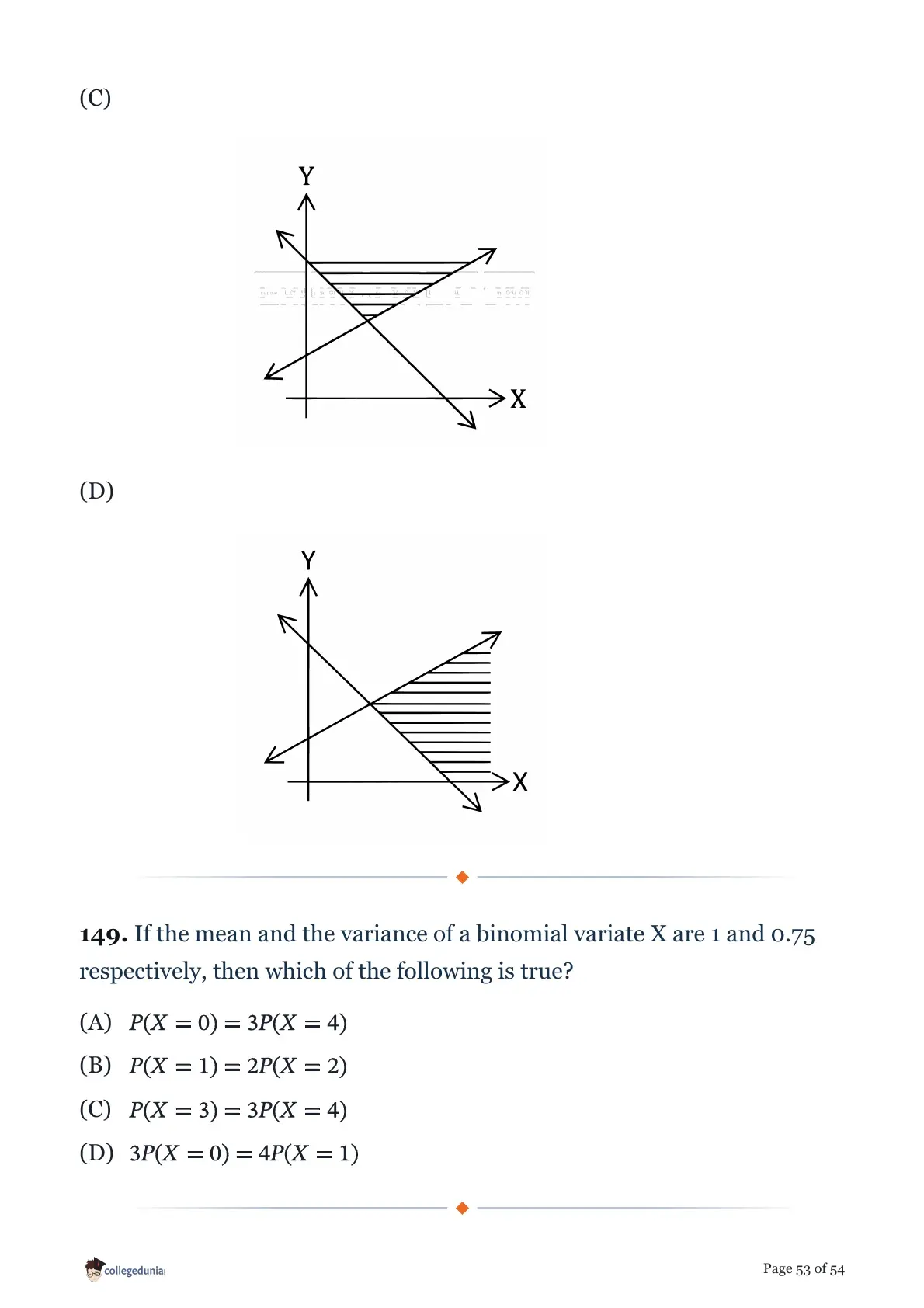
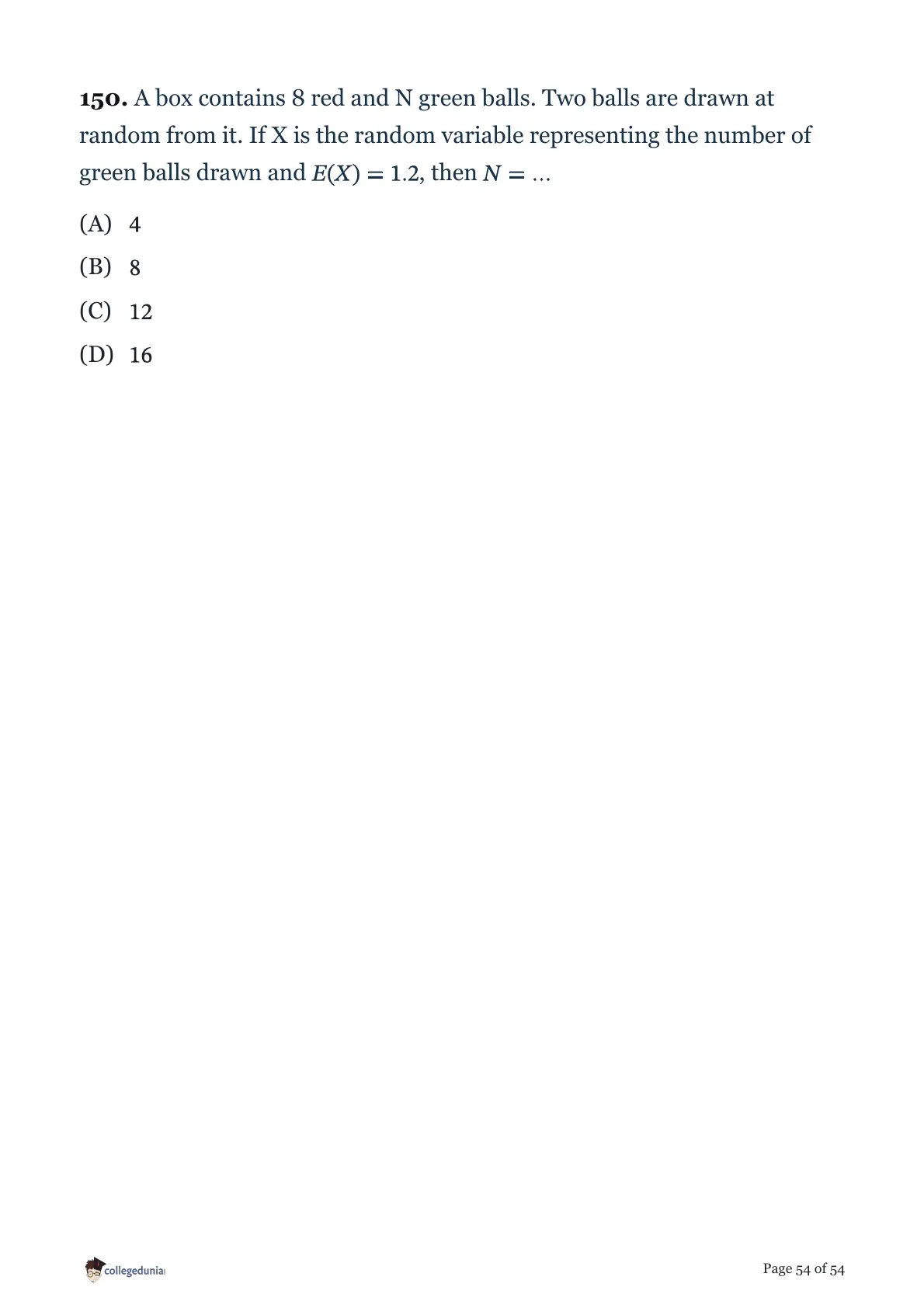
The region satisfying the inequalities \(y-x\geq 2, x+y\leq 5, x\geq 0\) and \(y\geq 0\) is
- (A)
![]()
- (B)
![]()
- (C)
![]()
- (D)
![]()


If the mean and the variance of a binomial variate X are 1 and 0.75 respectively, then which of the following is true?
A box contains 8 red and N green balls. Two balls are drawn at random from it. If X is the random variable representing the number of green balls drawn and \(E(X) = 1.2\), then \(N = \ldots\)
MHT CET PCM Exam Pattern 2026
| Parameter | Details |
|---|---|
| Conducting Body | Maharashtra Common Entrance Test Cell (Maharashtra CET Cell) |
| Exam Mode | Online (Computer-Based Test) |
| Duration | 180 minutes (3 hours) |
| Groups / Subjects | PCM (Physics, Chemistry, Mathematics) for Engineering |
| Total Questions |
150 |
| Total Marks | 200 |
| Question Type | Multiple Choice Questions (MCQs) |
| Marks Distribution |
|
| Negative Marking | No |
| Syllabus Weightage |
|



Comments