




MHT CET 2026 April 19 Shift 1 PCM Question Paper is available for download here. Maharashtra State CET Cell conducted MHT CET 2026 PCM Exam on April 19 in Shift 1 from 9 AM to 12 PM in CBT mode.
- The MHT CET 2026 PCM Question Paper consists of 150 multiple-choice questions (MCQs) totalling 200 marks divided into 3 sections: Physics, Chemistry, and Mathematics, with 50 questions in each subject.
- Physics and Chemistry questions carry 1 mark each while Mathematics questions carry 2 marks each.
- There is no negative marking for incorrect answers.
Download MHT CET 2026 April 19 Shift 1 PCM Question Paper with Solutions PDF from the links provided below.
MHT CET 2026 April 19 Shift 1 PCM Question Paper PDF Download
| MHT CET 2026 April 19 Shift 1 Question Paper | Download PDF | Check Solution |


















MHT CET 2026 April 19 Shift 1 PCM Questions with Solutions
Physics Section (Questions 1 to 50)
For two vectors \(\overset{⃗}{P}\) and \(\overset{⃗}{Q}\), \(\overset{⃗}{P}\cdot \overset{⃗}{Q} = |\overset{⃗}{P}\times \overset{⃗}{Q}|\)
The magnitude of \(\overset{⃗}{R} = \overset{⃗}{P}+\overset{⃗}{Q}\) is (\(cos45^{\circ} = \frac{1}{\sqrt{2}}\)) ?
Two stones of masses \(m\) and \(3m\) are whirled in horizontal circles, the heavier one in a radius \(\frac{r}{3}\) and the lighter one in radius \(r\). When both the stones experience same centripetal forces, the tangential speed of lighter stone is '\(n\)' times that of the value of heavier stone. The value of '\(n\)' is
Two particles having mass 'M' and 'm' are moving in a circular path with radius 'R' and 'r' respectively. The time period for both the particles is same. The ratio of angular velocity of the first particle to that of the second particle will be
Which of the following person is in an inertial frame of reference?
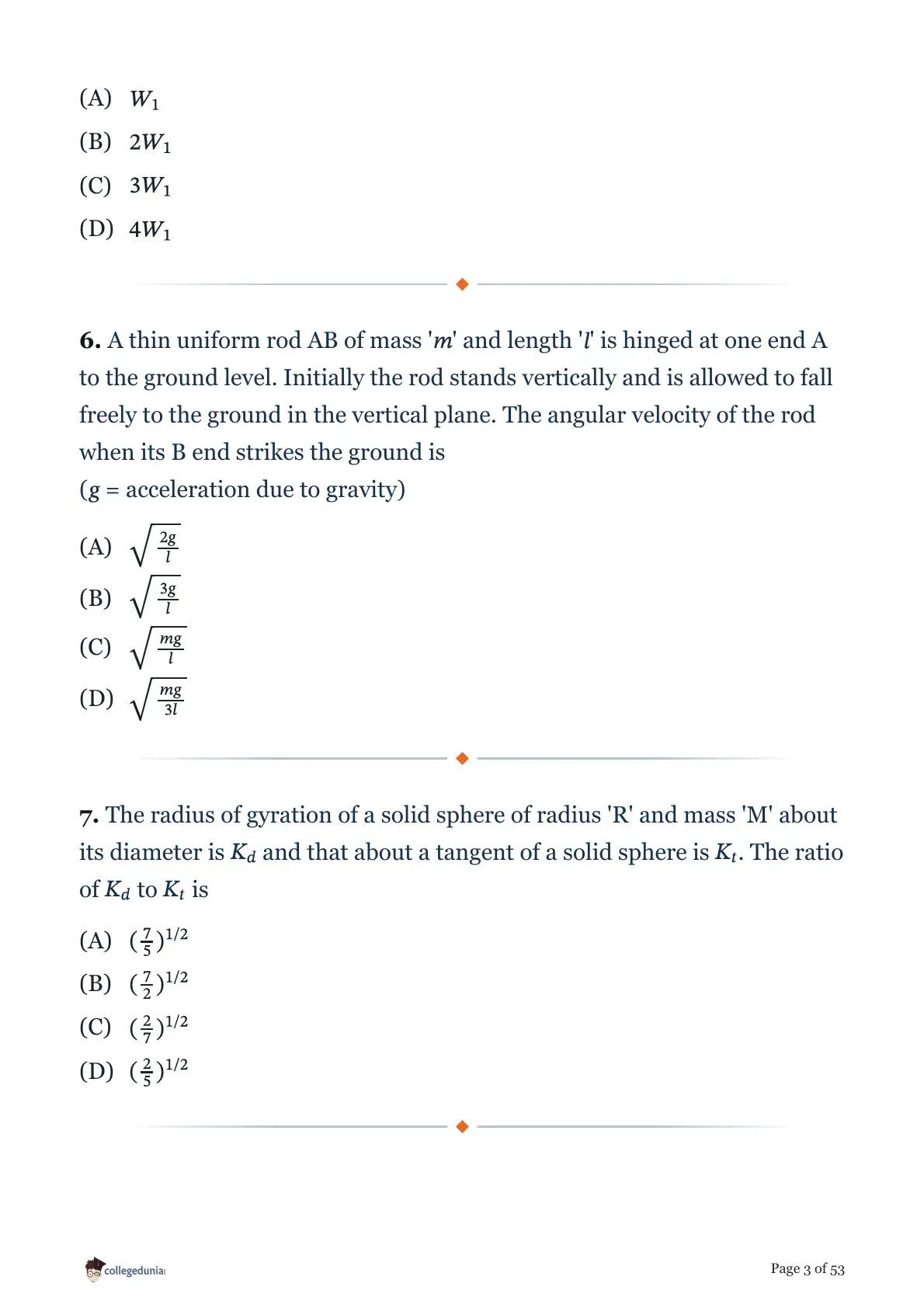
The spring is initially in unstretched condition. It is first stretched by a length '\(x\)' and the work done is \(W_1\). Then again it is stretched by further length '\(x\)' when the work done is \(W_2\). The value of \(W_2\) is given by
A thin uniform rod AB of mass '\(m\)' and length '\(l\)' is hinged at one end A to the ground level. Initially the rod stands vertically and is allowed to fall freely to the ground in the vertical plane. The angular velocity of the rod when its B end strikes the ground is
(\(g\) = acceleration due to gravity)
The radius of gyration of a solid sphere of radius 'R' and mass 'M' about its diameter is \(K_d\) and that about a tangent of a solid sphere is \(K_t\). The ratio of \(K_d\) to \(K_t\) is
A geostationary satellite is orbiting the earth at a height of \(4R\) above the surface of the earth, where \(R\) is the radius of the earth. Another satellite is orbiting the earth at a height \(1.5R\) from the surface of the earth with periodic time 'T' in hour. The value of 'T' in hour is
One large soap bubble of diameter 'D' breaks into \(64\) bubbles having surface tension 'T'. The change in surface energy is
The pressures inside two soap bubbles A and B are \(1.02\) atmosphere and \(1.04\) atmosphere respectively. The ratio of volume of bubble A to that of bubble B is (outside pressure \(= 1\) atmosphere)
An in-compressible fluid flows steadily through a horizontal cylindrical pipe. The pipe has radius '\(3R\)' at point A and '\(1.5R\)' at point B, further along the flow direction at the same level. If the velocity at point A is '\(v\)', then that at point B is
When \(170\) J of energy is incident on a surface of a body, \(17\) J of energy is reflected by it. If the coefficient of absorption is \(0.7\), then the amount of energy transmitted will be
A black body is at temperature \(827^{\circ}\text{C}\). The rate at which it emits energy is proportional to
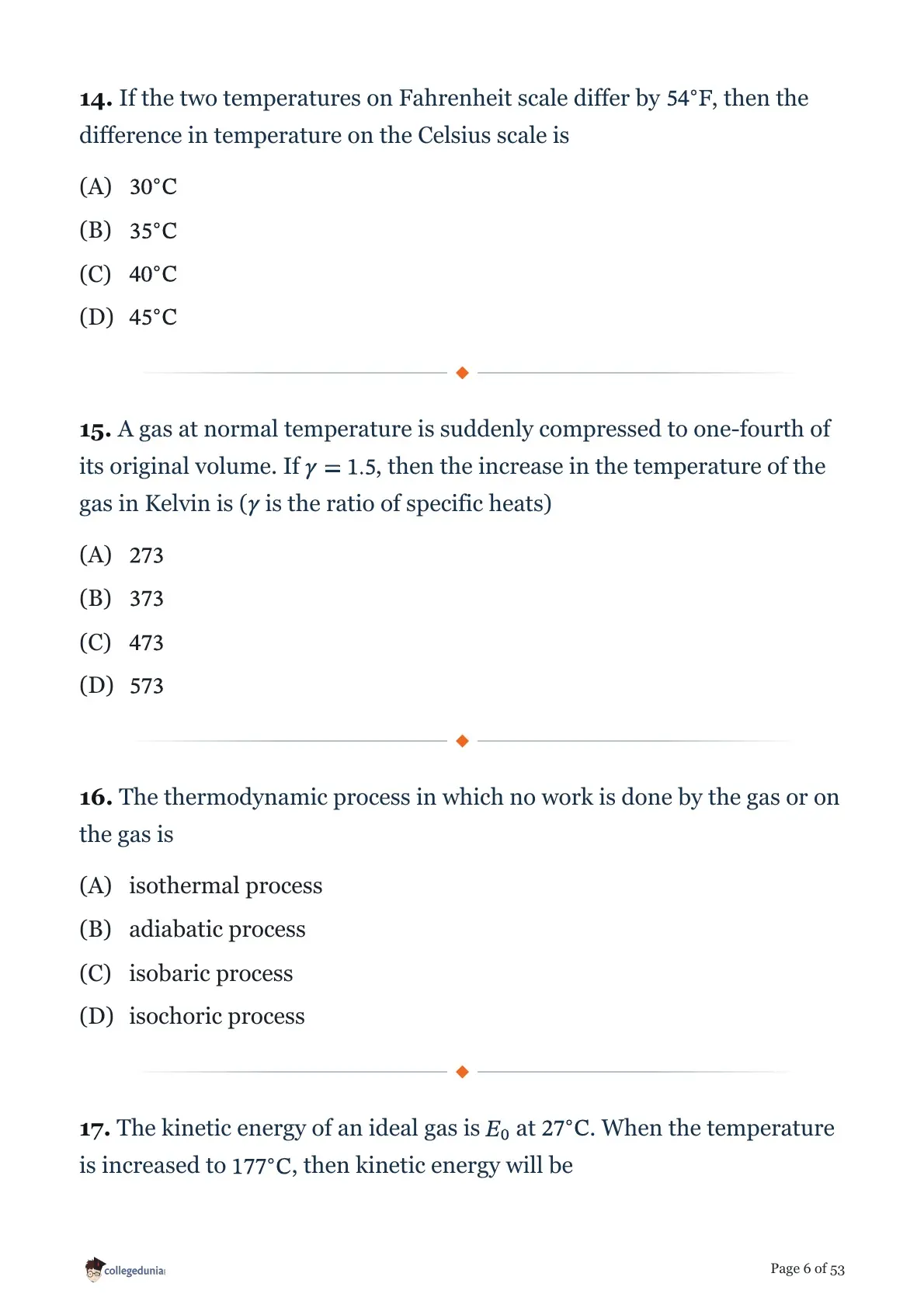
If the two temperatures on Fahrenheit scale differ by \(54^{\circ}\text{F}\), then the difference in temperature on the Celsius scale is
A gas at normal temperature is suddenly compressed to one-fourth of its original volume. If \(γ = 1.5\), then the increase in the temperature of the gas in Kelvin is (\(γ\) is the ratio of specific heats)
The thermodynamic process in which no work is done by the gas or on the gas is
The kinetic energy of an ideal gas is \(E_0\) at \(27^{\circ}\text{C}\). When the temperature is increased to \(177^{\circ}\text{C}\), then kinetic energy will be
A particle executes a simple harmonic motion with a periodic time \(8\) second. At time \(t = 0\), it is at a mean position. The ratio of the distance traveled by a particle in the 2nd and that in the 1st second of its motion is
(\(sin45^{\circ} = cos45^{\circ} = \frac{1}{\sqrt{2}}\), \(sin90^{\circ} = cos0^{\circ} = 1\))
The third overtone of a closed pipe of length '\(L_c\)' has the same frequency as the third overtone of the open pipe of length '\(L_0\)'. Both the pipes have same diameters. The ratio \(L_c:L_0\) is equal to
A tuning fork gives \(5\) beats per second with a \(33\) cm length of sonometer wire. If the length of the wire is shortened by \(1\) cm, the number of beats is still the same. The frequency of the fork is
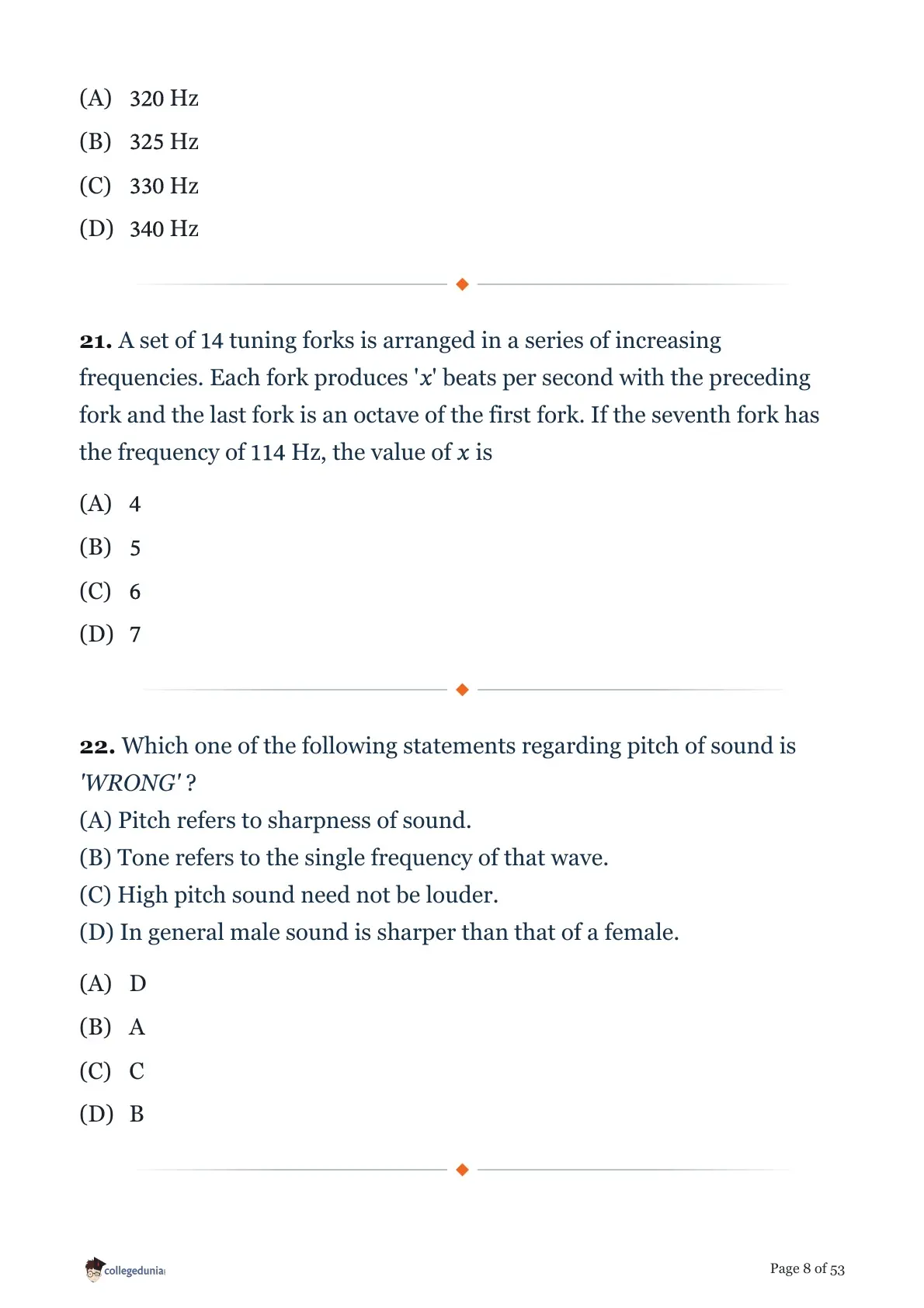
A set of \(14\) tuning forks is arranged in a series of increasing frequencies. Each fork produces '\(x\)' beats per second with the preceding fork and the last fork is an octave of the first fork. If the seventh fork has the frequency of \(114\) Hz, the value of \(x\) is
Which one of the following statements regarding pitch of sound is 'WRONG' ?
(A) Pitch refers to sharpness of sound.
(B) Tone refers to the single frequency of that wave.
(C) High pitch sound need not be louder.
(D) In general male sound is sharper than that of a female.
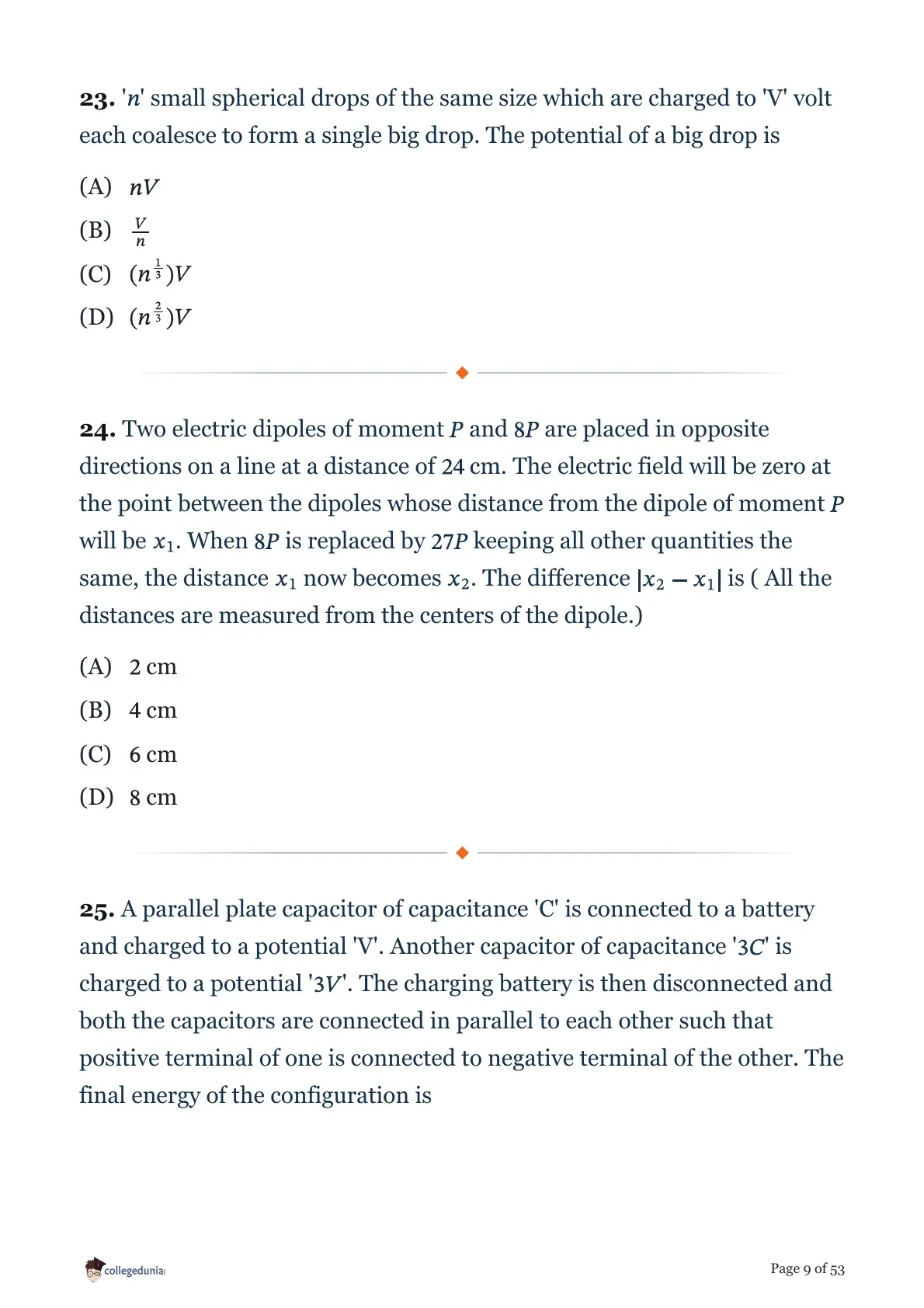
'\(n\)' small spherical drops of the same size which are charged to 'V' volt each coalesce to form a single big drop. The potential of a big drop is
Two electric dipoles of moment \(P\) and \(8P\) are placed in opposite directions on a line at a distance of \(24\) cm. The electric field will be zero at the point between the dipoles whose distance from the dipole of moment \(P\) will be \(x_1\). When \(8P\) is replaced by \(27P\) keeping all other quantities the same, the distance \(x_1\) now becomes \(x_2\). The difference \(|x_2-x_1|\) is ( All the distances are measured from the centers of the dipole.)
A parallel plate capacitor of capacitance 'C' is connected to a battery and charged to a potential 'V'. Another capacitor of capacitance '\(3C\)' is charged to a potential '\(3V\)'. The charging battery is then disconnected and both the capacitors are connected in parallel to each other such that positive terminal of one is connected to negative terminal of the other. The final energy of the configuration is
A slab of material of dielectric constant \(K\) has the same area as the plates of a parallel plate capacitor but has a thickness \((4/5)d\), where \(d\) is the separation of the plates. The capacitance in the presence and absence of dielectric are \(C\) and \(C_0\) respectively. The ratio \((C/C_0)\) is
In a meter bridge experiment, the balance point is obtained at length '\(l_1\)' cm from left hand when resistances in the left gap and right gap are \(15 \Omega\) and \(R \Omega\) respectively. When the resistance \(R\) is shunted with equal resistance the new balance point is at \((1.6\,l_1)\). The resistance \(R\) in ohm is
In a potentiometer circuit when two cells of e.m.f. \(1.5\) volt and \(1.2\) volt are connected to assist each other, balancing length is \(270\) cm. What will be the balancing length in cm when these two cells are connected in opposition?
The voltage across a lamp is \((6.0\pm 0.3)\) volt and the current passing through it is \((4.0\pm 0.1)\) ampere. The power consumed in watt will be (using percentage error)
A diamagnetic liquid is filled in a U-tube. One arm of a U-tube is placed in an external magnetic field with the meniscus in line with the field. The level of the liquid in that arm will
The frequency of oscillation of a small magnet in a magnetic field of induction 'B' is '\(n\)'. If the frequency of oscillations of the same magnet in a field of induction 'X' falls to \((\frac{n}{3})\), the value of 'X' is
Two circular coils X (smaller) and Y (bigger), each having a single turn, carry equal currents in the same direction and subtend the same angle at point 'O' along the axis of the coil. The distances of the centers of coil to point 'O' are \(d\) and \((\frac{d}{2})\) for coil Y and X respectively. The radii of coils Y and X are \((2r)\) and \((r)\) respectively. The magnetic induction due to the bigger coil at point 'O' is \(B_y\) and that due to smaller coil X at point 'O' is \(B_x\). (\(d≫r\)) The relation between \(B_x\) and \(B_y\) is
Two thin long parallel wires, \(W_1\) and \(W_2\) separated by distance '\(a\)', carry currents \(i\) and \(3i\) respectively in the same direction. The magnitude of the force per unit length exerted by wire \(W_1\) on wire \(W_2\) is
Two different coils have self-inductance \(3L\) and \(L\). The current in both the coils is increased at the same constant rate. At certain instant of time, the power given to the two coils is same. At that time there was current and voltage induced in the two coils. At the same instant, the ratio of energy stored in the first coil to that in the second coil is
Consider two coils in which a current in one coil carrying \(6\) A causes the change in the flux in the second coil \(12\times 10^{-4}\) weber/turn. The second coil has \(2000\) turns. The mutual inductance between the coils is
Magnetic flux linked with the coil in weber is given by the equation \(\Phi = 5t^2+6t+11\). The e.m.f. induced in the coil in the \(5^{\text{th}}\) second will be
For a series LCR circuit inductive reactance \(X_L\) is equal to resistance \(R\) and also equal to twice the capacitive reactance \(X_C\). The impedance of the circuit and the phase difference between voltage V and current i are respectively
An alternating voltage \(e = 150\sqrt{2}sin100t\) volt is applied to a capacitor of capacity \(2 μ\text{F}\). The root mean square value of current in the circuit is
In an LCR circuit at resonance, the a.c. source current is
A) maximum in a series LCR circuit only.
B) maximum in a parallel LCR circuit only.
C) maximum in both series and parallel LCR circuits.
D) minimum in both series and parallel LCR circuits.
The correct answer is
A glass slab of thickness \(6.0\) cm is placed on the piece of paper on which an inkdot is marked. By how much distance would an inkdot appear to be raised? The velocity of light in glass is \(2\times 10^8\text{ ms}^{-1}\) and that in air is \(3\times 10^8\text{ ms}^{-1}\).
In Young's double slit experiment, the wavelength of light used is \(λ\). The intensity on the screen at a point for path difference '\(λ\)' is 'X'. The intensity at the point for path difference \((\frac{λ}{6})\) is (\(cos180^{\circ} = -1\), \(cos30^{\circ} = \frac{\sqrt{3}}{2}\))
In a single slit diffraction pattern, the distance between the plane of the slit and the screen is \(1.4\) m. The width of the slit is \(0.66\) mm. The second maximum is formed at the distance of \(2.8\) mm from the center of the screen. The wavelength of light used is
In Young's double slit experiment, for the \(n^{\text{th}}\) dark fringe (\(n = 1,2,3,\ldots\)) the phase difference of the interfering waves in radian will be
A photoelectric surface is illuminated successively by monochromatic light of wavelength \(λ\) and \((λ/3)\). If the maximum kinetic energy of the emitted photo electrons in the second case is \(4\) times that in the first case, the work function of the surface of the material is (\(h\) = Planck's constant, \(c\) = speed of light)
According to Einstein's photoelectric equation, the graph of the kinetic energy of the emitted photoelectrons versus the frequency of incident radiation gives a straight line whose slope
The shortest wavelength in the Balmer series of hydrogen atom is equal to the shortest wavelength in the Brackett series of a hydrogen like atom of atomic number 'Z'. The value of 'Z' is
A radioactive sample has half-life of \(5\) years. The percentage of fraction decayed in \(10\) years will be
The material used for solar cell should have band gap
(A) equal to zero.
(B) equal to \(0.08\) eV.
(C) between \(1.0\) eV to \(1.8\) eV.
(D) equal to \(2\) eV.
For a two input logic gate, when the inputs are 'zero' and 'zero' the output is 'one'. When the inputs are 'one' and 'zero' the output is 'zero'. The type of logic gate is
In n-type semiconductor
A) pentavalent impurity are dopants and holes are majority carriers.
B) trivalent impurity are dopants and electrons are minority carriers.
C) pentavalent impurity are dopants and electrons are majority carriers.
D) trivalent impurity are dopants and holes are majority carriers.
Chemistry Section (Questions 51 to 100)
What is the percentage atom economy when formula weight of product is \(65\) u and the sum of formula weight of reactant is \(130\) u?
What quantity of \(\text{H}_2\text{O}\) in gram is present in \(0.25\) mol of it?
What is the wave number of lowest transition associated with Paschen series?
Which among the following molecule exhibits paramagnetism?
Identify correct order for repulsion between electron pair present in valence shell of central atom of molecule?
What is the number of \(sp^3\) hybrid carbon atoms in \(\text{HO}(\text{CH}_2)_2\text{CH}(\text{CH}_3)_2\)?
Which of the following is not an illustration of viscosity?
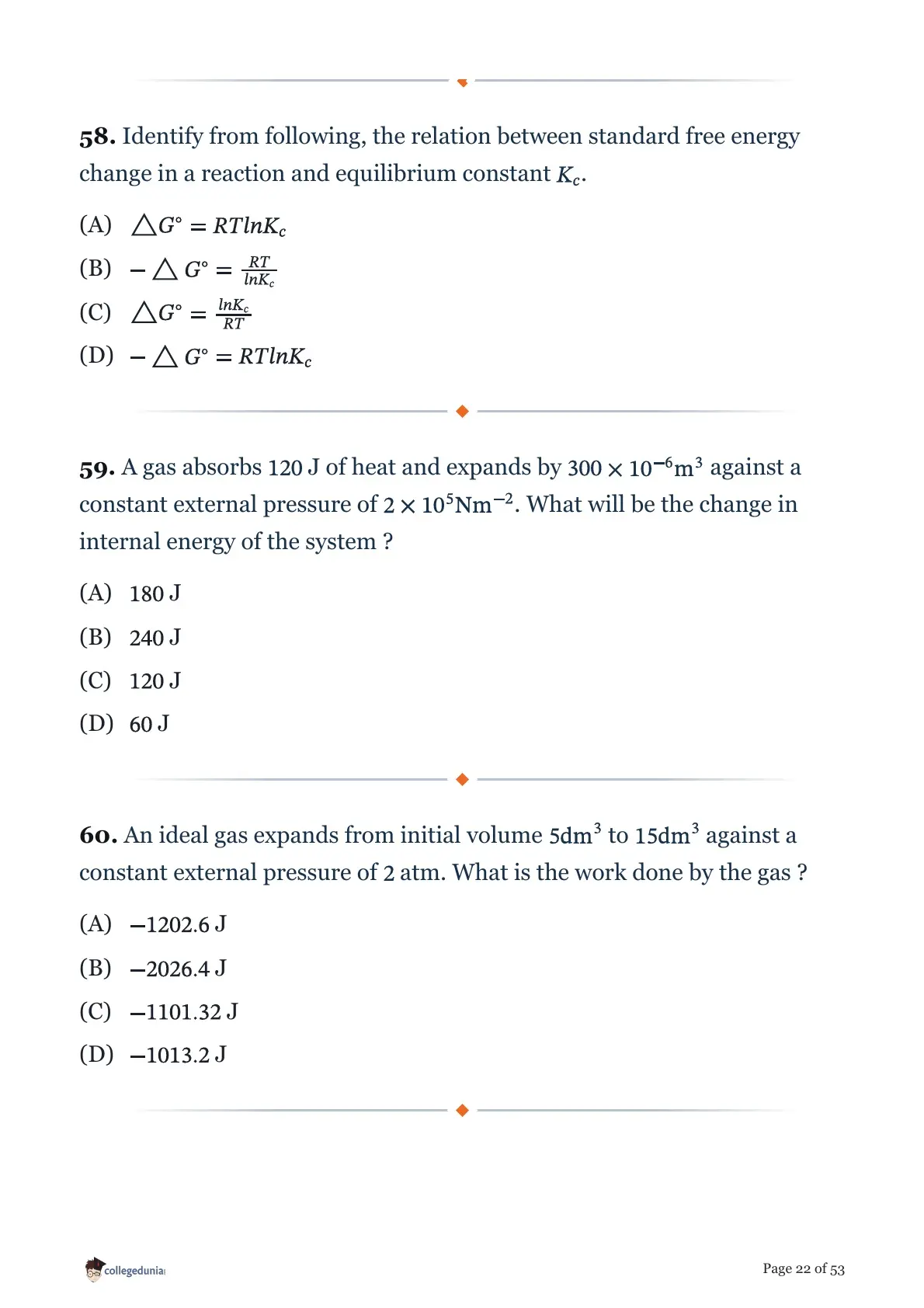
Identify from following, the relation between standard free energy change in a reaction and equilibrium constant \(K_c\).
A gas absorbs \(120\) J of heat and expands by \(300\times 10^{-6} \text{m}^3\) against a constant external pressure of \(2\times 10^5 \text{Nm}^{-2}\). What will be the change in internal energy of the system ?
An ideal gas expands from initial volume \(5 \text{dm}^3\) to \(15 \text{dm}^3\) against a constant external pressure of \(2\) atm. What is the work done by the gas ?
A weak base is \(1.3\%\) dissociated in its aqueous solution. If \(K_b\) for weak base is \(1.69\times 10^{-5}\) at \(298\) K. Find the concentration of aqueous solution of weak base.
What is the pH of solution containing \(5\times 10^{-4} \text{M} \text{H}^+\) ion?
Identify change in oxidation state of oxidising agent in following redox reaction.
\(3\text{H}_3\text{AsO}_{3(aq)}+\text{BrO}_{3(aq)}^-⟶\text{Br}_{(aq)}^-+3\text{H}_3\text{AsO}_{4(aq)}\)
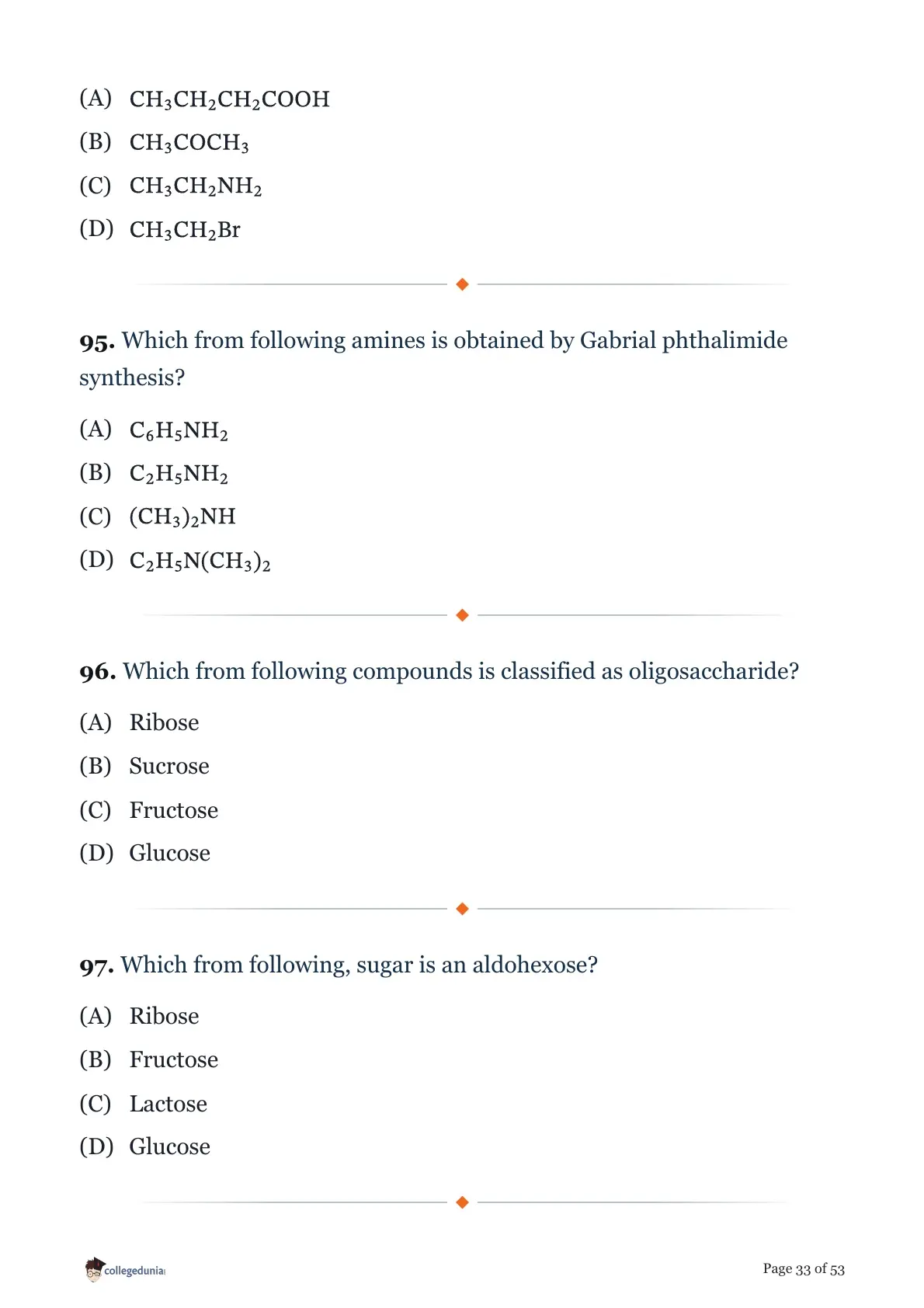
Which element from following forms superoxide with oxygen?
What is the number of chiral carbon atoms in 2-chlorobutane?
Identify the aldehyde from following so that the aldehydic group is NOT attached with any \(sp^3\) hybrid 'c' atom.
Which from following is a primary benzylic alcohol?
Which from the following aldehydes contains two \(-\text{CHO}\) groups in a molecule?
Gold crystallizes as fcc unit cell, the edge length of unit cell is \(408\) pm. What is the radius of gold atom?
What is the number of tetrahedral voids present in \(0.5\) mole of compound forming hcp structure?
Which among the following pairs of solutions is isotonic in nature?
A solution of non volatile solute has boiling point elevation \(0.70\) K if \(K_b\) for the solvent is \(2.44 \text{K kg mol}^{-1}\). What is the molality of the solution?
van't Hoff factor for \(\text{BaCl}_2\) is \(2.47\), calculate the percentage dissociation of in its aqueous solution.
What is number of moles of electron passed when a current of \(2\) Amp flows through solution of electrolyte for \(10\) minutes?
What is the conductivity of \(0.02 \text{M} \text{AgNO}_3\) solution having cell constant \(1.2 \text{cm}^{-1}\) and resistance \(95.0 \text{ohms}\) ?
During the electrolysis of aqueous NaCl the product formed at cathode is?
Which of the following is an elementary reaction ?
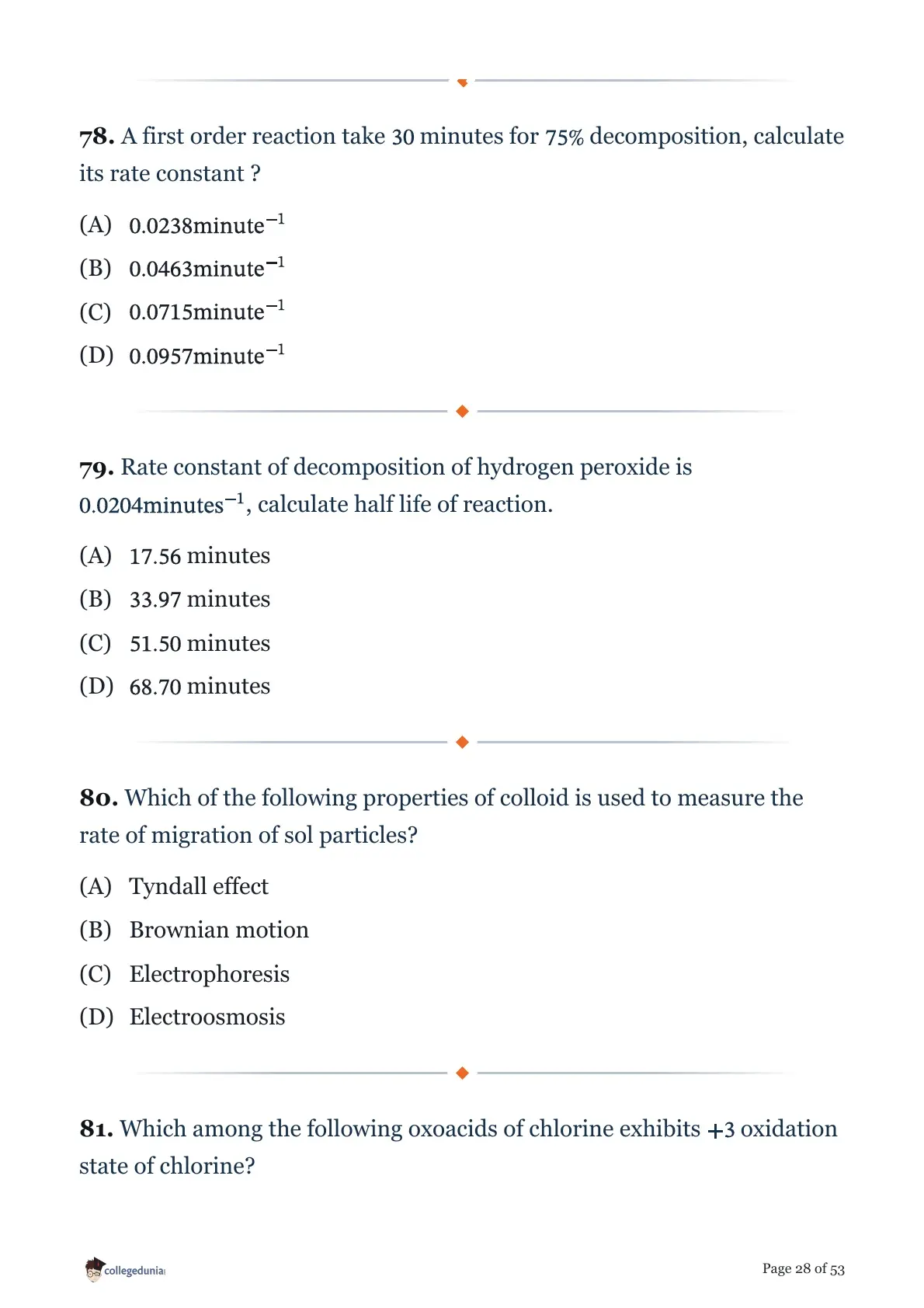
A first order reaction take \(30\) minutes for \(75\%\) decomposition, calculate its rate constant ?
Rate constant of decomposition of hydrogen peroxide is \(0.0204 \text{minutes}^{-1}\), calculate half life of reaction.
Which of the following properties of colloid is used to measure the rate of migration of sol particles?
Which among the following oxoacids of chlorine exhibits \(+3\) oxidation state of chlorine?
Identify general electronic configuration exhibited by \(2^{\text{nd}}\) series of transition elements.
Identify metals present in brass.
What is the highest possible oxidation state exhibited by manganese ?
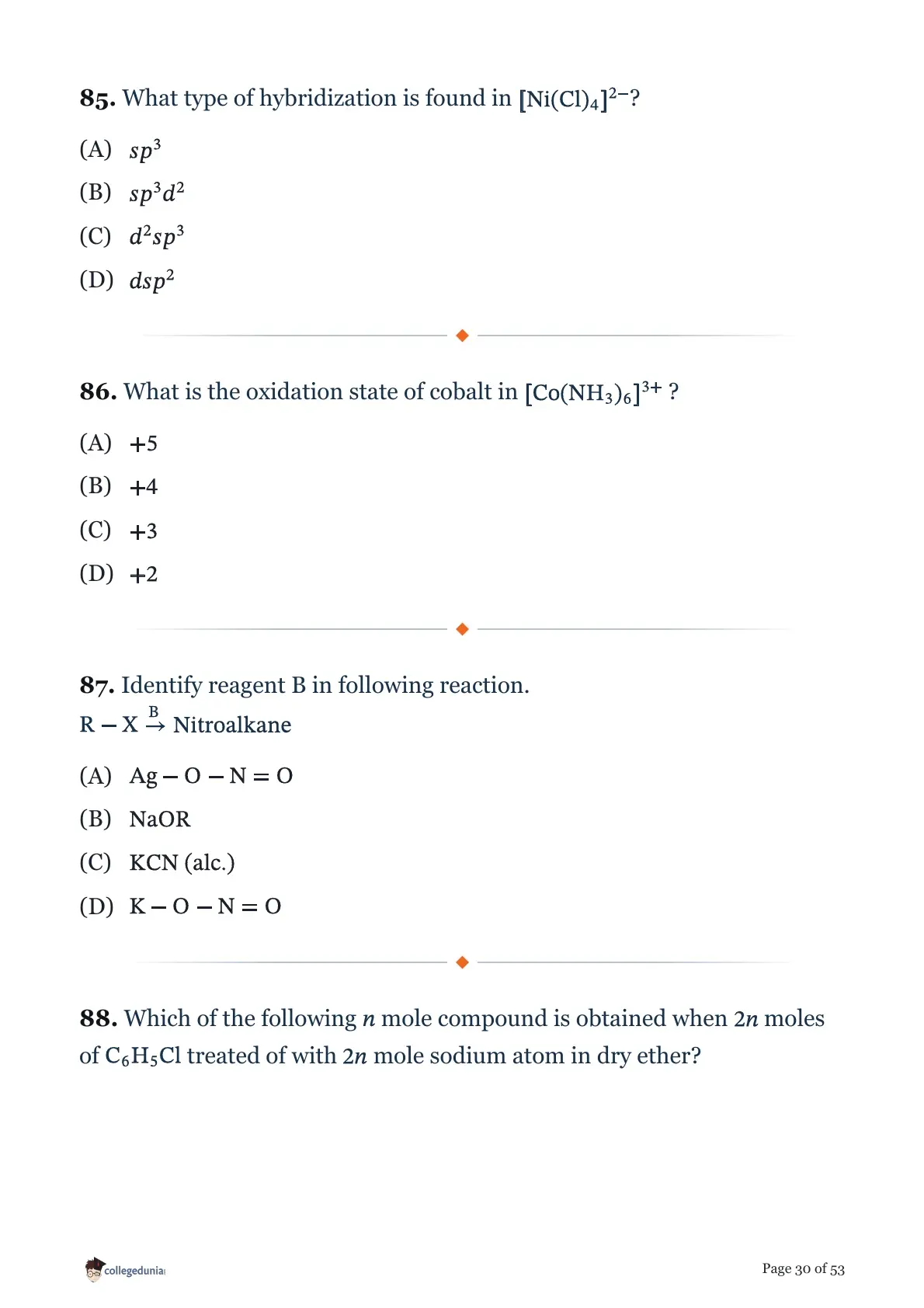
What type of hybridization is found in \([\text{Ni}(\text{Cl})_4]^{2-}\)?
What is the oxidation state of cobalt in \([\text{Co}(\text{NH}_3)_6]^{3+}\) ?
Identify reagent B in following reaction.
\(\text{R}-\text{X}\overset{\text{B} \,}{\rightarrow }\text{Nitroalkane}\)
Which of the following \(n\) mole compound is obtained when \(2n\) moles of \(\text{C}_6\text{H}_5\text{Cl}\) treated of with \(2n\) mole sodium atom in dry ether?
Which from the following compounds is not obtained when methyl bromide is treated with ethyl bromide in presence of sodium metal in dry ether?
Which of the following pair of reagents is used for the conversion of carboxylic acid to alcohol ?
Which from the following hydroxy compounds contain only one \(-\text{OH}\) group in a molecule?
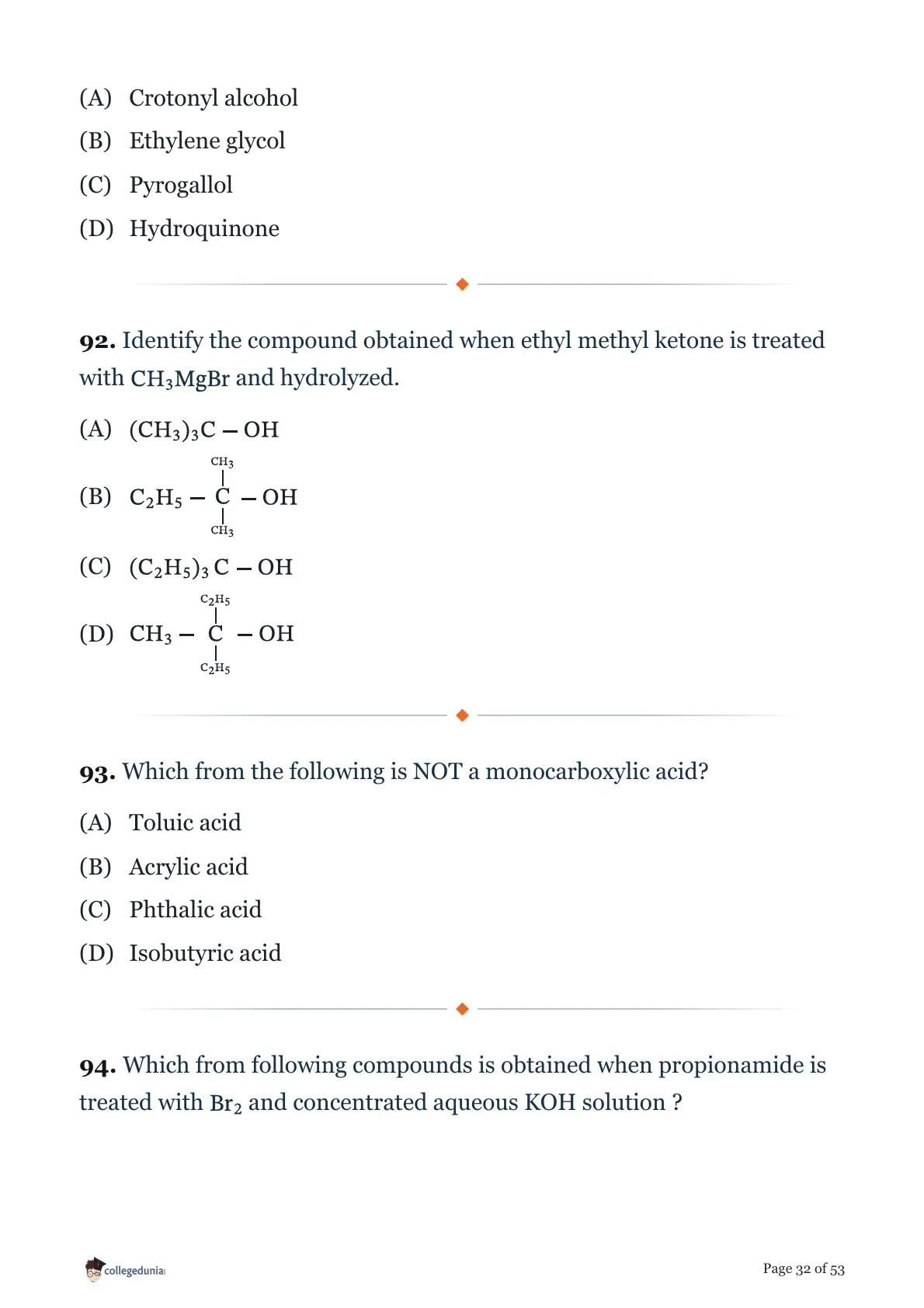
Identify the compound obtained when ethyl methyl ketone is treated with \(\text{CH}_3\text{MgBr}\) and hydrolyzed.
Which from the following is NOT a monocarboxylic acid?
Which from following compounds is obtained when propionamide is treated with \(\text{Br}_2\) and concentrated aqueous KOH solution ?
Which from following amines is obtained by Gabrial phthalimide synthesis?
Which from following compounds is classified as oligosaccharide?
Which from following, sugar is an aldohexose?
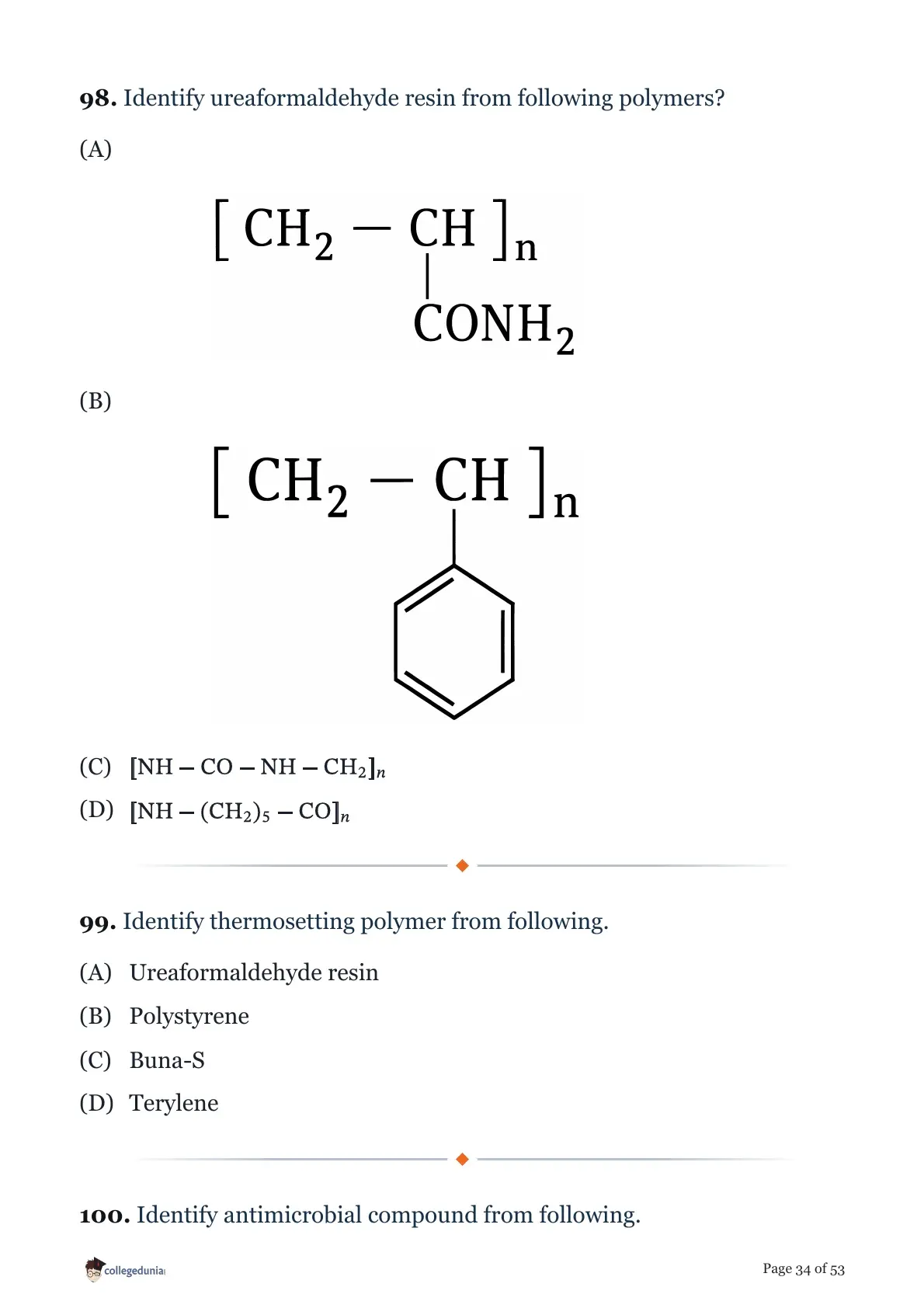
Identify ureaformaldehyde resin from following polymers?
- (A)
![]()
- (B)
![]()
- (C) \([\text{NH}-\text{CO}-\text{NH}-\text{CH}_2]_n\)
- (D) \([\text{NH}-(\text{CH}_2)_5-\text{CO}]_n\)


Identify thermosetting polymer from following.
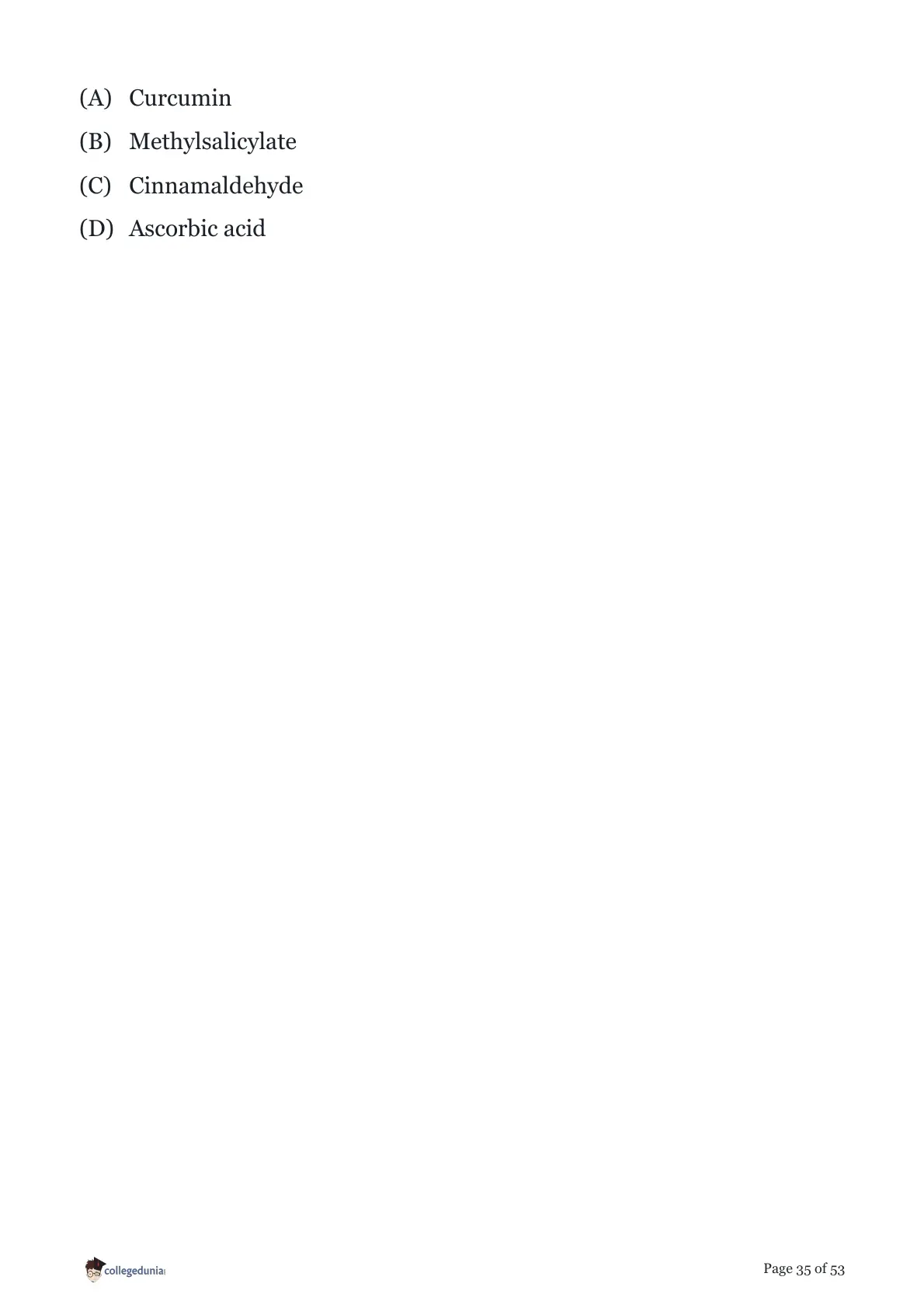
Identify antimicrobial compound from following.
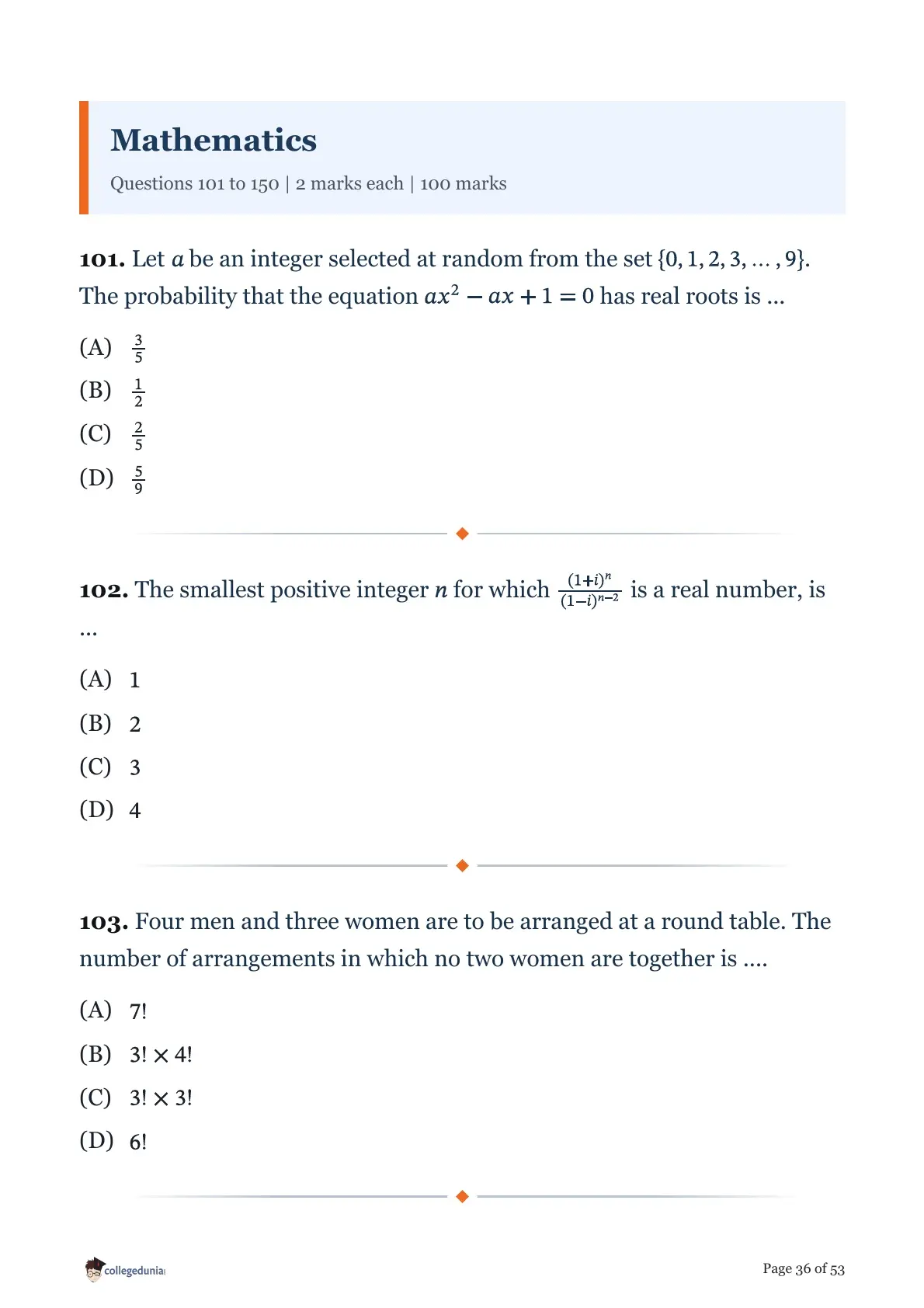
Mathematics Section (Questions 101 to 150)
Let \(a\) be an integer selected at random from the set \(\{0,1,2,3,\ldots ,9\}\). The probability that the equation \(ax^2-ax+1 = 0\) has real roots is ...
The smallest positive integer \(n\) for which \(\frac{(1+i)^n}{(1-i)^{n-2}}\) is a real number, is ...
Four men and three women are to be arranged at a round table. The number of arrangements in which no two women are together is ....
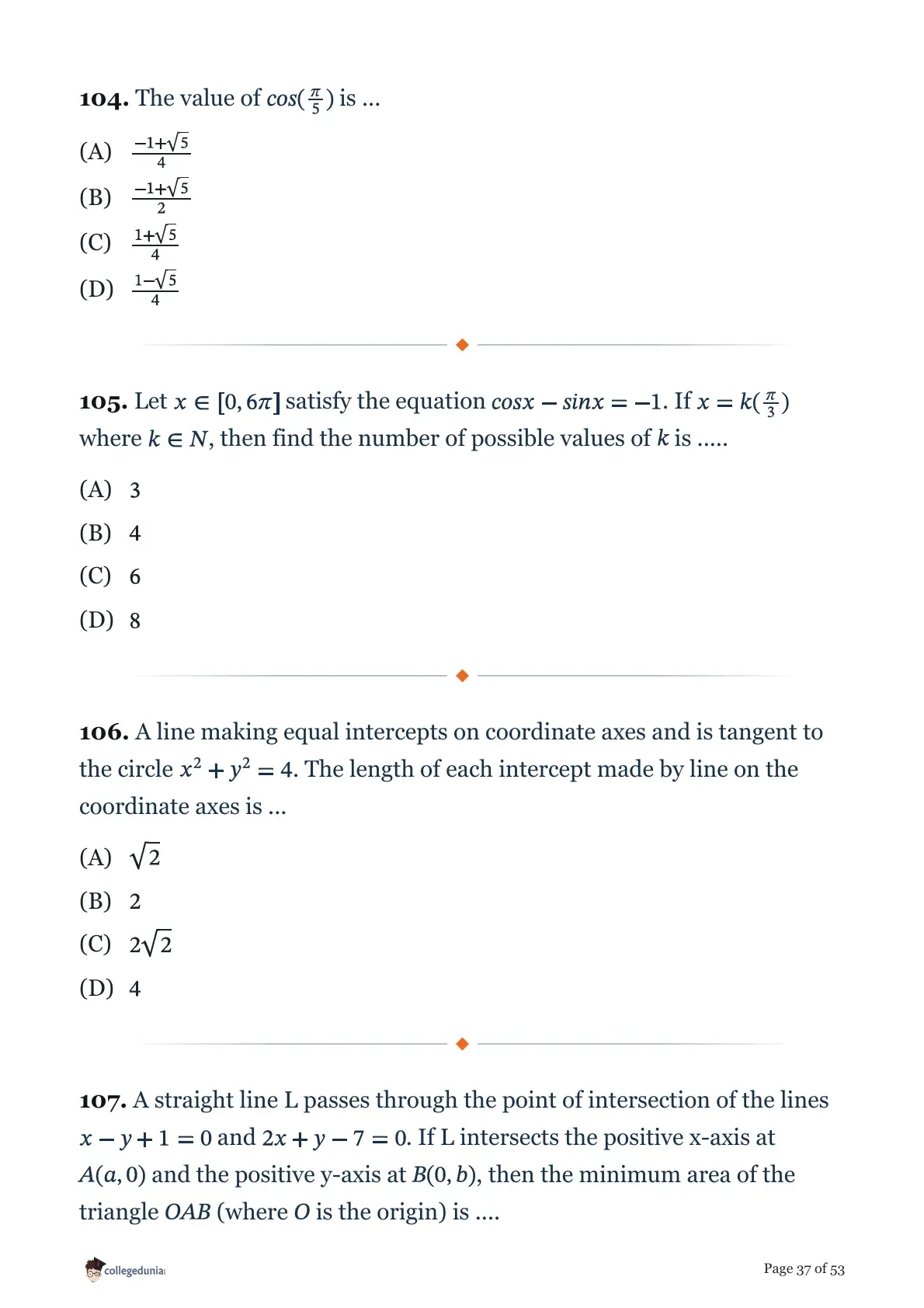
The value of \(cos(\frac{π}{5})\) is ...
Let \(x\in [0,6π]\) satisfy the equation \(cosx-sinx = -1\). If \(x = k(\frac{π}{3})\) where \(k\in N\), then find the number of possible values of \(k\) is .....
A line making equal intercepts on coordinate axes and is tangent to the circle \(x^2+y^2 = 4\). The length of each intercept made by line on the coordinate axes is ...
A straight line L passes through the point of intersection of the lines \(x-y+1 = 0\) and \(2x+y-7 = 0\). If L intersects the positive x-axis at \(A(a,0)\) and the positive y-axis at \(B(0,b)\), then the minimum area of the triangle \(OAB\) (where \(O\) is the origin) is ....
If the combined equation of angle bisectors of the lines \(x^2-2pxy-y^2 = 0\) is \(x^2-2qxy-y^2 = 0\), then which of the following is true?
A tangent having slope \(-\frac{1}{2}\) to the ellipse \(3x^2+4y^2 = 12\) intersects the X-axis and Y-axis at the points A and B respectively. if O is the origin, then the area of \(△AOB\) is ...
If the function \(f(x) = \frac{2\sqrt{2}-(cosx+sinx)^3}{1-sin2x}\) is continuous at \(x = \frac{π}{4}\), then the value of \(f(\frac{π}{4})\) is ...
The value of \(\underset{x\rightarrow 0}{lim}(\frac{8}{x^8})[1-cos\frac{x^2}{2}-cos\frac{x^2}{4}+cos\frac{x^2}{2}\cdot cos\frac{x^2}{4}]\) is equal to ...
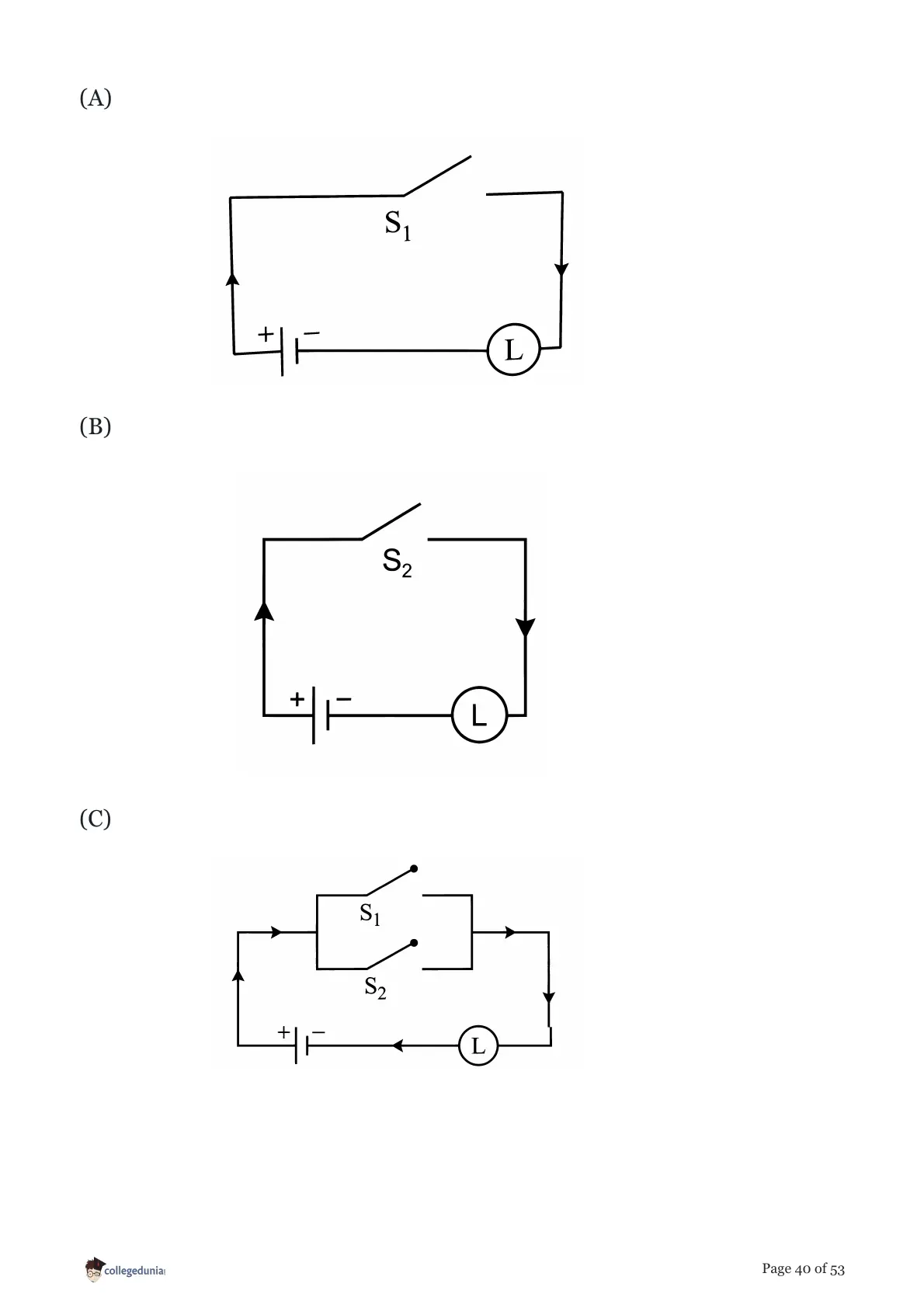
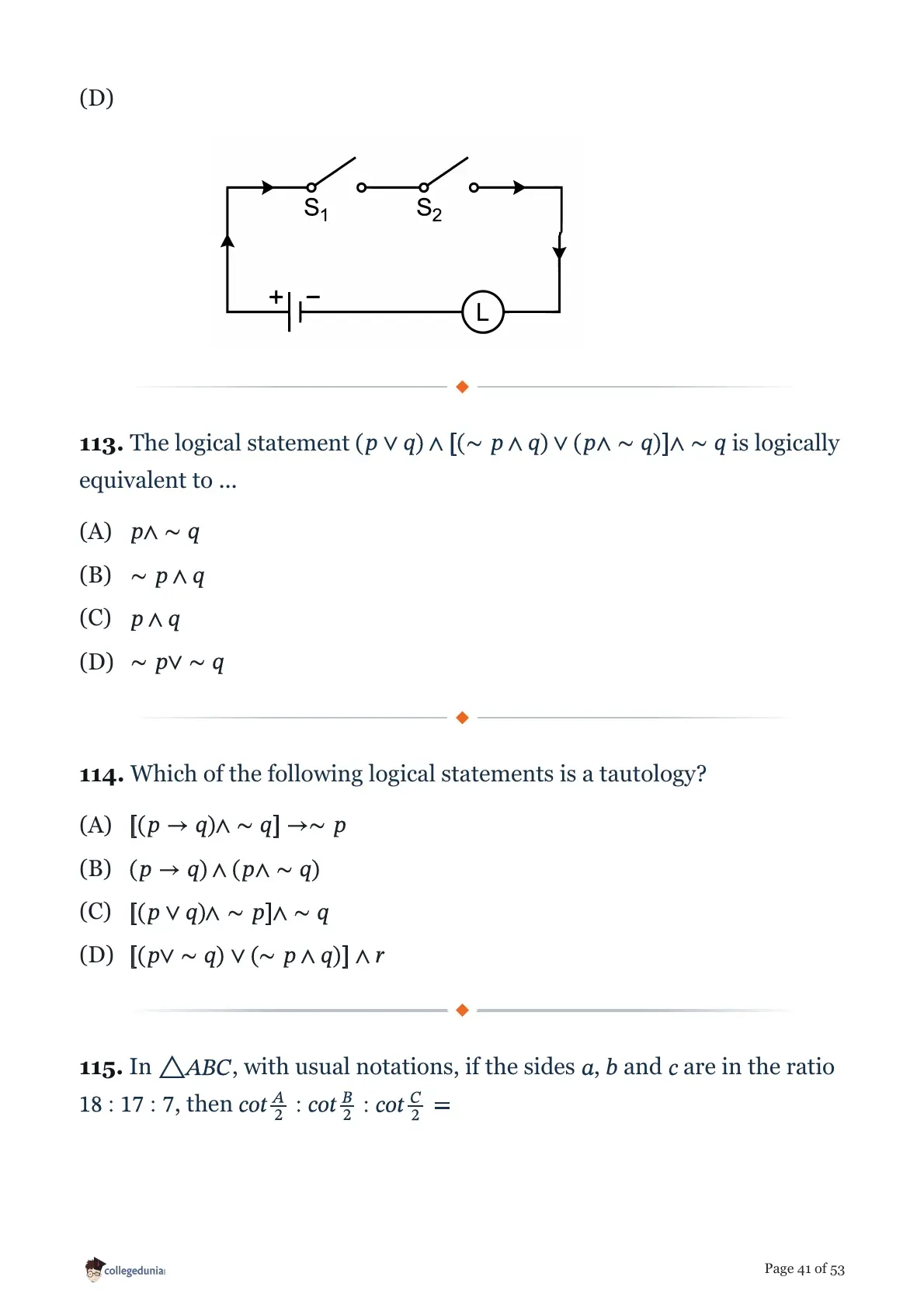
The simplified switching circuit for the following circuit is

- (A)
![]()
- (B)
![]()
- (C)
![]()
- (D)
![]()


The logical statement \((p∨q)∧[(\sim p∧q)∨(p∧\sim q)]∧\sim q\) is logically equivalent to ...
Which of the following logical statements is a tautology?
In \(△ABC\), with usual notations, if the sides \(a\), \(b\) and \(c\) are in the ratio \(18:17:7\), then \(cot\frac{A}{2}:cot\frac{B}{2}:cot\frac{C}{2} =\)
If \(A = [a_{ij}]_{3\times 3}\), where \(a_{ij} = \{\begin{array}{cc}1, & \text{if }i+j\text{ is even} \\ 0, & \text{if }i+j\text{ is odd}\end{array}\), then \(\text{adj}(A) = \ldots\) ..
The inverse of matrix \(\left[ \begin{array}{ccc}1+pq & p & 0 \\ q & 1+pq & p \\ 0 & q & 1\end{array} \right]\) is ...
\(\sum _{k = 1}^{2026}sin^{-1}(cos\frac{kπ}{4}) =\)
If \(sin^{-1}(tan\frac{π}{4})-sin^{-1}(\sqrt{\frac{3}{x}}) = \frac{π}{6}\) then \(x\) is a root of the equation
If \(f(x) = x^2\) and \(g(x) = [x^2]\) where \([\cdot ]\) represents the greatest integer function then, \((f\circ g)(\frac{3}{2})+(g\circ f)(\frac{3}{2})\) is equal to ...
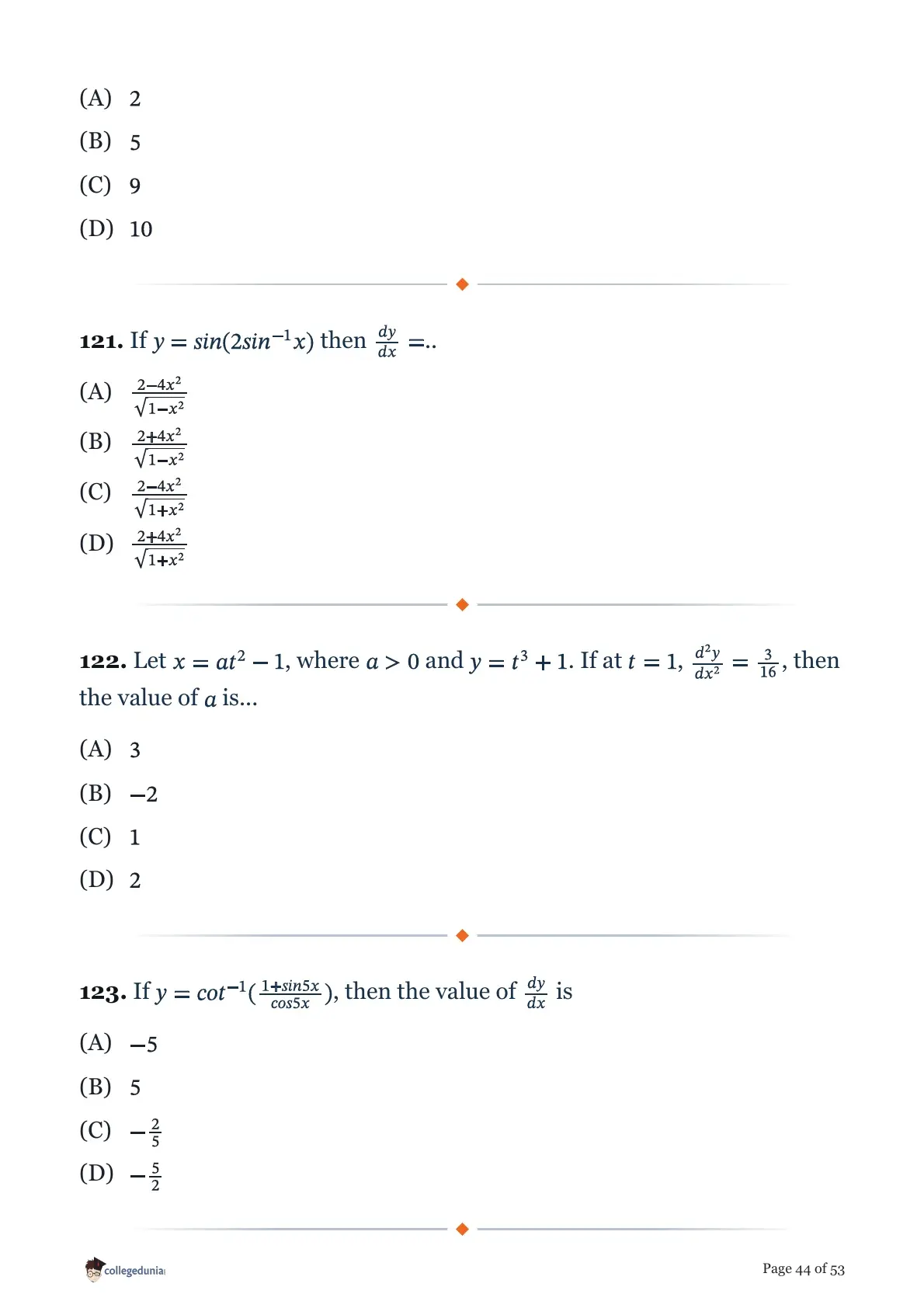
If \(y = sin(2sin^{-1}x)\) then \(\frac{dy}{dx} =\)..
Let \(x = at^2-1\), where \(a > 0\) and \(y = t^3+1\). If at \(t = 1\), \(\frac{d^2y}{dx^2} = \frac{3}{16}\), then the value of \(a\) is...
If \(y = cot^{-1}(\frac{1+sin5x}{cos5x})\), then the value of \(\frac{dy}{dx}\) is
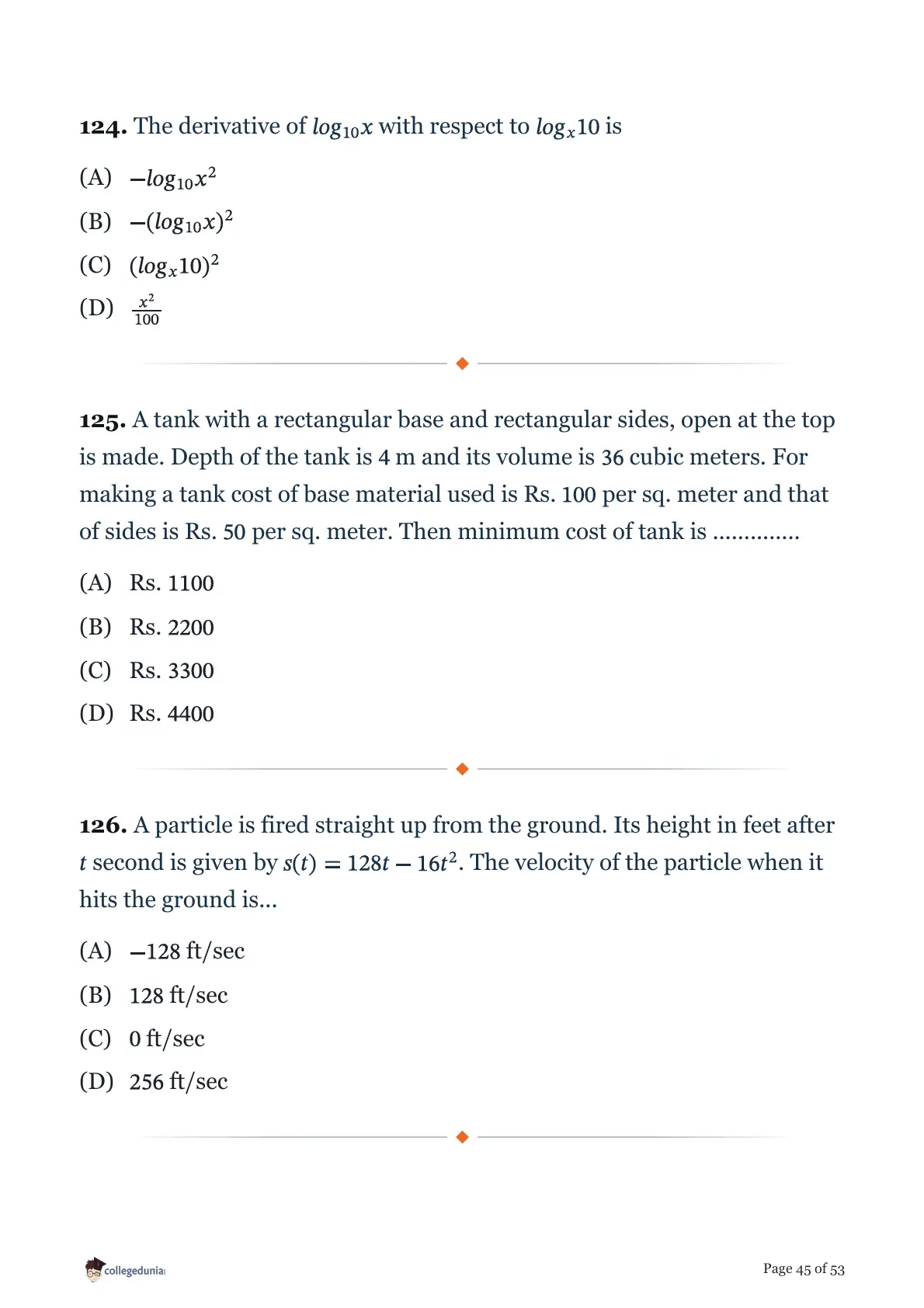
The derivative of \(log_{10}x\) with respect to \(log_x10\) is
A tank with a rectangular base and rectangular sides, open at the top is made. Depth of the tank is \(4\) m and its volume is \(36\) cubic meters. For making a tank cost of base material used is Rs. \(100\) per sq. meter and that of sides is Rs. \(50\) per sq. meter. Then minimum cost of tank is ..............
A particle is fired straight up from the ground. Its height in feet after \(t\) second is given by \(s(t) = 128t-16t^2\). The velocity of the particle when it hits the ground is...
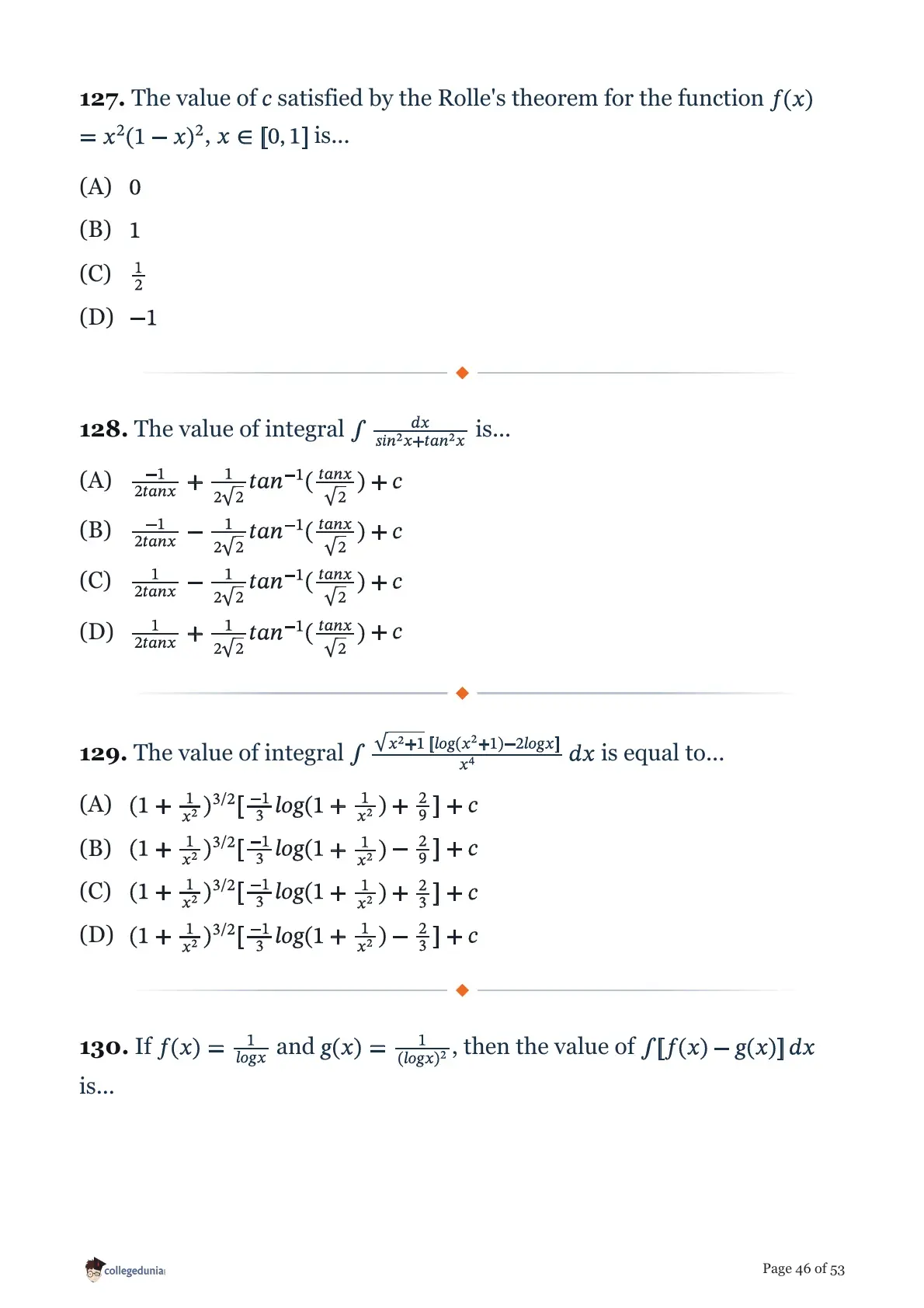
The value of \(c\) satisfied by the Rolle's theorem for the function \(f(x) = x^2(1-x)^2\), \(x\in [0,1]\) is...
The value of integral \(\int \frac{dx}{sin^2x+tan^2x}\) is...
The value of integral \(\int \frac{\sqrt{x^2+1}\,[log(x^2+1)-2logx]}{x^4}\,dx\) is equal to...
If \(f(x) = \frac{1}{logx}\) and \(g(x) = \frac{1}{(logx)^2}\), then the value of \(\int [f(x)-g(x)]\,dx\) is...
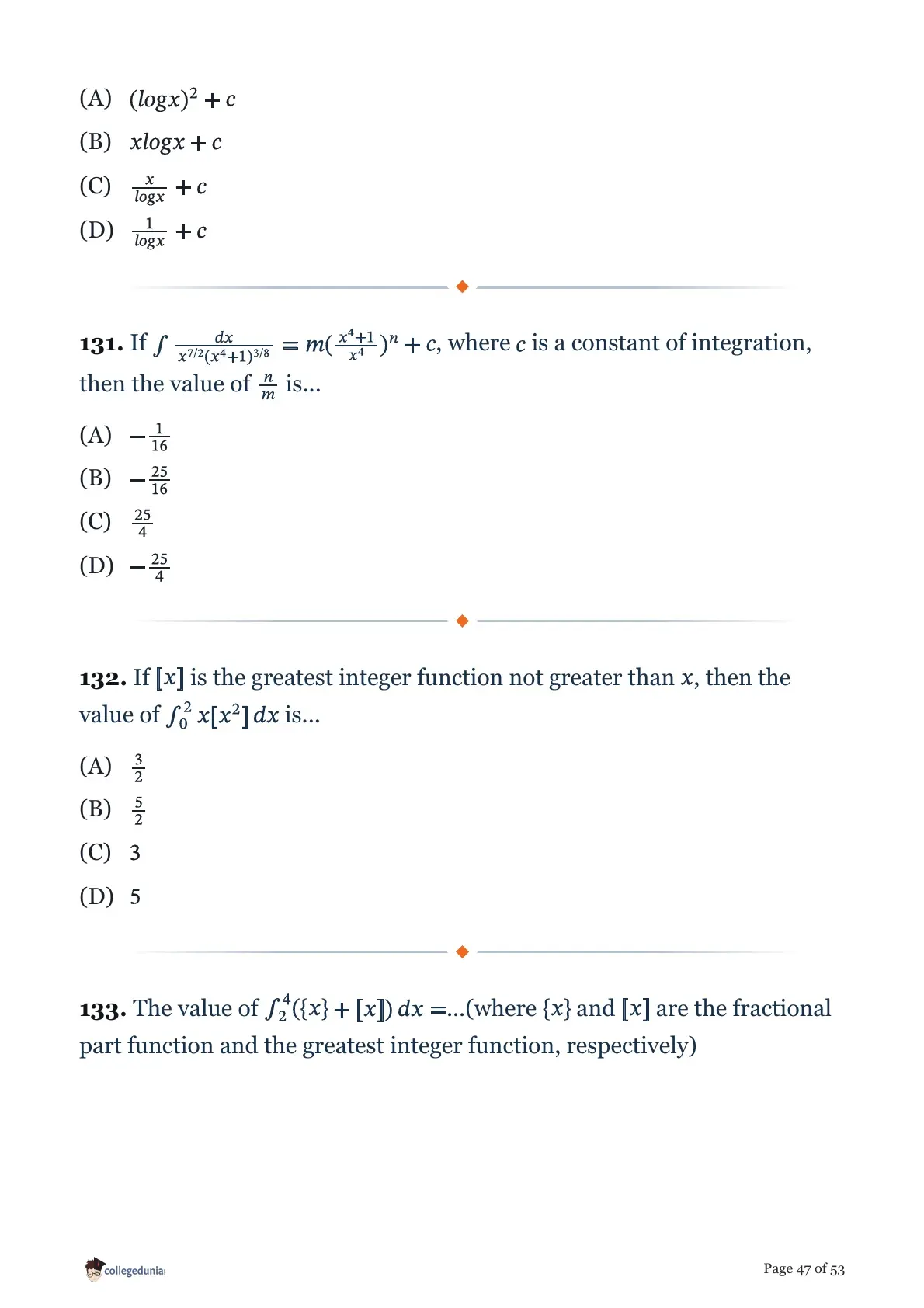
If \(\int \frac{dx}{x^{7/2}(x^4+1)^{3/8}} = m(\frac{x^4+1}{x^4})^n+c\), where \(c\) is a constant of integration, then the value of \(\frac{n}{m}\) is...
If \([x]\) is the greatest integer function not greater than \(x\), then the value of \(\int _0^2x[x^2]\,dx\) is...
The value of \(\int _2^4(\{x\}+[x])\,dx =\)...(where \(\{x\}\) and \([x]\) are the fractional part function and the greatest integer function, respectively)
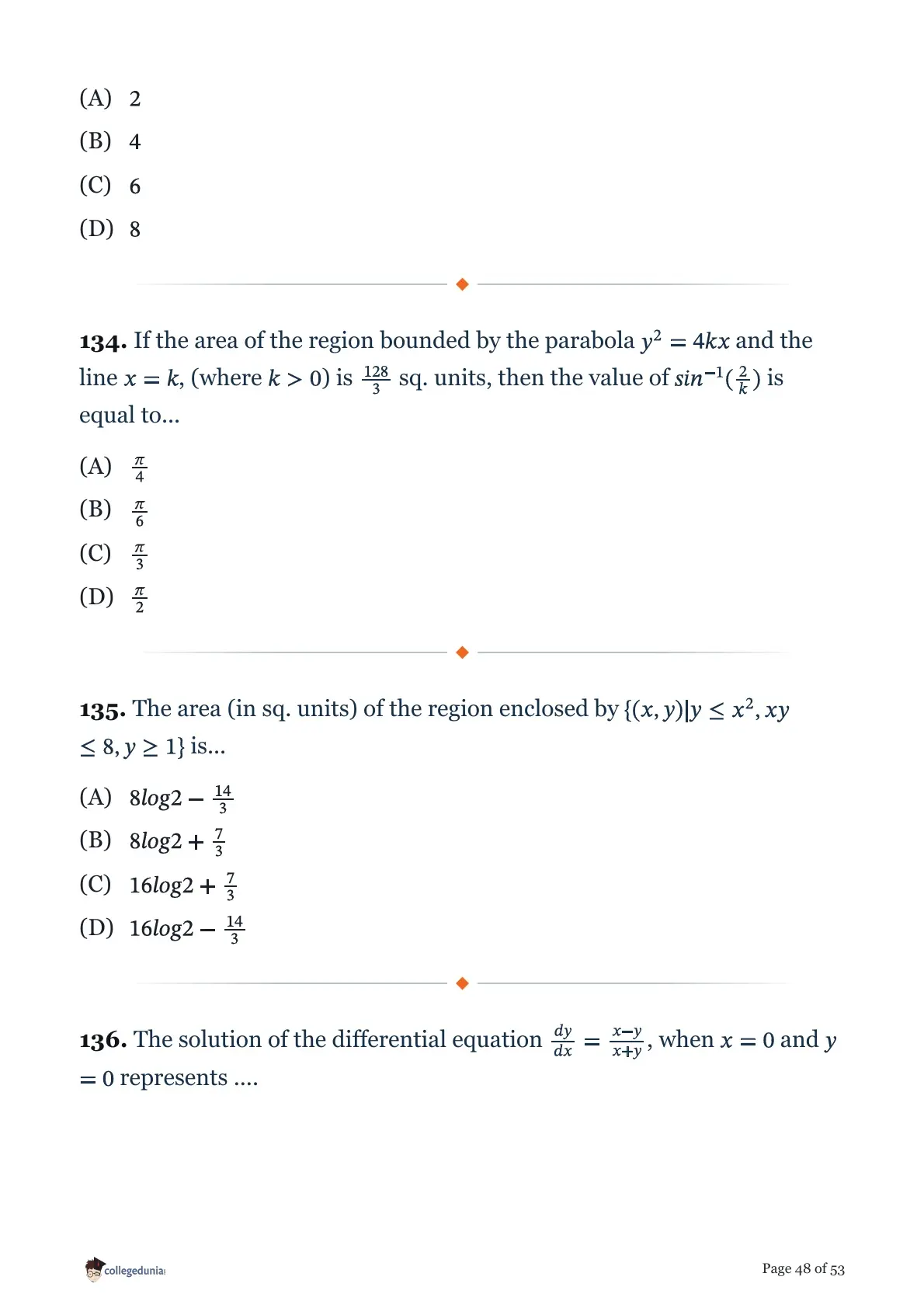
If the area of the region bounded by the parabola \(y^2 = 4kx\) and the line \(x = k\), (where \(k > 0\)) is \(\frac{128}{3}\) sq. units, then the value of \(sin^{-1}(\frac{2}{k})\) is equal to...
The area (in sq. units) of the region enclosed by \(\{(x,y)|y\leq x^2,xy\leq 8,y\geq 1\}\) is...
The solution of the differential equation \(\frac{dy}{dx} = \frac{x-y}{x+y}\), when \(x = 0\) and \(y = 0\) represents ....
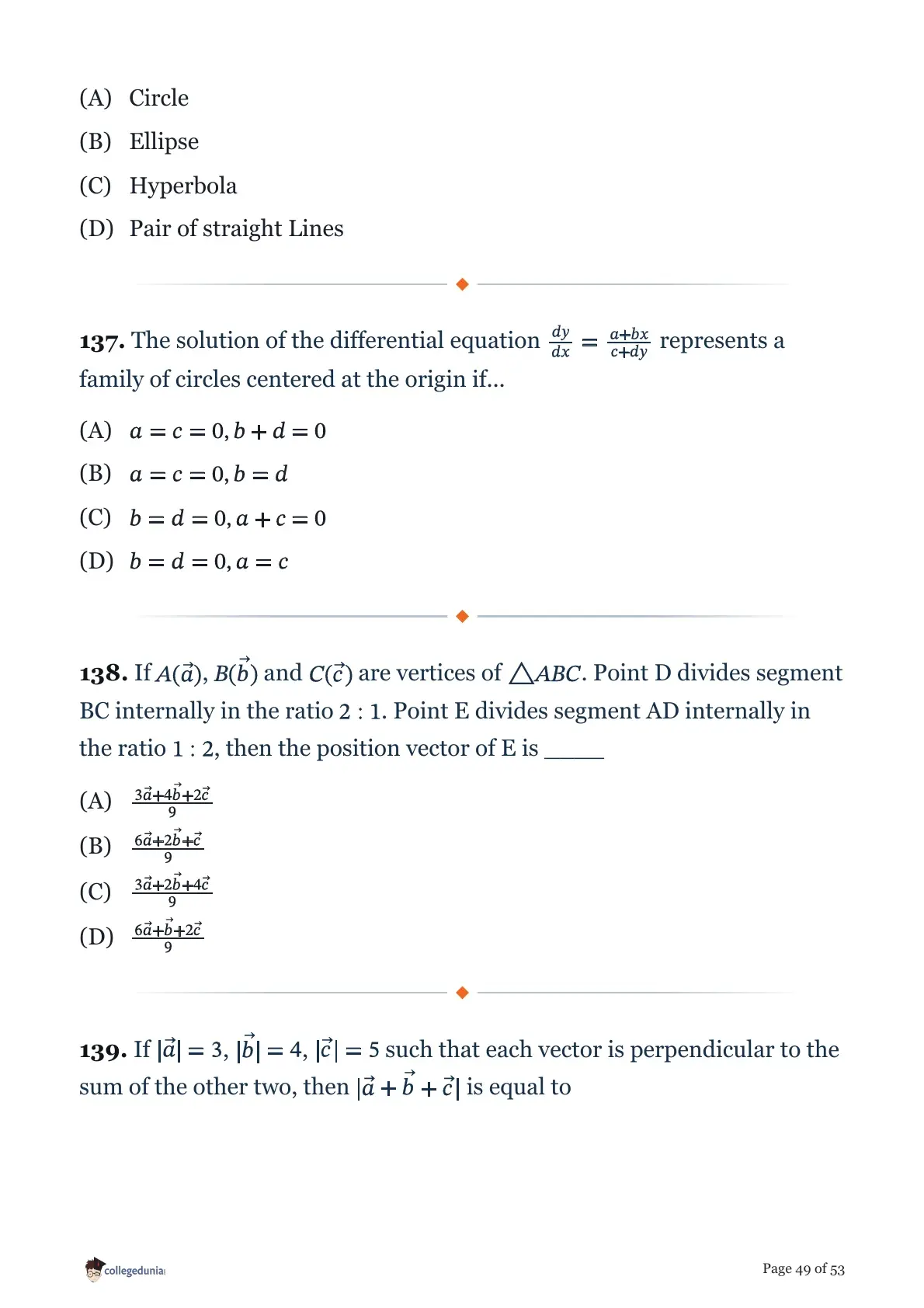
The solution of the differential equation \(\frac{dy}{dx} = \frac{a+bx}{c+dy}\) represents a family of circles centered at the origin if...
If \(A(\overset{⃗}{a})\), \(B(\overset{⃗}{b})\) and \(C(\overset{⃗}{c})\) are vertices of \(△ABC\). Point D divides segment BC internally in the ratio \(2:1\). Point E divides segment AD internally in the ratio \(1:2\), then the position vector of E is ____
If \(|\overset{⃗}{a}| = 3\), \(|\overset{⃗}{b}| = 4\), \(|\overset{⃗}{c}| = 5\) such that each vector is perpendicular to the sum of the other two, then \(|\overset{⃗}{a}+\overset{⃗}{b}+\overset{⃗}{c}|\) is equal to
The value of \(x\) so that the volume of the parallelopiped formed by the vectors \(\hat{i}+x\hat{j}+\hat{k}\), \(\hat{j}+x\hat{k}\) and \(x\hat{i}+\hat{k}\) is minimum, is
The sum of all real values of \(λ\) for which the vectors \(\overset{⃗}{a} = λ\hat{i}+\hat{j}+\hat{k}\), \(\overset{⃗}{b} = \hat{i}+λ\hat{j}+2\hat{k}\), \(\overset{⃗}{c} = 2\hat{i}+3\hat{j}+λ\hat{k}\) are coplanar is...
If \(ABC\) is a right-angled triangle in which \(BC\) is the longest side and the position vector of \(B\) and \(C\) are respectively \(3\hat{i}-2\hat{j}+\hat{k}\) and \(5\hat{i}+\hat{j}-3\hat{k}\), then the value of \(\overline{AB}\cdot \overline{AC}+\overline{BA}\cdot \overline{BC}+\overline{CA}\cdot \overline{CB}\) is
The plane \(\frac{x}{2}+\frac{y}{3}+\frac{z}{4} = 1\) cuts the axes at the points A, B, C then the area of triangle ABC is
From a point P \((a,b,c)\), perpendiculars PA and PB are drawn to XY plane and ZX plane respectively. If O is the origin, then the equation of plane OAB is
If \(p\) is the shortest distance between the lines \(\frac{x+1}{7} = \frac{y+1}{-6} = z+1\) and \(\overset{⃗}{r} = (3\hat{i}+5\hat{j}+7\hat{k})+μ(\hat{i}-2\hat{j}+\hat{k})\) then \([p]\) is... ,(where \([\,.\,]\) denotes the greatest integer function.)
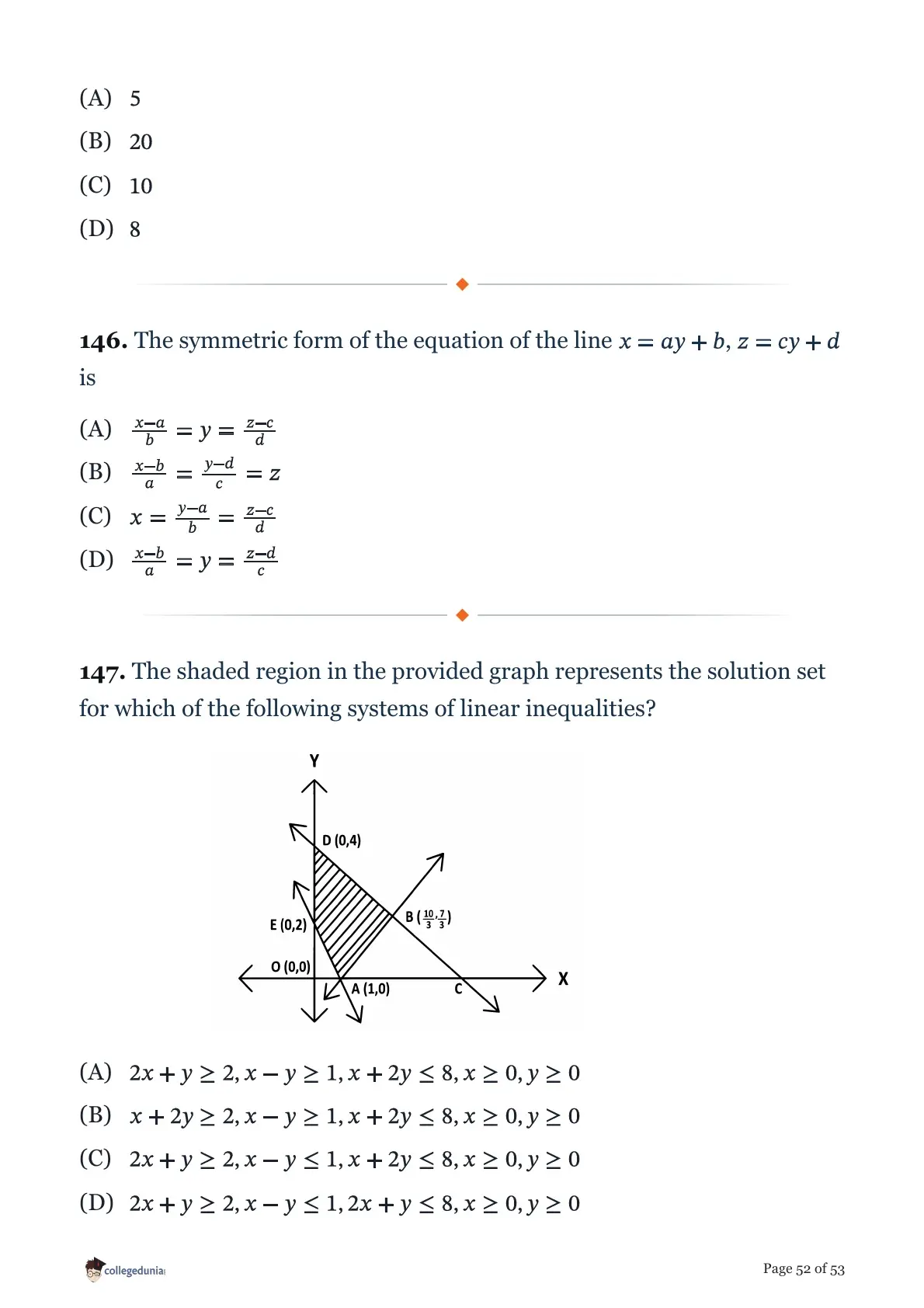
The symmetric form of the equation of the line \(x = ay+b\), \(z = cy+d\) is
The shaded region in the provided graph represents the solution set for which of the following systems of linear inequalities?

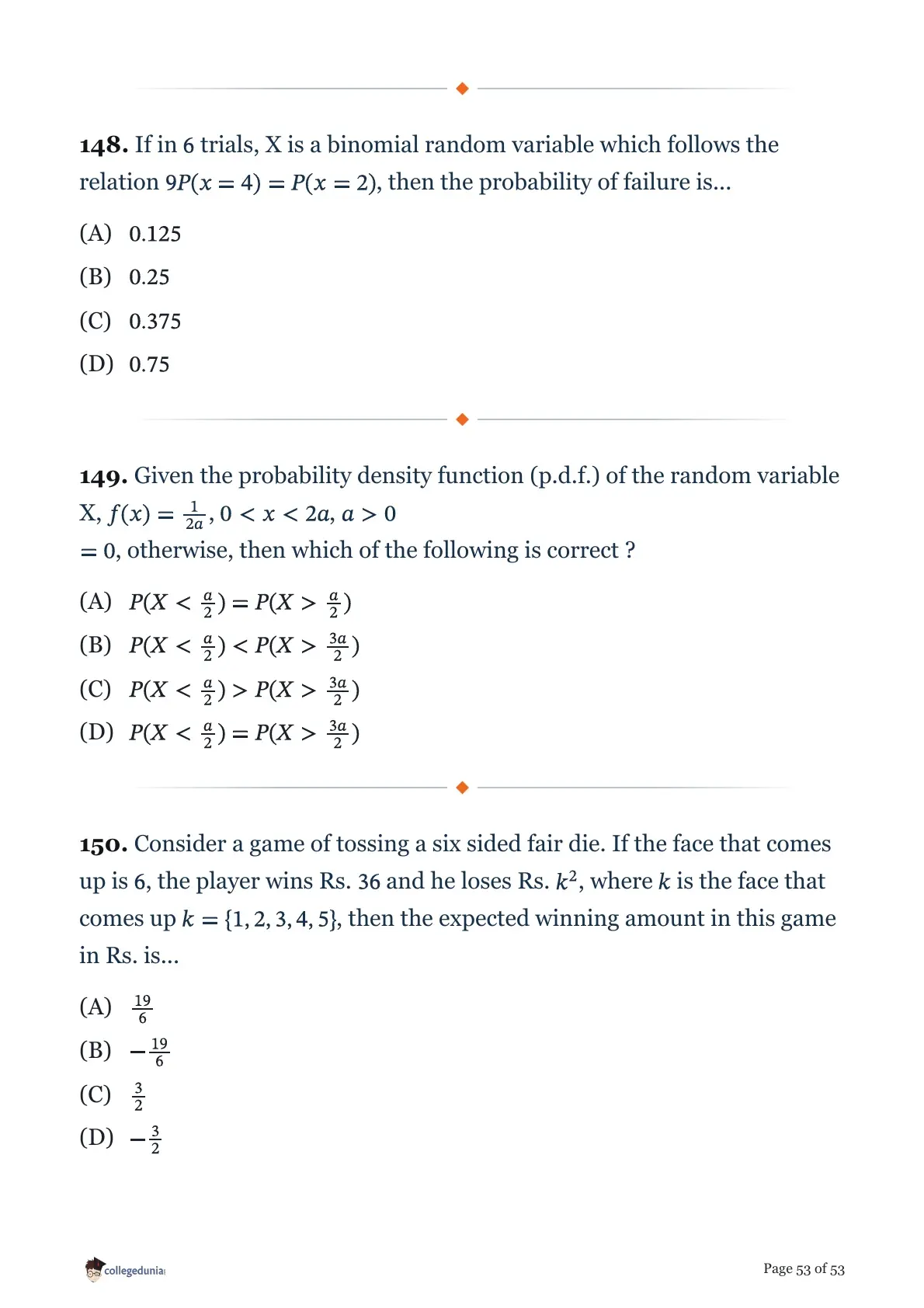
If in \(6\) trials, X is a binomial random variable which follows the relation \(9P(x = 4) = P(x = 2)\), then the probability of failure is...
Given the probability density function (p.d.f.) of the random variable X, \(f(x) = \frac{1}{2a}\), \(0 < x < 2a\), \(a > 0\)
\(= 0\), otherwise, then which of the following is correct ?
Consider a game of tossing a six sided fair die. If the face that comes up is \(6\), the player wins Rs. \(36\) and he loses Rs. \(k^2\), where \(k\) is the face that comes up \(k = \{1,2,3,4,5\}\), then the expected winning amount in this game in Rs. is...
MHT CET PCM Exam Pattern 2026
| Parameter | Details |
|---|---|
| Conducting Body | Maharashtra Common Entrance Test Cell (Maharashtra CET Cell) |
| Exam Mode | Online (Computer-Based Test) |
| Duration | 180 minutes (3 hours) |
| Groups / Subjects | PCM (Physics, Chemistry, Mathematics) for Engineering |
| Total Questions |
150 |
| Total Marks | 200 |
| Question Type | Multiple Choice Questions (MCQs) |
| Marks Distribution |
|
| Negative Marking | No |
| Syllabus Weightage |
|



Comments