




MHT CET 2026 May 13 Shift 2 PCM Question Paper is available for download here. Maharashtra State CET Cell conducted MHT CET 2026 PCM Exam on May 13 in Shift 2 from 2 PM to 5 PM in CBT mode.
- The MHT CET 2026 PCM Question Paper consists of 150 multiple-choice questions (MCQs) totalling 200 marks divided into 3 sections: Physics, Chemistry, and Mathematics, with 50 questions in each subject.
- Physics and Chemistry questions carry 1 mark each while Mathematics questions carry 2 marks each.
- There is no negative marking for incorrect answers.
Download MHT CET 2026 May 13 Shift 2 PCM Question Paper with Solutions PDF from the links provided below.
MHT CET 2026 May 13 Shift 2 PCM Question Paper PDF Download
| MHT CET 2026 May 13 Shift 2 Question Paper | Download PDF | Check Solution |
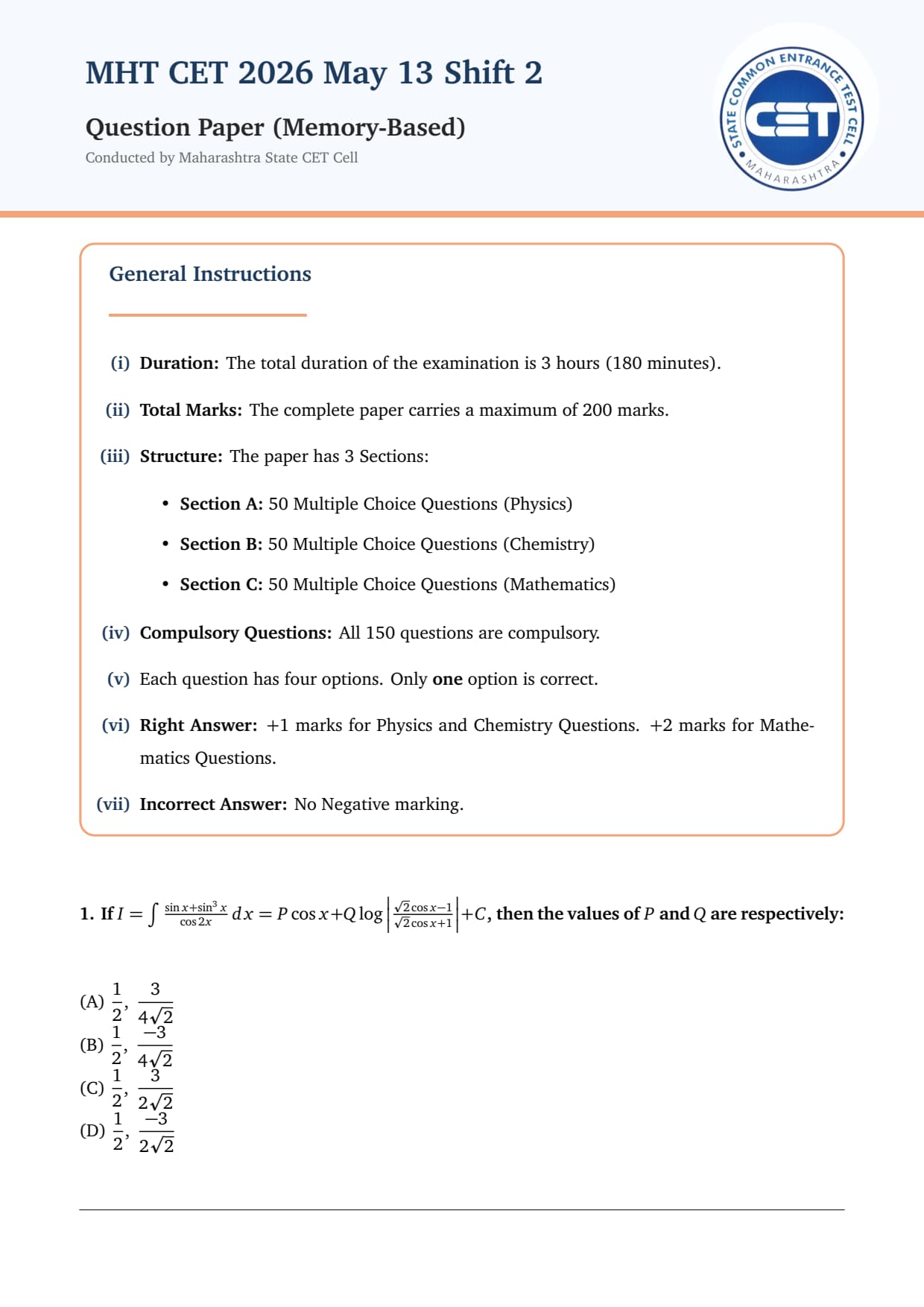


If \(I = \int \frac{\sin x + \sin^3 x}{\cos 2x}\,dx = P \cos x + Q \log \left| \frac{\sqrt{2}\cos x - 1}{\sqrt{2}\cos x + 1} \right| + C\), then the values of \(P\) and \(Q\) are respectively:
In a triangle \(\triangle ABC\), if \(a\), \(b\), and \(c\) are in arithmetic progression, then \(\cos A + 2\cos B + \cos C =\)
If the area of triangle \(ABC\) is \(b^2 - (c-a)^2\), then \(\tan B =\)
In a \(\triangle ABC\), \(a = 1\), \(b = \sqrt{3}\) and \(\angle C = \dfrac{\pi}{6}\). Then the measure of the third side \(c =\)
The integral \(\displaystyle\int \frac{1}{\sqrt[4]{(x-1)^3(x+2)^5}}\,dx\) is equal to: (where \(C\) is a constant of integration)
Calculate the pH of 0.02 M monobasic acid having 2% dissociation.
What is the pH of \(2 \times 10^{-3}\) M solution of monoacidic weak base if it ionises to the extent of 5%?
Identify \(base_2\) for the following equation according to Br\o{nsted--Lowry theory: \[HCl_{(aq)} + H_2O_{(l)} \rightleftharpoons H_3O^+_{(aq)} + Cl^-_{(aq)}\]
Calculate the pH of 0.01 M sulphuric acid.
What is the pH of a weak dibasic acid that is 2% dissociated in its M/100 solution at 298 K?
An open pipe resonates with a tuning fork of frequency 500 Hz. It is observed that two successive nodes are separated by 34 cm. The velocity of sound in air is:
A train moving at 20 m/s approaches a stationary observer. The frequency of the whistle emitted by the train is 640 Hz. If the velocity of sound is 340 m/s, the apparent frequency heard by the observer is:
Unpolarized light of intensity \(I_0\) is incident on two polaroids placed coaxially. The transmission axis of the second polaroid is at an angle of \(60^\circ\) to the first. The intensity of emerging light is:
A parallel plate capacitor has capacitance \(C\). If a dielectric slab of dielectric constant \(K\) and thickness equal to half the plate separation is introduced parallel to the plates, the new capacitance is:
An infinite line charge of uniform linear charge density \(\lambda\) is placed along the \(z\)-axis. The work done in moving a charge \(q\) from \((a,\,0,\,0)\) to \((2a,\,0,\,0)\) is:
MHT CET PCM Exam Pattern 2026
| Parameter | Details |
|---|---|
| Conducting Body | Maharashtra Common Entrance Test Cell (Maharashtra CET Cell) |
| Exam Mode | Online (Computer-Based Test) |
| Duration | 180 minutes (3 hours) |
| Groups / Subjects | PCM (Physics, Chemistry, Mathematics) for Engineering |
| Total Questions |
150 |
| Total Marks | 200 |
| Question Type | Multiple Choice Questions (MCQs) |
| Marks Distribution |
|
| Negative Marking | No |
| Syllabus Weightage |
|



Comments