



Doppler Effect is a topic from the Wave Motion chapter of Class 12 Physics, and it is part of the Physics section of the MHT CET for candidates who are preparing for the PCM (Physics, Chemistry, and Mathematics).
The key topics covered in Doppler Effect PYQs are:
- Apparent frequency when the source moves
- Apparent frequency when the observer moves
- Source and observer both moving
- Trains and whistles
- Reflection of sound from a moving obstacle
Practising Doppler Effect MHT CET PYQ helps candidates to understand question pattern, improve calculation speed, and identify concepts which were asked in previous exams.
Based on chapter-wise analysis of the MHT CET Physics paper, you can get less than 1 mark per paper by covering Doppler Effect. The chapter recorded 33 questions across the 80 shifts in the data, and 16 of them came in the 2025 and 2026 papers, which is fewer than 1 of the 50 Physics questions in a typical shift.
MHT CET Doppler Effect Chapter: Question Count, Marks and Weightage:
| What it shows | Number |
|---|---|
| Questions in the PDF (2017-2026) | 33 |
| Questions in the 2025 and 2026 papers (33 shifts) | 16 |
| Questions in the 2018 to 2026 papers (80 shifts) | 32 |
| Typical number of Physics questions from this topic in one shift | Fewer than 1 out of 50 |
| Marks for each question | 1 |
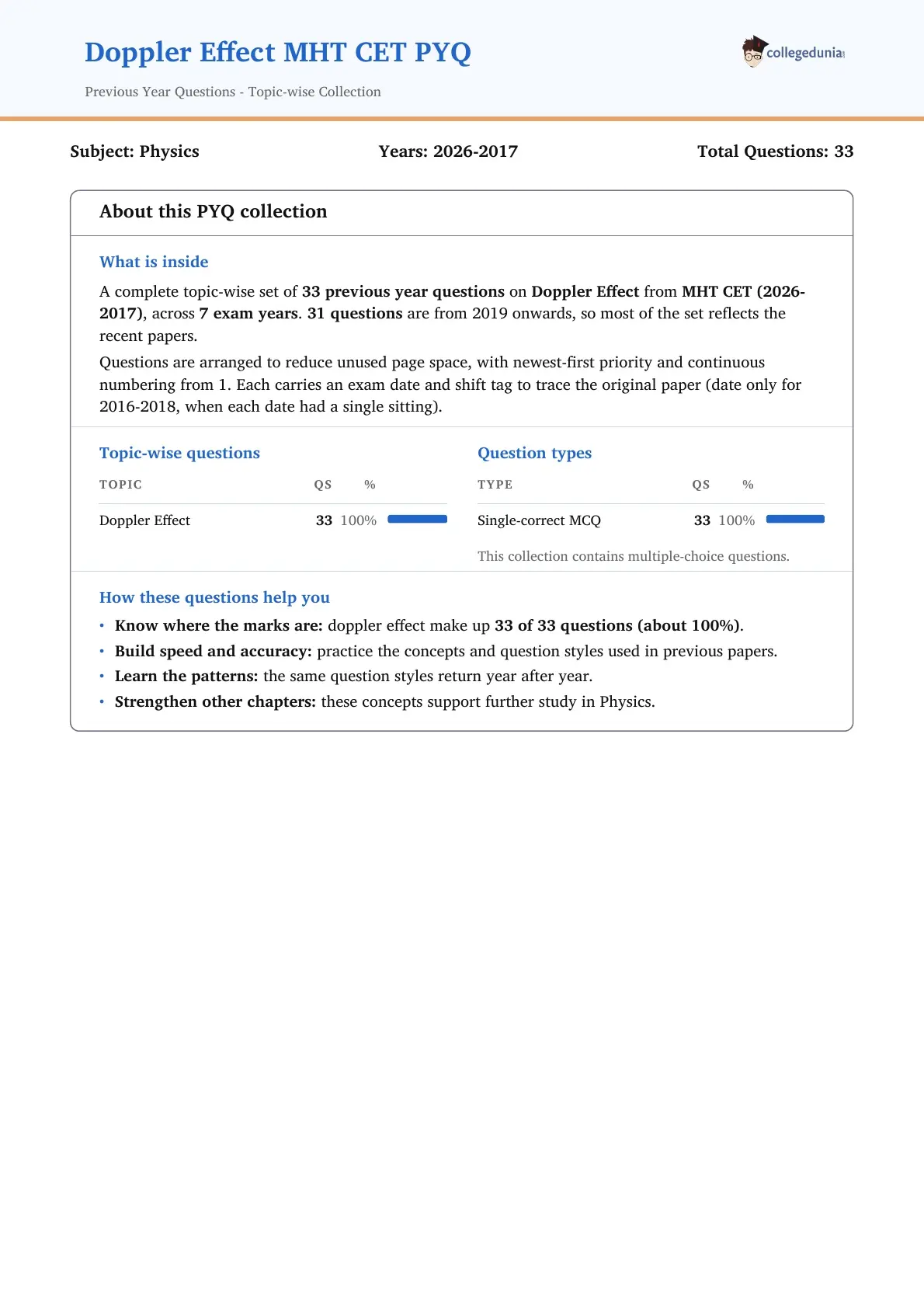
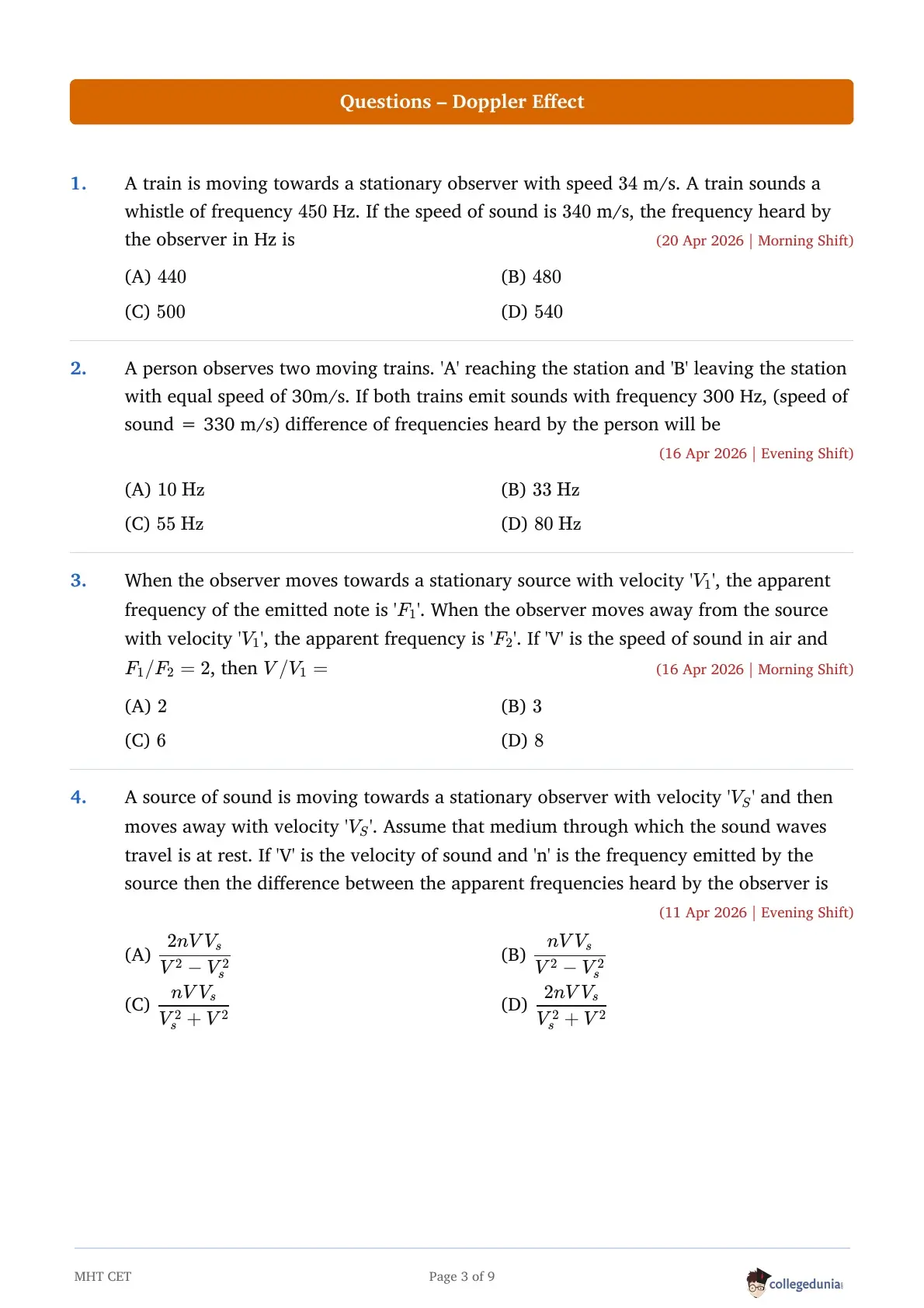
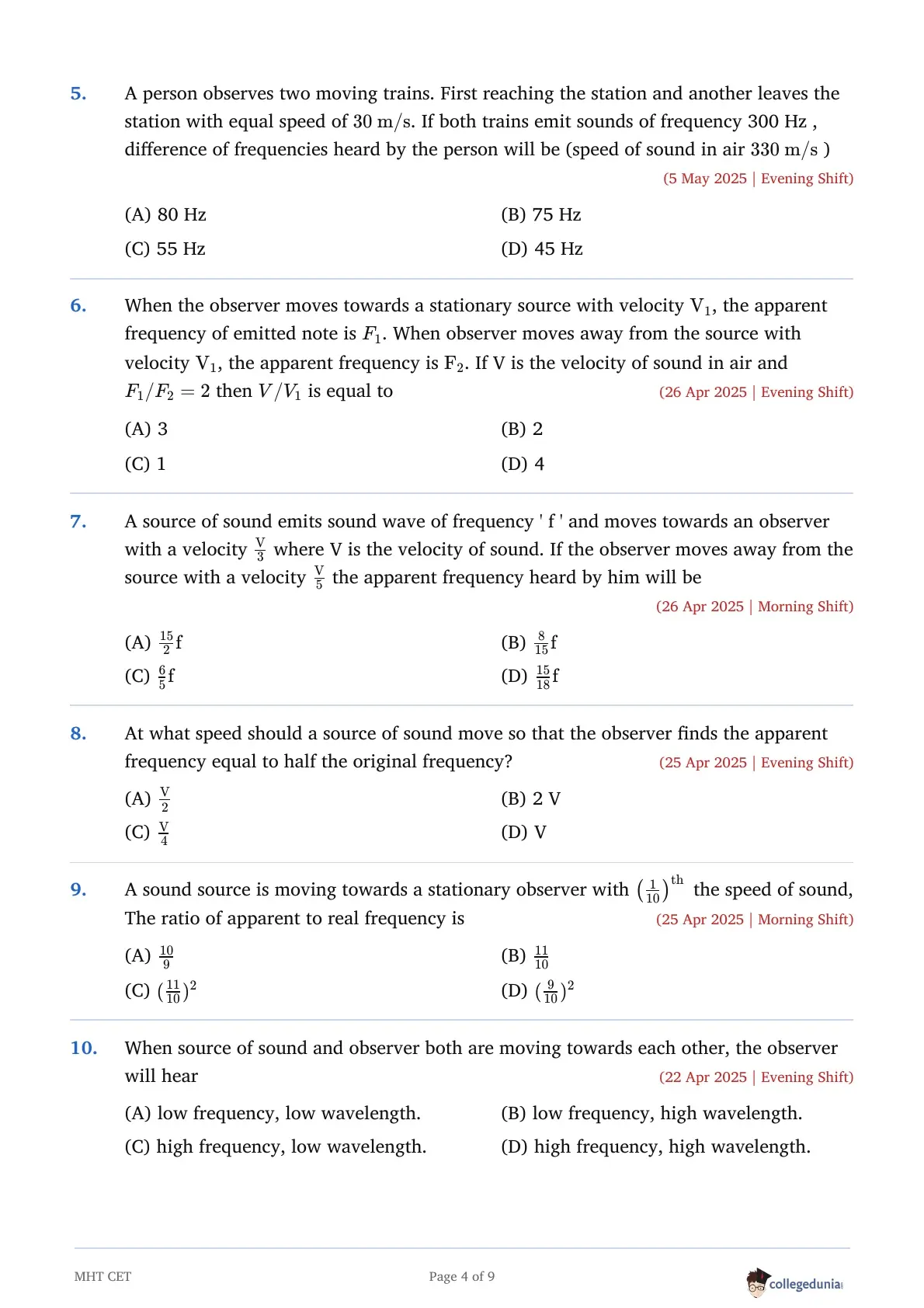
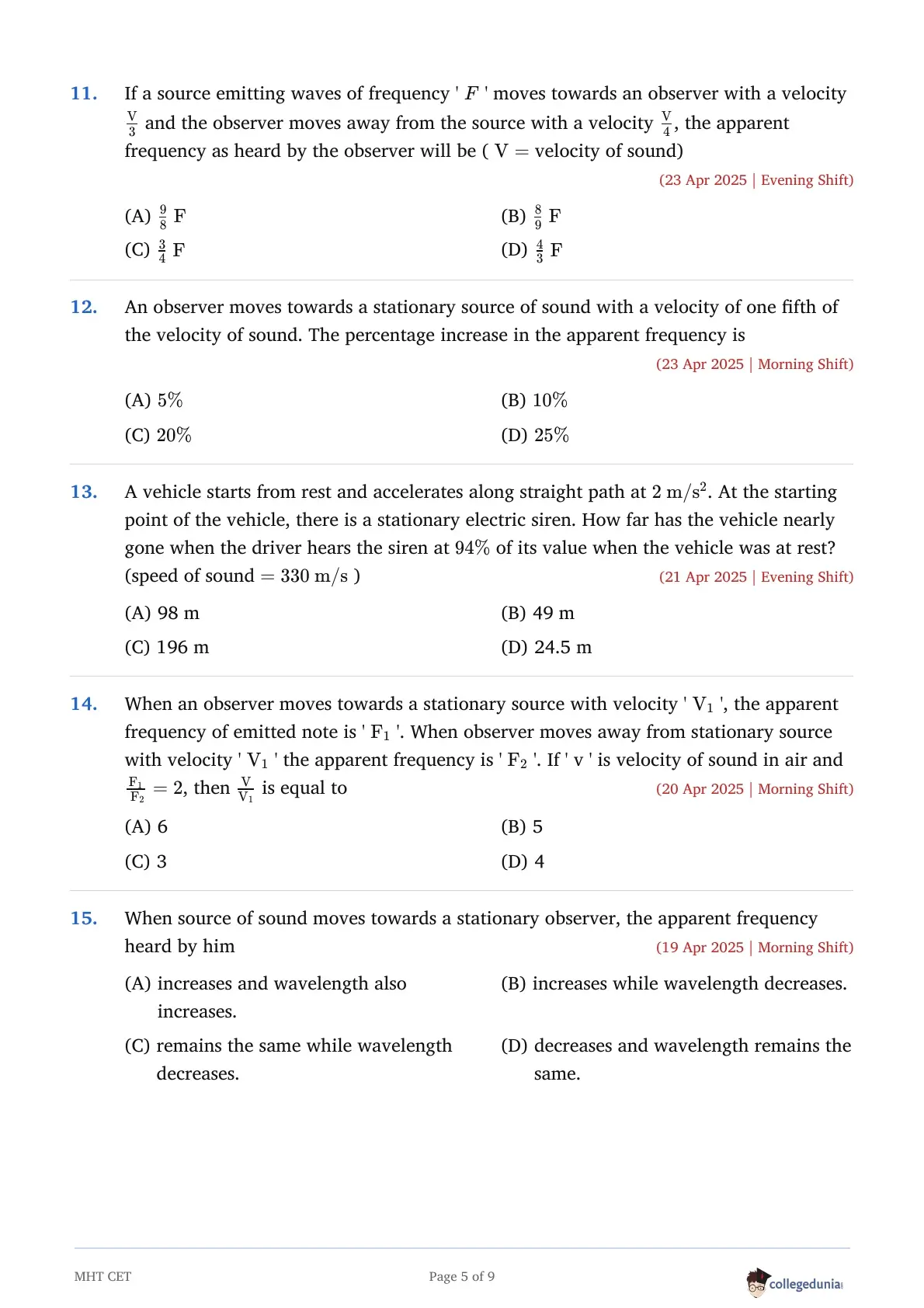
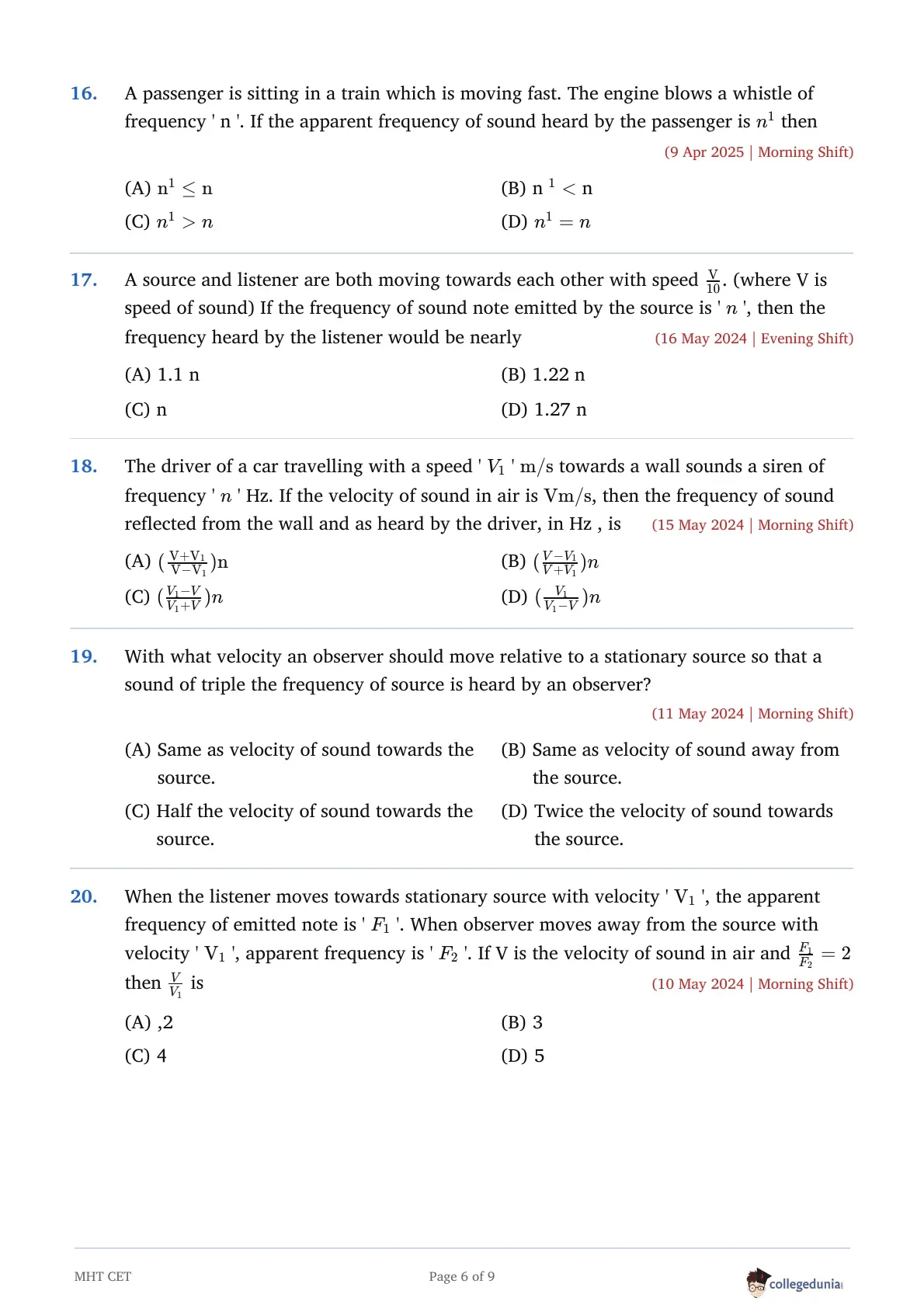
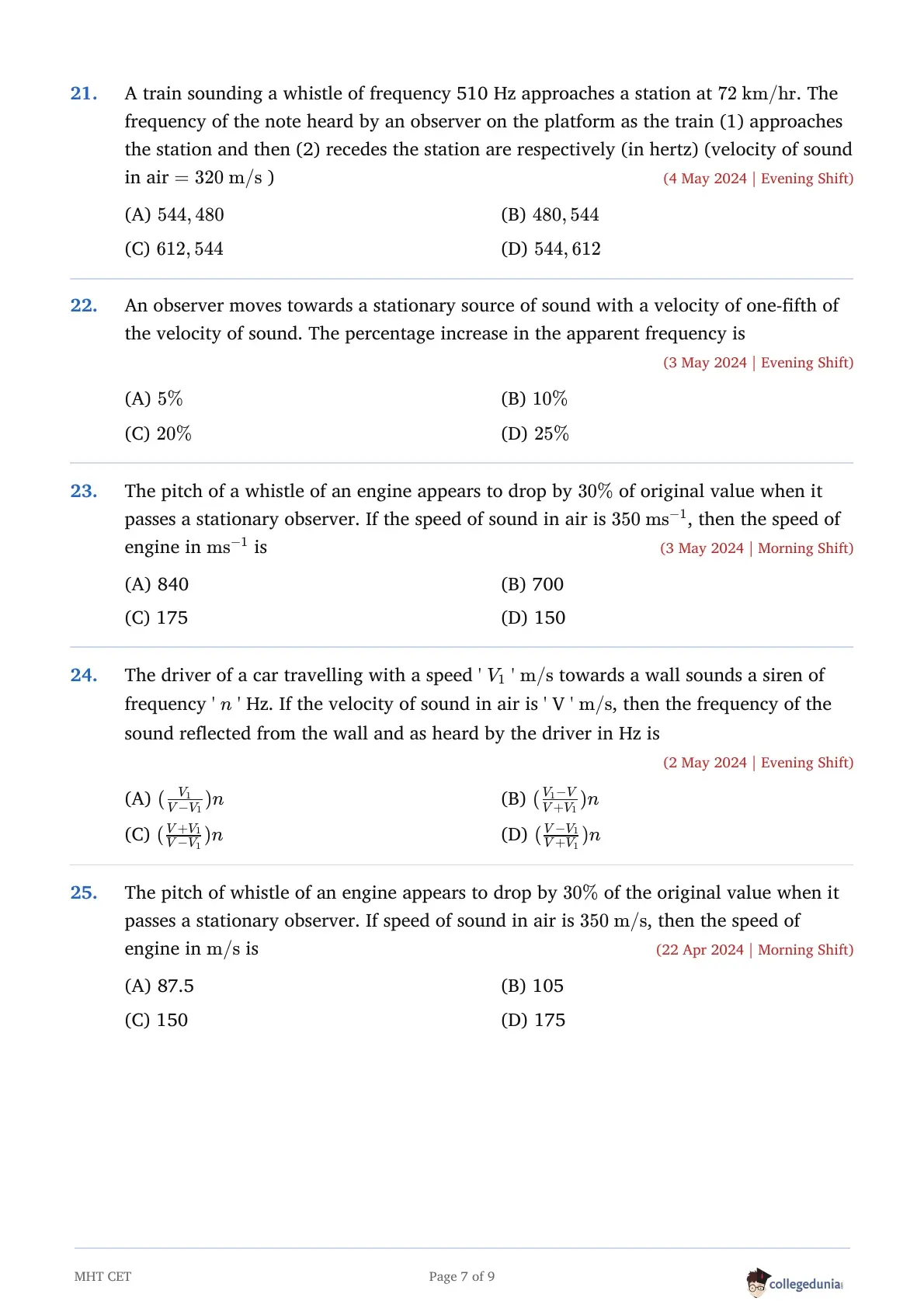
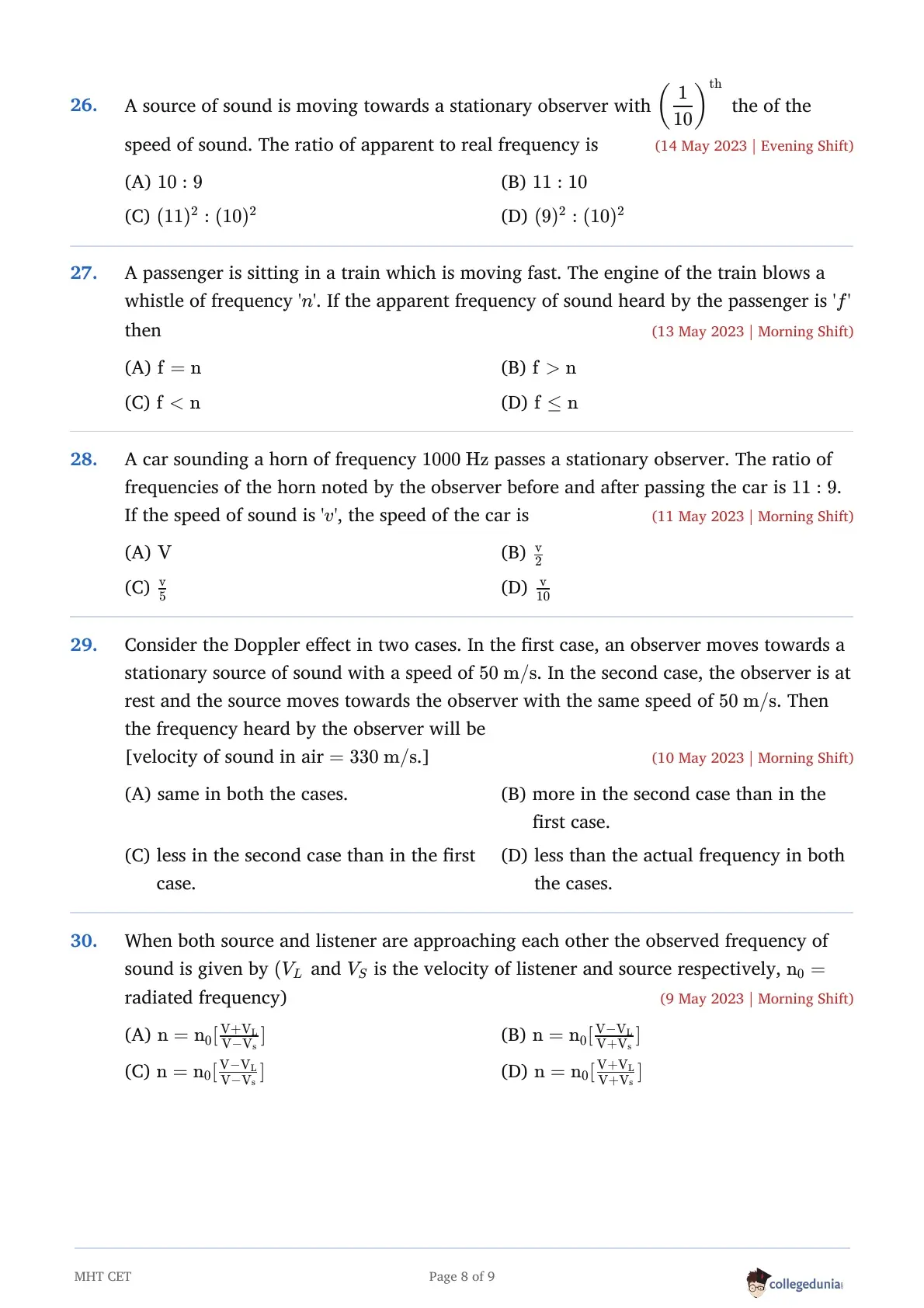
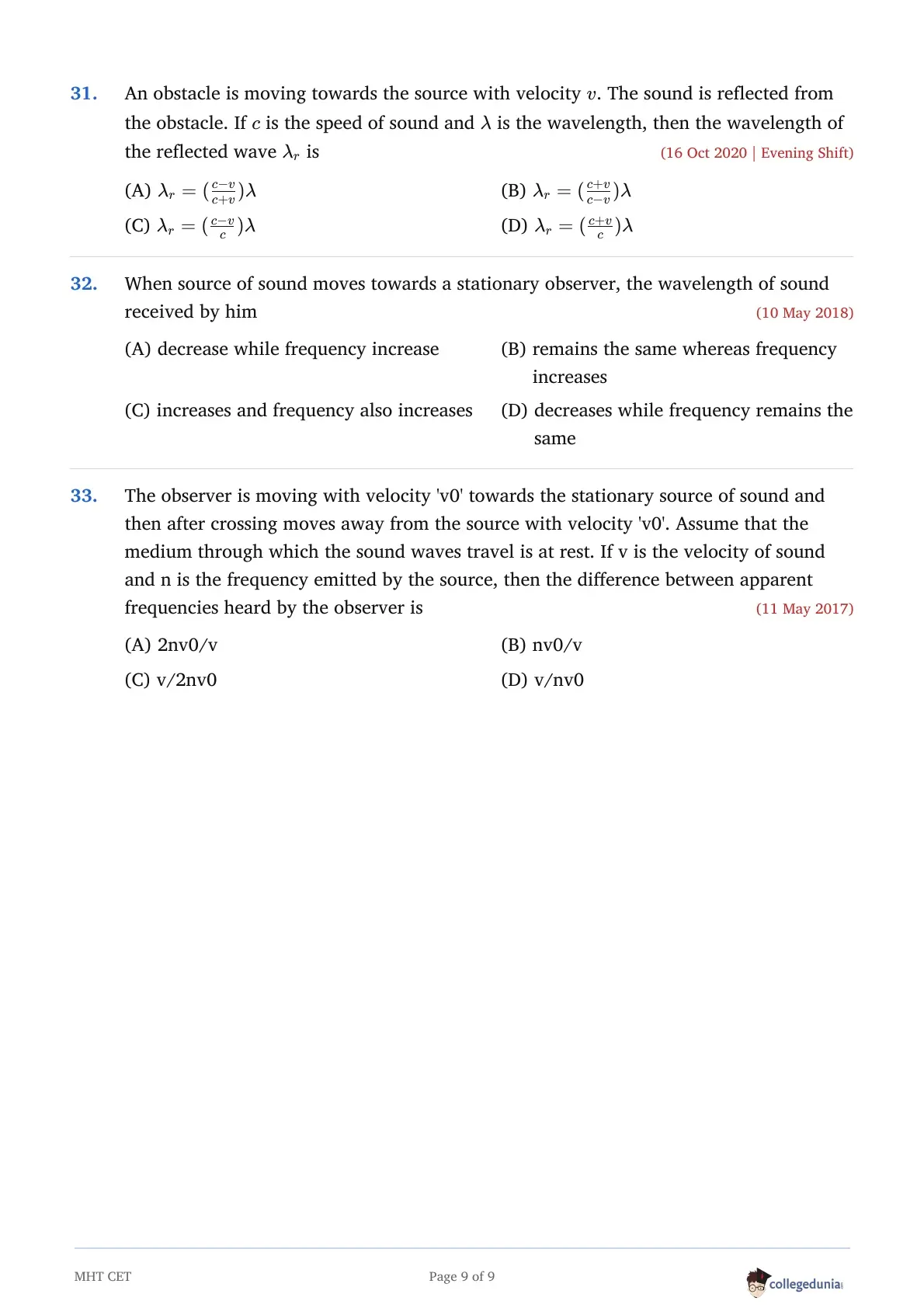
The PDF holds 33 questions from MHT CET 2026 to 2017, newest first, each with its exam date and shift. Options are as printed and answer keys are not included.
Doppler Effect PYQ Statistics (2022-2026)
The table below shows the number of questions asked in MHT CET Doppler Effect PYQs. Every shift has 50 Physics questions, and the last column is the number of questions asked divided by the shifts held, rounded to a whole number.
| Year | Questions Asked | Shifts Held | Typical Questions in One Shift |
|---|---|---|---|
| 2026 | 4 | 16 | Fewer than 1 out of 50 |
| 2025 | 12 | 17 | About 1 out of 50 |
| 2024 | 9 | 18 | About 1 out of 50 |
| 2023 | 5 | 12 | Fewer than 1 out of 50 |
| 2022 | 0 | 1 | Fewer than 1 out of 50 |
The 2018 to 2021 papers in the PDF add 2 more questions: 2021 had none, 2020 had 1, 2019 had none, 2018 had 1; the papers before 2018 add 1 from 2017.
MHT CET Doppler Effect Important Questions: Based on the Last 5 Years
The major types of questions asked from Doppler Effect in MHT CET cover the following topics:
| Topic | Questions in the PDF | Questions in 2022-2026 | Typical Questions in One Shift (2022-2026) |
|---|---|---|---|
| Source moving towards a stationary observer | 5 | 4 | less than 1 |
| Moving observer and stationary source | 10 | 9 | less than 1 |
| Trains, whistles and passing vehicles | 12 | 12 | less than 1 |
| Source and observer both moving, or reflection from an obstacle | 6 | 5 | less than 1 |
Pair PYQs with Other Study Material for MHT CET 2027
Click on the link to practise problems and time management skills:
| Resource | Link |
|---|---|
| MHT CET Sample Paper | Check Here |
| MHT CET Mock Test | Check Here |
Question Style in MHT CET Doppler Effect PYQs
Every question in this PDF is a single-correct MCQ. Most apply the Doppler formula once, and several repeat across years with different numbers.
| Question Style | What it Tests |
|---|---|
| Apparent frequency, observer moving | The apparent frequency heard by an observer moving towards a stationary source, and the speed an observer needs for the sound to appear three times as high |
| Apparent frequency, source moving | A source moving towards or away from a stationary observer, and the speed at which the frequency appears to be half the original |
| Trains and whistles | A train whistling at 510 Hz and approaching a station at 72 km/h, and two trains, one arriving and one leaving |
| Pitch drop | The pitch of a whistle that appears to drop by 30% as an engine passes a stationary observer |
| Reflection from an obstacle | Sound reflected from an obstacle that moves towards the source, and a car driving towards a wall while sounding a siren |
How to Use the Doppler Effect PYQ PDF for MHT CET
- Start with the 2025 and 2026 papers first, because they hold 16 of the 33 questions.
- Learn n' = n(v ± v₀)/(v ∓ vs) and decide the signs from the direction of motion before substituting.
- Questions that repeat across years are common here, so solve the 2026 and 2025 sets and check how the numbers change.
- Solve year-wise PYQs by timing yourself, as time management is crucial.
- Re-attempt only the questions you got wrong, and note which formula or step you missed.
Video: Doppler Effect PYQs and MCQs
Source: Ritesh Dalal | Physics Edupoint
Doppler Effect PYQ for MHT CET Physics FAQs
Ques. How many questions come from Doppler Effect every year?
Ans. In this PDF, the questions are 4 from 2026, 12 from 2025, 9 from 2024, 5 from 2023 and 1 from 2020 and the rest from earlier papers. In 2025 and 2026 together the chapter had 16 questions across 33 shifts, which is fewer than 1 in a typical shift.
Ques. Which topics are asked most frequently in MHT CET Doppler Effect?
Ans. Trains, whistles and passing vehicles is the largest group with 12 of the 33 questions, about 36%.
Ques. What kind of questions are asked from Doppler Effect?
Ans. Single-correct MCQs on the apparent frequency heard when the source, the observer or both are moving, usually with a train or a car as the source.
Ques. What is the best way to practise Doppler Effect PYQs?
Ans. First solve the 2025 and 2026 questions completely, then the older ones, and finally re-attempt the questions you got wrong.
Ques. Can I score full marks from Doppler Effect?
Ans. In 2025 and 2026 together the chapter had 16 questions across 33 shifts. Learning the Doppler formula and its sign convention is enough to secure it. Each Physics question in MHT CET is worth 1 mark.
Ques. Does the Doppler Effect PYQ PDF include solutions?
Ans. No. The PDF contains the questions with their exam date and shift, without answer keys or solutions.



Comments