



Hydrocarbons is a Class 11 chapter in the Chemistry section of the MHT CET for candidates who are preparing for the PCM (Physics, Chemistry, and Mathematics).
The key topics covered in Hydrocarbons PYQs are:
- Preparation and properties of alkanes
- Reactions of alkenes: addition, ozonolysis and oxidation
- Alkynes and their hydration
- Aromatic hydrocarbons and electrophilic substitution
- Stability and reactivity orders
Practising Hydrocarbons MHT CET PYQ helps candidates to understand question pattern, improve calculation speed, and identify concepts which were asked in previous exams.
Based on chapter-wise analysis of the MHT CET Chemistry paper, you can get about 2 marks per paper by covering Hydrocarbons. The chapter recorded 110 questions across the 80 shifts in the data, and 51 of them came in the 2025 and 2026 papers, which is about 2 of the 50 Chemistry questions in a typical shift.
MHT CET Hydrocarbons Chapter: Question Count, Marks and Weightage:
| What it shows | Number |
|---|---|
| Questions in the PDF (2016-2026) | 110 |
| Questions in the 2025 and 2026 papers (33 shifts) | 51 |
| Questions in the 2018 to 2026 papers (80 shifts) | 109 |
| Typical number of Chemistry questions from this topic in one shift | About 1 out of 50 |
| Marks for each question | 1 |

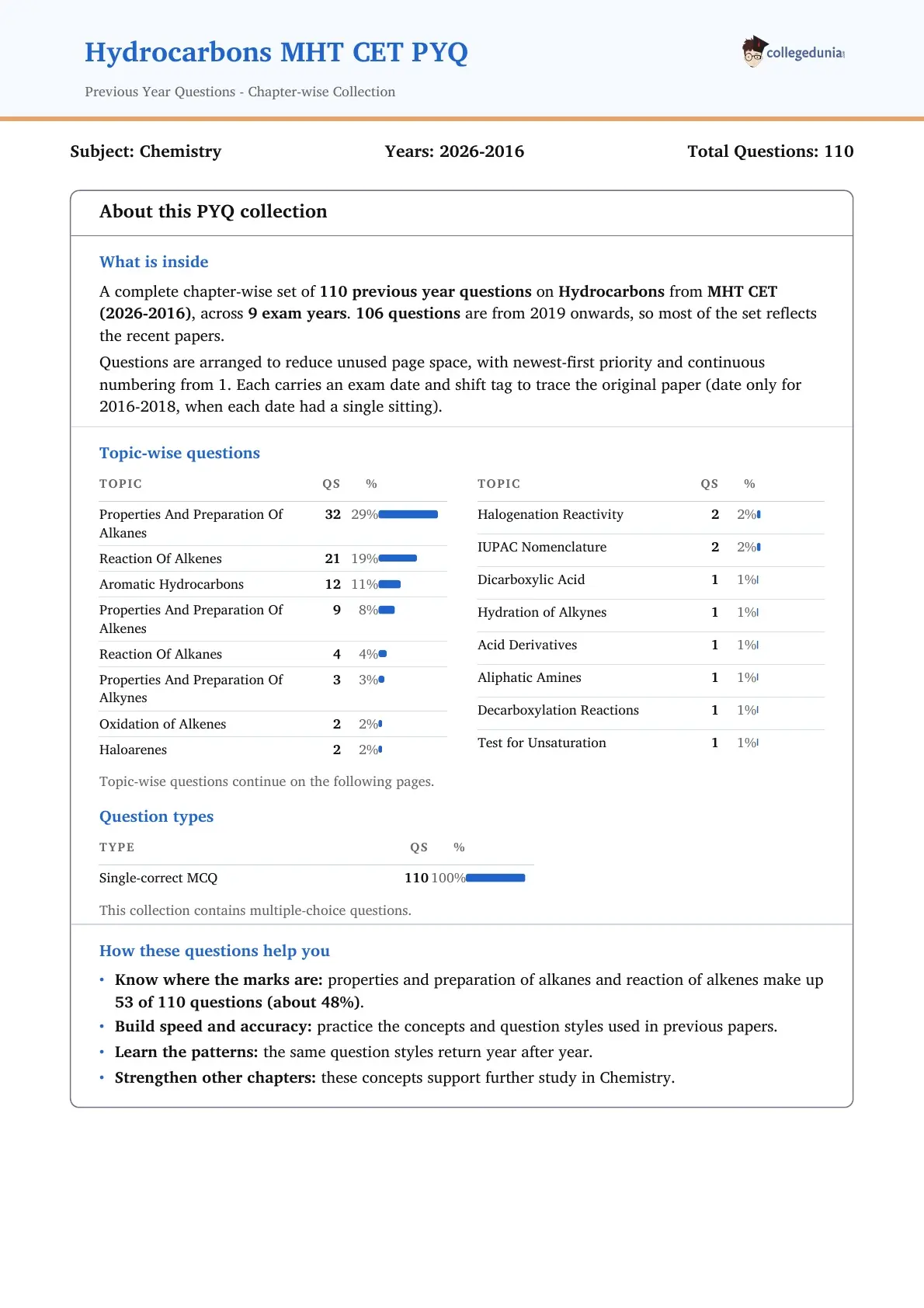
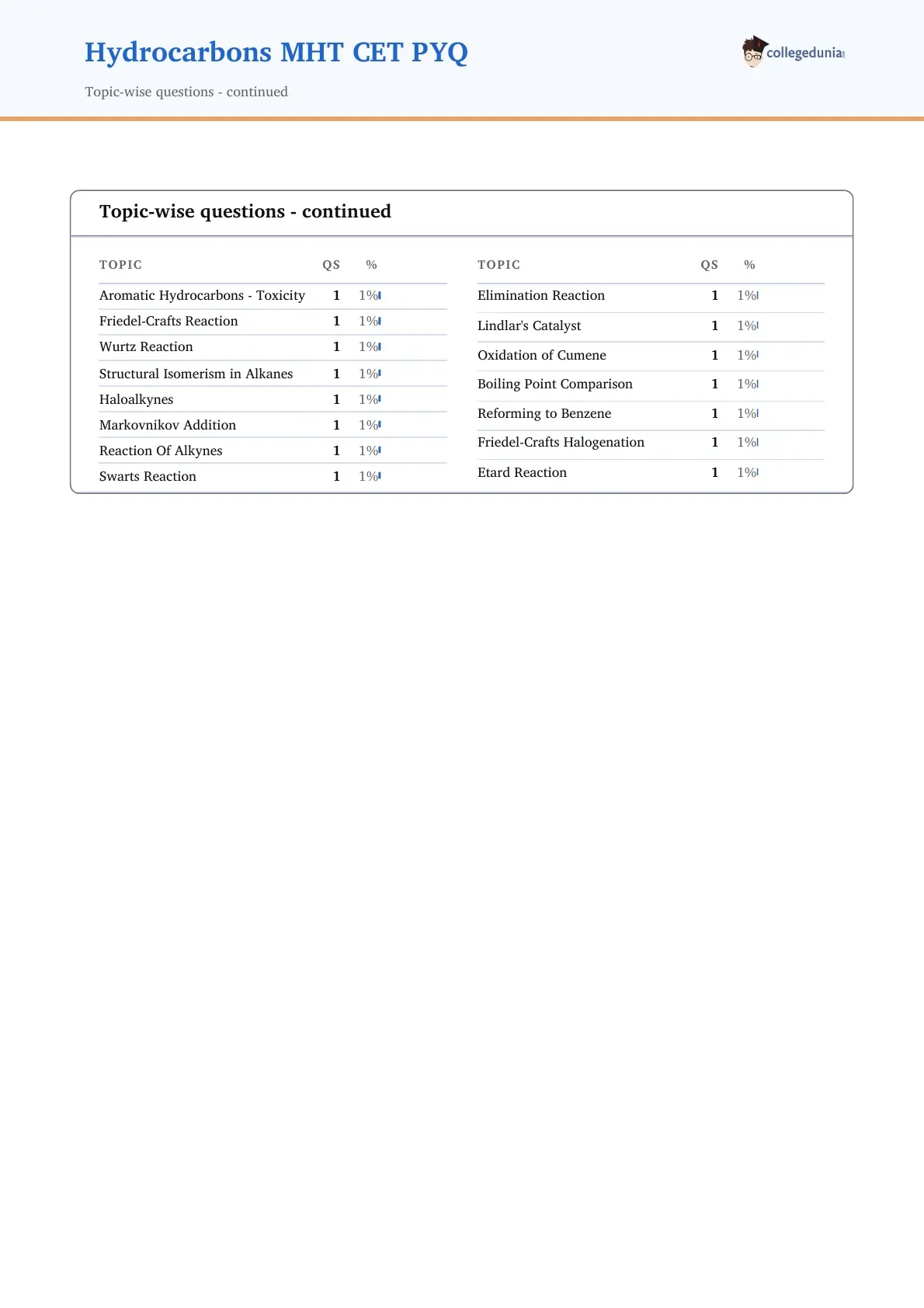
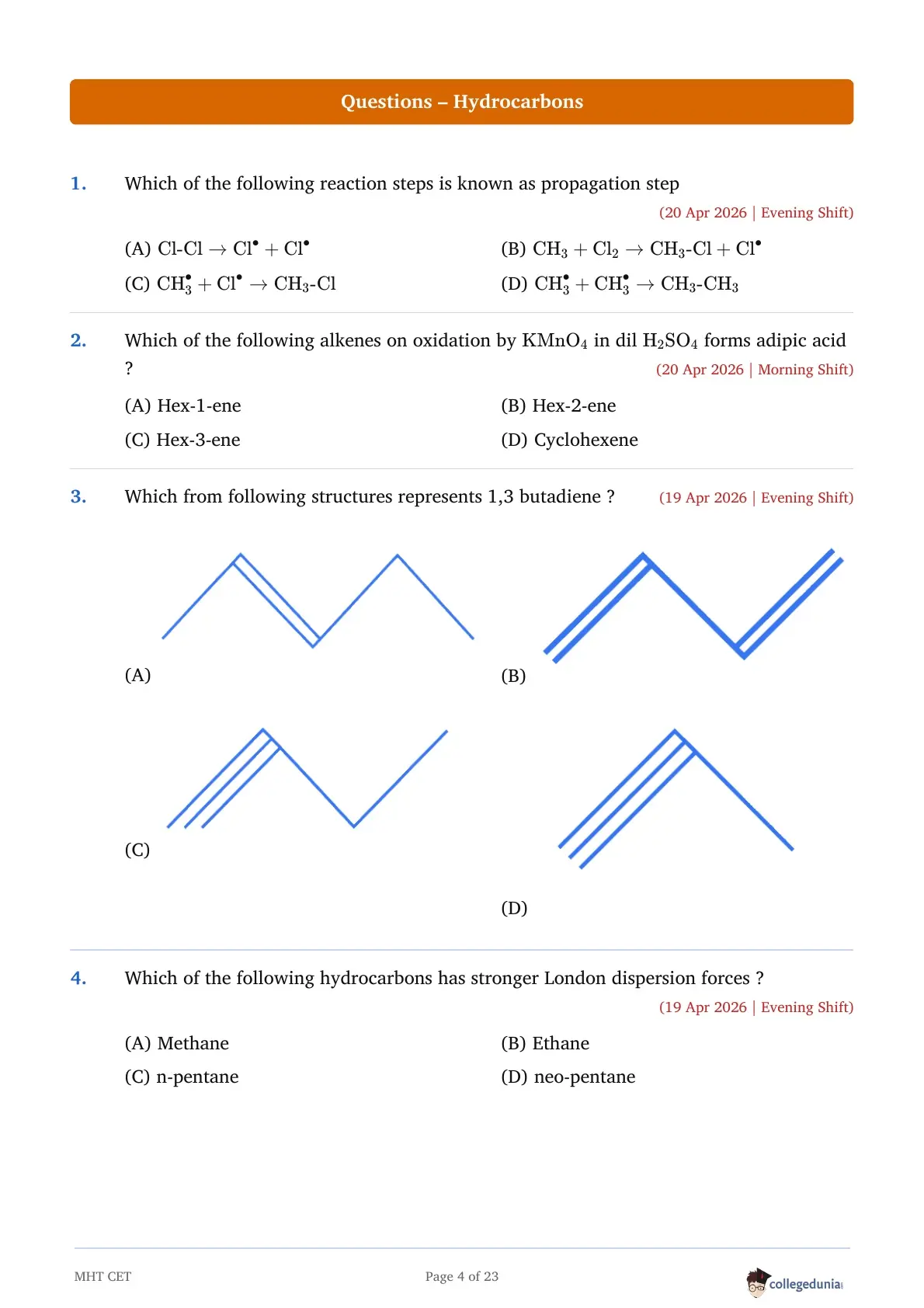
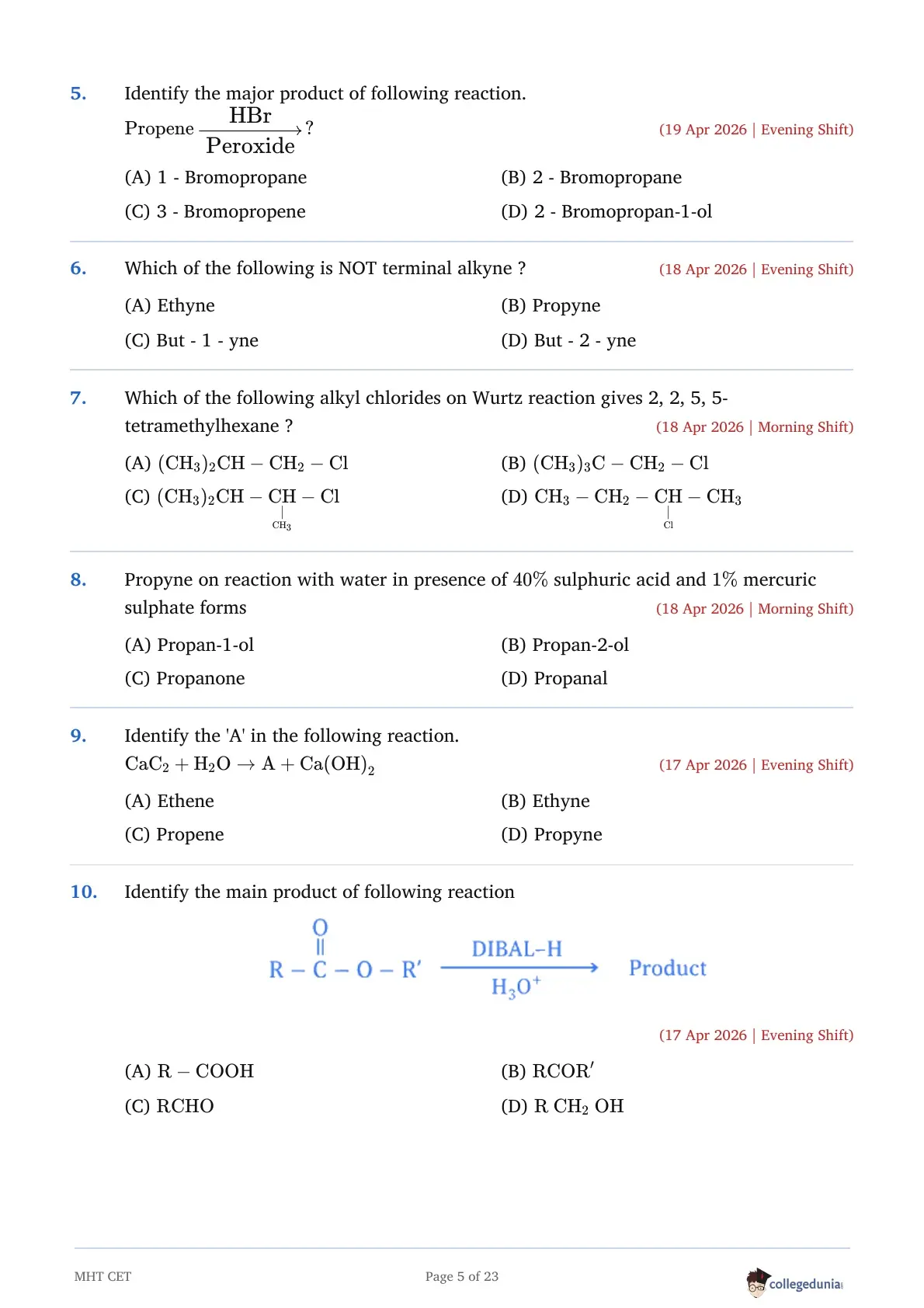

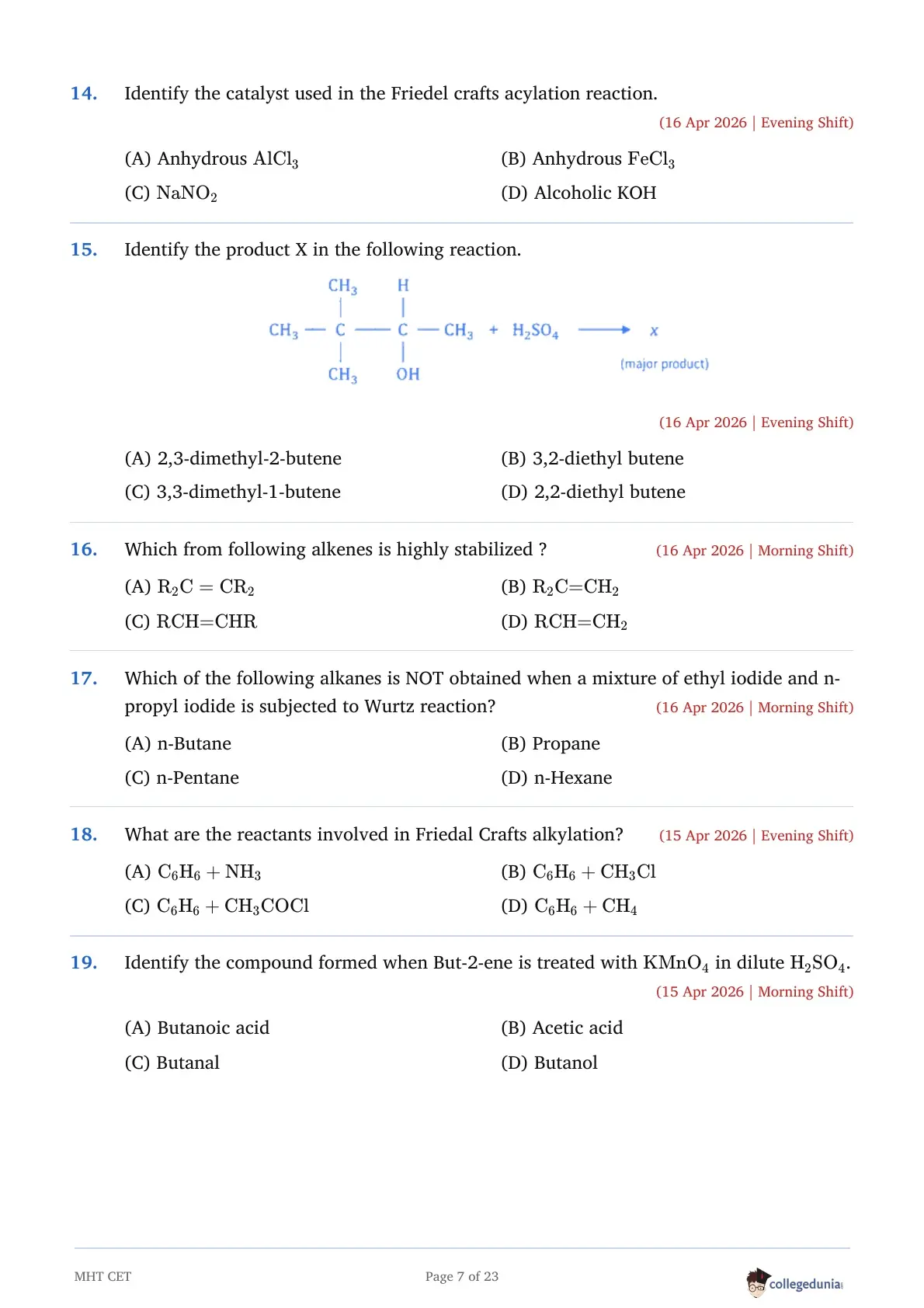
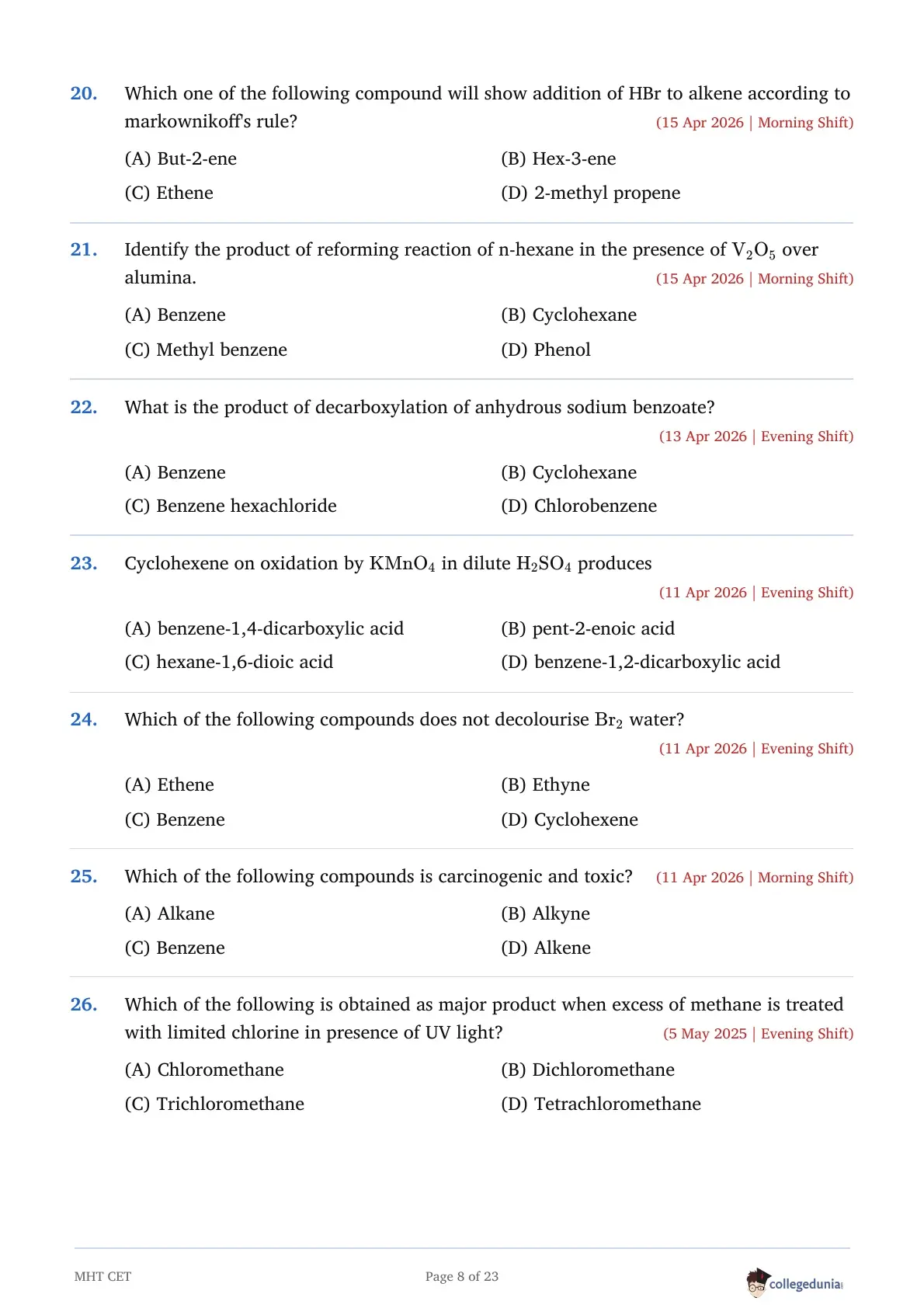
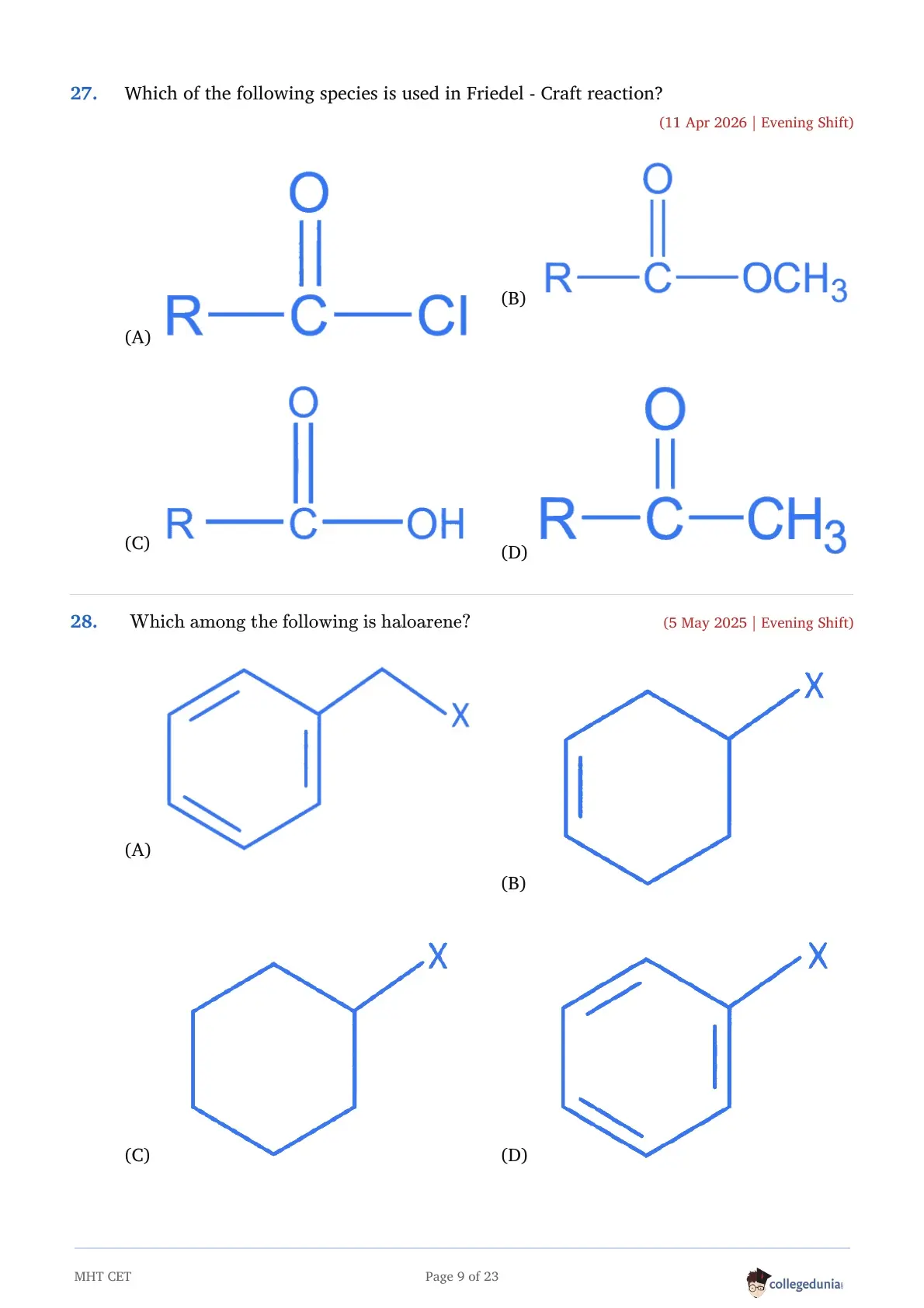


The PDF holds 110 questions from MHT CET 2026 to 2016, newest first, each with its exam date and shift. Options are as printed and answer keys are not included.
Hydrocarbons PYQ Statistics (2022-2026)
The table below shows the number of questions asked in MHT CET Hydrocarbons PYQs. Every shift has 50 Chemistry questions, and the last column is the number of questions asked divided by the shifts held, rounded to a whole number.
| Year | Questions Asked | Shifts Held | Typical Questions in One Shift |
|---|---|---|---|
| 2026 | 26 | 16 | About 2 out of 50 |
| 2025 | 25 | 17 | About 1 out of 50 |
| 2024 | 21 | 18 | About 1 out of 50 |
| 2023 | 14 | 12 | About 1 out of 50 |
| 2022 | 0 | 1 | Fewer than 1 out of 50 |
The 2018 to 2021 papers in the PDF add 23 more questions: 2021 had 11, 2020 had 3, 2019 had 6, 2018 had 3; the papers before 2018 add 1 from 2016.
MHT CET Hydrocarbons Important Questions: Topic-Wise Breakdown
The major types of questions asked from Hydrocarbons in MHT CET cover the following topics:
| Topic | Questions in the PDF | Share of the PDF |
|---|---|---|
| Properties And Preparation Of Alkanes | 32 | 29% |
| Reaction Of Alkenes | 21 | 19% |
| Aromatic Hydrocarbons | 12 | 11% |
| Properties And Preparation Of Alkenes | 9 | 8% |
| Reaction Of Alkanes | 4 | 4% |
| Properties And Preparation Of Alkynes | 3 | 3% |
| Oxidation of Alkenes | 2 | 2% |
| Haloarenes | 2 | 2% |
| Other topics tagged in the PDF | 25 | 23% |
Pair PYQs with Other Study Material for MHT CET 2027
Click on the link to practise problems and time management skills:
| Resource | Link |
|---|---|
| MHT CET Sample Paper | Check Here |
| MHT CET Mock Test | Check Here |
Question Style in MHT CET Hydrocarbons PYQs
Every question in this PDF is a single-correct MCQ. Most ask for the product of a reaction, a reagent, or an order of stability or reactivity.
| Question Style | What it Tests |
|---|---|
| Products of reactions | The products of the ozonolysis of propene, the product when propyne reacts with water in the presence of sulphuric acid and mercuric sulphate, and the product of the reaction of propene with HCl in the presence of a peroxide |
| Oxidation of alkenes | The product obtained when an alkene is reacted with cold, dilute alkaline potassium permanganate |
| Orders of stability and reactivity | The stability order of alkenes, and the order of reactivity of halogens towards alkanes |
| Named reactions and steps | The reaction step known as propagation, the reaction in which alkyl chlorides are heated with metal fluorides, and the product of decarboxylation of anhydrous sodium benzoate |
| Mole and mass calculations | The difference in molar masses of undecane and decane, and the number of moles of carbon and hydrogen atoms in n moles of a molecule |
How to Use the Hydrocarbons PYQ PDF for MHT CET
- Start with the 2025 and 2026 papers first, because they hold 51 of the 110 questions.
- Learn the products of ozonolysis, hydration and addition reactions with the Markovnikov and anti-Markovnikov rules.
- For stability orders of alkenes, count the alkyl groups on the double bond and compare hyperconjugation.
- Solve year-wise PYQs by timing yourself, as time management is crucial.
- Re-attempt only the questions you got wrong, and note which formula or step you missed.
Video: Hydrocarbons PYQs and MCQs
Source: PW MHT CET
Hydrocarbons PYQ for MHT CET Chemistry FAQs
Ques. How many questions come from Hydrocarbons every year?
Ans. In this PDF, the questions are 26 from 2026, 25 from 2025, 21 from 2024, 14 from 2023 and 11 from 2021 and the rest from earlier papers. In 2025 and 2026 together the chapter had 51 questions across 33 shifts, which is about 2 in a typical shift.
Ques. Which topics are asked most frequently in MHT CET Hydrocarbons?
Ans. Properties And Preparation Of Alkanes is the largest topic tag in the PDF with 32 of the 110 questions, about 29%.
Ques. What kind of questions are asked from Hydrocarbons?
Ans. Single-correct MCQs. Common ones ask for the major product of a reaction, a reagent, or an order of stability or reactivity.
Ques. What is the best way to practise Hydrocarbons PYQs?
Ans. First solve the 2025 and 2026 questions completely, then the older ones, and finally re-attempt the questions you got wrong.
Ques. Can I score full marks from Hydrocarbons?
Ans. In 2025 and 2026 together the chapter had 51 questions across 33 shifts. Learning the reactions of alkanes, alkenes and alkynes with their products is enough to secure it. Each Chemistry question in MHT CET is worth 1 mark.
Ques. Does the Hydrocarbons PYQ PDF include solutions?
Ans. No. The PDF contains the questions with their exam date and shift, without answer keys or solutions.



Comments