



Surface Tension is a Class 12 chapter in the Physics section of the MHT CET for candidates who are preparing for the PCM (Physics, Chemistry, and Mathematics).
The key topics covered in Surface Tension PYQs are:
- Surface energy and work done in forming drops
- Splitting and joining of drops
- Excess pressure in drops and soap bubbles
- Capillary rise
- Floating of a needle, disc or coin on water
Practising Surface Tension MHT CET PYQ helps candidates to understand question pattern, improve calculation speed, and identify concepts which were asked in previous exams.
Based on chapter-wise analysis of the MHT CET Physics paper, you can get less than 1 mark per paper by covering Surface Tension. The chapter recorded 28 questions across the 80 shifts in the data, and 7 of them came in the 2025 and 2026 papers, where it contributed about 0.4% per shift.
MHT CET Surface Tension Chapter: Question Count, Marks and Weightage:
| 0.35 Average questions per shift (2018-2026) | 7 Questions in the 2025 and 2026 papers (33 shifts) |
| 28 Questions in the PDF (2018-2025) | 0.7% Estimated Physics paper weightage (0.4% in 2025-2026) |
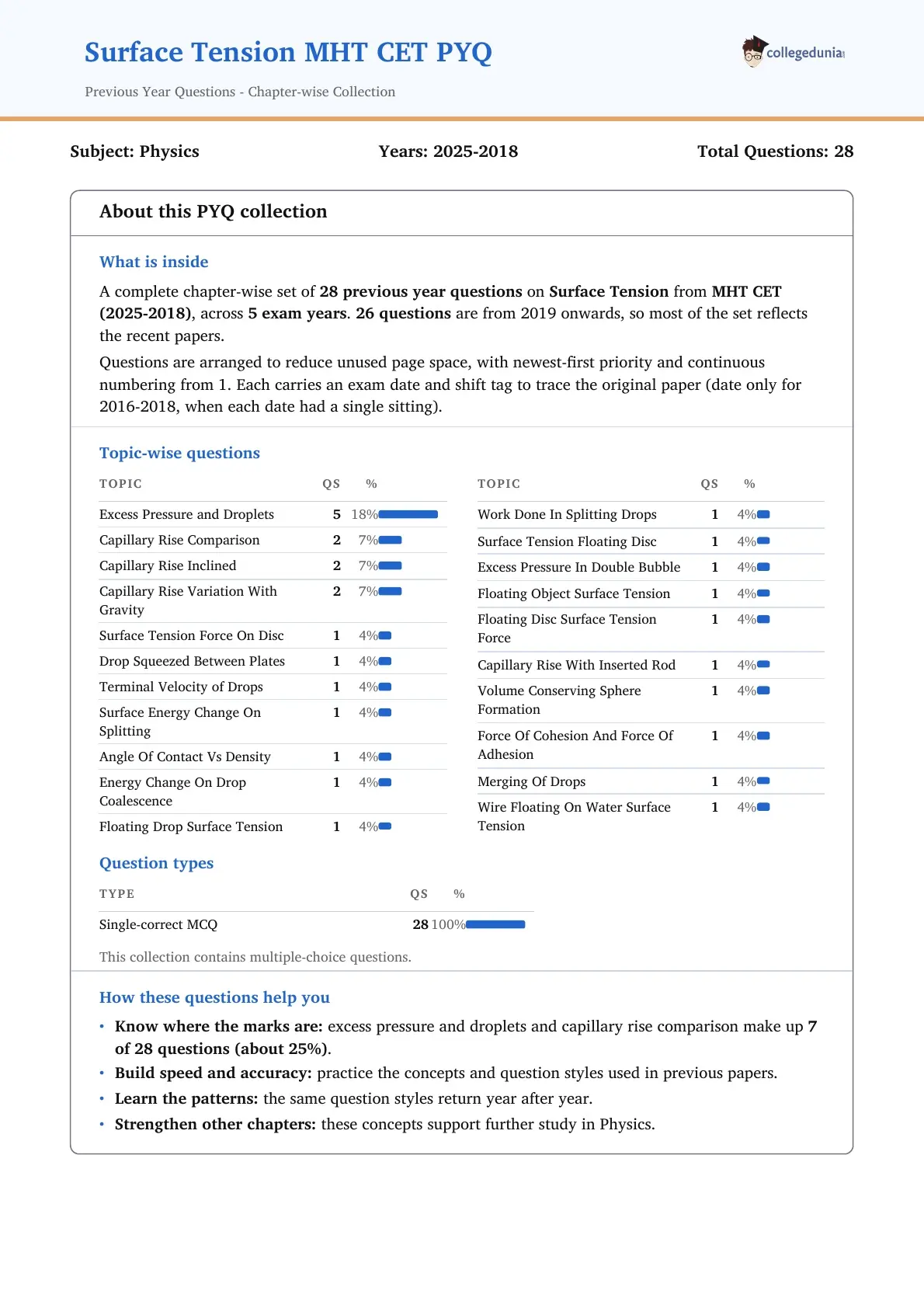
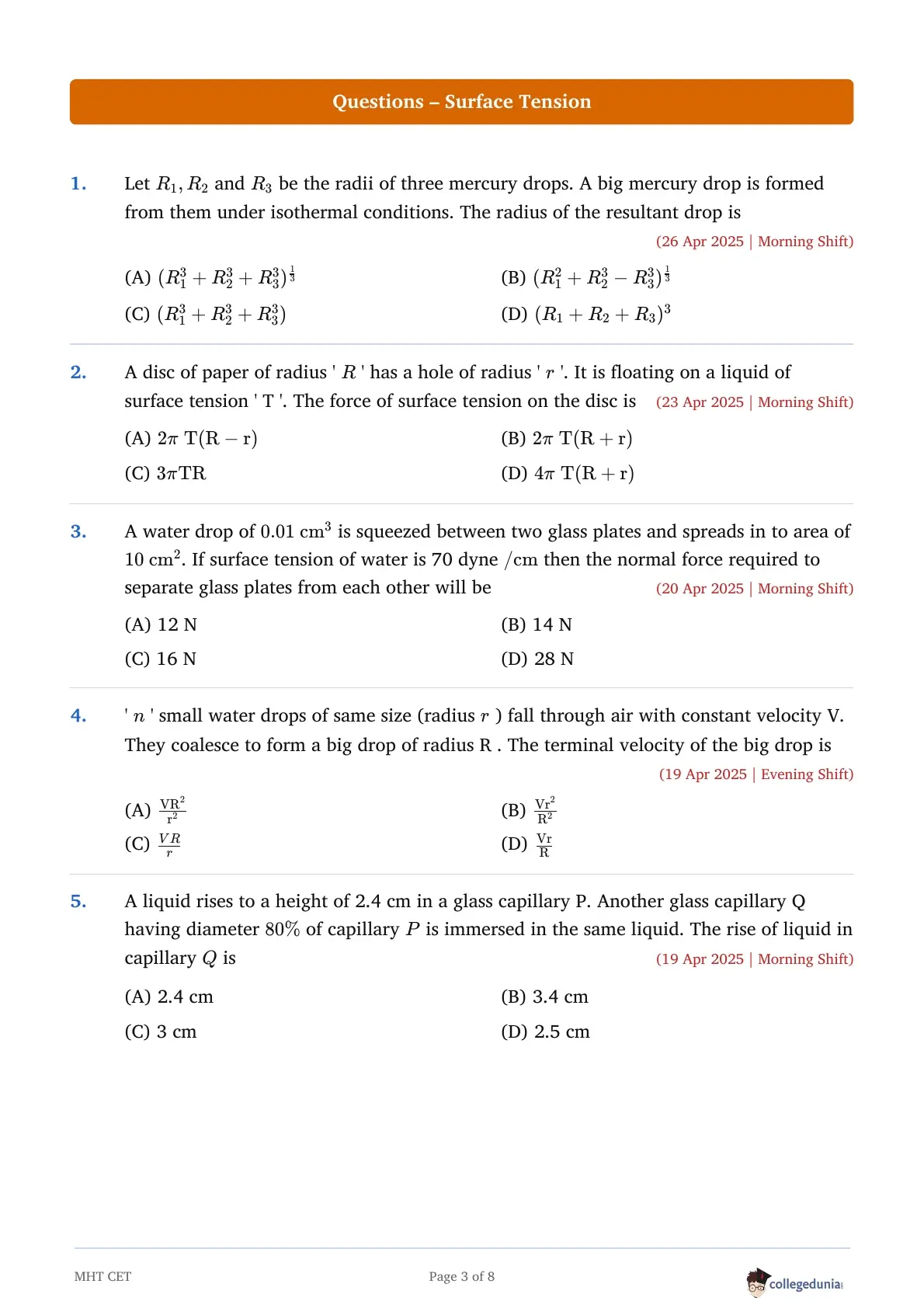
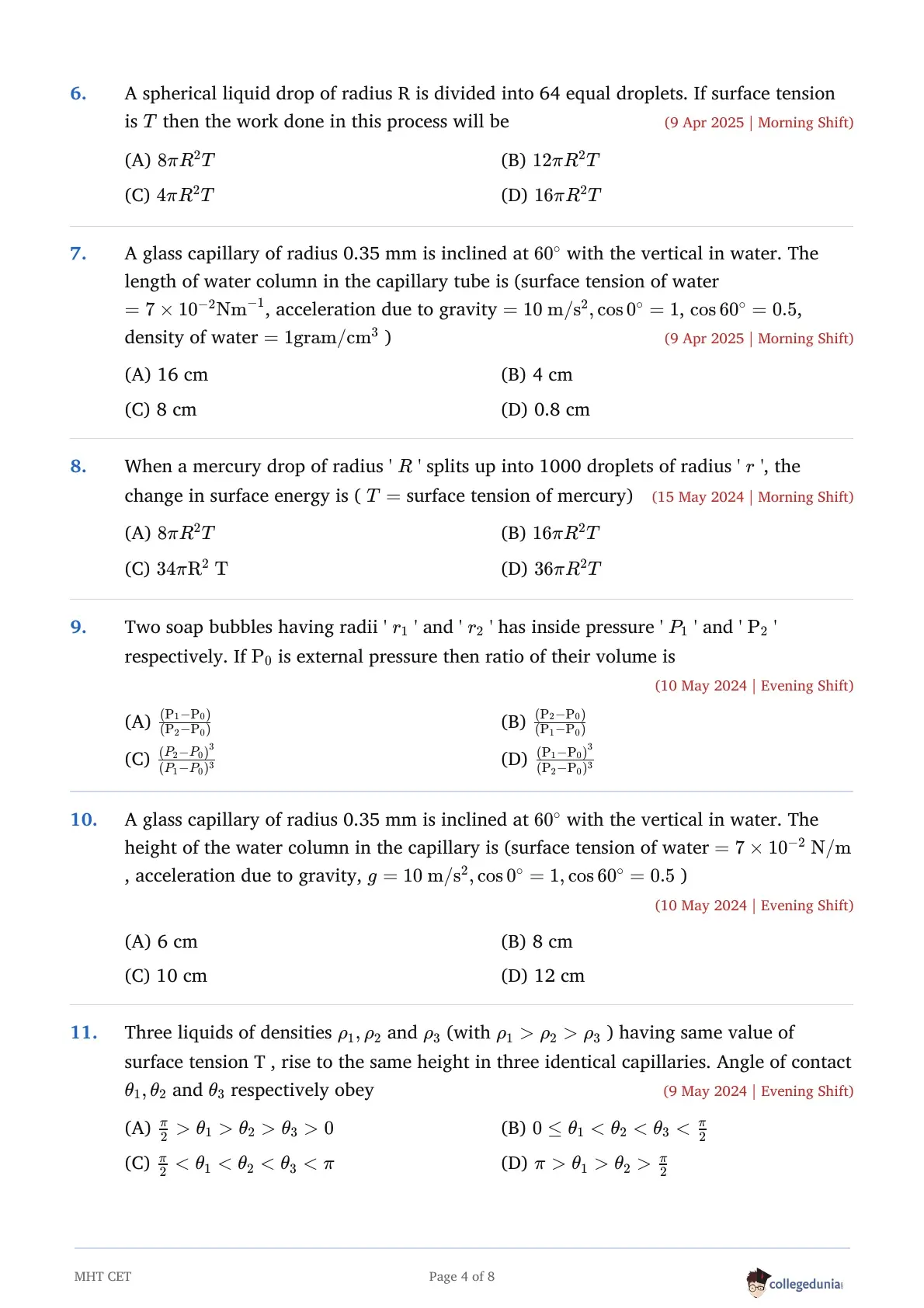
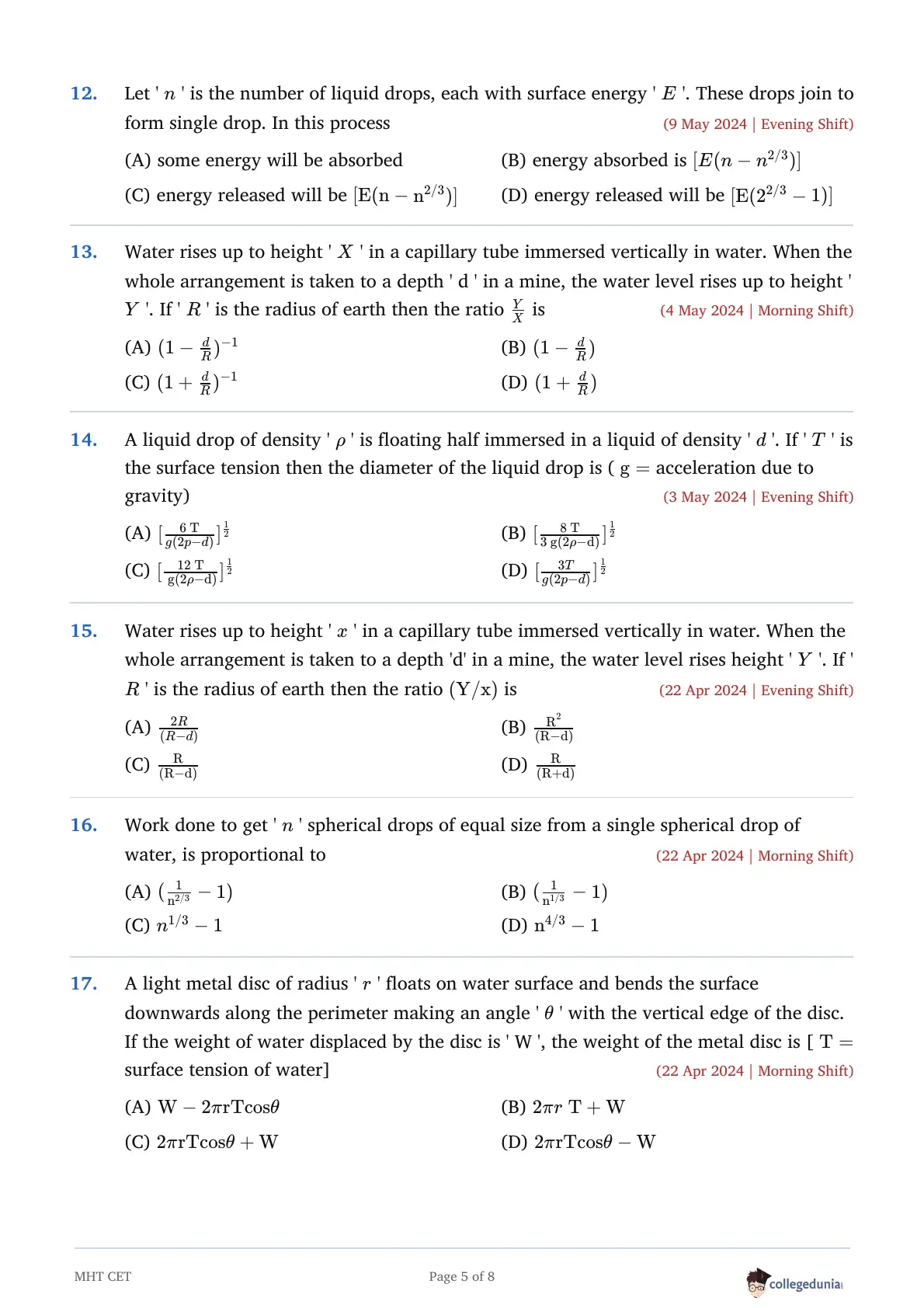
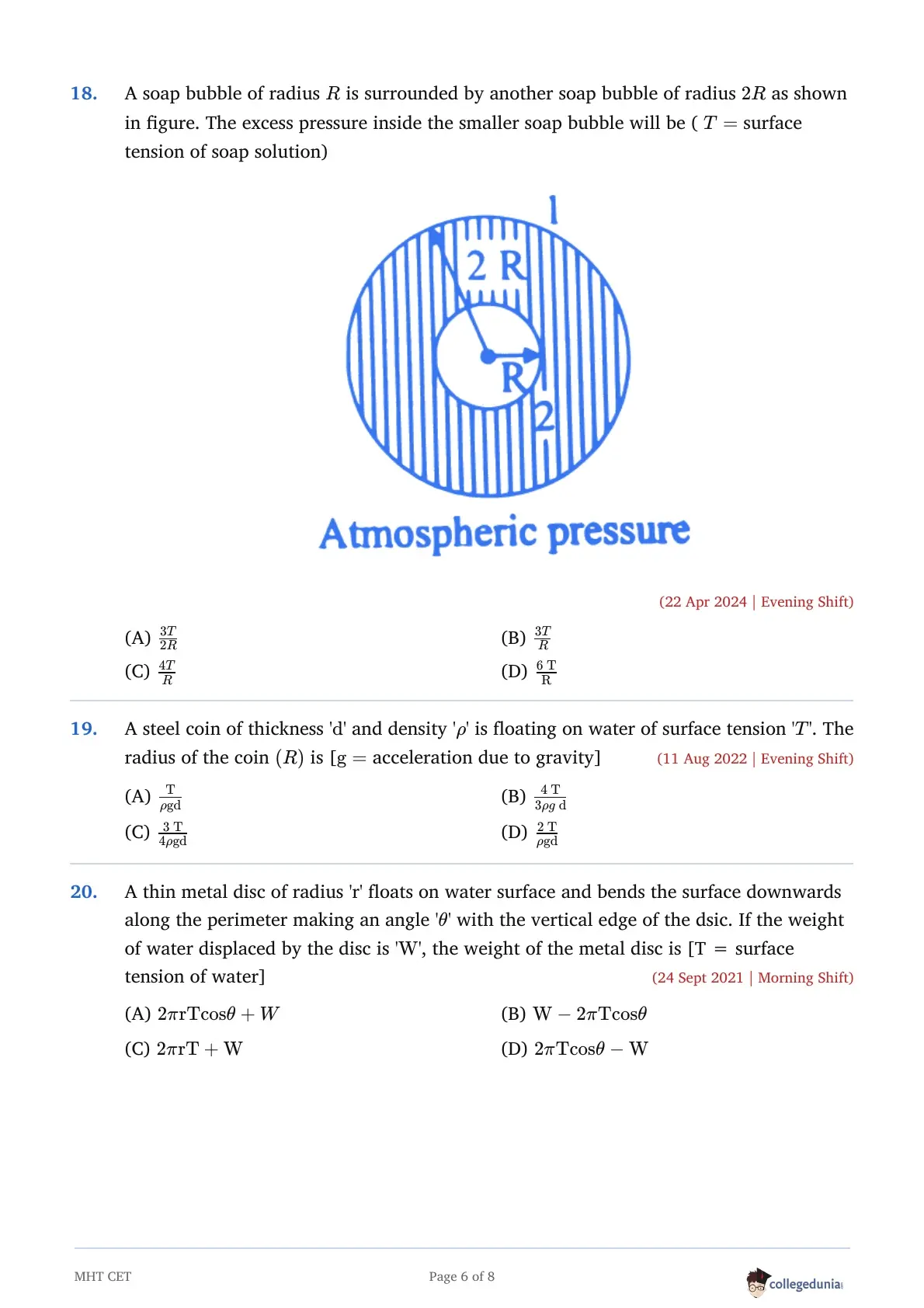
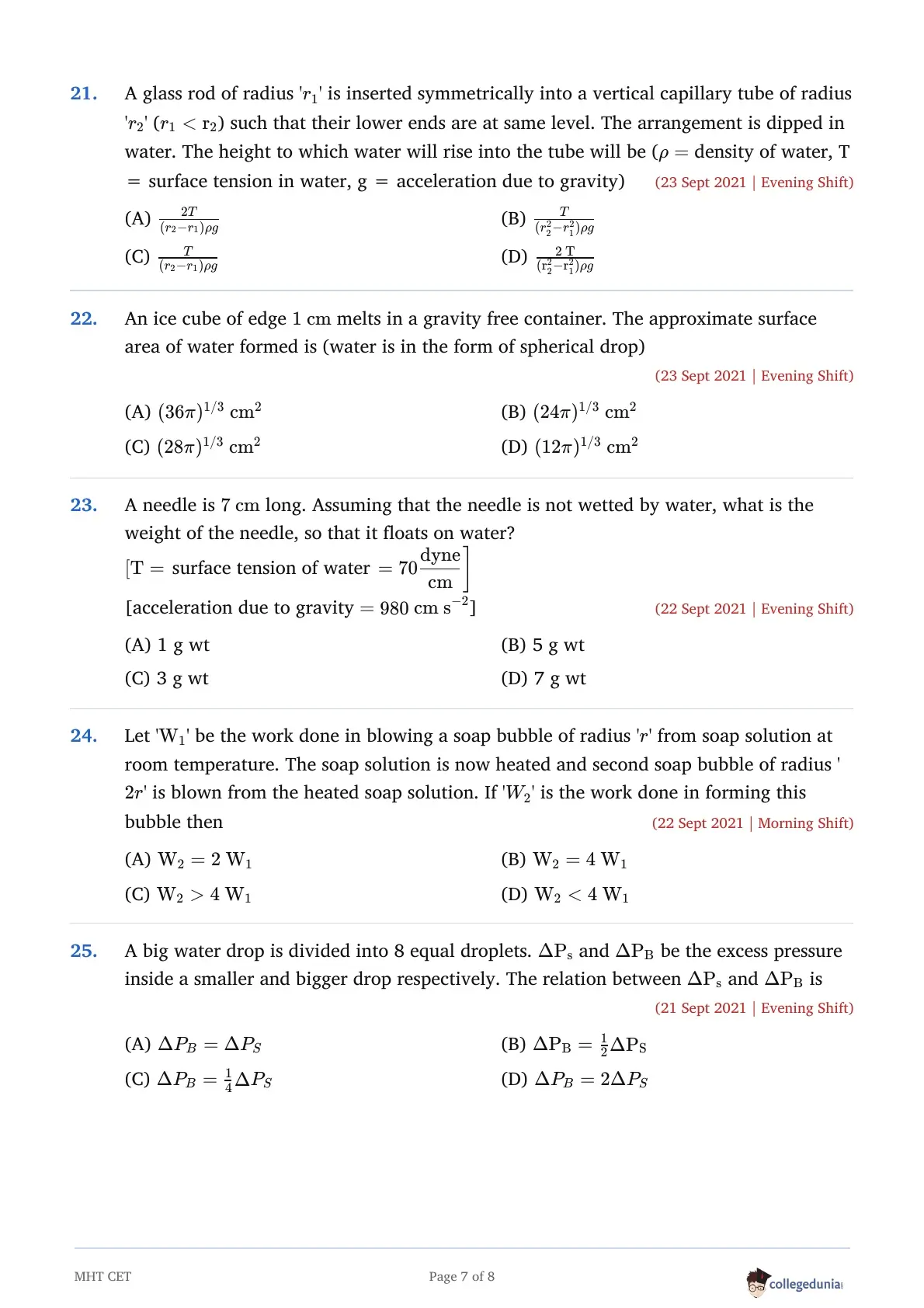
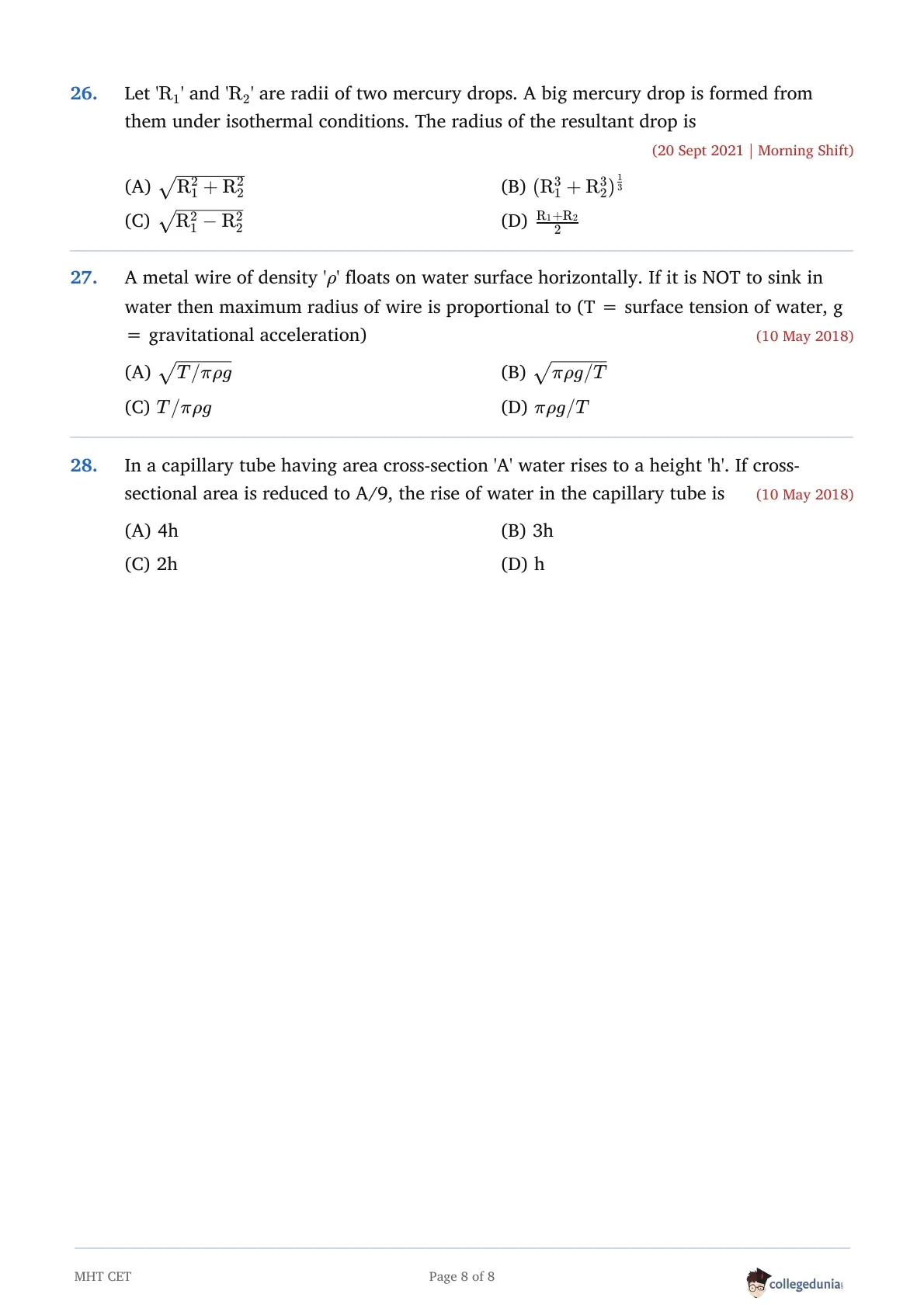
The PDF holds 28 questions from MHT CET 2025 to 2018, newest first, each with its exam date and shift. Options are as printed and answer keys are not included.
Surface Tension PYQ Statistics (2022-2026)
The table below shows the number of questions asked in MHT CET Surface Tension PYQs. Every shift has 50 Physics questions, so the last column is the average per shift divided by 50.
| Year | Total Questions (across shifts) | Shifts in the Data | Average per Shift | Weightage (out of 50 Physics Qs) |
|---|---|---|---|---|
| 2026 | 0 | 16 | 0.00 | 0.0% |
| 2025 | 7 | 17 | 0.41 | 0.8% |
| 2024 | 11 | 18 | 0.61 | 1.2% |
| 2023 | 0 | 12 | 0.00 | 0.0% |
| 2022 | 1 | 1 | 1.00 | 2.0% |
The 2018 to 2021 papers in the PDF add 9 more questions: 2021 had 7, 2020 had none, 2019 had none, 2018 had 2.
MHT CET Surface Tension Important Questions: Based on the Last 5 Years
The major types of questions asked from Surface Tension in MHT CET cover the following topics:
| Topic | Questions in the PDF | Questions in 2022-2026 | Average per Shift (2022-2026) |
|---|---|---|---|
| Capillary rise | 7 | 5 | 0.08 |
| Splitting, joining and surface energy of drops and bubbles | 14 | 10 | 0.16 |
| Floating of a needle, disc, coin or wire on water | 6 | 3 | 0.05 |
| Other surface tension questions | 1 | 1 | 0.02 |
Pair PYQs with Other Study Material for MHT CET 2027
Click on the link to practise problems and time management skills:
| Resource | Link |
|---|---|
| MHT CET Sample Paper | Check Here |
| MHT CET Mock Test | Check Here |
Question Style in MHT CET Surface Tension PYQs
Every question in this PDF is a single-correct MCQ. Most are numerical and use the surface energy of a drop or the capillary rise formula.
| Question Style | What it Tests |
|---|---|
| Splitting and joining drops | A mercury drop that splits into 1000 droplets, a spherical drop divided into 64 equal droplets, and three mercury drops joined into a big drop |
| Capillary rise | A liquid rising 2.4 cm in a capillary, a capillary of radius 0.35 mm inclined at 60° with the vertical, and a glass rod inserted into a capillary tube |
| Soap bubbles | Two soap bubbles of radii r₁ and r₂ with their inside pressures, a soap bubble surrounded by another bubble, and the work done in blowing a bubble |
| Floating bodies | A light metal disc of radius r floating on water, a steel coin of thickness t, a needle 7 cm long, and a wire that is not to sink |
| Water between plates | A water drop squeezed between two glass plates so that it spreads over a given area |
How to Use the Surface Tension PYQ PDF for MHT CET
- Start with the 2025 and 2026 papers first, because they hold 7 of the 28 questions.
- Learn that splitting a drop into n drops needs work W = 4πR²T(n^(1/3) - 1) and changes the radius by n^(1/3).
- For the floating questions, balance the weight against the vertical component of the surface tension force.
- Solve year-wise PYQs by timing yourself, as time management is crucial.
- Re-attempt only the questions you got wrong, and note which formula or step you missed.
Video: Surface Tension PYQs and MCQs
Source: Learn with Shukla
Surface Tension PYQ for MHT CET Physics FAQs
Ques. How many questions come from Surface Tension every year?
Ans. In this PDF, the questions are 7 from 2025, 11 from 2024, 1 from 2022, 7 from 2021 and 2 from 2018. In 2025 and 2026 together the chapter had 7 questions across 33 shifts, about 0.21 per shift.
Ques. Which topics are asked most frequently in MHT CET Surface Tension?
Ans. Splitting, joining and surface energy of drops and bubbles is the largest group with 14 of the 28 questions, about 50%.
Ques. What kind of questions are asked from Surface Tension?
Ans. Single-correct MCQs, mostly numerical. Common ones ask for the work done or the change in energy when a drop splits or joins, the capillary rise, or the condition for a disc or needle to float.
Ques. What is the best way to practise Surface Tension PYQs?
Ans. First solve the 2025 and 2026 questions completely, then the older ones, and finally re-attempt the questions you got wrong.
Ques. Can I score full marks from Surface Tension?
Ans. In 2025 and 2026 together the chapter had 7 questions across 33 shifts. Learning the surface energy, excess pressure and capillary rise formulas is enough to secure it. Each Physics question in MHT CET is worth 1 mark.
Ques. Does the Surface Tension PYQ PDF include solutions?
Ans. No. The PDF contains the questions with their exam date and shift, without answer keys or solutions.



Comments