



Education Content Expert
Alkyl Halides are a class of organic compounds containing a halogen atom (F, Cl, Br, or I) bonded to a hydrocarbon group (alkyl group). They are also known as Haloalkanes. They can be classified as Primary Alkyl Halides (1°), Secondary Alkyl Halides (2°), or Tertiary Alkyl Halides (3°) based on the number of carbon-halogen bonds and the degree of substitution on the carbon atom bonded to the halogen.
- Alkyl Halides are typically colorless, volatile liquids with low boiling points and high vapor pressures.
- They are immiscible with water but miscible with organic solvents.
- They can be prepared through various methods such as halogenation of alkanes, haloform reaction, and elimination reactions.
- They can also be obtained by treating alcohols or carboxylic acids with a halogenating agent.
- They are highly reactive compounds and participate in various reactions such as nucleophilic substitution reactions, elimination reactions, and addition reactions.
- Alkyl Halides are also commonly used as starting materials in the synthesis of other organic compounds.
| Table of Content |
Key Terms: Halides, Alkyl Halides, Haloalkanes, Fluorine, Atom, Halocarbons, Halogen, Alkane, Halogen Bond
What are Alkyl Halides?
[Click Here for Sample Questions]
Alkyl Halides, also known as Haloalkanes or Halogen Alkanes, are chemical substances that are frequently produced from alkanes that include one or maybe more halogens.
- Alkyl Halides can alternatively be thought of as a subset of the larger category of halocarbons.
- Halogen atoms are substituted for hydrogen atoms in an aliphatic hydrocarbon to produce alkyl halide, also known as haloalkanes.
- Alkali Metals, alkyl, solvents, and carboxylic acids are only a few examples of organic building blocks that can be used to make them.
- Alkyl halides typically have hydrogen atoms bonded to the sp3 hybridized carbon atom of alkyl groups.
- Alkyl Halide examples include Iodoethane, 2-chloropropane, 1-bromo-2-methylpropane.
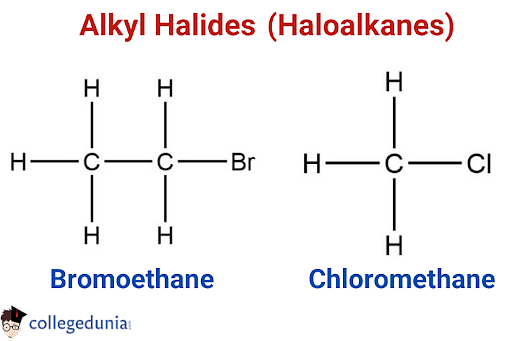
Alkyl Halides
Read More:
| Relevant Concepts | ||
|---|---|---|
| Physical Properties of Haloalkanes and Haloarenes | Halides | Classification of Haloalkanes and Haloarenes |
| Nature of C-X Bond in Haloarenes | Wurtz Reaction | Nomenclature of Amines |
Classification of Alkyl Halides
[Click Here for Previous Year Questions]
Alkyl Halides can be categorized according to a number of factors. They are listed below.
- Halogen Atom Count
- Arrangement of the Halogen Atom along Carbon Atom Sequence
Halogen Atom Count
In this, the categorization is mostly based on how many halogen atoms are present in the structure—either one, two, or even more. This category includes;
- Mono Haloalkane: CH3-CH2-X [Where X may be Cl, F, Br, or I.]
- Dihaloalkane: X-CH2-CH2-X [Where X can be Cl, F, Br, or I]
- Tri-haloalkane: X-CH2-CHX-CH2-X [Where X can be Cl, F, Br, or I]
Arrangement of Halogen Atom along Carbon Atom Sequence
Halogen atom's arrangement on the carbon atom sequence determines the categorization.
- Basic Alkyl Halide
- Secondary Alkyl Halide
- Tertiary Alkyl Halide
Basic Alkyl Halide
The carbon that is connected to the halogen family in these haloalkanes can only be joined to one other alkyl group. Whatever rigid group is tied to it doesn't matter. These are some instances of primary haloalkanes:
- CH3- CH2- Br
- CH3CH2- CH2- CL
Secondary Alkyl Halide
The two secondary alkyl groups, that could be same among different, are immediately connected to the carbon atom that is bound to the hydroxyl group in this sort of haloalkane.
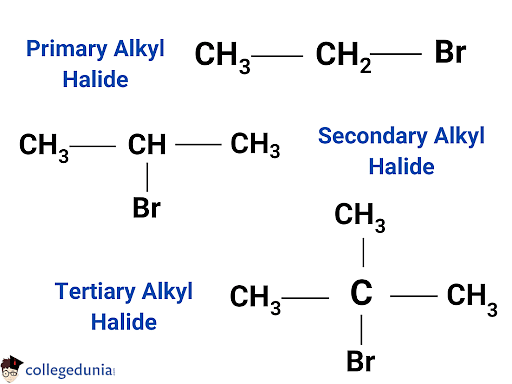
Primary, Secondary & Tertiary Alkyl Halides
Tertiary Alkyl Halide
The carbon atom that bears the halogen atom is intimately linked to three alkyl groups in this form of haloalkane. This alkyl group may include a combination of the same or distinct alkyls.
Alkyl Halides Properties
[Click Here for Sample Questions]
Alkyl Halides have no pigment when they are present in their purest form. However, as bromides and iodides are illuminated, they become coloured. Several volatile halogen substances smell properties.
Boiling and Melting Points
- At normal temperature, gases of methyl chloride, methyl bromide, ethyl chloride, and certain chlorofluoromethanes exist.
- Organic halogen chemicals have polar molecules, as is well known.
- As the size and quantity of electrons rise, the attraction becomes higher.
- Thus, the boiling points of chlorides, bromides and iodides are higher than that of the hydrocarbon with the same molecular mass.
- The boiling points of alkyl halides decrease in the order RI > RBr > RCl > RF.
Density
- Hydrocarbon compounds containing bromo, iodo, and poly-chloro groups are more heavy than water.
- The density rises as the amount of carbon atoms, halogen atoms, and halogen atomic mass increase.
Solubility
- Energy is needed to break the hydrogen bonds between the water molecules and overpower the attraction between both the haloalkane molecules in order for haloalkanes to dissolve in water.
- When new affinities between the water molecules and haloalkanes are generated, very little energy is dissipated.
- As a result, haloalkanes are less soluble in water.
- Haloalkanes will, however, dissolve more readily in an organic solvent than in water.
- The complicated interaction between haloalkanes and original molecules has the same potential as that which is broken by the special and molecular haloalkanes.
Alkyl Halides Chemical Reactions
[Click Here for Previous Year Questions]
Chemical Reactions are a vital part of chemistry and are used to understand the behavior and transformation of different chemicals and their molecules. Three of the most common types of chemical reactions in haloalkanes or Alkyl Halides are nucleophilic substitution reactions, elimination reactions, and reactions with metals.
Nucleophilic Substitution Reactions
Nucleophilic substitution reactions are a type of reaction in which a nucleophile (an electron-rich species) attacks a substrate (a molecule) and replaces a leaving group (an electron-deficient species).
- In haloalkanes, this type of reaction involves the substitution of a halogen (chlorine, bromine, or iodine) by a nucleophile.
- The reaction between haloalkanes and nucleophiles can be either SN1 or SN2 type.
- In the SN1 reaction, the substrate breaks apart, and the nucleophile reacts with the carbocation that is generated.
- In the SN2 reaction, the nucleophile directly replaces the leaving group.
Elimination Reactions
Elimination reactions in haloalkanes involve the removal of a molecule of a halogen and a hydrogen atom from the same carbon atom to form a double bond.
- The reaction can occur via an E1 or E2 mechanism. In the E1 mechanism, the substrate breaks apart, and the halogen and hydrogen are eliminated.
- In the E2 mechanism, the substrate is attacked by a strong base, which causes the halogen and hydrogen to be eliminated.
Reactions with Metals
Reactions between haloalkanes and metals involve the replacement of a halogen atom with a metal.
- This type of reaction is used in the synthesis of organometallic compounds, which have applications in various fields, including catalysis and pharmaceuticals.
- The reaction can occur by a direct exchange of the halogen for the metal, or by an intermediate species, such as a metal halide.
In conclusion, haloalkane chemical reactions are an important aspect of chemistry, and understanding their mechanisms and properties is essential for the development of various chemical processes and technologies.
Uses of Alkyl halides
[Click Here for Sample Questions]
The uses of the Alkyl halides are as follows:
- There are many halogen-containing organic molecules in nature, some of which have clinical applications.
- These groups of substances have uses in both daily life and industry.
- They serve as raw materials for the synthesis of a wide variety of organic compounds as well as solvents for generally nonpolar molecules.
- Typhoid fever can be effectively treated using the antibiotic chloramphenicol, which contains chlorine and is generated by soil microorganisms.
- Some totally fluorinated substances are being investigated as prospective surgical blood substitutes.
- In organic synthesis, they serve as counterparts to synthons.
- They were reviously employed as propellants and refrigerants.
- They are additionally utilized in fire extinguishers.
Preparation of Alkyl Halides
[Click Here for Previous Year Questions]
Alkyl Halides can be prepared using the following methods:
Preparation of Alkyl Halides from Alkenes
- Alkenes that have hydrogen halides added to them either behave according to Markovnikov's rule or demonstrate the Kharash effect.
- Markovnikov addition reactions are mostly electrophilic addition reactions of alkenes that adhere to this criterion.
Preparation of Alkyl Halides from Alcohols
- When halides are added to alcohols, it is simple to create alkyl halides.
- In this reaction, the halogen atom linked to the other chemical replaces the hydroxyl group of the alcohol.
- For primary, secondary, and tertiary alcohols, a catalyst is needed for this reaction, but not for tertiary alcohols.
Preparation of Alkyl Halides by Free Radical Halogenation
When alkanes are subjected to free radical chlorination or bromination, a complex combination of isomeric mono- and poly haloalkanes results.
Things to Remember
- Alkyl Halides are organic compounds containing a halogen atom (F, Cl, Br, I) bonded to an alkyl group.
- Alkyl halides can be classified based on the number of halogen atoms and the arrangement of the halogen along the carbon atom sequence.
- They are classified into three major types namely Primary Alkyl Halides, Secondary Alkyl Halides, or Tertiary Alkyl Halides.
- Alkyl halides are colorless, volatile liquids with low boiling points and high vapor pressures, immiscible with water but miscible with organic solvents.
- They can be prepared through halogenation of alkanes, haloform reaction, elimination reactions.
- Alkyl halides can also be prepared by treating alcohols or carboxylic acids with a halogenating agent.
- They are highly reactive and participate in nucleophilic substitution, elimination, and addition reactions.
- Alkyl halides are commonly used as raw materials in the synthesis of other organic compounds.
Check More:
Previous Year Questions
- The order of reactivity of various alkyl halides towards nucleophilic…
- When alkyl halides are heated with dry… (AIIMS - 1994)
- The ease of dehydrohalogenation of alkyl halide with… (WBJEE - 2011)
- Tertiary alkyl halide cannot be used in the Williamsons…
- Boiling points of the hydrogen halides…
- Which of the following hydrogen halides is most basic… (AIIMS - 2001)
- Zerevitinov’s determination of active hydrogen in a… (NEET - 1994)
- Which of the following is an optically active compound… (NEET - 1989)
- Following is the substitution reaction in which… (KCET - 2011)
- What are the starting materials to get 2-methylpropene… (KEAM)
Sample Questions
Ques. Why are Haloalkanes so poorly soluble in water? (2 Marks)
Ans. Haloalkanes are only marginally soluble in water because it takes energy to break the hydrogen bonds between water molecules and to overcome the attraction between the haloalkane molecules. On the other hand, because the new attractions between the haloalkane and the water molecules are weaker than the initial hydrogen bonds in water, they dissipate less energy.
Ques. Why do Aryl Halides behave differently from Alkyl Halides in nucleophilic substitution reactions? (5 Marks)
Ans. Aryl Halides are less reactive in nucleophilic substitution processes for the reasons listed below. Aryl halides, also known as aryl halogens, are a class of organic compounds that contain a halogen atom bonded to an aromatic ring. They differ from alkyl halides in their chemical properties and reactivity due to the nature of the aromatic ring.
- Resonance Stabilization: The aromatic ring in aryl halides is stabilized by resonance, which makes the ring more stable and less reactive than alkyl halides.
- Electron-Withdrawing Groups: Aryl halides have electron-withdrawing groups, such as nitro or carbonyl groups, attached to the ring which decrease the reactivity of the ring
- Steric Hindrance: The large size of the aryl ring can cause steric hindrance, making it harder for nucleophiles to attack the ring.
- The benzene ring of haloarenes is in resonance with the lone pair of electrons on the halogen. As a result, the partial double bond character of the C-Cl bond is added, strengthening the link.
- They are hence less reactive in nucleophilic substitution processes.
- In haloarenes, the carbon atom that is connected to the halogen is sp2 hybridized. Sp2 hybridized carbon is more electronegative than sp3 hybridized carbon.
- The C-CI link in haloarenes is shorter than the C-Cl bond in haloalkanes because the sp2-hybridized carbon can hold the electron pair of the C-X bond more tightly.
Ques. In the case of Alkyl Halides, elimination reactions, particularly B-elimination, are just as frequent as nucleophilic substitution reactions. Name the reagents utilized in each scenario. (5 Marks)
Ans. Alkynes can undergo both nucleophilic substitution and elimination (beta-elimination) reactions However, a particular product can be produced with the right reagent selection and reaction circumstances. Most of the time, strong, larger bases and high temperatures work well for the elimination reaction. On the contrary hand, at cooler temperatures, the substitution reaction works best for weaker and smaller bases.
- Alkyl halides, also known as haloalkanes, can undergo both elimination and substitution reactions.
- Elimination reactions, also known as B-elimination, involve the removal of a leaving group and a hydrogen atom from adjacent carbons in the alkyl halide to form a double bond.
- Common reagents used for B-elimination reactions of alkyl halides include strong bases such as sodium hydroxide (NaOH), potassium hydroxide (KOH), and lithium hydroxide (LiOH).
- Nucleophilic substitution reactions involve the replacement of a halide leaving group with a nucleophile.
- Common reagents used for nucleophilic substitution reactions of alkyl halides include strong nucleophiles such as hydroxide ions (OH-), cyanide ions (CN-), and azide ions, as well as nucleophilic catalysts such as water, alcohols, and ammonia.
- The reaction conditions, such as temperature and solvent, also play a vital role in determining the outcome of the reaction, whether it would be an elimination or substitution reaction.
Ques. Why do Iodoforms have noticeable antibacterial effects? (2 Marks)
Ans. Iodine, which is created when iodoform (CHI3) comes into touch with skin, is responsible for the substance's antibacterial properties. Iodoform releases I2 when it comes into contact with skin. The liberation of I2, not iodoform itself, is responsible for the antibacterial effects of iodine.
Ques. Find the A and B products of the following reaction. (5 Marks)
A + B = CH3-CH2-CH=CH-CH3 + HCI
Ans. 2-Chloro-pentane and 3-Chloro-pentane are the end products produced. When an alkene reacts with hydrogen halide, both sides of the double bond gain hydrogen and halide. This process is known as hydrohalogenation.
- The procedure yields 2-chloro-pentane and 3-chloro-pentane.
- These substances are produced from the first product by the chlorine atom joining the second carbon atom and the hydrogen atom joining the third carbon atom.
- In the second product, hydrogen is transferred to the second carbon atom while the chlorine atom is transported to the third carbon atom.
Ques. Why can't Aryl Halides be made by reacting phenol with HCl while having ZnCl2 around? (3 Marks)
Ans. A carbocation is created during the formation of an alkyl halide, which combines with HCl to produce an alkyl halide.
However, phenyl carbocation production is required for the aryl halide to react with HCl in the presence of ZnCl2, which is not conceivable because it is a highly unstable structure that never exists in its free state. No aryl halide is produced as a result.
Ques. Which Alcohol is best converted to Haloalkane using thionyl chloride? (2 marks)
Ans. Thionyl chloride is preferred because all of the byproducts created during the conversion of alcohol to haloalkane are gasses that escape into the atmosphere.
- Thionyl chloride (SOCl2) is a commonly used reagent for converting alcohols to haloalkanes, also known as alkyl chlorides.
- The best alcohol to convert to a haloalkane using thionyl chloride is a primary alcohol.
- Primary alcohols react with thionyl chloride to form alkyl chlorides through a process known as an "SN1 reaction".
- Secondary alcohols can also be converted to haloalkanes using thionyl chloride, but the reaction is typically slower and less efficient compared to primary alcohols.
- Tertiary alcohols do not react with thionyl chloride, as they lack a hydrogen atom on the carbon atom adjacent to the hydroxyl group, which is needed for the reaction to proceed.
- The reaction of thionyl chloride with primary alcohols is an exothermic reaction, so it should be carried out in a well-ventilated area and with appropriate safety measures.
Ques. By interacting with HCl, phenol cannot be transformed into chlorobenzene. (5 marks)
Ans. Due to resonance, the carbon-oxygen bond in phenol has the characteristics of a partial double bond and is more difficult to break than a single bond. As a result, it cannot be changed into chlorobenzene by HCl reaction.
- Phenol is a weak acid and HCl is a strong acid.
- When phenol and HCl interact, the HCl protonated the phenol, creating an phenoxide ion.
- Chlorination of phenol requires a strong electrophile, such as chlorine gas or a chlorinating agent, to attack the aromatic ring and replace a hydrogen atom with a chlorine atom.
- The protonated form of phenol, the phenoxide ion, is not reactive enough to undergo chlorination.
- Therefore, interacting with HCl alone will not result in the formation of chlorobenzene from phenol.
Ques. How to make Aryl Halides more reactive?(5 Marks)
Ans. To make aryl halides more reactive, the following methods can be used:
- Electron-Donating Groups: By attaching electron-donating groups, such as methoxy or amino groups, to the ring, the reactivity of the ring can be increased.
- Activation: Using activating reagents such as Lewis acids can help to activate the ring and increase its reactivity.
- Deactivating Groups: If the aryl halide is bonded with an electron-withdrawing group like nitro group, deactivating it can increase reactivity.
Ques. Which of the two forms of Dibromobenzene has a greater melting point and why? (5 Marks)
Ans. Dibromobenzene can exist in two forms namely para-dibromobenzene and meta-dibromobenzene.
- The form of dibromobenzene that has a greater melting point is para-dibromobenzene.
- This is because the para-dibromobenzene molecules have a greater degree of symmetry, leading to stronger intermolecular forces between them. These stronger forces result in a higher melting point.
- Additionally, para-dibromobenzene molecules also have a greater degree of planarity, which also contributes to the stronger intermolecular forces.
- In contrast, meta-dibromobenzene molecules have a lower degree of symmetry and planarity, leading to weaker intermolecular forces and a lower melting point.
- P-dibromobenzene has a greater melting point than the other two chemicals. This is because p-symmetry dibromobenzene makes it easier for the molecule to fit into the crystal lattice. As a result, the molecules' bonds must be broken at a greater temperature, which raises the melting point.
For Latest Updates on Upcoming Board Exams, Click Here: https://t.me/class_10_12_board_updates
Check-Out:



Comments