



Content Writer
Amide is a nitrogen-containing compound that may be classified into two groups: ammonia and amines. When an acid's hydroxyl group (OH) is substituted by an amino group, the result is a molecule that is neutral or very weakly acidic. Carboxamides (R′CONR2), which are generated from carboxylic acids (R′COOH), is the most significant category. Sulfonamides (RSO2NR2) are structurally similar to sulfonic acids (RSO3H). Ionic amides, also known as saltlike amides, are highly alkaline chemicals created by combining ammonia, an amine, or a covalent amide with a reactive metal like sodium. CO-NH is the amide formula or amide group formula.
| Table of Content |
Key Terms: Formamide, amide, ammonia, Organic Compound, Inorganic Compound, nomenclature, amines, covalent bond, hydrogen bond
Covalent Amides
[Click Here for Sample Questions]
Covalent amides made from ammonia are solids, except formamide, which is a liquid; those with less than five carbon atoms are water-soluble. They are both organic and inorganic solvents that are nonconductors of electricity. Even low-molecular-weight covalent amides have high boiling points.
Although polyamides (amides linked together to form large molecules called polymers) are abundant in biological systems, simple covalent amides have no practical natural sources. The most common way to make simple amides is to react acids or acid halides with ammonia or amines. They can also be made when nitriles react with water.
Covalent amides are changed to acids and amines by hydrolysis (a chemical reaction with water); this process is normally sluggish unless it is catalysed by a strong acid, an alkali, or an enzyme. Nitriles can be made by dehydrating amides. Amides are difficult to oxidise or reduce, but in the presence of a catalyst, hydrogenation (the addition of hydrogen at high temperatures and pressures) may convert most carboxylic acid amides to amines.
A potent reducing agent, lithium aluminium hydride, transforms amides into amines. Imides are formed by reacting amides with acid chlorides or anhydrides to produce compounds with two carbonyl (CO) groups attached to the same nitrogen atom.
Acetamide, also known as ethanamide (CH3CONH2), and dimethylformamide HCON(CH3)2 are economically important amides that are utilised as solvents, sulfa medicines, and nylons. Urea, also known as carbamide [CO(NH2)2, is a crystalline molecule that is formed as a byproduct of protein synthesis and excreted by animals in their urine. It's produced in enormous amounts from ammonia and carbon dioxide for use in fertilisers, animal feed, and the manufacture of urea-formaldehyde resins, which are used to make plastics.
Read More:
| Class 12 Chemistry Related Concepts | ||
|---|---|---|
| Etard reaction | Williamson Ether Synthesis | Electrophilic Aromatic Substitution |
| Ester Hydrolysis | Reimer Tiemann Reaction | Esterification |
Amide Structure
[Click Here for Sample Questions]
To remember the structure of an amide, all you need to remember is that an amide compound must have a nitrogen atom.
- The carbonyl group is made up of two carbon atoms that are doubly linked to an oxygen atom.
- The amine group, in which a nitrogen atom shares a single bond with R groups, is the second. R groups can be thought of as substituents for other atoms or molecules in a structure.
- Finally, there is a single bond, which is also an amide's defining functional group.
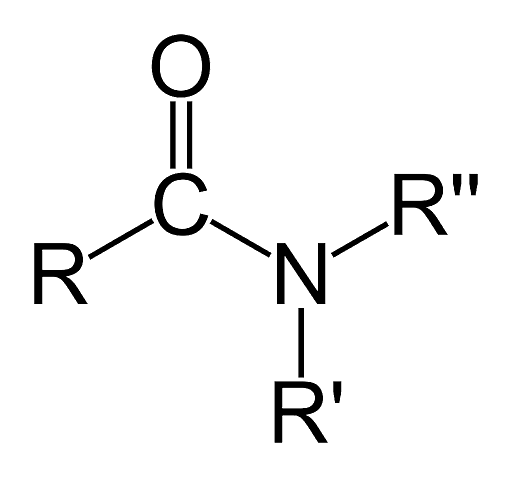
Amide Structure
Amide Nomenclature
[Click Here for Sample Questions]
In conventional nomenclature, the prefix "amide" is appended to the stem of the parent acid's name. Acetamide is an amide formed from acetic acid, for example (CH3CONH2). Even though ethanamide is recommended by the IUPAC, this and other formal names are rarely used. In the name of an amide made from a primary or secondary amine, the nitrogen substituents appear first. CO-NH is the amide formula, sometimes known as the acid amide formula.
The amide generated from dimethylamine and acetic acid is N, N-dimethylacetamide (CH3CONMe2, where Me = CH3). Even the term dimethylacetamide is frequently abbreviated. Lactams are cyclic amides that can be classified as secondary or tertiary.
Production of Amide
[Click Here for Sample Questions]
- Amides are carbonyl group molecules having nitrogen atoms linked to the carbon atom. As with amines, several naming criteria apply to amides, but they all include the class-specific suffix –amide:
- Amidation is the reaction of carboxylic acids with amines or ammonia to form amides. When a water molecule is removed from the process, the amide is created from the remaining fragments of carboxylic acid and amine:
- A physiologically important process is the formation of amides from amines and carboxylic acids. Through this mechanism, amino acids (molecules with both amine and carboxylic acid substituents) bond together in a polymer to form proteins.

Production of Amide
Types of Amides
[Click Here for Sample Questions]
When visiting an amide, there are a few things you should know about nomenclature, whether it's a name or a structure. Primary amine, secondary amine, and tertiary amine are the three categories of amines based on their names. The differences are categorized according to the location of the nitrogen atom about the carbon atom in the chain of a molecule. When identifying a primary amide, use 'ic acid' or 'oic acid' at the end, followed by an 'amide'.
To illustrate that nitrogen is related to an alkyl group, the Secondary amide is termed by integrating an N. A hydrocarbon chain with hydrogen and carbon atoms is known as an alkyl group.
Chemical Properties of Amides
[Click Here for Sample Questions]
- The presence of a lone pair on the nitrogen causes resonance in the amide group.
- Amides have a planner constraint because of the incomplete double bond.
- Amides are amphoteric, meaning they can function as both an acid and a base.
- Amides engage in hydrogen bonding due to the presence of a high electronegative element (oxygen) in the amide group.
- Amides go through several chemical reactions. Hofmann rearrangement, amide reduction, and Vilsmeier- Haack reactions are examples of chemical reactions.
- When amides are heated with water, acids, or alkalies, a hydrolysis process occurs, resulting in carboxylic acids and free ammonia as a product.
- Dehydration- When heated with a dehydrating agent such as phosphorus pentoxide (P2O5), phosphorus trichloride (POCl3), or sulfonyl dichloride (SOCl2), amides lose a molecule of water and become nitriles (cyanides).
Basicity
[Click Here for Sample Questions]
In comparison to amines, amides are fairly weak bases. The conjugate acid of an amine has a pKa of approximately 9.5, whereas the conjugate acid of an amide has a pKa of around 0.5. As a result, amides in water don't have as distinct acid-base properties. The carbonyl takes electrons away from the amine, explaining the absence of basicity. Amides, on the other hand, are much stronger bases than carboxylic acids, esters, aldehydes, and ketones (their conjugate acids have pKas ranging from 6 to 10).
Applications And Occurrence
[Click Here for Sample Questions]
Amides are commonly used in technology as structural materials. An amide relationship is simple to construct, resistant to hydrolysis, and provides structural stiffness. The most durable materials are polyamides and nylons. Various medications, such as penicillin, LSD, and paracetamol, are amides. Furthermore, plant N-alkylamides have a wide spectrum of biological functions.
Things To Remember
- An amine is a nitrogen-containing compound that can be divided into two groups: ammonia and amines.
- In the usual structure of amides, a nitrogen atom is linked to a carbonyl carbon atom.
- CO-NH is the acid amide formula, often known as the amide group formula.
- In the nomenclature for amides, the -ic acid of the common name or the -oic ending of the IUPAC for the equivalent carboxylic acid is substituted with -amide.
- Amides can be used to make structural materials that are both strong and durable (e.g., nylon, Kevlar).
Read More:
Sample Questions
Ques. What do amines do? (2 Marks)
Ans. Amines have a crucial role in the metabolism and physiology of living beings. Polyamines have an important role in cell proliferation, growth, rejuvenation, and metabolism. They govern the permeability and stability of cellular membranes and are involved in practically every stage of DNA, RNA, and protein production.
Ques. Are amides poisonous? (2 Marks)
Ans. Amide Local anesthetics are mostly metabolized in the liver. As a result, liver function may have a considerable impact on metabolic rate. Slower metabolism and a higher risk of local anesthetic toxicity may occur from significant liver impairment. Above 842 F, sodium amide can spontaneously ignite in damp or dry air. It is extremely damaging to the eyes, skin, and mucous membranes. Water and traditional ABC fire extinguishers can exacerbate a sodium amide fire, hence they should never be used.
Ques. Are amides polar? (2 Marks)
Ans. Amides are more polar than carboxylic acids because the NH2 group of an amide has more hydrogen bonding opportunities than the OH group of a carboxylic acid. An N atom is connected to a C or H atom through bonds to form the amine functional group. Because of the electronegativity of the N atom, both the C-N and N-H bonds are polar.
Ques. How do amides differ from amines? (2 Marks)
Ans. When nitrogen is added to an organic framework, it creates two types of molecules. Amines are organic compounds with a nitrogen atom linked to a hydrocarbon framework. Amides are compounds that have a nitrogen atom linked to one side of a carbonyl group. The presence of a carbonyl group in the structure distinguishes amines from amides; amines have no carbonyl groups connected to the nitrogen atom, whereas amides contain a carbonyl group coupled to a nitrogen atom.
Ques. What are amide anesthetics? (2 Marks)
Ans. Lidocaine, bupivacaine, and ropivacaine are amide local anesthetics that are often used for pain relief during minor surgery or invasive procedures like biopsies, tiny excisions, or dental operations. Articaine is a kind of amide LA that is commonly used in dentistry. LAs are weak bases that exist in both charged and uncharged forms in solution.
Ques. Why do amides have higher boiling points? (2 Marks)
Ans. All acid derivatives have the greatest boiling points, but amides have the highest. This is not simply due to the dipole-dipole interaction; primary and secondary amides also undergo hydrogen bonding. Tertiary amides lack N-H bonds and are therefore unable to form hydrogen bonds, although they are powerful hydrogen bond acceptors.
Ques. Are amides more polar than alcohols? (2 Marks)
Ans. The most polar is an amide, whereas the least polar is an alkane. Because of its hydrogen bonding abilities and the presence of one oxygen atom in an alcohol molecule, alcohol is placed third in terms of polarity. Carboxylic acids are more polar than alcohols due to the presence of two oxygen atoms in each molecule.
Ques. Why does amide have a higher boiling point than carboxylic acid? (2 Marks)
Ans. An amide has a greater boiling point than a carboxylic acid. Because amide has a greater capability for hydrogen bonding than a carboxylic acid. Carboxylic acid has one hydrogen bond donor and two hydrogen bond acceptor atoms, while an amide has two donors and two acceptor atoms.
Ques. Are alcohols acidic or basic? (3 Marks)
Ans. Alcohols do not produce H+ nor OH- in solution when dissolved in water. Hence, by the Arrhenius definition of an acid and base, alcohols are neither acidic nor basic. It can be said that they are very weak Brønsted acids(acids that are proton donors) with pKa values generally in the range of 15 – 20.
Ques. What is the oldest way of preparing alcohol? (3 marks)
Ans. One of the oldest ways of preparing alcohol is by sugar fermentation which produces the alcohol ethyl alcohol. This alcohol is produced in absence of air. This process of fermentation produces carbon dioxide. When the ferment comes in contact with air it oxidises which changes ethanol (the fermented mixture) into ethanoic acid.
For Latest Updates on Upcoming Board Exams, Click Here: https://t.me/class_10_12_board_updates
Check-Out:



Comments