



Education Journalist | Study Abroad Lead
The angle of incidence refers to the angle that is formed between the normal, which is the line that is formed perpendicular to the incident point, and the incident ray of light. This is an important concept of reflection of light. In this article, we will explore the definition and formulas of the angle of incidence and its relation with the angle of reflection.
| Table of Content |
Key Terms: Angle of incidence, angle of refraction, angle of reflection, incidence, refraction, reflection, light, ray of light, incident ray, reflected ray
What is the Angle of Incidence?
[Click Here for Sample Questions]
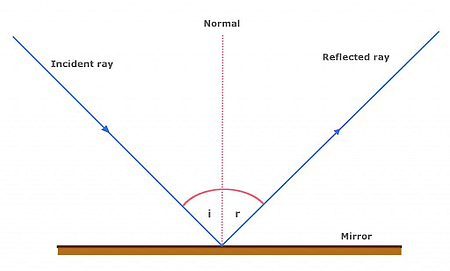
The angle that a ray of light makes with the normal drawn at the point of incidence when it falls on a surface of contact is known as the angle of incidence. When a path of a ray of light collides with a line parallel to an interface, it forms the angle of incidence. The angle produced by the normal and the ray of light is called the angle of incidence.
In the same way, the angle that is formed between the reflected ray and the normal at the point of incidence is known as the angle of reflection.
Also Read:
| Related Articles | ||
|---|---|---|
| Biconvex Lens | PHOTOMETRY | Kaleidoscope |
| Reflection on a Plane Mirror | Periscope | Wave Particle Duality |
Key Concepts
[Click Here for Sample Questions]
When a ray of light is reflected on a surface, it reflects back at an angle equal to the angle of incidence.
- The ray of light that first hits the surface to be reflected further is known as the incident ray.
- The incident ray hits the surface at a point known as point of incidence with a certain angle that is called the angle of incidence.
- A line that is drawn perpendicular to the point of incidence is known as a normal.
- The ray of light that is reflected back after hitting the surface is known as the reflected ray.
Formula of Angle of Incidence
[Click Here for Sample Questions]
The rule of reflection states that the angle of incidence equals the reflected angle. Hence, the angle of incidence and reflection are always the same, and they are in the same plane as normal.
- ∠i = ∠r
- The angle of incidence = 900 - the angle the ray of light makes with the surface.
Example of Angle of Incidence
[Click Here for Sample Questions]
- When a seismic wave collides with strata, it forms an acute angle. The angle of incidence is 0, the wavefront is parallel to the surface, and the path of the ray is perpendicular, or normal, to the contact in normal incidence.
- The angle that is formed by a ray of sunlight colliding with a line perpendicular to a surface; for example, a surface directly facing the sun has an angle of incidence of 0, whereas for a surface parallel to the sun (like rays of the sun striking a horizontal rooftop) has an angle of incidence as 90°. Sunlight with a 90° incidence angle is absorbed, while light with a lower angle is reflected.

The insolation of the sun varies at different places on Earth due to its varying angle of incidence
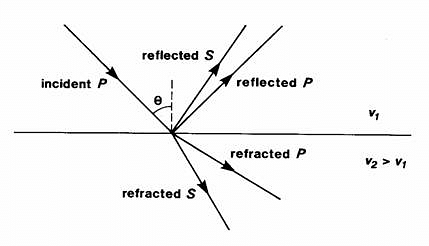
- The angle created between a ray propagated on a surface and the line normal to the point of occurrence on the same surface is known as the angle of incidence. When a ray of light strikes a mirror's surface, it reflects back to the source.
Angle of Incidence
Relation between Angle of Incidence and Angle of Refraction
[Click Here for Sample Questions]
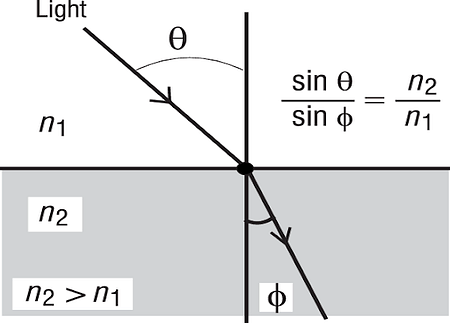
Snell's law states that the ratio of the sine of the angle of refraction to the sine of the angle of incidence is always constant and equivalent to the ratio of phase velocities of the two mediums it is passing through, describing the relationship between the angle of incidence and angle of refraction.
A ray of light strikes the flat surface of a mirror. From the incident point, the same ray is refracted. The point is divided by a perpendicular, which splits both angles. The angle of incident ray and angle of refracted ray can be related using the normal.
The angle of incident ray and angle of refracted ray
The ray of light makes contact with two different mediums. The first is a more scarce medium, whereas the second is a denser medium. When compared to the speed of light in the denser medium, the rarer medium has a faster speed. The medium has a significant influence on the angle of incidence and refraction.
Air or any other type of gas is an example of a rarer medium. Denser mediums include glass, diamonds, and kerosene. The speed of light is slowed inside the denser medium, but there is no resistance to the speed of light from any rarer medium.
The angle of incidence can be calculated by using Snell's Law.
According to this law:
\(\frac{sin\theta}{sin\phi} = \frac{n_2}{n_1}\)
where,
θ = angle of incidence
Φ = angle of refraction
n1 = the incident medium's index
n2 = the refracting medium's index.
Also Read:
Things to Remember
- The point of incidence is the location where light strikes a surface. The normal is a line that is drawn perpendicular to that location.
- The angle that a ray of light makes with the normal drawn at the point of incidence when it falls on a surface of contact is known as the angle of incidence.
- ∠i = ∠r
- Snell's law states that the ratio of the sine of the angle of refraction to the sine of the angle of incidence is always constant and equivalent to the ratio of phase velocities of the two mediums it is passing through.
\(\frac{sin\theta}{sin\phi} = \frac{n_2}{n_1}\)
- The angle of deviation decreases as the angle of incidence rises, and when it reaches a point where the angle of incidence equals the angle of emergence, the angle of deviation is at its minimum, and it will begin to decrease again.
- The angle of reflection is the angle created at the point of incidence between the normal and the reflected beam.
Sample Questions
Ques. What is the best way to get the smallest possible angle of incidence? (1 mark)
Ans. A ray of light can be entirely reflected off the surface between two mediums when it passes from one medium to another with a lower refractive index. In this method, the smallest possible angle of incidence can be achieved.
Ques. Does the refractive index depend on the Angle of Incidence? (1 mark)
Ans. The refractive index is a completely separate measurement. It has nothing to do with the angle of light incidence. The refractive index is a measurement of the speed of light as it slows down as the medium changes.
Ques. What causes the angle of incidence to be the same as the angle of reflection (2 marks)
Ans. The angle of incidence equals the angle of reflection because the light ray chooses the shortest path to its destination, Fermat's principle describes how light behaves. When a light ray is reflected from a plane surface, it exhibits the same behavior. As a result, the incidence and reflection angles are the same.
Ques. What is Snell’s law? (3 marks)
Ans. Snell's law states that the ratio of the sine of the angle of refraction to the sine of the angle of incidence is always constant and equivalent to the ratio of phase velocities of the two mediums it is passing through, describing the relationship between the angle of incidence and angle of refraction.
\(\frac{sin\theta}{sin\phi} = \frac{n_2}{n_1}\)
where,
θ = angle of incidence
Φ = angle of refraction
n1 = the incident medium's index
n2 = the refracting medium's index.
Ques. If a ray of light strikes a surface forming an angle of 20o with the surface. Calculate. (3 marks)
i)Angle of incidence
ii)Angle of reflection
Ans. i) The angle formed by the normal with the surface is 90o. Also, it is given that the incident light forms an angle of 20o with the surface. Therefore,
Angle of incidence = 90o - 20o
= 70o
ii) As we know from the law of reflection that the angle of incidence is equal to the angle of reflection. Therefore, the angle of reflection is 70o.
For Latest Updates on Upcoming Board Exams, Click Here: https://t.me/class_10_12_board_updates
Check-Out:



Comments