



Education Journalist | Study Abroad Lead
The first Atomic structure model was proposed by J. J. Thomson in 1898. According to his proposal, the negatively charged electrons are planted within the Atom and positively charged electrons are distributed in a uniform manner. Rutherford’s Nuclear Model of Atom has also been discussed in detail here. The structure of Atoms as known today is based on this model to a large extent. However, this model had several drawbacks. Candidates will come across the three main postulates of Bohr’s model as well as the drawbacks in this chapter.
| Table of Content |
Keyterms: Atomic Spectra, Spectral Series, Balmer Series, Emission Line spectrum, Absorption Spectrum
Atomic Spectra
[Click Here for Sample Questions]
- The atomic spectra can be defined as the spectrum of the electromagnetic radiation that is emitted or absorbed by electrons during transitions between different energy levels within an atom. When an electron gets excited from one energy level to another, it either emits or absorbs light of a specific wavelength.
- Emission Line spectrum: When an atomic gas or vapor is excited at low pressure by passing an electric current through it, the emitted radiation has a spectrum that contains specific wavelengths only. This kind of spectrum is known as the Emission Line Spectrum and it consists of bright lines on a dark background.
- The spectrum emitted by atomic hydrogen is as follows:
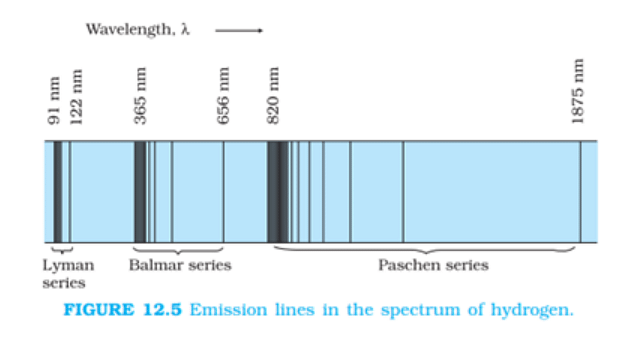
- The study of emission line spectra of material helps us to identify the gas by serving as a type of fingerprint.
- Absorption Spectrum: When white light passes through gas and after analyzing the transmitted light using a spectrometer, we find dark lines in the spectrum correspond precisely to those wavelengths that are found in the emission line spectrum of the gas. This is known as the absorption spectrum of the material of the gas.
Also Read:
| Related Articles | ||
|---|---|---|
| Value of c | Particle Physics | Bohr Radius |
| Atoms Important Questions | Atoms Ncert Solutions | Atoms MCQ |
Spectral Series
[Click Here for Sample Questions]
- The frequencies of the light emitted by a particular element exhibit a regular pattern. For instance, hydrogen is the simplest atom and thus, it has the simplest spectrum. At first sight, there might not be any resemblance of order or regularity in spectral lines but the spacing between the lines within certain sets of hydrogen spectrum decreases regularly and each of these sets is known as spectral series.
- The first spectral series was observed by a Swedish schoolteacher named Johann Jakob Balmer n the visible region of the hydrogen spectrum and this series is known as the Balmer series.
- The line with the longest wavelength 656.3 nm in the red is known as H∞. The next line with wavelength 486. 1 nm in the blue-green is known as
![]() . The third line with a wavelength of 434.1 nm in the violet is known as HY and so on.
. The third line with a wavelength of 434.1 nm in the violet is known as HY and so on. - The Balmer series in the emission spectrum of hydrogen is given as follows;
-
![Spectral Series]()
Spectral Series - As the wavelength decreases, the lines appear closer together and are weaker in intensity.
- Balmer formulated a simple empirical formula for the observed wavelengths is : \(1 _R \frac{1}{2^2} \frac{1}{n^2}\)
 . The third line with a wavelength of 434.1 nm in the violet is known as HY and so on.
- In the above formula, λ is the wavelength while R is known as the Rydberg constant and n can have integral values like 3, 4, 5, etc. The value of R is 1.097 ×10⁷ m-1. This is also known as the Balmer formula.
- When n = ∞ is considered, one obtains the limit of series at λ = 364.6 nm and this is the shortest wavelength in the entire Balmer series. Beyond this limit, no further distinct lines appear, and instead, only a faint continuous spectrum is seen.
- There are other series of spectra for hydrogen which was discovered after their discoverers such as Lyman, Paschen, Brackett, and Pfund series, and these are represented by the given formulae:
| Lyman series | \(1_– R \frac{1}{1^2} \frac{1}{n^2}\) | n = 2, 3, 4 |
| Paschen series | \(1_– R \frac{1}{3^2} \frac{1}{n^2}\) | n = 4, 5, 6 |
| Brackett series | \(1_– R \frac{1}{4^2} \frac{1}{n^2}\) | n = 5, 6, 7 |
| Pfund series | \(1_– R \frac{1}{5^2} \frac{1}{n^2}\) | n = 6, 7, 8 |
- The Lyman series is in the ultraviolet region while Paschen and Brackett's series are found in the infrared region.
- The Balmer formula when written in terms of frequency of light is \(Rc \frac{1}{2^2} \frac{1}{n^2}\)
- The empirical formulas are given for the observed wavelengths, series such as Lyman, Paschen, Brackett and Pfund and Balmer formula in terms of frequency of light are important as the wavelengths give that hydrogen atom radiate or absorb but these results are empirical and don’t give any reasoning as to why only certain frequencies are observed in the hydrogen spectrum.
Things to Remember
- The first Atomic structure model was proposed by J. J. Thomson in 1898.
- The atomic spectra can be defined as the spectrum of the electromagnetic radiation that is emitted or absorbed by electrons during transitions between different energy levels within an atom.
- Emission Line spectrum is when an atomic gas or vapor is excited at low pressure by passing an electric current through it, the emitted radiation has a spectrum that contains specific wavelengths only.
- The frequencies of the light emitted by a particular element exhibit a regular pattern. For instance, hydrogen is the simplest atom and thus, it has the simplest spectrum.
- The first spectral series was observed by a Swedish schoolteacher named Johann Jakob Balmer n the visible region of the hydrogen spectrum and this series is known as the Balmer series.
Also Read:
Sample Questions
Ques. In the hydrogen spectrum, which among the following series lie in the ultraviolet region? (1 Mark)
(A) Balmer series
(B) Brackett series
(C) Pfund series
(D) Lyman series
Ans: D)
Explanation: In the hydrogen spectrum, the Lyman series is the one that lies in the ultraviolet region.
Ques. Which among the following is the correct reason as to why hydrogen atom doesn’t emit X- rays? (1 Mark)
(A) Its energy levels are close to each other
(B) Its energy levels are too far apart
(C) It is too small in size
(D) It has a single electron
Ans: D)
Explanation: The hydrogen atom doesn’t emit X-rays because it has a single electron.
Ques. Brackett series is obtained when all the transitions of electrons terminate on which of the following orbits? (1 Mark)
(A) 4th orbit
(B) 5th orbit
(C) 3rd orbit
(D) 2nd orbit
Ans: A)
Explanation: The Brackett series is obtained when all the transitions of electrons terminate in the 4th orbit.
Ques. The spectral line of 4860 A is given by which among the following spectral series in the hydrogen atom? (1 Mark)
(A) Lyman
(B) Paschen
(C) Balmer
(D) Brackett
Ans: C)
Explanation: The spectral line of wavelength 4860 lies in the visible region of the Balmer series of the spectrum.
Ques. Which among the following spectral series fall within the visible range of the electromagnetic radiation? (1 Mark)
(A) Lyman
(B) Paschen
(C) Pfund
(D) Balmer
Ans: D)
Explanation: The Balmer spectral series falls within the visible range of electromagnetic radiation.
Ques. The spectral lines in the Brackett series arise due to the transition of electrons in hydrogen atoms from higher orbits to the orbit with which among the following n value? (1 Mark)
(A) n = 1
(B) n = 2
(C) n = 3
(D) n =4
Ans: D)
Explanation: The spectral lines in the Brackett series arise due to the transition of electrons in hydrogen atoms from higher orbits to orbit with an n value of 4.
Ques. What is the atomic spectrum? (1 Mark)
Ans: Atomic spectrum is defined as the spectrum of electromagnetic radiation that is emitted or absorbed by electrons during transitions between different energy levels within an atom.
Ques. What causes Atomic spectra? (1 Mark)
Ans: When an electron gets excited from one energy level to another, it either emits or absorbs light of a specific wavelength.
Ques. What are the types of Atomic spectra? (1 Mark)
Ans: There are three types of atomic spectra such as emission spectra, absorption spectra, and continuous spectra.
Ques. What are the uses of Atomic spectroscopy? (1 Mark)
Ans: The uses of atomic spectroscopy are as follows: They are used to identify the spectral lines of materials that are used in metallurgy, Used in pharmaceutical industries to find the traces of the materials used, and they are used to study multidimensional elements.
Ques. A hydrogen atom in the ground state is excited by an electron beam 12-5 eV energy. Find out the maximum number of lines emitted by an atom from its excited state. (2019) (4 Mark)
Ans: We have: ΔE = 12.5eV
Let the electron move to n = n from n = 1 level.
ΔE = E - E1
12.5 = -(13.6/n2) - (-13.6/12)
12.5 = 13.6 (1- (1/n2))
1 - (12.5/13.6) = 1/n2
1.1/13.6 = 1/n2
13.6/1.1 = n2
12.36 = n2
n = 3.5
n = 3RD
The maximum number of lines emitted by an atom from its excited state is equal to 3.
Ques. A 12.5 eV electron beam is used to bombard gaseous hydrogen at room temperature. Up to which energy level the hydrogen atoms would be excited? Calculate the wavelengths of the first member of Lyman and first member of the Balmer series. (2014) (4 Mark)
Ans:


Ques. When is Ha line of the Balmer series in the emission spectrum of hydrogen atom obtained? (2012) (1 Mark)
Ans: Balmer series can be obtained when an electron moves from any other orbit to the second orbit n2=n>2 from the second orbit n1=2.
For Latest Updates on Upcoming Board Exams, Click Here: https://t.me/class_10_12_board_updates
Check-Out:



Comments