



Content Curator
Average Cost Price is the ratio of total cost of production to the total number of products. That is, in simple words, it is the meaning of cost price. Finding average cost price is very significant in calculating the profit earned or loss caused by a seller by selling a particular product. If there are more products manufactured in a company or industry, the average cost price can be found.
| Table of Content |
Keyterms: Average Cost Price, cost price, Profit, Loss, selling price
Cost Price and Selling Price
[Click Here for Sample Questions]
The amount at which a product is bought before selling it to anybody or the actual amount spent on producing a particular product or service is known as cost price. The amount at which the person sells it to anybody else is the selling price of that product.

Cost Price and Selling Price
The cost price is not the same for everybody. If a shopkeeper buys a school bag for 450 rupees and sells it another one for 600 rupees. 450 rupees will be the cost price of the shopkeeper and 600 will be that of the consumer. And the selling price of the shopkeeper is 600 rupees. If the customer who bought the bag sells it to another person for 550 rupees, the selling price of the first customer will be 550. The profit or loss that happened to the sellers can also be found using this method,
(i) If Sp>Cp, there will be a profit.
For example,
Cost price of the shopkeeper = 450 rupees
Selling price of the shopkeeper = 600 rupees
Here, Sp> Cp, therefore shopkeeper earns profit
Profit = Sp-Cp = 600-450 = 150rupees
(ii) If Cp> Sp, there will be a loss.
For example,
Cost price of first customer = 600 rupees
Selling price of first customer= 550 rupees
Here, Cp>Sp, therefore the first customer causes loss.
Loss = Cp-Sp = 550-600 = 50 rupees.
Also Read: Selling price
Marginal Cost Pricing
[Click Here for Sample Questions]
Marginal Cost Pricing is a technique of fixing the price or cost of a product just greater than the price of manufacturing. It has both merits and demerits. Its advantage is that, when using marginal cost pricing, the cost price and the profit of the products can be easily found. But, when a shopkeeper or seller uses this marginal pricing for a long term, to price his commodity, he can only earn a very little amount as profit or sometimes, no profit at all and causes loss for him.
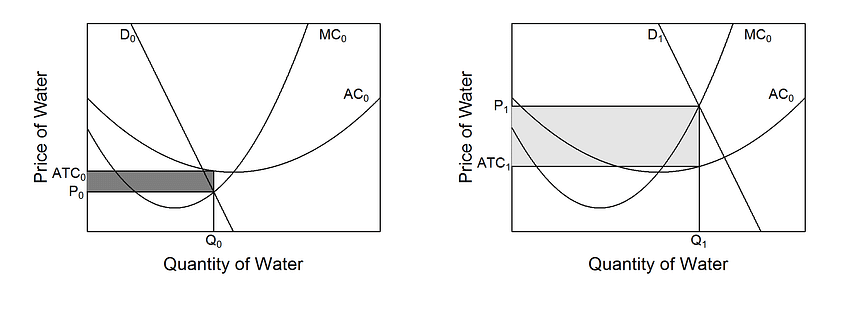
Marginal Cost price
Average Cost Price Formula
[Click Here for Sample Questions]
Average cost price is the mean of all cost prices. It can be calculated by adding all the cost prices and dividing it by the number of products.
The formula to find out average cost price is,
Average cost price = Total cost of production/ Total number of products.
X = ∑(x1+x2+x3+.....xn)/n
X = ∑(xn)/n
Where,
X = Average Cost Price
∑ = Summation
Xn = total price of products
n = number of products
Things to Remember
[Click Here for Sample Questions]
- Average cost price is the mean of all cost prices.
- If Sp>Cp = Profit
- If Cp>Sp = Loss
- Marginal Cost can have both profit and loss.
- The formula to find out average cost price is X = ∑(xn)/n.
Also Read:
Sample Questions
Ques 1. A person works for different wages in a week for rupees 450, 500,300, 400 ,500 and 300 in each day. Find the average cost of his wages. (3 marks)
Ans. Number of days = 7
Average cost price =
Total cost of production/ Total number of products.
X = ∑(x1+x2+x3+.....xn)/n
X = ∑(xn)/n
=(350+450+500+300+400+500+300)/7
= 2800÷7
= 400 rupees
The average cost of his wages is rupees 400.
Ques 2. There are different types of vessels and their cell five vessels per day cost 700 400 350 225 and 550. Find the average cost of vessels they sell in a day. (3 marks)
Ans. Number of vessels= 5
Average cost price = Total cost of production/ Total number of products.
X = ∑(x1+x2+x3+.....xn)/n
X = ∑(xn)/n
= (700+400+350+225+550)/5
= 2225÷5 = 445 rupees
Average cost of the vessels he sells in a day is 445 rupees.
Ques 3. The amount earned by a car manufacturing company from 2018 to 2021 are as follows; 1,25,00000, 1,40,60000 and 2,55,60000. What is the average cost price of a car they sell in a year? (3 marks)
Ans. Number of years = 3
Average cost price = Total cost of production/ Total number of products.
X = ∑(x1+x2+x3+.....xn)/n
X = ∑(xn)/n
= (1,25,00000 + 1,40,60,000 + 2,55,60,000)/ 3
= 5,21,20,000 ÷ 3
= 17,373,333.33 rupees
Average cost price of cars in a year is 17,373,333.33 rupees
Ques 4. The electricity consumption charges of five households in a locality are 500 1080, 1400, 2030 and 615. Find the average price of electricity consumption in a household. (3 marks)
Ans. Number of household = 5
Average cost price = Total cost of production/ Total number of products.
X = ∑(x1+x2+x3+.....xn)/n
X = ∑(xn)/n
( 500 + 1080 + 1400 + 2030 + 615) / 5 = 1125 rupees
Average cost price of one household is Rs 1125.
Ques 5. A footpath seller sells bags for 3 consecutive days. The amount he obtained each day is as follows; 2500, 3450, and 5400. What is the average cost price he obtained in one day? (3 marks)
Ans. Number of days = 3
Average cost price= Total cost of production/ Total number of products.
X = ∑(x1+x2+x3+.....xn)/n
X = ∑(xn)/n
= ( 2500+ 3450 + 5400)/3
= 5625 ÷ 3 = 1125 rupees
Average cost of one day is 1125 rupees.
Ques 6. A merchant bought 15kg apples for 1800 rupees and 20kg oranges for 1300 rupees. He sold apples for 140 rupees per kg and oranges for 65 rupees per kg. Find his net profit or loss. (3 marks)
Ans. Cp of apples = 1800 rupees
Cp of oranges = 1300 rupees
Sp of apples = 140×15
= 2100 rupees
Sp of Oranges = 65 × 20
= 1300 rupees
Total Cp= 1800+ 1300 = 3100 rupees
Total Sp = 2100+ 1300 = 3400 rupees
Sp>Cp
Profit = Sp-Cp
= 3400-3100
= 300 rupees.
Therefore, the merchant earned a profit of 300 rupees.
Ques 7. A shopkeeper has 3 plastic chairs in old stock of prices, 450, 350 and 400 rupees. He combines 3 new plastic chairs which cost 310, 425 and 520 rupees. Find the average price of total stock. Also find, his net profit or loss, if he sell each old chair for 400 rupees and each new for 450 rupees. (3 marks)
Ans. Total number if chairs = old + new
= 3+3 = 6
Average cost price =Total cost of production/ Total number of products.
X = ∑(x1+x2+x3+.....xn)/n
X = ∑(xn)/n
(450+ 350+ 400+ 310+ 425+ 520)/6
= 2455÷ 6
= 409.16 rupees
Total Sp of old chairs = 400× 3 = 1200
Total Sp of new chairs = 450× 3 = 1350
Total Sp = 1200+ 1350 = 2550 rupees
Total Cp = 2455 rupees
Sp>Cp
Profit = Sp-Cp = 2550- 2455 = 95 rupees
Therefore, the seller earned a profit of 95 rupees.
Ques 8. An industry that manufactures cricket bats of 5 rates. The rates are as follows; 1080, 1200, 850, 750 and 1100 rupees. Find the average cost price of cricket bats, if they sell 3 bats of each rate per day. (3 marks)
Ans. Total number of bats= 5× 3 sets
= 15 bats
Average cost price = Total cost of production/ Total number of products.
X = ∑(x1+x2+x3+.....xn)/n
X = ∑(xn)/n
[(1080×3)+(1200×3)+(850×3)+(750×3)+
(1100×3)]/15
= (3240+ 3600+ 2550+ 2250+ 3300)/15
= 14940÷ 15
= 996 rupees.
Average cost price of a cricket bat is 996 rupees.
For Latest Updates on Upcoming Board Exams, Click Here: https://t.me/class_10_12_board_updates
Check-Out:



Comments