



Content Curator
Boyle’s law states that pressure and volume of a gas are inversely proportional when temperature and mass of gas are constant. Boyle’s Law explains the relation between volume and pressure of a gas. Boyle’s law is also known by the name Mariotte’s law. Boyle’s law can be mathematically represented as: P1V1 = P2V2
Where,
- P1 = initial pressure exerted by the gas
- V1 = initial volume occupied by the gas
- P2 = final pressure exerted by the gas
- V2 = final volume occupied by the gas
Boyle’s law explains the phenomenon where if we squeeze a gas-filled balloon, it bursts. When pressure is applied to the balloon, the volume tries to reduce and in case it cannot, the balloon bursts.
| Table of Content |
What is Boyle’s Law?
[Click Here for Previous Year Questions]According to Boyle’s Law, at a constant temperature and mass, the volume of the given amount of gas is inversely proportional to its pressure.
- If the temperature and the mass of a given gas are kept constant, the volume of the gas will decrease with the increase in pressure.
- Boyle’s Law is one of the most significant gas laws that explain an inverse relationship between pressure and volume.
- This gas law is given by one of the founders of modern experimental chemistry, an English Chemist, Robert Boyle in 1662.
- While experimenting on gases, and studying the deviating behaviour in the variable physical environment, Robert Boyle put forward Boyle’s Law.
- Boyle’s law works in a way that when the temperature is constant, the volume increases, and the pressure falls. In the same manner, the pressure increases, when volume falls.
- For a gas, the relation between volume and pressure (which is kept at a constant mass and temperature) can be mathematically shown as. P ∝ (1/V). (Here, P = pressure exerted by the gas and V = volume occupied).
- This proportionality can further be shown in the form of an equation by adding a constant, k. Thus, P = k*(1/V) ⇒ PV = k
-
For a fixed amount of gas at a constant temperature, the pressure v/s volume curve can be represented as:
For a fixed amount of gas at constant temperature, the pressure v/s volume curve can be represented as:
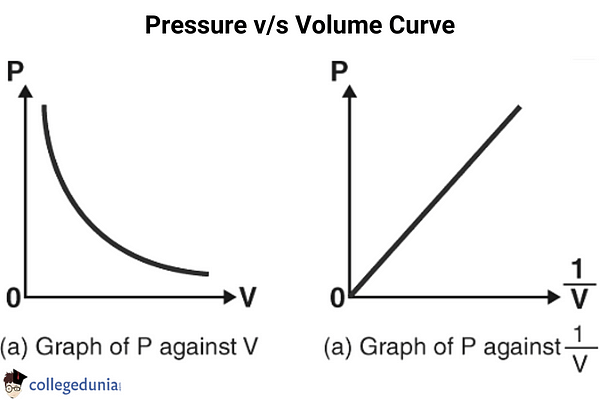
Pressure v/s Volume Curve
We can see that a straight line is acquired when the pressure applied by gas which is represented as P is taken on the Y-axis and the volume is inversely occupied by the gas (1/V) on the X-axis.
Frequently Asked QuestionsQues. State the mathematical form of Boyle's Law. Ans. This empirical relation, first given by Robert Boyle in the year 1662, states that the pressure (p) of a given gas quantity varies inversely with its volume (v) at a constant temperature. Thus, it can be represented in an equation form, pv = k, (k as a constant). Ques. A fixed amount of a gas is seen to occupy a volume of 1L, while exerting a pressure of 400 kPa on the container walls. Determine the pressure exerted by the gas in the case it is completely transferred into a new container with a volume of 3 liters (considering that the temperature and quantity of gas remain constant)? Ans. As per the given question, Initial volume (V1) = 1L Initial pressure (P1) = 400 kPa Final volume (V2) = 3L According to Boyle’s law, P1V1 = P2V2 ⇒ P2 = (P1V1)/V2 Thus, P2 = (1L * 400 kPa)/3L = 133.33 kPa Hence, the gas exerts a pressure of 133.33 kPa on the 3-liter container walls. |
Boyle’s Law Formula
[Click Here for Sample Questions]Boyle’s Law can be better understood with the help of a mathematical expression and a graph that defines the relationship between gas volume with that of pressure, given the temperature and mass of the gas are kept constant.
Let V be the volume of a given mass of gas and the P pressure exerted by it. At a constant temperature, the pressure exerted by a gas is inversely proportional to its volume, i.e.,
| P ∝ 1/V |
Here,
- P is referred to as the pressure applied by the gas
- V is referred to as the volume occupied by the gas
This proportionality can be equated by adding a constant k. Now,
P = k * (1/V)
⇒ PV= k
This means that at a constant temperature and mass, the product of the volume and pressure of a given mass of a gas is constant.
- Pressure v/s Volume graph is a curve it gives a straight line when the pressure of a given mass of gas is taken on the Y-axis and the inverse of volume taken on the x-axis.
Hence, the formula of Boyle's law:
| P1V1 = P2V2 |
- P1 = initial pressure exerted by the gas
- V1 = initial volume occupied by the gas
- P2 = final pressure exerted by the gas
- V2 = final volume occupied by the gas
Boyle’s Law Derivation
[Click Here for Previous Year Questions]As per Boyle’s Law,
P1V1 = P2V2
The given equation can be derived from the pressure-volume relationship expressed by Boyle’s law. It is already known that, for a fixed quantity of gas kept at a constant temperature, PV = k
PV = k (at constant temperature and mass)
So,
Initial pressure x initial volume= k
⇒ P1V1= k
Final pressure*Final volume= k
⇒ P2V2= k
Therefore, Initial pressure* initial volume= Final pressure*Final volume,
Hence, it can be said that:
- P1V1 = k (initial pressure x initial volume)
- P2V2 = k (final pressure x final volume)
∴ Thus, P1V1 = P2V2
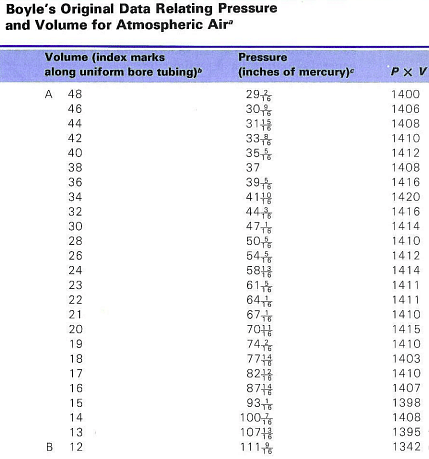
Boyle’s Original Data for Atmospheric Air
Solved ExamplesQues. A balloon is filled with hydrogen gas by a balloon seller at room temperature. The balloon will burst if the pressure exceeds 0.2 bar. Upto what volume can the balloon be expanded if the gas occupies 2.27 L volume at 1 bar pressure? Ans. Given that,
According to Boyle’s Law, P1V1 = P2V2 V2 = (P1V1)/P2 V2 = (1 bar x 2.27 L ) / (0.2 bar) = 11.35 L Thus, the volume of the balloon should be less than 11.35 L as it will burst at 0.2 bar pressure. |
Read More:
| Read more about other Gas Laws | ||
|---|---|---|
| Charle’s Law | Avogadro’s law | Behaviour of Gas Molecules |
| Vapour Pressure | Combined gas law | Gas Constant |
Graphical Representation of Boyle’s Law
[Click Here for Sample Questions]
Boyle’s Law can be graphically represented in many ways. Thus,
Graphical representation of Pressure and Volume
In the picture given below volume (V) is taken on the x-axis and pressure (P) is demonstrated on the y-axis, also known as the PV graph.
- Each curve on the graph is a representation of a rectangular hyperbola and corresponds to a distinct fixed temperature and is called an isotherm.
- Higher curves in the graph are equivalent to higher temperatures. It should be kept in mind that when the pressure is halved, the volume of the gas doubles.

Pressure and Volume
Graphical representation of Pressure inversely proportional to Volume
This graph proves that P α 1/V through the acquired straight lines.

Pressure inversely proportional to Volume
Graphical representation of Pressure and Volume relationship with Pressure
The following graph proves that the product of the volume of the gas is always fixed at a specific temperature.

Pressure and Volume relationship with Pressure
Frequently Asked QuestionsQues. Define Boyle's temperature. Ans. The temperature wherein a real gas follow ideal gas law over an appreciable pressure range is known Boyle's temperature or Boyle's point. Ques. What is the mathematical form of Boyle's law? Ans. The mathematical form of Boyle’s law is P1V1 = P2V2. |
Boyle’s Law Examples
[Click Here for Previous Year Questions]Some examples of Boyle’s Law are:
Boyle’s Law in Respiration
Boyle's law is used by our lungs during respiration.
- Inhaling causes the lungs to expand because they are filled with air.
- As the volume grows, the pressure level decreases.
- Similarly, when the lungs are emptied of air, they contract, reducing the volume and increasing the pressure.
- The change in pressure and volume is both instantaneous and periodic.
Boyle’s Law in Soda Bottle
Another example of Boyle's Law in Thermodynamics is a soda bottle filled with a mixture of carbon dioxide and water.
- It is difficult to compress a soda can or container that has been sealed.
- This is because the air molecules inside the container are densely packed and have little room to move.
- When you open a can or a bottle, some of the air molecules leave, making room for more air molecules to move around and compressing the bottle.
- The change in pressure as a function of volume can be clearly seen here.
Boyle’s Law in a Syringe
The syringe used in the medical field perfectly demonstrates the working of Boyle’s Law.
- When the plunger of a syringe is pulled, the volume of the fluid inside the syringe increases, and ultimately the pressure decreases.
- But when we push the plunger downward, the volume of the fluid gets decreased as the pressure in the syringe increases.

Effect of Pressure on Volume of Gas (Boyle’s law)
Read More:
| Check out more topics from Class 11 States of Matter Chapter | ||
|---|---|---|
| Dalton’s Law of Partial Pressure | Real Gas | NCERT Solutions for Class 11 States of Matter Chapter |
| Critical Pressure | Difference between real and ideal gas | Three states of matter |
| Kinetic molecular theory of gases | Phase changes | Critical temperature |
| STP formula | Molar Volume formula | Density of gas formula |
Things to Remember
- Boyle’s Law defines the pressure-volume relationship of a gas at constant temperature and mass.
- Boyle’s formula is P1V1 = P2V2 (thus, Initial pressure * Initial volume = Final pressure * Final volume).
- Pressure- inverse Volume graph is a straight line. But, the pressure-volume graph gives a curve.
- While calculating Boyle’s law, the temperature and mass are always taken to be constant.
- Breathing, soda bottle, syringes, and the bursting of a balloon are some real-life examples of Boyle’s Law.
Download PDF on Boyle’s Law:

Sample Questions
Ques. Given, P1 = 530 mm, P2 = 780mm , V1 = 300L. Find V2. (1 mark)
Ans. V2 = P1V1/P2
V2 = 530 x 300/780
V2= 203.8 L
Ques. Why is Boyle law important? (1 mark)
Ans. Boyle’s law is important because it helps represent how gases behave. It proveshow gas, pressure and volume are inversely proportional to one another. When pressure is applied on a gas, the volume shrinks and the pressure rises.
Ques. Theoretically show the relationship between pressure and volume. (1 mark)
Ans. Pressure and volume are inversely proportional to one another according to Boyle’s law. Thus,
P ∝ (1/V)
Ques. As per what is Given
P2 = 780mm ,
V1 = 400L,
V2= 600 L.Thus, Find P1. (1 mark)
Ans. P1V1 = P2V2
P1= P2V2/V1
P1 = 780 * 600 / 300
P1 = 1170 mm
Ques. What happens to the pressure in case volume is doubled? (1 mark)
Ans. For a fixed mass of gas at a constant temperature, pressure is inversely proportional to volume. In the case volume is doubled, the pressure will be halved.
Ques. A fixed amount of gas takes up 3L of space and exerts a pressure of 600 kPa on the container's walls. What pressure would the gas exert if it were totally transferred into a new container with a volume of 6 liters (provided the temperature and quantity of gas remained constant)? (2 marks)
Ans. Assume that the initial volume (V1) is 3L.
600 kPa initial pressure (P1)
6L final volume (V2)
P1V1 = P2V2, according to Boyle's law,
P2 = (P1V1)/V2
P2 = (3L * 600 kPa)/6L
P2 = 300 kPa
As a result, the gas exerts a pressure of 300 kPa on the 6-liter container's walls.
Ques. A gas has a volume of 4.31 l at 0.755 atm pressure. Calculate the volume if the pressure is changed to 1.25 atm. (2 marks)
Ans. From the Boyle’s law,
Initial pressure* initial volume= Final pressure*Final volume,
i.e., P1V1 = P2V2
Let final volume = x
So, 0.755*4.31 = 1.25*x
x = 0.755*4.31/1.25
x = 2.603 liters
Ques. On the walls of container 1, a gas exerts a pressure of 4 kPa. The pressure exerted by the gas grows to 8 kPa when container 1 is emptied into a 20-liter container. Calculate container 1's volume. Assume that the gas's temperature and volume remain unchanged. (2 marks)
Ans. Assume that the final volume (V2) is 20L.
4 kPa initial pressure (P1)
8 kPa final pressure (P2)
P1V1 = P2V2, according to Boyle's law,
V1 = ( 8kPa * 20 L)/4 kPa
V1= 40 L
As a result, container 1 has a volume of 40 L.
Ques. A container holds 400. mL of CO2 at 30.° C and 600 torr. What will be the volume of the CO2 if the pressure is increased to 900 torr? (2 marks)
Ans. P1= 600 torr
P2 = 900 torr
V1 = 400. mL
V2 = ?
P1V1 = P2V2
V2 = P1V1/P2
V2= 600 torr x 400. mL/900 torr
V2= 266.6 mL CO2
Ques. At a constant pressure, a given amount of a gas occupies a volume of 2 litres at 1000ºC. What would be volume if gas is cooled to 0ºC keeping pressure constant. (3 marks)
Ans. As per the given equation,
Initial volume V1 = 2L
Final Volume V2 = ?
According to Charle’s Law,
Upon substitution, we get,
V2 = (V1 /T1) x T2
= (2L /1273 K) x 273 K
= 0.4291 L
T1 = 1000 + 273 = 1273 K
T2 = 0 + 273 = 273 K
V1 /T1 = V2 /T2
or V2 = (V1 /T1) x T
Ques. At a constant temperature of 297K, an ideal gas exerts a pressure of 4atm in a 4L vessel. What will be the final volume of a gas, if the pressure is increased to 6atm? (3 Marks)
Ans. Known,
P1 = 4atm
P2 = 6atm
V1 = 4L
V2 =?
According to Boyle’s Law,
P1V1 = P2V2
Substituting the values,
4*4= 6* V2
V2 = (4*4)/6
= 16/6
= 2.67L
So, the final volume of the gas in the vessel will be 2.67L.
Ques. At a temperature of 40°C, what will be the minimum pressure required to compress a 600dm3 of gas at 2 bar to 300 dm3? (3 Marks)
Ans. Known,
P1 = 2 bar
P2 =?
V1 = 600dm3
V2 = 300 dm3
Boyle’s law says that,
Initial pressure* initial volume= Final pressure*Final volume,
i.e., P1V1 = P2V2
2*600= P2* 300
P2= (2*600)/300
= 1200/300
= 4 bar
So, the minimum pressure required to compress the 300dm3 volume of gas is 4 bar.
Ques. At NTP, the given mass of a gas occupies a volume of 5dm3. Now, if the pressure of the gas is changed at 2.04 * 105 N/m2, find out the change in the volume of gas at the same temperature. (3 Marks)
Ans. Known,
P1 = NTP, i.e., 1.013* 105 N/m2
P2 = 2.04 * 105 N/m2
V1 = 5dm3
V2 =?
Boyle’s law says that,
Initial pressure* initial volume= Final pressure*Final volume,
i.e., P1V1 = P2V2
1.013* 105 * 5= 2.04 * 105 * V2
V2 = (1.013* 105 * 5)/ 2.04 * 105
= 2.48 dm3
So, the change in the volume of the gas is V1 – V2
V1 – V2 = 5 – 2.48
= 2.52 dm3.
Therefore, the change in the volume of the gas at constant temperature is 2.52 dm3
Ques. If 60cm3 gas at 3 atm. is expanded to 90 cm3 at constant T, then what is the final pressure? (3 Marks)
Options:
(a) 60×3/90
(b) 90×3/60
(c) None of these
(d) 3×1/60×90
Ans. Known,
P1 = 3 atm
P2 =?
V1 = 60cm3
V2 = 90cm3
Boyle’s law says that,
Initial pressure* initial volume= Final pressure*Final volume,
i.e., P1V1 = P2V2
3* 60 = P2*90
P2 = (3 * 60)/90
= 60* 3/90
Therefore, the correct option is A.
Ques. A gas bulb having a capacity of 200ml is evacuated and kept in a container having a capacity of 1.8L and 600mm pressure. The temperature is constant at 298K. If the bulb implodes isothermally, find out the final pressure of the container? (3 Marks)
Ans. Known,
P1 = 600mm
P2 =?
V1 = 1800ml – 200ml = 1600ml
V2 = 1800ml
Boyle’s law says that,
Initial pressure* initial volume= Final pressure*Final volume,
i.e., P1V1 = P2V2
600* 1600 = P2* 1800
P2 = (600*1600)/1800
= 533.3mm
Therefore, the final pressure of the container is 533.3mm.
Ques. A balloon is designed to have a maximum volume of 2.5 liters. The balloon is filled with 2.0 liters of helium at sea level (101.3 kPa), and reaches to a place where water boils at 88 oC, will the balloon burst? (5 marks)
Ans. First, let us calculate the pressure at which the boiling point of water is 88 degree celcius:
We know that water boils at 100 oC at 101.3 kPa. Since pressure is inversely proportion to temperature,
P1T1 = P2T2
101.3*100 = P2*88
P2 = 101.3*100/88
P2 = 89.144 kPa
Now, applying Boyle’s law for the new pressure,
P1V1 = P2V2
⇒ 101.3*2 = 89.144*V2
V2 = 2.27 litres
Since the balloon was to burst beyond 2.5 litres, the balloon will not burst in this case.
Also Read:



Comments