



Coccus is a spherical-shaped bacterium known as a cocci in microbiology. There are a variety of bacterial species, and it is often possible to identify them by their distinctive configurations. Diplococci is a word used to describe pairs of cocci.
- According to the basic morphologies, bacteria can be divided into five groups.
- For example, spherical (cocci), rod-shaped (bacilli), spiral-shaped (spirilla), comma-shaped (vibrios), or corkscrew-shaped (spirochaetes).
- They may occur as single cells, pairs, chains, clusters, or chains of cells.
- Cocci can cause certain diseases in humans.
- Pneumonia and UTI (urinary tract infection) are common examples of it.
| Table of Content |
Key terms: Coccus, Cocci, Diplococci, Staphylococcus, Enterococci, Bacteria, Tetrads, Streptococcus, Gram-Positive, Gram-Negative.
Definition of Cocci Bacteria
[Click Here for Sample Questions]
Any bacteria or archaeon with a round, spherical, or ovoid shape is referred to as a coccus (plural cocci).
- Staphylococci and Streptococci are two species that are found within the coccus genus of bacteria.
- Cocci can grow in pairs, chains, or clusters based on their adhesion and position during cell division.
- Unlike numerous bacilli-shaped bacteria, most cocci bacteria are non-motile and do not contain flagella.
Structure of Cocci Bacteria
[Click Here for Sample Questions]
Cocci might have different structural characteristics for gram-positive and gram-negative types. Additionally, both types of cocci might have different cell formations as well. Cocci are organisms that reside on their host's body and can be commensal or harmful.
Gram-Positive and Gram-Negative Cocci
[Click Here for Sample Questions]
Cocci that turns positive for gram-staining are classified as Gram-Positive cocci bacteria. They have a thick peptidoglycan layer in their cell wall. Common examples of Gram-Positive Cocci are Staphylococcus, Blantia, Ruminococcus, and Streptococcus.
- The diverse gram-positive cocci vary in habitat and physiology.
- Human skin is home to obligate aerobes called Micrococcus spp.
- Despite being facultative anaerobes, Staphylococcus species also live on human skin.
- They produce lactic acid as a byproduct of glucose fermentation.
- These species produce a lot of carotenoids, which give their colonies yellow or orange color.
There are some cocci that do not retain violet stain during gram-staining. They uptake the counterstain- Safranin and appear red in color. These are called Gram-Negative Cocci. Their cell walls have a thin peptidoglycan layer. Examples of Gram-Negative bacteria are Anaeroglobus, Acidaminococcus, Veillonella, Megasphaera, and Negativococcus.
Types of Cocci Bacteria
[Click Here for Sample Questions]
Cocci can exist as solitary cells or as connected cells after cell division. Based on cellular configuration, those that stay connected can be divided into the following categories:
- Cocci that are in pairs are known as diplococci.
- Streptococcus pneumoniae and Neisseria gonorrhoeae grow in pairs.
- Chains of cocci make up streptococci.
- Streptococcus pyogenes is an example of streptococci.
- Staphylococci are those that grow as irregular (grape-like) clusters of cocci.
- Tetrads that are found in Micrococcus species, are collections of four cocci organized on a single plane.
- Bacteria belonging to the genus Sarcina are found in cuboidal formations of eight cocci.
- Sarcina ventriculi is one of the Sarcina genus of cocci.
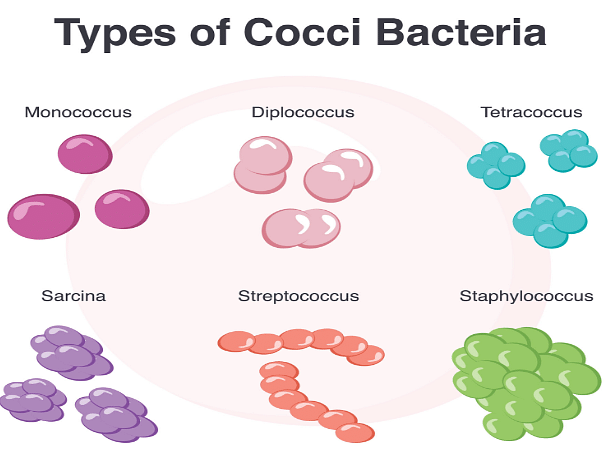
Types of Cocci Bacteria
Also read: Infectious Diseases
Diseases Causing Cocci Bacteria
[Click Here for Sample Questions]
Cocci are known to cause various infections in the human body. Few of them are described below.
Staphylococcus
Staphylococcus bacteria cause staph infections. Many healthy people frequently have these kinds of germs on their skin or in their noses. Most of the time, these bacteria just cause mild skin illnesses.
Peptostreptococci
Humans have commensal Peptostreptococcus species, which are part of the gut microbiota and mostly inhabit the mouth, skin, gastrointestinal, vaginal, and urine tracts. These microorganisms can develop septicemic and pathogenic characteristics under immunosuppressed or stressful situations. It can be harmful to the host. In addition to necrotizing soft tissue infections, peptostreptococcus can result in abscesses in the brain, liver, breast, and lungs.
Pneumococcus
Streptococcus pneumoniae, often known as pneumococcus, is the bacterium that causes pneumococcal illness. Those who have pneumococcal illness can spread the bacterium to others when they cough or sneeze. The bacteria pneumococcus can infect several bodily areas including Lungs (Pneumonia).
Enterococci
Enterococci are Gram-positive, facultative anaerobic organisms. Numerous diseases, including endocarditis, urinary tract infections, prostatitis, intra-abdominal infections, cellulitis, and wound infections as well as concomitant bacteremia, are caused by Enterococcus faecalis and E. faecium.
Also Read:
| Related Articles | ||
|---|---|---|
| Virus | E.coli Bacteria | Heterotrophic Bacteria |
| Difference Between Gram-positive and Gram-negative Bacteria | Viral Disease | Bacterial Transformation |
Things to Remember
- Bacteria can be classified according to their fundamental shapes.
- The bacteria can be either spiral, bacillus, vibrios, spirochaetes or coccus.
- The coccus’ shape and growth type can classify them in diplococcus, streptococcus, tetrad, sarcina, or staphylococcus.
- Cocci includes both Gram-positive and Gram-negative bacteria.
- Cell wall and cellular structure of both types of cocci may differ from each other.
- Most cocci bacteria are non-motile and lack flagella.
- Cocci like streptococcus, Pneumococcus, Enterococcus causes infections in the human body.
Sample Questions
Ques. What shape does the bacteria cocci have? (3 marks)
Ans. Microbiologists refer to coccus, a spherical-shaped bacteria, as cocci. Numerous bacterial species can be distinguished from one another by specific configurations. Diplococci are complete pairs of cocci. Streptococci are columns or chains of cell-groupings. Staphylococci are clusters of cells that resemble grapes, sarcina are collections of eight or more cells, and tetrads are collections of four cells arranged in a square pattern. Variations in how bacteria reproduce lead to these distinctive groupings. Bacterial cell walls control their tremendously variable structure.
Ques. Which diseases are caused by Cocci bacteria? (3 marks)
Ans. The spread of a dangerous strain of bacteria on or within the body is referred to as a bacterial infection. Any portion of the body can become infected by bacteria. The most frequent gram-positive strains of the bacteria Staphylococcus and Streptococcus, as well as other species, are responsible for skin infections. Typical bacterial skin infections include impetigo, cellulitis, and folliculitis. Other diseases caused by cocci are pneumonia, UTI, cough, intra-abdominal infection, wound infection etc.
Ques. Describe coccidiosis. (1 mark)
Ans. Coccidiosis refers to a parasitic condition brought on by coccidian protozoa (apicomplexans) such Isopora and Eimeria. Numerous animals, including dogs, cats, and even birds, are affected by this disease of the gastrointestinal tract.
Ques. Give the difference between gram positive bacteria and gram negative bacteria. (2 marks)
Ans. Thick layers of peptidoglycan make up the cell wall of gram-positive bacteria. In contrast, gram-negative bacteria have a cell wall made of very thin peptidoglycan layers. A gram-positive cell retains the purple stain after the gram staining process. Gram-negative bacteria do not retain the purple stain and appear as red colored bacteria.
Ques. What is the difference between bacilli and cocci bacteria? (1 mark)
Ans. Bacilli are rod-shaped bacteria, whereas cocci are spherical or oval-shaped bacteria. This is the major distinction between the two types of bacteria. Bacilli are motile and cocci are non motile bacteria.
Ques. Which is more harmful between gram-positive and gram-negative bacteria? (1 mark)
Ans. Gram-negative microorganisms are thought to be more dangerous. These are the root of some disorders. Additionally, a slime layer covers their outer membranes, which also conceals the antigens that are present in the cell.
Ques. Give some examples of gram positive bacteria. (1 mark)
Ans. Blantia, Ruminococcus, Finegoldia, Anaerococcus, Peptococcus, Parvimonas are gram-positive bacteria.
Ques. What are the different types of Cocci bacteria? (1 mark)
Ans. The coccus bacterium family includes Diplococcus bacteria, Streptococcus bacteria, Staphylococcus bacteria, and Enterococcus bacteria.
For Latest Updates on Upcoming Board Exams, Click Here: https://t.me/class_10_12_board_updates
Check-Out:



Comments