



Exams Prep Master
Curie constant is widely used in finding various other related physical properties of a material in magnetism and matter. Unlike the others, the curie constant is dependent on the material property that can relate a material magnetic susceptibility to its temperature and this was first derived by a physicist named- Marie Curie. According to the law, the magnetization in a paramagnetic material is directly proportional to the applied magnetic field. Curie’s temperature refers to the temperature at which a ferromagnetic substance or material on heating it or material changes in paramagnetic substance. Here we will discuss the curie constant in detail and mention the applications and limitations of it before answering some of the important questions related to the topic.
| Table of Content |
Key takeaways: Curie constant, Curie’ law, Susceptibility, Magnetization, Paramagnetism, Magnetic Field, Magnetism, Ferromagnetic substance, Permeability
Curie Constant
[Click Here for Sample Questions]
Curie constant, in magnetism, is a material-dependent property. It is a consequence of Curie’s law and relates magnetic susceptibility(x) to absolute temperature(K). Perie Curie formulated this based on her experimental observations and stated a law which is known as Curie’s law. Curie's law states that for paramagnetic materials the induced magnetization is directly proportional to an applied magnetic field and inversely proportional to the absolute temperature. This means that if we heat a material the magnetization is going to decrease. Thus for a paramagnetic material, the susceptibility (x) and permeability (μ) are both dependent on the property of the material and the sample temperature.
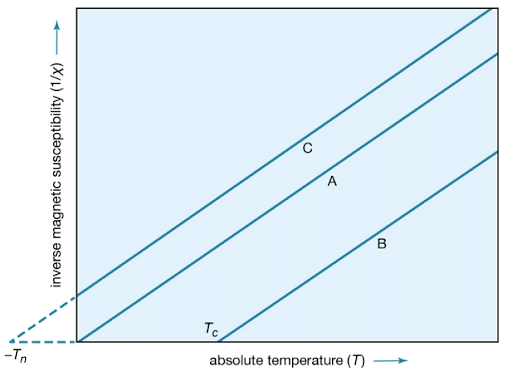
However, it is found that if a ferromagnetic material is heated enough, the magnetization disappears and the material becomes paramagnetic in nature. The disappearance of the magnetization is gradual with increasing temperature. The temperature transition of a ferromagnet to a paramagnet is called Curie’s temperature or Curie point.
Also read: Magnetic Properties
Formula of Curie Constant
[Click Here for Previous Year Questions]
When Curie constant is expressed in SI units in a given absolute temperature(K), is given by-
\(C = \frac {\mu _0 \mu ^2_B}{3k_B} ng^2 J (J+1)\)
Where, C is the Curie constant; kB is the Boltzmann’s constant; n is the number of atoms or molecules per unit volume; μB is the Bohr magneton; g is the Lande-g factor; μ0 is the permeability of free space; J is the azimuthal or angular quantum number.
For a two-level system, the equation for the Curie constant becomes,\(C = \frac{1}{k_B} n \mu_0 \mu^2\) , where μ is the magnetic moment of the material.
When these equations are expressed in Gaussian units then the Curie Constant equation is given by,
\(C = \frac {\mu ^2_B}{3k_B} ng^2 J (J+1)\)
With the same set of terms as for the SI units.
And the two-level system equation reduces to-
\(C = \frac{1}{k_B} n \mu^2\)
Also Read:
| Related Articles | ||
|---|---|---|
| Magnetic Properties of Materials | magnetic levitation project | Magnetization and Magnetic Intensity |
| Permanent Magnets and Electromagnets | Earth’s Magnetic Field | Magnetic Pole |
Application of Curie Constant
[Click Here for Sample Questions]
The curie constant is applied as the proportionality constant to equate the magnetization of material to an absolute temperature at a given magnetic field. As per curie’s law, magnetization is inversely proportional to the temperature.
M = CBT …(i)
Where C is the Curie constant; M is the magnetization of the material; B is the applied magnetic field, and T is the temperature on an absolute scale.
But we know that,
M=xH, and
B=μH, where H is the magnetic intensity vector.
Using them in equation (i), we get a relation between curie constant(C) and susceptibility (x) that is,
x = CμT
This is the equation of curie’s law derived by Pierre Curie; it tells us that susceptibility and permeability for a paramagnetic material are also temperature-dependent.
Also read: Paramagnetic
Value and Unit of Curie constant
[Click Here for Previous Year Questions]
The value of the Curie constant is found out by considering a single cubic lattice where there is one atom per unit cell. We then assume that each atom carries a magnetic moment μ=210-6B and use that in equation(i). We get the value of the Curie constant that is 1C=1.3047 KATm.
The unit of curie constant is K.A./(T.m).
The dimension of the curie constant is found out using the dimension of other quantities and is [M-1 L-1T2A2K].
Read More: Permanent Magnets and Electromagnets
Limitation of Curie’s Law and Constant
[Click Here for Sample Questions]
Curie’s law has limitations so is for the Curie constant. As it has been seen that when the field is increased or the temperature is lowered, the magnetization increases until it reaches the saturation value, at which point all the dipoles are perfectly aligned with the field. Beyond this point, Curie’s law is no longer valid. It also fails in the Curie-Weiss law.
Read More: Magnetic effects of electric current
Things to Remember
- Unlike any other physical constant, the Curie constant is a material-dependent property It is a consequence of Curie’s law and relates magnetic susceptibility(x) to absolute temperature(K).
- Curie's law states that for paramagnetic materials the induced magnetization is directly proportional to an applied magnetic field and inversely proportional to the absolute temperature.
- The limitation of Curie’s law is that when the temperature is lowered or the magnetic field is increased, the magnetization of the material doesn't go beyond a certain point and fails to establish Curie’s law.
- Curie constant is given by(in SI units).
\(C = \frac {\mu _0 \mu ^2_B}{3k_B} ng^2 J (J+1)\)
- The unit of curie constant is K.A./(T.m) . And the dimension is [M-1 L-1T2A2K]. The value of 1C =1.3047 KATm.
Also Read:
Previous Year Questions
- An electron in motion is associated with… [ KCET 1996]
- Two parallel wires carry electric current in same direction. The wires... [ KCET 1996]
- Resistance of an ideal ammeter is...[ KCET 1996]
- If a current of 0.1 A is passed through the coil, what is the couple acting?...[CBSE Class 12 ]
- The acceleration of the falling magnet is..[NEET]
- A bar magnet is equivalent to ............[KCET 2004]
- A metal ring is held horizontally and bar magnet is dropped through….[NEET]
- The total charge, induced in a conducting loop when it is moved in magnetic field depend on...[NEET 1992]
- If a charge particle enters perpendicular in the uniform magnetic field, then...[JIPMER 2016]
- A metal ring is held horizontally and bar magnet is dropped through….[NEET]
- The total charge, induced in a conducting loop when it is moved in magnetic field depend on...[NEET 1992]
- If a charge particle enters perpendicular in the uniform magnetic field, then...[JIPMER 2016]
- Materials suitable for permanent magnet, must have which of the following properties ?
- At what temperature, the ferromagnetic substances become paramagnetic ?
- Ampere’s circuital law can be derived from…..
- If a magnetic dipole of moment M situated in the direction of …
- If the susceptibility of dia, para and ferro magnetic materials are ….
- Materials suitable for permanent magnet, must have which of the following properties ?
- At what temperature, the ferromagnetic substances become paramagnetic ?
- a magnetic induction of strength at its centre is...
Sample Questions
Ques. What is Curie constant and write its mathematical formula in Gaussian unit? (3 marks)
Ans. Curie constant is a material-dependent property It is a consequence of Curie’s law and relates magnetic susceptibility(x) to absolute temperature(K).
The Curie constant in Gaussian units is given by,
\(C = \frac {\mu ^2_B}{3k_B} ng^2 J (J+1)\)
C is the Curie constant; kB is the Boltzmann’s constant; n is the number of atoms or molecules per unit volume; μB is the Bohr magneton; g is the Lande-g factor; μ0 is the permeability of free space; J is the azimuthal or angular quantum number.
Ques. State and explain Curie’s Law. (3 marks)
Ans. Curie's law states that for paramagnetic materials the induced magnetization is directly proportional to an applied magnetic field and inversely proportional to the absolute temperature. This means that if we heat a material the magnetization is going to decrease.
The equation is given by, M = CBT
[Where, C is the Curie constant; M is the magnetization of the material; B is the applied magnetic field, and T is the temperature in absolute scale.]
Ques. The dimension of Curie Constant is- (1 mark)
a) [M-1 L-1T2A2K]
b) [L-1 T2A2K]
c) [M L-2T2A2K]
d) None of the above
Ans. a) [M-1 L-1T2A2K] is the correct answer.
Ques.The value of 1C= (1 mark)
a) 13.0 ATm.
b) 1.30 KATm.
c) 1.30 KAT.
d) 13.0 KATm.
Ans. c) 1.3047 KATm is the correct answer.
Ques. What is Curie point or Curie Temperature? (2 marks)
Ans. When a ferromagnetic material is heated enough, the magnetization disappears and the material becomes paramagnetic in nature. The disappearance of the magnetization is gradual with increasing temperature. The temperature transition of a ferromagnet to a paramagnet is called Curie’s temperature or Curie point.
Ques. The susceptibility of material at 300 K is 1.210-5. At what temperature will the susceptibility equal to 1.4410-5? (3 marks)
Ans. According to Curie’ law,
xm= CμT
Therefore, xm /xm’ = T’/T
Or, T’=T(xm /xm’ )
Or, T’= (3001.210-5)/(1.4410-5)
Or, T’= 250 K
Therefore, at 250 K the susceptibility of the given material is equal to 1.4410-5
Ques. Find the susceptibility when the curie constant is 0.3 and the difference in critical temperature and paramagnetic curie temperature is 0.01. (2 marks)
Ans. The susceptibility in magnetic materials is given by,
xm = C/(T0 -TC) —(a)
Where C is the Curie constant, T0 is the critical temperature and TC is the paramagnetic curie temperature.
Now according to the question, C = 0.3 and T0 -TC =0.01, putting them in equation (a),
we get susceptibility as,
xm = 0.3/0.01 = 30.
Ques. State the limitation of Curie’s law. (2 marks)
Ans. The limitation of Curie’s law is that when the temperature is lowered or the magnetic field is increased, the magnetization of the material doesn't go beyond a certain point and fails to establish Curie’s law.
Ques. How can Curie constant be expressed in Gaussian units? (4 marks)
Ans. For a two-level system, the equation for the Curie constant becomes,\(C = \frac{1}{k_B} n \mu_0 \mu^2\) , where μ is the magnetic moment of the material.
When these equations are expressed in Gaussian units then the Curie Constant equation is given by,
\(C = \frac {\mu ^2_B}{3k_B} ng^2 J (J+1)\)
With the same set of terms as for the SI units.
And the two-level system equation reduces to-
\(C = \frac{1}{k_B} n \mu^2\)
Where,
C is the Curie constant.
n is the number of magnetic atoms per unit volume.
g is the g-factor.
μB is the Bohr magneton.
kB is the Boltzmann constant.
J is the angular momentum quantum number.
Ques. What are the limitations of Curie’s law and constant? (2 marks)
Ans. Curie’s law has limitations so is for the Curie constant. As it has been seen that when the field is increased or the temperature is lowered, the magnetization increases until it reaches the saturation value, at which point all the dipoles are perfectly aligned with the field. Beyond this point, Curie’s law is no longer valid. It also fails in the Curie-Weiss law.
For Latest Updates on Upcoming Board Exams, Click Here: https://t.me/class_10_12_board_updates
Check-Out:



Comments