



Education Content Expert
Diatom is a unicellular eukaryotic alga that has a siliceous covering and a symmetrical body. Diatoms are a plethora of unicellular organisms that range in number from 20,000 to 2 million species.
- Diatoms comprise the taxonomic phylum Bacillariophyta.
- Diatoms are usually aquatic creatures found in fresh, and saltwater.
- Some diatoms are also found in moist places, such as soil.
- Diatoms might be found alone or in colonies.
- When they are in colonies, they form shapes such as zigzags, stars, or fans.
Diatoms are encased in a frustule, which is a silica shell made up of two separate valves that enclose the plasma membrane. Frustules are incredibly detailed, with microscopic pores arranged in a pattern designed specifically for catching the sunlight.
Read More: NCERT Solutions for Class 11 Biology Biological Classification
| Table of Content |
Key Terms: Diatoms, Protista, Flagella, Oogamy, Anisogamy, Isogamy, Kingdom Protista, Pennate Diatoms, Centric Diatoms
What are Diatoms?
[Click Here for Sample Questions]
Diatoms are members of the taxonomic phylum Bacillariophyte. Diatoms are members of the Kingdom Protista.
- Diatoms are among the most important microscopic aquatic organisms.
- They are directly or indirectly useful as food for many animals.
- Diatomaceous earth, a substance made up of fossil diatoms, is used in filters, insulation, abrasives, paints, and varnishes.
- Diatoms may be unicellular or found in colonies.
- Diatoms can be broadly divided into two orders on the basis of symmetry and shape.
- Round Non-motile Centrales have radial markings and Elongated Pennales that have pinnate markings.
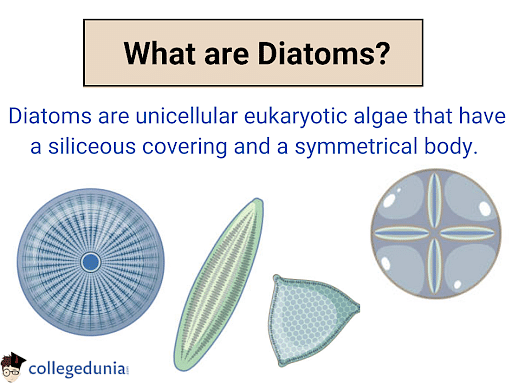
Diatoms
Read More:
| Relevant Concepts | ||
|---|---|---|
| Two Kingdom Classification | Taxonomic Hierarchy of Plants and Animals | Five Kingdom Classification |
| Botanical Name and Biological Classification | Taxonomy | Diversity In Living Organism |
Characteristics of Diatoms
[Click Here for Sample Questions]
The various characteristics of diatoms are as follows:
- Habitat: Diatoms may be found in both freshwater and saltwater.
- Diatom Shell: The shell wall of diatoms contains silica. Their cell wall is referred to as a shell or frustule.
- Diatoms have shell walls that overlap.
- The shells of diatoms are often translucent in color.
- These creatures' cell walls are often made of cellulose.
- The silica particles are inserted in several locations throughout this cellulose cell wall.
- As a result, the cell wall looks to be comprised of silica.
- Diatom Nucleus: The diatom contains a diploid nucleus.
- Diatoms Have Pigments: Diatoms have chloroplasts in their cell walls.
- Pigments are found in the chloroplasts of diatoms.
- Chlorophyll a, chlorophyll c, and xanthophyll are the pigments involved.
- Fucoxanthin is another name for this xanthophyll.
- Diatoms seem golden in hue as a result of their pigments.
- Diatom Movement: Diatoms are immotile due to the lack of flagella in them.
- They float on the surface of the water because of the low molecular weight of stored lipids.
- Some diatoms move with the assistance of a slimy fluid.
- The slimy excretion is composed of an oily substance secreted by diatoms.
- This offers lubrication for the diatoms' movement.
Read More: Biological Classification Important Questions
Examples of Diatoms
[Click Here for Sample Questions]
Some examples of diatoms are:
- Pinnularia is a mucilaginous diatom that has an elongated, elliptical shape.
- Navicula is a genus of the Naviculaceae family, order Naviculales, and class Bacillariophyceae. It is the genus that creates around one-quarter of the oxygen on the planet. Members of this genus are considered keystone species since they provide food for numerous aquatic animals.
- Chaetoceros is one of the most numerous planktonic diatom genera in marine seas.
- Bacillaria is a genus of the Bacillariaceae family, Bacillariales order, and Bacillariophyceae class that has elongated cells.
Classification of Diatoms
[Click Here for Sample Questions]
There are two kinds of diatoms found in nature. One is circular, whereas the other one is elongated. Diatoms are categorized into two categories based on their form. These categories are described more below:
- Pennate Diatoms: These diatoms have an extended form. These diatoms can be split in two. As a result, they exhibit bilateral symmetry. Pennate diatoms are naturally mobile. They move in a gliding motion.
- Centric Diatoms: These diatoms have a round-circular form. They have radial symmetry. These diatoms are not mobile in nature.
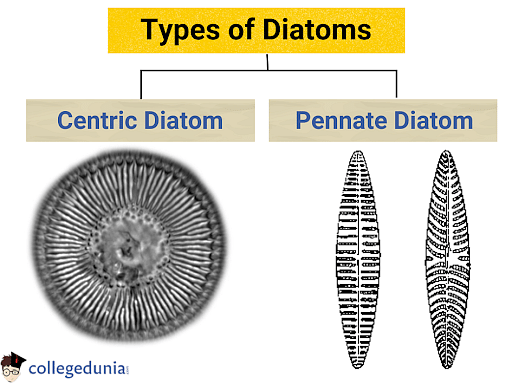
Classification of Diatoms
Read More: Biological Classification
Reproduction in Diatoms
[Click Here for Sample Questions]
Protists reproduces in both sexual and asexual ways which are discussed as follows:
Asexual Reproduction
This is the most typical way for creatures of the protist kingdom to reproduce. Asexual reproduction occurs under suitable conditions. It is classified as follows:
- Fission of Binary Atoms: In this sort of reproduction, two daughter cells are generated by the division of a single mother cell. Following this process, each daughter cell generated by binary fission grows to the size of a normal organism.
- Spore Formation: Some protists have a specific structure known as sporangia. This sporangium is responsible for spore production. After some time, the sporangia explode and all the spores become loose (released into the environment). After germination, these spores create a new cell.
Read More: Biological Classification MCQs
Sexual Reproduction
Two gametes (haploid in nature) unite to produce a zygote during the sexual reproduction process (diploid in nature). This merger is referred to as syngamy. This fusion is classified into three categories.
- Isogamy: The isogamy form of fusion is the most straightforward method of sexual reproduction. The fusing gametes in isogamy are physically identical, but physiologically they might be similar or distinct.
- Anisogamy: It occurs when the fusing gametes are physically distinct but physiologically similar or dissimilar.
- Oogamy: Anisogamy results in this form of fusion. The male gamete is tiny and motile in this form of fusion, whereas the female gamete is big and non-motile. This female gamete is referred to as an egg. The development of male and female gametes occurs in sex organs.
Salient Features of Protista Kingdom
[Click Here for Sample Questions]
The living species of Kingdom Protista include dinoflagellates, diatoms, euglenoids, slime molds, and protozoans. The creatures of this kingdom are all unicellular and eukaryotic in nature.
There are several forms of nutrition in protists:
- Photosynthesis or Holophytic Mode: These creatures are capable of producing their own nourishment. Food may be synthesized using the photosynthesis approach.
- Holozoic Nutritional Mode: These creatures eat in a manner similar to that of mammals. Food is first eaten and then digested by these creatures.
- Absorptive Mode: Some protists get their sustenance from decomposing organic materials.
- Nutrition in a Mixotrophic Mode: Some protists consume food in a variety of ways.
Diatoms Microscopic View
[Click Here for Sample Questions]
Diatoms are easily visible under a microscope.
- Diatoms are not easily visible to the naked eye, thus, they must be examined using a microscope.
- Under the microscope, diatoms create fascinating specimens.
- They feature complicated surface patterns with extremely minute punctures.
- The resolving power of a microscope lens is measured using small holes in the frustules of some of the animals.
Also Check:
| Related Topics | ||
|---|---|---|
| Algae | Difference Between Algae and Bryophytes | Phycology |
| Prokaryotic and Eukaryotic Cells | Parasitic Symbiosis | Difference Between Aerobic And Anaerobic Bacteria |
Uses of Diatoms
[Click Here for Sample Questions]
The major uses of diatoms are:
- Soundproofing using Diatoms.
- Oil and syrup filtration.
- Polishing of stones.
- In steam boilers, as a heat insulator.
- Diatoms are utilized in the production of toothpaste.
- Some diatoms are utilized in the production of skin medications.
- Diatoms are utilized in the production of some pharmaceuticals.
- Diatoms are employed as insecticides because they absorb oil and dry it.
Things to Remember
- Diatoms are eukaryotes that belong to the Heterokont algal family.
- The number of diatom species is estimated to be between 20,000 and 2 million.
- Diatoms can be found in water or in wet settings such as soil.
- Some diatoms exist as free-floating cells in ponds, lakes, and ocean plankton.
- There are two types of diatoms namely Pennate Diatoms and Centric Diatoms.
- Diatoms can reproduce both by sexual and asexual means of reproduction.
- Diatoms are a key source of these energy-rich compounds, which feed on the entire food chain.
Sample Questions
Ques. What type of reproduction do diatoms use? (3 Marks)
Ans. Diatoms reproduce mostly asexually and by cell division, which results in the formation of two daughter cells; each daughter cell includes one valve, and reproduction occurs through furrowing.
Further, Diatoms may reproduce sexually, and during this process, the diatoms must go through a spore phase known as the resting spore. During asexual reproduction, which is the most frequent method of reproduction in diatoms, the chromosomes are divided into two parts called frustules or theca.
Ques. What features do diatoms have? (3 Marks)
Ans. The features of diatoms are:
- Silica is found in the shell wall of diatoms. Their cell wall is referred to as a shell or frustule. The shells of diatoms are often translucent in color.
- Diatoms may be found in both freshwater and saltwater.
- Diatoms have a diploid nucleus.
Ques. How are Diatoms classified? (2 Marks)
Ans. Diatoms are categorized into many forms that vary according to class and division. Diatoms are classified into three groups based on recent revisions namely Centric Diatoms (Coscinodiscophyceae), Pennate Diatoms without a Raphe (Fragilariophyceae), and Pennate Diatoms with a Raphe (Fragilariophyceae) (Bacillariophyceae).
Ques. Do diatoms influence the climate? (2 Marks)
Ans. Diatoms have a worldwide impact on climate. Diatoms "breathe" in carbon dioxide from the environment and "breathe" out oxygen when they photosynthesize. Despite their microscopic size, diatoms may be found in the world's waters. The action of diatom carbon fixation and oxygen release modifies the chemistry of the atmosphere.
Ques. Why do diatoms need to reproduce sexually? (3 Marks)
Ans. When Diatoms reproduce asexually, the daughter cell that obtains the bigger frustule from the parents serves as the foundation for additional smaller frustules. Diatoms become smaller with each cycle of reproduction, and their number diminishes as well. In order to avoid size decline, sexual reproduction is required. The major reasons for resting spore formation in diatoms are changes in environmental circumstances and a scarcity of nutrients.
Ques. What size are diatoms? (3 Marks)
Ans. Almost all diatoms are tiny, with cells ranging in size from 2 m to 500 m, or half a millimeter. The largest diatoms are around the width of human hair. To examine diatoms, scientists utilize light microscopes (LM) or scanning electron microscopes (SEM). The silica cell walls of diatoms seem transparent when seen under a light microscope (because we are seeing through glass). The cells of diatoms seem opaque when seen via a scanning electron microscope.
Ques. Do diatoms fossilize? What happens to diatoms when they die? (3 Marks)
Ans. Because diatom cell walls are made of inorganic silica, they do not disintegrate. When diatoms die, their silica cells settle to the bottom of the pond, lake, or ocean. Because cell walls are inorganic, they can be kept for tens of millions of years. The cell walls of many soft-bodied creatures are not replaced by another mineral. Diatom fossils retain their original silica cell wall.
Given the correct conditions, any of these creature remnants can survive and emerge as fossils. Paleolimnologists and geologists study fossil diatoms and other ancient organisms to better understand previous Earth conditions.
Ques. Where can diatoms be found? (3 Marks)
Ans. Diatoms can be found in water or in wet settings such as soils. Some diatoms exist as free-floating cells in ponds, lakes, and ocean plankton. Planktonic animals frequently have particular adaptations to resist sinking, such as long chains of cells joined by silica spines. Other species develop buoyant, sink-resistant zig-zag or star-shaped colonies.
Diatoms with a particular structure known as a raphe may migrate over surfaces. These diatoms may migrate across small grains of sand, over tidal muck, and even on other diatoms.
Ques. Are diatoms affected by climate? (3 Marks)
Ans. Diatoms are affected by climate in a variety of ways. Scientists expect that when the world heats owing to increased carbon dioxide, bigger marine plankton, such as diatoms, would decline in comparison to smaller plankton, such as coccolithophores and cyanobacteria. A changing climate impacts river flow in many sections of the world's lakes and rivers.
Droughts and floods are becoming more frequent and severe, which has an influence on diatom species and where they develop. Furthermore, climate influences lake and ocean circulation patterns and thermal stratification, which affect diatom species composition.
Ques. How long does it take a diatom cell to die? (3 Marks)
Ans. A single diatom cell can split and divide again to generate two new cells. Cells can divide as frequently as once per day or as seldom as once per several weeks. Because diatom cells get increasingly smaller with each cell division, the silica cell wall acts as a biological limitation.
As a result, the diatom cell gets smaller as it ages. It's intriguing that each daughter cell is smaller than the parent. Inside the parent cell, the daughter cell creates a new silica cell wall, but the stiff glass cell wall cannot grow. For the rest of its life, the infant will be smaller than the mother.
Check-More:



Comments