



Education Journalist | Study Abroad Lead
Capacitor and Battery are both energy storing devices which perform the function of energy storage and discharge. The main difference between a Capacitor and a Battery is that batteries store energy in the form of chemicals where it converts the chemical energy to electrical energy through the process of electrolysis. On the other hand, a capacitor stores electrostatic energy in an electrical field. Although, Capacitors have low internal resistance, they can store energy for a short period of time, unlike batteries which have a longer shelf life.
| Table of Content |
What is Battery?
[Click Here for Sample Questions]
A standard battery is made up of three basic components plus a casing. Two of them are electrodes. An electrolyte is the third element. This is a gooey paste or liquid that goes between the electrodes and fills the space. Various chemicals can be used to make the electrolyte. Whatever the substance's composition, it must be able to conduct ions — charged atoms or molecules — without allowing electrons to pass through. As a result, electrons are forced to leave the battery through terminals that connect the electrodes to a circuit.
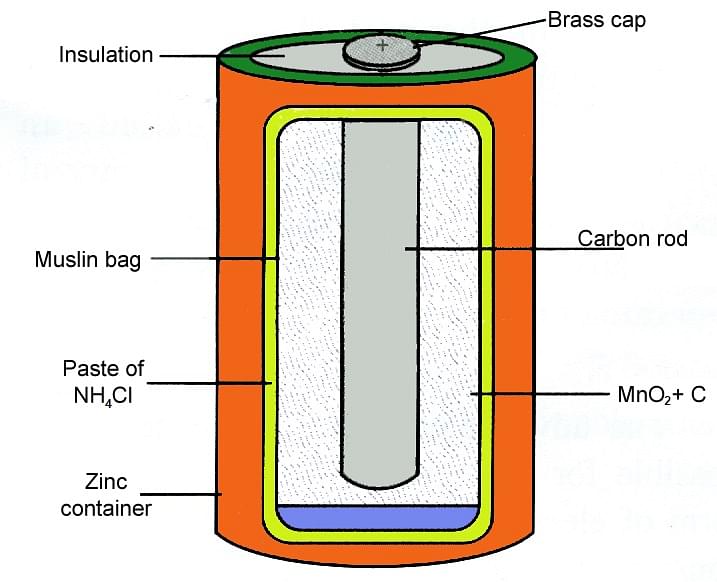
Dry Cell Battery Parts
The electrons are unable to move if the circuit is not switched on. Chemical reactions on the electrodes are prevented as a result of this. As a result, energy can be stored until required. Different materials are often used for the anode and cathode. The cathode is usually made of a substance like lithium, which readily gives out electrons. Carbon, in the form of graphite, has a high affinity for electrons. As a result, it is an excellent cathode material.
Batteries' ability to hold a charge might deteriorate over time. Even rechargeable batteries are subject to this phenomenon. Researchers are constantly on the lookout for novel approaches to this issue. When a battery can no longer be utilized, however, most people throw it away and replace it with a new one. Some batteries must be recycled because they contain hazardous substances.
Also Read:
What is a Capacitor?
[Click Here for Previous Year Questions]
Capacitors can block direct current (a one-way flow of electrons) in a circuit while allowing alternating current to flow. (Alternating currents, such as those found in domestic electrical outlets, reverse direction frequently). Capacitors aid in tuning a radio to a specific frequency in certain circuits.
The design of capacitors is rather simple. The most basic is made up of two components that can conduct electricity and are referred to as conductors. These conductors are separated by a gap that does not carry electricity. Electrons move in and out of the capacitor when it is connected to a live circuit. These negative-charged electrons are stored on one of the capacitor's wires. Electrons will not pass through the space between them. Even so, the electric charge that accumulates on one side of the gap has an effect on the charge on the other. A capacitor, on the other hand, remains electrically neutral throughout. In other words, the conductors on both sides of the gap create charges that are equal but opposite (negative or positive).
Several factors influence the amount of energy a capacitor can hold. The more charge a conductor can store, the larger its surface area. In addition, the better the insulator between the two conductors, the more charge may be held.

Capacitor
Difference between Battery and Capacitor
[Click Here for Sample Questions]
The key differences between a battery and a capacitor are tabulated below.
| Battery | Capacitor |
|---|---|
| Chemical energy is stored in a battery to hold its potential energy. | An electrostatic field is used to store electrical energy in a capacitor. |
| Battery is a DC component, essentially. | It is best suited to AC applications. |
| The rate of charge/discharge is slower than that of capacitors. | Because energy is stored directly on the plates, the charge/discharge rate is frequently faster than a battery. |
| In a battery, the charges are not separated. | Capacitors store electrons in advance. |
| The battery lasts for a longer period of time. | The discharge of capacitors is almost immediate. |
Things to Remember
- Batteries and capacitors are both electrical devices that can store electrical charge and discharge it. The manner in which they do it, however, varies greatly.
- A capacitor stores potential energy in an electric field, unlike a battery, which stores it in a chemical form.
- Batteries, like a steady electrical flow, store and distribute energy in a linear fashion.
- Capacitors, on the other hand, release energy in bursts. The energy is stored directly on the plates of a capacitor, making charging and discharging faster than with batteries.
- Batteries, on the other hand, can recover their stored energy more quickly and for longer periods of time than capacitors.
Also Read:
Sample Questions
Ques. What are the benefits of using capacitors? (2 marks)
Ans. Capacitors can help in voltage pulsation reduction. The capacitor is charged when a high voltage is applied to the parallel circuit, and it is discharged when a low voltage is applied. To deal with this, a capacitor is employed to smooth out the ripples and maintain a constant voltage.
Ques. Why isn't DC used in capacitors? (2 marks)
Ans. Because DC has no frequency, reactance is infinite. This is why DC is obstructed. While AC has a certain frequency, the capacitor allows it to flow. Because it contains two electrodes separated by a dielectric medium, a capacitor can store charge.
Ques. How do capacitors function? (2 marks)
Ans. A capacitor is an electrical component that stores energy drawn from a battery. The terminals are connected to two metal plates on the inside, separated by a non-conducting material. When a capacitor is engaged, it rapidly releases electricity in a fraction of a second.
Ques. Is it better to use a capacitor or a battery? (3 marks)
Ans. Capacitors have a much lower internal resistance, which means they can easily supply high currents up to several amps. However, they have two drawbacks: they don't create energy (you have to charge them before you can discharge energy from them) and they have a low storage capacity; even supercapacitors can only store a fraction of the energy that an aa battery can store. The supercapacitor is superior to a standard rechargeable battery in some ways, but it also has some serious drawbacks. The supercapacitor will prove to be substantially superior when it develops. The future of energy storage (the most pressing issue for a sustainable power source) will most likely be determined by the supercapacitor's resurgent development.
Ques. Is It Possible to Use a Capacitor as a Battery? (3 marks)
Ans. Capacitors have a far higher energy density than batteries. While capacitors have recently improved, so have batteries, and you'll still need 10 – 100 times the mass and size of capacitors to store proportionate energy to a battery.
As they deplete, batteries also offer the benefit of maintaining a relatively consistent output voltage. Because capacitors' output voltage drops linearly as they charge, you'll require expensive voltage-control circuitry to bring them all together.
Ques. In a capacitor, what is the liquid? (2 marks)
Ans. The electrolyte, the conducting liquid inside the capacitor, is what gives it its name. It can be shaped and formed as a liquid to fit the porous structure of the anode and the developed oxide layer in the same way as a "tailor-made" cathode can.
Ques. What influences the lifespan of a capacitor? (2 marks)
Ans. Any harmful environmental extremes (i.e. hot or cold temperatures) and the workload on the capacitor diminish its lifespan. Constant currents that exceed the manufacturer's rating will degrade capacitors quickly.
Previous Year Questions
- Extraction of metal from the ore cassiterite involves...[JEE Advanced 2011]
- Commonly used vectors for human genome sequencing are...[NEET UG 2014]
- Interfascicular cambium and cork cambium are formed due to..
- Pneumotaxic centre is present in...[UP CPMT 2007]
- Reaction of HBr with propene in the presence of peroxide gives….[NEET UG 2004]
- Assuming the expression for the pressure exerted by the gas on the walls of the container, it can be shown that pressure is...[MHT CET 2016]
- Which among the following is the strongest acid?...[TS EAMCET 2017]
- Isopropyl alcohol on oxidation forms..
- A vector is not changed if..
- Which of the following arrangements does not represent the correct order of the property stated against it?...[JEE Main 2013]
For Latest Updates on Upcoming Board Exams, Click Here: https://t.me/class_10_12_board_updates
Check-Out:



Comments