



Exams Prep Master
Diffraction is the bending of waves when it is passed through a narrow aperture. Whereas interference is the addition of two waves to result in another wave of similar amplitude. Diffraction and interference occur in all waves. The major difference between diffraction and interference is that in diffraction, secondary waves are formed from different parts of the same wave. Whereas, in interference, waves from different sources are merged together to form a resultant wave.
| Table of Content |
Key Terms: Diffraction, Interference, Waves, Light, Superimposing of waves, Fringe width, Constructive and Destructive interference
What is Diffraction of Light?
[Click Here for Sample Questions]
The bending of light around corners such that it spreads out and illuminates places is known as diffraction. In general, it's difficult to distinguish between diffraction and interference since they both happen at the same time. A silver line appears in the sky as sunlight penetrates through or strikes a cloud. This is due to diffraction of sunlight.
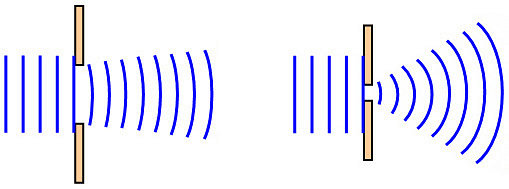
Diffraction of Waves
Also Read:
What is Interference of Light?
[Click Here for Previous Year Questions]
Interference is the phenomenon in which two or more waves collide and superimpose to generate a new wave. The resultant wave may be of larger, lower, or of equal amplitude depending on the nature of the superimposition or alignment of the overlapping waves' peaks and troughs.
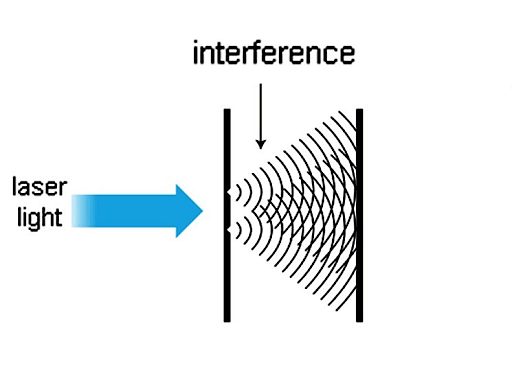
Interference of Light
Difference between Interference and Diffraction
[Click Here for Sample Questions]
Interference is a feature caused by waves from two independent coherent sources, whereas Diffraction is caused by secondary wavelets that originate from the same wave but occur in various areas of it. It's essential to understand the fundamental differences between them by looking at the region of least intensity; in interference, this region is extremely dark, but in diffraction, it's less dark. There are a few other criteria that distinguish diffraction from interference, in addition to these few distinctions which are tabulated below.
| Interference of Waves | Diffraction of Waves |
|---|---|
| The superposition or overlapping of two waveforms originating from two distinct coherent sources causes interference. | The superposition of secondary wavelets from different parts of the wavelength causes diffraction. |
| In interference, the fringe width is usually constant. | In diffraction, the width of the fringes varies. |
| We also observed that bright fringes had the same intensity as dark fringes. | The intensity rapidly decreases. It signifies that the intensity of subsequent fringes in a diffraction pattern decreases. |
| It means that the amount of light fringes in an interference pattern has the same magnitude of intensity. | This means that diffraction fringes are broad near the obstruction and get smaller as you get closer to the shadow side. |
| In interference, all maxima have the same magnitude of intensity. | The magnitude of the maxima may vary. |
| In interference, we see a good contrast between peaks and minima. | In the case of diffraction, the contrast between maxima and minima is low. |
| We discover that interference has a high number of fringes. | In diffraction, there are fewer fringes. |
| In an interference pattern, the intensity at minima is frequently very low or near zero, resulting in black minima. In addition, the contrast between the black and brilliant fringe is excellent. | The intensity of minima in a diffraction pattern is never zero, and the contrast between a dark and a brilliant fringe or fringes is low. |

Interference pattern of Light
In Physics, the difference between interference and diffraction is well explained in the table above. Let us now distinguish between light interference and diffraction:
| Interference of Light | Diffraction of Light |
|---|---|
| Waves propagate behind obstacles, causing interference. | Diffraction is a process in which certain points in the wave oscillations' space are amplified while others are canceled or adjusted. |
| In the same elastic environment, waves in an interference pattern remain away from the original path. | In the same material environment, wave superposition occurs. |
| Cracks and obstacles should be the same length. | The waves have a consistent phase difference, which is why they are referred to as coherent waves. In the diffraction patterns, we study coherent waves. |
| After interference, the direction of wave propagation remains constant. | After diffraction, the direction of wave propagation remains constant. |
| Interference does not need the presence of an obstruction or slit. | For interference, a slit or obstacle is required.. |
| In interference, the spacing of the fringes is uniform. | In diffraction, the spacing of the fringes is not uniform. |
| In interference, the superposition of waves begins with changing wavefronts. It indicates that the two waves are not coherent or that there is a phase discrepancy between them. | When it comes to diffraction, the superposition begins with distinct segments of the same wavefronts. It indicates that there is no phase difference between the waves emitted by the sources, or that the sources are coherent. |
| In an interference pattern, all brilliant fringes have the same intensity. | When bright fringes in a diffraction pattern are moved away from the bright side, their intensity drops; nevertheless, they may be brightened by bringing them closer to the core brilliant fringe. |
Things to Remember
- The bending of light around corners such that it spreads out and illuminates places, where a shadow is expected, is known as diffraction.
- Interference is the phenomenon in which two or more waves collide and superpose to generate a new wave that may be of larger, lower, or equal amplitude depending on the nature of the superimposition or alignment of the overlapping waves' peaks and troughs.
- Interference is a feature caused by waves from two independent coherent sources, whereas Diffraction is caused by secondary wavelets that originate from the same wave but occur in various areas of it.
- In interference, all maxima have the same magnitude of intensity. While, the magnitude of the maxima may vary.
- In interference, we see a good contrast between peaks and minima. Whereas, in the case of diffraction, the contrast between maxima and minima is low.
Also Read:
Previous Year Questions
Sample Questions
Ques: In physics, what is the basic difference between diffraction and interference? (2 marks)
Ans: The main distinction is that diffraction happens when waves collide with an obstruction, whereas interference occurs when two waves collide. Diffraction occurs when light travels through the edges of opaque solids or through tiny apertures and seems to be reflected, whereas interference occurs when two sound waves collide and make it difficult to discriminate between them.
Ques: Explain the Differences Between the two types of interference. (2 marks)
Ans: The following are the two types of interference:
- Constructive interference and
- Destructive interference.
Constructive interference occurs only when the phase and amplitude of the two superposing waves are the same. Destructive interference, on the other hand, occurs when two superposing waves are of different phases or have a phase difference, but their amplitudes are the same.
Ques: Give an example of diffraction and interference in real life. (2 marks)
Ans: Diffraction occurs when light passes through a hole in a dark environment or a solar or lunar Corona.
Interference is responsible for the thin layer of light that we observe on the oil drop and soap bubble.
Ques: What is the direction of diffraction and interference wave propagation? (2 marks)
Ans: After diffraction, the wave propagation direction is clearly altered. In the case of interference, however, the wave propagation direction does not alter after superposition.
Ques: What is meant by diffraction of light? (2 marks)
Ans: The bending of light around corners such that it spreads out and illuminates places, where a shadow is expected, is known as diffraction. In general, it's difficult to distinguish between diffraction and interference since they both happen at the same time. The diffraction of light is responsible for the silver line we see in the sky. A silver line appears in the sky as sunlight penetrates through or strikes a cloud.
Ques: What do you mean by interference? (2 marks)
Ans: Interference is the phenomenon in which two or more waves collide and superpose to generate a new wave that may be of larger, lower, or equal amplitude depending on the nature of the superimposition or alignment of the overlapping waves' peaks and troughs.
Ques: What is constructive interference? (2 marks)
Ans. When two waves travel in the same phase, their amplitude gets added together to form a resultant wave. This is known as Constructive interference of waves.
Ques: What is destructive interference? (2 marks)
Ans. When two waves are completely out of phase with each other, their amplitude cancels out with each other. This is known as destructive interference of waves.
For Latest Updates on Upcoming Board Exams, Click Here: https://t.me/class_10_12_board_updates
Check-Out:



Comments