



Education Journalist | Study Abroad Lead
The difference quotient formula is used in the definition of a function's derivative. The function is calculated by applying the limit as the variable h approaches 0 to the difference quotient of a function. It is the slope of a secant line formula and the difference quotient formula of a function can be stated as y = f(x).
| Table of Content |
Key Takeaways: Differentiability, Function, Secant Line, Slope, Tangent, Quotient, Line, Curve, Continuity
What is the Difference Quotient Formula?
[Click Here for Sample Questions]
The phrases "difference" and "quotient" have a slope formula to them. The slope of a secant line drawn to a curve may be calculated using the difference quotient formula. What is the definition of a secant line. A curve's secant line is a line that connects any two points on the curve. Consider the curve y = f(x) and the secant line that connects two points on the curve (x, f(x)) and (x + h, f(x + h)). The function f(x) difference's quotient is thus illustrated below.
(f(x+h)−f(x))/h
Here,
f(x+h) is derived by replacing x with x+h in the actual function f(x).
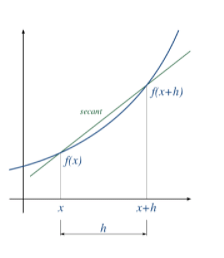
Quotient Formula Graph
Discover about the Chapter video:
Continuity and Differentiability Detailed Video Explanation:
Also Read: Continuity Equation
Derivation of Difference Quotient Formula
[Click Here for Sample Questions]
Consider the function y = f(x) and draw a secant line across two points on the curve (x, f(x)) and (x + h, f(x + h). The slope of the secant line is calculated using the slope formula as follows:
As the slope of any straight line is equal to change in y / change in x, the difference quotient formula is derived.
[ f(x + h) - f(x) ] / [ (x + h) - x] = [ f(x + h) - f(x) ] / h
Also note that, the secant of y = f(x) becomes a tangent to the curve y = f(x) as h is 0. If h is 0, the difference quotient yields the tangent's slope, and hence the derivative of y = f(x).
f ' (x) = lim h→0h→0 [ f(x + h) - f(x) ] / h
Also Read:
| Related Articles | ||
|---|---|---|
| Integers As Exponents | Ordinate | Collinear points |
| Operations on Rational Numbers | Addition And Subtraction Of Integers | Multiplication And Division Of Integers |
Things to Remember
- The difference quotient is the term for the statement in single-variable calculus that, when carried to the limit when h approaches 0, produces the derivative of the function f.
- The slope of a line passing through two locations is calculated using the Difference Quotient Formula. It is also used in the derivative's definition.
- The derivative is usually found using the difference quotient formula. The derivative of the function is given by the limit of the difference quotient when h is 0.
- f ' (x) = lim h→0h→0 [ f(x + h) - f(x) ] / h
- The difference quotient is also known as the Newton quotient (after Isaac Newton) or Fermat's difference quotient (after Pierre de Fermat).
Also Read:
Sample Questions
Ques: Find the difference quotient of the function f(x)= In x. (2 marks)
Ans: The difference quotient of f(x) is.
[ f(x + h) - f(x) ] / h
= [ ln (x + h) - ln x ] / h
= ln [ (x + h) / x ] / h
(Quotient property of logarithms, ln m - ln n = ln (m / n))
Ques: Find the difference quotient of the function f(x) = x2 – 4x + 3? (3 marks)
Ans: f(a) = a2-4a+3
f(a+h)= (a+h)2-4(a-h)+3
Expanding f(a +h) using (m ± n)2 = m2 ± 2mn + n2 algebraic property. Now, distributing 4 in the second group and then combining like terms
f(a+h)=(a2+2ah+h2)–4(a+h)+3=a2+2ah+h2–4a–4h+3=a2+2ah+h2–4a–4h+3
Difference between the two expressions
f(a+h)–f(a)=a2+2ah+h2–4a–4h+3–(a2–4a+3)=a2+2ah+h2–4a–4h+3–a2+4a–3=h2+2ah–4h
Difference Quotient=h2+2ah–4hh=h+2a–4
The function f(x)=x2 -4x + 3 has a difference quotient of h+2a-4
Ques. What is the difference quotient of the function f(x) = 2x+5? (3 marks)
Ans. Calculate f(x+h)
f(x+h)=2(x+h)+5f(x+h)=2(x+h)+5
= 2x + 2h + 5
Now, substitute f(x+h) with f(x) with the difference quotient formula
[f(x+h)−f(x)]h[f(x+h)−f(x)]h =[2(x+h)+5−(2x+5)]h
=2h/h =2
Hence, the difference quotient of f(x)= 2x+h is 2
Ques. What is the difference quotient of the function f(x) = 3x-5? (2 marks)
Ans. Difference quotient of f(x)
= [ f(x + h) - f(x) ] / h
= [ (3(x + h) - 5) - (3x - 5) ] / h
= [ 3x + 3h - 5 - 3x + 5 ] / h
= [ 3h ] / h
= 3
Ques. Given, fa+h=6a+6h+5 and f(a)=6a+5. Choose the correct option (2 marks)
a)f(x) = 6(x+1)
b)Difference quotient of f(x) is 6h
c)f(x) = 6x + 5
d)Difference quotient of f(x) is 6
Ans. c) f(x) = 6x + 5
As, the function f(x) will be equal to 6x + 5 after solving the expressions fa+h=6a+6h+5 and f(a)=6a+5.
Ques. Find the difference quotient of fx=14x . (3 marks)
Ans. Finding out f(a) and f(a+h)
f(a)=14af(a+h)=14(a+h)
Subtracting the two expressions above
f(a+h)–f(a)=14(a+h)–14a=a4a(a+h)–a+h4a(a+h)=a–(a+h)4a(a+h)=a–a–h4a(a+h)=-h4a(a+h)
Multiply the expression by 1h
Difference Quotient=h2+2ah–4hh=1h⋅-h4a(a+h)
=-14aa+h
Hence, the function has the difference quotient of -14a(a+h) or -14a2+4ah
Ques. What is the function's difference quotient as depicted by the graph? (3 marks)
Ans.

Difference quotient =f(a+h)–f(a)h
Subtract the two expressions since both f(a) and f(a+h) are already known. When dispersing the negative sign, it is vital to double-check.
f(a+h)–f(a)=4(a+h)+9–(4a+9)=4a+4h+9–4a–9=4h
Divide the difference by h
=4hh=4
Hence, the difference quotient of the function is 4
Ques. By using the limit h=0 to the difference quotient formula, find the derivative of f(x) 2x2-3. (3 marks)
Ans.
= [ f(x + h) - f(x) ] / h
= [ (2(x + h)2 - 3) - (2x2 - 3) ] / h
= [ (2 (x2 + 2xh + h2) - 3) - 2x2 + 3 ] / h
= [ 2x2 + 4xh + 2h2 - 2x2 + 3 ] / h
= [ 4xh + 2h2 ] / h
= [ h (4x + 2h) ] / h
= 4x + 2h
By using the limit as h= 0
f '(x) = 4x + 2(0) = 4x
Ques. Find the difference quotients of f(x) =8 and g(x) = π. State the reason behind these difference quotients. (4 marks)
Ans. f(a+h)=8
g(a+h)=π
As a result, the difference for each is equal to zero, and their difference quotients are also equal to zero.
Throughout any given interval, the constant functions and will always stay constant. This indicates that at any point along their curves, the rate of change will be zero.
Ques. State the difference quotient of the function f(x) = 2x/3-x. (3 marks)
Ans. First, calculating f(a) and f(a+h)
f(a)=2a3–af(a+h)=2(a+h)3-(a+h)=(2a+2h)3–a-h
Subtracting f(a) and f(a+h) with a common denominator
fa+h–fa=2a+2h3–a–h–2a3–a=2a+2h3–a3–a–h3–a–2a3–a–h3–a–h(3–a=6a–2a2+6h–2ha–6a–2a2–2ah3–a–h3–a=6h3–a–h3–a
Difference Quotient=h2+2ah–4hh=1h⋅6h(3-a-h)(3–a)
Canceling out h
=6(3–a–h)(3–a)
Hence, the f(x) = 2x/3-x is the difference quotient of 6(3–a–h)(3–a)
Ques. f(x)= px +q, where p and q are nonzero coefficients, is the generic form of a linear function. Show that every linear function's difference quotient equals the coefficient before x. (2 marks)
Ans. Deriving f(a) and f(a+h) in p and q terms
f(a)=pa+qf(a+h)=p(a+h)+q=pa+ph+q
Subtracting the two and dividing by h
Difference Quotient=h2+2ah–4hh=pa+ph+q–(pa+q)h=phh=p
Hence, the difference quotient of f(x)= px +q is p
For Latest Updates on Upcoming Board Exams, Click Here: https://t.me/class_10_12_board_updates
Check-Out:



Comments