



Content Writer
Esters are all around us. The majority of naturally occurring fats and oils are glycerol fatty acid esters. Esters are usually aromatic, and those with low molecular weights are widely employed in perfumes, essential oils and pheromones. For example, ethyl ethanoate is the ester produced by ethanol and ethanoic acid. In this, the Ethanol is reduced to ethyl while ethanoic acid is converted to ethanoate.
| Table of Content |
Key Terms: Chemical compounds, Condensation, Compounds, Esters, benzene, Ethanol, Esterification, Ester group, Oleochemicals
What is Ester?
[Click Here for Sample Questions]
Esters are chemical compounds that include an ester group, which is represented by the formula R-COO-R'. Esters are oleochemicals, which means they are naturally derived compounds rather than manufactured, possibly hazardous chemicals.
They are formed by the condensation of carboxylic acid and alcohol. The following is the typical chemical equation for an esterification reaction:
Alcohol + Carboxylic Acid ⇔ Water + Ester
Also Read:
Esterification
[Click Here for Sample Questions]
Esterification refers to the chemical process used for the production of the ester. It is a process of mixing an organic acid (RCOOH) with an alcohol (ROH) to produce an ester (RCOOR) and water. In other words, it is a chemical reaction that produces at least one ester product. Ester is formed by the esterification of an alcohol and a carboxylic acid.
Esterification Reaction
[Click Here for Sample Questions]
Esters are formed when carboxylic acids are heated with alcohol using an acid catalyst. Typically, concentrated sulphuric acid is used as a catalyst.
Dry hydrogen chloride gas, on the other hand, is beneficial in some instances that lean toward aromatic sweet-smelling esters with the benzene ring. The esterification process is the chemical reaction used for the production of the ester.

Mechanism of Esterification
[Click Here for Sample Questions]
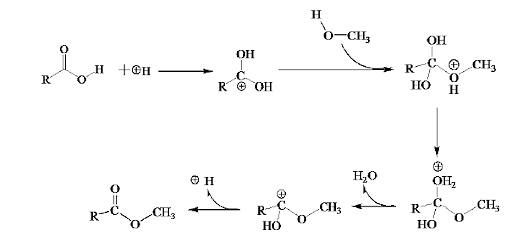
The esterification mechanism consists of five stages. The procedure is as follows:
- Stage 1: Cation Formation- The first step involves ethanoic acid absorbing a proton (a hydrogen ion) from concentrated sulphuric acid. This proton binds to one of the solitary oxygen pairs that is double-bonded to the carbon.
- Stage 2: Delocalized Carbonation- Methanol serves as a nucleophile to a carbocation, despite the fact that there is an excess of methanol molecules in the solution. Here, the carboxyl oxygen is protonated, resulting in a delocalized carbocation, which makes the carbocation a greater electrophile.
- Stage 3: Proton Transfer -The protonated ether evaporates as methanol but accomplishes nothing. A proton transfers to one of the hydroxyl groups, which makes it an excellent leaving group.
- Stage 4: Forming a Pi Bond- The oxygen alcohol atom from the hydroxyl group gives a pair of electrons to the carbon atom and forms a bond after removing water molecules. Because its concentration is low in comparison to the concentration of the methanol, this removed water is not a suitable nucleophile capable of reversing the reaction.
- Stage 5: The concentration of water required to reverse the whole process is incredibly low.
Methods of Esterification
[Click Here for Sample Questions]
There are three methods that are used for the production of esters.
1. Production of esters from carboxylic acids-
- This technique can be used to convert alcohols into esters. However, it does not work with phenols, which are molecules in which the -OH group is directly linked to a benzene ring. Phenols react very slowly with carboxylic acids that the reaction is useless for preparation.
- Esters are formed when carboxylic acids and alcohols are heated in the presence of an acid catalyst.
- Mostly the catalyst used in this is the concentrated sulphuric acid. In certain situations, dry hydrogen chloride gas is used, but this usually involves aromatic esters.

2. Production of esters from acid chlorides-
- This technique is applicable to both alcohols and phenols.
- In the case of phenols, the reaction starts by first converting the phenol into a more reactive state. Even at room temperature, introducing an acyl chloride or acid chloride to alcohol results in the formation of esters and clouds of steamy acidic vapours containing hydrogen chloride.
- One of the example of ester formation is given below:

Production of esters from acid chlorides
- When liquid ethanoyl chloride is added to ethanol, it produces hydrogen chloride as well as the liquid ester ethyl ethanoate.
- Phenol is made up of a -OH group attached to a benzene ring. The reaction between ethanoyl chloride and phenol is not as strong as the ethanol reaction. Along with hydrogen chloride gas, phenyl ethanoate is formed.
- C6H5COCl is the formula for Benzoyl chloride. The -COCl group binds to a benzene ring. Benzoyl chloride is significantly less reactive than acyl chlorides like ethanoyl chloride.
- When phenol is dissolved in sodium hydroxide solution, it first transforms to the ionic molecule sodium phenoxide (sodium phenate).
- As a result, the phenoxide ion reacts more quickly with benzoyl chloride than the phenol.
- To obtain solid phenyl benzoate, it must be shaken with benzoyl chloride for around 15 minutes.

Production of esters from acid chlorides
3. Production of esters from acid anhydrides-
- This process can be used to create esters from alcohols and phenols once again. The reactions are slower than the reactions with acyl chlorides, and the mixture must generally be warmed.
- In the case of a phenol, you can first react with sodium hydroxide solution to produce the more reactive phenoxide ion.
- The reaction with phenol will be similar, but slower. Ethanoic acid and phenyl ethanoate will combine and form phenyl ethanoate.
- This reaction is not significant, but it is involved in the production of aspirin. The process will speed up if the phenol is first transformed into sodium phenoxide by adding sodium hydroxide solution.
- Phenyl ethanoate is produced again. However, this time the by-product is sodium ethanoate rather than ethanoic acid.

Properties of Ester
[Click Here for Sample Questions]
Some of the properties of Ester are as follows-
- Boiling Point: Small esters have similar boiling points to aldehydes and ketones with the same number of carbon atoms. Esters, like aldehydes and ketones, are polar compounds with dipole-dipole interactions and van der Waals dispersion forces. They do not establish ester-ester hydrogen bonds, thus their boiling points are much lower than those of an acid with the same amount of carbon atoms.
- Water Solubility: Many esters' solubility in lipids and water is an essential physical characteristic. Esters are water soluble because their polar oxygen-carbon links may participate in hydrogen bonding.
The positively charged hydrogen in a water molecule will be attracted to the negatively charged oxygen in an ester molecule. Small esters are very soluble in water but as the ester molecule grows bigger, it becomes less soluble in water. When the ester chains become too long, the hydrocarbon components begin to break the hydrogen bonds between the water molecules.
- Melting Point: The melting point of a material determines whether it is a fat or an oil. Saturated chains are common in fats. These enable more effective van der Waals dispersion forces between molecules which require more energy to break the chains and raise the melting point.
Importance and uses of Ester
[Click Here for Sample Questions]
The following are some of the uses of ester:
- Due to their inherently pleasant smells, esters are popular among perfumers and personal care product makers. For example, Propyl Ethonoate smells like fresh pairs of shoes, whereas Pentyl Nonoate smells like flowers and Propyl Octanoate smells like coconut.
- Esters can also be used as a solvent. Solvents dissolve substances, allowing them to combine and function effectively. To attain the correct consistency, many personal care products, such as powders, lotions, and shaving creams, include solvents.
- Esters are useful for the skin. They are emollients, which means they moisturise and soften the skin. Emollients are active chemicals in lotions and creams used to enhance skin texture. Esters, unlike other types of emollients, do not leave an oily residue on the skin, which offers them a benefit.
Things to Remember
- The process of esterification is used as a test reaction for new carbonaceous acid catalysts.
- Esterification is the chemical reaction that results from the reaction of alcohol (ROH) and an organic acid (RCOOH) to produce an ester (RCOOR) and water.
- At the carbonyl carbon, esters react with nucleophiles. Carbonyl is a weakly electrophilic compound that is attacked by strong nucleophiles.
- Esters have a higher polarity than ethers but a lower polarity than alcohols. Unlike their parent alcohols and carboxylic acids, they may participate in hydrogen bonding as hydrogen bond acceptors but not as hydrogen bond donors.
- Esters have the general formula R–COO–R′, which is similar to that of organic acids except that the H in the –COOH has been replaced by a hydrocarbon group. The end of an ester's name is ate, as in ethyl acetate.
Also Read:
Sample Questions
Ques: Why do esters have a pleasant odour? (1 Mark)
Ans: Volatile compounds have the ability to emit odours. The volatile property of the chemical causes it to smell. The compound's volatile nature is due to weak intermolecular forces.
Ques: Which type of ester can be found in Apple? (1 Mark)
Ans: Ethyl-2-methyl butyrate is a naturally occurring ester found in apples, oranges, strawberries, cheeses, milk, mango, and cognac, among other things.
Ques: Give a chemical test to differentiate between Benzoic acid and Phenol. (Comptt. Delhi 2012, 1 Mark)
Ans: With NaHCO3 solution, benzoic acid produces a vigorous effervescence, whereas phenol does not.
Ques: Rearrange the following compounds in the increasing order of their boiling points: (All India 2013, 1 Mark)
CH3 — CHO, CH3 — CH2 — OH, CH3 — CH2— CH3
Ans: CH3CH2CH3 < CH3CHO < CH3CH2CH
Ques: How can water be removed from the production of ethyl acetate? (All India 2014, 2 Marks)
Ans: Ethyl acetate is the product of the reaction of ethanol with acetic acid (Fischer esterification process) in presence of an acid catalyst, such as sulphuric acid, hydrochloride acid, etc. with the equation:
CH3CH2OH + CH3COOH ↔ CH3 COOC2H5 + H2O
Ques: Why is an esterification a slow process? (2 Marks)
Ans: The ester is the sole component of the combination that does not establish hydrogen bonds, it has the lowest intermolecular interactions. Larger esters tend to develop at a slower rate. In some situations, heating the reaction mixture under reflux for a period of time may be required to achieve an equilibrium mixture.
Ques: What are the most prevalent applications for esters? (2 Marks)
Ans: Phosphate esters are physiologically significant (nucleic acids are among them) and are widely utilised in industry as solvents, plasticizers, flame retardants, gasoline and oil additives, and pesticides. Sulfuric and sulphurous acid esters are employed in the production of colours and medicines.
Ques: Are esters naturally occurring? (2 Marks)
Ans: Esters are found all over the world. They are well-known for creating a variety of pleasing scents and tastes. They are found naturally in many foods, including fruits, as well as in alcoholic drinks. Triesters, molecules with three ester groups, are found in nature as oils and fats.
For Latest Updates on Upcoming Board Exams, Click Here: https://t.me/class_10_12_board_updates
Check-Out:



Comments