



Exams Prep Master
Eugenol is an organic component found primarily in plants such as cloves, cinnamon, wormwood, and lemon balm. This phenolic molecule is a weak acid exhibiting antifungal, antioxidant, neuroprotective, and antimicrobial properties. As a significant particle of essential oils, eugenol is generally a pale yellow oily liquid. It is termed an aromatic photochemical due to its sharp, strong, and spicy odor. The term 'Eugenol' is derived from Eugenia Caryophyllata, the nomenclature identity priorly used for cloves.
| Table of Contents |
Key Terms: Chain-Substituted Guaiacol, Reduced Phenylpropanoid, Phenolic Molecule, Eugenol, Weak Acid, Aromatic Photochemical, Carbon, Hydroxide bond, Methoxy group, Allyl group
What is Eugenol?
[Click Here for Sample Questions]
Eugenol is a phenolic compound and is part of the allylbenzene class present in the form of chain-substituted guaiacol. This phenoplast substance is primarily found in clove oil apart from other angiosperms such as holy basil, sweet basil, nutmeg, and cinnamon. The molecular structure of this antiseptic substance consists of a six-membered carbon ring with double bonds on every second carbon. A hydroxide(OH) bond, methoxy group (OCH3), and allyl (CH2-CH=CH2) group is individually bonded to one of the carbons in the ring.
Also Read:
| Related Articles | ||
|---|---|---|
| Uses of Methanol and Ethanol | Isopropyl Alcohol | Preparation of Alcohols |
| Nomenclature of Alcohols Phenols and Ethers | Esterification | IUPAC Nomenclature of Organic Compounds |
Structure of Eugenol
[Click Here for Sample Questions]
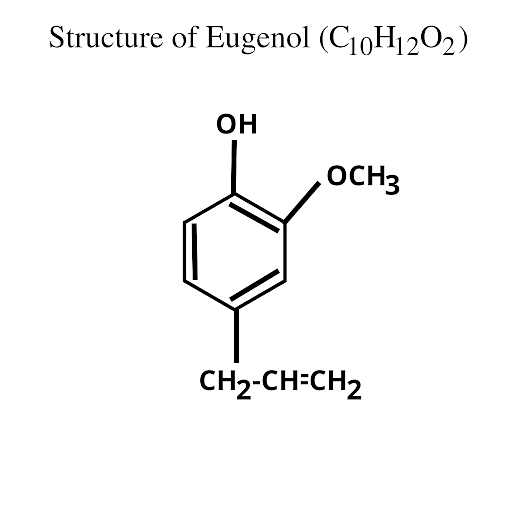
Structure of Eugenol - C10H12O2
Physical Properties of Eugenol
[Click Here for Sample Questions]
Eugenol is an aromatic component with a pungent taste. Being one of the major compounds found in Clove oil, it is a semi-volatile substance. This reduced phenylpropanoid has a large polar surface area with non-polar properties. There are 3 rotational bonds present in the structure of eugenol with the overall compound having 24 bonds. The significant physical properties of eugenol are listed in the below table.
| IUPAC Name | 2-methoxy-4-(prop-2-en-1-yl) phenol |
| Other Names |
|
| Color | Colorless to pale yellow |
| Density | 1.06 g cm-3 |
| Molar mass | 164.2 g/mol |
| Hydrogen bond donor count | 1 |
| Hydrogen bond acceptor count | 2 |
| Formal charge | 0 |
| Melting point | 265.65 K / -7.5°C / 18.5° F |
| Boiling point | 527.15K / 254°C / 489.2°F |
| Acidity (pKa value ) | 10.19 at 25°C / 298.15K |
Chemical Properties of Eugenol
[Click Here for Sample Questions]
Eugenol is a weak acid in nature having the aspect that turns red litmus paper into blue. Eugenol is soluble in water and organic solvents with different solubility levels. It is miscible in water, ether, and other volatile oils and can be dissolved in chloroform and alcohol. When exposed to direct air, the compound consistency thickens making it darker. Some of the chemical properties of Eugenol with other chemical compounds are listed below.
- When Eugenol reacts with iron chloride it undergoes double displacement with hydrochloric acid as a product. The chemical reaction is given below.
| C10H12O2 + FeCl3 → C10H9O2Fe + 3HCl |
- Eugenol upon reacting with bromine forms 1,3- Dibromobutyl benzene and oxygen molecule. Here the bromine molecule replaces oxygen atoms to form 1,3-Dibromo-1-phenylbutane. The chemical reaction is shown below.
| C10H12O2 + Br2 → C10H12Br2 + O2 |
Uses of Eugenol
[Click Here for Sample Questions]
Eugenol has varied uses due to its antiseptic, antimicrobial, and antioxidant properties.
- It is used as a flavoring substance in foods due to the presence of strong, spicy flavors.
- The anti-inflammatory and antimicrobial properties of eugenol can potentially treat skin conditions such as acne and inflammation. It is thus used in cosmetics, perfumes, and essential oils.
- Chemistry Eugenol when combined with zinc oxide is used as a dental cavity liner. This protects the pulp in case of tooth decay. Additionally, this compound is used as an anesthetic in dentistry.
- With antifungal properties, it is incorporated into pesticides and fungicides. Most mosquito repellents include eugenol due to its strong aroma.
- It is also used to efficiently treat oral infections, migraines, etc due to its neuroprotective properties.
Things to Remember
- Eugenol is present in abundant quantities in Clove oil extracted from buds, stems, or leaves.
- It is a weakly acidic phenolic compound with neuroprotective and antioxidant characteristics.
- This component present in essential oils turns a brown shade when contacted with air.
- Eugenol present in clove oil has a toxic effect when consumed in higher doses. Abdominal pain, diarrhea, and nausea are some of the adverse effects.
Also Read:
Sample Questions
Ques. Is Eugenol a soluble component? (3 Marks)
Ans. Eugenol is a non-polar compound soluble partially in water whereas it has high solubility with organic solvents. This pale yellow liquid can dissolve in glacial acetic acid and alkali hydroxide solutions such as ethanol and methanol. Moreover, this oily component is miscible with chloroform, ether, and other volatile oils.
Ques. Name any functional group present in Eugenol (3 Marks)
Ans. Several functional groups are present in the structure of eugenol. Reactive groups such as phenol (OH), allyl (H2C=CH-CH2R), and methoxy (OCH3) group are present in the chemistry Eugenol. The presence of the hydroxyl group gives the molecule phenol properties. The stability of the compound is ensured with the presence of the allyl group.
Ques. Is Isoeugenol the same as eugenol? (3 Marks)
Ans. Both eugenol and isoeugenol have chemical formulas (C10H12O2) but differ in the arrangement of molecules. The fundamental difference between these structural isomers is odor. While eugenol has a spicy odor resembling cloves, isoeugenol has a much more fragrant odor. Also, eugenol is a pale yellow oil liquid while isoeugenol can be either in crystalline or liquid form depending upon the type of isomer.
Ques. Is eugenol an inhalable substance? (3 Marks)
Ans. Eugenol is highly toxic if inhaled directly in the form of clove oil. The inhaled substance can damage the respiratory system and cause irritation, shortness of breath, and abnormal breathing. It is non-toxic when consumed in unburned form as a food additive. Upon consumption in heavy doses, it can cause severe damage to the liver, kidneys, and other important organs.
Ques. Which technique is used for the extraction of Eugenol? (3 Marks)
Ans. Steam Distillation is a method in which essential oils are extracted from different plants. Upon extraction of essential oils from clove, cinnamon, holy basil, and sweet basil, 3% potassium hydroxide is combined. This extracts the eugenol present in essential oils. Additionally, sodium hydroxide solution is also used in the same amount to isolate Eugenol.
Ques. How many bonds are present in the structure of Eugenol? (3 Marks)
Ans. A total of 24 bonds exist in the structure of the eugenol (C10H12O2) molecule. 7 multiple bonds, 3 rotatory bonds, a single six-membered carbon ring, an outer double bond, and 12 non-hydrogen bonds are present. Within these bonds, 6 bonds are aromatic. For instance, ether and hydroxyl are aromatic bonds in the chemistry of eugenol.
Ques. What is the melting and boiling point for chemistry eugenol? (2 Marks)
Ans. The melting point of Eugenol is -7.5° Celsius (18.5°F) while the boiling point is 254° Celsius(489.2 °F). Eugenol should not be stored in temperatures over 25° Celsius and should be kept away from direct sunlight and air. This prevents it from turning darker and thick in density.
Ques. Name any five medical properties of Eugenol present in clove oil. (3 Marks)
Ans. Chemistry Eugenol has antibacterial, antifungal, antioxidant, anti-inflammatory, antineoplastic, antiseptic, anesthetic, and neuroprotective properties. The multiple properties of Eugenol help in treating diseases and symptoms such as skin conditions, toothache, etc. The compound also exhibits non-carcinogenic characteristics.
Ques. What happens when Eugenol is heated? (3 Marks)
Ans. When eugenol is heated at high temperatures it decomposes and emits irritating and pungent smoke. Decomposition of this organic component results in the production of carbon dioxide (CO2) and carbon monoxide (CO). No specific decomposition temperature is verified for the compound. Usually, it starts the decomposition mechanism when heated beyond its boiling point ( 254°C) and emits toxic fumes.
Ques. Is eugenol reactive in nature? (3 Marks)
Ans. Under normal conditions, it is a non-reactive and potentially stable component. Additionally, it is a non-flammable substance under normal conditions. Combustion occurs when exposed to direct fire conditions. In addition, Eugenol has low compatibility with reactive substances such as oxidizing agents, iron, strong alkalies, and zinc.
Check-Out:



Comments