



Education Journalist | Study Abroad Lead
Ferrite is a ceramic-like substance that has magnetic properties and is used in a variety of electronic devices. Ferrites are hard, brittle, iron-containing, grey or black in colour, and polycrystalline—that is, made up of many tiny crystals. They are made up of a chemical mixture of iron oxide and one or more additional metals. Ferric oxide (iron oxide or rust) reacts with a variety of different metals, including magnesium, aluminium, barium, manganese, copper, nickel, cobalt, and even iron itself, to generate ferrite.
Read Also: Maltase
| Table of Content |
Key Takeaways: Ferrites, Metals, Magnets, Crystals, Electronic devices, Magnesium, Aluminium, Barium, Manganese, Copper, Nickel, Cobalt, Iron
Structure of Ferrite
[Click Here for Sample Questions]
Ferrite crystals are those that have the inverted spinel structure rather than the normal spinel structure: The B cations occupy one-eighth of the tetrahedral holes, whereas the A cations occupy one-fourth of the octahedral sites. The remaining one-fourth is taken care of by the B cation.
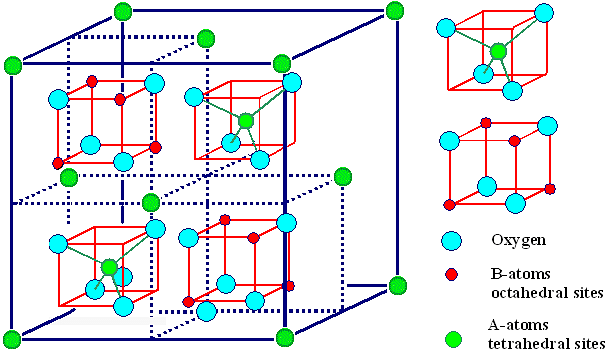
Structure of Ferrite
In addition, mixed structure spinel ferrites with the formula [M2+1- Fe3+] [M2+ Fe3+2- ] O4 are conceivable. The magnetic substance, known as "ZnFe" has the formula ZnFe2O4, with Zn2+ filling the tetrahedral sites and Fe3+ occupying the octahedral sites; it is a typical spinel ferrite structure. Only a few ferrites, such as the strontium and barium ferrites SrFe12O19 (SrO:6Fe2O4) and BaFe12O19, have a hexagonal crystal shape (BaO:6Fe2O6). Concerning their magnetic properties, often, the various ferrites are classified as either "soft", "semi-hard," or "hard," which refers to their low or high magnetic coercivity.
Also Read:
| Related Articles | ||
|---|---|---|
| Chemical Indicators | Acids & Bases | Types of Titration |
| Phenolphthalein | Saturated Solutions | Dilution Formula |
Composition of Ferrite
[Click Here for Sample Questions]
Ferrite is a ceramic-like substance with magnetic properties that can be used in a wide range of electronic devices. Ferrites are brittle, hard, iron-containing minerals that are often black or grey in colour and polycrystalline, meaning they are made up of many tiny crystals. These are made up of a chemical mixture of iron oxide and one or more additional metals. Permanent magnetism that occurs in solids is known as ferrimagnetism.
Ferrites are typically ferromagnetic ceramic compositions formed from iron oxides. Magnetite (Fe3O4) is one well-known example. Ferrites, like most other ceramics, are brittle, poor, and difficult conductors of electricity. Several ferrites have a spinel structure with the formula AB2O4, where A and B represent distinct metal cations, most often iron (Fe). Typically, spinel ferrites have a structural pattern of cubic close-packed (fcc) oxides (O2-), with A cations occupying one-eighth of the tetrahedral holes and B cations occupying half of the octahedral holes, resulting in A2+B23+O42-.
Hard Ferrites
Hard ferrites are used to make permanent ferrite magnets, which have a high remanence and coercivity following magnetization. Hard ferrite magnets can be made from barium and iron oxide, as well as strontium carbonate. High coercivity refers to the materials' resistance to demagnetization, which is a crucial property for a permanent magnet. They have a high magnetic permeability as well. These so-called ceramic magnets are inexpensive and commonly utilised in home items such as refrigerator magnets. The magnetic field H can be as strong as 30 to 160 kilo ampere turns per metre (400 to 2000 oersteds), while the magnetic field B can be as strong as 0.35 tesla. At the same time, ferrite magnets have a density of up to 5 g/cm3.
Soft Ferrites
Zinc, nickel, and/or manganese compounds are found in ferrites, which are employed in electromagnetic or transformer cores. Soft ferrites are ferrites that have a low coercivity. The low coercivity of the material allows it to readily reverse direction without losing energy (hysteresis losses), while the high resistivity of the material inhibits eddy currents in the core, which is another cause of energy loss. They can be widely employed in RF transformers and inductor cores in applications such as loopstick and switched-mode power supplies antennas used in AM radios due to their comparatively low losses at higher frequencies.
Semi-hard Ferrites
Cobalt ferrite, with the chemical formula CoFe2O4 (CoOFe2O3), is a semi-hard material that falls between soft and hard magnetic materials. Because of its high saturation magnetostriction (at 200 ppm), it is mostly employed in magnetostrictive applications such as actuators and sensors. The cobalt ferrite also has the advantage of being rare-earth-free, making it a viable alternative to Terfenol-D. Inducing a magnetic uniaxial anisotropy can also be used to adjust its magnetostrictive properties. This can be accomplished through magnetic field-assisted compaction, magnetic annealing, or uniaxial pressure reaction. With the use of spark plasma sintering, this last method has the benefit of being ultra-fast (less than 20 minutes).
Production of Ferrite
[Click Here for Sample Questions]
Ferrites are made by heating a combination of constituent metal oxides at higher temperatures, as shown in this idealized equation:
ZnFe2O4 = Fe2O3 + ZnO
The finely powdered precursor mixture is pressed into a mould in a few circumstances. Typically, strontium and barium ferrites are supplied as their carbonates, SrCO3 and BaCO3, respectively. During the heating process, these carbonates are calcined:
MO + CO2 → MCO3
Following that, the two oxides mix to form ferrite. Sintering is done on the oxide mixture that results.
Uses of Ferrite
[Click Here for Sample Questions]
Ferrite cores are employed in transformers, electromagnets, and electronic inductors because of their high electrical resistance, which results in very low eddy current losses. They are commonly observed as a lump in a computer cable called a ferrite bead, which serves to prevent high-frequency electrical noise (also known as radio frequency interference) from leaving or entering the device. The data was saved in the residual magnetic fields of the hard ferrite cores that were combined into core memory arrays in the early computer memories. Magnetic recording tape coatings can be made with ferrite particles.
Things to Remember
[Click Here for Sample Questions]
- Ferrite is a magnetic ceramic-like material that can be employed in a wide range of electronic devices.
- Ferrites are brittle, hard iron-containing minerals that are often black or grey in colour and polycrystalline, meaning they are made up of many small crystals.
- Permanent ferrite magnets are made from hard ferrites and have a strong remanence and coercivity after magnetization.
- Ferrites are a chemical compound made composed of iron oxide and one or more other metals.
- Because of their high electrical resistance, ferrite cores are used in transformers, electromagnets, and electronic inductors. This results in very low eddy current losses.
Also Read:
Sample Questions
Ques: What are the Most Common Ferrites? (2 Marks)
Ans: Manganese-zinc ferrite (MnZn - chemical formula Mn2Zn(1-a)Fe2O4) is a common soft ferrite. Nickel-zinc ferrite (NiZn - having the chemical formula NiaZ(1-a)Fe2O4) has a higher saturation induction and permeability than NiZn. NiZn ferrites have higher resistivity than MnZn ferrites, making them more suited for frequencies above 1 MHz.
Ques: Give the Uses of Ferrite? (2 Marks)
Ans: Ferrite particles can be found in radar-absorbing coatings or materials used in stealth aircraft, as well as in the absorption tiles that line the rooms where electromagnetic compatibility tests are conducted. Ferrite magnets are the most prevalent audio magnets, including those used in electromagnetic instrument pickups and loudspeakers. In these applications, ferrite magnets have essentially superseded the more expensive Alnico magnets, with the exception of a few "vintage" goods.
Ques: What is Barium Ferrite? (2 Marks)
Ans: Permanent magnets are commonly made using BaFe12O19, which is a common material. Barium ferrites are tough ceramics that are corrosion-resistant and moisture resistant. They can be employed in loudspeaker magnets and as a medium for magnetic recording on magnetic stripe cards.
Ques: What are Hard Fertilisers? (2 Marks)
Ans: Because hard ferrites have a high coercivity, they are difficult to demagnetize. They can also be used to make permanent magnets for uses like loudspeakers, refrigerator magnets, and small electric motors.
Ques: What type of substances would make better Permanent Magnets: Ferromagnetic or Ferrimagnetic? (1 Mark)
Ans: Ferromagnetic substances would make better magnets.
Example: Fe, Co, Ni etc.
Ques: Magnetic ceramics or ferrites contain various compounds of iron. How can they be used? (2 Marks)
Ans: It's simple to magnetise ceramic magnets or ferrites. These materials are extremely corrosion resistant and typically do not require any additional corrosion protective coatings. Magnetic ceramics or ferrites are highly responsive to magnetic fields because of their low hysteresis losses, and their reduced conductivity reduces eddy current losses. High-efficiency transformers require the use of such materials.
Ques: What is the heating element of an electric heater made of? (3 Marks)
Ans: When a known quantity of voltage is applied, specific resistance is defined as the resistance offered per unit length and unit cross-sectional area. The ohm metre is its SI unit. It's the reciprocal of specific conductance, which is a measurement of a material's ability to conduct electricity. The melting point of a material is typically described as the point at which it transitions from solid to liquid. It is also pressure dependent and is specified at standard pressure. An electric heater's heating element should now be built of a material with a high specific resistance and melting point. When the particular resistance is high, a small piece of wire is utilised to generate the appropriate amount of heat; otherwise, a larger amount of wire would be required. Furthermore, a greater melting point is used in order to achieve a higher temperature.
Ques: Write a note on Ferrimagnetic substances. (2 Marks)
Ans: Ferrimagnetic substances, such as Fe3O4, ferrites of the formula M2+Fe2O4 where M = Mg, Cu, Zn, etc., are expected to have considerable magnetism based on the unpaired electrons but actually have a minimal net magnetic moment. The unequal amount of magnetic moments in opposite directions causes ferrimagnetism, which results in a net magnetic moment.
For Latest Updates on Upcoming Board Exams, Click Here: https://t.me/class_10_12_board_updates
Check-Out:



Comments