



Education Journalist | Study Abroad Lead
Inductance (L) is a property of an inductor that opposes changes in direction or magnitude of current that flows through it. When an electric current goes through a conductor, it creates a magnetic field around it. A changing magnetic field is caused by a changing current. The magnetic flux fluctuates as a result, and an electromotive force is induced. The induced one volt by altering current in one ampere per second in an inductance value is equal to one Henry value.
| Table of Content |
Key Terms: Inductance, Units, Magnetic field, Current, magnetic flux, changing magnetic field, inductor, electromotive force, volt, altering current, ampere
What is Inductance?
[Click Here for Sample Questions]
The tendency of an electrical conductor to resist a change in the electric current passing through it is known as inductance. A magnetic field is created around a conductor by the flow of electric current. The field strength is proportional to the current magnitude and follows any variations in current.
Any change in the magnetic field via a circuit generates an electromotive force (EMF) (voltage) in the conductors, according to Faraday's law of induction, a process known as electromagnetic induction.
In electrical and electronic circuits, inductance is a critical characteristic. It can be considered a fundamental electrical measurement, similar to resistance capacitance, that has an impact on all circuits to some amount.
Read More: Electromagnetic Induction
Inductance can also be used in a variety of electrical and electronic systems, as well as circuits. The gears come in a variety of shapes and sizes, as well as several different names. Coils, chokes, transformers, inductors, and other components are examples.
Similarly, each of these categories can be divided into subtypes, with some having cores and others not. Similarly, the fundamental components come in a variety of forms. When you study inductance and its many sorts and formats for transformers and inductors, you'll be able to understand how an electrical and electronic circuit works.
Also Read:
| Related Articles | ||
|---|---|---|
| Unit of Magnetic Flux | Emf formula | Experiment faraday henry |
| Magnetic Induction Formula | Motional emf | Electromagnetic Field |
Unit of Inductance
[Click Here for Previous Year Questions]
- The sign "L" is commonly used to represent an inductor on a circuit diagram or in an equation. Inductors are usually labeled L1, L2, etc. on circuit diagrams.
- The henry, H, is the SI unit of inductance, which can be expressed in terms of current and voltage rate of change.
- If the rate of change of current in a circuit is one ampere per second and the electromotive force is one volt, the inductance of the circuit is one henry.
Types of Inductance
[Click Here for Sample Questions]
Inductance can be utilized in two different ways:
Self-inductance
Self inductance is a property of a circuit, most commonly a coil, in which a change in current induces a change in voltage in that circuit due to the magnetic influence of the current flow. Self-inductance is an inductance that applies to a single circuit, or in other words, it is an inductance that occurs within a single coil. In single coils or chokes, this effect is used.
When the current grows, the self-induced emf in the coil resists the rise of current, and it also resists the fall of current when the current drops. In essence, if the current is growing, the induced emf is in the opposite direction of the applied voltage, and if the current is decreasing, the induced emf is in the same direction as the applied voltage.
A change in current in one circuit can create a change in magnetic flux in another circuit, and therefore induce a voltage in that circuit, according to Faraday's law of induction. In this scenario, the concept of inductance can be broadened by defining mutual inductance. Whether the current in the circuit is increasing or decreasing, induced current always opposes the change in current. Electromagnetic induction includes self-inductance.
The video below explains this:
Self Inductance and Inductor Detailed Video Explanation:
Read More: Uses of Inductor
Mutual inductance
Mutual Inductance is an inductive effect in which a change in current in one circuit produces a change in voltage across a second circuit due to a magnetic field connecting the two circuits. In transformers, this effect is used.
The basic functioning principle of the transformer, motors, generators, and any other electrical component that interacts with another magnetic field is mutual inductance. The current flowing in one coil induces a voltage in a nearby coil, which is known as mutual induction.
Read More: Eddy Current
Inductance Formula
[Click Here for Previous Year Questions]
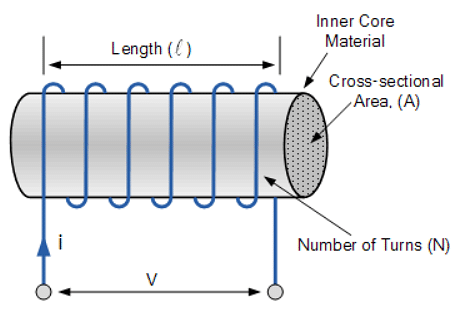
Inductance formula is expressed as:
L = μN2A/L
In Henry's equation,
- L = inductance (H)
- Μ=permeability (Wb/A.m)
- N is the total number of turns in the coil.
- A = the coil's surrounding area
- l is the coil's length (m)
With an inductance of L, the voltage induced in a coil (V) is given by
V = L(di/dt)
- Where V stands for voltage (volts)
- L is the value of inductance (H)
- T is the time taken in seconds
- I is current in Ampere
The inductance reactance is equal to
X = 2πfL
Where X is the reactance in ohms, f is the frequency in Hz, and L is the inductance in Henry(H)
- The total inductance of the series is
L=L1+L2+L3+….+Ln
- The total inductance in parallel is
1/L= 1/L1+1/L2+1/L3+….+1/Ln
Also Read:
Things to Remember
- L is the symbol for inductance, and Henry is the unit of measurement. The induced one volt by altering current in one ampere per second in an inductance value is equal to one Henry value
- The field strength is proportional to the current magnitude and follows any variations in current. Any change in the magnetic field via a circuit generates an electromotive force (EMF) (voltage) in the conductors, according to Faraday's law of induction, a process known as electromagnetic induction.
- When multiple electric circuits are near together, the magnetic field of one can pass through the magnetic field of the other; this is referred to as inductive coupling.
- A change in current in one circuit can create a change in magnetic flux in another circuit, and therefore induce a voltage in that circuit, according to Faraday's law of induction. In this scenario, the concept of inductance can be broadened by defining mutual inductance.
- Inductance can be determined using Maxwell's equations in the most general situation. Simplifications can be used to solve a variety of significant cases. The surface current density and magnetic field can be determined by solving the Laplace equation when high-frequency currents are considered with the skin effect.
Also Read: NCERT Solutions for Class 12 Physics Chapter 6 Electromagnetic Induction
Previous Year Questions
- The average e.m.f. induced in the coil is 0.1 V, when it is removed from the field in t sec….[NEET 1991]
- The current in a coil of L = 40 mH is to be increased uniformly from…..[VITEEE 2017]
- A dynamo converts….[UPSEE 2014]
- A 800 turn coil of effective area 0.05 m2 is kept perpendicular to….[NEET 2019]
- A cycle wheel of radius 0.5m is rotated with constant angular velocity of...[NEET 2019]
- A long solenoid has 1000 turns. When a current of….[NEET 2016]
- At the centre of the solenoid, a coil of 100 turns and radius 0.01 m is….[NEET 2017]
- In the series L−C−R circuit … [KCET 2011]
- A rectangular coil of 100 turns … [KCET 2013]
- A bar magnet is allowed to fall vertically … [KCET 2017]
- A jet plane of wing span 20m is travelling towards west … [KCET 2017]
- A rectangular, a square, a circular and an elliptical loop, all in the...[NEET 2009]
- A resistance 'R' draws power 'P' when connected to an AC source….[NEET 2015]
- the region of magnetic field as shown in the figure below. Then the e.m.f. generated is….[NEET 2016]
- A conducting loop in the shape of a right angled isosceles triangle of height...[JEE Advance 2016]
- If a transformer of an audio amplifier has output impedance…..[JCECE]
- the circular loop of wire is moved with velocity towards the infinite current carrying wire…… [VITEEE 2016]
- Two identical coaxial coils P and Q carrying equal amount of current in the same direction are ...[KEAM]
- The polarity of induced emf is given by….[KEAM]
- In a coil of resistance 100Ω , a current is induced by changing the magnetic flux through it….. [JEE Main 2017]
Sample Questions
Ques 1. Calculate the self-inductance of a 100-turn solenoid with a 10cm2 cross-sectional area and a 62.8cm length. (3 Marks)
Ans. The length l, number of turns N, and cross-sectional area A of a solenoid are the only geometric elements that determine its self-inductance. The following formula connects all of these variables.
L=μ0N2A/l
As a result of entering values into the above, we have
L= (4π×10−7)(100)2(10×10−4)/ 62.8×10−2 =2×10⁻⁵H
Ques 2. The cross-sectional area of a 500-turn solenoid is 20m2. Find the length of the solenoid if its self-inductance is 20H. (3 Marks)
Ans. The length l, number of turns N, and cross-sectional area A of a solenoid are the only geometric elements that determine its self-inductance. The following formula connects all of these variables.
L=μ0N2A/l
We get by plugging the numbers into the formula above and solving for the unknown length l
\(\ell\)=20(4π×10−7)(500)2/(20)=0.314m
Ques 3. If inductors of 5H, 2H, and 7H are connected in series, what is the corresponding resistance? (2 Marks)
Ans. L1 = 5H, L2 = 2H, L3 = 7H are all known values.
L = L1 + L2 + L3 = 5H + 2H + 7H = 14 H is the formula for series inductance.
Ques 4. A circuit is connected to a 50 H inductor with a frequency of 200 Hz. How do you calculate the reactance? (2 Marks)
Ans. X= 2 π f L
200 x 3.14 x 50 x 3.14 = 12560 ohm
Ques 5. When a direct current of 8 amps is passed through a 1000 turn copper wire inductor coil, it generates a magnetic flux of 300 mWb. Determine the coil's self-inductance. (3 Marks)
Ans. When we use the aforementioned equation for inductance, we get a value of 300 mWb, which is equal to 0.3 Wb. In addition, the N is 1000 and the I is 8 A.
L = Φ N/I
(0.3 Wb)(1000)/8A = L
37.5 L x 37.5 H
The coil's self-inductance is thus 37.5 H.
Ques 6. When a direct current of 5 amps is passed through an inductor coil with 550 turns of copper wire, it generates a magnetic flux of 20 Wb. Determine the coil's self-inductance. (3 Marks)
Ans. We can see that Wb is 20 and N is 550. In addition, I is 5 A. As a result, to get the coil's self-inductance, we use the inductance equation, which is: L = Φ N/I
(20 Wb)(550)/5A= L
L= 2200 H
As a result, the coil's self-inductance is 2200 H.
Ques 7. What factors have an impact on mutual inductance? (2 Marks)
Ans. The following factors influence mutual inductance between two coils:
- Area of cross-section
- Number of turns in each coil
- Space between the two coils
- Medium permeability between the two coils
- Strength (in case of the solenoid)
For Latest Updates on Upcoming Board Exams, Click Here:https://t.me/class_10_12_board_updates
Do Check Out:



Comments