



Exams Prep Master
Insecticides are chemicals that are used to control insects by killing or preventing them from engaging in undesirable or destructive behaviours. Insecticides are classified based on their structure and mode of action. There are many insecticides that act upon the insect’s nervous system, while others act as growth regulators or endotoxins. Such substances are generally used in order to control pests that infest cultivated plants or to reduce disease-carrying insects in specific areas. Let’s learn more about the topic and discuss some important questions.
| Table of Content |
Keyterms: Insecticides, Indsects, Nervous system, Endotoxins, Plants, Growth regulator, Agriculture, Medicine, Industry, Food chain
Read More: Maltose
What are Insecticides?
[Click Here for Sample Questions]
The substances that are used to kill insects are called insecticides. They have a wide application in the field of agriculture, medicine, and industry and have the potential to alter ecosystem components primarily and are toxic to animals and humans as well. Few of the insecticides become concentrated as they spread in the food chain.

Insecticides
Read More: Polyamides
Classification of Insecticide
[Click Here for Sample Questions]
- Insecticides are classified as organic and inorganic depending on the chemical composition.
- They are classified as stomach poisons, contact poisons, fumigant poisons, and systemic poisons based on the mode of entry in the insects.
- Insecticides are classified as physical poisons, nerve poisons, respiratory poisons, protoplasmic poisons, general poisons, and chitin inhibitors based on the mode of action.
- Depending on toxicity, they are classified into four types:
- Extremely toxic – Colour: red, oral LD50: 1-50, symbol: skull and poison
- Moderately toxic – Colour: blue, oral LD50: 501 – 5000, symbol: danger
- Highly toxic – Colour: yellow, oral LD50: 51 – 500, symbol: poison
- Less toxic – Colour: green, oral LD50: >5000,symbol: caution
- They are classified as ovicides, pesticides, larvicides, and adulticides based on the stage of specificity.
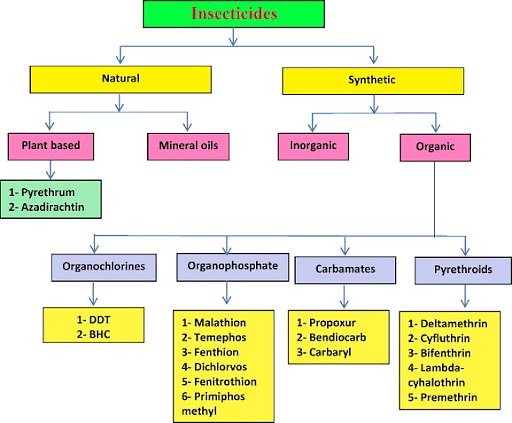
Classification of Insecticide
Read More: Neoprene
Types of Insecticide
[Click Here for Sample Questions]
Below mentioned are the three different types of insecticides.
- Systemic – Systemic insecticides are the type of insecticide that is introduced into the soil to get absorbed by the plant roots and once the insecticide enters the roots, it moves to external areas such as fruits, twigs, leaves and branches. It acts as a poison to any insect that comes to chew the plant and forms a layer on the plant surface area.
- Ingested – Few of the examples of ingested pesticides are roaches and rats.
- Contact – Contact insecticides are the type of insecticides that act like bullets as they aim only at a particular target to kill insects by its application and usually, household insect spray works like contact insecticides as it is directly hit at the insect.
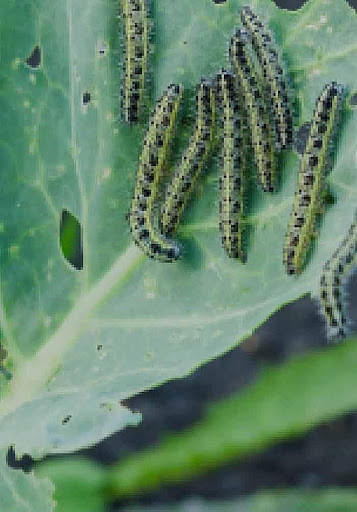
Types of Insecticide
Read More: Antidepressant Drugs
Classification of Insecticides based on Chemical Nature
[Click Here for Sample Questions]
Insecticides are classified into four groups based on their chemical nature.
Synthetic Insecticides and Natural Insecticides
A major organic chemistry's emphasis is given to developing chemical tools to enhance agriculture's productivity and insecticides can also represent a main area of emphasis. Along with this, various major insecticides are inspired by biological analogues, where many others are not found in nature.
Below listed are some important Synthetic and natural insecticides. Let us briefly understand these.
Organochlorides
One of the best-known organochlorines is given as DDT, which was created by the Swiss scientist named "Paul Müller" and for this, he was awarded the 1948 Nobel Prize for Medicine or Physiology, and it was introduced in 1944. Organochlorides also function by opening the sodium channels in the nerve cells of the insect and the contemporaneous chemical industry rise, which is facilitated by the large-scale production of DDT and related to the chlorinated hydrocarbons.

Organochlorides
Read More: Copolymers
Carbamates and Organophosphates
Organophosphates are the other large class of contact insecticide types and they can also target the nervous system of the insects. These interfere with the acetylcholinesterase enzymes and other cholinesterases, disrupting the nerve impulses and disabling or killing the insect.

Carbamates and Organophosphates
Read More: Synthetic Polymers
Chemical Warfare
Nerve agents such as tabun, sarin, soman, VX and Organophosphate insecticides work in the same way and they have a cumulative toxic effect on wildlife. Hence, the multiple exposures to the chemicals amplify toxicity and Organophosphate use declined with the rise of substitutes in the US.
Carbamate Insecticides
Such have a much shorter action duration and are somewhat less toxic and contain similar organophosphates.
Pyrethroids
Pyrethroid pesticide types mimic the natural compound pyrethrum's insecticidal activity, which is the biopesticide found in pyrethrins and are less toxic compared to carbamates and organophosphates. Along with this, these compounds are the nonpersistent sodium channel modulators, Compounds present in this group are often applied against household pests.

Pyrethroids
Read More: Sulphonation
Disadvantages of Insecticides
[Click Here for Sample Questions]
- Non-target organisms – Insecticides can kill more than intended organisms and are risky to humans and when these insecticides mix with water sources through drift, leaching, or runoff, they harm aquatic wildlife. Birds when drinking such contaminated water and eating affected insects then they die. Few examples of insecticides such as DDT were banned in the US as it affects the reproductive abilities of predatory birds.
- Resistance – Insects when repeatedly exposed to insecticides build up resistance until finally, they have little or no effect at all and the reproduction in insects is so quick that they produce a new generation every three to four weeks and because of this, the resistance builds up rapidly.
Read More: Diazotisation
Things to Remember
- The substances that are used to kill insects are called insecticides. They have a wide application in the field of agriculture, medicine, and industry and have the potential to alter ecosystem components primarily and are toxic to animals and humans as well.
- Systemic insecticides are the type of insecticide that is introduced into the soil to get absorbed by the plant roots and once the insecticide enters the roots, it moves to external areas such as fruits, twigs, leaves and branches.
- Contact insecticides are the type of insecticides that act like bullets as they aim only at a particular target to kill insects by its application and usually, household insect spray works like contact insecticides as it is directly hit at the insect.
- One of the best-known organochlorines is given as DDT, which was created by the Swiss scientist named "Paul Müller" and for this, he was awarded the 1948 Nobel Prize for Medicine or Physiology, and it was introduced in 1944.
Also Read:
Sample Questions
Ques: How are the insecticides classified based on their chemical nature? (2 marks)
Ans. Insecticides are classified into four groups based on their chemical nature. Below mentioned are the four different groups.
- Organic Insecticides
- Inorganic Insecticides
- Synthetic Insecticides
- Miscellaneous Insecticides
Ques: What are Ryanoids? (3 marks)
Ans. Ryanoids are synthetic analogues with the same mode of action as ryanodine and ryanodine is a naturally occurring insecticide that is extracted from Ryania speciosa (a Salicaceae). They bind to the calcium channels in skeletal and cardiac muscle by blocking the nerve transmission and Rynaxypyr was the first insecticide to be registered from this class, where the generic name is given as chlorantraniliprole.
Ques: Give the Environmental Effects on Non-target Species? (3 marks)
Ans: A few insecticides that are not intended to kill are harmed by the other creatures. For example, birds can be poisoned when they eat food, which is recently sprayed with insecticides and the birds mistake an insecticide granule on the ground for food and eat it. Especially when sprayed aerially, the sprayed insecticide can drift from the area to which it is applied and into the wildlife areas.
Ques: Explain about a Pesticide? (3 marks)
Ans: Any product that kills the pests are called pesticides or in other words, it refers to agricultural chemicals, which can be used to destroy the pests that threaten food crops' mass production. However, they can also be used to describe fly spray, flea powder or in reality, any pests killer that is regarded as a nuisance to animals we live with or humanity.
Ques: What is Pesticide Resistance Mean? (2 marks)
Ans: When the species of pests become allowed to live in a pesticide-rich environment, the surviving individuals reproduce and then their offspring in turn more resistant to the pesticide.
As a result of this, the farmers and others must use much stronger concentrations of pesticides to achieve similar results.
Ques: Write a short note on organochlorides. (3 marks)
Ans. One of the best-known organochlorines is given as DDT, which was created by the Swiss scientist named "Paul Müller" and for this, he was awarded the 1948 Nobel Prize for Medicine or Physiology, and it was introduced in 1944. Organochlorides also function by opening the sodium channels in the nerve cells of the insect and the contemporaneous chemical industry rise, which is facilitated by the large-scale production of DDT and related to the chlorinated hydrocarbons.
Ques: What are carbamates and organophosphates? (2 marks)
Ans. Organophosphates are the other large class of contact insecticide types and they can also target the nervous system of the insects. These interfere with the acetylcholinesterase enzymes and other cholinesterases, disrupting the nerve impulses and disabling or killing the insect.
Ques: What is meant by pyrethroid pesticide? (2 marks)
Ans. Pyrethroid pesticide types mimic the natural compound pyrethrum's insecticidal activity, which is the biopesticide found in pyrethrins and are less toxic compared to carbamates and organophosphates. Along with this, these compounds are the nonpersistent sodium channel modulators, Compounds present in this group are often applied against household pests.
For Latest Updates on Upcoming Board Exams, Click Here: https://t.me/class_10_12_board_updates
Check-Out:



Comments