



Education Journalist | Study Abroad Lead
Leibniz Theorem, sometimes known as the Leibniz Rule, is a generalisation of the product rule of differentiation. If two functions f(x) and g(x) are differentiable n times individually, then their product f(x).g(x) is also differentiable n times, according to the Leibniz theorem. The procedure of determining the derivative of an antiderivative is described in this theorem. The term "successive differentiation" is also used to describe it. The Leibniz rule can be used to calculate the product of many functions as well as a variety of derivatives. Let us look at the various formulations and proofs for the Leibniz rule.
| Table of Contents |
Key Takeaways: Leibnitz Theorem, Derivative, Differentiation, Antiderivative, Function, Integration, Successive Differentiation, Binomial Expansion
Leibnitz Theorem Definition
[Click Here for Sample Questions]
The Leibnitz rule is a generalisation of the product differentiation rule. If two functions f(x) and g(x) are differentiable n times individually, then their product f(x)g(x) is also differentiable n times, according to the Leibniz rule. Polynomial functions, trigonometric functions, exponential functions, and logarithmic functions are examples of these functions.
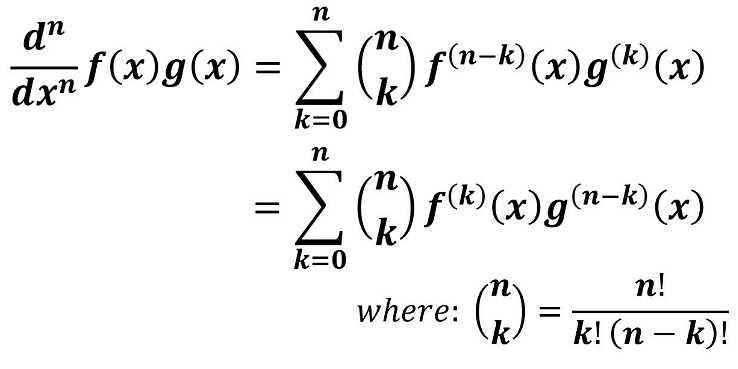
The derivative of the product of two functions is where the Leibniz rule comes in handy. The sum of the product of the first derivative of the function f(x) and the function g(x) and the product of the first derivative of the function g(x) and the function f(x) is equal to the first derivative of the product of the functions f(x) and g(x) (x). We can generalize the Leibniz rule with the below-mentioned formula.

Leibnitz Theorem
Read More: Derivatives of Function in Parametric Form
Leibnitz Theorem: Formula
[Click Here for Sample Questions]
Assume you have two functions, u(t) and v(t), with derivatives up to the nth order. Let's have a look at the derivative of the product of these two functions now.
The first derivative could be expressed as follows:
(uv)’ = u’v+uv’
The second derivative is obtained by differentiating the above expression once again.
(uv)’’
= [(uv)’]’
= (u’v+uv’)’
= (u’v)’+(uv’)’
= u′′v + u′v′ + u′ v′ + uv′′
= u′′v + 2u′v′ + uv′′
We can also find the third derivative in the same way.
(uv)′′′
= [(uv)′′]′
= (u′′v + 2u′v′ + uv′′)′
= (u′′v)′ + (2u′v′)′ + (uv′′)′
= u′′′v + u′′v′ + 2u′′v′ + 2u′v′′ + u′v′′ + uv′′′
= u′′′v + 3u′′v′ + 3u′v′′ + uv′′′
When these formulations are compared, they appear to be quite similar to binomial expansion raised to the exponent. We may obtain the formula for the nth order of the derivative product of two functions by considering the components with zero exponents, u0 and v0, which correspond to the functions u and v themselves.

The Leibnitz theorem can be used to calculate the product of many functions as well as a variety of derivatives. Mathematical induction can be used to prove the Leibnitz theorem.
Read More: Inverse Process of Differentiation
Proof of Leibnitz Theorem
[Click Here for Sample Questions]
Assume that the functions u(t) and v(t) have (n+1)th order derivatives. The derivative of (n+1)th order can be expressed in the following way using the recurrence relation:

When we differentiate, we get:

Because the limits for both sums are the same, the summation on the right side can be combined to make a single sum. Let us now consider an intermediate index, such as 1≤ m≤ n. When i = m, the first term can be expressed as follows:

When i = m-1, the second term will be:

When these two terms are added together, we get:

The concept of combinatorics tells us that:

We can write the total of these two terms when i = m and when i = m-1, as follows based on the above concept:

When the value of m goes from 1 to n, we can see that this created combination will cover all the terms from i = 1 to i = n, but not i = 0 in the first term and i = 1 in the second term, which are equivalent.

As a result, the resultant derivative of the (n+1)th order product of two functions is:

Hence Leibnitz theorem gets proved.
Read More: Differential Equation
Applications of Leibnitz Theorem
[Click Here for Sample Questions]
- The combination of the Leibniz Rule for R3 with Reynold's first Transport Theorem yields the second Reynold's Transport Theorem.
- The Leibniz formula computes the derivative of the product of two functions of the nth order and serves as a link between integration and differentiation.
Read More: Definite, Indefinite and Methods of Integration
Things to Remember
- The Leibnitz theorem asserts that if two functions, a(x) and b(x), are independently differentiable, then their combination a(x)b(x) is also n times differentiable.
- The Leibnitz theorem, commonly known as sequential differentiation, describes the process of determining an antiderivative's derivative.
- The product differentiation rule is a generalisation of the Leibnitz rule. These functions include polynomial functions, trigonometric functions, exponential functions, and logarithmic functions.
- The derivative on the nth order of the product of two functions can be stated with the help of a formula- according to the theorem.
- The Leibnitz theorem can be used to calculate the product of many functions as well as a variety of derivatives.
Also Read:
Sample Questions
Ques. Define Leibnitz Theorem. (3 Marks)
Ans. A Leibnitz theorem is the rule of the Leibnitz, which is defined for derivatives of the antiderivative in mathematics. The derivative on the nth order of the product of two functions can be shown using a formula, according to the given premise. Antiderivatives (or primitives) of a function are functions that may have rendered the function as a derivative. The indefinite integral of the function is the formula that supplies all of these antiderivatives, and the process of obtaining the antiderivatives is referred to as integration.
Ques. What does Leibnitz Theorem express and also express its general notation? (3 Marks)
Ans. The nth order derivative of a product of two functions is expressed using the Leibniz formula. The symbols dx and dy are used by Leibniz to indicate infinitesimal increments of x and y, respectively, while Δx and Δy are used to denote finite increments of x and y, respectively.
Ques. What is the purpose of the Leibniz Rule? (3 Marks)
Ans. To find the first, second, or derivative of the product of two or more functions, the Leibnitz rule is utilised. The Leibniz rule for the first derivative of the product of two functions is (f(x)g(x))' = f'(x)g(x) + f(x)g'(x), and the Leibniz rule for the second derivative of the product of two functions is (f(x)g(x))'' = f''(x)g(x) + 2f'(x)g'(x) + f(x)g'(x).
Ques. How Do We Apply Leibniz's Rule? (3 Marks)
Ans. (f(x).g(x))n = ∑n Crf(n-r) (x).gr(x) is the generalised formula for Leibnitz theorem. It may be modified to determine the first derivative of a product of two functions as (f(x)g(x))' = f'(x)g(x) + f(x)g'(x), and the second derivative of a product of two functions as (f(x)g(x))'' = f''(x)g(x) + 2f'(x)g'(x) + f(x)g'(x). For the product of two or more functions, as well as n derivatives of the product of the functions, the Leibniz rule can be implemented.
Ques. What is the Leibnitz theorem for integral state differentiation? (3 Marks)
Ans. There is an integral sign for differentiation in the Leibnitz theorem. The product of two functions can be differentiated up to the nth order, and this can be stated using the formula. Gottfried Leibnitz proved this theorem. He explains that the derivative of the integral is always expressible for the integral of the form. Both calculus and arithmetic benefit from this theorem. This theorem will immediately assist you in solving a variety of difficulties.
Ques. What is the differentiation rule of Leibniz? (3 Marks)
Ans. The Leibniz integral rule specifies a differentiation formula for a definite integral whose limits are functions of the differential variable. Under the integral sign, it's referred to as differentiation. This rule can be used to evaluate some oddly shaped definite integrals.
Ques. What Is Leibnitz's First Derivative Rule For Two Functions? (3 Marks)
Ans. The first derivative of the product of the functions f(x) and g(x) according to the Leibnitz rule is

Ques. What Is Leibniz's Second Derivative Rule For Two Functions? (3 Marks)
Ans. The first derivative of the product of the functions f(x) and g(x) according to the Leibniz rule is f(x) and g(x) is
Or

For Latest Updates on Upcoming Board Exams, Click Here: https://t.me/class_10_12_board_updates
Check-Out:



Comments