



Content Curator
It is critical in plant nutrition that primary and secondary macronutrients and vital micronutrients are not deficient. These ingredients must also be present in the correct proportions. Primary macronutrients are consumed in vast quantities by plants, while secondary macronutrients are consumed in smaller amounts. Each of these nutrients has a specific purpose in the plant's nutrition. A lack of any of them causes deficiencies, which have varying negative impacts on the plant's overall health depending on which nutrient is deficient and to what degree.
| Table of Content |
Key terms: nutrition, micronutrient, plant growth, nitrogen, calcium , magnesium.
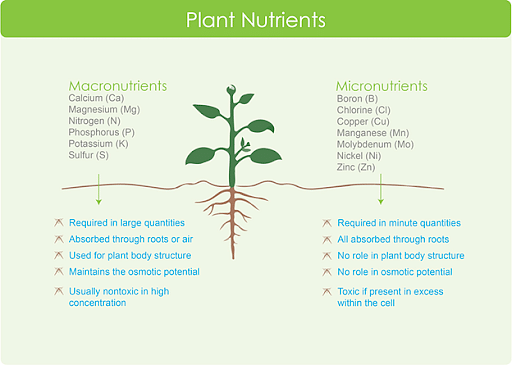
Plants are made up of 60 chemical elements, 16 of which are essential. Some of the 16, in the form of CO2 or water, are taken from the air. Carbon, hydrogen, and oxygen are the three elements. If we leave aside leaf fertilization and the three ingredients described above, for the time being, the remaining 13 are derived from the soil. These are broken down into macronutrients and micronutrients, both of which are necessary for crop growth.
Role of Nutrients in Plant Growth
[Click Here for Sample Questions]
Mineral nutrition refers to the naturally occurring inorganic nutrients found deep beneath the soil surface. In plant cells, nutrients serve a variety of roles and participate in a variety of metabolic processes. It comprises osmotic pressure regulation, membrane permeability, enzymatic activity, maintaining cell-sap concentration, the electron transport system, buffering action, and many other factors. Nutrients are also classified as follows:
- Micro-nutrients
- Macronutrients
Let's take a closer look at each of the nutrient kinds discussed under Mineral Nutrition.

Micronutrients
Micronutrients are elements present in small levels, often less than 10 mmoles per kilogram of dry matter. Micronutrients include iron, manganese, copper, molybdenum, zinc, copper, boron, chlorine, and nickel. Trace or micronutrients are nutrients that are required in small levels. It contains the following items:
- Plant tissues absorb copper in the form of Cu2+ ions. The component is necessary for plants' overall metabolic processes. Furthermore, the element aids in carbohydrate-nitrogen balance.
- Zinc is absorbed by plants in the form of Zn2+ ions. Zinc aids in the production of tryptophan, phosphorus metabolism, and carbohydrates.
- Manganese is required for the processes of photosynthesis, nitrogen metabolism, and respiration. The mineral is necessary for chlorophyll production and acts as a nitrogen metabolism activator.
- Chlorine is usually absorbed in the form of Cl – ions by plants. The element aids in determining the solute concentration and is required for the photosynthetic reaction's water splitting.
- The plants obtain boron as BO33- or B4O72- . Boron is used in membrane functioning, cell differentiation, pollen germination, glucose transfer, and many other processes.
- Ferric ions (Fe +3) are the form of iron that is absorbed. The micronutrient iron is the one that is needed the most. Iron is a key component of proteins that participate in the electron transport chain. Chlorophyll is formed in part with the help of iron.
- Molybdenum is absorbed as molybdate ions (MoO 22+) in the body. Nitrogenase and nitrate reductase are two enzymes that contain molybdenum.
Do Check Out :
| Related Topics | ||
|---|---|---|
| Calcium Deficiency Symptoms | Rhizobium | Denitrification |
| Minerals | Sulphur Cycle | Mineral Nutrition |
Macronutrients
[Click Here for Previous Questions]
Macronutrients are elements that are found in enormous levels in plant tissues. They exceed 10 moles per kilogram of dry materials. The macronutrients are carbon, hydrogen, oxygen, nitrogen, phosphorus, sulphur, potassium, calcium, and magnesium.
The element is essential for average growth and reproduction to take place. Plants cannot finish their life cycle or set seeds if they lack vital nutrients. The key element must be unique and cannot be replaced by another. The element must be involved in metabolism directly. They are of two types:
Primary Macronutrients
Macronutrients are necessary for plant growth and a healthy overall state.
Nitrogen
Nitrogen is important for plant growth as it is used in protein synthesis and energy metabolism. The plant absorbs nitrogen in the form of nitrate, which is essential for plant growth. It is also required for photosynthesis and the creation of chlorophyll. Nitrogen is primarily engaged in the aerial zone, which is the area of the plant that people can see. It encourages cellular division. A nitrogen deficit causes the loss of vigour and colour. Starting at the bottom of the plant, growth slows and leaves fall off.
Potassium
Potassium is involved in water control and the transport of reserve chemicals in plants. It improves photosynthesis, strengthens cell tissue, and promotes nitrate absorption. Potassium also promotes blooming as well as glucose and enzyme synthesis. As a result, the plant's ability to tolerate unfavourable circumstances, such as low temperatures, improvement, and withering, is reduced. As a result, a lack of Potassium makes plants more susceptible to dry spells, frosts, and fungus attacks. Other important nutrients like nitrogen, calcium, and magnesium, become unbalanced as a result. Dark stains form on the leaves when there is a potassium deficiency.
Phosphorus
Phosphorus plays a role in root growth by stimulating it. It encourages flowering in the aerial zone. Although phosphorus is required for plant growth, it is significantly more critical during the flowering stage. Phosphorus is engaged in energy transfer and storage. It also boosts the overall health of the plant and increases its ability to endure severe climatic conditions. Phosphorus is required for the creation of organic compounds and the proper execution of photosynthesis. A lack of phosphorus causes late, ineffective flowering, browning and wrinkling of the leaves and an overall lack of vigour.
Read more: Nodule FormationSecondary Macronutrients
Secondary macronutrients are also essential, even if they are consumed in smaller amounts than primary macronutrients. Examples: Calcium, Sulphur, and Magnesium.
Magnesium
Magnesium is required for photosynthesis since it is the core of the chlorophyll molecule. As a result, it is a necessary component for plant growth. Phosphorus absorption and transportation are aided by magnesium. It aids in the storage of sugars inside the plant. Magnesium acts as an enzyme activator, activating more enzymes than any other mineral. Magnesium deficiency causes weak stalks, a loss of greenness in the oldest leaves, and the emergence of yellow and brown spots on the leaves' veins, despite the veins remaining green.
Calcium
Calcium binds to the cell walls of plant tissues, stabilizing them and promoting their formation. Calcium is also essential in cell development and growth. It increases plant vitality by stimulating root development and growth. Calcium aids in the retention of minerals in the soil as well as their transfer. It aids in the development of seeds and neutralizes harmful chemicals in plants. Calcium regulates and stabilizes various processes, and a calcium deficiency results in yellow and brown patches on the leaves. It also slows the growth of plants in general.
Sulphur
Chlorophyll is formed with the help of sulphur. It is required for photosynthesis and also plays a role in protein synthesis and tissue development. Sulphur is important in nitrogen metabolism because it promotes nitrogen efficiency. Sulphur also helps plants defend themselves in general. Sulphur deficiency is uncommon, but the plant becomes lighter in colour, resembling a pale green when it occurs.
Read more: Vitamins and Minerals
Deficiency Symptoms of Essential Elements
[Click Here for Sample Questions]
- The critical concentration of an essential element is the level below which plant growth is slowed.
- When the element is present below the critical concentration, it is said to be deficient.
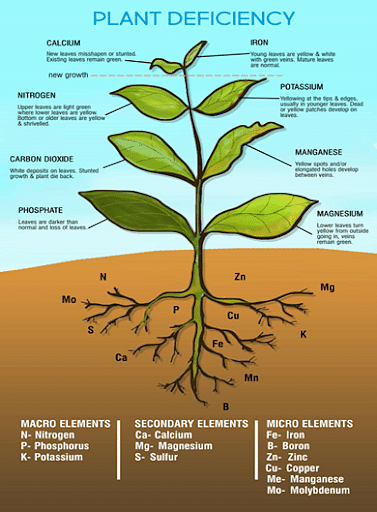
- Plants exhibit distinct morphological changes in the absence of a specific element, known as deficiency symptoms and are diagnostic of particular element deficits.
- The deficiency symptoms differ from element to element, but they always go away once the lacking mineral nutrient is given to the plant.
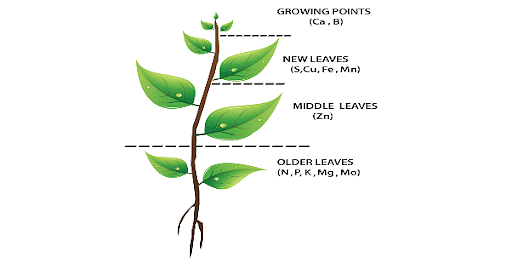
- When elements are generally stationary and are not moved out of the mature organs, deficiency symptoms emerge first in the young tissues.
- Sulphur and calcium, for example, are part of the cell's structural components and hence are difficult to release.
- Chlorosis, necrosis, stunted plant growth, premature fall of leaves and buds, and suppression of cell division are examples of deficient symptoms seen in plants.
- Chlorosis is a yellowing of the leaves produced by a lack of chlorophyll due to a lack of the elements N, K, Mg, S, Fe, Mn, Zn, and Mo.
- Necrosis is the loss of tissue, especially leaf tissue, caused by a lack of Ca, Mg, Cu, and K.
- Cell division is inhibited by a lack of or low N, K, S, and Mo levels.
- Some elements, such as N, S, and Mo, can cause flowering to be delayed if their concentration in plants is low.
| Macronutrient | Deficiency Symptoms |
|---|---|
| Nitrogen | Yellowing of leaves and development of chlorosis |
| Magnesium | Yellowing of leaves and tips and margins of leaves turning upwards |
| calcium | Younger leaves margins show chlorosis |
| Potassium | Development of weak stalks |
| Phosphorus | General metabolism getting disrupted and abnormalities in size and shape of chloroplasts |
| Sulphur | Young leaves becoming chlorotic and pigmented |
Read Also: Class 11 Biology Chapter 12 Mineral Nutrition
Things to Remember
[Click Here for Previous Questions]
- Plants are made up of 60 chemical elements, among which 16 elements are essential.
- Micronutrients include iron, manganese, copper, molybdenum, zinc, copper, boron, chlorine, and nickel.
- The macronutrients are carbon, hydrogen, oxygen, nitrogen, phosphorus, sulphur, potassium, calcium, and magnesium.
- Macronutrients are found at enormous levels in plants.
- Macronutrients can be further classified into two types, primary macronutrients and secondary macronutrients.
| Chapter Related Topics | ||
|---|---|---|
| Nitrogen Fixation | ammonification | deficiency symptoms |
| transport of mineral nutrients | catalase enzyme | Mineral Toxicity |
Previous Year's Questions
- Which one of the following is a micronutrient for plants?….[NEET 1996]
- Mg is a component of….[NEET 2000]
- A plant requires magnesium for….[NEET 2007]
- A prokaryotic autotrophic nitrogen fixing symbiont….[NEET 2011]
- A system of rotating crops with legume or grass pasture to….[NEET 2016]
- Best defined function of manganese in green plants…. [NEET 2012]
- Boron in green plants assists in…. [NEET 2003]
- Deficiency symptoms of nitrogen and potassium… [NEET 2014]
- For its activity, carboxypeptidase requires….[NEET 2012]
- Gray spots of oat are caused by deficiency of….[NEET 2003]
- If by radiation all nitrogenase enzyme is….[NEET 2003]
- In which of the following forms is iron…. [ NEET 2018]
- Leguminous plants are able to fix atmospheric nitrogen….[NEET 2010]
- The deficiencies of micronutrients, not only affects growth of plants….[NEET 2005]
- What is true for cyanobacteria….[NEET 2001]
- Which is essential for the growth of root tip ?….[NEET 2016]
- Which of the following can fix atmospheric nitrogen? ….[NEET 1995]
Sample Questions
Ques 1: How would you determine the actual lacking mineral element if a plant exhibits symptoms that could be caused by a lack of more than one nutrient? (3 Marks)
Ans: A nutrient shortage in plants can manifest itself in a variety of ways. Chlorosis and delayed blooming are two examples of nitrogen shortage. Similarly, a nutrient deficit might elicit the same symptoms as another nutritional deficiency. Necrosis, for instance, is caused by a lack of calcium, magnesium, copper, and Potassium.
Another thing to keep in mind is that various plants react differently to the same nutrient shortage. As a result, to diagnose a nutrient deficiency in a plant, all of the symptoms that have arisen in its various portions must be investigated and compared to the standard tables that are accessible.
Ques 2: List at least four different plant deficiency symptoms. Describe them and link them to the mineral shortage in question. (3 Marks)
Ans: Chlorosis, necrosis, stunted plant growth, premature fall of leaves and buds, and suppression of cell division are examples of deficient symptoms seen in plants.
- Chlorosis is a yellowing of the leaves produced by a lack of chlorophyll due to a lack of the elements N, K, Mg, S, Fe, Mn, Zn, and Mo.
- Necrosis is the loss of tissue, especially leaf tissue, caused by a lack of Ca, Mg, Cu, and K.
- Cell division is inhibited by a lack of or low N, K, S, and Mo levels.
- Some elements, such as N, S, and Mo, can cause flowering to be delayed if their concentration in plants is low.
Ques 3: How would you determine the actual lacking mineral element if a plant exhibits symptoms that could be caused by a lack of more than one nutrient? (3 Marks)
Ans: A nutrient shortage in plants can manifest itself in a variety of ways. Chlorosis and delayed blooming are two examples of nitrogen shortage. Similarly, a nutrient deficit might elicit the same symptoms as another nutritional deficiency. Necrosis, for instance, is caused by a lack of calcium, magnesium, copper, and Potassium.
Another thing to keep in mind is that various plants react differently to the same nutrient shortage. As a result, to diagnose a nutrient deficiency in a plant, all of the symptoms that have arisen in its various portions must be investigated and compared to the standard tables that are accessible.
Ques 4: 'All elements present in a plant do not have to be essential for its life.' Comment (3 Marks)
Ans: Different types of nutrients are absorbed by plants from the soil. Some nutrients ingested by plants are not required for survival because they are not engaged in the physiology or metabolism of the plant. Plants that grow near radioactive areas, for example, tend to acquire radioactive metals. Similarly, plants growing near mining areas acquire gold and selenium. But they don’t need these minerals.
Ques 5: Explain the role of Potassium as a macronutrient? (3 Marks)
Ans: Potassium is involved in water control and the transport of reserve chemicals in plants. It boosts photosynthesis, strengthens cell tissue, and initiates the nitrate absorption process. Potassium aids flowering as well as the creation of carbohydrates and enzymes. As a result, the plant's ability to withstand adverse conditions including cold temperatures, improvement, and wilting is diminished.
Ques 6: Which elements are needed for the synthesis of chlorophyll in plants? (3 Marks)
Ans: Chlorophyll molecules are green pigments that trap light in plants. As a result, magnesium plays a vital role in the structure of chlorophyll molecules. For plants, iron is a necessary micronutrient. It is needed for the synthesis of chlorophyll and serves a variety of additional activities. In order to manufacture chlorophyll, plants must be exposed to light. Plants will be slender and pale if they are not exposed to sunlight.
Ques 7: What is the process through which plants absorb minerals? (3 Marks)
Ans: Plants take minerals from the soil in the form of ions. Previously, it was thought that mineral absorption occurred simultaneously with water absorption in plants, but we now know that the two processes are distinct. Minerals must be dissolved in water in order to be absorbed. Plants absorb minerals through their roots. The larger the surface area of the roots, the more minerals are absorbed.
Ques 8: What is critical concentration, and how does it work? What harm does it cause to the plants? (3 Marks)
Ans: The critical concentration of an essential element is the level below which plant growth is slowed. When the element is present below the critical concentration, it is said to be deficient. Plants exhibit distinct morphological changes in the absence of a specific element, known as deficiency symptoms and are diagnostic of particular element deficits.
Do Check Out:



Comments