



Education Journalist | Study Abroad Lead
Magnetic Dipole Moment is a quantity that is used to represent the orientation and strength of magnetic dipoles. It can also be defined as the torque that an object experiences when placed in a magnetic field. The electrons moving around the atomic nuclei also creates a magnetic dipole moment. The sum of the effects of all the electrons may cancel out the overall effect in the atom. In that case, it will not be a magnetic dipole. If these effects are not cancelled out then the atom has a permanent magnetic dipole moment, like in iron atoms. When millions of atoms are locked in the same spontaneous alignment then it forms a ferromagnetic domain. Magnetic needles and compasses are also a kind of magnetic dipoles.
| Table of Content |
Key Terms: Magnetic Moment, Electromagnets, Ferromagnetism, Magnetic Field, Magnetic Dipole Moment, Magnetic Dipole, Monopole, Quadrupole
Read More: Magnetic Properties of Materials
Magnetic Moment
[Click Here for Sample Questions]
It is the magnitude that determines the strength and the orientation of a magnet other than the object which has created the magnetic field. Examples of such objects are a loop of electric current (electromagnets), elementary particles such as electrons in an atom, permanent magnets, and many astronomical objects.
The word “magnetic moment” denotes the magnetic moment of a system, the component of a magnetic moment can be determined by the same magnetic dipole. For example, the magnetic north and south pole are divided by a small minor distance. Higher-order expressions might be needed with the dipole moment for prolonged objects. The magnetic dipole moment of the object is also defined as the torque experienced by that object in the magnetic field. Therefore the magnetic moment can be considered as a vector.

Magnetic Moment
What is Magnetic Dipole Moment?
[Click Here for Previous Year Questions]
A magnetic dipole moment can be defined as a vector aligning torque on an object in an external magnetic field. The relationship can be written as
\(\tau = m \times B\)
Where,
- τ refers to the torque acting on the dipole
- m is the magnetic moment
- B is the external magnetic field
There is another substitute definition considering the thermodynamic calculation for magnetic dipole moment. The magnetic dipole moment of a structure is defined as the negative of the gradient of its energy, Uint, with respect to the outer magnetic field. We get
\(\mathbf{m}=-\hat{\mathbf{x}} \frac{\partial U_{\mathrm{int}}}{\partial B_{x}}-\hat{\mathbf{y}} \frac{\partial U_{\mathrm{int}}}{\partial B_{y}}-\hat{\mathbf{z}} \frac{\partial U_{\mathrm{int}}}{\partial B_{z}}\)
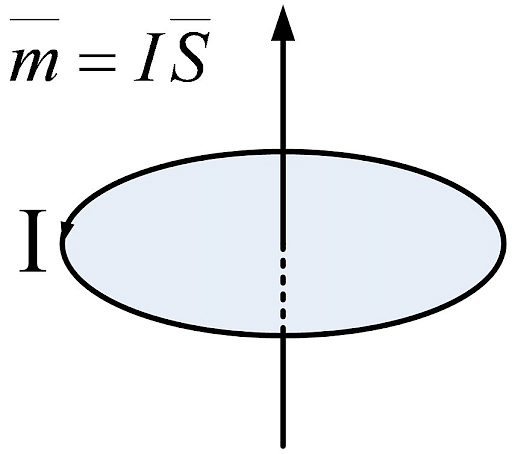
Magnetic Dipole Moment of Closed Circuit
Magnetic Dipole
[Click Here for Sample Questions]
It is the magnitude that determines the strength and magnetic orientation of a magnet or any magnetic object. Generally, a magnetic moment refers to a magnetic dipole moment, the object which has a dipole moment can be signified as a magnetic dipole.
A magnetic dipole is magnetic north and south pole which are separated by some distance.
Read More:
| Related articles | ||
|---|---|---|
| Magnitude of A Vector | Magnetism and Matter | Paramagnetism |
| Gauss Law for Magnetism | Magnetic Flux | Magnetic Declination |
Theory Underlying Magnetic Dipole
[Click Here for Previous Year Questions]
The field of any magnet can be represented by a series of terms of which every other term is more complicated than the previous one. The first term is a monopole (means isolated south or north pole) and dipole (means two opposite poles) and quadrupole (means four poles combined to form two dipoles). The degree of magnetic field for every term reduces progressively sooner with the distance than in the previous term. Therefore for a big enough distance, the first non-zero term will determine the field.
Magnetic Potential
It is a scalar quantity which is the characteristic of a point magnetic field, the negative gradient of which gives the value of magnetic field strength at that point.
In the magnetic pole model theory, the field related is a demagnetizing field which is represented by H and it is related by magnetic potential as
\(H(r) = - \nabla \psi\)
In the Amperian loop theory, the magnetic field is of magnetic induction represented by B such as
\(B(r) = \nabla \times A\)
These potentials can be measured for any kind of loop or magnetic charge distribution but the field should be restricted in a small region to give
\(\begin{aligned} &A(r, t)=\frac{\mu_{0}}{4 \pi} \int j\left(r^{\prime}\right)\left|r-r^{\prime}\right| d V^{\prime} \\ &\psi(r, t)=\frac{1}{4 \pi} \int \rho\left(r^{\prime}\right)\left|r-r^{\prime}\right| d V^{\prime} \end{aligned}\)
Here, P = magnetic pole density similar to J (current density)
For longer distances the first non zero terms is considered and the formula becomes
\(A(r) = \frac{\mu_0}{4\pi} \frac{m \times r}{|r|^3}\)
Where m is:
\(m = \displaystyle \frac{1}{2} \iiint Vr \times jdV\)
In this, r refers to the position vector, j is the electric current density and the integral is a volume integral. × is the vector cross product.
The first non zero term of scalar potential is given as
\(\psi (r) = \frac{m.r}{4\pi |r|^3}\)
M can also be represented in the form of magnetization field as
\(m = \displaystyle \iiint MdVm\)
Derivation of Magnetic Dipole Formulae
[Click Here for Sample Questions]
The magnetic field B, at a distance l from its axis and field of radius R due to a current-carrying loop having current i is given by
\(B = \displaystyle \frac{\mu_0 iR^2}{2(R^2 + l^2)^{\frac{3}{2}}}\)
For simplification let us assume that the distance of the point is very far from the current-carrying loop.
\(B=\frac{\mu_{0} i R^{2}}{2 l^{3}\left(\left(\frac{R}{i}\right)^{2}+1\right)^{\frac{3}{2}}} \approx \frac{\mu_{0} i R^{2}}{2 l^{3}}=\frac{\mu_{0}}{4 \pi} \frac{2 i\left(\pi R^{2}\right)}{l^{3}}\)
The area of the loop is given as
A = R2
The magnetic field can be written as
\(B=\frac{\mu_{0}}{4 \pi} \frac{2 i A}{l^{3}}=\frac{\mu_{0}}{4 \pi} \frac{2 \mu}{l^{3}}\)
which is similar to the Electric dipole field
\(\bar{E}=\frac{1}{4 \pi \epsilon_{0}} \frac{2 \bar{p}}{r^{3}}\)
Therefore μ→is called a magnetic dipole moment. Different Electric fields do not have charge counterparts as magnetic fields. Hence there is no source or sink for the magnetic fields, only a dipole exists in this case. Most elementary particles behave as magnetic dipoles. The electron acts as a magnetic dipole and has a spin magnetic moment. It is inherent directly from the electron, it does not have any area and it doesn’t even spin around itself. The magnetic property is fundamental to the electron.
The formula for a magnetic moment for N turns of an electric loop carrying current i is
μ = NiA
Internal Magnetic Field of a Dipole
[Click Here for Previous Year Questions]
The two types of the dipole, one is the current-carrying coil and the other is magnetic poles, both give the same value for the magnetic field at a far distance. Far distance means farther from the source. But inside the source, they give different values.
If a magnetic dipole is made from a current-carrying coil by making it smaller and smaller. But keeping the value of product * current even, the value of the limiting field is given by
\(B(x)=\frac{\mu_{0}}{4 \pi}\left[\frac{3 n(n \cdot m)-m}{|x|^{3}}+\frac{8 \pi}{3} m \partial(x)\right]\)
If a magnetic dipole is made by taking the north pole and south pole, bringing them as close as possible then the limiting field is given by
\(H(x)=\frac{1}{4 \pi}\left[\frac{3 n(n . m)-m}{|x|^{3}}+\frac{4 \pi}{3} m \partial(x)\right]\)
Both these fields are related by B = μ0(H+M) where M(x) = mδ(x) is magnetization.
Read More
| Related Articles | ||
|---|---|---|
| Magnetic Susceptibility | Magnetic Force and Magnetic Field | Poles of Magnets |
| Ferromagnetism | Faraday's Laws of Electromagnetic Induction | Earth's Magnetic Field |
Things to Remember
- A magnetic dipole moment is a quantity that is used to represent the orientation and strength of magnetic dipoles.
- When millions of atoms are locked in the same spontaneous alignment then it forms a ferromagnetic domain.
- The word “magnetic moment” denotes the magnetic moment of a system, the component of a magnetic moment can be determined by the same magnetic dipole.
- A magnetic dipole moment can be defined as a vector aligning torque on an object in an external magnetic field.
- Different Electric fields do not have charge counterparts as magnetic fields.
- There are two types of dipole, one is the current-carrying coil and the other is magnetic poles.
- A magnetic dipole is magnetic north and south pole which are separated by some distance.
Previous Year Questions
- A galvanometer of resistance, GG , is shunted by a resistance SS ohm. To keep the main current in the circuit unchanged, the resistance to be put in series with the galvanometer is…..[NEET 2011]
- A long solenoid carrying a current produces a magnetic field B along its axis. If the current is doubled and the number of turns per cm is halved the new value of the magnetic field is...[NEET 2003]
- A long solenoid of 50cm50cm length having 100turns100turns carries a current of 2.5A2.5A. The magnetic field at the centre of the solenoid is : (μo=4π×10−7TmA−1)(μo=4π×10−7TmA−1)...[NEET 2020]
- A long straight wire of radius a carries a steady current I. The current uniformly distributed over its cross-section. The ratio of the magnetic fields B and B', at radial distance a2a2 and 2a respectively, from the axis of the wire is :….[NEET 2016]
- A metallic rod of mass per unit length 0.5kgm−10.5kgm−1 is lying horizontally on a smooth inclined plane which makes an angle of 30∘30∘ with the horizontal. The rod is not allowed to slide down by flowing a current through it when a magnetic field of induction 0.25T0.25T is acting on it in the vertical direction. The current flowing in the rod to keep it stationary is….[NEET 2018]
- A milli voltmeter of 2525 milli volt range is to be converted into an ammeter of 2525 ampere range. The value (in ohm) of necessary shunt will be...[NEET 2012]
- A proton and an alpha particle both enter a region of uniform magnetic field BB, moving at right angles to the field BB. If the radius of circular orbits for both the particles is equal and the kinetic energy acquired by proton is 1MeV1MeV, the energy acquired by the alpha particle will be….[Neet 2015]
- A proton carrying 1 MeV kinetic energy is moving in a circular path of radius R in uniform magnetic field. What should be the energy of an αα-particle to describe a circle of same radius in the same field?...[NEET 2012]
- A square current carrying loop is suspended in a uniform magnetic field acting in the plane of the loop. If the force on one arm of the loop is →FF→ .the net force on the remaining three arms of the loop is...[NEET 2010]
- A straight conductor carrying current ii splits into two parts as shown in the figure. The radius of the circular loop is RR. The total magnetic field at the centre PP at the loop is :...[NEET 2019]
- A 2μC2μC charge moving around a circle with a frequency of 6.25×10¹²Hz6.25×1012Hz produces a magnetic field 6.28T6.28T at the centre of the circle. The radius of the circle is
- Two wires with currents 2A2A and 1A1A are enclosed in a circular loop. Another wire with current 3A3A is situated outside the loop as shown. Then ∮→B.→dl∮B→.dl→ around the loop is
- Two particles AA and BB having equal charges +6C+6C, after being accelerated through the same potential difference, enter a region of uniform magnetic field and describe circular paths of radii 2cm2cm and 3cm3cm respectively. The ratio of mass of AA to that of BB is
- A particle of mass mm and charge qq with an initial velocity vv is subjected to a uniform magnetic field BB along the vertical direction. The particle will
- Consider a circular loop of radius R on the xy-plane carrying a steady current anticlockwise. The magnetic field at the center of the loop is given by
- Ampere?s circuital law can be derived from
- If a magnetic dipole of moment $M$ situated in the direction of a magnetic field $B$ is rotated by $180^{\circ}$, then the amount of work done is
- Under the influence of a uniform magnetic field a charged particle is moving in a circle of radius RR with constant speed vv . The time period of the motion
- In a mass spectrometer used for measuring the masses of ions, the ions are initially accelerated by an electric potential VV and then made to describe semicircular paths of radius RR using a magnetic field BB. If VV and BB are kept constant, the ratio ( charge on the ion mass of the ion )( charge on the ion mass of the ion ) will be proportional to
- A circular coil of nn turns and radius RR has a magnetic induction of strength at its centre is
Sample Questions
Ques. What is a ferromagnetic domain? Explain with an example. (3 Marks)
Ans. It is known that electrons are charged particles. Therefore when these electrons move around the nucleus in the atom, it creates a current in the opposite direction of the rotation of the electron. This current-carrying loop creates a magnetic field around the nucleus. This field may cancel out with the field of other electrons. The atoms like iron have a permanent magnetic dipole if they don’t cancel the field. A magnetic dipole made up of millions of iron atoms that are aligned spontaneously into the same arrangement is called a ferromagnetic domain. Macroscopic magnetic dipoles include a magnetic compass and bar magnets.
Ques. What is the definition and formula for magnetic dipole moment? (3 Marks)
Ans. A vector that connects the aligning torque on an item caused by the external magnetic field to the field vector itself is called the magnetic dipole moment.
The formula for dipole moment is-
\(\tau = m \times B\)
- τ - dipole’s torque
- B - external magnetic field
- m - magnetic moment.
Ques. What is a magnetic dipole? (3 Marks)
Ans. A magnetic dipole is the limit of the closed-loop carrying current or a pair of poles where they are separated by a very small distance while the magnetic dipole remains constant. Its magnetic equivalent is the electric dipole, though it is not a perfect match. A real magnetic monopole, which refers to the magnetic equivalent of an electric charge, has never been detected in nature.
Ques. What is the SI unit of magnetic dipole moment? (3 Marks)
Ans. The dimensions of the magnetic dipole moment are
Magnetic moment = current × area/flux density.
According to this, the unit of magnetic dipole moment is meter-kilogram-second-ampere and SI is ampere-square-meter. The erg per gauss is the unit and measurement in the centimetre-gram-second electromagnetic system.
Ques. What is the magnetic dipole moment of a current loop? (3 Marks)
Ans. The magnitude of the magnetic dipole moment in a current-carrying loop having current i and the area of loop A is -
M = nIA
- I = current in the loop
- A = area of the loop
The direction of the magnetic dipole moment is perpendicular to the plane of the loop.
Ques. What is the underlying theory behind the magnetic dipole? (3 Marks)
Ans. The field of any magnet can be represented by a series of terms of which every other term is more complicated than the previous one. The first term is a monopole(means isolated south or north pole) and dipole (means two opposite poles) and quadrupole (means four poles combined to form two dipoles). The degree of magnetic field for every term reduces progressively sooner with the distance than in the previous term. Therefore for a big enough distance, the first non-zero term will determine the field. To date, no isolated monopoles have been found.
Ques. Explain the magnetic dipole moment behaviour of an atom? (3 Marks)
Ans. In an atom, electrons are in a definite orbit around the nucleus. It is known that electrons are charged particles, so their path around the nucleus is like a current-carrying loop. The electrons spin in the anticlockwise direction, so the current moves in the clockwise direction. The migration of electrons leads to the formation of the south pole and north pole. Therefore an atom behaves as a magnet. In some atoms, the effect may cancel out between each other but not in every case. In iron, it has a permanent dipole due to the resultant magnetic field in the atoms.
For Latest Updates on Upcoming Board Exams, Click Here: https://t.me/class_10_12_board_updates
Check-Out:



Comments