



Education Journalist | Study Abroad Lead
Electromagnets are magnets that are powered by electricity. The electromagnet was developed first in the year 1824 by British scientist William Sturgeon, who used a painted horseshoe-shaped iron piece wrapped in bare copper wire.
Unlike a permanent magnet, the strength of an electromagnet can be modified by altering the amount of electric current flowing through it. Magnetism is lost when the flow of current is interrupted. Electric current has the capability to generate a magnetic field in a plane perpendicular to the current flow’s direction. Electromagnets generally use this principle.
An electromagnet can be expressed as a magnet that is known to function on electricity. Unlike a permanent magnet, an electromagnet’s strength can be altered by changing the amount of electric current flowing via it. In case the current flow is cut, the property of magnetism stops existing.
Read More: Permanent Magnets and Electromagnets
| Table of Content |
Key Terms: Electromagnetism, Electric Current, Magnetic Flux, Ferromagnetic, Circuits, Electromagnets, Electric Field, Magnetic field
What are Electromagnets?
[Click Here for Previous Year Questions]
Electromagnet is made of a wire twisted in a coil, creating a magnetic field because of the current flowing through the wire and coil's core. The magnetic field disappears as soon as the current is turned off. An electromagnet can be represented as a magnet which is known to function on electricity.
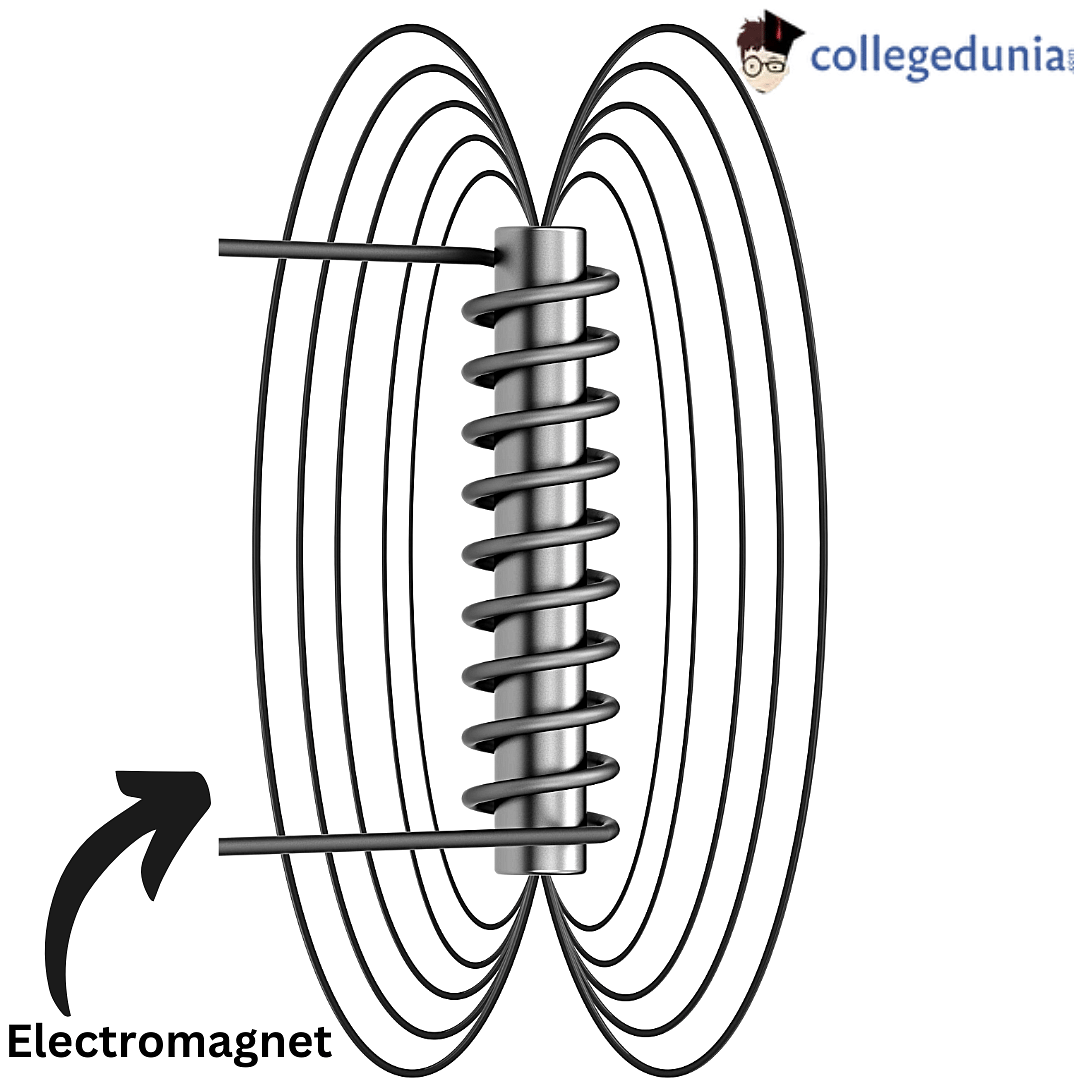
Electromagnet
The magnetic core around the coil of wire is made of ferromagnetic material, such as iron. The magnetic flux is strengthened by the magnetic core, which results in more powerful magnets. An electromagnet functions when the electric current causes a magnetic field to form a circle around the current.
Properties of Magnet
Out of the many properties of magnets, a few are as mentioned below:
- Attractive Property: Ferromagnetic materials, such as iron and nickel, have attractive properties. Meaning that they are attracted by magnets.
- Repulsive Property: In magnets, the like poles repel one another, whereas the unlike poles attract each other.
- Directive Property: A freely suspended magnet is seen to point in the north-south direction.
Read More: Inductance formula
History of Electromagnets
[Click Here for Sample Questions]
Electromagnets produce electromagnetic fields and function on the principles of electromagnetism. Electromagnetic fields are the result of the interaction of two fields: electric and magnetic fields. Hans Christian Oersted, a Danish physicist, proved in 1820 that when current travels via a wire, a nearby compass needle deflects.

Horseshoe Magnet
The electromagnet was designed in 1824 by British scientist William Sturgeon, who used a painted horseshoe-shaped iron piece wrapped in bare copper wire. Sturgeon further demonstrated the electromagnet's strength by lifting other iron fragments. Joseph Henry, a US physicist, developed a more advanced electromagnet in 1830 and popularised it.
Read More: Rare Earth Magnets
Making of Electromagnet
[Click Here for Previous Year Questions]
The formation of an Electromagnet can be achieved by:
- When charged particles such as protons and electrons remain stationary, electric forces such as attraction or repulsive forces are formed between them.
- Due to their mobility, they create magnetic forces that either repulse or attract charged particles.
- A magnet's magnetic field is generated by many particles travelling within the magnet.

Formation of Electromagnets
- Electromagnets are often manufactured out of a wire that has been twisted into a sequence of twists.
- A conventional magnet is wrapped around the wire turns.
- The electromagnet is stronger since it is constructed of ferromagnetic material like iron.
The electromagnet can be strengthened using the following ways.
- Draping the coil around a piece of iron (such as an iron nail).
- Increasing the coil's number of turns.
- Increasing the amount of current that passes through the coil.
What is a magnet?Magnet can be defined as an object which can produce magnetic fields and attract unlike poles and repel like poles. What are some major uses of permanent magnets?Some of the major uses of Permanent magnets are in generators, electric accelerators, and electric motors. |
Read More: Eddy Currents
Working of Electromagnet
[Click Here for Sample Questions]
The working principle of an electromagnet is:
- Individual magnetic fields cancel each other out when the atoms in the nail are orientated in arbitrary ways.
- Under the influence of electric current, these atoms are reoriented to point in the same direction.
- These different magnetic fields merge to form a powerful magnetic field.
- The reorientation degree rises as the current flow increases, resulting in a greater magnetic field.
- Increased current flow has no effect on the magnetic field created until all the particles are reoriented correctly in the same direction.
- The magnet is saturated at this stage.
Read More:
| Topic Related Concepts | ||
|---|---|---|
| Magnetic Field due to Lurrent Element | Magnetism and Matter | Gauss Law for Magnetism |
Applications of Electromagnets
[Click Here for Previous Year Questions]
The primary functioning concept of most electric equipment in the house is the electromagnetic principle.
- An electric fan, electric doorbell, induction stove, magnetic locks, and other electromagnet applications in the house are only a few examples. Electromagnetic induction keeps the motor spinning in an electric fan, which causes the blades to revolve. When the button of an electric doorbell is pressed, the coil is charged by electromagnetic forces, and the bell sounds.
- Cell phones and telephones we used to make long-distance calls could not have existed without electromagnets. Mobile phones and cell phones are useful due to electromagnetic pulses and signal interaction.
- Data is saved in the electromagnetic format in the form of bytes and bits in e-book devices and phones. A magnetic tape, included in the computer hardware, works on electromagnetism. Electromagnets played a significant part in the data storage of VCP and VCR in the past.
- Electromagnets are also used in medicinal applications. The MRI scan, which stands for Magnetic Resonance Imaging, is an electromagnet-based instrument. With the use of electromagnetism, the gadget can scan all the minute features of the human body.
Advantages and Disadvantages of Electromagnets
[Click Here for Sample Questions]
Electromagnets have both benefits and disadvantages when compared to permanent magnets. They are superior in certain regions, whereas permanent magnets are better in others. Electromagnets have proven to be advantageous over permanent magnets in many aspects.
Advantages of Electromagnets
Some of the major advantages of Electromagnets are:
- Electromagnets are not permanent magnets.
- The magnetic strength of Electromagnets can be both increased or decreased.
- Electromagnets typically tend to have higher magnetic power than permanent magnets.
Disadvantages of Electromagnets
Some of the major disadvantages of Electromagnets are:
- One of the downsides of electromagnets is that they heat up quickly, resulting in a significant loss of electrical energy owing to heat creation. A steady magnetic field is required for a continuous power supply.
- A considerable amount of area is required to maintain a high magnetic field with a significant number of coils of copper wires. As a result, electromagnets are unsuitable for use in compact places.
- Electromagnets are prone to short-circuit because of magnetic fields produced by an electric current which can also injure the user.
Read Also:
Things to Remember
- An electromagnet can be expressed as a magnet that functions on electricity. It is constructed of a coil of wire (i.e., wire curled in series).
- Particle Accelerators, Amplifiers, Magnetic Separation, Electric Motors and Generators, MRI machines, Control Switches in Relays, and Hard Drives are just a few examples of electromagnet applications.
- An electromagnet’s poles can be reversed by means of reversing the flow of electricity.
- An electromagnet can be strengthened by draping the coil around a piece of iron (like, iron nail).
Previous Year Questions
Questions on Lenz Law :
- Lenz’s law is consequence of the law] of conservation of….. [UPSEE 2019]
- The magnetic field is increasing at a constant rate. The directions of induced current in wires AB and CD are…. [VITEEE 2019]
- the circular loop of wire is moved with velocity towards the infinite current carrying wire…… [VITEEE 2016]
- Two identical coaxial coils P and Q carrying equal amount of current in the same direction are ...[KEAM]
- The polarity of induced emf is given by….[KEAM]
Questions on Electromagnetic Induction:
- If a transformer of an audio amplifier has output impedance 8000 0 and the speaker has input impedance…...[JCECE 2005]
- A conducting loop in the shape of a right angled isosceles triangle of …..[JEE Advance 2016]
- A 10m long horizontal wire extends from North East to South West. It is falling with a speed of 5.0ms−1……. [ JEE Main 2019]
- According to Lenz's law of electromagnetic induction … [JKCET 2008]
- An electric bulb is rated at … [JKCET 2006]
Question on Transformers:
- The output of a step down transformer is measured to…..[KCET 2017]
- The core of a transformer is laminated to reduce….[KCET 2001]
Questions on Eddy Currents :
- The working of magnetic braking of trains is based on….[KCET 2018]
- Induction furnace uses ______ to produce heat…. [JIPMER 2019]
Questions on Faradays laws of induction:
- Two identical circular coils A and B are kept on a horizontal tube side by side without touching each other…. [KCET 2013]
- The magnetic flux through a circuit of resistance RR changes by an amount….[NEET 2004]
Sample Questions
Ques: What is an electromagnet's foundation? (2 marks)
Ans: The electric current running through the coil determines the strength of the electromagnet; the higher the current, the stronger the electromagnet. Because the current increases, more electrons pass through the system, increasing the magnetic field around it.
Ques: What happens when a component of the electromagnet is disconnected? (2 marks)
Ans: The magnetic field vanishes when the wire is disconnected, and the nail ceases to be a magnet. The magnetic domains of the nail will realign sufficiently to make it a permanent magnet if you keep the wire attached long enough.
Ques: What kind of current is used in the production of electromagnets? (2 marks)
Ans: As current travels in only one direction in a DC circuit, a powerful magnet, such as a permanent magnet DC, should be utilised. The electric current oscillates 50 or more times per second in an AC circuit, depending on the frequency and altering the direction of the current, leading to an excessive amount of heat, which might destroy the circuit. In the long run, using AC might harm the electromagnet.
Ques: Can one use an electromagnet to generate electricity? (2 marks)
Ans: Magnets' characteristics are employed to generate electricity. Moving magnetic fields attract and repel electrons. Electrons are dispersed around in metals like copper and aluminium. When you move a magnet around a coil of wire or vice versa, the electrons in the wire are pushed out, and an electrical current is created. Kinetic energy (the energy of motion) is converted into electrical energy via electricity generators.
Ques: What occurs when the current flow of an electromagnet is reversed? (2 marks)
Ans: When the current flowing through the wire is reversed, the north and south poles are reversed as well. The north and south poles reverse when the current is reversed again. The north and south poles will swap locations every time the current is reversed.
Ques: How can you tell the difference between an electromagnet and a permanent magnet? (3 marks)
Ans: The fundamental distinction between electromagnets and permanent magnets is that when a current is sent through them, they have a magnetic attraction to other metallic things. It offers several advantages, including the ability to regulate the magnetic attraction's strength by changing the current flow. It is commonly used in research and industry when magnetic attraction is necessary for this purpose.
Electromagnets also offer several benefits over permanent magnets like-
- They can be switched on and off whenever you choose
- The magnetic field's strength can be adjusted, and
- Electromagnets are excellent for gathering scrap steel and iron in scrap yards because of their qualities.
Ques: Describe the various types of electromagnets? (3 marks)
Ans: Electromagnets can be classified as resistive, superconductors, or hybrids.
Resistive magnets: Copper wires are used to produce a magnetic field in this type of magnet. The magnetic field is created when the copper wire is twisted around a piece of iron and an electric current is sent through the copper wire. The stronger the field, the more copper wires are twisted.
Superconductors: The current running through superconductive metal has no resistance. The same approach is used to create superconductor magnets. The temperature of the copper coil is lowered using liquid nitrogen or liquid helium in these electromagnets. The copper atoms are separated from the current flow at a low temperature, resulting in a strong magnetic field. Even when the electricity is cut off, these electromagnets continue to function.
Hybrid electromagnets: They're a hybrid of the two sorts of electromagnets stated above: resistive and superconductor.
Ques: Are electromagnets temporary magnets? Why/why not? (5 marks)
Ans: Electromagnets are temporary magnets. The reason behind the same is discussed below.
Electromagnets are devices that generate a magnetic field using electricity. When an electrical current travels through these coils of wire, they act like bar magnets with separate north and south poles. It acts almost like a natural magnet, with north and south poles that attract and repel natural magnet north and south poles, respectively. It can attract specific materials. An electromagnet is built entirely of non-magnetic materials.
A permanent magnet maintains its magnetism over time. Magnetic fields may line up and work with one another in minerals like magnetite, iron, nickel, or neodymium, giving the item a significant magnetic field.
Temporary magnets retain their magnetism only when they are in close contact with a permanent magnetic field or an electric current. As a result, they require an external force to remain magnetised.
Current travels through the coil when the battery is attached to it. A magnetic field is created in this way. The magnetic permeability of iron is great, allowing it to strengthen the magnetic field created by the wire. However, when the battery's power is turned off, the current stops flowing, and the magnetic field evaporates. Electromagnets are transitory magnets because of this.
As a result, an electromagnet is referred to as a transient magnet.
For Latest Updates on Upcoming Board Exams, Click Here: https://t.me/class_10_12_board_updates
Check-Out:



Comments