



Education Journalist | Study Abroad Lead
Magnetic Susceptibility is a numerical measure of the ability of a material to be magnetised in response to a particular applied magnetic field. Mathematically, the ratio of the magnetization M within the material to the applied magnetic field strength H is known as the magnetic susceptibility of the material. Magnetization entails a particular amount of magnetism (dipole moment) per unit volume, this ratio is technically known as volume susceptibility.
Read More: Magnetic Field on the Axis of a Circular Current Loop
| Table of Content |
Key Terms: Magnets, Magnetic effect, Diamagnetic Material, Paramagnetic Materials, Magnetic field lines, Dipole moment, Magnetic field, Electromagnet, Magnetization
Magnetic Susceptibility
[Click Here for Sample Questions]
- The degree of magnetization of a substance in response to an applied magnetic field is measured by magnetic susceptibility.
- It is a dimensionless proportionality constant.
- Susceptibility refers to the overall quantity of magnetization that occurs at the same moment when a magnetic field is applied to a material.
- Interactions between electrons and nuclei cause this phenomenon.
- When both the nuclei and the electrons are externally applied under a magnetic field, susceptibility arises.
Also Read: Moving Charges and Magnetism
Magnetic Susceptibility Formula
[Click Here for Previous Year Questions]
Magnetic Susceptibility is the ratio of magnetization to the applied magnetising field intensity. It is a dimensionless quantity.
Mathematically,
χ=M/H
Where,
χ = Magnetic susceptibility
M= Magnetization
H = Field intensity
Also Read:
| Related Articles | ||
|---|---|---|
| Magnetic Properties of Materials | Magnetic effects of electric current | Magnetization and Magnetic Intensity |
| Electromagnetic field | Earth’s Magnetic Field | Magnetic Pole |
Types of Magnetic Materials
[Click Here for Sample Questions]
Diamagnetic Material
- Magnetic materials that line up with the magnetic field are known as diamagnetic materials.
- For diamagnetic materials, the magnetic susceptibility value is χ<0.
- This relationship indicates that magnetic susceptibility is always negative for diamagnetic materials.

Diamagnetical Material
- The magnets repel these materials, which cause them to shift from a stronger magnetic field to a lesser magnetic field.
- These materials are temperature insensitive.
- Magnetization in diamagnetic materials is in the opposite direction.
- The diamagnetic materials' magnetization intensity is within a certain range.
- The relative permeability of any diamagnetic substance is almost the same.
Read More: The Solenoid and the Toroid
Diamagnetic material examples:
- Gold
- Tin
- Mercury
- Water
- Copper
- Zinc
- Bismuth
- Silver
- Antimony
- Marble
- Glass
- NaCl etc.
| Material | χv [× 10−5 (SI units)] |
|---|---|
| Superconductor | −105 |
| Pyrolytic carbon | −40.9 |
| Bismuth | −16.6 |
| Mercury | −2.9 |
| Silver | −2.6 |
| Carbon (diamond) | −2.1 |
| Lead | −1.8 |
| Carbon (graphite) | −1.6 |
| Copper | −1.0 |
| Water | −0.91 |
Paramagnetic Materials
- The term paramagnetic refers to magnetic materials that align with the magnetic field.
- Magnetic susceptibility for paramagnetic materials is >0, implying that it is always a tiny positive number.
- Different dependencies exist for paramagnetic materials.
- Temperature is a dependent quantity for each paramagnetic substance.
- The magnetic field can be reduced by increasing the temperature of paramagnetic materials.
- The relative permeability of these materials ranges between 1.00001 and 1.003.
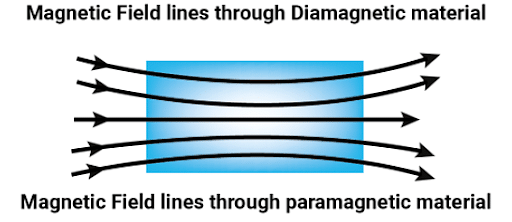
Paramagnetic Materials
The following are some examples of paramagnetic materials:
- Alkaline earth metal
- Aluminium
- Oxygen
Read More: Magnetic Flux
The magnetization of paramagnetic materials can be calculated using Curie's law. As a result, according to Curie's law, the magnetization formula is:
M = χ H = {C / T x H}
Where,
M = magnetization
C = material-specific Curie constant
χ = magnetic susceptibility
H = auxiliary magnetic field
T = absolute (Kelvin) temperature
Ferromagnetic Materials
- Ferromagnetic materials are magnetic materials that are strongly magnetised in a magnetic field.
- The magnets attract them strongly, and they travel from lesser magnetic fields to stronger magnetic fields.
- They do not have constant susceptibilities in most cases.
- The magnetization is not proportional to the applied field strength.
- The positive values of measured ferromagnetic susceptibilities are rather high.
- The relative permeability value ranges between 1,000 and 100,000.
- The following are some examples of ferromagnetic materials:
- Iron
- Cobalt
- Nickel (and their alloys)
Also Read:
Things to Remember
- The magnetic susceptibility of a substance can reveal information about its behaviour.
- Magnetic susceptibility can explain whether or not a substance may be attracted or repelled by a magnetic field.
- It is a dimensionless quantity.
- Mathematically, it can be expressed as- χ=M/H. Where, χ = Magnetic susceptibility, M= Magnetization and H = Field intensity
- When paramagnetic materials come across higher magnetic fields, they can be attracted by the magnetic field. This happens when they align with the applied magnetic field.
- Magnetic field alignment is not possible in diamagnetic materials. As a result, each substance is pushed away from higher magnetic fields and toward lower magnetic fields.
- The material's magnetization is always higher than the applied field.
- Quantitative measurements can be applied to magnetic susceptibility values.
- Magnetic susceptibility can provide us with the necessary information depending on the material structure.
- Magnetic Susceptibility can also reveal information about energy levels and material bonding.
Read More: Magnetism and Gauss’s Law
Previous Year Questions
- An electron in motion is associated with… [ KCET 1996]
- Two parallel wires carry electric current in same direction. The wires... [ KCET 1996]
- Resistance of an ideal ammeter is...[ KCET 1996]
- If a current of 0.1 A is passed through the coil, what is the couple acting?...[CBSE Class 12 ]
- The acceleration of the falling magnet is..[NEET]
- A bar magnet is equivalent to ............[KCET 2004]
- A metal ring is held horizontally and bar magnet is dropped through….[NEET]
- The total charge, induced in a conducting loop when it is moved in magnetic field depend on...[NEET 1992]
- If a charge particle enters perpendicular in the uniform magnetic field, then...[JIPMER 2016]
- Who invented the cyclotron?
- The ferromagnetic substance is converted into paramagnetic substances … [JIPMER 1996]
- The relative permeability is represented by μr … [KCET 2001]
- A device which converts electrical energy into mechanical energy … [JKCET 1999]
- A circular loop of radius R, carrying current I, lies in x-y plane … [JEE Advance 1999]
- When a material is placed in a magnetic field B … [COMEDK UGET]
- Susceptibility of a magnetic substance is found to depend on temperature … [JEE Advance 1998]
- If a magnetic dipole of moment M situated in the direction of …
- If the susceptibility of dia, para and ferro magnetic materials are ….
- Materials suitable for permanent magnet, must have which of the following properties ?
- At what temperature, the ferromagnetic substances become paramagnetic ?
- a magnetic induction of strength at its centre is...
Sample Questions
Ques: What is Magnetic Susceptibility? Explain (2 Marks)
Ans: Magnetic Susceptibility is a measure of the extent to which a substance becomes magnetized when it is placed in an external magnetic field. It has no dimensions.The ratio of the magnetization M within the material to the applied magnetic field strength H is known as the magnetic susceptibility of the material. Mathematically,
χ=M/H
Where,
χ: magnetic susceptibility
M: magnetization
H: field intensity
Ques: What are the values for magnetic susceptibility for different types of materials? (2 Marks)
Ans: Diamagnetic substances have negative susceptibilities (χ < 0)
Paramagnetic, superparamagnetic, and ferromagnetic substances have positive susceptibilities (χ > 0).
Ques: Why does the manufacturer prefer soft iron for the production of electromagnets? (2 Marks)
Ans: Soft iron is used to produce electromagnets because it has a higher susceptibility and lower retentivity. It is the only substance that may provide hope to manufacturers for better product development.
Ques: What is Retentivity? (2 Marks)
Ans: Retentivity is defined as the ability of a magnetic field to stay in a material after the external source has been removed. It provides information on the material's magnetic strength. Alternatively, when the applied magnetic field is reduced to zero after the saturation point of magnetization is reached, the leftover magnetization displayed by the substance is referred to as retentivity.
Ques: What is coercivity? (2 Marks)
Ans: The least value of magnetising intensity necessary to restore the material to its previous state is known as coercivity. When the applied magnetic field is reversed in the case of a ferromagnetic substance, the substance loses its magnetization completely at a certain point Hc. Coercivity is the term for this situation.
Ques: State the differences between Paramagnetic and diamagnetic material? (5 Marks)
Ans: The following are the differences between diamagnetic and paramagnetic materials:
Diamagnetic substances:–
- When diamagnetic material is held in a magnetising field, the diamagnetic substance repels the magnetic field lines.
- Relative permeability of diamagnetic substance is less than one is μr<1
- The susceptibility of diamagnetic substances is negative.
Paramagnetic substance:-
- Whenever a paramagnetic substance is kept in an external magnetic field, the lines of the field pass through the paramagnetic substance.
- Relative permeability of paramagnetic substance is more than one μr<1
- The susceptibility of paramagnetic substances is positive.
For Latest Updates on Upcoming Board Exams, Click Here: https://t.me/class_10_12_board_updates
Do Check Out:



Comments