



Education Journalist | Study Abroad Lead
Mu naught or vacuum permeability of free space is a physical constant. It is the measure of the amount of resistance that is offered against the formation of the magnetic field in a vacuum. Mu naught is represented as μ0.
The value of mu naught is given by μ0 = 4\(\pi\) × 10-7 H/m.
| Table of Content |
Key Terms: Mu naught value, Permeability of Free space, Magnetic Field, Physical Constant, Henry, Micrometer, Electromagnetism, Permeability
What is the Value of Mu Naught?
[Click Here for Sample Questions]
Mu naught value or μ0 represents the permeability of free space. It has an exactly defined value till 20 May 2019 but on 20 May 2019, the value of mu naught was revised. There was a revision to the SI system that took place on 20 May 2019.
- It is the value of the measured amount of resistance that is given against the formation of the magnetic field.
- Mu naught is the permeability constant of the vacuum in the magnetic field.
- Mu naught is a physical constant that is often used in electromagnetism.
- The sign μ is a Greek alphabet that is used to represent mu in physics.
- The value of Mu naught is equal to μ0 = 4\(\pi\) × 10-7 H/m.
- The approximated value of Mu naught is equal to 12.57 ×10⁻⁷ H/m.
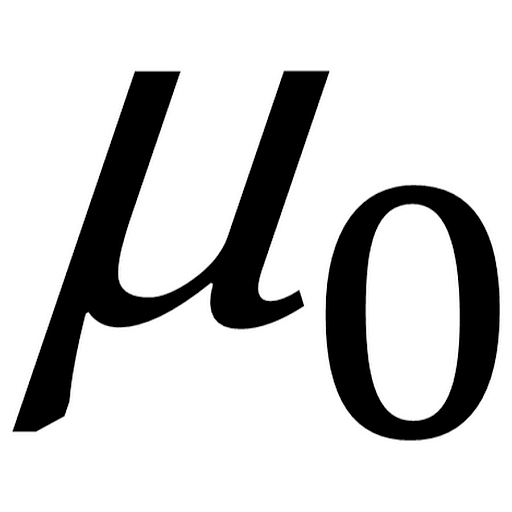
- Mu naught is also the proportionality constant between the free space permeability and the magnetic field strength in any of the mediums.
- As per the revised SI, the vacuum permeability is no longer a constant. It becomes a value that is needed to determine the experimentally.
The recently measured value is: 4π × 10000000008220 × 10-7H•m1
The video below explains this:
Mu Naught value Detailed Video Explanation:
Also Read:
Mu Naught Unit
[Click Here for Sample Questions]
Mu naught is measured in H/m or Henry per meter.
- To represent the magnetic permeability in a vacuum we used to write using the Greek alphabet that is μ.
- The sign μ is an abbreviation of the unit micron(s) or micrometer(s).
- Both of these are referred to as a unit of displacement that is equal to 0.000001-meter or 0.001 mm (millimeter).
- The dimensional unit of Mu Naught is M1L1T-2A-2.
1μ (micrometer) = 0.000001 meter
Calculation of Mu Naught
[Click Here for Sample Questions]
To calculate the Mu naught value or the permeability of free space first, we need to know the magnitude and the direction. The force per unit length is represented by F on the electric current. It is given by the product of current and magnetic density.
The formula for force is: F = I × B
If there are two conductors or currents then one is I1 and the other is I2. They are r distance apart. If we suppose that I1 produces a magnetic field B1 then as per the third law of Newton it is said that each object has an equal and opposite direction. According to this, the force of the wire will be the same and in the opposite direction to the other one.
The magnitude of the force is: I1 is B = μ × I12πr
As we already know that F = I × B
The force that will be experienced would be I2 × B
So, when we place the value of B in it, then it will be F = μ × I1 × I2 2πr
If this experiment is carried out in a vacuum then μ0 = μ
The distance, r is assumed as 1 meter
Let’s calculate between these two wires
F = μ02π
On substituting, we get,
F = 4π ×10-7 N/m or 4π ×10-7 Wb A-1 m-1
Also Read:
| Related Articles | ||
|---|---|---|
| Torque current loop | Universal Motor | Moving Charges and Magnetism MCQ |
| Magnetism Formula | Solenoid and Toroid | Magnetic Field Due to Current Element |
Things to Remember
- The value of Mu naught is equal to μ0 = 4pi × 10-7Hm.
- Mu naught value or μ0 is the permeability constant of the vacuum in the magnetic field.
- Mu naught is a physical constant that is often used in electromagnetism.
- Mu naught value is the measurement of the resistance amount that is offered against the formation of the magnetic field.
- Mu naught value is calculated using Henry per meter.
- The sign μ is an abbreviation of the unit micron(s) or micrometer(s). Both of these are referred to as a unit of displacement that is equal to 0.000001-meter or 0.001 mm(millimeter).
Also Read:
Sample Questions
Ques: What is absolute permeability? (3 marks)
Ans: The measurement of the possible flow of a standard liquid under some fixed conditions through a porous medium, if there is no reaction between the solids & the liquid is called absolute permeability. It is the magnetic permeability of a material. It is the conductivity of the magnetic flux. In simple words, absolute permeability is the ability to flow the fluid. The absolute permeability is represented with the Greek alphabet μ & it is measured in H/m.
Ques: Write the SI unit of magnetic susceptibility. (4 marks)
Ans: SI UNITS of magnetic susceptibility:
| Quantity | Unit |
|---|---|
| Magnetic field strength | H ampere/meter (A m-1) |
| Magnetic flux | Weber (Wb) |
| Magnetic induction | Weber (Wb) |
| Magnetic flux density | B tesla (T) |
| Magnetic susceptibility | e none |
Ques: What is the mu naught unit? (2 marks)
Ans: The mu naught unit is the unit that is used to represent the measurement of an entity. This measurement of the entity is referred to as units in physics. As there are so many different scales to measure an entity. The unit to represent mu naught value is calculated using H/m which means henries per meter.
Ques: What is 1 ampere? (3 marks)
Ans: We can define 1 ampere as 1 Coulomb of charge per second. An ampere is a unit of electric current in the international system of units (SI). It is used by both scientists as well as technologists. In other words, An ampere is a measurement of the amount of electric charge which is a passing point in an electric circuit per unit of time with one coulomb per second or 6.241×10¹⁸ which constitutes one ampere.
Ques: What is vacuum permeability? (2 marks)
Ans: The magnetic permeability in a classical vacuum is called its vacuum permeability. It is derived from the production of a magnetic field by a moving electric charge or an electric current & it can be derived from all the other magnetic field production formulas in a vacuum. The value of vacuum permeability is a physical constant of 1.257×10⁻⁶Henry per meter (H/m)which is symbolized as μ o.
Ques: What is mu naught in a magnetic field? (2 marks)
Ans: A permeability constant is a synonym for the permeability of free space & magnetic constant in a magnetic field. It is that value that is the measurement of the amount of resistance that is offered in opposition to the formation of the magnetic field in free space or a vacuum. The mu naught value is represented as μ0 in physics.
Ques: Write the characteristics of a material used for making permanent magnets. (5 marks)
Ans: The material that is for making permanent magnets has the following characteristics:
- The material should possess a high coercivity.
- The material should have a reasonable value of retentivity.
- The area of the hysteresis curve should be significant.
- The material of steel & Alnico
- has all these characteristics.
- The material should be strong for making permanent magnets.
- A ferromagnetic material is popular as the most suitable material for making permanent magnets.
Ques: What is the dimensional formula of Mu naught? (5 marks)
Ans: The dimensional formula of Mu naught is
μ0=[M1L1T-2A-2]
Explanation of the formula:
To find the dimensions using the formula,
c2=1/μ0£0
Where c= the speed of light
£0= the permittivity of free space
[c2] = L2 T-2
[£0]=[q2/Fr24π]=[A2 T2 /MLT-2 L2]=[M-1 L-3 T4A2
Therefore, μ0=1M1L-3T-4A2L2T2
μ0=1/[M1L1T2A2]
μ0=M1 L1T-2A-2
For Latest Updates on Upcoming Board Exams, Click Here: https://t.me/class_10_12_board_updates
Check-Out:



Comments