



Content Writer
Peptide bond or peptide linkage is a chemical connection produced when the carboxyl group of one molecule combines with the amino group of another molecule. This is a type of condensation or dehydration that occurs often between amino acids. When an amide bond forms between the amino group of one amino acid and the carboxyl group of another amino acid at a position other than the alpha position it is called an isopeptide bond.
The bond formed as a result of the CO-NH interaction is known as a peptide bond, and the molecule formed is known as an amide. An amide group, or (in the context of proteins) a peptide group, is a four-atom functional group with the formula -C(=O)NH. Polypeptides and proteins like PNA are made up of chains of amino acids joined together by peptide bonds.
| Table of Content |
Key Terms: Peptide bond, amino acids, amide group, carboxyl group, hydrolysis, peptide leakage, atom, Polypeptides, proteins, water
Peptide Bond or Peptide Linkage: Definition
[Click Here for Sample Questions]
Peptide bond or peptide linkage is a bond created when the carboxyl group of two molecules combines with the amino acid group of the other molecule, resulting in the creation of an amide group and a molecule of water.
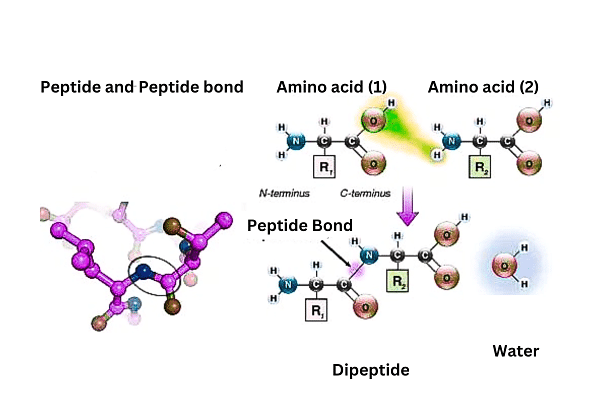
Peptide Bond
Also Read:
| Related Articles | ||
|---|---|---|
| Maltose | Amylose | Sucrose |
| Ideal and Non-Ideal Solutions | Colligative Property | Solubility |
| Crystal Lattices and Unit Cells | Packing Efficiency | Dehydration of Alcohols |
Peptide Bond Formation
[Click Here for Sample Questions]
A Dehydration Synthesis process is involved in the formation of peptide bond or peptide linkage. The carboxyl group of one amino acid travels towards the amino group of another amino acid during the creation of a peptide bond. The carboxyl group (COOH) of the first amino acid loses one hydrogen and one oxygen atom as a result. The amino group (NH2) of the other amino acid on the other hand loses one hydrogen.
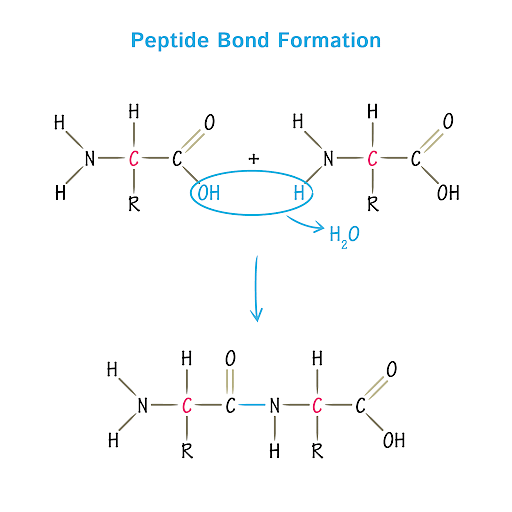
The water molecule is released and an amide bond (C-N) is formed between the two amino acids as a result. The formation of a dipeptide molecule occurs when the carboxyl group of one amino acid condenses with the amino group of another amino acid, resulting in the formation of a peptide bond & the release of a H2O molecule. The creation of the peptide bond is an endergonic reaction that necessitates energy, which in living beings is obtained from ATP. This process is known as a dehydration synthesis reaction because it involves the elimination of a water molecule.
Characteristics of Peptide Bond or Peptide Linkage
[Click Here for Sample Questions]
- Peptide bond is found in all proteins and is responsible for binding the amino acids in a chain together.
- Monopeptide is a protein that only contains one amino acid. Dipeptide contains Two amino acids. Tripeptide contains Three amino acids.

Characteristics of Peptide Bond
- Peptide bonds possess a partial double bond which makes them strong. This is why they cannot be broken by heat or or in a high salt concentration.
- Peptide Linkage is made of rigid, planar bonds causing stabilized protein structure.
- Peptide Bonds contain polar hydrogen atoms of amino groups (partial positive charge groups) and polar oxygen atoms of carboxyl groups (partial negative charge groups)
Peptide Bond or Peptide Linkage: Hydrolysis
[Click Here for Sample Questions]
The primary step in all protein hydrolysis reactions is peptide bond hydrolysis. Acid-catalyzed peptide bond hydrolysis is the most prevalent form of protein breakdown. Peptide hydrolysis is also required in several synthetic reactions in which amino acids from one peptide are cleaved and transferred to another, resulting in the production of distinct peptides. Similarly, many peptides and proteins build up in cells that cause toxicity. Hydrolysis of peptide bonds is also necessary for the elimination of such poisons.
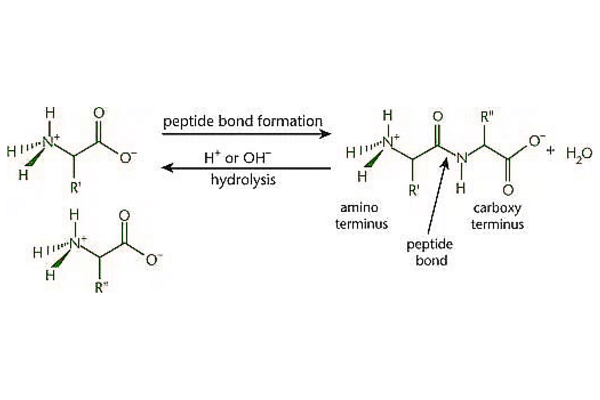
Hydrolysis of Peptide Bond
In living organisms, peptide bond hydrolysis is also a key stage in protein digestion. The presence of acid catalyses the hydrolysis of the peptide link in the presence of water. Peptide bond hydrolysis is a peptide bond degradation method in which polypeptides are either split into smaller peptides or smaller peptides are degraded into individual amino acids.
Things to Remember
[Click Here for Sample Questions]
- The amide bond between the amino acids is maintained by a partial double bond because that slows down the breakdown process.
- The OH– ions of water attack the carbon atom in the presence of water that causes the peptide bond to degrade.
- When the amide bond develops between the carboxyl group of one amino acid and the amino group of another amino acid at places other than the alpha, the peptide bond is also referred to as isopeptide bond.
- Peptide bonds are planar and move very little around the C-N bond, whereas the single bonds on either side of the C-N bond rotate a lot.
- To generate an amide, the peptide bond connects the carboxyl group of one amino acid to the amine group of the next amino acid.
Also Read:
Sample Questions
Ques: What is a peptide bond and how does it work? (2 marks)
Ans: A peptide bond is a sort of amide bond created between two molecules in which one molecule of Alpha-carboxyl group combines with another molecule Alpha-amino group, releasing a water molecule.
Ques: In a peptide bond which components of amino acids are involved? (2 marks)
Ans: The carboxyl group of one amino acid and the amino group of another amino acid form a peptide link.
Ques: What do you mean by polypeptide? (2 marks)
Ans: Polypeptide means a peptide is a protein made up of two or more amino acids. Polypeptides are made up by amino acids that in turn make up the proteins.
Ques: What is the relationship between a polypeptide and a protein? (2 marks)
Ans: A polypeptide is a simple polymer of amino acids connected together by covalent peptide bonds, but a protein is a complex molecule with a stable structure formed by the folding of one or more polypeptide chains held together by non covalent links.
Ques: What is the best way to recognise a peptide bond? (2 marks)
Ans: A peptide bond can be identified using the biuret test.
Ques: Is a peptide bond a weak or strong bond? (2 marks)
Ans: Peptide bonds are extremely strong covalent bonds with high bond dissociation energy. During protein synthesis it is generated by the combining of two amino acid residues.
Ques: What is the significance of peptide bonds? (3 marks)
Ans: The backbone of proteins is made up of peptide bonds that are extremely important in biochemistry. One of the greatest mysteries of the beginning of life is the activation of amino acids and production of peptides under primitive geological settings.
Ques: What is the best way to break down peptide bonds? (3 marks)
Ans: Hydrolysis can break down a peptide linkage or peptide bond. They will decompose in the presence of water and produce 2–4 kcal/mol of Gibbs energy. This is a very slow process and has a half life of between 350 to 600 years per bond at 25 °C.
Ques: Is peptide bond formation catalysed by the ribosome? (3 marks)
Ans: The big subunit of the ribosome catalyses the chemical phase of protein synthesis known as peptide bond formation. The active location for peptide bond production is entirely made up of RNA according to crystal structures.
Ques: What type of RNA contributes to the formation of peptide bonds? (2 marks)
Ans: Transfer-RNA (tRNA) helps in the formation of peptide bonds. Each amino acid has its own Transfer-RNA (tRNA) that attaches to it and transports it to the polypeptide chain's developing end.
For Latest Updates on Upcoming Board Exams, Click Here: https://t.me/class_10_12_board_updates
Check-Out:



Comments