



Education Journalist | Study Abroad Lead
Dehydration synthesis refers to the reaction wherein two smaller molecules are joined together chemically by removing elements from each of these molecules in order to form a different compound or molecule. This process of synthesis is referred to as dehydration synthesis as there is a loss of water molecules involved. Many reactions which involve dehydration synthesis are majorly associated with the formation of biological polymers (polymerization) where in on the addition of each monomer to the polymer chain, there is the elimination of one molecule of water.
| Table of Content |
Key Takeaways: Dehydration Synthesis, Polymerisation, Condensation Reaction, Glycosidic Bond, Monomer, Polymer, Acetic acid
What is Dehydration Synthesis?
[Click Here for Sample Questions]
Dehydration reactions refer to a subset of condensation reactions in which the two functional groups inherently combine in order to form a covalent bond which is accompanied by the release of a small molecule, for instance, water, Hydrochloric acid, methanol or acetic acid. Though these above mentioned small molecules are commonly observed in the large scale industrial synthesis of organic molecules, in biological systems, water is the most frequent byproduct of a condensation reaction.
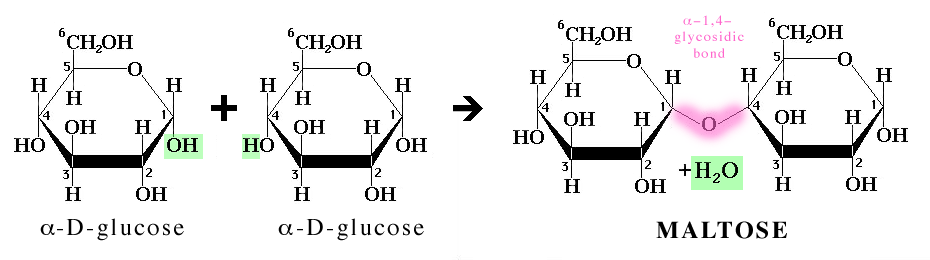
Dehydration Synthesis Reaction
Since each step occurs with the elimination of water molecules, the reaction is called a dehydration reaction and it results in the formation of a new substance. Many biochemical reactions occur through the mechanism of dehydration synthesis.
For instance, the formation of the peptide from amino acids is a dehydration synthesis reaction. It is a reaction which leads to the formation of peptide bonds occurring between two amino acid molecules. Here, the amino group of one molecule and carboxyl group of another molecule condenses with the elimination of water molecules and form an amide linkage in dipeptide.
One common dehydration reaction which involves a simple molecule is the formation of symmetric ethers from alcohol condensation. This is a reaction which is catalysed by the presence of an acid and thus, occurs at a pH < 7 (less than 7).
The following equation represents the formation of ethoxyethane from ethanol through dehydration synthesis.
2 C2H5OH ↔ C4H10O + H2O
Read more:
| Related Articles | ||
|---|---|---|
| Dehydration of Alcohols | Williamson synthesis | Difference between electrophile and nucleophile |
| Chemical Reactions | Benzene Reactions | Endothermic Reactions |
Types of Dehydration Synthesis Reactions
[Click Here for Sample Questions]
Dehydration synthesis can be classified according to a number of different criteria.
Criteria 1: They can be grouped on the basis of the nature of the reactants taking part in the reaction. For instance, some reactants are molecules which possess two functional groups and can react with one another. as in the case of amino acids which contain an amine group and a carboxylic acid group attached to the same carbon atom.
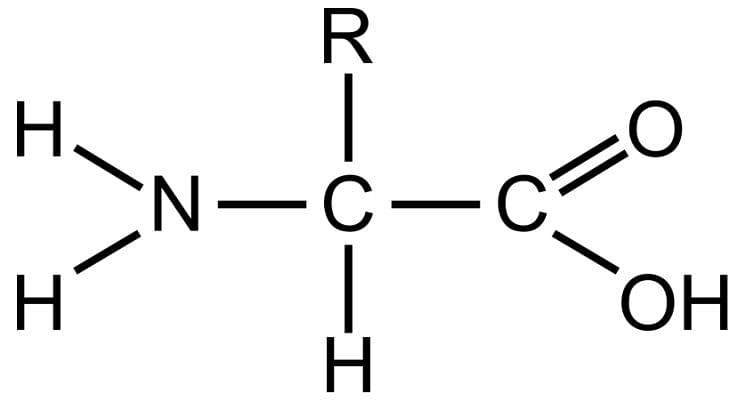
Amino Acid
The amine group (-NH3) of one amino acid can react with the acid group (-COOH) of another in order to form an amide bond. This also results in releasing one molecule of water per reaction between the functional groups. Furthermore, the newly formed amino acid dimer again undergoes the same reaction as it contains one free amine group and one free carboxylic acid group, thereby allowing the reaction to proceed with more amino acids and leading to formation of a polypeptide chain.
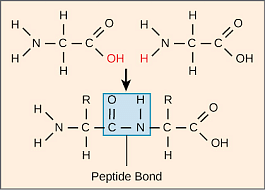
Dehydration reaction occurring as a result of peptide bond formation between two amino acids.
Bi-functional monomers, give rise to linear products wherein the constituent monomers are attached to each other end-to-end. Moreover, the reactants can also have multiple functional groups, which can result in the creation of a branched product, for instance, the formation of glycogen from the constituent glucose molecules.
Criteria 2: Dehydration reactions can also be classified on the nature of the catalyst. For instance, in the formation of symmetrical ethers, the catalyst present is a hydrogen ion. However, for reactions occurring within a living organism, the pH, salt concentrations and temperature cannot be altered. Under such situations, the presence of some other catalyst plays a critical role in driving a particular reversible reaction in one direction.
Alternatively, the reactions of the process of dehydration can be further classified on the basis of the products which they produce. In biological systems, most dehydration reactions create polymers. Therefore, these reactions can be further grouped on the basis of the fact that whether they create complex carbohydrates from simpler monosaccharides, lead to formation of fatty acids from acetyl coA or result in the synthesis of proteins from amino acids.
Examples of Dehydration Synthesis Reactions
[Click Here for Sample Questions]
Dehydration reactions are those which are involved in the industrial production of polyester fibres and polyethylene terephthalate (PET). PET is formed by dehydration synthesis from two monomers – ethylene glycol and terephthalic acid.
Example 1: Formation of Glycosidic Bond
Glycosidic bonds are those covalent bonds which are formed between a carbohydrate and any other molecule. Many of these glycosidic bonds involve the process of a dehydration reaction. For instance, when maltose is formed from glucose, there is formation of a glycosidic bond between the two constituent glucose molecules which is accompanied by the release of one molecule of water.
Similarly, long polymers of glucose can be formed in a manner which is similar, as summarised above, by undergoing through a series of dehydration reactions in order to give rise to starch, cellulose or glycogen-based chains based on the position of the glycosidic bonds.
Other disaccharides such as sucrose and lactose are also formed through dehydration reactions between two monosaccharides.
Glycosidic bonds are also involved when a carbohydrate is modified.
Example 2. Triglyceride Formation
One of the intermediates of the process of carbohydrate and fat metabolism is Acetyl CoA (a molecule in which a two-carbon acetyl group is attached to coenzyme A). Though it is primarily intended to become a part of the Krebs cycle in the mitochondria, it can also be used to generate chains of long-chain fatty acids. These fatty acids then subsequently lead to formation of triglycerides (energy storage molecules).
Triglycerides derive their name as the three hydroxyl groups on glycerol undergo esterification with fatty acids in order to form the triglyceride. Furthermore, each of the three fatty acids undergoes a dehydration reaction with the alcohol moieties on glycerol in order to generate one molecule of triglyceride.
One of the predominant reasons why triglycerides are considered a better storage medium than carbohydrates is because of their high energy density. Triglycerides have a much larger proportion of carbon atoms which can undergo oxidation and contain fewer oxygen molecules as a result of which the fatty acids are generated from hydrocarbons. Furthermore, the removal of three water molecules in the process of forming a triglyceride additionally increases the energy density of the molecule.
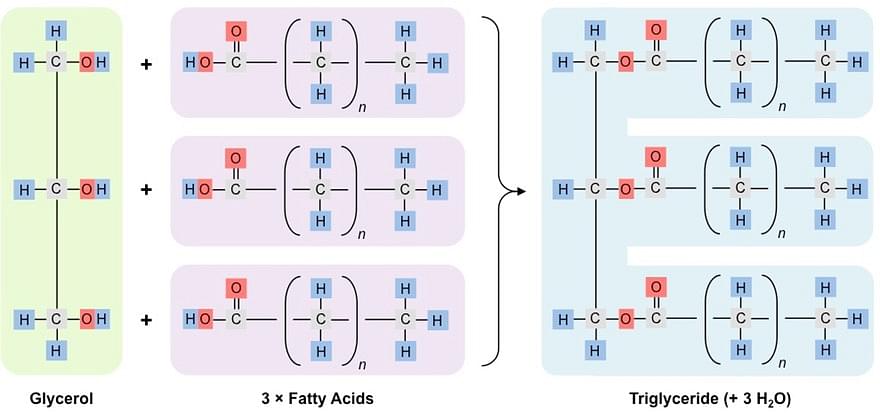
Triglyceride Formation
In the above structure, R1, R2 and R3 are referring to the long chain hydrocarbons, each of which is further attached to a carboxylic acid functional group. They form ester linkages with the hydroxyl groups which are attached to the α, β, and α’ of glycerol which additionally gives rise to a triglyceride.
Example 3. Hydrolysis
Hydrolysis is also referred to as the reverse of a dehydration reaction. This is because it involves the breaking of a covalent bond through the addition of a molecule of water. Moreover, hydrolysis is catalysed by a group of enzymes which are called hydrolases. Among them, the most commonly known hydrolases are the digestive enzymes which are present in living organisms.
The path can be traced as the digestion begins from the mouth, where salivary amylase breaks down starch molecules. This is the reason why extended chewing of starchy foods gives rise to a sweet taste in the mouth. The action of the enzyme salivary amylase generates monosaccharides. This is subsequently followed by the action of proteases in the stomach that initiates the process of breaking the peptide bonds in proteins.
The process of digestion is continued by hydrolytic enzymes from the pancreas and small intestine wherein various enzymes act on the lipids, carbohydrates, nucleic acids and proteins present in the food. Similar enzymes which are involved in intracellular digestion are present within the lysosomes.
Additionally, there are specific enzymes which reverse the post-translational modifications of proteins, such as phosphatases. These enzymes are capable of removing the phosphate groups which are attached to the protein via a hydrolysis reaction. In a similar manner, ATPase enzymes catalyse the hydrolysis of the terminal phosphodiester bond in ATP. These ATP molecules play a critical role in releasing the energy stored in the molecule.
Numerous enzymes which are involved in the process of hydrolysis contain a serine residue in their active site and are therefore known as serine hydrolases. These serine hydrolases include the majority of the digestive enzymes and are those which are involved in the major metabolic pathways occurring within the cell.
Things To Remember
- Dehydration synthesis is a reaction which is accompanied by the loss of a molecule of water at each step.
- In addition to dehydration synthesis, the loss of a water molecule also occurs as a result of condensation reaction ( reaction between two functional groups, such as -OH, -COOH and so on.
- Polymerization reactions represent dehydration synthesis reactions wherein the monomers condense in order to form polymers.
- Hydrolysis is referred to as the reverse of the reaction of the dehydration synthesis process wherein there is addition of a water molecule accompanied by the cleavage of the bonds of the reacting molecules.
Also Read:
Sample Questions
Ques. What is the major point of difference between Condensation and Dehydration Reactions. [2 marks]
Ans. When two given molecules combine together in order to form a single compound, and they release one small molecule, it is called a condensation reaction. In cases where the small molecule which gets removed during the reaction is water, then the reaction is called a dehydration reaction. However, if the water molecule is not removed, then it is a condensation reaction only.
Condensation reactions do not occur frequently in nature as most of the times when two reactants are taking part in the reaction in order to form a compound, water is released in one of its three forms. The condensation reaction is also referred to as the reverse of hydrolysis, wherein we get two elements from a single compound after the completion of the reaction.
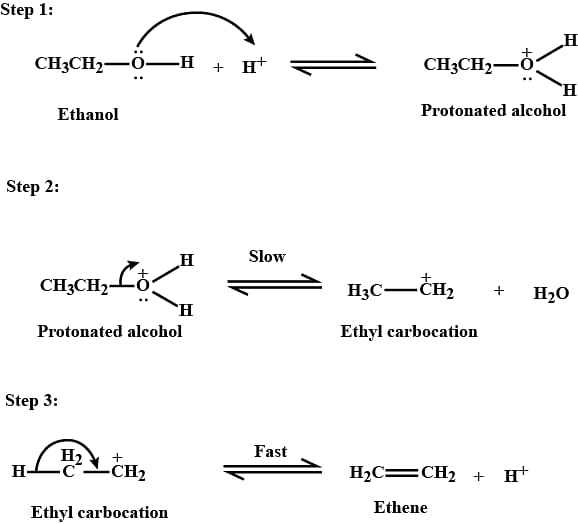
Ques. Elucidate the mechanism of acid dehydration of ethanol which leads to yielding ethene. [3 marks]
Ans: The mechanism of dehydration of ethanol (alcohol) to form ethene (alkenes) occurs by the following three steps:
Ques. Preparation of ethers by the process of acid dehydration of secondary or tertiary alcohols is not a suitable method. Give the reasoning for the same. [5 marks]
Ans. Acid catalysed dehydration of the primary alcohols to ethers occurs via SN2 reaction which involves a nucleophilic attack by the alcohol molecule on the protonated alcohol molecule.
Under these conditions, secondary and tertiary alcohols give alkenes rather than ethers. The reason behind that is because of steric hindrance, nucleophilic attack by the alcohol molecule on the protonated alcohol molecule does not occur. Instead protonated secondary and tertiary alcohols lose a molecule of water to form stable secondary and tertiary carbocation.
These carbocations prefer to lose a proton in order to form alkenes rather than undergoing nucleophilic attack by alcohol molecules in order to form ethers.
Ques. Write the names of the reagents and equations for the preparation of the following ethers by the process of Williamson’s synthesis :
(i) 1-Propoxypropane
(ii) 2-Methoxy-2-methylpropane
(iii) Ethoxybenzene
(iv) Methoxyethane [3 marks]
Ans.

Ques. Explain how the – OH group which is attached to a carbon of the benzene ring activates it towards the process of electrophilic substitution? [4 marks]
Ans. Phenol may be regarded as the resonance hybrid of structures I-V, as demonstrated below.

As a result of +R effect of the -OH group, the electron density in the benzene ring increases thereby facilitating the attack of an electrophile. Thus, the presence of the -OH group activates the benzene ring in such a way that it moves towards electrophilic substitution reactions. Furthermore, since the electron density is relatively higher at the two ortho-and one para-positions, the electrophilic substitution occurs mainly at ortho and para positions.
Ques. Illustrate two reactions that show the acidic nature of phenol. Compare its acidity with that of ethanol. [4 marks]
Ans. The reactions illustrating the acidic nature of phenol are demonstrated as follows:
(a) Reaction with sodium: Phenol reacts with active metals like sodium in order to liberate Hydrogen gas.
(b) Reaction with NaOH: Phenol dissolves in NaOH in order to form sodium phenoxide and water.
Phenol is more acidic than ethanol. This is due to the fact that phenoxide ion which is left after the loss of a proton from phenol is stabilised by the resonance, whereas the ethoxide ion which is left after loss of a proton from ethanol, is not resonance stabilised.
Ques. Elucidate the mechanism of hydration of ethene to yield ethanol. [3 marks]
Ans. Direct addition of water to ethene in the presence of acid does not occur. However, indirectly, ethene first passes through the concentrated sulphuric acid, when ethyl hydrogen sulphate is formed.
Ques. It is observed that alcohols are more soluble in water as compared to hydrocarbons as a consequence of them having comparable molecular masses. Explain this fact. [2 marks]
Ans. Alcohols are able to form hydrogen bonds with water by breaking the hydrogen bonds which are already existing between the water molecules. Therefore, they are more soluble in water.
On the other hand, hydrocarbons cannot form hydrogen bonds with water and thus are insoluble in water.
Ques. Why propanol has a higher boiling point as compared to that hydrocarbon, butane? [2 marks]
Ans. The molecules of butane are held together via weak Van der Waals forces of attraction while those of propanol are held together by stronger forces of intermolecular hydrogen bonding.
For Latest Updates on Upcoming Board Exams, Click Here: https://t.me/class_10_12_board_updates
Check-Out:



Comments