



Content Curator
Phylogeny is a study of evolutionary relationships. Phylogenetic Analysis is defined as a means of inferring evolutionary relationships. A phylogenetic tree is also called The "Tree of Life'' or "Dendrogram". The concept of a phylogenetic tree evolved from an ancient concept of a ladder-like evolution of life forms from moderate to powerful. The term phylogenetic or phylogenic is derived from the ancient Greek word, which refers to race, origin, or lineage. Phylogenetic trees are hypothetical means it is not a fact.
| Table of Content |
Key Terms: Phylogenetic tree, Phylogeny, outgroup, internal nodes, Terminal points, Evolutionary Tree, Fungi Phylogeny
Read More: Basic Internal Anatomy of Leaf
What is a Phylogenetic tree?
[Click Here for Sample Questions]
Phylogenetic tree is characterized as a diagrammatic portrayal of living organisms' evolutionary links. This diagrammatic representation represents how different species evolved from a species of common ancestors
The phylogenetic tree is a two-dimensional graph that depicts the evolutionary relationship between creatures that are related to each other.
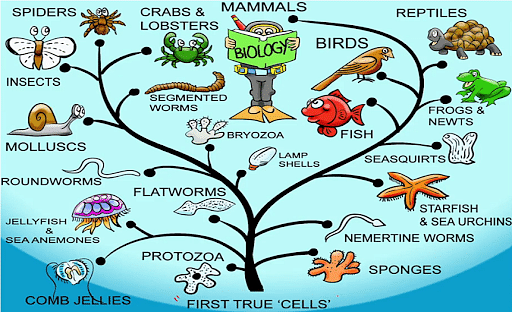
Phylogenetic tree
In the above diagram, The “First true cells” are known as Ancestors. You can also see humans in the diagram, which means the human originated from the first true cells.
Molluscs and mammals are distinctly related to each other. Reptiles and Birds are closely related to each other, it is said to be a closely related organism.
Construction of Phylogenetic Tree
[Click Here for Sample Questions]
Phylogenetic tree can be constructed in two different ways-
1. Character-based method
This method is based directly on the sequence characters, therefore it is called the discrete method.The character-based method uses the aligned character for constructing the phylogenetic tree. These aligned characters include either the DNA or protein sequence during the tree inference. The two most popular character-based method is
A) Maximum parsimony
B) Maximum likelihood
2. Distance-based method
This method is based on the amount of distance or the dissimilarity between the two aligned sequences. In this method the sequence data is transformed into pairwise distances and then the matrix is used for building a tree.
Also Read:
Steps To Prepare The Phylogenetic Tree
[Click Here for Sample Questions]
- Selection of an organism or a gene family
- Selection of appropriate molecular markers
- Amplification
- Sequencing
- Assembly
- Alignment
- Evolutionary model
- Phylogenetic analysis
- Construction of a tree
- Evolution of a phylogenetic tree
Types of the Phylogenetic Tree
[Click Here for Sample Questions]
The four types of Phylogenetic trees are-

The four types of Phylogenetic trees
1. Rooted Tree
Make the inference about the most common ancestor of the leaves or branches of the tree (Ancestors are known in the rooted tree).

Rooted Tree
2. Un Rooted Tree
Make an illustration about the leaves or branches do not make any assumptions regarding the most common ancestors (ancestors unknown)

Un Rooted Tree
3. Bifurcating Tree
A tree that has a maximum of two descendants which come from interior nodes is known as bifurcating tree.

Bifurcating Tree
4. Multifurcating Tree
A tree that has multiple descendants which come from interior nodes is known as a multifurcating tree.

Multifurcating Tree
Example. In the below diagram you can see A, B, C, D, E points . They are known as Terminal points. Terminal points: The points which are at the terminal end are known as terminal points.
I1,I2,I3,I4 –Internal nodes/points. Internal nodes: Internal nodes are nodes from where diversion is occurring. From the diagram, we can say that D and E are closely related and B and D are distantly related.
Importance of Phylogenetic Tree:
[Click Here for Sample Questions]
Phylogenetic trees are a fundamental tool to derive useful evidence from the fields of anatomy, paleontology, embryology and molecular genetics. The following are some of the other implications of the evolutionary tree:
- Used in the search for new species.
- Used to study evolutionary histories.
- To study how the species were spread geographically.
- It is used to identify the most recent common ancestors and to recognize new closely related species that are
- To relate the milestones of the evolution of major life forms to the tree of life.
- To represent the evolutionary relationship between organisms that are believed to have some common ancestry.
- Phylogenetic trees help in tracing the infectious microbes with their evolutionary histories.
Also Read:
Things to Remember
- A phylogenetic tree is a diagram that shows how organisms have changed in the period of time.
- Phylogenetic trees are only that: theories, not facts.
- Phylogenetic trees can be drawn in a variety of ways. The information carried by a tree does not change when it is rotated around its branch points.
- If two species share a recent common ancestor, they are more closely connected in trees than if they share a distant common ancestor.
- The branching pattern of a phylogenetic tree shows how species or other groups descended from a common ancestor.
Sample Questions
Ques. What characteristics distinguish a good phylogenetic tree? (2 marks)
Ans. A phylogenetic tree can be constructed based on morphological (body form), biochemical, behavioral, or molecular characteristics of species or other groups. The species which are closely related have fewer sequence difference than less closely related ones.
Ques. What are the applications of phylogenetic? (2 marks)
Ans. The application of Phylogenetic are-
- Forensic
- Conservation
- Classification
- Computing and bioinformatics
- Determination of pathogen sources are some of the applications of phylogenetic trees.
Ques. What is the Difference between Ontogeny and Phylogeny? (3 marks)
Ans. Ontogeny is the process by which an organism develops, whereas phylogeny is the process by which organisms evolve.
Take a chicken as an example; ontogeny will explain the full development cycle of the chicken starting with a single cell. Now, assuming that an ostrich is descended from the chicken family, phylogeny will explain how the chicken evolved into an ostrich, i.e., it will explain the evolutionary process.
Ques. Who is closely related to the phylogenetic tree? (2 marks)
Ans. The relatedness of two species in a phylogenetic tree has a very specific meaning. When the two species share a common ancestor recently, they are more connected, and when they have a less recent common ancestor, they are automatically less related.
Ques. Difference between phylogenetic tree and cladogram. (2 marks)
Ans. A cladogram is a diagram that depicts the relationship between various species based on their differences. A phylogenetic tree is a graphic that depicts the evolutionary history of species on a geological time scale.
Ques.How is phylogenetic tree related to bioinformatics? (2 marks)
Ans. A phylogenetic tree is a graphic representation of the relationship between species, demonstrating the evolutionary path from a common ancestor to several descendants. Which shows that molecular phylogenetics is an important part of bioinformatics.
Ques.What is the purpose of an outgroup in a phylogenetic tree? (2 marks)
Ans. In phylogenetic analysis, an outgroup is used to determine where the tree's root should be located (and sometimes which character state is ancestral on the tree). A lineage that is not part of the clade being researched but is closely linked to it is referred to as an outgroup.
Also Read:



Comments