



Education Journalist | Study Abroad Lead
Electrolysis can be defined as the process of carrying out non-spontaneous reactions under the influence of electrical energy. The electrochemical cell that helps in a chemical reaction through the induction of electrical energy is termed an electrolytic cell. Michael Faraday was the first scientist who discovered and explained the quantitative aspects of electrolysis. He carried out extensive investigations on the electrolysis of solutions and melts of electrolytes. The products of electrolysis are dependent upon a number of factors such as the nature of the material being electrolysed and the types of electrodes being used.
| Table of Content |
Key Takeaways: Electrochemistry, Electrolysis, Chemical Reactions, Electrochemical Cell, Anode, Cathode, Anion, Cation, Ionic Compounds, Electric Current, Electrolyte
What is Electrolysis?
[Click Here for Sample Questions]
The process in which ionic compounds are decomposed into their elemental form by passing a direct electric current through these compounds in a fluid form is known as electrolysis. Anions are oxidised at the anode whereas the cations undergo reduction at the cathode. The products that we require to conduct electrolysis are an electrolyte, electrodes, and also, we need a form of external power source. The salt bridge or an ion-exchange membrane is also used but it's optional, they are used to keep the products from diffusing near the opposite electrode mainly.
The ‘electrolytic cell’ is a tool in which electrolysis is usually done, it has two electrodes (cathode and anode) which are connected to a direct current source and an electrolyte. This electrolyte is an ionic compound that undergoes decomposition, either in the molten form or in a dissolved state in a suitable solvent. Electrodes, generally are made from either metal, graphite or semiconductor materials are used. But, the suitable electrode choice is done on the basis of chemical reactivity between the electrode and electrolyte and also the cost of manufacturing.
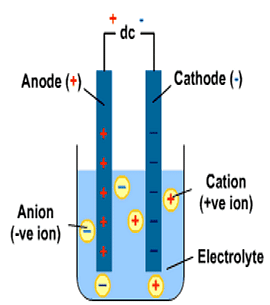
Electrolysis
Also Read:
| Related Articles | ||
|---|---|---|
| Conduction of Electricity in Liquids | Electrolytic & Galvanic Cells | Electrolytic Capacitor |
| Electrolytic, Photochemical, Thermal Decomposition | Cell Potential | Daniell Cell |
Factors Affecting Products of Electrolysis
[Click Here for Sample Questions]
- Electrolysed products depend on the material that is getting electrolyzed. Basically, it means that the nature of the electrolytes decides the process of electrolysis. Electrolysis is a fast process for a strong electrolyte but for an electrolyte that is weak needs an extra potential, otherwise known as overpotential. Electrolytic products depend on the value of this overpotential as well.
- The products of electrolysis depend on the nature of the electrodes. Simply saying, in the case of an inert electrode like gold and platinum, they do not participate in the reaction, whereas, in case the electrode which is used is reactive in nature.
- Many oxidising as well as reducing agents which are present in the electrolytic cell affect electrolysis products.
- Electrolysis products depend on the standard electrodes potential of different oxidizing as well as reducing agents which are present in the electrolytic cell.
- When there are multiple reactions, electrolytic products depend on the standard electrode potential of many reactions which are taking place. For example, the electrolysis of aqueous solutions of sodium chloride. The reduction reaction has the highest value of the standard electrode potential which happens at the cathode, out of several multiple reduction reactions that are taking place.
- In the same way, as in all the oxidation reactions, the oxidation reaction with the lowest value of the standard electrode potential takes place at the anode.
Products of Electrolysis
[Click Here for Sample Questions]
Products of electrolysis are dependent on the nature of the material being electrolysed and the type of electrodes being used. In the case when the electrode is inert (e.g., platinum or gold), it does not participate in the chemical reaction and acts only as a source or sink for electrons. But on the other side, when the electrode is reactive, it participates in the electrode reaction. Therefore, the products of electrolysis differ for reactive and inert electrodes.
Electrolysis of Molten NaCl
In the case when sodium chloride is melted above 801°C, then, two electrodes are inserted into the melt, and the electric current is passed through this molten salt. The chemical reactions then take place at the electrodes. As the electrolyte is molten Sodium Chloride, we only have Na+ and Cl− ions in the solution.
The sodium ions then migrate to the cathode, where the electrons enter the melt and are then reduced to the sodium metal:
\(Na^+ + e^- \rightarrow Na\)
Then, the chloride ions migrate towards the anode. They then give up their electrons to the anode and are oxidized to form the chlorine gas:
\(Cl^- \rightarrow \frac{1}{2}Cl_2 + e^-\)
The overall reaction of the breakdown of sodium chloride into its elements via electrolysis:
\(2NaCl \rightarrow 2Na_{(s)} + Cl_{2(g)}\)

Electrolysis of Molten NaCl
Electrolysis of Aqueous CuBr
In an aqueous solution of Copper Bromide, we take water as well into the equation because water can be both oxidized and reduced. Water competes with dissolved Cu2+ and Br− ions. Therefore, the ions which are present in the solution are Br−, Cu2+, H+, OH−.
The positive ions start to get attracted to the negative cathode. As there is a competition between copper ions and hydrogen ions. The hydrogen ion has a lower reduction potential than the copper ion (ER0 = +0.521V), and the copper ions are then reduced and copper metal gets deposited at the electrode – observe a pink layer.
Reaction at Cathode:
\(Cu^{2+} + 2e^- \rightarrow Cu_{(s)}\)
Reaction at the anode:
\(2Br^- \rightarrow Br_{2(g)} + 2e^-\)
Cu2+ reduction (E0 = 0.521 V) produces more energy and is, therefore, more favourable than the reduction of H2O (E0 = 0 V). So, in an aqueous solution, the copper reduction will take place.
The oxidation occurs at the anode, water’s oxidation potential is -1.23 volts, while for bromide ions it is -1.07 volts. Therefore, oxidation of bromine will happen, which is energetically more favourable.
Electrolysis of Aqueous NaCl
For the aqueous solution of sodium chloride, we will have to take water into the equation. As we know that the water gets both oxidized and reduced, it then competes with the dissolved Na+ and Cl- ions. Then rather than sodium being produced, hydrogen is produced.
Reaction at the cathode:
\(2H_2O_{(l)} + 2e^- \rightarrow H_{2(g)} + 2OH^-\)
Reaction at the anode:
\(Cl^- \rightarrow \frac{1}{2}Cl_{2(g)} + 1e^-\)
The reduction of Na+ (E0 = -2.7 V) is more difficult than the reduction of water (E0 = 0.0 V) due to the high energy value. Therefore, in an aqueous solution, a reduction of water will take place.
Things to Remember
- Electrolysis can be defined as the process of carrying out non-spontaneous reactions under the influence of electrical energy. Electrolysis is responsible for producing products that are present in the compound.
- An electrochemical cell is a tool that is responsible for producing the difference between the forms of the electrode via a chemical reaction.
- When there is more than one cation and anion present in the compound, each ion will then compete for reduction and oxidations. The reactions which have more positive redox potentials will then be reduced or oxidised, as compared to the others.
- The factors affecting electrolysis are electrode nature, nature and state of electrolyte, electrode potential’s nature also the nature and the electrode potential of the ions present as well as the overvoltage at the electrodes.
- Electrolysis can be used for determining the equivalent eight of substances, the metallurgy of the alkali as well as alkaline earth metals, and purification of metals. Electroplating for corrosion resistance and ornaments is another use.
Also Read:
Sample Questions
Ques. Define electrolysis. (3 Marks)
Ans. Electrolysis is defined as the process which makes use of an electric current via an electrolyte to create a non-spontaneous chemical reaction. In the process, the direct current is passed through an ionic substance that is either in a molten state or is dissolved in its suitable solvent and this produces chemical reactions at the electrodes which decomposes the materials.
Ques. What do you understand by an Inert Electrode and an Active Electrode? (3 Marks)
Ans. The inert electrodes can be defined as those electrodes that do not enter the electrolytic chemical reactions. These electrodes are made up of noble metals like gold and platinum.
Whereas, the active electrodes can be defined as those electrodes that do take part in the reactions of electrolysis and can either be dissolved into an electrolyte or any other substance gets deposited on them.
Ques. In electrolysis of water:
(a) Give the name of the gas which gets collected at the cathode and anode.
(b) Why is the volume of a gas collected at an electrode double of the anode?
(c) Why do we add a few drops of dil. H2SO4 to water? (3 Marks)
Ans. a) Hydrogen is evolved at the cathode and oxygen is evolved at the anode.
b) At the cathode, the H+ ions take their two electrons to convert themselves into the H2 gas. 2 moles of the H+ ions give 1 mole of H2 gas.
2H+(aq) + 2e− → H2(g)
At the anode, OH− ions release the two electrons to get converted into water and O2.
2 moles of the OH− ions give 0.5 moles of O2.
Thus, the volume of one gas collected at one electron is double of another.
c) In order to make the water conduct electricity, acid is added as the distilled water is a non-conductor of electricity.
Ques. In terms of Faraday’s Law, how much electricity is required to produce the following:
(i) 20 g of Ca from molten CaCl2
(ii) 40 g of Al from molten Al2O3 (3 Marks)
Ans. According to the question, the molar mass of calcium = 40 g per mol and aluminium = 27 g per mol
(1) Ca2+ + 2e− → Ca
1 mole that is 40 g of Ca will need 2 F of electricity.
0.5 mole that is 20 g of Ca will need 1 F of electricity.
(2) Al3++3e− → Al
1 mole that is 27 g of Al will need 3 moles of electrons.
Therefore, 40 g of Al will need (3 x 40 F)/27 = 4.4 F
Ques. Is electrolysis used in metallurgical processes? (3 Marks)
Ans. Electrolysis is a widely used procedure in metallurgy. Yes. It is used for metallurgical processes, like the extraction known as electro mining or refining which is electrorefining of the ore or compounds and also for the incorporation of the metals from the solution known as electroplating. The metallic sodium and chlorine gas are produced using electrolysis of the molten sodium chloride.
The electrolysis of the aqueous sodium chloride solution gives sodium hydroxide and chlorine gas. The hydrogen and oxygen are produced using water electrolysis. The products formed can be neutral elements or new molecules.
Ques. A, B and C are 3 electrolytic cells containing solutions ZnSO4, AgNO3 and CuSO3 respectively which are connected to each other in a series. Now, a current of 1.5 amperes is passed until 1.45 g of silver gets deposited at the cathode of cell B. How long does the current flow and what mass of copper and zinc are deposited? (5 Marks)
Ans. Cell B: Ag+ + e− ? Ag (cathode)
1 mole (108 g) of Ag will be deposited by 96500 C.
1.45 g of Ag will be deposited by (96500×1.45)/108=1295.6 C.
Now, Q = It
1295.6 = 1.5 × t
t = 864 s
Cell A: Zn2+ + 2e− → Zn
2 moles of electrons (2×96500 C of current) produces 1 mole (63.5 g) of zinc
1295.6 C of electricity will deposit (65.3)/2 x96500=0.438 g of zinc
Cell C: Cu2+ + 2e− → Cu
2 moles of electrons (2×96500 C) of current will produce 1 mole (63.5 g) of Cu
1295.6 C of current will deposit (63.5×1295.6)/2 x 96500=0.426 g of copper
Ques. Define the charge required for the following reductions. (3 Marks)
(i) 1 mol of Al3+ to Al
(ii) 1 mol of Cu2+ to Cu
(iii) 1 mol of MnO4- to Mn2+
Ans. Al3+ + 3e− → Al
Reduction requires 3 F of electricity or 3 × 96500 = 2.895 × 10⁵ C.
Cu2+ + 2e− → Cu
This reduction requires 2 F of electricity or 2 × 96500 = 1.93 × 10⁵ C.
MnO4- + 5e− → Mn2+
The reduction will require 5 Faraday of electricity or 5 × 96500 = 4.825 × 10⁵ C.
One point to be noted here is that 1 mole of electron has a charge of 1 faraday.
Ques. Solution of Ni(NO3)2 get electrolysed between the platinum electrodes which uses a 5-ampere current for 20 minutes. Then, what mass of Ni gets deposited at the cathode? (3 Marks)
Ans. According to the question,
I = 5A
Time = 20 × 60 = 1200 s
∴ Charge = current × time
= 5 × 1200 = 6000 C
Reaction is,
Ni2+ (aq.) + 2e → Ni (s)
Ni deposit (2 × 96487) C = 58.7g
∴ Ni deposit 6000 C = (58.7 x 6000)/2 x 96487
= 1.825g
∴ 1.825g of nickel is deposited at the cathode.
For Latest Updates on Upcoming Board Exams, Click Here: https://t.me/class_10_12_board_updates
Check-Out:



Comments