



Education Journalist | Study Abroad Lead
The solubility curve gives the deviation in the solubility of a substance with the change of temperature. It helps determine the quantity of solute that will dissolve in the given quantity of solvent at diverse temperatures. It is used to differentiate the material that will crystallize or concentrate from a solution with two or more solutes.
| Table of Content |
Key Takeaways: Solubility Curve, Solubility, Effect of temperature, Effect of pressure, Solubility rules
Solubility
[Click Here for Sample Questions]
The solubility of a substance is defined as its maximum amount that can be dissolved in a specified amount of solvent at a given temperature.
Solubility Curve
[Click Here for Sample Questions]
The solubility curve demonstrates the variation in the solubility of a specified substance with temperature change.
The graphical representation of a solubility curve gives the relation between temperature and solubility of a substance at different temperatures. The solubility curve changes due to the change in the following:
Effect of Temperature on Solubility Curve
The changes in temperature significantly impact the solubility of a solid in a liquid as the solubility of any given substance varies at different temperatures.
Effect of Pressure on Solubility Curve
Pressure changes do not significantly affect the solubility of solids in liquids as solids and liquids are greatly incompressible and remain unchanged by any variations in pressure.
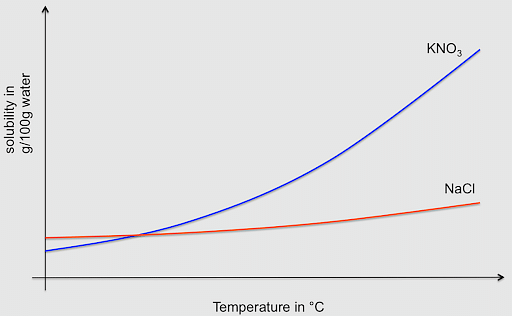
Solubility Curve Graph
Also Read:
| Related Articles | ||
|---|---|---|
| Solubility of a Solid in a Liquid | Hinsberg’s Reagent | Sandmeyer reaction |
| Saturated solution | Unsaturated solution | Supersaturated solution |
Importance of Solubility
[Click Here for Sample Questions]
The importance of the solubility curve are:
- The solubility of a particular substance can be calculated at a given temperature
- The process through which the solubility of a substance take place at a given temperature can be estimated
- The solubility curve helps us to understand the substance that crystallizes first from a solution containing more than one solute.
- The solubility curve helps to estimate the comparison between the solubility of two substances at a given temperature
- Solubility curve gives the difference between the composition of the solutes in the substance.
- It gives the detailed explanation of change of solubility in substances with a change in temperature.
Solubility Rule Chart
[Click Here for Sample Questions]
General rules of solubility are as follows:
- Chloride salts are soluble. A few exceptions are PbCl2, Hg2Cl2 and AgCl.
- Salts of Na+, K+ and NH4+ are soluble.
- All sulfate salts are soluble, a few exceptions include BaSO4, CaSO4 and PbSO4.
- Almost all nitrate (NO3–) salts are soluble.
- Almost all hydroxide compounds are sparingly soluble. The notable exceptions are NaOH and KOH, where Barium hydroxide and calcium hydroxide are moderately soluble.
- All sulfide, phosphate and carbonate salts are sparingly soluble.
Things to Remember
- The solubility of a substance depends on the nature of solute, solvent, temperature, and pressure.
- The solubility of a given substance at a specific temperature can be found by its solubility curve.
- A graphical representation between the solubility and temperature in a given solvent is called the solubility curve.
- Temperature changes are critical in solubility as the solubility of a substance varies at different conditions of temperatures.
Also Read:
Sample Questions
Ques: A solution in equilibrium with a precipitate of Ag2S was found to consist 6.3 x 10⁻¹⁸mol of S2/L and 1.26 x 10⁻⁷mol of Ag+/L. Find out the solubility product of Ag2S. (2 marks)
Ans: The solubility product is given by the product of the concentrations of the ions in equilibrium state with a precipitate of a sparingly soluble substance.
Ksp (Ag2S) = [Ag+] 2 [S2-]
= (1.26 x 10⁻¹⁷)2 (6.3 x 10⁻¹⁸)
= 1.0 x 10-51
Ques: In equilibrium, a solution with a precipitate of AgCl was found. The solution contained 1.0 x 10⁴ mol of Ag+/L and 1.7 x 10⁻⁶ mol of Cl–/L. Find out the solubility product of AgCl. (2 marks)
Ans: As given, for AgCl
Ksp = [Ag+][Cl–]
= (1.0 x 10⁻⁴) (1.7 x 10⁻⁶)
= 1.7 x 10⁻¹⁰
Ques: The solubility product of BaSO4 is 1.5×10⁻⁹. Calculate the solubility of barium sulfate in pure water and in 0.1M BaCl2. (3 marks)
Ans: BaSO4(s) = Ba2+(aq)+SO42−(aq)
Therefore, Ksp = [Ba2+] [SO42−] = x
Then, 1.5×10−9 = x multiplied by x;
x2 = 15×10−10 or 3.87×10⁻⁵
Hence, solubility of BaSO4 in pure water is 3.87×10⁻⁵
Let us assume the solubility of BaSO4 in 0.1M BaCl2 be ′s′
At initial, (from BaCl2) = 0
At equilibrium, (0.1M+s) = s
So, 1.5×10−9 = (s+0.1) × s = s×0.1 (as we know, s<<1)
Therefore, s=1.5×10⁻⁸
Ques: The solubility product of BaCl2 is 4×10⁻⁹. Calculate its solubility. (2 marks)
Ans: Let us assume the solubility of BaCl2 is S mol liter−1
BaCl2 = Ba+ + 2Cl−
Ks = [Ba2+] [Cl−]2
= S×(2S)2
Ks =4×S3
S=1x10⁻³
Ques: The pH of a saturated solution of Ba(OH)2 is 12. Calculate the value of solubility product (Ksp) of Ba(OH)2. (3 marks)
Ans: Ba(OH)2 = Ba2+ + 2OH−
pH = 12 ⇒ p(OH) = 14 − pH
p(OH) = 14−12 = 2
[OH−] = 10 −POH =10−2 or 1×10⁻²
because concentration of Ba 2+ is half of OH−
Ba2+ = 0.5×10⁻²
Ksp = (0.5×10⁻²)(1×10⁻²)
2Ksp = 0.5×10−6 = 5×10⁻⁷
Ques: Find the relationship between the solubility product Ksp and solubility (s) for a sparingly soluble salt ApBq. (3 marks)
Ans: The dissociation equilibrium of a sparingly soluble salt ApBq can be shown as:
ApBq = pAa+ +qBb−
Let s be the solubility in mol / liter.
Then the expression for the solubility product will be as represented as:
Ksp = [Aa+]p [Bb−]q
Ksp = [Aa+]p [Bb−]q
= (ps)p(qs)q
= ppqq(s)p+q
Ques: The solubility product of three sparingly soluble salts M2X, MX and MX3 are identical. What will be the order of their solubility?(2 marks)
Ans: Let S be the solubility in moles/ liter.
The representation for the solubility product of M2X is (2S)2S = 4S3
The representation for the solubility product of MX is S(S) = S2
The representation for the solubility product of MX3 is S(3S)3 = 27S4
Since solubility constant of all are same, so order of solubility MX3 > M2X > MX.
Ques: The solubility of a sparingly soluble salt AxBy in water is S moles per litre. What will be the value of the solubility product? (2 marks)
Ans: If S denotes the molar solubility of AxBy, the molar solubilities of the ions Ay+ and Bx− will be xS and yS.
Therefore, the value of the solubility product will be
Ksp = [Ay+]x[B x− ]y
= (xS)x(yS)y
= xxyySx+y
Ques: The solubility curve of KNO3 in water is given below. Find out the amount of KNO3 that dissolves in 50g of water at 40. (2 marks)
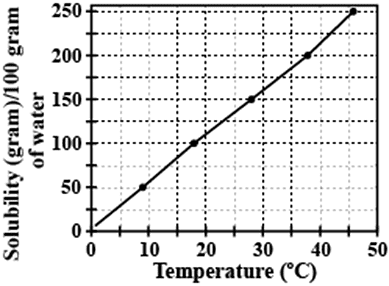
Ans: The amount of KNO3 that dissolves in 50 g of water at 40 degree C is closest to 100 g.
At 40 degree C, the solubility is around 200 g KNO3 in 100 g of water.
Therefore, about 100 g of KNO3 will dissolve in 50 g of water at 40 degree C.
Ques: The solubility of calcium phosphate in water is x mol L−1 at 25 degree celsius. Find out its solubility product. (2 marks)
Ans: Let the solubility be S,
Ca3(PO4)2 → 3Ca+2 + 2PO4−3
3S 2S
Hence Ksp =(3S)3(2S)2 = 108S5
For Latest Updates on Upcoming Board Exams, Click Here: https://t.me/class_10_12_board_updates
Check-Out:



Comments