



Content Curator
Urochordata come under the Classification of Animal Kingdom. They are a subphylum of the Phylum Chordata and consist only of marine filter-feeding invertebrates that are found in seawater. They feed on planktonic particles and are known to produce crystalline cellulose.
Urochordata is a hermaphroditic organism that has a central nervous system and an open circulatory system. However, their shape and size can vary as per their characteristics.
Some examples of Urochordata include Oikopleura, Herdmania, and Salpa.
- Urochordata is also known as Tunicates or Sea Squirts.
- Urochordata along with Cephalochordata are known as Protochordates.
- Nerve cord and Notochord are found only in the larva.
- In the adult stage, they look like a sac as they are covered in a protective unit.
- There are two types of characteristics in Urochordata: Larvae and Adults.
- Urochordata is further classified into the groups: Ascidiacea, Thaliacea, and Larvacea.
Related Links
- Appearing for NEET, Download NEET PYQ for all subjects
- Appearing for CUET, Download CUET PYQ for all subjects
Key Terms: Urochordata, Tunicate, Chordata, Notochord, Protochordate, Ascidiacea, Thaliacea
What is Urochordata?
[Click Here for Sample Questions]
Urochordata is a subphylum of the Phylum Chordata where animals are classified and distinguished on the basis of the presence of a notochord, a dorsal hollow nerve cord, and paired pharyngeal gill slits.
Urochordata is also known as “Tunicates” or “Sea Squirts” as they refer to marine invertebrates that are found at almost every altitude, but mostly in salty or shallow water.
- Also known as “Tunicates” because the body of the adults is covered with a cellulose-like substance known as tunicin.
- The larva undergoes a metamorphosis to change into an adult.
- The notochord is present only during the larval stage and vanishes in the adult stage.
- The body of the adult is fixed to the substratum present in the sea.
- They excrete through multiple body parts such as the intestine and the surface of the gills.
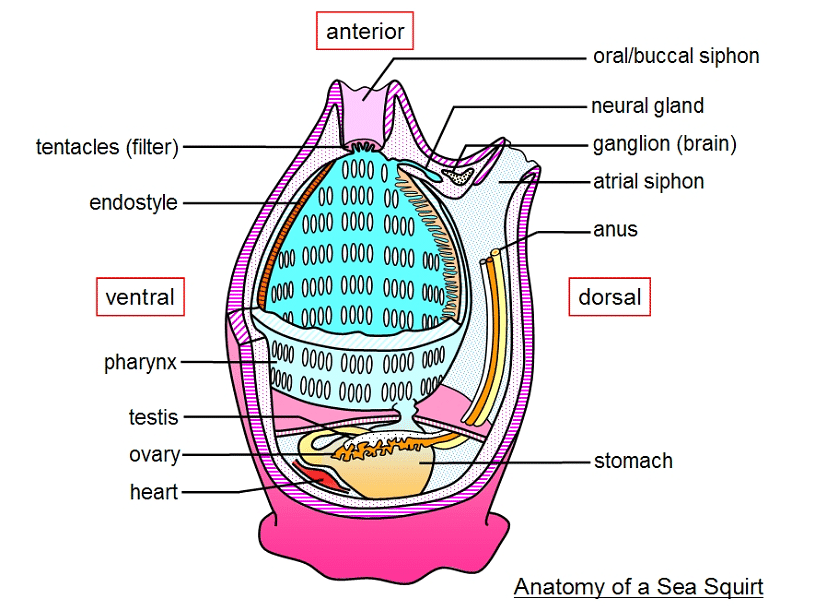
Urochordata Diagram
Also check:
Characteristics of Urochordata
[Click Here for Sample Questions]
The following are some of the characteristics that separate Urochordata from the other Chordata subphylums:
- Unsegmented body covered with a tunic and does not have a tail.
- Include complete digestive tract but do not include Coelom.
- Nephrocytes, Pyloric Gland, and Neural Gland carry out the process of Excretion.
- The respiratory system includes at least two-gill slits in the pharyngeal wall.
- Open circulatory system along with a tubular but ventral heart.
The characteristics of Urochordata are further divided into two groups:
Larval Characteristics
Larval Characteristics are listed below:
- An elongated Larva is also known as Ascidian Tadpole Larva.
- Include Pharyngeal Gills.
- The Notochord is restricted to the near end of the tail.
- The Dorsal hollow nerve cords are spread across from one end to another.
- The post-anal tail is quite active and can be seen easily.
Adult Characteristics
Adult Characteristics are elaborated below:
- The body is covered by a tunic which is made up of a protein (tunicin) and cellulose (polysaccharide)
- Hermaphrodite: Can reproduce sexually by a cross and external fertilization, as well as asexually by budding causing alternation of generation
- Sessile or fixed in one place as they are attached to the sea’s substratum
- The branchial siphon is connected to the branchial basket (pharynx)
- The water in their body enters through the incurrent branchial siphon and exits through the ex-current atrial siphon
- Small tentacles are located around the incurrent branchial siphon to prevent any unwanted particles from entering the body
Classification of Urochordata
[Click Here for Sample Questions]
The subphylum Urochordata is further classified into three groups:
Ascidiacea
- Color: Bright
- Nature: Solitary as well as Colonial
- Larvae do not eat and are plank
- Larval characteristics disappear when they turn into an adult
- Adults have a sac-like body and the nervous system changes into nerve ganglion
- Examples: Ciona, Ascidia, Herdmania
Thaliacea
- Free-living Pelagic Urochordates
- The tunic or outer cover is thin and transparent
- Presence of pharyngeal gill slits
- Show Polymorphism
- Incurrent branchial siphons and ex-current branchial siphons are located at opposite ends of the body
- Examples: Doliolum, Salpa
Larvacea or Appendicularia
- Small in size
- Found worldwide
- Most of them are protandrous
- Adults include the characteristics present during the larval stage
- Make use of a unique feeding tool, also known as a house
- Presence of a nerve cord that looks like a tube
- Most of the organs are held in the trunk
- Flat and thin tail
- Examples: Appendicularia, Oikopleura
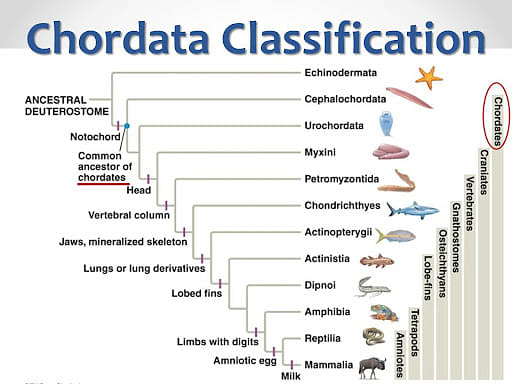
Chordata Classification
Things to Remember
- Urochordata are also known as Tunicates or Sea Squirts and a subphylum of the Phylum Chordata.
- Urochordata feed on planktonic particles.
- The larva is also known as “Ascidian Tadpole” and undergoes Retrogressive Metamorphosis.
- The notochord is present only during the larval stage and vanishes in the adult stage.
- Urochordata are hermaphroditic organisms.
- Urochordata have a central nervous system and an open circulatory system.
- Urochordata excrete using various glands and body parts.
- Urochordata are further classified into Ascidiacea, Thaliacea, and Larvacea groups.
Also check:
Sample Questions
Question 1: What is Urochordata? (2 marks)
Answer: Urochordata is a subphylum of the Phylum Chordata. They refer to marine invertebrates, found mainly in the sea or shallow water. They survive by feeding on planktonic particles as they absorb water with the help of pharyngeal gill slits. Some examples of Urochordata include Oikopleura, Herdmania, and Salpa.
Question 2: Why are Urochordata also known as “Sea Squirts” and “Tunicates”? (2 marks)
Answer: Urochordata are also known as “Sea Squirts” as they refer to marine invertebrates that are found at almost every altitude, but mostly in salty or shallow water. They are also known as “Tunicates” because the body of the adults is covered with a cellulose-like substance known as tunicin
Question 3: What are the prominent or main characteristics of Urochordata? (5 marks)
Answer: The following are some of the main characteristics of Urochordata:
- Unsegmented body covered with a tunic and does not have a tail
- Include complete digestive tract but do not include Coelom
- Nephrocytes, Pyloric Gland, and Neural Gland carry out the process of Excretion
- The respiratory system includes at least two gill slits in the pharyngeal wall
- Open circulatory system along with a tubular but ventral heart
Question 4: What are the characteristics of Larvae in Urochordata? (5 marks)
Answer: The following are the Larval characteristics of Urochordata:
- An elongated Larva is also known as Ascidian Tadpole Larva
- Include Pharyngeal Gills
- The Notochord is restricted to the near end of the tail
- The Dorsal hollow nerve cords are spread across from one end to another
- The post-anal tail is quite active and can be seen easily
Question 5: What are the characteristics of Adults in Urochordata? (5 marks)
Answer: The following are the Larval characteristics of Urochordata:
- The body is covered by a tunic which is made up of a protein (tunicin) and cellulose (polysaccharide)
- Sessile or fixed in one place as they are attached to the sea’s substratum
- The branchial siphon is connected to the branchial basket (pharynx)
- The water in their body enters through the incurrent branchial siphon and exits through the ex-current atrial siphon
- Small tentacles are located around the incurrent branchial siphon to prevent any unwanted particles from entering the body
Question 6: What are the different groups of Urochordata? (3 marks)
Answer: The subphylum Urochordata is classified into three groups: Ascidiacea, Thaliacea, and Larvacea or Appendicularia.
Ascidiacea are bright in color and the larval characteristics disappear when they turn into an adult. For example, Ciona, Ascidia, and Herdmania
Thaliacea are free-living Pelagic Urochordates that include pharyngeal gill slits and show polymorphism. For example, Doliolum, Salpa
Larvacea or Appendicularia are small and the larval characteristics do not disappear when they turn into an adult. For example, Appendicularia, Oikopleura
Question 7: How do Urochordata breathe? (2 marks)
Answer: The respiratory system in Urochordata includes gill slits that are located in the pharyngeal wall. The branchial siphon is connected to the branchial basket (pharynx) from where the water enters and exits through the ex-current atrial siphon. Moreover, the number of slits can be two or more than two.
Lastly, the respiratory pigment is rich in Sulphuric Acid and Vanadium.
Question 8: Describe the nervous system of Urochordata. (2 marks)
Answer: Urochordata have a central nervous system. While the larvae have a nervous system, when they change into adults, the nervous system also changes into a nerve ganglion.
While a central nervous system is made up of the brain, spinal cord, and nerves that extend from the spinal cord to all parts of the body, a nerve ganglion is a collection of nerve cells that are present outside of the central nervous system and the nerve acts as the axon of a neuron.
Question 9: How do Urochordata reproduce? (2 marks)
Answer: Urochordata are Hermaphrodites, that is, they can reproduce both sexually as well as asexually. In sexual reproduction, they always make use of cross and external fertilization. On the other hand, in asexual reproduction, they make use of budding, which causes an alternation of generations.
Question 10: How do Urochordata excrete? (2 marks)
Answer: While Urochordata have a proper digestive system that helps them digest food, that is, planktonic particles, they do not have a Coelom. In Urochordata, the process of excretion is carried out by the nephrocytes, the pyloric gland, and the neural gland. In addition to it, Urochordata excretes through multiple body parts such as the intestine and gill surface.
Check out:



Comments