



Content Curator
Newton and Dyne are both considered units of force. A force is an action of pull or push that can change the state of an object undergoing inertia.
- Inertia is the tendency of an object to stay in a state of rest or uniform motion without undergoing any change.
- Under the International System of Units or SI unit, a Newton is a derived unit for force.
- Under the Centimeter-Gram-Second (CGS) units system, a dyne is also the derived unit of force.
- In addressing difficulties, the relationship between Newton and Dyne is critical.
| Table of Content |
Key Terms: Force, Laws of Motion, Dyne, Newton, Inertia, Derived Unit, Value of 1 Newton, Value of 1 Dyne, Dyne into Newton, Newton into Dyne, Second law of motion, Relation between Newton and Dyne
What is Force?
[Click Here for Sample Questions]
Force can be defined as an action of pull or push that can influence the motion of an object having mass undergoing inertia.
- Simply, force can cause an object undergoing rest to move or an object undergoing movement to stop.
- It can also be defined as the product of mass and acceleration.
- It has both a magnitude and a direction and it is measured in Newton in S.I Unit or as Dyne in C.G.S Unit.
- The dimensional formula of force is [M1 L1 T-2].
Mathematically it is expressed as:
F = ma
Where,
- F = Force acting upon a given body
- m = mass of the given body
- a = acceleration of the given body
Also Read:
| Related Articles | ||
|---|---|---|
| Force of friction | Force and motion | Balanced force |
| Differences Between Acceleration and Velocity | Newton's First Law of Motion | Measurement of length |
What is Newton?
[Click Here for Sample Questions]
The S.I unit of force is Newton, which is symbolized by N. Newton was a researcher and a scientist. He discovered gravity, as well as gave us the equation of the well-known three laws of motion.
Definition of 1 Newton
1 Newton is defined as the force required to provide an object of mass of one kilogram (1 kg) with an acceleration of one meter per second per second (1 ms-2) in the direction of the applied force.
Mathematically, it can be given as
\(1\ \mathrm{N} = 1 \frac{\mathrm{kg\:m}}{\mathrm{s^2}}\)
Where
- N = Unit of force Newton
- kg = Kilogram
- m = metre
- s = second
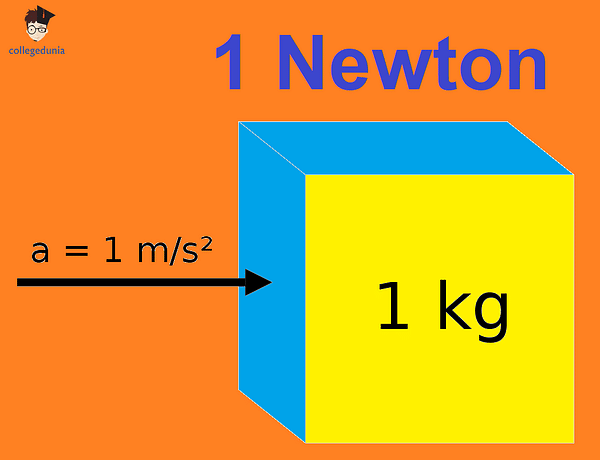
1 newton
What is Dyne?
[Click Here for Sample Questions]
Dyne is the derived C.G.S. unit for force first proposed in 1873. The word "Dyne" is used to describe it in the C.G.S system which is the predecessor of the current S.I system.
Definition of 1 Dyne
1 Dyne is defined as a body with a mass of one gram traveling at a speed of one centimeter per second square.
Mathematically, it can be given as
\(1 \: Dyne = 1\: \frac {g \: cm}{s^2}\)
Relation Between Newton and Dyne
[Click Here for Sample Questions]
The relation between Newton and Dyne can be given as
| \(1 \: Newton = 10^5 \: Dyne\) |
| \(1 \: Dyne = 10^{-5}\: Newton\) |
Relation Between Newton and Dyne Derivation
[Click Here for Sample Questions]
We know the definition of force from the second law of motion is given by that
Force = mass × acceleration
For mass,
- The SI unit is kilogram (kg)
- The CGS unit is gram (g)
Therefore, we can write
1 kg = 1000 g
For acceleration
- The SI unit is m/s2
- The CGS unit is cm/s2
Therefore, we can write
1 m/s2 = 100 cm/s2
So we get the expression,
1 N = 1 kg × 1 m/s2
⇒ 1 N = 1000 g × 100 cm/s2
⇒ 1 N = 100000 g cm/s2 = 105 g cm/s2 = 105 dyne
Thus,
1 N = 105 dyne
Things to Remember
- Force is described as a pull or push action that can impact the motion of a mass that is experiencing inertia.
- Force is dimensionally represented as M1L1T-2.
- Newton is the unit of force in the S.I system.
- Dyne is the unit of force in the C.G.S system.
- The force required to accelerate an object of mass 1 kilogram at a rate of 1 m/s2 is called 1 Newton.
- The force required to accelerate an item at 1 cm/s2 in a mass of 1 gram is called 1 Dyne.
- 1 Newton = 105 dyne.
Also Read:
| Related Articles | ||
|---|---|---|
| Non contact force | Effects of forces | Mathematical Formulation of Second Law of Motion |
| Inertia and mass | Balanced and Unbalanced Forces | Force and Laws of motion |
Sample Questions
Ques. Define 1 Newton. (1 Mark)
Ans. 1 Newton is defined as the force required to cause an acceleration of 1 m/s2 to a body of 1 kg mass.
Ques. Define 1 Dyne. (1 Mark)
Ans. 1 Dyne is defined as the force required to cause an acceleration of 1 cm/s2 to a body of 1 g mass.
Ques. Which would require a greater force –– accelerating a 2 kg mass at 5 m s-2 or a 4 kg mass at 2 m s-2? (2 Marks)
Ans. We have F = ma.
Here we have m1 = 2 kg; a1 = 5 m s-2 and m2 = 4 kg; a2 = 2 m s-2 . ( Here a = acceleration)
Thus, F1 = m1a1 = 2 kg × 5 m s-2 = 10 N;
and F2 = m2a2 = 4 kg × 2 m s-2 = 8 N.
⇒ F1 > F2 .
Thus, accelerating a 2 kg mass at 5 m s-2 would require a greater force.
Ques. A constant force acts on an object of mass 5 kg for a duration of 2 s. It increases the object’s velocity from 3 m s-1 to 7 m s-1. Find the magnitude of the applied force. Now, if the force was applied for a duration of 5 s, what would be the final velocity of the object? (2 Marks)
Ans. We have been given that u = 3 m s-1 and v = 7 m s-1, t = 2 s and m = 5 kg.
We have, F = {m(v-u)}/t
Substitution of values in this relation gives F = 5 kg (7 m s-1 – 3 m s-1 )/2 s = 10 N.
Now, if this force is applied for a duration of 5 s (t = 5 s),
Then the final velocity can be calculated by rewriting as v = u + { Ft }/m
On substituting the values of u, F, m, and t, we get the final velocity, v = 13 m s-1.
Ques. A motorcar is moving with a velocity of 108 km/h and it takes 4 s to stop after the brakes are applied. Calculate the force exerted by the brakes on the motorcar if its mass along with the passengers is 1000 kg. (3 Marks)
Ans. The initial velocity of the motorcar u = 108 km/h = 108 × 1000 m/(60 × 60 s) = 30 m s-1
and the final velocity of the motorcar v = 0 m s-1.
The total mass of the motorcar along with its passengers = 1000 kg and the time taken to stop the motorcar, t = 4 s.
We have the magnitude of the force (F) applied by the brakes as {m(v – u)}/t.
On substituting the values,
we get F = { 1000 kg × (0 – 30) m s-1 }/4 s = – 7500 kg m s-2 or – 7500 N.
The negative sign tells us that the force exerted by the brakes is opposite to the direction of motion of the motorcar.
Ques. A force of 5 N gives a mass m1, an acceleration of 10 m s-2, and a mass m2, an acceleration of 20 m s-2. What acceleration would it give if both the masses were tied together? (2 Marks)
Ans. We have m1 = F/a1 ; and m2 = F/a2.
Here, a1 = 10 m s-2; a2 = 20 m s-2 and F = 5 N.
Thus, m1 = 5 N/10 m s-2 = 0.50 kg; and m2 = 5 N/20 m s-2 = 0.25 kg.
If the two masses were tied together, the total mass, m would be m = 0.50 kg + 0.25 kg = 0.75 kg.
The acceleration, produced in the combined mass by the 5 N force would be, a = F/m = 5 N/0.75 kg = 6.67 m s-2.
Ques. A bullet of mass 20 g is horizontally fired with a velocity of 150 m s-1 from a pistol of mass 2 kg. What is the recoil velocity of the pistol? (4 Marks)
Ans. We have the mass of bullet, m1 = 20 g (= 0.02 kg) and the mass of the pistol, m2 = 2 kg;
Initial velocities of the bullet (u1) and pistol (u2) = 0, respectively.
The final velocity of the bullet, v1 = + 150 m s-1.
The direction of the bullet is taken from left to right.
Let v be the recoil velocity of the pistol. Total momenta of the pistol and bullet before the fire, when the gun is at rest = (2 + 0.02) kg × 0 m s-1 = 0 kg m s-1
Total momenta of the pistol and bullet after it is fired = 0.02 kg × (+ 150 m s-1) + 2 kg × v m s-1 = (3 + 2v) kg m s-1
According to the law of conservation of momentum
Total momenta after the fire = Total momenta before the fire 3 + 2v = 0 ⇒ v = − 1.5 m s-1.
The negative sign indicates that the direction in which the pistol would recoil is opposite to that of the bullet, that is, right to left.
Ques. Two persons manage to push a motorcar of mass 1200 kg at a uniform velocity along a level road. The same motorcar can be pushed by three persons to produce an acceleration of 0.2 ms-2. With what force does each person push the motorcar? (Assume that all persons push the motorcar with the same muscular effort) (2 Marks)
Ans. Given, the mass of the car (m) = 1200kg
When the third person starts pushing the car, the acceleration (a) is 0.2 ms-2. Therefore, the force applied by the third person (F = ma) is given by:
F = 1200 kg × 0.2 ms-2 = 240 N
The force applied by the third person on the car is 240 N. Since all 3 people push with the same muscular effort, the force applied by each person on the car is 240 N.
Ques. A hammer of mass 500 g, moving at 50 m s-1, strikes a nail. The nail stops the hammer in a very short time of 0.01 s. What is the force of the nail on the hammer? (4 Marks)
Ans. Given, the mass of the hammer (m) = 500 g = 0.5 kg
Initial velocity of the hammer (u) = 50 m/s
Terminal velocity of the hammer (v) = 0 (the hammer is stopped and reaches a position of rest).
Time period (t) = 0.01s
Therefore, the acceleration of the hammer is given by a = (v-u)/t = (0 – 50 ms-1) / 0.01 s
a = -5000 ms-2
Therefore, the force exerted by the hammer on the nail (F = ma) can be calculated as:
F = (0.5kg) × (-5000 ms-2) = -2500 N
As per the third law of motion, the nail exerts an equal and opposite force on the hammer. Since the force exerted on the nail by the hammer is -2500 N, the force exerted on the hammer by the nail will be +2500 N.
Ques. A bullet of mass 10 g traveling horizontally with a velocity of 150 m s–1 strikes a stationary wooden block and comes to rest in 0.03 s. Calculate the distance of penetration of the bullet into the block. Also, calculate the magnitude of the force exerted by the wooden block on the bullet. (5 Marks)
Ans. Given, the mass of the bullet (m) = 10g (or 0.01 kg)
Initial velocity of the bullet (u) = 150 m/s
final velocity of the bullet (v) = 0 m/s
Time period (t) = 0.03 s
To find the distance of penetration, we calculate the acceleration of the bullet
Let the distance of penetration be s
According to the first law of motion
v = u + at
0 = 150 + a (0.03)
a = -5000 ms-2
v2 = u2 + 2as
0 = 1502 + 2 × (-5000)s
s = 2.25 m
As per the second law of motion, F = ma
F = 0.01kg × (-5000 ms-2)
F = -50 N
Ques. A hockey ball of mass 200 g traveling at 10 ms-1 is struck by a hockey stick so as to return it along its original path with a velocity of 5 ms-1. Calculate the magnitude of the change of momentum that occurred in the motion of the hockey ball by the force applied by the hockey stick. (3 Marks)
Ans. Given
- The mass of the ball (m) = 200g
- Initial velocity of the ball (u) = 10 m/s
- The final velocity of the ball (v) = – 5m/s
Initial momentum of the ball = mu = 200g × 10 ms-1 = 2000 g.m.s-1
Final momentum of the ball = mv = 200g × –5 ms-1 = –1000 g.m.s-1
Therefore, the change in momentum (mv – mu) = –1000 g.m.s-1 – 2000 g.m.s-1 = –3000 g.m.s-1
This means that the momentum of the ball reduces by 1000 g.m.s-1 after being struck by the hockey stick.
Ques. We want to move a wooden cabinet across a floor at a steady speed using a horizontal force of 200 N. What will be the friction force applied to the cabinet? (2 Marks)
Ans. Because the cabinet's velocity is constant, its acceleration must be zero. As a result, the force acting on it is also zero. This means that the amount of the opposing frictional force is equal to the 200 N force applied to the cabinet. The total friction force is thus -200 N.
For Latest Updates on Upcoming Board Exams, Click Here: https://t.me/class_10_12_board_updates
Also Check:



Comments