



Education Journalist | Study Abroad Lead
Zinc Hydroxide is an inorganic chemical compound with the chemical formula Zn(OH)2. Zinc Hydroxide occurs naturally in three rare minerals namely wulfingite, ashoverite and sweetite. Zinc hydroxide, like many other hydroxide metals, is naturally an amphoteric hydroxide. It quickly dissolves in a dilute solution of a strong acid, such as HCl, and an alkaline solution, such as sodium hydroxide.
| Table of Contents |
Key Terms: Zinc Hydroxide, Inorganic Compound, Wulfingite, Ashoverite, Sweetite, Amphoteric Hydroxide, Strong Acid, Sodium Hydroxide
What is Zinc Hydroxide?
[Click Here for Sample Questions]
The chemical formula of Zinc Hydroxide is Zn(OH)2. It is an inorganic chemical compound occurring in three rare minerals- wulfingite, ashoverite and sweetite. It is an amphoteric hydroxide and dissolves when exposed to a strong acid. Zinc hydroxide has a melting point of 125 °C (257 °F) and appears to be a white powder in appearance.
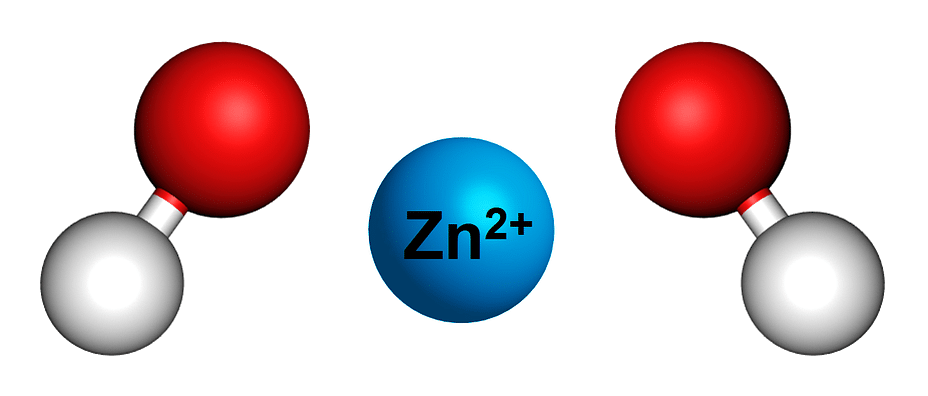
Zinc Hydroxide
Read More:
| Topics Related to Periodic Table | ||
|---|---|---|
| Amphoteric Oxides | Zinc Sulfide Formula | Polymerization |
| Acids, Bases and Salts | Oxidation and Reduction | Nitrous Oxide |
Structure of Zinc Hydroxide
[Click Here for Sample Questions]
The structure of zinc hydroxide is as follows:
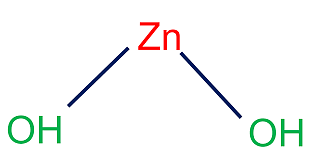
Structure of Zinc Hydroxide
Preparation of Zinc Hydroxide
[Click Here for Sample Questions]
Zinc Hydroxide is prepared by adding a small amount of sodium hydroxide solution to any zinc salt solution.
Zn2+ + 2OH− → Zn(OH)2
This reaction can be expressed as an aquated ion reaction with hydroxide by proton donation, as shown below, as it produces Hexa-aqua ions in high water and Tetra-aqua ions in low water.
Zn2+(OH2)4(aq) + OH−(aq) → Zn2+(OH2)3OH−(aq) + H2O(l)
In case too much sodium hydroxide is added, the zinc hydroxide precipitate dissolves, leaving behind a colourless zincate ion solution.
Zn(OH)2 + 2OH− → Zn(OH)42-
Zinc hydroxide will dissolve because it is naturally surrounded by water ligands; when excess sodium hydroxide is added to the solution, hydroxide ions reduce the complex to -2 charges, making it soluble. When ammonia is added in excess, an equilibrium is formed, which leads to the formation of hydroxide ions, resulting in a reaction similar to sodium hydroxide, leading to the formation of a charged +2 complex with a 4-number bond with ammonia ligands, allowing the complex to dissolve.
Physical Properties of Zinc Hydroxide
[Click Here for Sample Questions]
The physical properties of Zinc Hydroxide are as follows:
| Odour | Odourless |
| Appearance | Dull white flocculent precipitate |
| Valency of Zn | 2 |
| Oxidation State | +2 |
| pH | 8.88 |
| Solubility | Insoluble in alcohol, but slightly soluble in water. |
| Density | 3.05 g/cm³ |
| Molecular Weight/ Molar Mass | 99.424 g/mol |
| Melting Point | 125° C (257° F) |
Chemical Properties of Zinc Hydroxide
[Click Here for Previous Year Questions]
When aluminium comes in contact with a solution of zinc hydroxide, white precipitate forms that are soluble in excess of the reagent, indicating the presence of aluminium.
2Al3+(aq) + 3Zn(OH)2(aq) → 2Al(OH)3(s) + 3Zn
Zinc cations react with hydrogen sulfide in the presence of ammonia, and ammonium chloride forms a white precipitate of acid-soluble zinc sulfide.
Zn2+(aq) + S2- → ZnS(s)
Uses of Zinc Hydroxide
[Click Here for Sample Questions]
The major uses of Zinc Hydroxide are as follows:
- The compound is used as an adsorbing agent in medicine.
- It acts as a retentive in careful dressings. Zinc is applied to large bandages used after surgical procedures to engross the blood from the injury.
- It is used as an intermediate in the industrial processing of pesticides and pigments.
Read More: Extraction of Zinc
Things to Remember
[Click Here for Sample Questions]
- Zinc hydroxide has the chemical formula Zn(OH)2 and is an inorganic chemical compound with the formula.
- Wulfingite, ashoverite, and sweetite are three rare minerals that contain the compound Zinc Hydroxide.
- Zinc is an amphoteric hydroxide that reacts with both bases and acids.
- It is an odourless, white-powder-like substance with a melting point of 125oC.
- It is slightly soluble in water, whereas it is insoluble in alcohol.
- Zinc Hydroxide is prepared by adding a small amount of sodium hydroxide solution to a solution of any zinc salt.
Sample Questions
Ques. List some physical properties of Zinc Hydroxide. (3 Marks)
Ans. The chemical formula of Zinc Hydroxide is Zn(OH)2.
- Zinc hydroxide has a concentration of 3.05 g / cm3.
- Molar Mass / Molecular weight is 99.424 g / mol.
- Zinc hydroxide has a melting point of 125 ° C (257 ° F).
- It has the appearance of a white powder.
Ques. Do acids and bases react with zinc hydroxide? Is it true that zinc hydroxide is soluble in acid? (3 Marks)
Ans. Zinc hydroxide interacts with both bases and acids. When exposed to strong acids, it dissolves as a soluble hydroxide.
Zinc hydroxide is an amphoteric hydroxide. Zinc hydroxide easily dissolves in a dilute solution of a strong acid, such as hydrochloric acid, and a base or alkaline solution, such as sodium hydroxide.
Ques. What is the Zinc Hydroxide? (3 Marks)
Ans. Zinc Hydroxide is an inorganic chemical compound and it is a strong white amphoteric compound that can be dissolved in solid acid or a solid base solution. Ashoverite, Wulfingite, and Sweetite are three rare minerals that contain Zinc Hydroxide naturally.
Ques. Is Zinc Hydroxide Acid or Base? (3 Marks)
Ans. Zinc hydroxide is amphoteric, which explains why it can act as both a base and an acid. However, it is not alkaline because, as a base, it does not dissolve in water (or has very low solubility), leading to the formation of hydroxide ions in solution.
Ques. Explain what happens when sodium hydroxide is added to zinc sulphate. (3 Marks)
Ans. The molecular formulas for zinc sulphate and sodium hydroxide are ZnSO4 and NaOH respectively. When sodium hydroxide is added to zinc sulphate, a zinc hydroxide (Zn(OH)2) precipitate is formed. This precipitate of zinc hydroxide appears to be white in colour.
Ques. What is the procedure to prepare zinc hydroxide? (3 Marks)
Ans. Zinc Hydroxide is simply prepared by adding a small amount of sodium hydroxide (NaOH) solution to a solution of any zinc salt.
The reaction for the procedure to prepare zinc hydroxide is as follows:
Zn2+ + 2OH− → Zn(OH)2
Ques. What is zinc hydroxide used for? (3 Marks)
Ans. The uses of zinc hydroxide are:
- It is used as an absorbent in surgical instruments.
- Part of the zinc is applied to large bandages used after surgery to absorb blood from the wound.
- It is used as an intermediate for the commercial production of pesticides and pigments.
Do Check Out:



Comments