




CBSE Class 12 Physics Set 2 - (55/1/2) Question Paper 2025 is available for download here. CBSE conducted Class 12 Physics exam on February 21, 2025 from 10:30 AM to 1:30 PM. The Physics theory paper is of 70 marks, and the internal assessment is of 30 marks.
Also Check: CBSE Class 12 Question Paper 2025 (All Subjects)
The Physics question paper includes the following types of questions:
- MCQs: 1 mark each
- Very short-answer questions: 2 marks each
- Short-answer type questions: 3 marks each
- Case-study based questions: 4 marks each
- Long-answer type questions: 5 marks each
CBSE Class 12 Physics Set 2 - (55/1/2) Question Paper 2025 with Solution PDF
| CBSE Official PDF | CD PDF | CD PDF with Solutions |
|---|---|---|
| Download official PDF 4.37 MB | Download Collegedunia PDF 0.76 MB | Download solutions PDF 0.98 MB |
CBSE Class 12 Physics 2025 Set 2 (55/1/2) Questions with Solutions
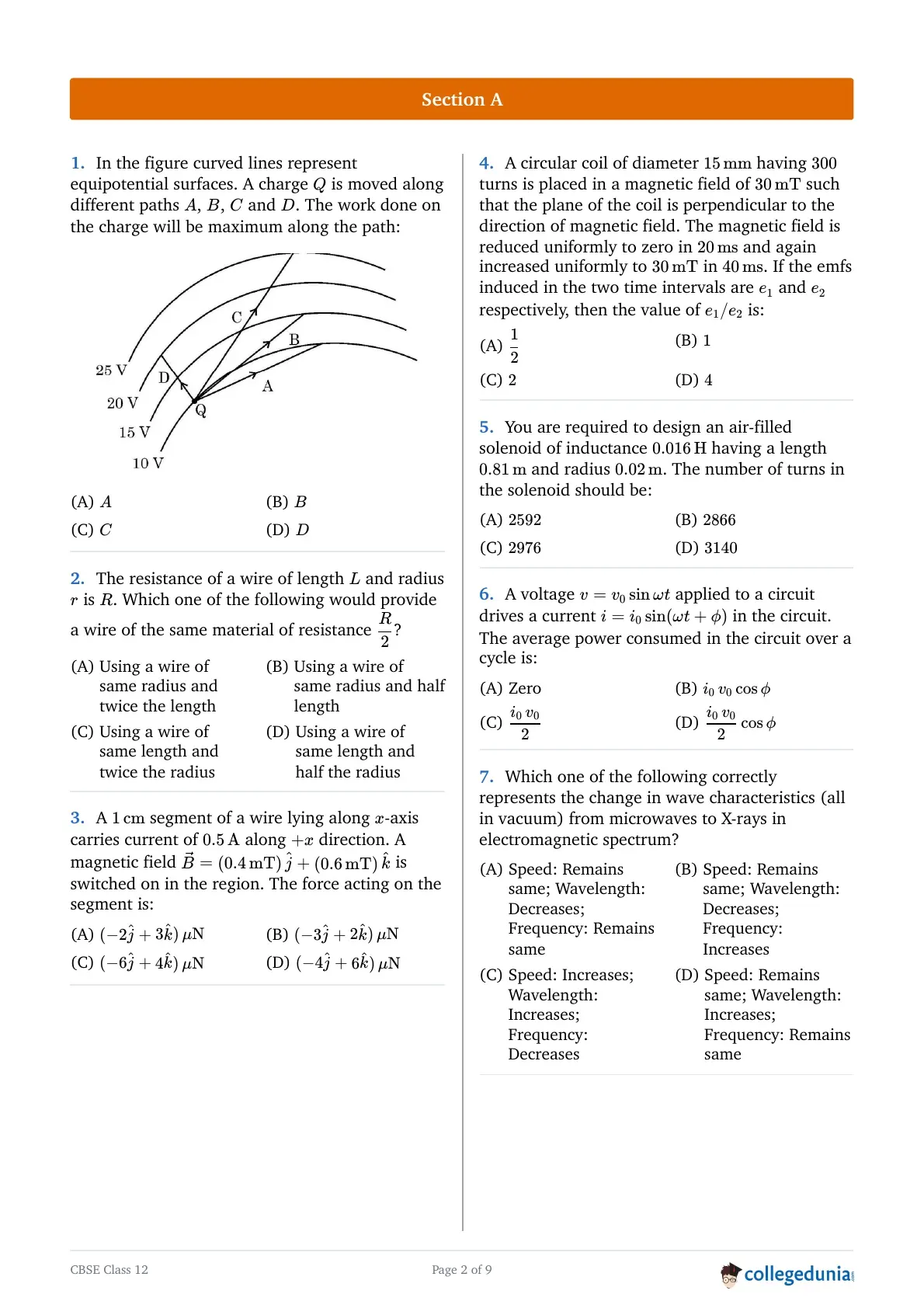
In the figure curved lines represent equipotential surfaces. A charge \(Q\) is moved along different paths \(A\), \(B\), \(C\) and \(D\). The work done on the charge will be maximum along the path:
The resistance of a wire of length \(L\) and radius \(r\) is \(R\). Which one of the following would provide a wire of the same material of resistance \(\dfrac{R}{2}\)?
A 1 cm segment of a wire lying along the x-axis carries a current of 0.5 A along the \( +x \)-direction. A magnetic field \( \mathbf{B} = (0.4 \, \text{mT}) \hat{j} + (0.6 \, \text{mT}) \hat{k} \) is switched on in the region. The force acting on the segment is:
A circular coil of diameter \(15\,\text{mm}\) having \(300\) turns is placed in a magnetic field of \(30\,\text{mT}\) such that the plane of the coil is perpendicular to the direction of magnetic field. The magnetic field is reduced uniformly to zero in \(20\,\text{ms}\) and again increased uniformly to \(30\,\text{mT}\) in \(40\,\text{ms}\). If the emfs induced in the two time intervals are \(e_1\) and \(e_2\) respectively, then the value of \(e_1 / e_2\) is:
You are required to design an air-filled solenoid of inductance \(0.016\,\text{H}\) having a length \(0.81\,\text{m}\) and radius \(0.02\,\text{m}\). The number of turns in the solenoid should be:
A voltage \(v = v_0 \sin \omega t\) applied to a circuit drives a current \(i = i_0 \sin(\omega t + \phi)\) in the circuit. The average power consumed in the circuit over a cycle is:
Which one of the following correctly represents the change in wave characteristics (all in vacuum) from microwaves to X-rays in electromagnetic spectrum?
The speed of light in two media '1' and '2' are \(v_1\) and \(v_2\,(\gt v_1)\) respectively. For a ray of light to undergo total internal reflection at the interface of these two media, it must be incident from:
A source produces monochromatic light of frequency \(5.0 \times 10^{14}\,\text{Hz}\) and the power emitted is \(3.31\,\text{mW}\). The number of photons emitted per second by the source, on an average, is:
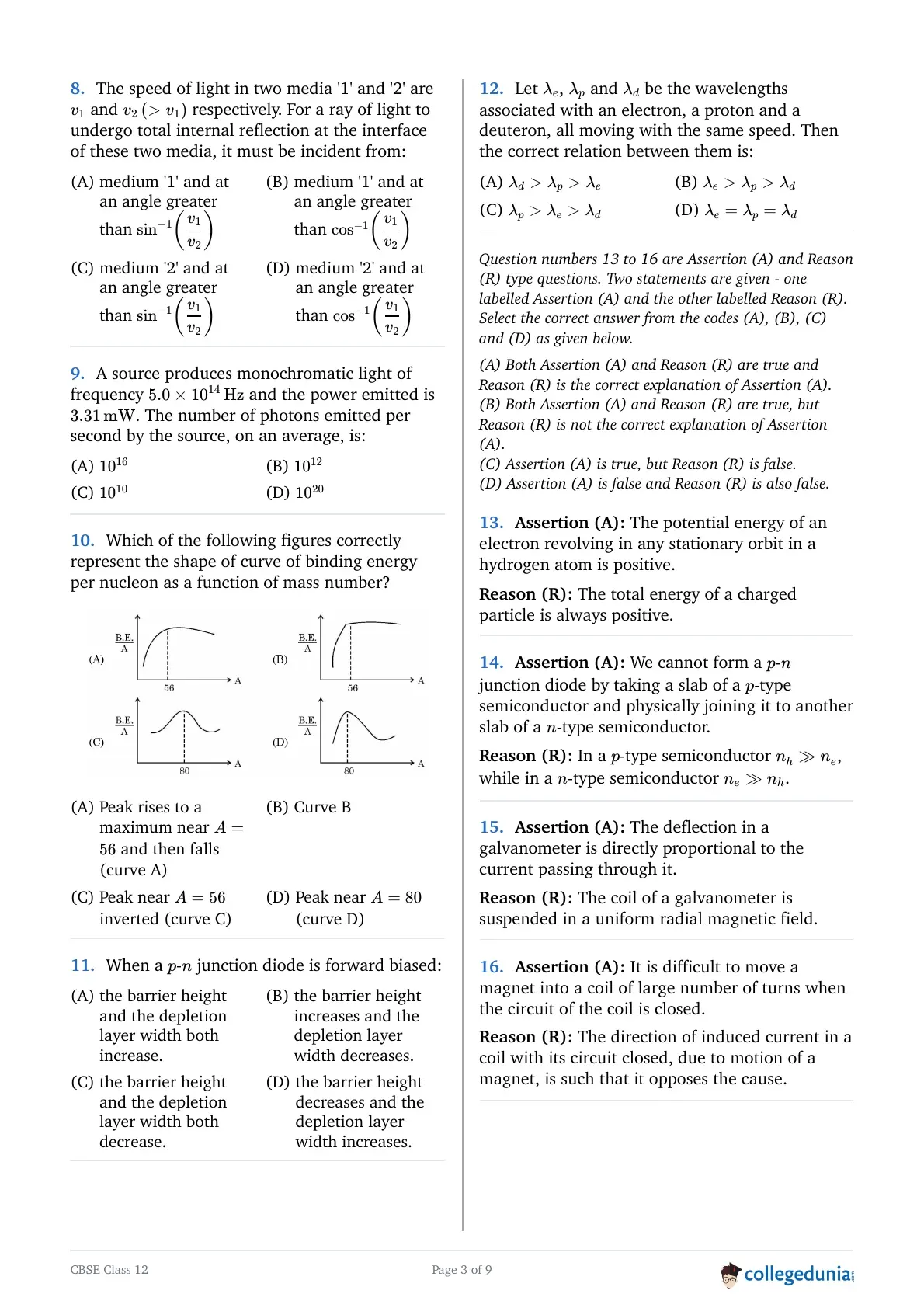
Which of the following figures correctly represent the shape of the curve of binding energy per nucleon as a function of mass number?
- (A)
![]()
- (B)
![]()
- (C)
![]()
- (D)
![]()


When a \(p\)-\(n\) junction diode is forward biased:
Let \(\lambda_e\), \(\lambda_p\) and \(\lambda_d\) be the wavelengths associated with an electron, a proton and a deuteron, all moving with the same speed. Then the correct relation between them is:
Assertion (A): The potential energy of an electron revolving in any stationary orbit in a hydrogen atom is positive.
Reason (R): The total energy of a charged particle is always positive.
Assertion (A): We cannot form a \(p\)-\(n\) junction diode by taking a slab of a \(p\)-type semiconductor and physically joining it to another slab of a \(n\)-type semiconductor.
Reason (R): In a \(p\)-type semiconductor \(n_h \gg n_e\), while in a \(n\)-type semiconductor \(n_e \gg n_h\).
Assertion (A): The deflection in a galvanometer is directly proportional to the current passing through it.
Reason (R): The coil of a galvanometer is suspended in a uniform radial magnetic field.
Assertion (A): It is difficult to move a magnet into a coil of large number of turns when the circuit of the coil is closed.
Reason (R): The direction of induced current in a coil with its circuit closed, due to motion of a magnet, is such that it opposes the cause.
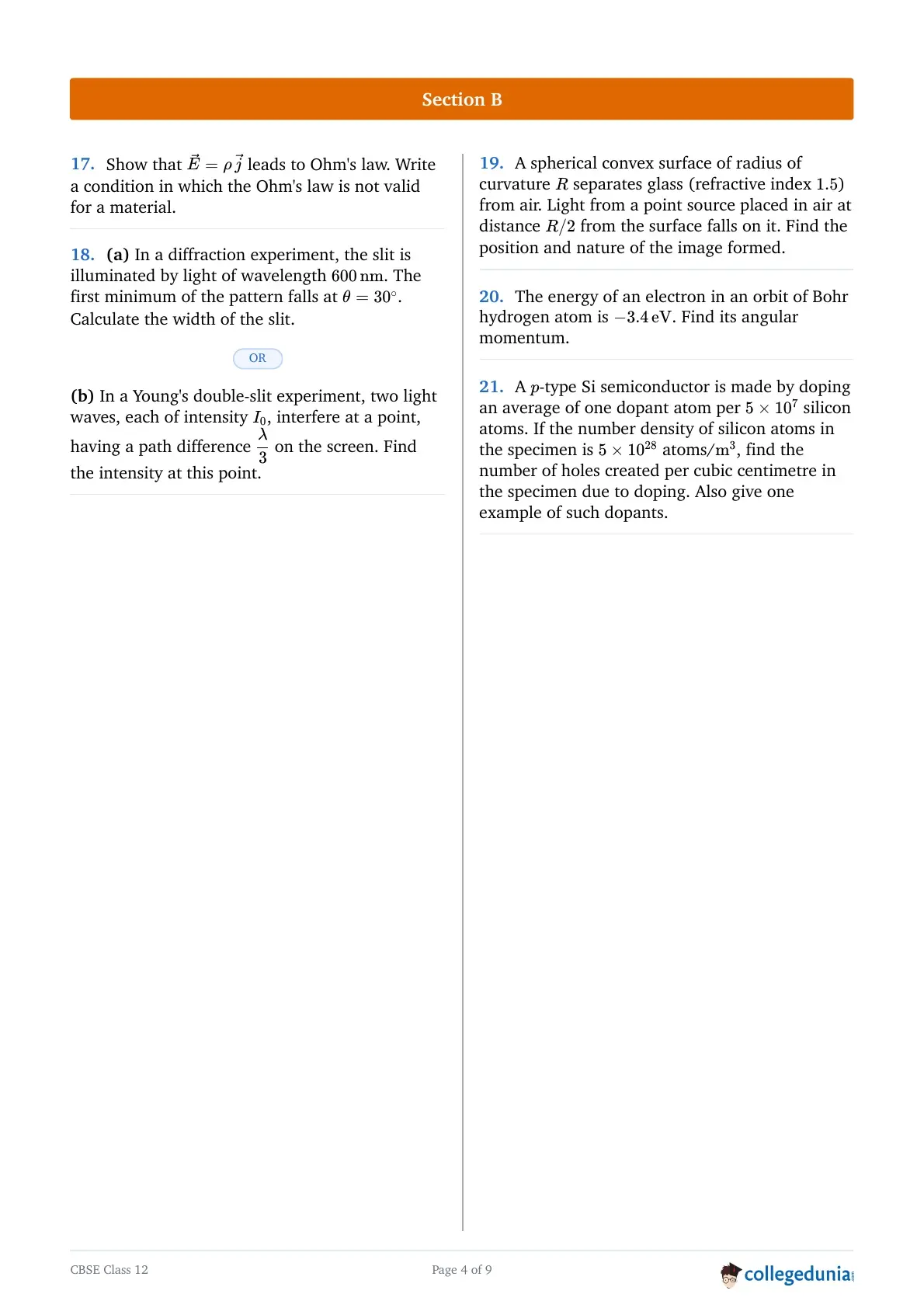
Show that \( \mathbf{E} = \rho \mathbf{J} \) leads to Ohm's law. Write a condition in which Ohm's law is not valid for a material.
In a diffraction experiment, the slit is illuminated by light of wavelength \(600\,\text{nm}\). The first minimum of the pattern falls at \(\theta = 30^\circ\). Calculate the width of the slit.
In a Young's double-slit experiment, two light waves, each of intensity \(I_0\), interfere at a point, having a path difference \(\dfrac{\lambda}{3}\) on the screen. Find the intensity at this point.
A spherical convex surface of radius of curvature \(R\) separates glass (refractive index \(1.5\)) from air. Light from a point source placed in air at distance \(R/2\) from the surface falls on it. Find the position and nature of the image formed.
The energy of an electron in an orbit of Bohr hydrogen atom is \(-3.4\,\text{eV}\). Find its angular momentum.
A \(p\)-type Si semiconductor is made by doping an average of one dopant atom per \(5 \times 10^7\) silicon atoms. If the number density of silicon atoms in the specimen is \(5 \times 10^{28}\) atoms/\(\text{m}^3\), find the number of holes created per cubic centimetre in the specimen due to doping. Also give one example of such dopants.
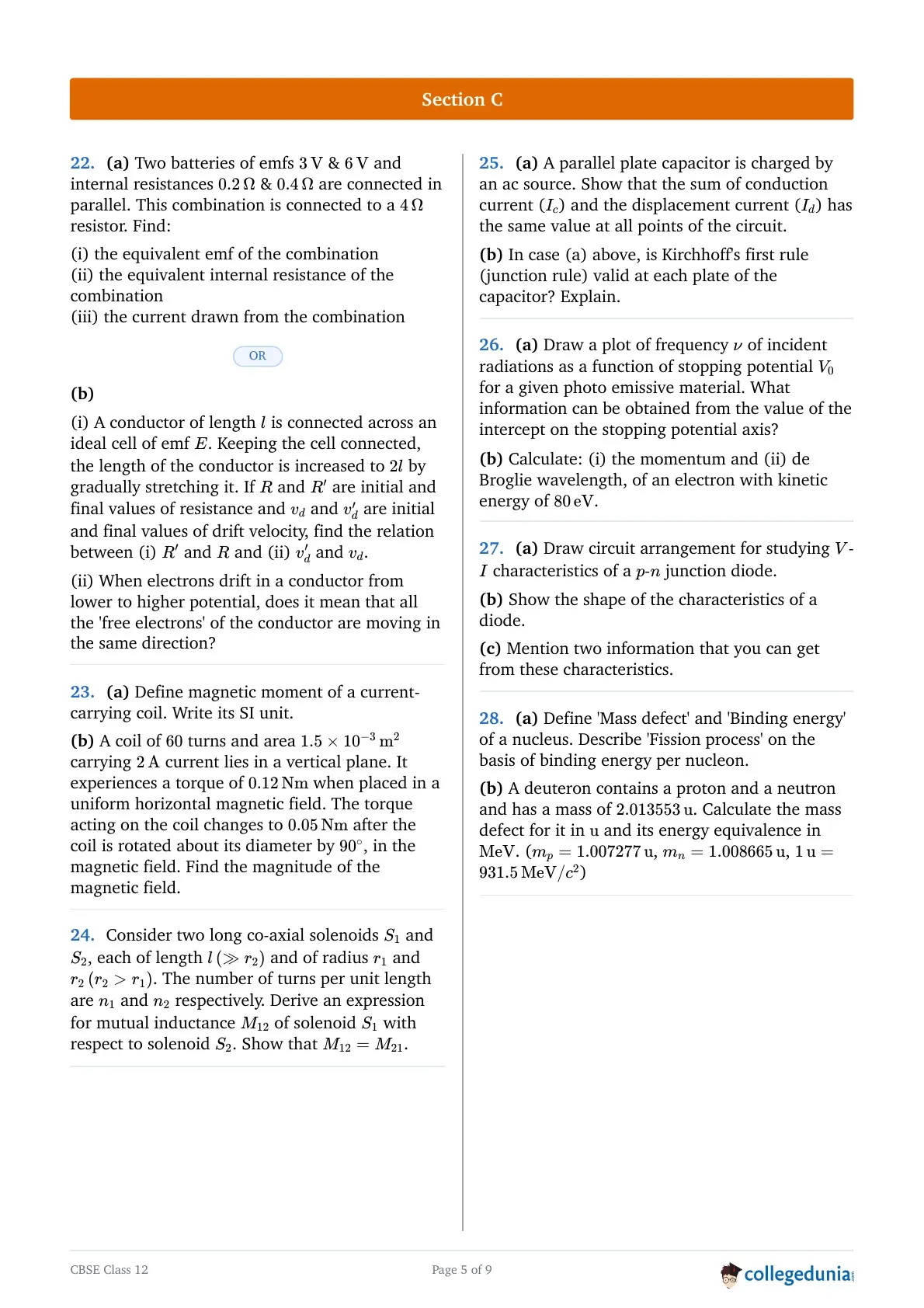
Two batteries of emf's \(3V \& 6V\) and internal resistances 0.2 Ω \(\&\) 0.4 Ω are connected in parallel. This combination is connected to a 4 Ω resistor. Find:
(i) the equivalent emf of the combination
(ii) the equivalent internal resistance of the combination
(iii) the current drawn from the combination
(i) A conductor of length \(l\) is connected across an ideal cell of emf \(E\). Keeping the cell connected, the length of the conductor is increased to \(2l\) by gradually stretching it. If \(R\) and \(R'\) are initial and final values of resistance and \(v_d\) and \(v_d'\) are initial and final values of drift velocity, find the relation between (i) \(R'\) and \(R\) and (ii) \(v_d'\) and \(v_d\).
(ii) When electrons drift in a conductor from lower to higher potential, does it mean that all the 'free electrons' of the conductor are moving in the same direction?
(a) Define magnetic moment of a current-carrying coil. Write its SI unit.
(b) A coil of 60 turns and area \( 1.5 \times 10^{-3}\,\text{m}^2 \) carrying 2 A current lies in a vertical plane. It experiences a torque of 0.12 Nm when placed in a uniform horizontal magnetic field. The torque acting on the coil changes to 0.05 Nm after the coil is rotated about its diameter by \( 90^{\circ} \), in the magnetic field. Find the magnitude of the magnetic field.
Consider two long co-axial solenoids \(S_1\) and \(S_2\), each of length \(l\,(\gg r_2)\) and of radius \(r_1\) and \(r_2\,(r_2 \gt r_1)\). The number of turns per unit length are \(n_1\) and \(n_2\) respectively. Derive an expression for mutual inductance \(M_{12}\) of solenoid \(S_1\) with respect to solenoid \(S_2\). Show that \(M_{12} = M_{21}\).
(a) A parallel plate capacitor is charged by an ac source. Show that the sum of conduction current (\(I_c\)) and the displacement current (\(I_d\)) has the same value at all points of the circuit.
(b) In case (a) above, is Kirchhoff's first rule (junction rule) valid at each plate of the capacitor? Explain.
(a) Draw a plot of frequency \( \nu \) of incident radiations as a function of stopping potential \( V_0 \) for a given photo emissive material. What information can be obtained from the value of the intercept on the stopping potential axis?
(b) Calculate : (i) the momentum and (ii) de Broglie wavelength, of an electron with kinetic energy of \( 80\,\text{eV} \).
(a) Draw circuit arrangement for studying \(V\)-\(I\) characteristics of a \(p\)-\(n\) junction diode.
(b) Show the shape of the characteristics of a diode.
(c) Mention two information that you can get from these characteristics.
(a) Define 'Mass defect' and 'Binding energy' of a nucleus. Describe 'Fission process' on the basis of binding energy per nucleon.
(b) A deuteron contains a proton and a neutron and has a mass of \(2.013553\,\text{u}\). Calculate the mass defect for it in \(\text{u}\) and its energy equivalence in \(\text{MeV}\). (\(m_p = 1.007277\,\text{u}\), \(m_n = 1.008665\,\text{u}\), \(1\,\text{u} = 931.5\,\text{MeV}/c^2\))
Comprehension:
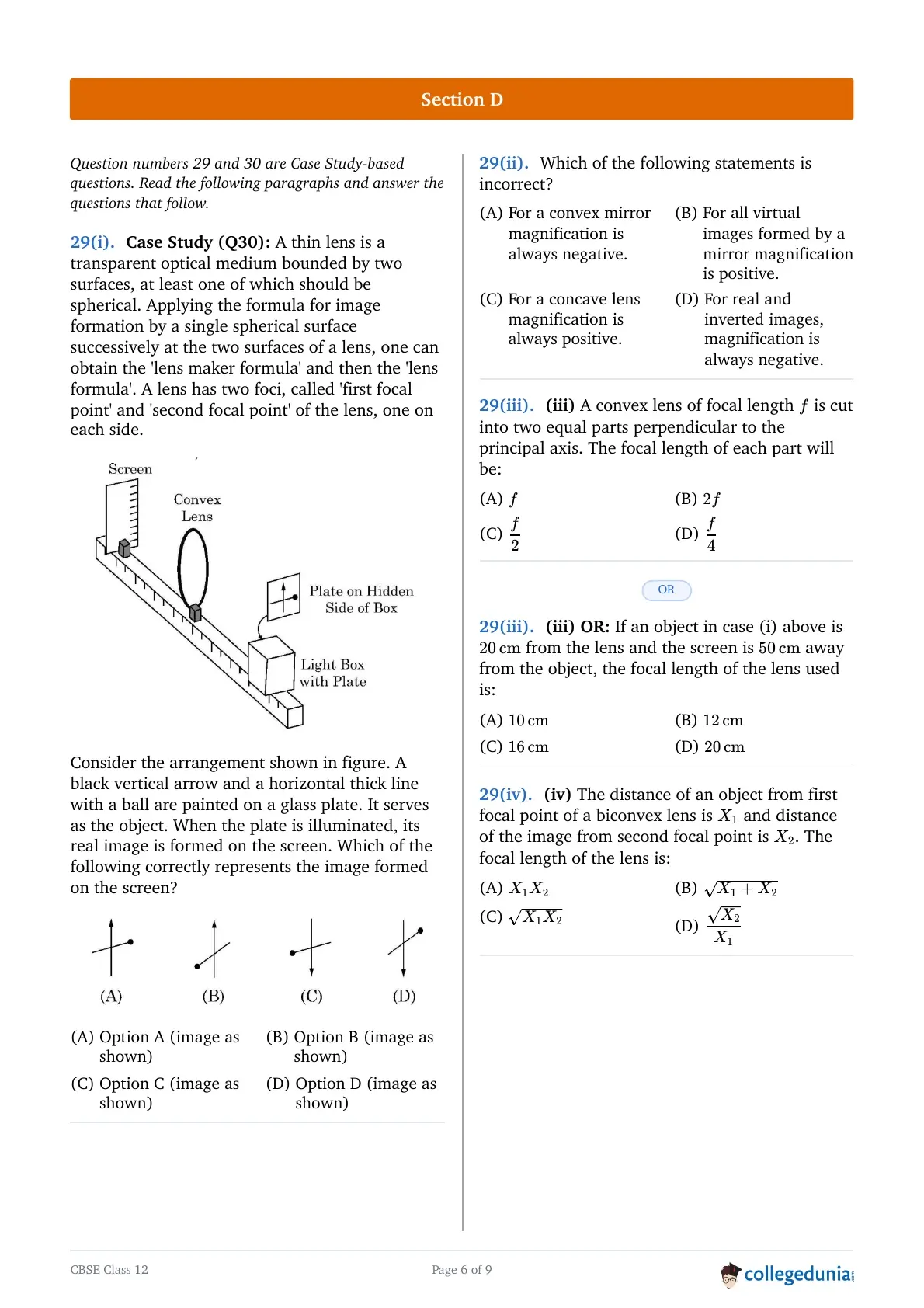
Case Study (Q30): A thin lens is a transparent optical medium bounded by two surfaces, at least one of which should be spherical. Applying the formula for image formation by a single spherical surface successively
Read More
at the two surfaces of a lens, one can obtain the 'lens maker formula' and then the 'lens formula'. A lens has two foci, called 'first focal point' and 'second focal point' of the lens, one on each side.Consider the arrangement shown in the figure. A black vertical arrow and a horizontal thick line with a ball are painted on a glass plate. It serves as the object. When the plate is illuminated, its real image is formed on the screen.
Which of the following correctly represents the image formed on the screen?

- (A)
![]()
- (B)
![]()
- (C)
![]()
- (D)
![]()


(ii) Which of the following statements is incorrect?
(iii) A convex lens of focal length \(f\) is cut into two equal parts perpendicular to the principal axis. The focal length of each part will be:
(iii) OR: If an object in case (i) above is \(20\,\text{cm}\) from the lens and the screen is \(50\,\text{cm}\) away from the object, the focal length of the lens used is:
(iv) The distance of an object from first focal point of a biconvex lens is \(X_1\) and distance of the image from second focal point is \(X_2\). The focal length of the lens is:
Comprehension:
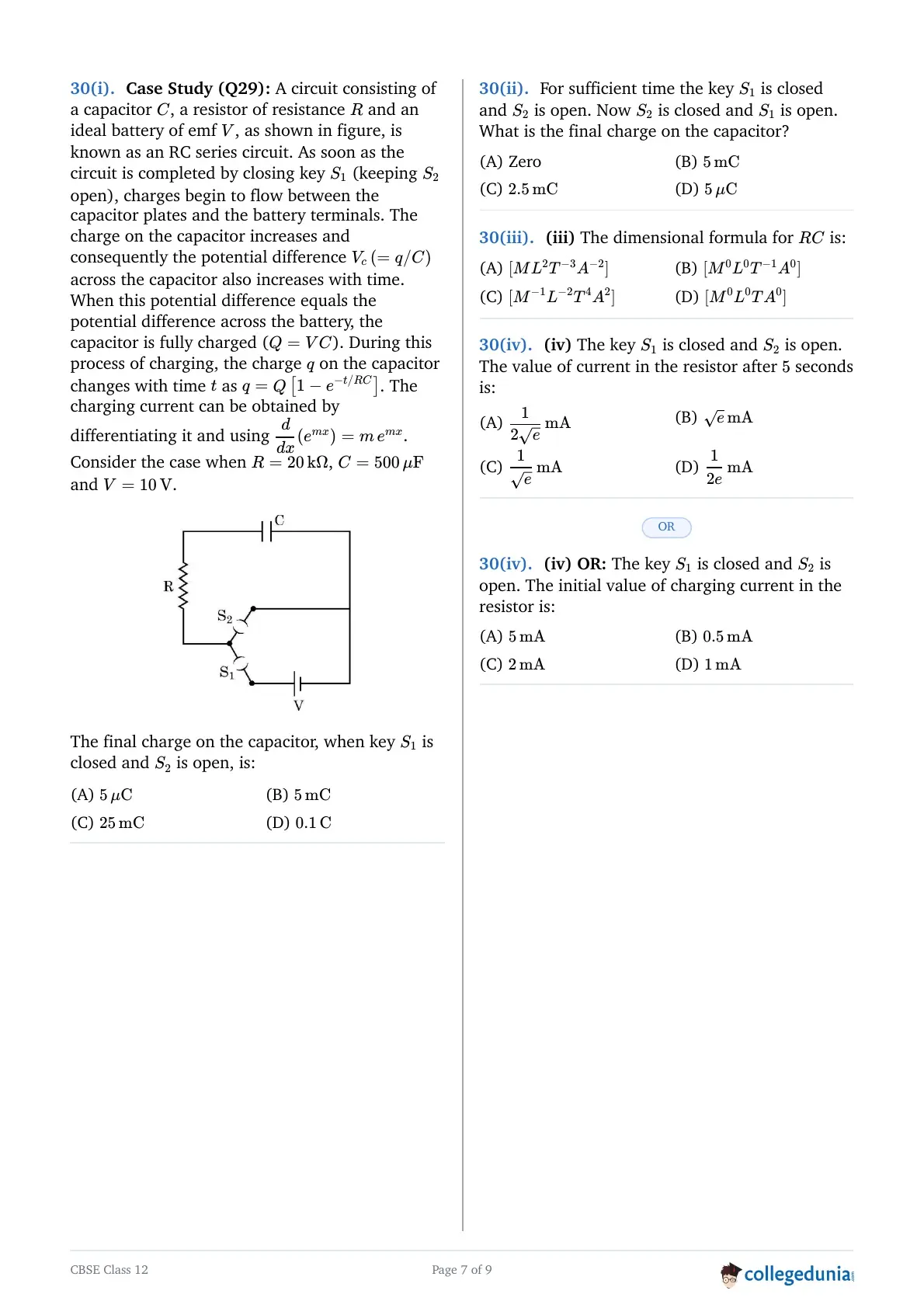
Case Study (Q29): A circuit consisting of a capacitor \(C\), a resistor of resistance \(R\) and an ideal battery of emf \(V\), as shown in figure, is known as an RC series circuit. As soon as the circuit is completed by closing key \(S_1\) (keeping \(S_2\) open), charges begin to flow between the capacitor plates and the battery terminals. The charge on the capacitor increases and consequently the potential difference \(V_c\,(= q/C)\) across the capacitor also increases
Read More
with time. When this potential difference equals the potential difference across the battery, the capacitor is fully charged (\(Q = VC\)). During this process of charging, the charge \(q\) on the capacitor changes with time \(t\) as \(q = Q\left[1 - e^{-t/RC}\right]\). The charging current can be obtained by differentiating it and using \(\dfrac{d}{dx}(e^{mx}) = m\, e^{mx}\). Consider the case when \(R = 20\,\text{k}\Omega\), \(C = 500\,\mu\text{F}\) and \(V = 10\,\text{V}\).(i) The final charge on the capacitor, when key \(S_1\) is closed and \(S_2\) is open, is:
(ii) For sufficient time the key \(S_1\) is closed and \(S_2\) is open. Now \(S_2\) is closed and \(S_1\) is open. What is the final charge on the capacitor?
The dimensional formula for \( RC \) is:
(iv) The key \(S_1\) is closed and \(S_2\) is open. The value of current in the resistor after \(5\) seconds is:
(iv) OR: The key \(S_1\) is closed and \(S_2\) is open. The initial value of charging current in the resistor is:
(i) (1) What are coherent sources? Why are they necessary for observing a sustained interference pattern?
(2) Lights from two independent sources are not coherent. Explain.
(ii) Two slits \(0.1\,\text{mm}\) apart are arranged \(1.20\,\text{m}\) from a screen. Light of wavelength \(600\,\text{nm}\) from a distant source is incident on the slits.
(1) How far apart will adjacent bright interference fringes be on the screen?
(2) Find the angular width (in degree) of the first bright fringe.
(i) Define a wavefront. An incident plane wave falls on a convex lens and gets refracted through it. Draw a diagram to show the incident and refracted wavefront.
(ii) A beam of light coming from a distant source is refracted by a spherical glass ball (refractive index \(1.5\)) of radius \(15\,\text{cm}\). Draw the ray diagram and obtain the position of the final image formed.
(i) Two point charges \(5\,\mu\text{C}\) and \(-1\,\mu\text{C}\) are placed at points \((-3\,\text{cm}, 0, 0)\) and \((3\,\text{cm}, 0, 0)\) respectively. An external electric field \(\vec{E} = \dfrac{A}{r^2}\,\hat{r}\), where \(A = 3 \times 10^5\,\text{V m}\), is switched on in the region. Calculate the change in electrostatic energy of the system due to the electric field.
(ii) A system of two conductors is placed in air and they have net charge of \(+80\,\mu\text{C}\) and \(-80\,\mu\text{C}\) which causes a potential difference of \(16\,\text{V}\) between them.
(1) Find the capacitance of the system.
(2) If the air between the capacitor is replaced by a dielectric medium of dielectric constant \(3\), what will be the potential difference between the two conductors?
(3) If the charges on two conductors are changed to \(+160\,\mu\text{C}\) and \(-160\,\mu\text{C}\), will the capacitance of the system change? Give reason for your answer.
(i) Consider three metal spherical shells \(A\), \(B\) and \(C\), each of radius \(R\). Each shell is having a concentric metal ball of radius \(R/10\). The spherical shells \(A\), \(B\) and \(C\) are given charges \(+6q\), \(-4q\) and \(14q\) respectively. Their inner metal balls are also given charges \(-2q\), \(+8q\) and \(-10q\) respectively. Compare the magnitude of the electric fields due to shells \(A\), \(B\) and \(C\) at a distance \(3R\) from their centres.
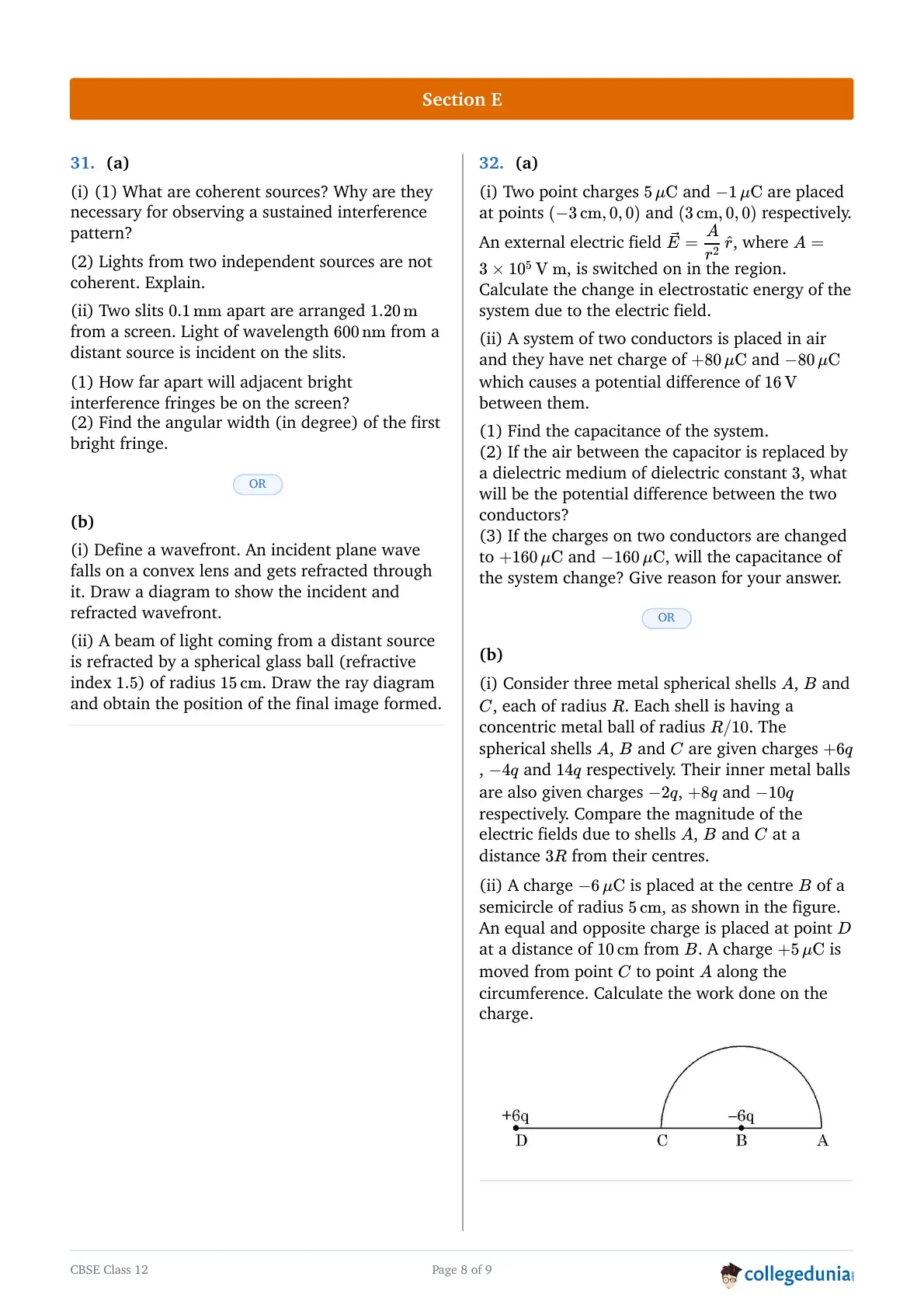
(ii) A charge \(-6\,\mu\text{C}\) is placed at the centre \(B\) of a semicircle of radius \(5\,\text{cm}\), as shown in the figure. An equal and opposite charge is placed at point \(D\) at a distance of \(10\,\text{cm}\) from \(B\). A charge \(+5\,\mu\text{C}\) is moved from point \(C\) to point \(A\) along the circumference. Calculate the work done on the charge.
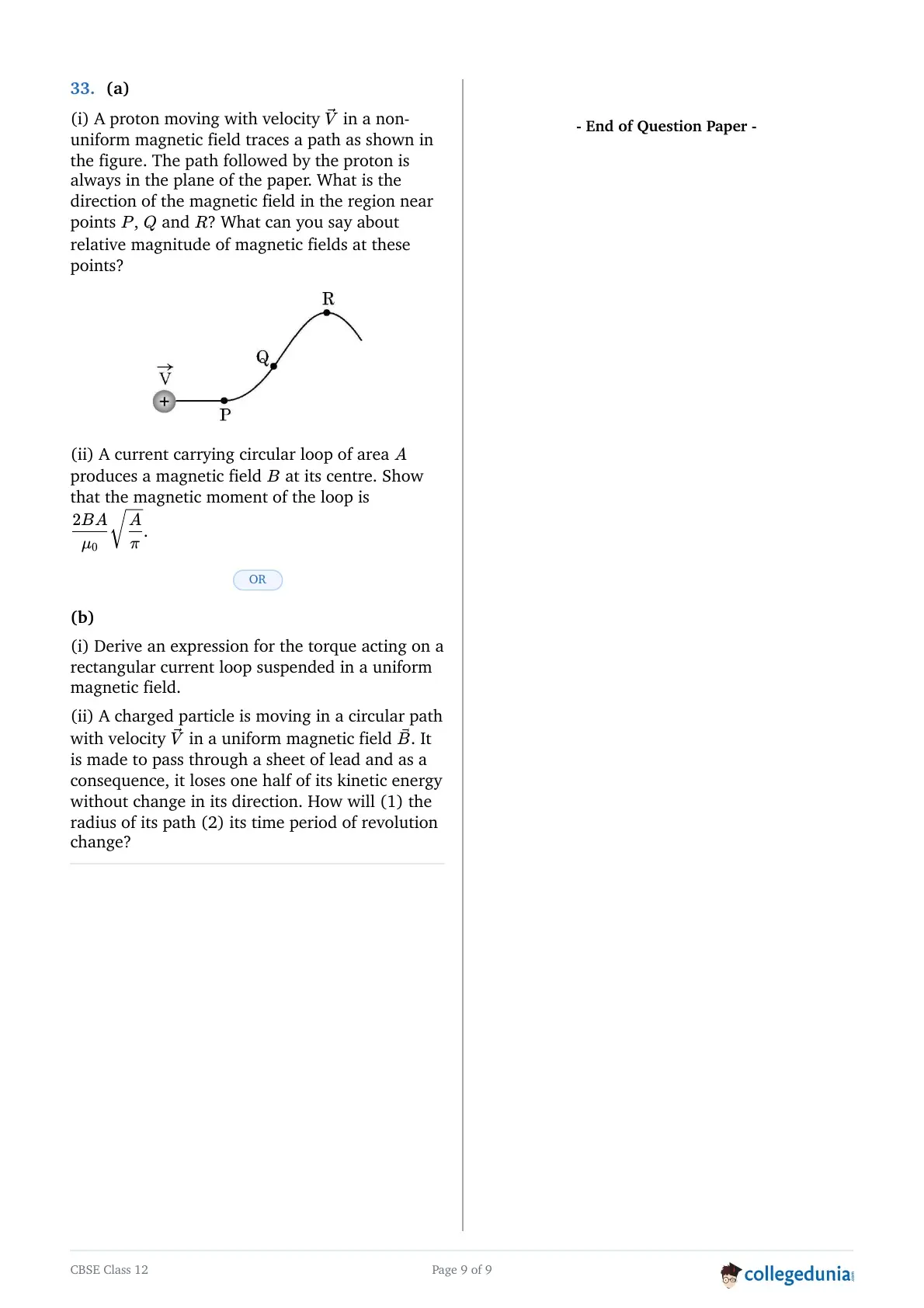
(i) A proton moving with velocity \(\vec{V}\) in a non-uniform magnetic field traces a path as shown in the figure. The path followed by the proton is always in the plane of the paper. What is the direction of the magnetic field in the region near points \(P\), \(Q\) and \(R\)? What can you say about relative magnitude of magnetic fields at these points?
(ii) A current carrying circular loop of area \(A\) produces a magnetic field \(B\) at its centre. Show that the magnetic moment of the loop is \(\dfrac{2BA}{\mu_0}\sqrt{\dfrac{A}{\pi}}\).
(i) Derive an expression for the torque acting on a rectangular current loop suspended in a uniform magnetic field.
(ii) A charged particle is moving in a circular path with velocity \(\vec{V}\) in a uniform magnetic field \(\vec{B}\). It is made to pass through a sheet of lead and as a consequence, it loses one half of its kinetic energy without change in its direction. How will (1) the radius of its path (2) its time period of revolution change?
CBSE Class 12 Physics Question Paper Pattern 2025
The CBSE Class 12 Physics 2025 question paper is of 70 marks and has 33 questions in five sections, A to E, all compulsory, with internal choice in some questions of Sections B to E. The time allowed is 3 hours, with 15 minutes of extra reading time. The table below gives the section-wise paper pattern from the official CBSE question paper.
| Section | Questions | Question Type | Marks per Question | Marks |
|---|---|---|---|---|
| A | Q1 - Q16 | Multiple choice questions | 1 | 16 |
| B | Q17 - Q21 | Very short answer questions | 2 | 10 |
| C | Q22 - Q28 | Short answer questions | 3 | 21 |
| D | Q29 - Q30 | Case study-based questions | 4 | 8 |
| E | Q31 - Q33 | Long answer questions | 5 | 15 |
| Total | 33 questions | 70 |
CBSE Class 12 Physics Unit-Wise Topics with Marks Distribution
| Unit No. | Unit Name | Chapters | Allotted Marks |
|---|---|---|---|
| Unit 1 | Electrostatics | Electric Charges and Fields | 16 |
| Electrostatic Potential and Capacitance | |||
| Unit 2 | Current Electricity | Current Electricity | |
| Unit 3 | Magnetic Effects of Current and Magnetism | Moving Charges and Magnetism | 17 |
| Magnetism and Matter | |||
| Unit 4 | Electromagnetic Induction and Alternating Current | Electromagnetic Induction | |
| Alternating Current | |||
| Unit 5 | Electromagnetic Waves | Electromagnetic Waves | 18 |
| Unit 6 | Optics | Ray Optics and Optical Instruments | |
| Wave Optics | |||
| Unit 7 | Dual Nature of Radiation and Matter | Dual Nature of Radiation and Matter | 12 |
| Unit 8 | Atoms and Nuclei | Atoms | |
| Nuclei | |||
| Unit 9 | Electronic Devices | Semiconductor Electronics: Materials, Devices, and Simple Circuits | 07 |
| Total | 70 | ||



Comments