




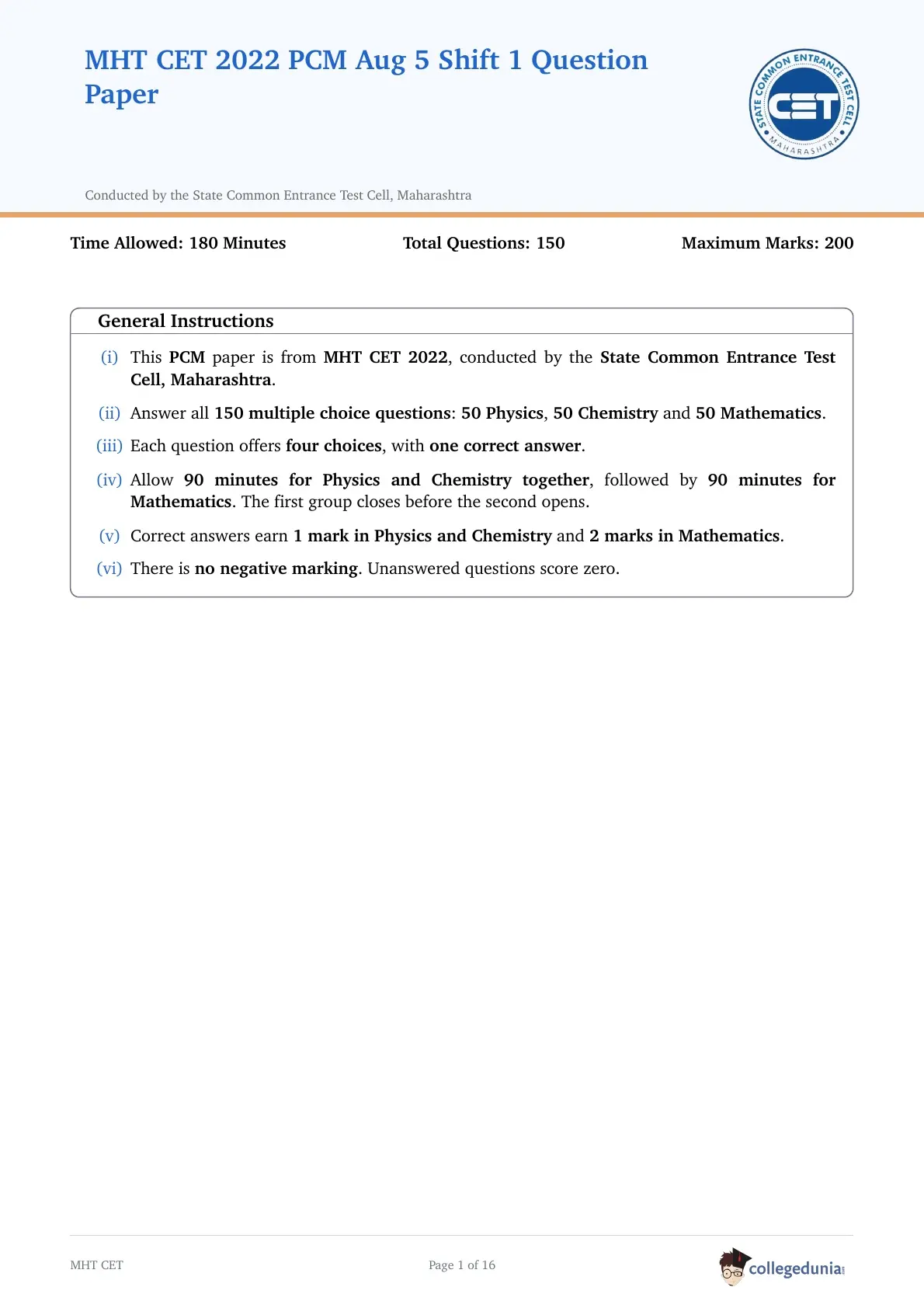
MHT CET 2022 Aug 5 Shift 1 PCM Question Paper is available for download here. Maharashtra State CET Cell conducted MHT CET 2022 PCM Exam on Aug 5 in Shift 1 from 9 AM to 12 PM in CBT mode.
The MHT CET 2022 PCM question paper includes the following:
- The MHT CET 2022 PCM Question Paper consists of 150 multiple-choice questions (MCQs) totalling 200 marks divided into 3 sections: Physics, Chemistry, and Mathematics, with 50 questions in each subject.
- Physics and Chemistry questions carry 1 mark each while Mathematics questions carry 2 marks each.
- There is no negative marking for incorrect answers.
MHT CET 2022 Aug 5 Shift 1 PCM Question Paper with Solution PDF
| CD PDF | CD PDF with Solutions |
|---|---|
| Download Collegedunia PDF 0.91 MB | - |
Also Check:
MHT CET 2022 Aug 5 Shift 1 PCM Questions with Solutions
Physics (Q1 - Q50)
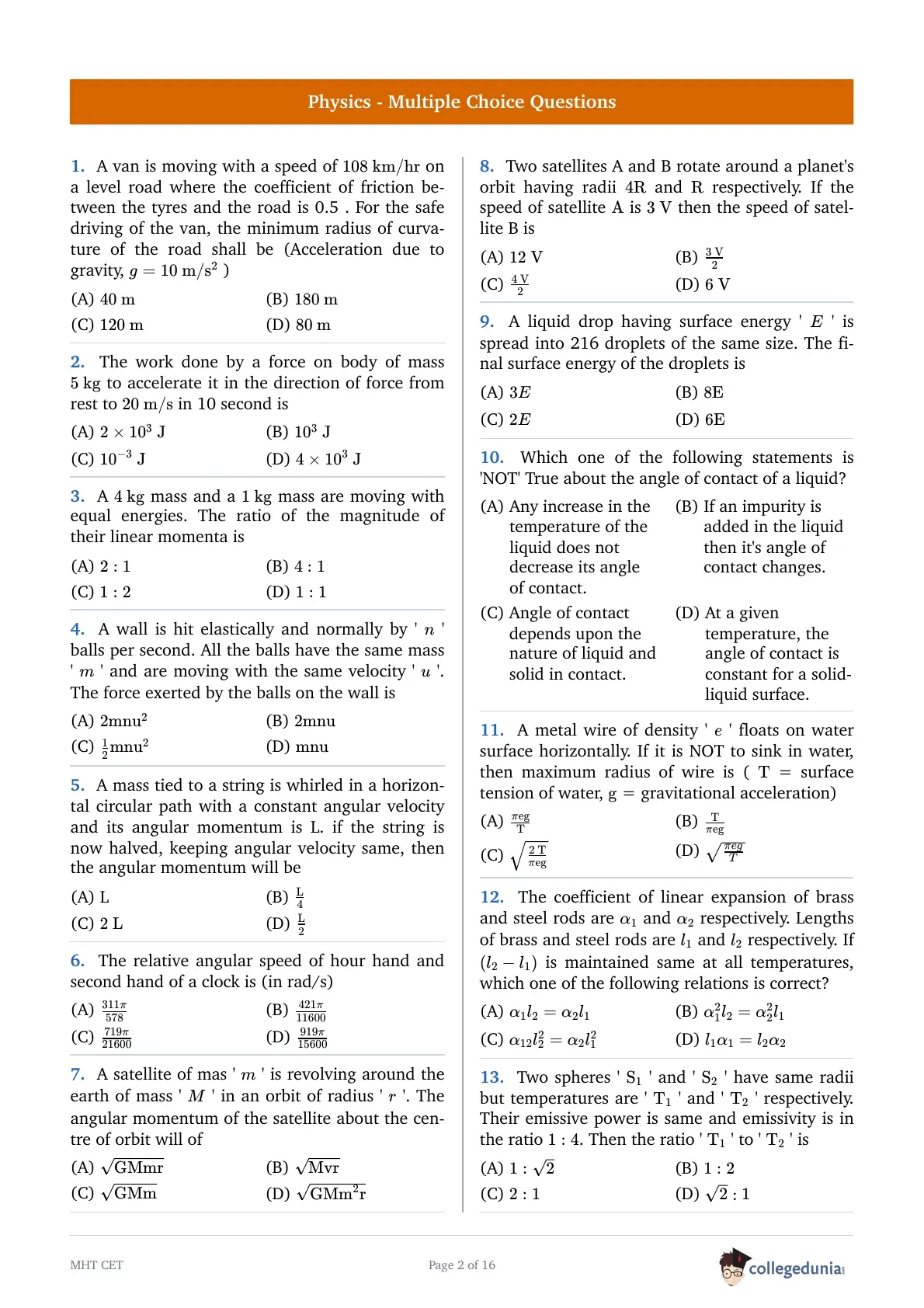
A van is moving with a speed of 108 km/hr on a level road where the coefficient of friction between the tyres and the road is 0.5. For the safe driving of the van, the minimum radius of curvature of the road shall be (Acceleration due to gravity, g=10 m/s2)
The work done by a force on body of mass 5 kg to accelerate it in the direction of force from rest to 20 m/s2 in 10 second is
A 4 kg mass and a 1 kg mass are moving with equal energies. The ratio of the magnitude of their linear momenta is
A wall is hit elastically and normally by ‘n’ balls per second. All the balls have the same mass ‘m’ and are moving with the same velocity ‘u’. the force exerted by the balls on the wall is
A mass tied to a string is whirled in a horizontal circular path with a constant angular velocity and its angular momentum is L. If the string is now halved, keeping angular velocity same, then the angular momentum will be
The relative angular speed of hour hand and second hand of a clock is (in rad/s)
A satellite of mass ‘m’ is revolving around the earth of mass ‘M’ in an orbit of radius ‘r’. The angular momentum of the satellite about the centre of orbit will be
Two satellites A and B rotate round a planet’s orbit having radius 4R and R respectively. If the speed of satellite A is 3 V then speed of satellite B is
A liquid drop having surface energy ‘E’ is spread into 216 droplets of the same size. The final surface energy of the droplets is __.
Which one of the following statements is ‘NOT’ true about the angle of contact of a liquid?
A metal wire of density ‘ρ’ floats on water surface horizontally. If it is NOT to sink in water, then maximum radius of wire is (T = surface tension of water, g = gravitational acceleration)
The coefficient of linear expansion of brass and steel rod are ‘α1’ and ‘α2’ respectively. Lengths of brass and steel rods are ‘l1’ and‘l2’ respectively. If (l2 - l1) is maintained same at all temperatures, which one of the following relation is correct?
Two spheres ‘S1’ and ‘S2’ have same radii but temperatures are ‘T1’ and ‘T2’ respectively. Their emissive power is same and emissivity is in the ratio 1 : 4. Then the ratio ‘T1’ to‘T2’ is
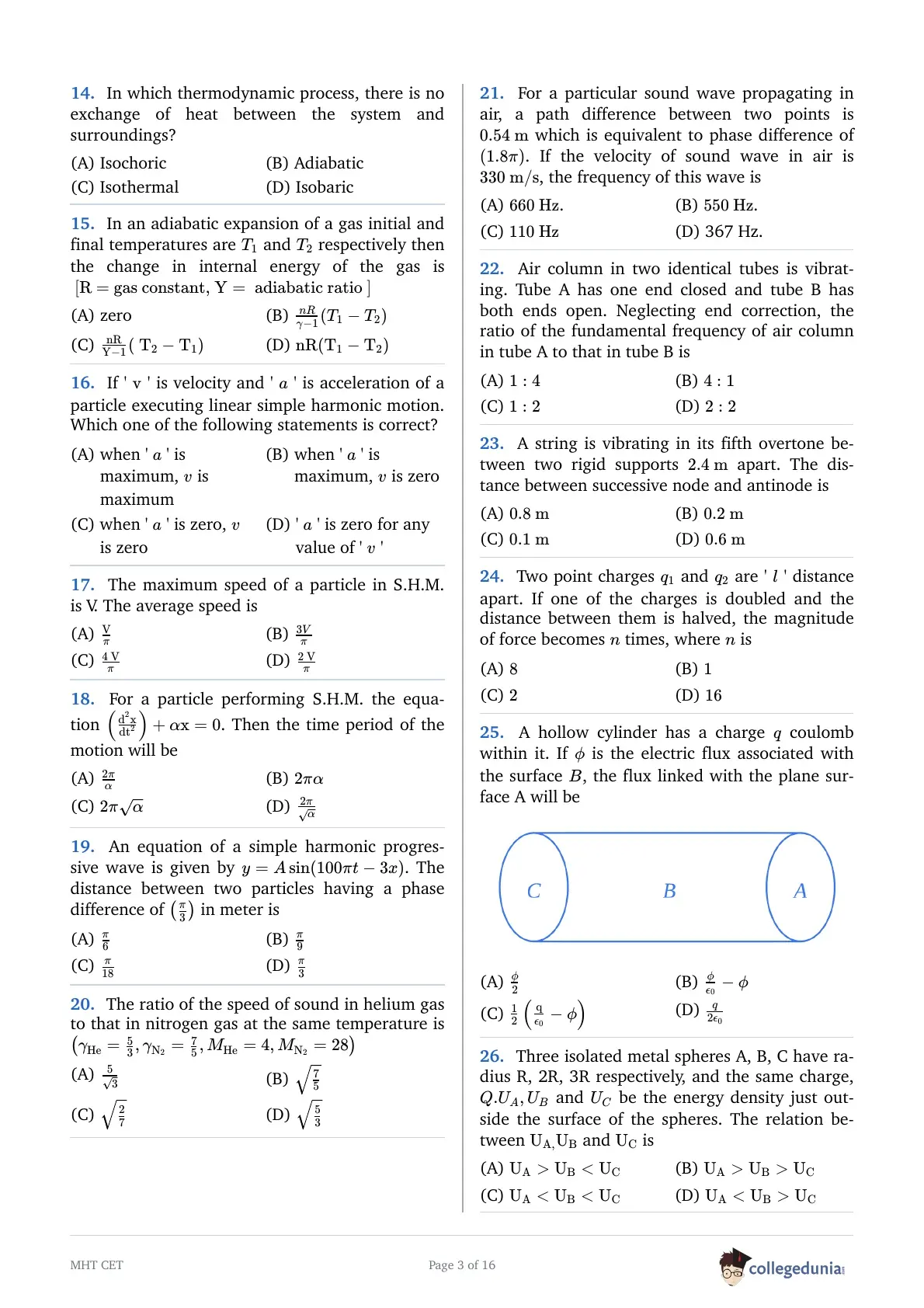
In which thermodynamic process, there is no exchange of heat between the system and surroundings?
In an adiabatic expansion of a gas initial and final temperatures are \(T_{1}\) and \(T_{2}\) respectively then the change in internal energy of the gas is \(\text{ [R = gas constant, }\mathrm{Y}=\text{ adiabatic ratio }]\)
If ‘V’ is velocity and ‘a’ is acceleration of a particle executing linear simple harmonic motion. Which one of the following statements is correct?
For a particle performing S.H.M. the equation \( \frac{d^2x}{dt^2} + \alpha x = 0 \). Then the time period of the motion will be:
An equation of a simple harmonic progressive wave is given by y = A sin (100πt-3x).The distance between two particles having a phase difference of \(\frac {π}{3}\) in metre is
The ratio of the speed of sound in helium gas to that in nitrogen gas at same temperature is (γHe = \(\frac {5}{3}\), γN2 = 4 , M N2 =28)
For a particular sound wave propagating in air, a path difference between two points is 0.54 m which is equivalent to phase difference of (1.8 π)c. If the velocity of sound wave in air is 330 m/s, the frequency of this wave is
Air column in two identical tubes is vibrating. Tube A has one end closed and tube B has both ends open. Neglecting end correction, the ratio of the fundamental frequency of air column in tube A to that in tube B is
A string is vibrating in its fifth overtone between two rigid supports 2.4 m apart. The distance between successive node and antinode is
Two point charges q1 and q2 are ‘l’ distance apart. If one of the charges is doubled and distance between them is halved, the magnitude of force becomes n times, where n is
A hollow cylinder has a charge q coulomb within it. It ϕ is the electric flux associated with the curved surface B, the flux linked with the plane surface A will be
Three isolated metal spheres A, B, C have radius R, 2R, 3R respectively, and the same charge, \(Q.U_{A},U_{B}\) and \(U_{C}\) be the energy density just outside the surface of the spheres. The relation between \(\mathrm{U}_{\mathrm{A},}\mathrm{U}_{\mathrm{B}}\) and \(\mathrm{U}_{\mathrm{C}}\) is
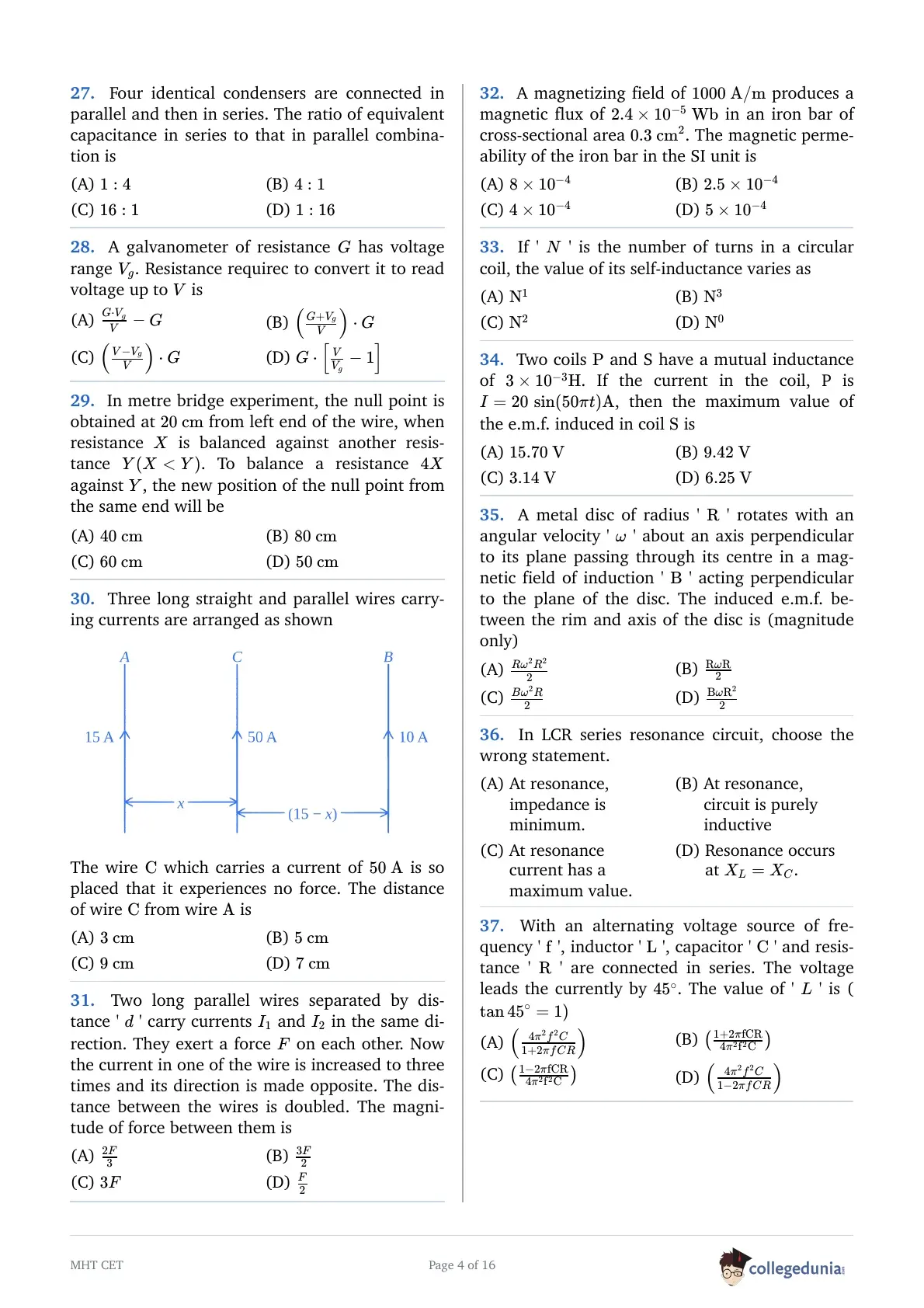
Four identical condensers are connected in parallel and then in series equivalent capacitance in series to that in parallel combination is
A galvanometer of resistance G has voltage range Vg. Resistance required to convert it to read voltage up to V is
In metre bridge experiment, null point is obtained at 20 cm from left end of the wire, when resistance X is balanced against another resistance Y (X < Y). To balance a resistance 4 X against Y, the new position of the null point from the same end will be
Three long straight and parallel wires carrying currents are arranged as shown

Two long parallel wires separated by distance ‘d’ carry currents I1 and I2 in the same direction. They exert a force F on each other. Now the current in one of the wire is increased to three times and its direction is made opposite. The distance between the wires is doubled. The magnitude of force between them is
A magnetizing field of 1000 A/m produces a magnetic flux of 2.4 x 10⁻⁵ Wb in an iron bar of cross-sectional area 0.3 cm2.The magnetic permeability of the iron bar in SI unit is
If ‘N’ is the number of turns in a circular coil, the value of its self-inductance varies as
Two coils P and S have a mutual inductance of 5 x 10⁻³ H. If the current in the coil, P is I = 10 sin (100 πt), then the maximum value of the e.m.f. induced in coil S is
A metal disc of radius ‘R’ rotates with an angular velocity ‘ω’ about an axis perpendicular to its plane passing through its centre in a magnetic field of induction ‘B’ acting perpendicular to the plane of the disc. The induced e.m.f. between the rim and axis of the disc is (magnitude only)
With an alternating voltage source of frequency ' \(\mathrm{f}\) ', inductor ' \(\mathrm{L}\) ', capacitor ' \(\mathrm{C}\) ' and resistance ' \(\mathrm{R}\) ' are connected in series. The voltage leads the currently by \(45^{\circ }\). The value of ' \(L\) ' is ( \(\tan 45^{\circ }=1)\)
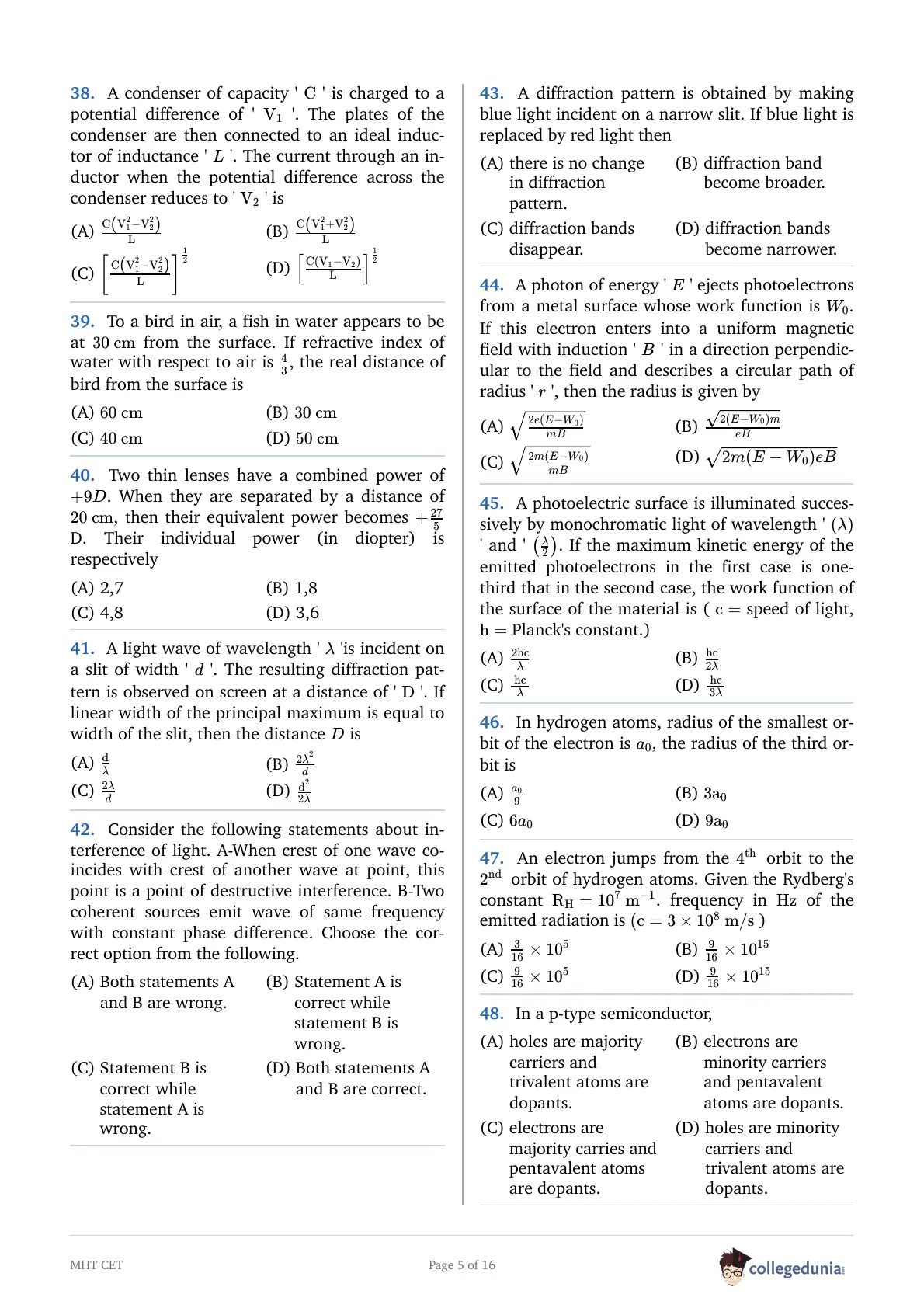
A condenser of capacity ‘C’ is charged to a potential difference of ‘V1’. The plates of the condenser are then connected to an ideal inductor of inductance ‘L’. The current through an inductor when the potential difference across the condenser reduces to ‘V2’ is
To a bird in air, a fish in water appears to be at 30 cm from the surface. If refractive index of water with respect to air is \(\frac {4}{3}\) ,the real distance of bird from the surface is
Two thin lenses have a combined power of +9D. When they are separated by a distance of 20 cm, then their equivalent power becomes +27/5 D. Their individual power (in dioptre) is
A light wave of wavelength ‘λ’ is incident on a slit of width ‘d’. The resulting diffraction pattern is observed on a screen at a distance ‘D’.If linear width of the principal maximum is equal to the width of the slit, then the distance D is
Consider the following statements about interference of light.
A – When crest of one wave coincides with crest of another wave at a point, this point is a point of destructive interference.
B – Two coherent sources emit wave of same frequency with constant phase difference.
Choose the correct option from the following.
A diffraction pattern is obtained by making blue light incident on a narrow slit. If blue light is replaced by red light then
A photon of energy ‘E’ ejects photoelectrons from a metal surface whose work function is W0. If this electron enters into uniform magnetic field of induction ‘B’ in a direction perpendicular to field and describes a circular path of radius‘r’, then radius is given by
A photoelectric surface is illuminated successively by monochromatic light of wavelength ' \((\lambda )\) ' and ' \(\left(\frac{\lambda }{2}\right)\). If the maximum kinetic energy of the emitted photoelectrons in the first case is one-third that in the second case, the work function of the surface of the material is ( \(\mathrm{c}=\) speed of light, \(\mathrm{h}=\) Planck's constant.)
In hydrogen atom, radius of the smallest orbit of the electron is a0, the radius of the third orbit is
An electron jumps from the 4th orbit to the 2nd orbit of hydrogen atom. Given the Rydberg’s constant R = 107 m-1. The frequency in Hz of the emitted radiation is (c = 3x10⁸ m/s)
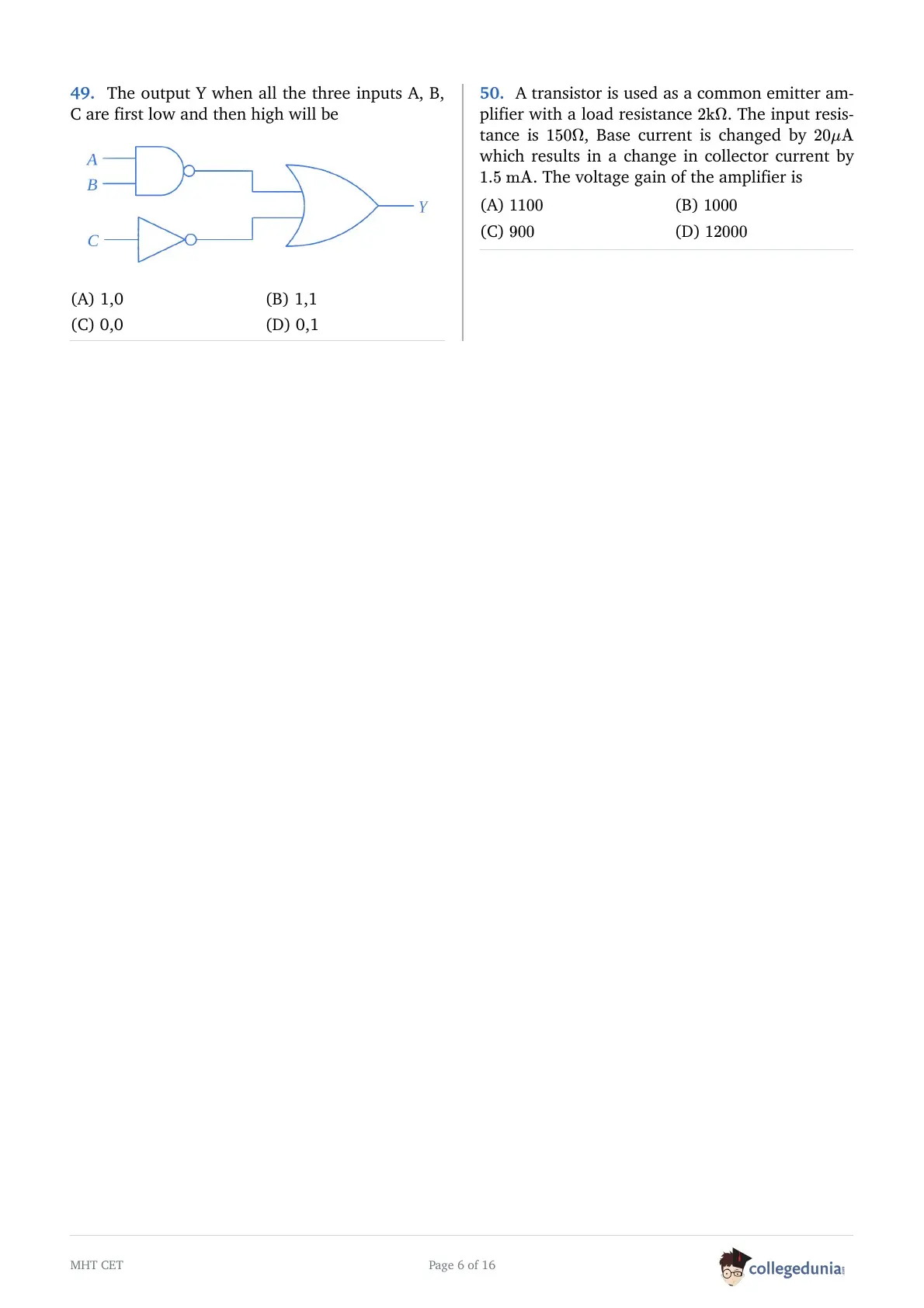
The output Y when all the three inputs A, B, C are first low and then high will be

A transistor is used as a common emitter amplifier with a load resistance 2 kΩ. The input resistance is 150 Ω. Base current is changed by 20 μA which results in a change in collector current by 1.5 mA. The voltage gain of the amplifier is
Chemistry (Q51 - Q100)
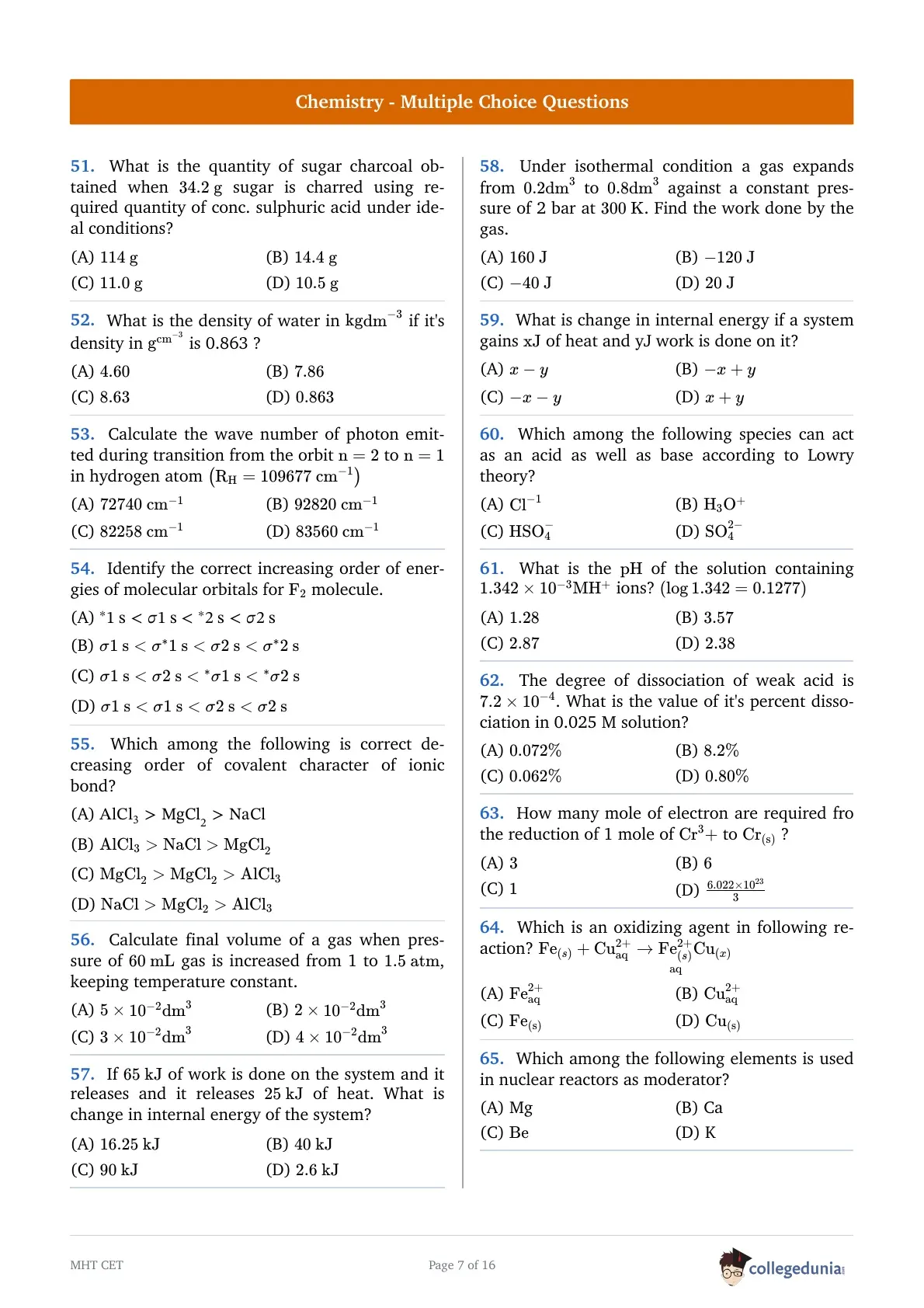
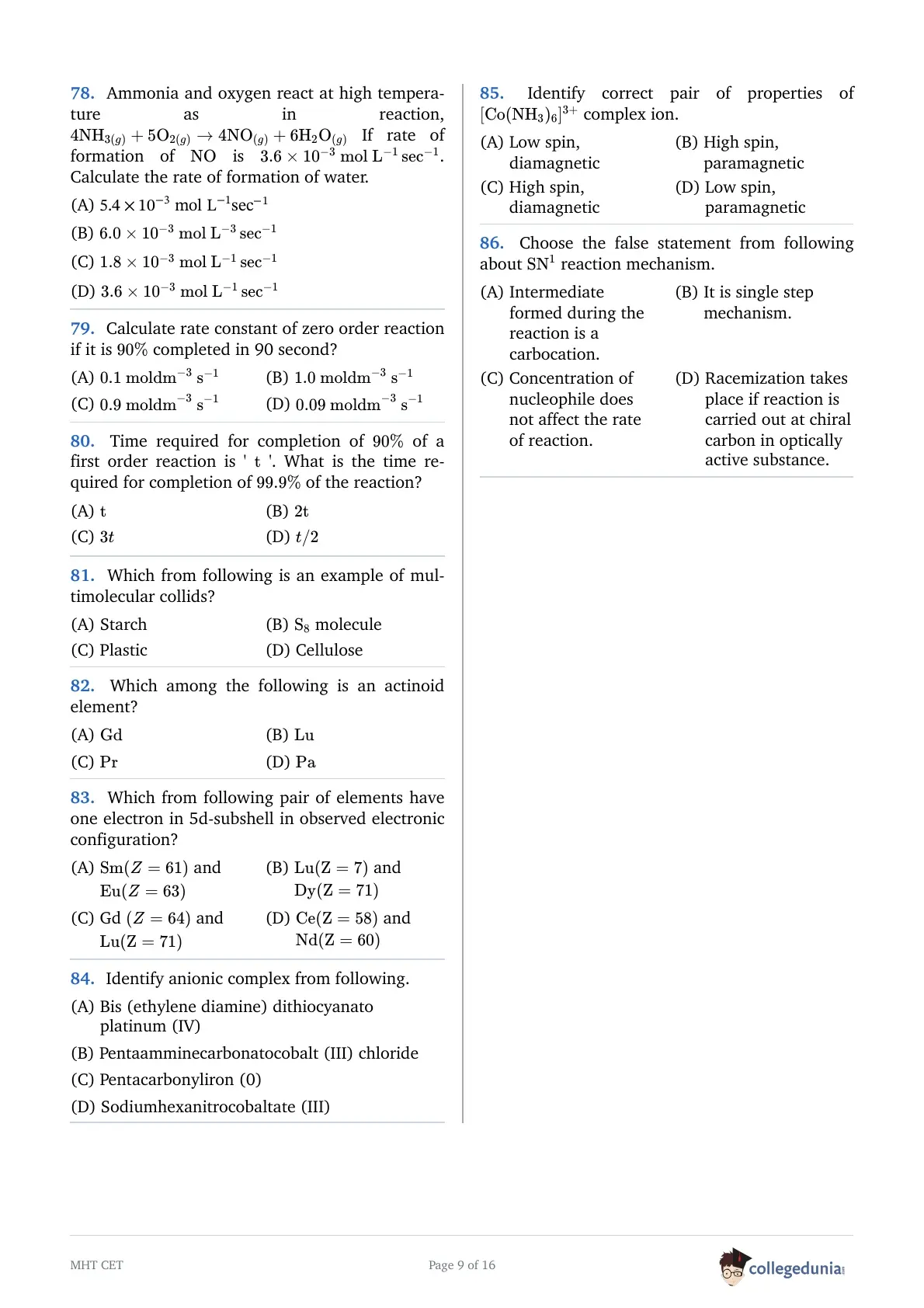
What is the quantity of sugar charcoal obtained when 34.2 g sugar is charred using required quantity of conc. sulphuric acid under ideal conditions?
What is the density of water in \(\mathrm{kg}\mathrm{dm}^{-3}\) if it's density in \(\mathrm{g}^{\mathrm{cm}^{-3}}\) is 0.863 ?
Calculate the wave number of photon emitted during the transition from the orbit n=2 to n = 1 in hydrogen atom (RH = 109677 cm–1)
Identify the correct increasing order of energies of molecular orbitals for \(\mathrm{F}_{2}\) molecule.
Which among the following is correct decreasing order of covalent character of ionic bond?
Calculate final volume of a gas when pressure of 60 mL gas is increased from 1 to 1.5 atm, keeping temperature constant
If \(65\ \mathrm{kJ}\) of work is done on the system and it releases and it releases \(25\ \mathrm{kJ}\) of heat. What is change in internal energy of the system?
Under isothermal conditions a gas expands from 0.2 dm3 to 0.8 dm3 against a constant pressure of 2 bar at 300 K. Find the work done by the gas.(1 dm3 bar = 100 J)
What is change in internal energy if a system gains \(\mathrm{xJ}\) of heat and yJ work is done on it?
Which among the following species can act as an acid as well as base according to Bronsted-Lowry theory?
What is the pH of the solution containing 1.342 x 10⁻³ M H+ ions? (log 1.342 =0.1277)
The degree of dissociation of weak acid is 7.2 x 10⁻⁴ . What is the value of it’s percent dissociation in 0.025 M solution?
How many mole of electrons are required for the reduction of 1 mole of Cr3+ to Cr(s)?
Which is an oxidizing agent in following reaction?
Fe(s) + Cu2+(aq) \(\to\) Fe2+(aq) + Cu(s)
Which among the following elements is used in nuclear reactors as moderator?
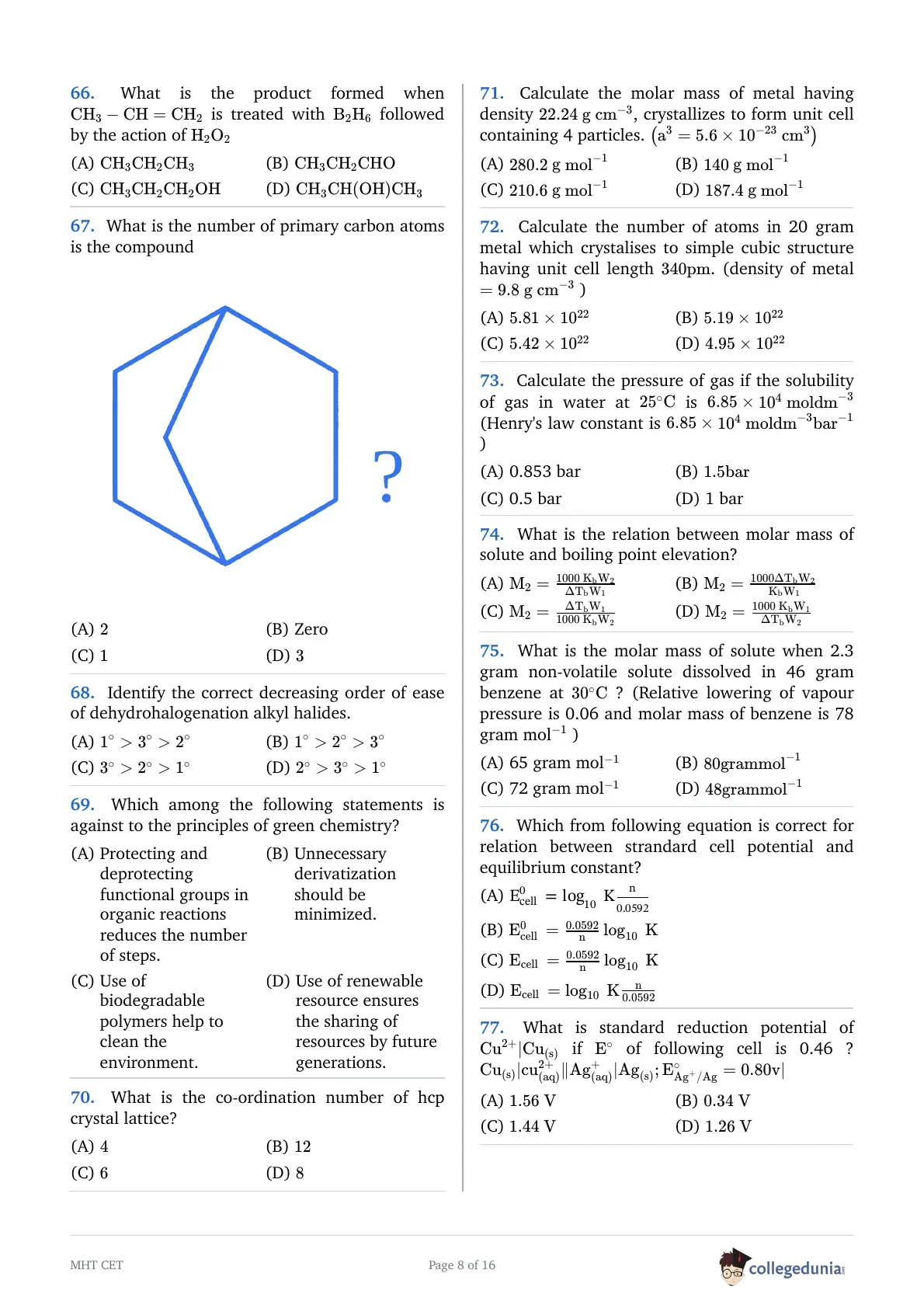
What is the product formed when CH3–CH=CH2 is treated with B2H6 followed by the action of H2O2?

Identify the correct decreasing order of ease of dehydrohalogenation of alkyl halides.
Which among the following statements is against to the principles of green chemistry?
Calculate the molar mass of metal having density \(22.24\ \mathrm{g}\ \mathrm{cm}^{-3}\), crystallizes to form unit cell containing 4 particles. \(\left(\mathrm{a}^{3}=5.6\times 10^{-23}\ \mathrm{cm}^{3}\right)\)
Calculate the number of atoms in 20 gram metal which crystallises to simple cubic structure having unit cell edge length 340 pm. (density of metal = 9.8 gcm–3)
Calculate the pressure of gas if the solubility of gas in water at 25°C is 6.85 x 10⁻⁴ mol.dm–3. (Henry’s law constant is 6.85 x 10⁻⁴ mol.dm–3.bar–1)
What is the relation between molar mass of solute and boiling point elevation of solution?
What is the molar mass of solute when 2.3 gram non-volatile solute dissolved in 46 gram benzene at 30°C? (Relative lowering of vapour pressure is 0.06 and molar mass of benzene is 78 gram mol–1)
Which from following equations is correct for relation between standard cell potential and equilibrium constant?
What is standard reduction potential of Cu2+ | Cu(s) if E° of following cell is 0.46V ? Cu(s) | Cu2+(aqs) || Ag+(aq) | Ag(s) ( Eo = 0.80V)
Ammonia and oxygen react at high temperature as in reaction,
4HN3(g) + 5O2(g) → 4NO(g) + 6H2O(g)
If rate of formation of NO is 3.6 x 10⁻³ mol L–1 .sec–1 . Calculate the rate of formation of water.
Time required for completion of 90% of a first order reaction is ‘t’. What is the time required for completion of 99.9%of the reaction?
Which from following pair of elements have one electron in 5d-subshell in observed electronic configuration?
Choose the false statement from following about SN1 reaction mechanism.
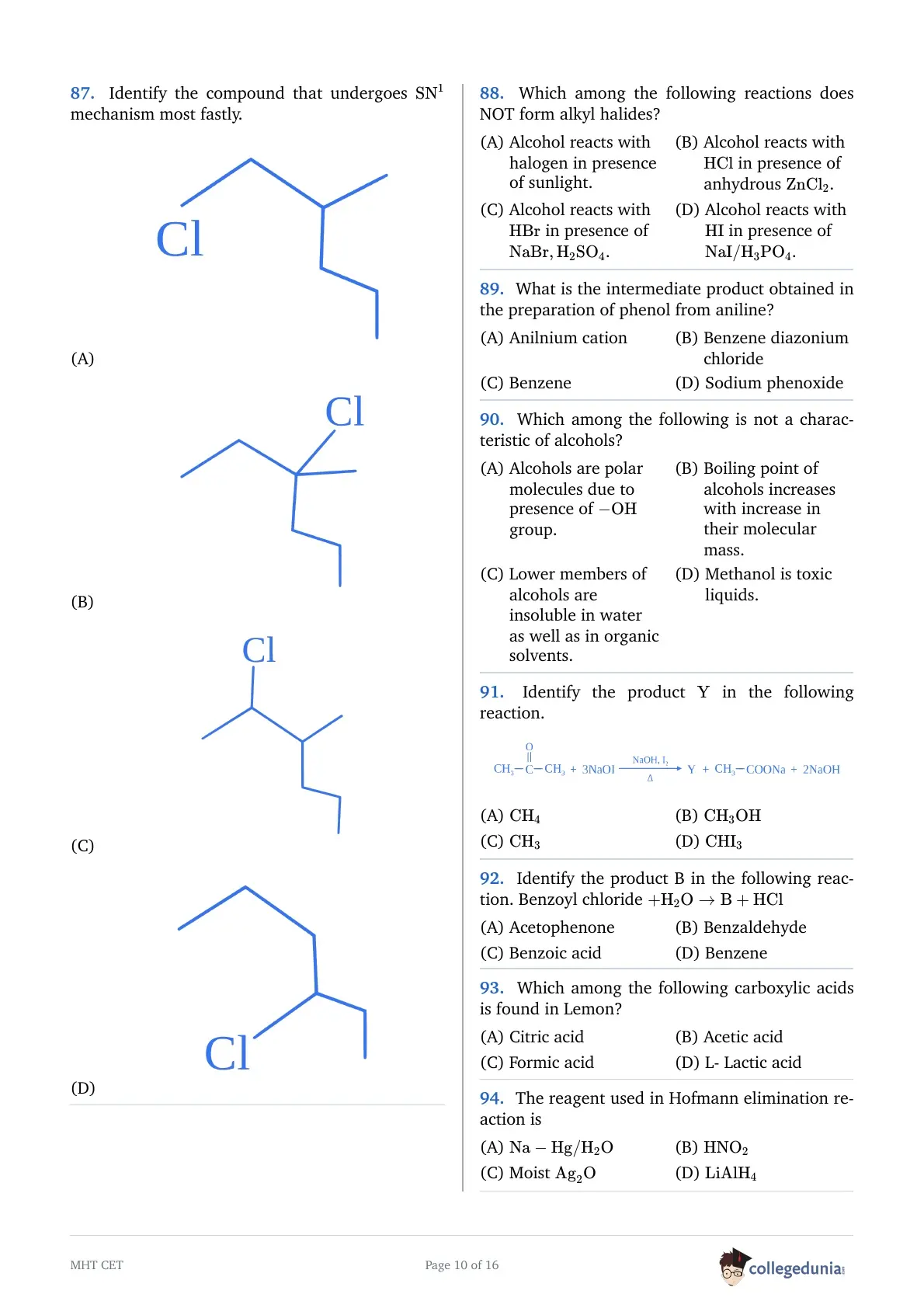
Identify the compound that undergoes \(\mathrm{SN}^{1}\) mechanism most fastly.
- (A)
![MHT CET 2022 5th August Morning Shift Chemistry - Haloalkanes and Haloarenes Question 1 English Option 1]()
- (B)
![MHT CET 2022 5th August Morning Shift Chemistry - Haloalkanes and Haloarenes Question 1 English Option 2]()
- (C)
![MHT CET 2022 5th August Morning Shift Chemistry - Haloalkanes and Haloarenes Question 1 English Option 3]()
- (D)
![MHT CET 2022 5th August Morning Shift Chemistry - Haloalkanes and Haloarenes Question 1 English Option 4]()
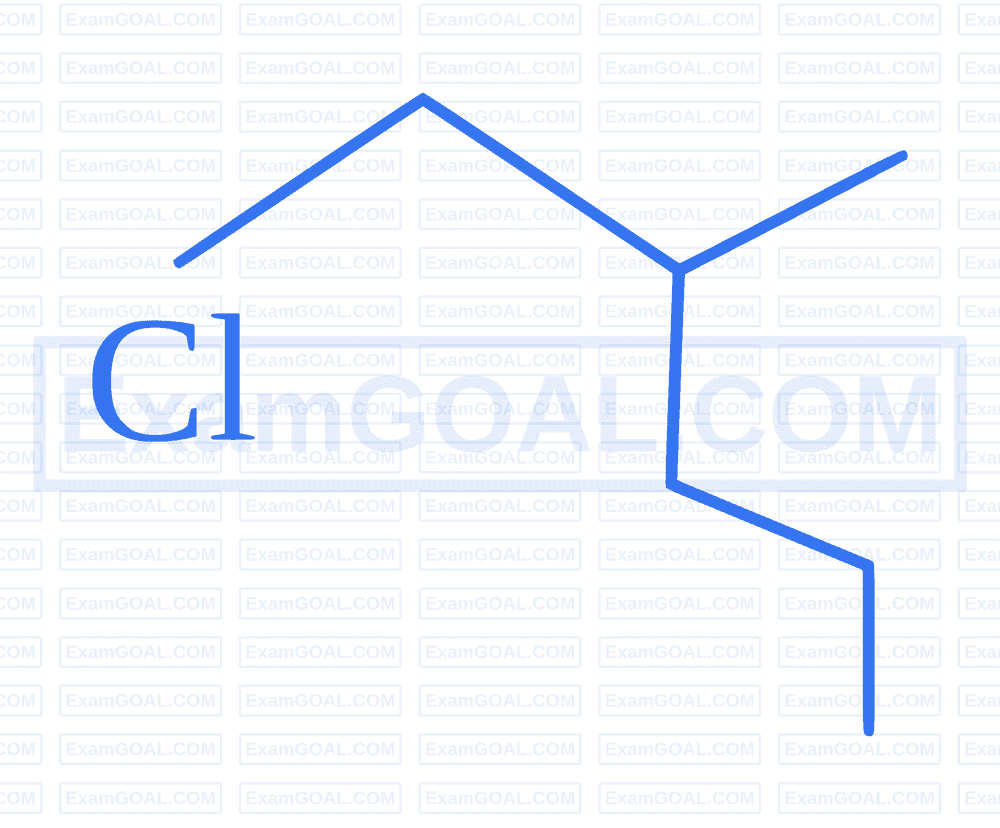
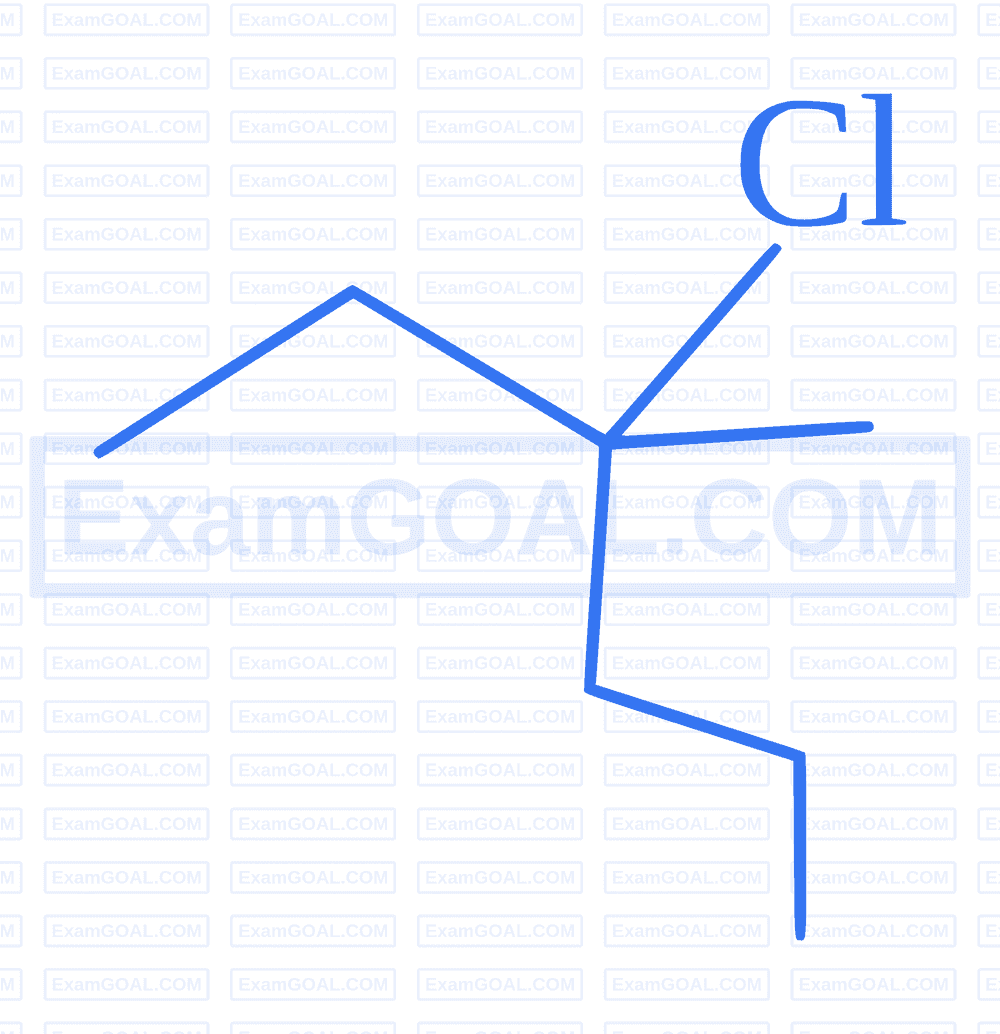
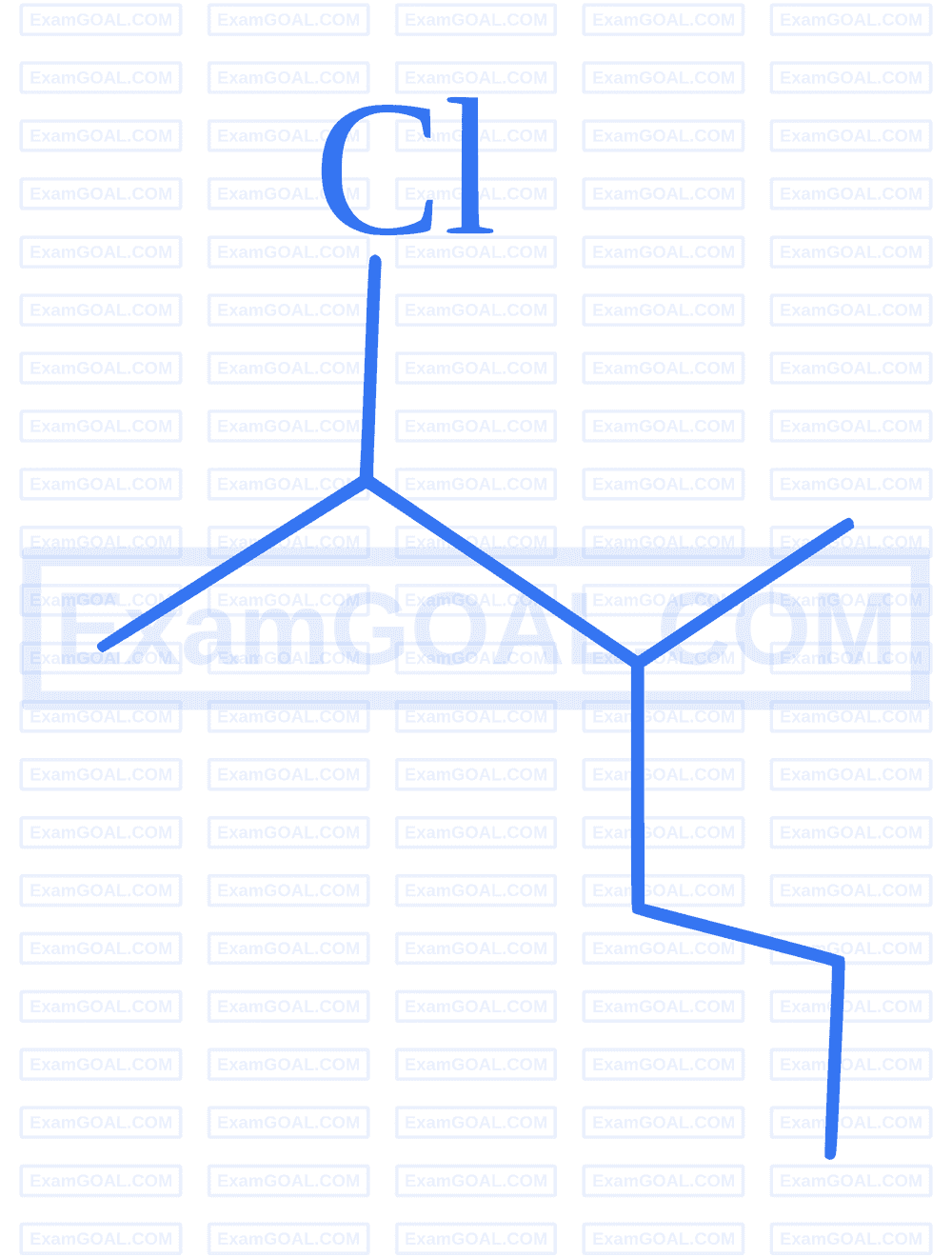
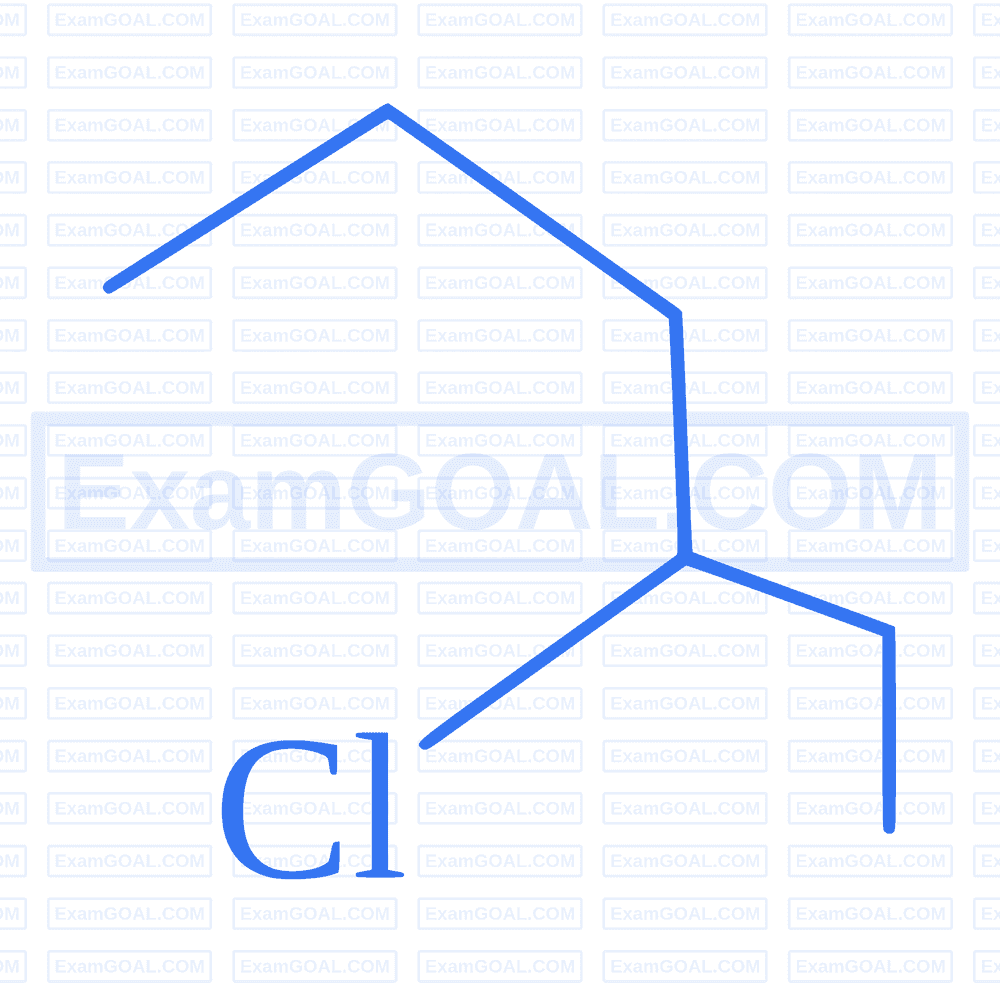
What is the intermediate product obtained in the preparation of phenol from aniline?

Identify the product B in the following reaction.
Benzoyl chloride + H2O \(\rightarrow\) B + HCl
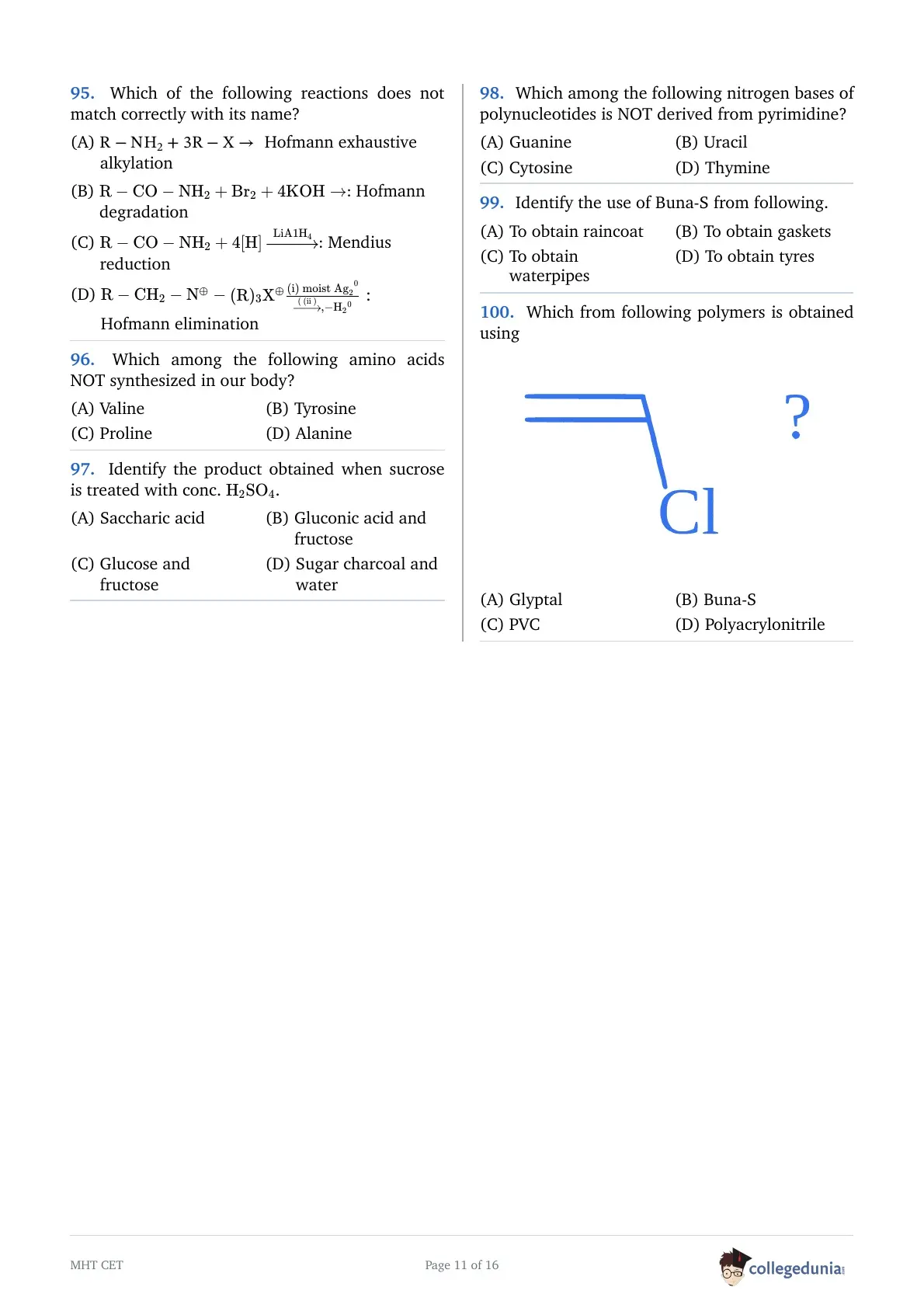
Which of the following reactions does not match correctly with its name?
Which among the following amino acids is NOT synthesized in our body?
Identify the product obtained when sucrose is treated with conc. H2SO4.
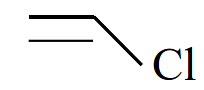
Which among the following nitrogen bases of polynucleotides is NOT derived from pyrimidine?
Mathematics (Q101 - Q150)
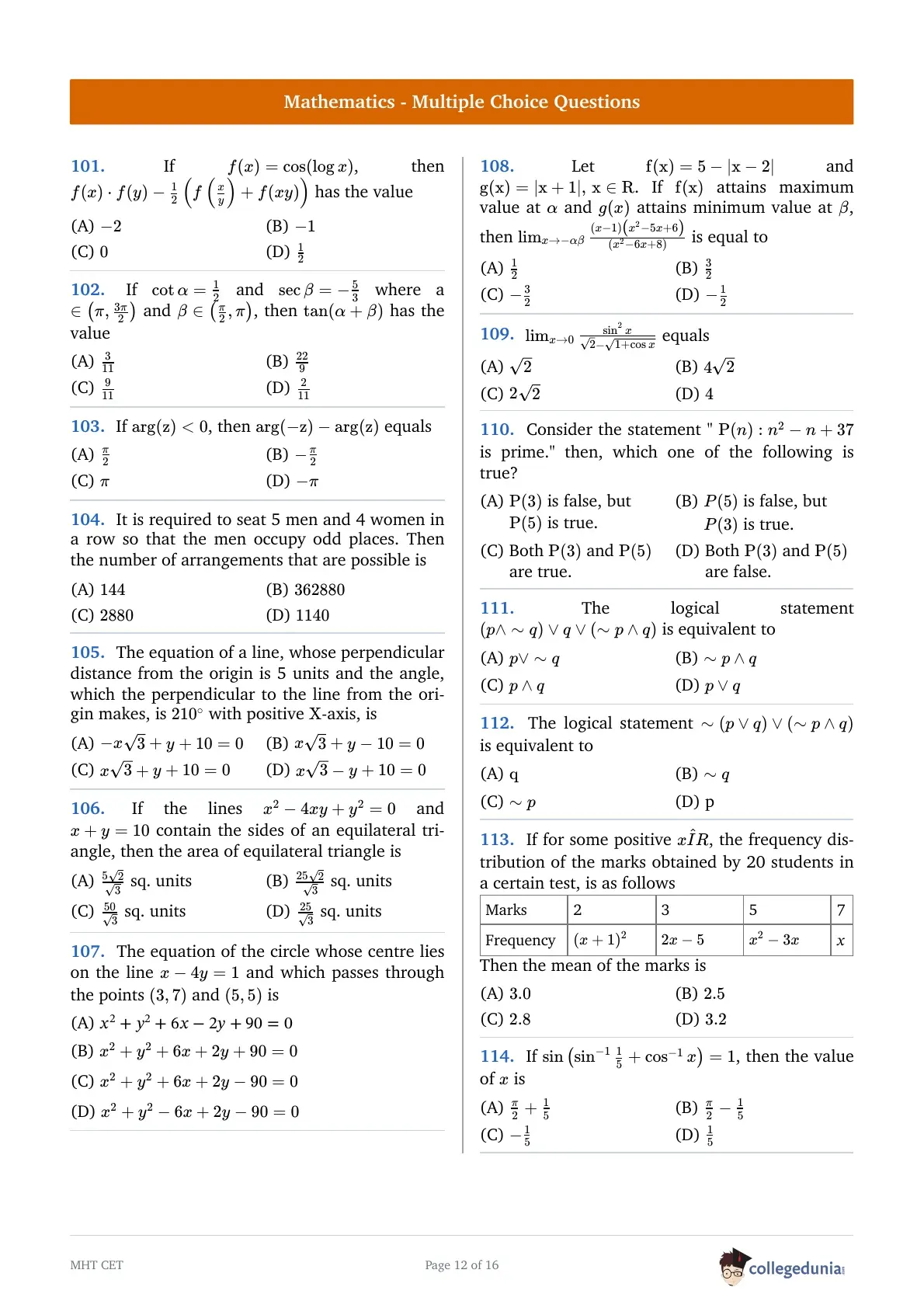
If \(f(x)=\cos (\log x)\), then \(f(x)\cdot f(y)-\frac{1}{2}\left(f\left(\frac{x}{y}\right)+f(xy)\right)\) has the value
If \(\cot \alpha =\frac{1}{2}\) and \(\sec \beta =-\frac{5}{3}\) where a \(\in \left(\pi ,\frac{3\pi }{2}\right)\) and \(\beta \in \left(\frac{\pi }{2},\pi \right)\), then \(\tan (\alpha +\beta )\) has the value
If \(\arg (\mathrm{z})\lt 0\), then \(\arg (-\mathrm{z})-\arg (\mathrm{z})\) equals
It is required to seat 5 men and 4 women in a row so that the men occupy odd places. Then the number of arrangements that are possible is
The equation of a line, whose perpendicular distance from the origin is 5 units and the angle, which the perpendicular to the line from the origin makes, is \(210^{\circ }\) with positive \(\mathrm{X}\)-axis, is
If the lines \(x^{2}-4xy+y^{2}=0\) and \(x+y=10\) contain the sides of an equilateral triangle, then the area of equilateral triangle is
The equation of the circle whose centre lies on the line \(x-4y=1\) and which passes through the points \((3,7)\) and \((5,5)\) is
Let \(\mathrm{f}(\mathrm{x})=5-|\mathrm{x}-2|\) and \(\mathrm{g}(\mathrm{x})=|\mathrm{x}+1|,\,\mathrm{x}\in \mathrm{R}\). If \(\mathrm{f}(\mathrm{x})\) attains maximum value at \(\alpha\) and \(g(x)\) attains minimum value at \(\beta\), then \(\lim _{x\rightarrow -\alpha \beta }\frac{(x-1)\left(x^{2}-5x+6\right)}{(x^{2}-6x+8)}\) is equal to
\(\lim _{x\rightarrow 0}\frac{\sin ^{2}x}{\sqrt{2}-\sqrt{1+\cos x}}\) equals
Consider the statement " \(\mathrm{P}(n):n^{2}-n+37\) is prime." then, which one of the following is true?
The logical statement \((p\wedge \sim q)\vee q\vee (\sim p\wedge q)\) is equivalent to
The logical statement \(\sim (p\vee q)\vee (\sim p\wedge q)\) is equivalent to
If for some positive \(x\hat{I}R\), the frequency distribution of the marks obtained by 20 students in a certain test, is as follows
| Marks | 2 | 3 | 5 | 7 |
| Frequency | \((x+1)^{2}\) | \(2x-5\) | \(x^{2}-3x\) | \(x\) |
If \(\sin \left(\sin ^{-1}\frac{1}{5}+\cos ^{-1}x\right)=1\), then the value of \(x\) is
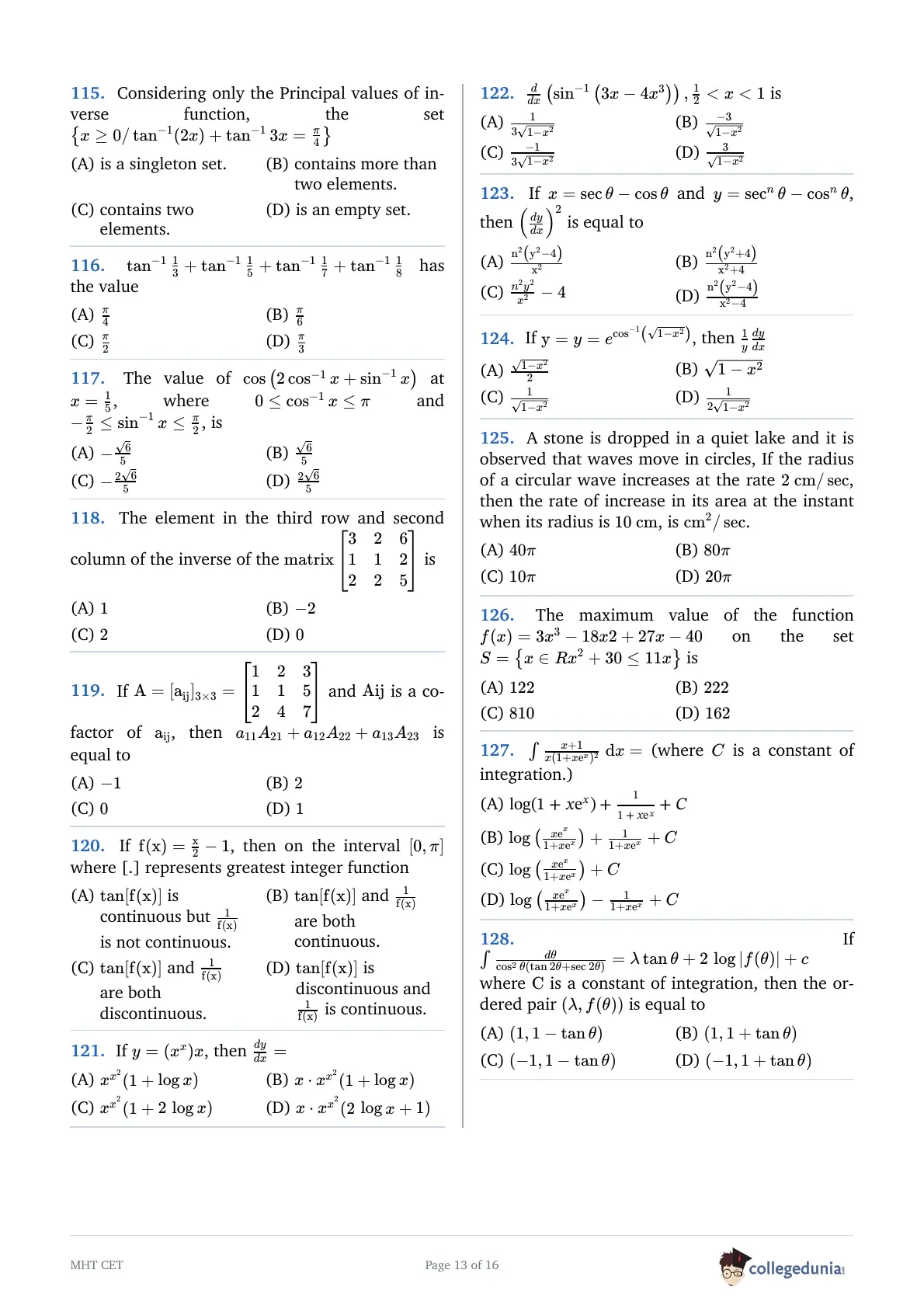
Considering only the Principal values of inverse function, the set \(\left\{x\geq 0/\tan ^{-1}(2x)+\tan ^{-1}3x=\frac{\pi }{4}\right\}\)
\(\tan ^{-1}\frac{1}{3}+\tan ^{-1}\frac{1}{5}+\tan ^{-1}\frac{1}{7}+\tan ^{-1}\frac{1}{8}\) has the value
The value of \(\cos \left(2\cos ^{-1}x+\sin ^{-1}x\right)\) at \(x=\frac{1}{5}\), where \(0\leq \cos ^{-1}x\leq \pi\) and \(-\frac{\pi }{2}\leq \sin ^{-1}x\leq \frac{\pi }{2}\), is
The element in the third row and second column of the inverse of the \(\mathrm{matrix}\begin{bmatrix} 3 & 2 & 6 \\ 1 & 1 & 2 \\ 2 & 2 & 5 \end{bmatrix}\) is
If \(\mathrm{A}=[\mathrm{a}_{\mathrm{ij}}]_{3\times 3}=\begin{bmatrix} 1 & 2 & 3 \\ 1 & 1 & 5 \\ 2 & 4 & 7 \end{bmatrix}\) and \(\mathrm{Aij}\) is a cofactor of \(\mathrm{a}_{\mathrm{ij}}\), then \(a_{11}A_{21}+a_{12}A_{22}+a_{13}A_{23}\) is equal to
If \(\mathrm{f}(\mathrm{x})=\frac{\mathrm{x}}{2}-1\), then on the interval \([0,\pi ]\) where [.] represents greatest integer function
\(\frac{d}{dx}\left(\sin ^{-1}\left(3x-4x^{3}\right)\right),\frac{1}{2}\lt x\lt 1\) is
If \(x=\sec \theta -\cos \theta\) and \(y=\sec ^{n}\theta -\cos ^{n}\theta\), then \(\left(\frac{dy}{dx}\right)^{2}\) is equal to
If \(\mathrm{y}=y=e^{\cos ^{-1}\left(\sqrt{1-x^{2}}\right)}\), then \(\frac{1}{y}\frac{dy}{dx}\)
A stone is dropped in a quiet lake and it is observed that waves move in circles, If the radius of a circular wave increases at the rate \(2\ \mathrm{cm}/\sec\), then the rate of increase in its area at the instant when its radius is \(10\ \mathrm{cm}\), is \(\mathrm{cm}^{2}/\sec\).
The maximum value of the function \(f(x)=3x^{3}-18x2+27x-40\) on the set \(S=\left\{x\in Rx^{2}+30\leq 11x\right\}\) is
∫\(\frac {e^x}{(2+e^x)(e^x +1)}\)dx = (where C is a constant of integration.)
If \(\int \frac{d\theta }{\cos ^{2}\theta (\tan 2\theta +\sec 2\theta )}=\lambda \tan \theta +2\,\log |f(\theta )|+c\) where \(\mathrm{C}\) is a constant of integration, then the ordered pair \((\lambda ,f(\theta ))\) is equal to
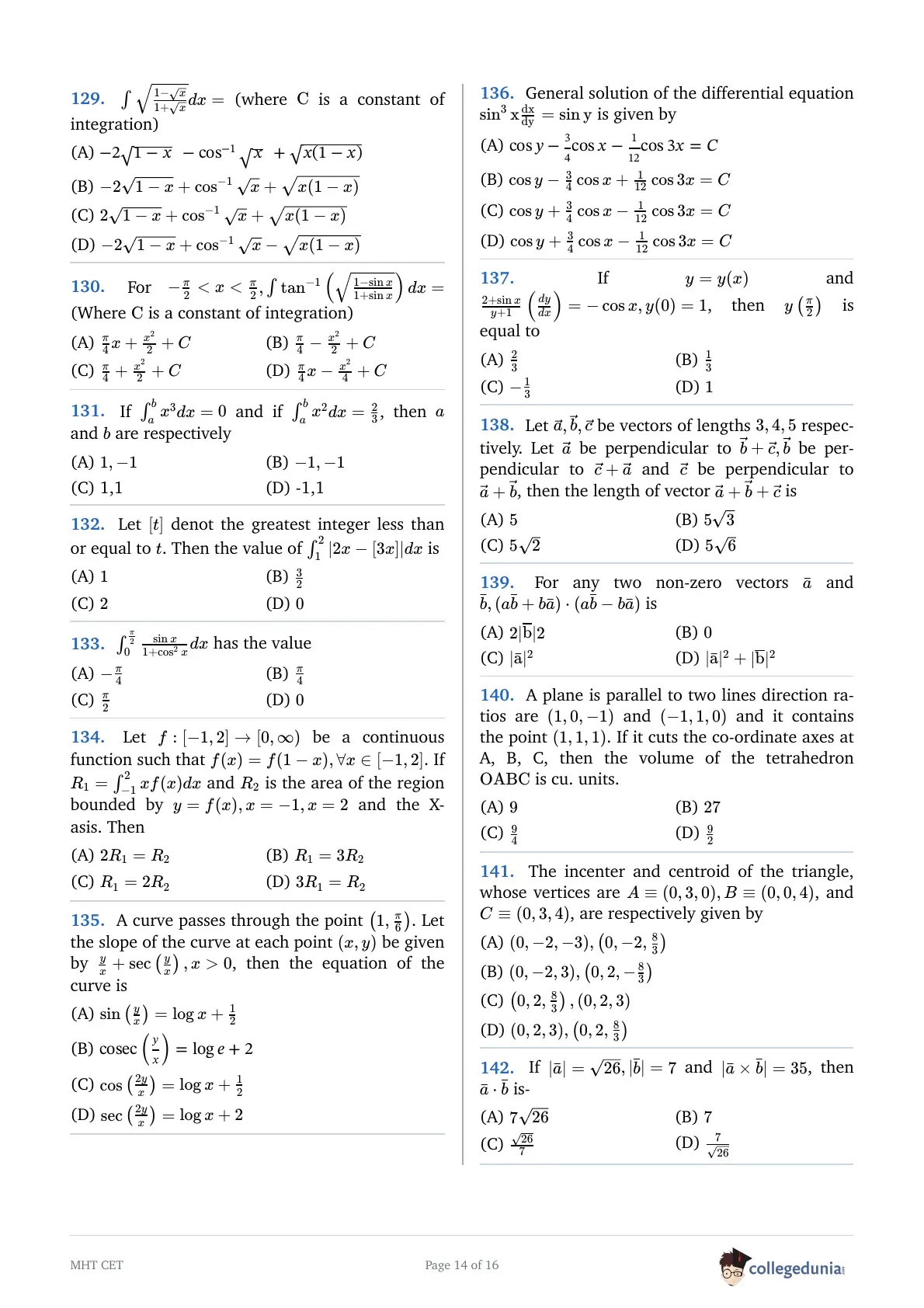
\(\int \sqrt{\frac{1-\sqrt{x}}{1+\sqrt{x}}}dx=\) (where \(\mathrm{C}\) is a constant of integration)
For \(-\frac{\pi }{2}\lt x\lt \frac{\pi }{2},\int \tan ^{-1}\left(\sqrt{\frac{1-\sin x}{1+\sin x}}\right)dx=\) (Where \(\mathrm{C}\) is a constant of integration)
If \(\int _{a}^{b}x^{3}dx=0\) and if \(\int _{a}^{b}x^{2}dx=\frac{2}{3}\), then \(a\) and \(b\) are respectively
Let \([t]\) denot the greatest integer less than or equal to \(t\). Then the value of \(\int _{1}^{2}|2x-[3x]|dx\) is
\(\int _{0}^{\frac{\pi }{2}}\frac{\sin x}{1+\cos ^{2}x}dx\) has the value
Let \(f:[-1,2]\rightarrow [0,\infty )\) be a continuous function such that \(f(x)=f(1-x),\forall x\in [-1,2]\). If \(R_{1}=\int _{-1}^{2}xf(x)dx\) and \(R_{2}\) is the area of the region bounded by \(y=f(x),x=-1,x=2\) and the X-asis. Then
A curve passes through the point \(\left(1,\frac{\pi }{6}\right)\). Let the slope of the curve at each point \((x,y)\) be given by \(\frac{y}{x}+\sec \left(\frac{y}{x}\right),x>0\), then the equation of the curve is
If \(y=y(x)\) and \(\frac{2+\sin x}{y+1}\left(\frac{dy}{dx}\right)=-\cos x,y(0)=1\), then \(y\left(\frac{\pi }{2}\right)\) is equal to
Let \(\vec{a},\vec{b},\vec{c}\) be vectors of lengths \(3,4,5\) respectively. Let \(\vec{a}\) be perpendicular to \(\vec{b}+\vec{c},\vec{b}\) be perpendicular to \(\vec{c}+\vec{a}\) and \(\vec{c}\) be perpendicular to \(\vec{a}+\vec{b}\), then the length of vector \(\vec{a}+\vec{b}+\vec{c}\) is
For any two non-zero vectors \(\bar{a}\) and \(\bar{b},(a\bar{b}+b\bar{a})\cdot (a\bar{b}-b\bar{a})\) is
A plane is parallel to two lines direction ratios are \((1,0,-1)\) and \((-1,1,0)\) and it contains the point \((1,1,1)\). If it cuts the co-ordinate axes at A, B, C, then the volume of the tetrahedron \(\mathrm{OABC}\) is cu. units.
The incenter and centroid of the triangle, whose vertices are \(A\equiv (0,3,0),B\equiv (0,0,4)\), and \(C\equiv (0,3,4)\), are respectively given by
If \(|\bar{a}|=\sqrt{26},|\bar{b}|=7\) and \(|\bar{a}\times \bar{b}|=35\), then \(\bar{a}\cdot \bar{b}\) is-
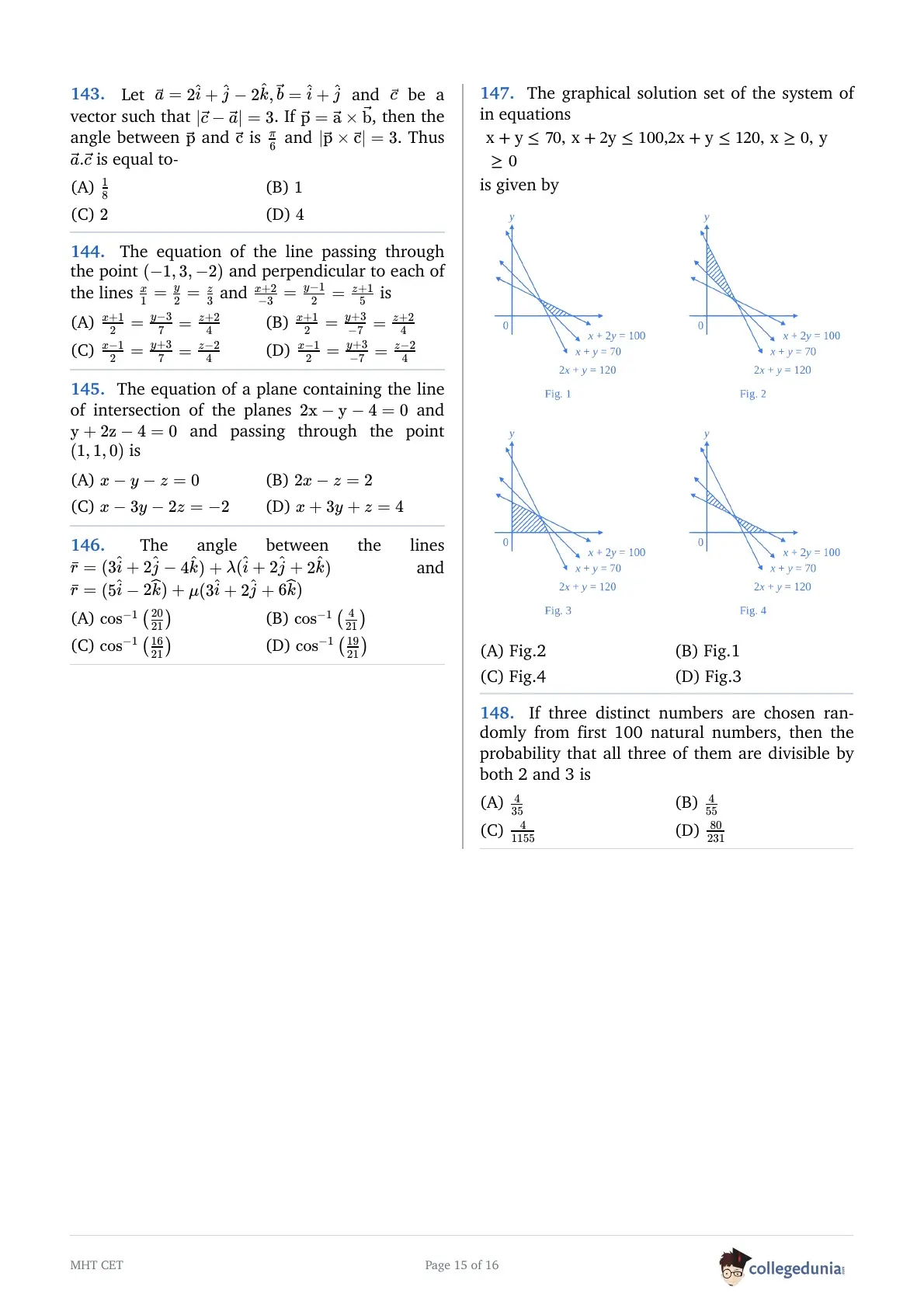
Let \(\vec{a}=2\hat{i}+\hat{j}-2\hat{k},\vec{b}=\hat{i}+\hat{j}\) and \(\vec{c}\) be a vector such that \(|\vec{c}-\vec{a}|=3\). If \(\vec{\mathrm{p}}=\vec{\mathrm{a}}\times \vec{\mathrm{b}}\), then the angle between \(\vec{\mathrm{p}}\) and \(\vec{\mathrm{c}}\) is \(\frac{\pi }{6}\) and \(|\vec{\mathrm{p}}\times \vec{\mathrm{c}}|=3\). Thus \(\vec{a}.\vec{c}\) is equal to-
The equation of a plane containing the line of intersection of the planes \(2\mathrm{x}-\mathrm{y}-4=0\) and \(\mathrm{y}+2\mathrm{z}-4=0\) and passing through the point \((1,1,0)\) is
The angle between the lines \(\bar{r}=(3\hat{i}+2\hat{j}-4\hat{k})+\lambda (\hat{i}+2\hat{j}+2\hat{k})\) and \(\bar{r}=(5\hat{i}-2\widehat{k})+\mu (3\hat{i}+2\hat{j}+6\widehat{k})\)
The graphical solution set of the system of in equations \(\mathrm{x}+\mathrm{y}\leq 70,\,\mathrm{x}+2\mathrm{y}\leq 100,2\mathrm{x}+\mathrm{y}\leq 120,\,\mathrm{x}\geq 0,\,\mathrm{y}\geq 0\) is given by


If three distinct numbers are chosen randomly from first 100 natural numbers, then the probability that all three of them are divisible by both 2 and 3 is
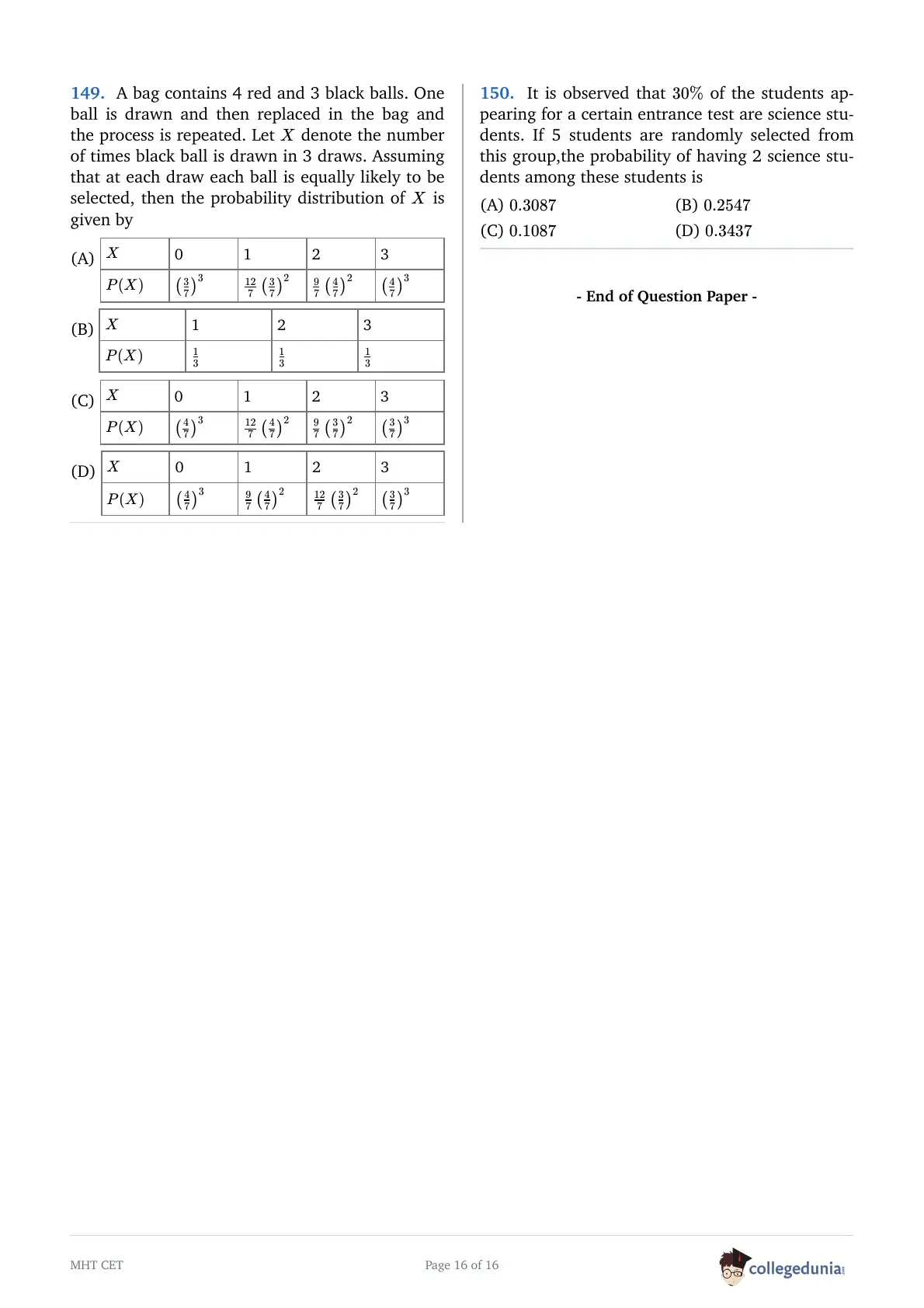
A bag contains 4 red and 3 black balls. One ball is drawn and then replaced in the bag and the process is repeated. Let \(X\) denote the number of times black ball is drawn in 3 draws. Assuming that at each draw each ball is equally likely to be selected, then the probability distribution of \(X\) is given by
It is observed that \(30\%\) of the students appearing for a certain entrance test are science students. If 5 students are randomly selected from this group,the probability of having 2 science students among these students is
MHT CET 2022 PCM Exam Pattern and Marking Scheme
| Parameter | Details |
|---|---|
| Conducting Body | Maharashtra Common Entrance Test Cell (Maharashtra CET Cell) |
| Exam Mode | Online (Computer-Based Test) |
| Duration | 180 minutes (3 hours) |
| Groups / Subjects | PCM (Physics, Chemistry, Mathematics) for Engineering |
| Total Questions |
150 |
| Total Marks | 200 |
| Question Type | Multiple Choice Questions (MCQs) |
| Marks Distribution |
|
| Negative Marking | No |
| Syllabus Weightage |
|



Comments