




MHT CET 2022 Aug 5 Shift 2 PCM Question Paper is available for download here. Maharashtra State CET Cell conducted MHT CET 2022 PCM Exam on Aug 5 in Shift 2 from 2 PM to 5 PM in CBT mode.
The MHT CET 2022 PCM question paper includes the following:
- The MHT CET 2022 PCM Question Paper consists of 150 multiple-choice questions (MCQs) totalling 200 marks divided into 3 sections: Physics, Chemistry, and Mathematics, with 50 questions in each subject.
- Physics and Chemistry questions carry 1 mark each while Mathematics questions carry 2 marks each.
- There is no negative marking for incorrect answers.
MHT CET 2022 Aug 5 Shift 2 PCM Question Paper with Solution PDF
| CD PDF | CD PDF with Solutions |
|---|---|
| Download Collegedunia PDF 0.95 MB | - |
Also Check:
MHT CET 2022 Aug 5 Shift 2 PCM Questions with Solutions
Physics (Q1 - Q50)
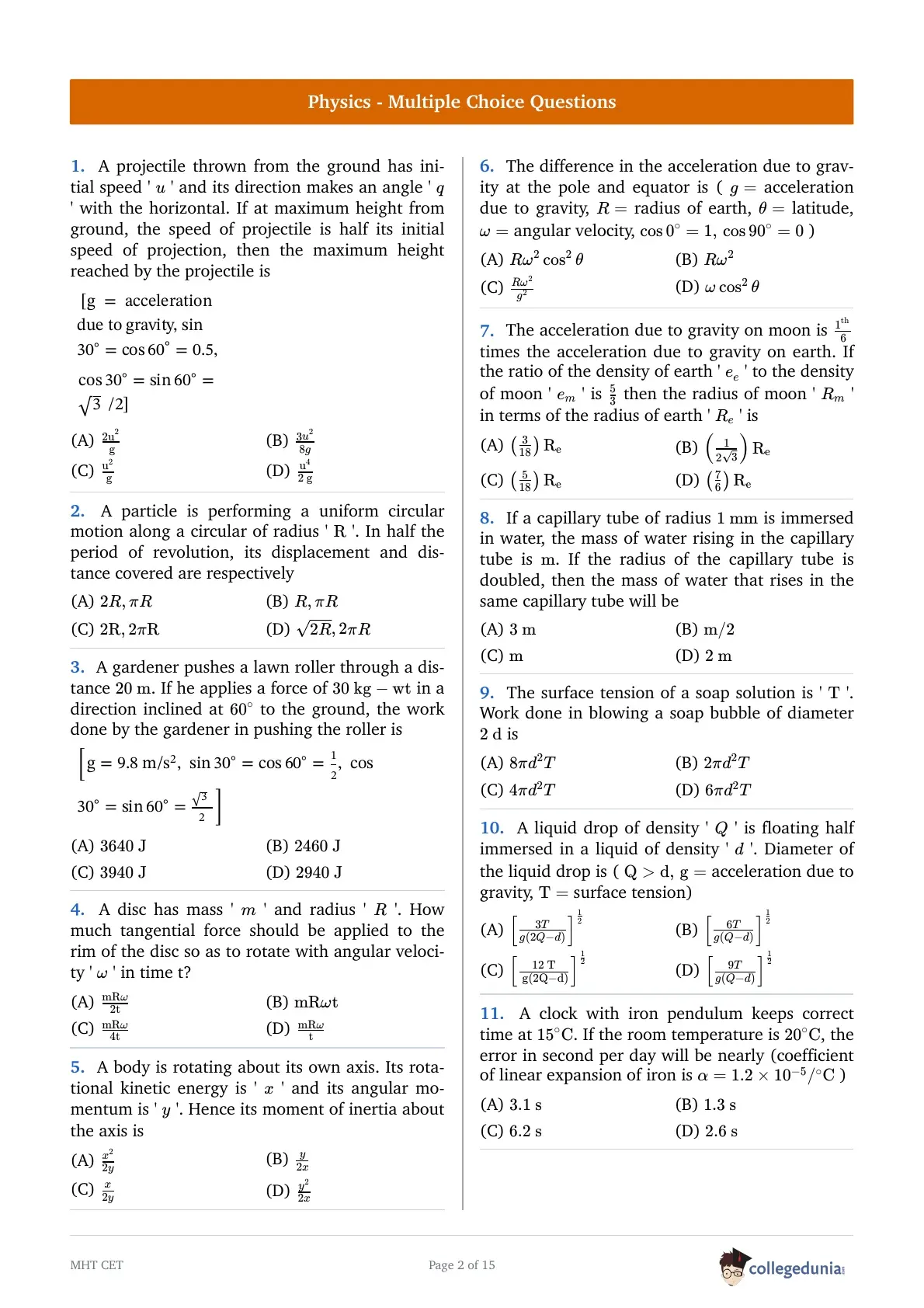
A projectile thrown from the ground has initial speed ' \(u\) ' and its direction makes an angle ' \(q\) ' with the horizontal. If at maximum height from ground, the speed of projectile is half its initial speed of projection, then the maximum height reached by the projectile is \(\begin{aligned} & \text{ [g }=\text{ acceleration due to gravity, }\sin 30^{\circ }=\cos 60^{\circ }=0.5, \\ & \cos 30^{\circ }=\sin 60^{\circ }=\sqrt{3}/2] \end{aligned}\)
A particle is performing a uniform circular motion along a circular of radius ' \(\mathrm{R}\) '. In half the period of revolution, its displacement and distance covered are respectively
A gardener pushes a lawn roller through a distance \(20\ \mathrm{m}\). If he applies a force of \(30\ \mathrm{kg}-\mathrm{wt}\) in a direction inclined at \(60^{\circ }\) to the ground, the work done by the gardener in pushing the roller is \(\left[\mathrm{g}=9.8\ \mathrm{m}/\mathrm{s}^{2},\,\sin 30^{\circ }=\cos 60^{\circ }=\frac{1}{2},\,\cos 30^{\circ }=\sin 60^{\circ }=\frac{\sqrt{3}}{2}\right]\)
A disc has mass ' \(m\) ' and radius ' \(R\) '. How much tangential force should be applied to the rim of the disc so as to rotate with angular velocity ' \(\omega\) ' in time t?
A body is rotating about its own axis. Its rotational kinetic energy is ' \(x\) ' and its angular momentum is ' \(y\) '. Hence its moment of inertia about the axis is
The difference in the acceleration due to gravity at the pole and equator is ( \(g=\) acceleration due to gravity, \(R=\) radius of earth, \(\theta =\) latitude, \(\omega =\) angular velocity, \(\cos 0^{\circ }=1,\,\cos 90^{\circ }=0\) )
The acceleration due to gravity on moon is \(\frac{1^{\text{th }}}{6}\) times the acceleration due to gravity on earth. If the ratio of the density of earth ' \(e_{e}\) ' to the density of moon ' \(e_{m}\) ' is \(\frac{5}{3}\) then the radius of moon ' \(R_{m}\) ' in terms of the radius of earth ' \(R_{e}\) ' is
If a capillary tube of radius \(1\ \mathrm{mm}\) is immersed in water, the mass of water rising in the capillary tube is \(\mathrm{m}\). If the radius of the capillary tube is doubled, then the mass of water that rises in the same capillary tube will be
The surface tension of a soap solution is ' \(\mathrm{T}\) '. Work done in blowing a soap bubble of diameter \(2\ \mathrm{d}\) is
A liquid drop of density ' \(Q\) ' is floating half immersed in a liquid of density ' \(d\) '. Diameter of the liquid drop is ( \(\mathrm{Q}>\mathrm{d},\,\mathrm{g}=\) acceleration due to gravity, \(\mathrm{T}=\) surface tension)
A clock with iron pendulum keeps correct time at \(15^{\circ }\mathrm{C}\). If the room temperature is \(20^{\circ }\mathrm{C}\), the error in second per day will be nearly (coefficient of linear expansion of iron is \(\alpha =1.2\times 10^{-5}/{}^{\circ }\mathrm{C}\) )
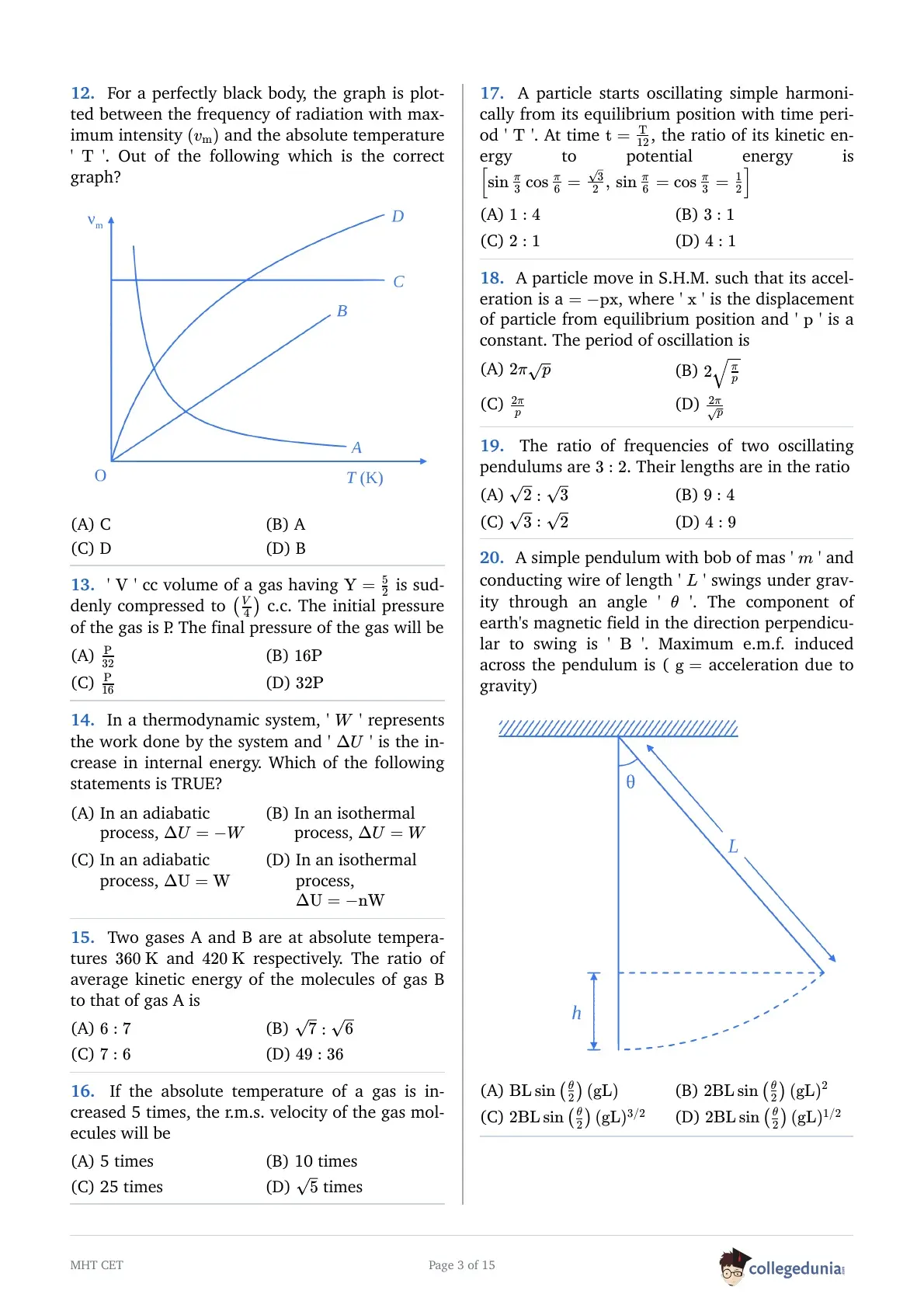
For a perfectly black body, the graph is plotted between the frequency of radiation with maximum intensity \((v_{\mathrm{m}})\) and the absolute temperature ' \(\mathrm{T}\) '. Out of the following which is the correct graph?

' \(\mathrm{V}\) ' cc volume of a gas having \(\mathrm{Y}=\frac{5}{2}\) is suddenly compressed to \(\left(\frac{V}{4}\right)\) c.c. The initial pressure of the gas is P. The final pressure of the gas will be
In a thermodynamic system, ' \(W\) ' represents the work done by the system and ' \(\Delta U\) ' is the increase in internal energy. Which of the following statements is TRUE?
Two gases A and B are at absolute temperatures \(360\ \mathrm{K}\) and \(420\ \mathrm{K}\) respectively. The ratio of average kinetic energy of the molecules of gas B to that of gas A is
If the absolute temperature of a gas is increased 5 times, the r.m.s. velocity of the gas molecules will be
A particle starts oscillating simple harmonically from its equilibrium position with time period ' \(\mathrm{T}\) '. At time \(\mathrm{t}=\frac{\mathrm{T}}{12}\), the ratio of its kinetic energy to potential energy is \(\left[\sin \frac{\pi }{3}\cos \frac{\pi }{6}=\frac{\sqrt{3}}{2},\,\sin \frac{\pi }{6}=\cos \frac{\pi }{3}=\frac{1}{2}\right]\)
A particle move in S.H.M. such that its acceleration is a \(=-\mathrm{px}\), where ' \(\mathrm{x}\) ' is the displacement of particle from equilibrium position and ' \(\mathrm{p}\) ' is a constant. The period of oscillation is
The ratio of frequencies of two oscillating pendulums are \(3:2\). Their lengths are in the ratio
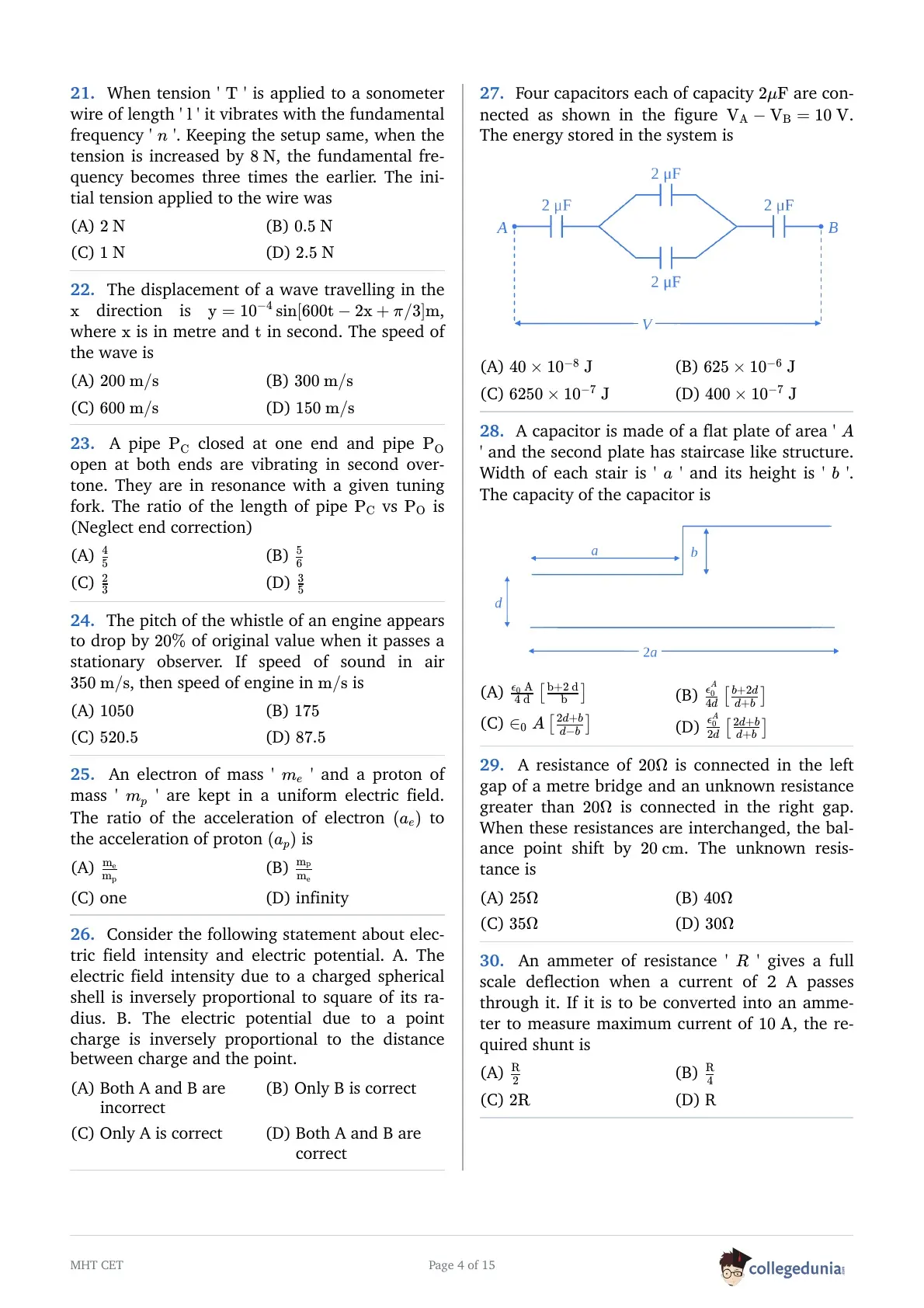
When tension ' \(\mathrm{T}\) ' is applied to a sonometer wire of length ' \(\mathrm{l}\) ' it vibrates with the fundamental frequency ' \(n\) '. Keeping the setup same, when the tension is increased by \(8\ \mathrm{N}\), the fundamental frequency becomes three times the earlier. The initial tension applied to the wire was
The displacement of a wave travelling in the \(\mathrm{x}\) direction is \(\mathrm{y}=10^{-4}\sin [600\mathrm{t}-2\mathrm{x}+\pi /3]\mathrm{m}\), where \(\mathrm{x}\) is in metre and \(\mathrm{t}\) in second. The speed of the wave is
A pipe \(\mathrm{P}_{\mathrm{C}}\) closed at one end and pipe \(\mathrm{P}_{\mathrm{O}}\) open at both ends are vibrating in second overtone. They are in resonance with a given tuning fork. The ratio of the length of pipe \(\mathrm{P}_{\mathrm{C}}\) vs \(\mathrm{P}_{\mathrm{O}}\) is (Neglect end correction)
The pitch of the whistle of an engine appears to drop by \(20\%\) of original value when it passes a stationary observer. If speed of sound in air \(350\ \mathrm{m}/\mathrm{s}\), then speed of engine in \(\mathrm{m}/\mathrm{s}\) is
An electron of mass ' \(m_{e}\) ' and a proton of mass ' \(m_{p}\) ' are kept in a uniform electric field. The ratio of the acceleration of electron \((a_{e})\) to the acceleration of proton \((a_{p})\) is
Consider the following statement about electric field intensity and electric potential. A. The electric field intensity due to a charged spherical shell is inversely proportional to square of its radius. B. The electric potential due to a point charge is inversely proportional to the distance between charge and the point.
Four capacitors each of capacity \(2\mu \mathrm{F}\) are connected as shown in the figure \(\mathrm{V}_{\mathrm{A}}-\mathrm{V}_{\mathrm{B}}=10\ \mathrm{V}\). The energy stored in the system is

A capacitor is made of a flat plate of area ' \(A\) ' and the second plate has staircase like structure. Width of each stair is ' \(a\) ' and its height is ' \(b\) '. The capacity of the capacitor is

A resistance of \(20\Omega\) is connected in the left gap of a metre bridge and an unknown resistance greater than \(20\Omega\) is connected in the right gap. When these resistances are interchanged, the balance point shift by \(20\ \mathrm{cm}\). The unknown resistance is
An ammeter of resistance ' \(R\) ' gives a full scale deflection when a current of 2 A passes through it. If it is to be converted into an ammeter to measure maximum current of \(10\ \mathrm{A}\), the required shunt is
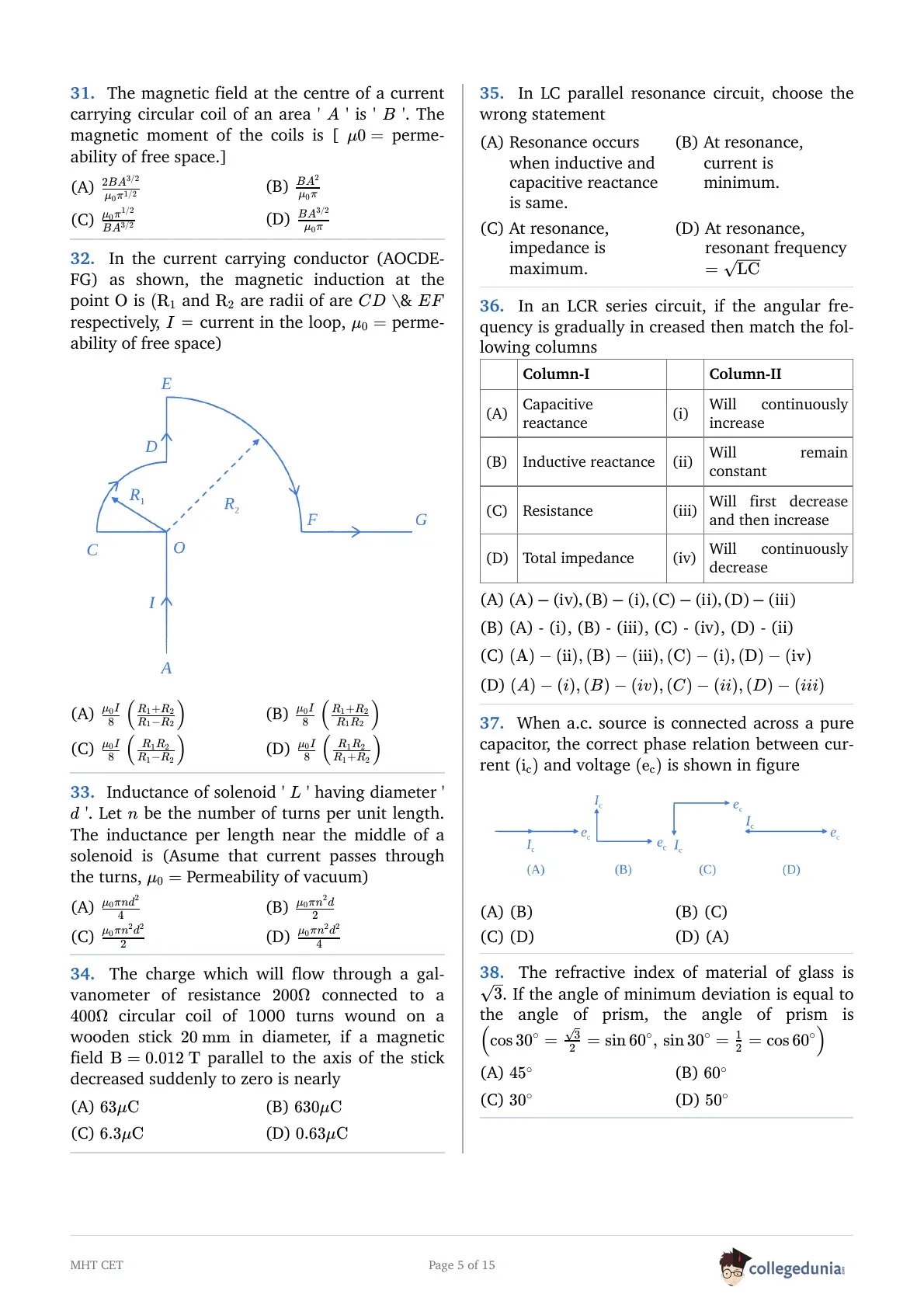
The magnetic field at the centre of a current carrying circular coil of an area ' \(A\) ' is ' \(B\) '. The magnetic moment of the coils is [ \(\mu 0=\) permeability of free space.]
In the current carrying conductor (AOCDEFG) as shown, the magnetic induction at the point \(\mathrm{O}\) is \((\mathrm{R}_{1}\) and \(\mathrm{R}_{2}\) are radii of are \(CD\) \& \(EF\) respectively, \(I\) = current in the loop, \(\mu _{0}=\) permeability of free space)

Inductance of solenoid ' \(L\) ' having diameter ' \(d\) '. Let \(n\) be the number of turns per unit length. The inductance per length near the middle of a solenoid is (Asume that current passes through the turns, \(\mu _{0}=\) Permeability of vacuum)
The charge which will flow through a galvanometer of resistance \(200\Omega\) connected to a \(400\Omega\) circular coil of 1000 turns wound on a wooden stick \(20\ \mathrm{mm}\) in diameter, if a magnetic field \(\mathrm{B}=0.012\ \mathrm{T}\) parallel to the axis of the stick decreased suddenly to zero is nearly
In LC parallel resonance circuit, choose the wrong statement
In an LCR series circuit, if the angular frequency is gradually in creased then match the following columns
| Column-I | Column-II | ||
|---|---|---|---|
| (A) | Capacitive reactance | (i) | Will continuously increase |
| (B) | Inductive reactance | (ii) | Will remain constant |
| (C) | Resistance | (iii) | Will first decrease and then increase |
| (D) | Total impedance | (iv) | Will continuously decrease |
When a.c. source is connected across a pure capacitor, the correct phase relation between current \((\mathrm{i}_{\mathrm{c}})\) and voltage \((\mathrm{e}_{\mathrm{c}})\) is shown in figure

The refractive index of material of glass is \(\sqrt{3}\). If the angle of minimum deviation is equal to the angle of prism, the angle of prism is \(\left(\cos 30^{\circ }=\frac{\sqrt{3}}{2}=\sin 60^{\circ },\,\sin 30^{\circ }=\frac{1}{2}=\cos 60^{\circ }\right)\)
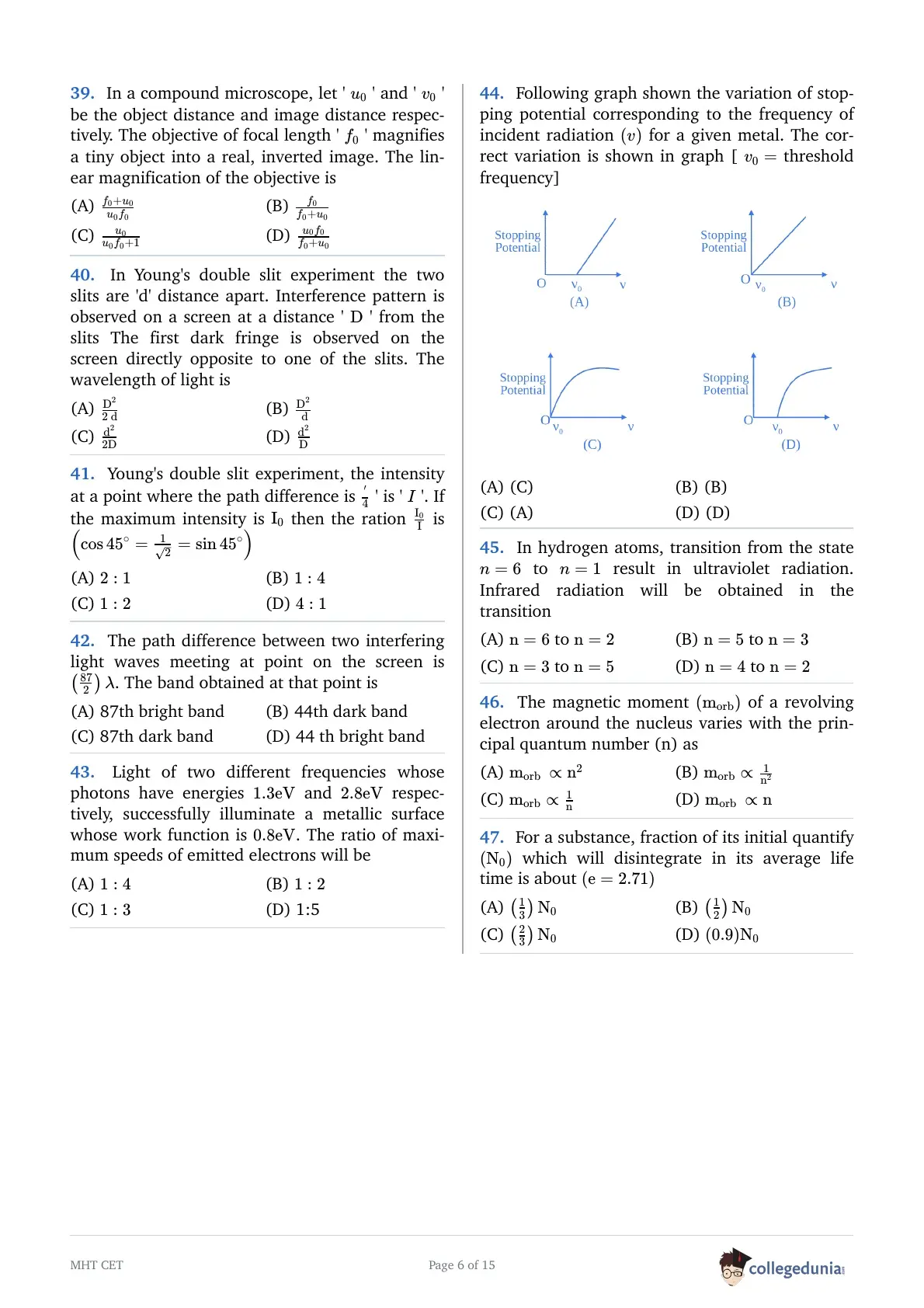
In a compound microscope, let ' \(u_{0}\) ' and ' \(v_{0}\) ' be the object distance and image distance respectively. The objective of focal length ' \(f_{0}\) ' magnifies a tiny object into a real, inverted image. The linear magnification of the objective is
In Young's double slit experiment the two slits are 'd' distance apart. Interference pattern is observed on a screen at a distance ' \(\mathrm{D}\) ' from the slits The first dark fringe is observed on the screen directly opposite to one of the slits. The wavelength of light is
Young's double slit experiment, the intensity at a point where the path difference is \(\frac{{}'}{4}\) ' is ' \(I\) '. If the maximum intensity is \(\mathrm{I}_{0}\) then the ration \(\frac{\mathrm{I}_{0}}{\mathrm{I}}\) is \(\left(\cos 45^{\circ }=\frac{1}{\sqrt{2}}=\sin 45^{\circ }\right)\)
The path difference between two interfering light waves meeting at point on the screen is \(\left(\frac{87}{2}\right)\lambda\). The band obtained at that point is
Light of two different frequencies whose photons have energies \(1.3\mathrm{eV}\) and \(2.8\mathrm{eV}\) respectively, successfully illuminate a metallic surface whose work function is \(0.8\mathrm{eV}\). The ratio of maximum speeds of emitted electrons will be
Following graph shown the variation of stopping potential corresponding to the frequency of incident radiation \((v)\) for a given metal. The correct variation is shown in graph [ \(v_{0}=\) threshold frequency]

In hydrogen atoms, transition from the state \(n=6\) to \(n=1\) result in ultraviolet radiation. Infrared radiation will be obtained in the transition
The magnetic moment \((\mathrm{m}_{\mathrm{orb}})\) of a revolving electron around the nucleus varies with the principal quantum number (n) as
For a substance, fraction of its initial quantify \((\mathrm{N}_{0})\) which will disintegrate in its average life time is about \((\mathrm{e}=2.71)\)
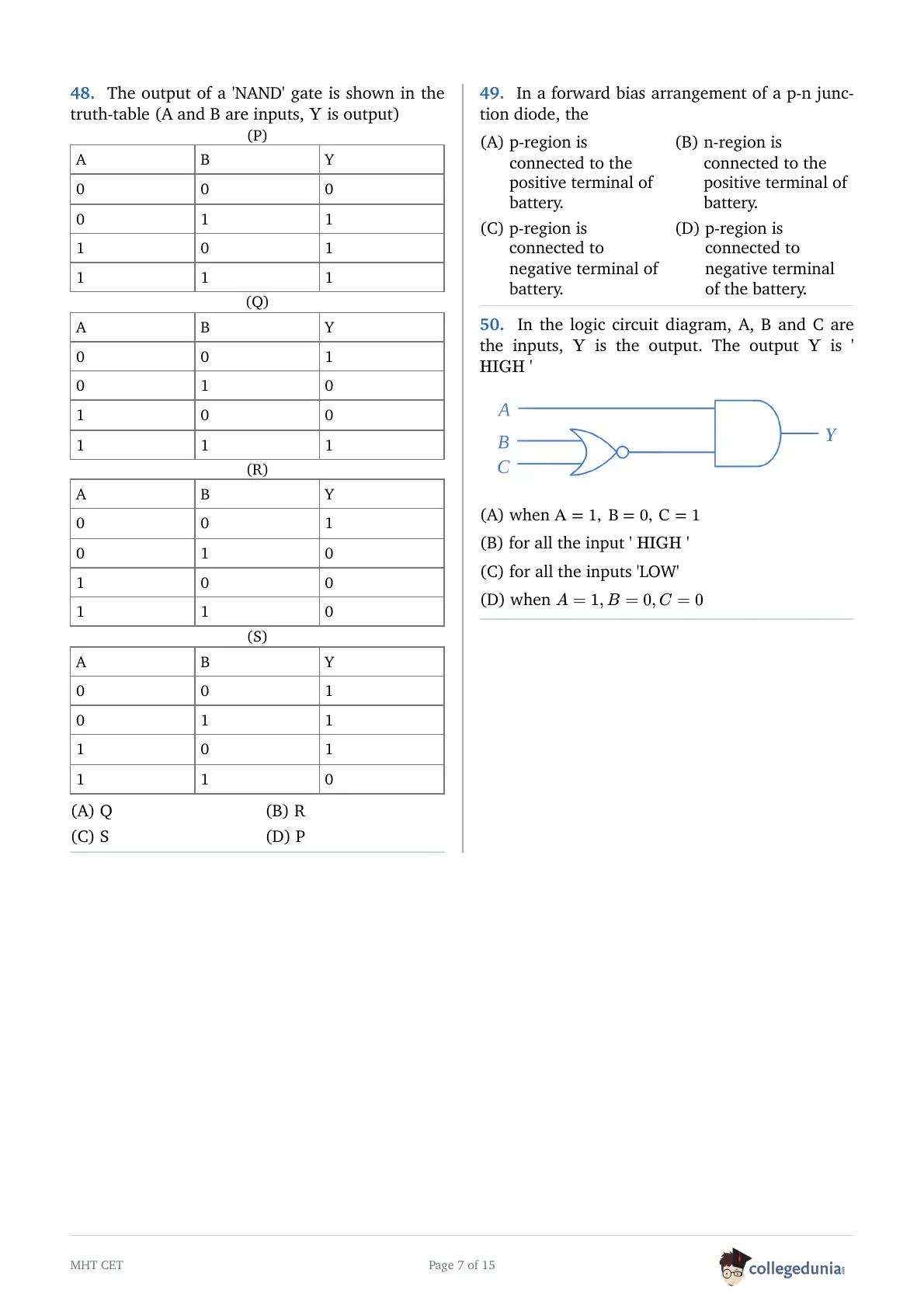
The output of a 'NAND' gate is shown in the truth-table (A and B are inputs, \(\mathrm{Y}\) is output)
| A | B | Y |
| 0 | 0 | 0 |
| 0 | 1 | 1 |
| 1 | 0 | 1 |
| 1 | 1 | 1 |
| A | B | Y |
| 0 | 0 | 1 |
| 0 | 1 | 0 |
| 1 | 0 | 0 |
| 1 | 1 | 1 |
| A | B | Y |
| 0 | 0 | 1 |
| 0 | 1 | 0 |
| 1 | 0 | 0 |
| 1 | 1 | 0 |
| A | B | Y |
| 0 | 0 | 1 |
| 0 | 1 | 1 |
| 1 | 0 | 1 |
| 1 | 1 | 0 |
In the logic circuit diagram, A, B and C are the inputs, \(\mathrm{Y}\) is the output. The output \(\mathrm{Y}\) is ' \(\mathrm{HIGH}\) '

Chemistry (Q51 - Q100)
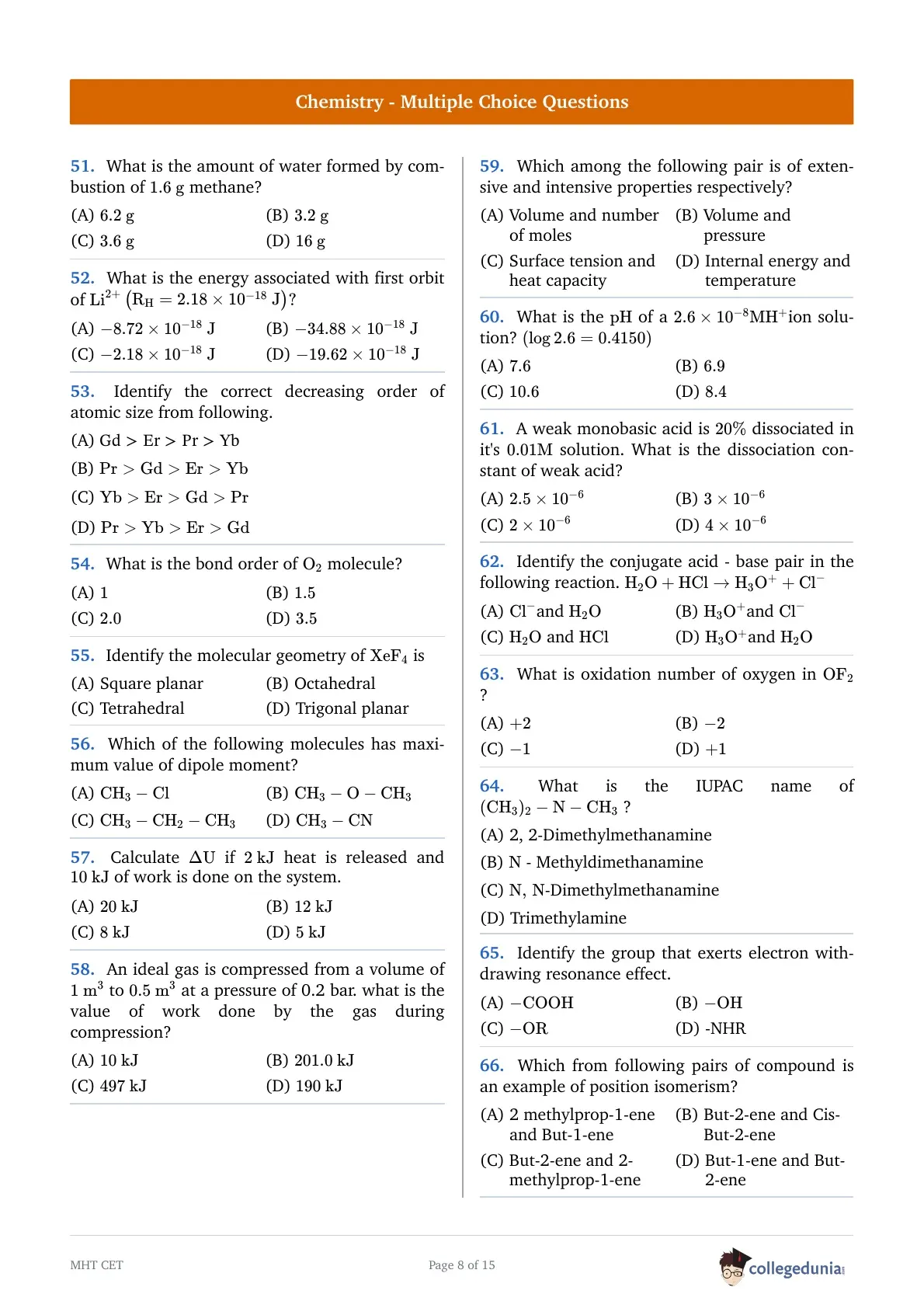
What is the amount of water formed by combustion of \(1.6\ \mathrm{g}\) methane?
What is the energy associated with first orbit of \(\mathrm{Li}^{2+}\left(\mathrm{R}_{\mathrm{H}}=2.18\times 10^{-18}\ \mathrm{J}\right)?\)
Identify the correct decreasing order of atomic size from following.
What is the bond order of \(\mathrm{O}_{2}\) molecule?
Identify the molecular geometry of \(\mathrm{XeF}_{4}\) is
Which of the following molecules has maximum value of dipole moment?
Calculate \(\Delta \mathrm{U}\) if \(2\ \mathrm{kJ}\) heat is released and \(10\ \mathrm{kJ}\) of work is done on the system.
An ideal gas is compressed from a volume of \(1\ \mathrm{m}^{3}\) to \(0.5\ \mathrm{m}^{3}\) at a pressure of 0.2 bar. what is the value of work done by the gas during compression?
What is the \(\mathrm{pH}\) of a \(2.6\times 10^{-8}\mathrm{M}\mathrm{H}^{+}\)ion solution? \((\log 2.6=0.4150)\)
Identify the conjugate acid - base pair in the following reaction. \(\mathrm{H}_{2}\mathrm{O}+\mathrm{HCl}\rightarrow \mathrm{H}_{3}\mathrm{O}^{+}+\mathrm{Cl}^{-}\)
What is oxidation number of oxygen in \(\mathrm{OF}_{2}\) ?
What is the IUPAC name of \((\mathrm{CH}_{3})_{2}-\mathrm{N}-\mathrm{CH}_{3}\) ?
Identify the group that exerts electron withdrawing resonance effect.
Which from following pairs of compound is an example of position isomerism?
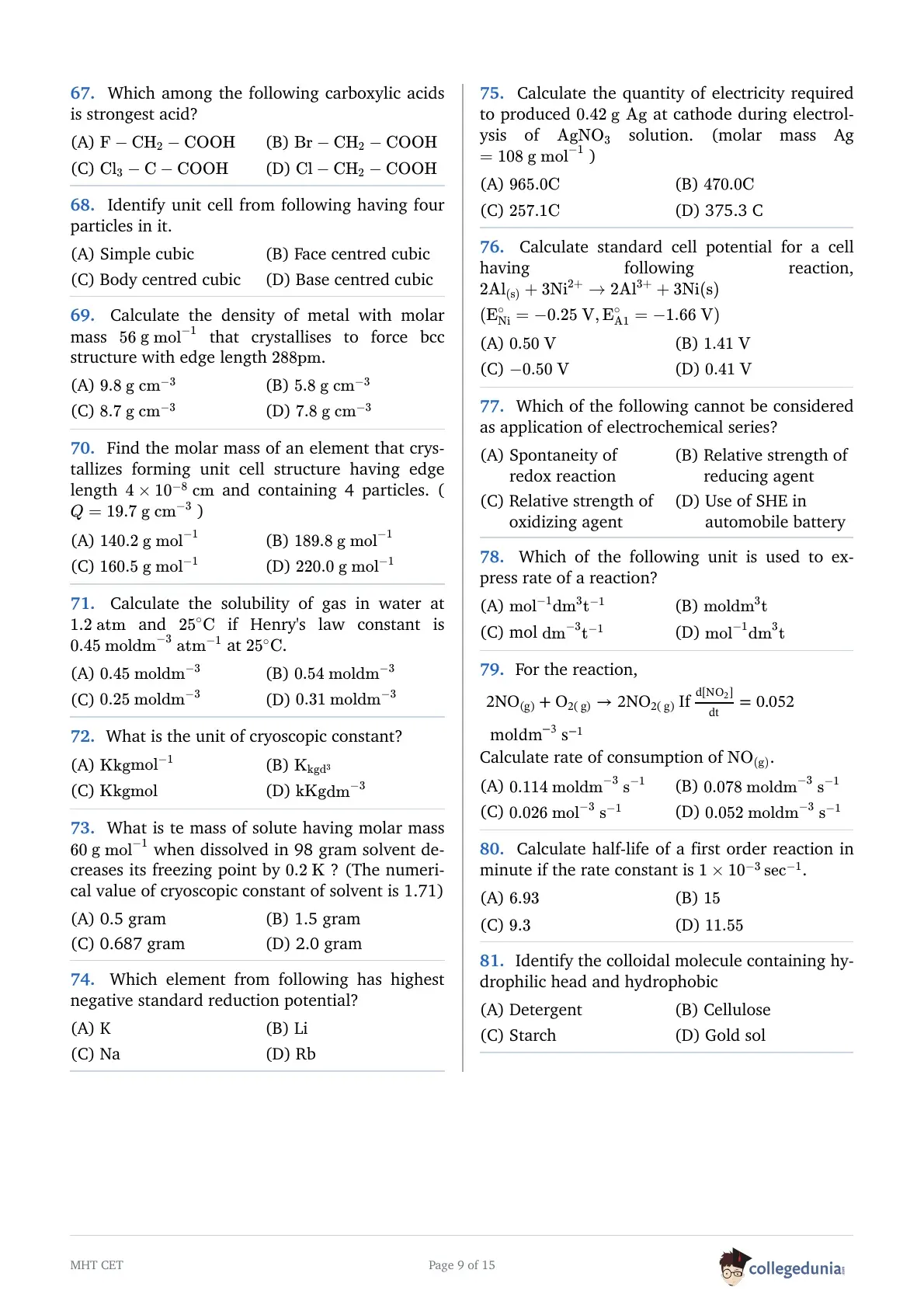
Which among the following carboxylic acids is strongest acid?
Identify unit cell from following having four particles in it.
Calculate the density of metal with molar mass \(56\ \mathrm{g}\ \mathrm{mol}^{-1}\) that crystallises to force bcc structure with edge length \(288\mathrm{pm}\).
Find the molar mass of an element that crystallizes forming unit cell structure having edge length \(4\times 10^{-8}\ \mathrm{cm}\) and containing 4 particles. ( \(Q=19.7\ \mathrm{g}\ \mathrm{cm}^{-3}\) )
Calculate the solubility of gas in water at \(1.2\ \mathrm{atm}\) and \(25^{\circ }\mathrm{C}\) if Henry's law constant is \(0.45\ \mathrm{mol}\mathrm{dm}^{-3}\ \mathrm{atm}^{-1}\) at \(25^{\circ }\mathrm{C}\).
What is the unit of cryoscopic constant?
What is te mass of solute having molar mass \(60\ \mathrm{g}\ \mathrm{mol}^{-1}\) when dissolved in 98 gram solvent decreases its freezing point by \(0.2\ \mathrm{K}\) ? (The numerical value of cryoscopic constant of solvent is 1.71)
Which element from following has highest negative standard reduction potential?
Calculate the quantity of electricity required to produced \(0.42\ \mathrm{g}\) \(\mathrm{Ag}\) at cathode during electrolysis of \(\mathrm{AgNO}_{3}\) solution. (molar mass Ag \(=108\ \mathrm{g}\ \mathrm{mol}^{-1}\) )
Calculate standard cell potential for a cell having following reaction, \(\begin{aligned} & 2\mathrm{Al}_{(\mathrm{s})}+3\mathrm{Ni}^{2+}\rightarrow 2\mathrm{Al}^{3+}+3\mathrm{Ni}(\mathrm{s}) \\ & (\mathrm{E}_{\mathrm{Ni}}^{\circ }=-0.25\ \mathrm{V},\mathrm{E}_{\mathrm{A}1}^{\circ }=-1.66\ \mathrm{V}) \end{aligned}\)
Which of the following cannot be considered as application of electrochemical series?
Which of the following unit is used to express rate of a reaction?
For the reaction, \(2\mathrm{NO}_{(\mathrm{g})}+\mathrm{O}_{2(\ \mathrm{g})}\rightarrow 2\mathrm{NO}_{2(\ \mathrm{g})}\text{ If }\frac{\mathrm{d}[\mathrm{NO}_{2}]}{\mathrm{dt}}=0.052\ \mathrm{mol}\mathrm{dm}^{-3}\ \mathrm{s}^{-1}\) Calculate rate of consumption of \(\mathrm{NO}_{(\mathrm{g})}\).
Calculate half-life of a first order reaction in minute if the rate constant is \(1\times 10^{-3}\sec ^{-1}\).
Identify the colloidal molecule containing hydrophilic head and hydrophobic
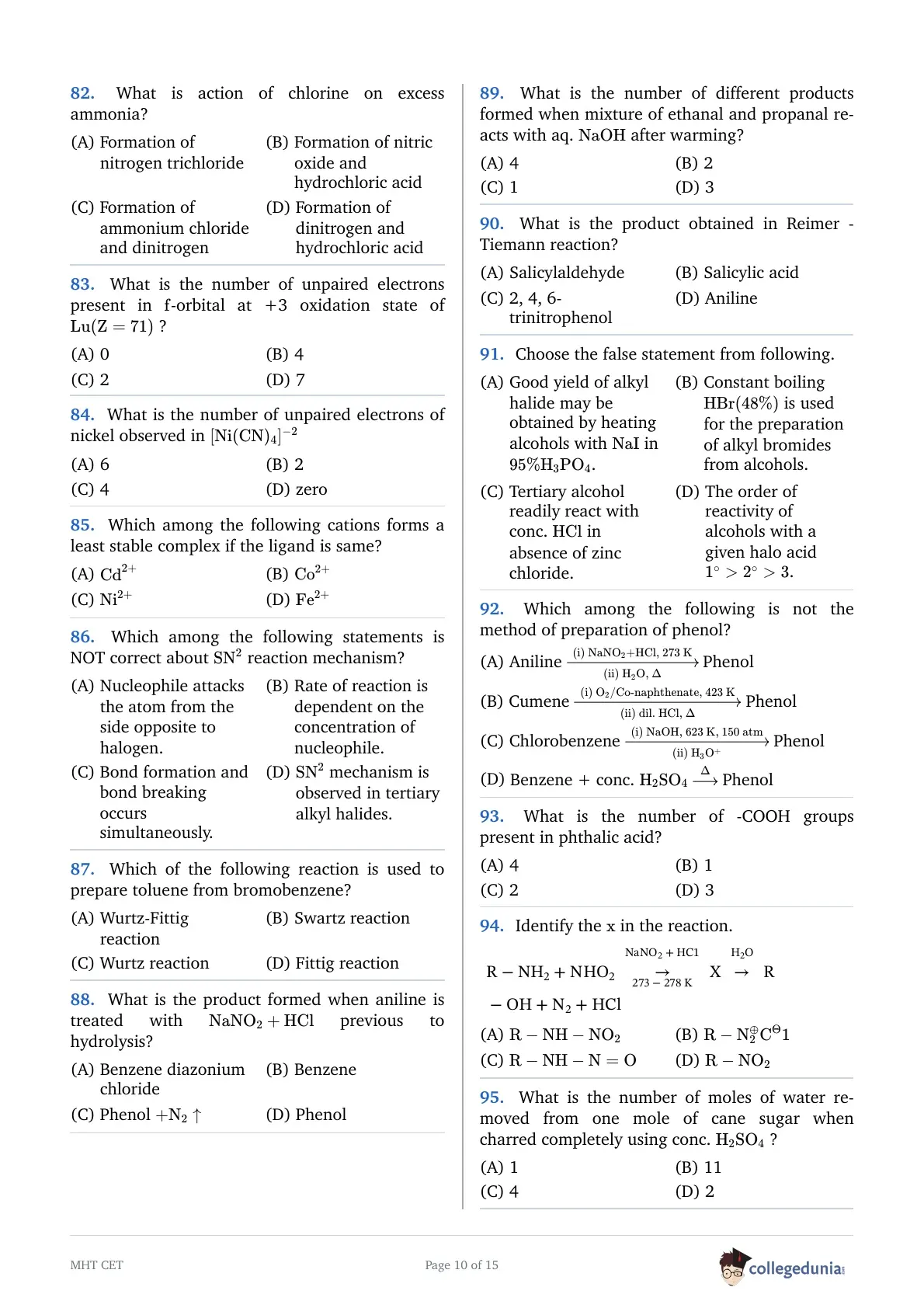
What is action of chlorine on excess ammonia?
What is the number of unpaired electrons present in \(\mathrm{f}\)-orbital at +3 oxidation state of \(\mathrm{Lu}(\mathrm{Z}=71)\) ?
What is the number of unpaired electrons of nickel observed in \([\mathrm{Ni}(\mathrm{CN})_{4}]^{-2}\)
Which among the following statements is NOT correct about \(\mathrm{SN}^{2}\) reaction mechanism?
Which of the following reaction is used to prepare toluene from bromobenzene?
What is the product formed when aniline is treated with \(\mathrm{NaNO}_{2}+\mathrm{HCl}\) previous to hydrolysis?
What is the number of different products formed when mixture of ethanal and propanal reacts with aq. \(\mathrm{NaOH}\) after warming?
What is the product obtained in Reimer - Tiemann reaction?
Choose the false statement from following.
Which among the following is not the method of preparation of phenol?
What is the number of -COOH groups present in phthalic acid?
Identify the \(\mathrm{x}\) in the reaction. \(\mathrm{R}-\mathrm{NH}_{2}+\mathrm{NHO}_{2}\xrightarrow[273-278\ \mathrm{K}]{\mathrm{NaNO}_{2}+\mathrm{HC}1}\mathrm{X}\xrightarrow{\mathrm{H}_{2}\mathrm{O}}\mathrm{R}-\mathrm{OH}+\mathrm{N}_{2}+\mathrm{HCl}\)
What is the number of moles of water removed from one mole of cane sugar when charred completely using conc. \(\mathrm{H}_{2}\mathrm{SO}_{4}\) ?
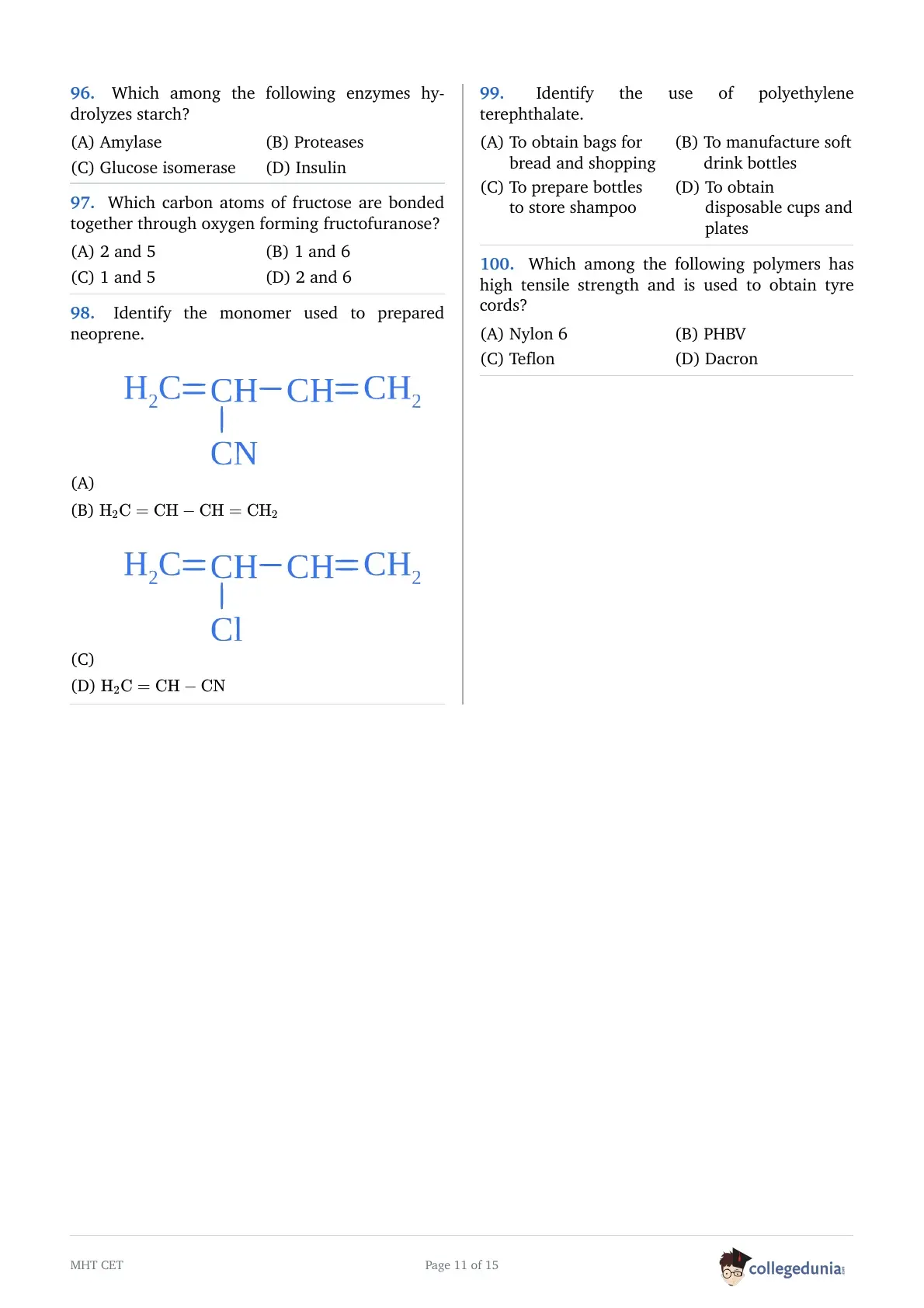
Which among the following enzymes hydrolyzes starch?
Which carbon atoms of fructose are bonded together through oxygen forming fructofuranose?
Identify the monomer used to prepared neoprene.
- (A)
![]()
- (B) \(\mathrm{H}_{2}\mathrm{C}=\mathrm{CH}-\mathrm{CH}=\mathrm{CH}_{2}\)
- (C)
![]()
- (D) \(\mathrm{H}_{2}\mathrm{C}=\mathrm{CH}-\mathrm{CN}\)


Identify the use of polyethylene terephthalate.
Which among the following polymers has high tensile strength and is used to obtain tyre cords?
Mathematics (Q101 - Q150)
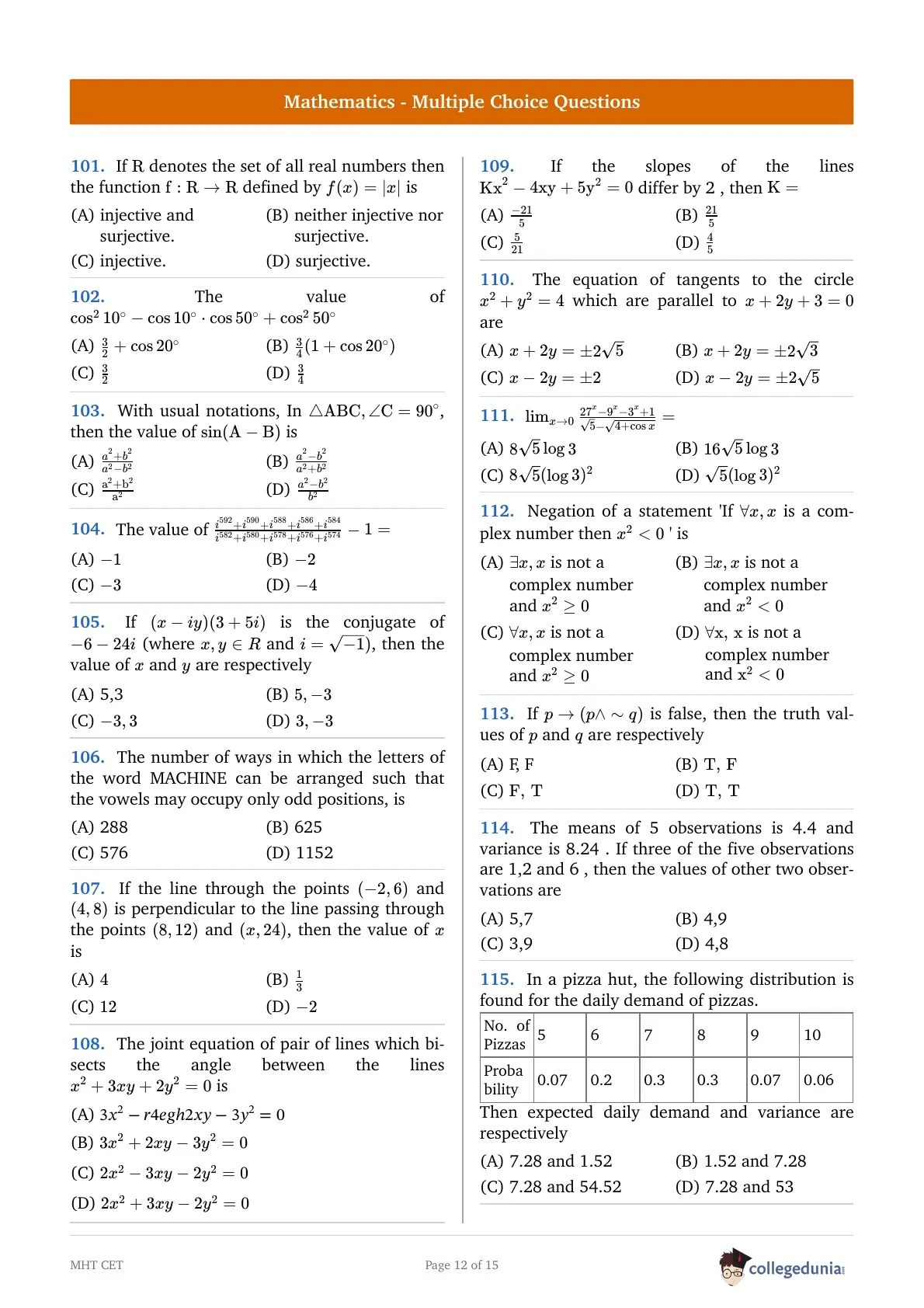
If \(\mathrm{R}\) denotes the set of all real numbers then the function \(\mathrm{f}:\mathrm{R}\rightarrow \mathrm{R}\) defined by \(f(x)=|x|\) is
The value of \(\cos ^{2}10^{\circ }-\cos 10^{\circ }\cdot \cos 50^{\circ }+\cos ^{2}50^{\circ }\)
With usual notations, In \(\triangle \mathrm{ABC},\angle \mathrm{C}=90^{\circ }\), then the value of \(\sin (\mathrm{A}-\mathrm{B})\) is
The value of \(\frac{i^{592}+i^{590}+i^{588}+i^{586}+i^{584}}{i^{582}+i^{580}+i^{578}+i^{576}+i^{574}}-1=\)
If \((x-iy)(3+5i)\) is the conjugate of \(-6-24i\) (where \(x,y\in R\) and \(i=\sqrt{-1})\), then the value of \(x\) and \(y\) are respectively
The number of ways in which the letters of the word MACHINE can be arranged such that the vowels may occupy only odd positions, is
If the line through the points \((-2,6)\) and \((4,8)\) is perpendicular to the line passing through the points \((8,12)\) and \((x,24)\), then the value of \(x\) is
The joint equation of pair of lines which bisects the angle between the lines \(x^{2}+3xy+2y^{2}=0\) is
If the slopes of the lines \(\mathrm{Kx}^{2}-4\mathrm{xy}+5\mathrm{y}^{2}=0\) differ by 2 , then \(\mathrm{K}=\)
The equation of tangents to the circle \(x^{2}+y^{2}=4\) which are parallel to \(x+2y+3=0\) are
\(\lim _{x\rightarrow 0}\frac{27^{x}-9^{x}-3^{x}+1}{\sqrt{5}-\sqrt{4+\cos x}}=\)
If \(p\rightarrow (p\wedge \sim q)\) is false, then the truth values of \(p\) and \(q\) are respectively
The means of 5 observations is 4.4 and variance is 8.24 . If three of the five observations are 1,2 and 6 , then the values of other two observations are
In a pizza hut, the following distribution is found for the daily demand of pizzas.
| No. of Pizzas | 5 | 6 | 7 | 8 | 9 | 10 |
| Probability | 0.07 | 0.2 | 0.3 | 0.3 | 0.07 | 0.06 |
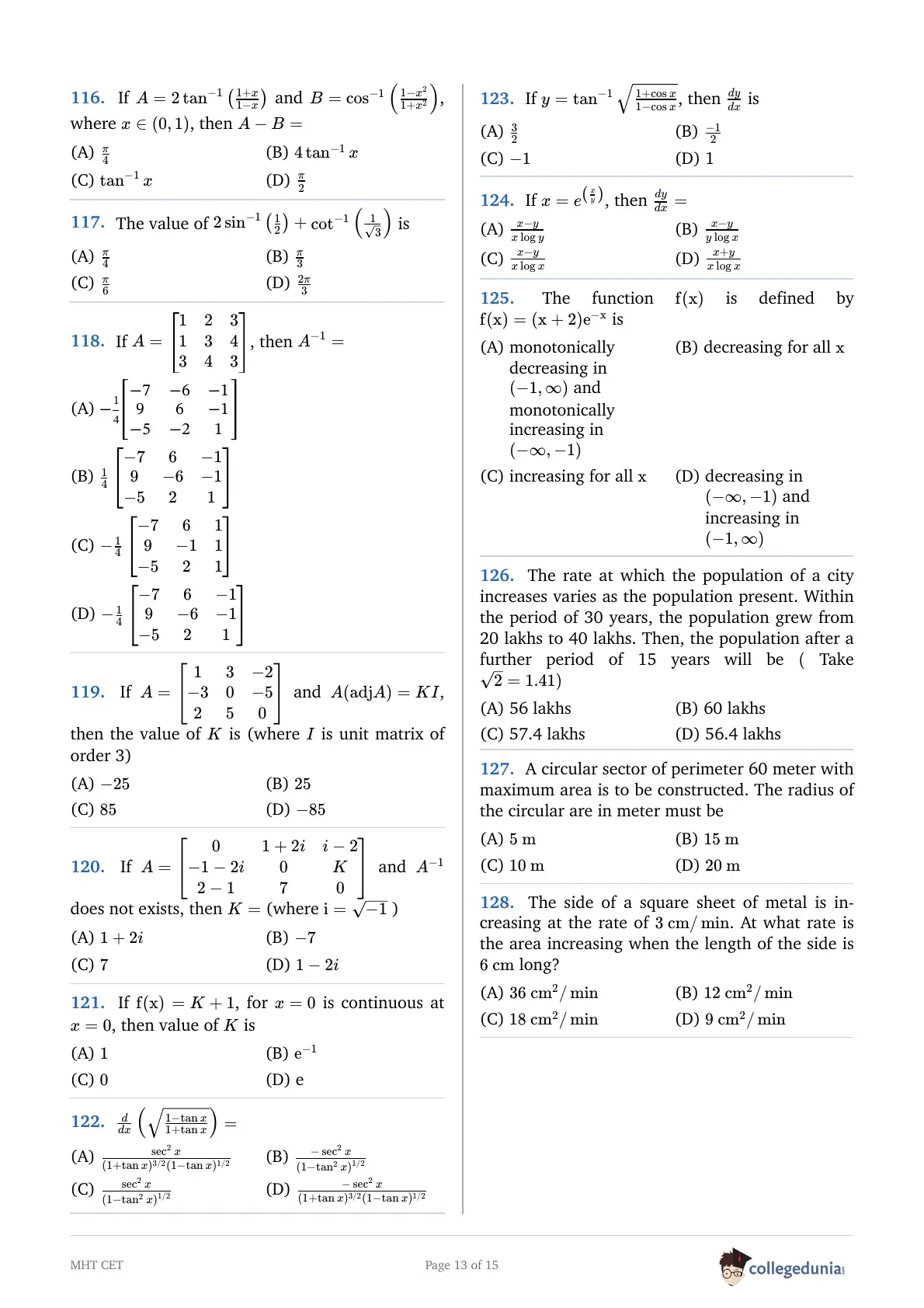
If \(A=2\tan ^{-1}\left(\frac{1+x}{1-x}\right)\) and \(B=\cos ^{-1}\left(\frac{1-x^{2}}{1+x^{2}}\right)\), where \(x\in (0,1)\), then \(A-B=\)
The value of \(2\sin ^{-1}\left(\frac{1}{2}\right)+\cot ^{-1}\left(\frac{1}{\sqrt{3}}\right)\) is
If \(A=\begin{bmatrix} 1 & 2 & 3 \\ 1 & 3 & 4 \\ 3 & 4 & 3 \end{bmatrix}\), then \(A^{-1}=\)
If \(A=\begin{bmatrix} 1 & 3 & -2 \\ -3 & 0 & -5 \\ 2 & 5 & 0 \end{bmatrix}\) and \(A(\mathrm{adj}A)=KI\), then the value of \(K\) is (where \(I\) is unit matrix of order 3)
\(\frac{d}{dx}\left(\sqrt{\frac{1-\tan x}{1+\tan x}}\right)=\)
If \(y=\tan ^{-1}\sqrt{\frac{1+\cos x}{1-\cos x}}\), then \(\frac{dy}{dx}\) is
If \(x=e^{\left(\frac{x}{y}\right)}\), then \(\frac{dy}{dx}=\)
The function \(\mathrm{f}(\mathrm{x})\) is defined by \(\mathrm{f}(\mathrm{x})=(\mathrm{x}+2)\mathrm{e}^{-\mathrm{x}}\) is
The rate at which the population of a city increases varies as the population present. Within the period of 30 years, the population grew from 20 lakhs to 40 lakhs. Then, the population after a further period of 15 years will be \((\) Take \(\sqrt{2}=1.41)\)
A circular sector of perimeter 60 meter with maximum area is to be constructed. The radius of the circular are in meter must be
The side of a square sheet of metal is increasing at the rate of \(3\ \mathrm{cm}/\min\). At what rate is the area increasing when the length of the side is \(6\ \mathrm{cm}\) long?
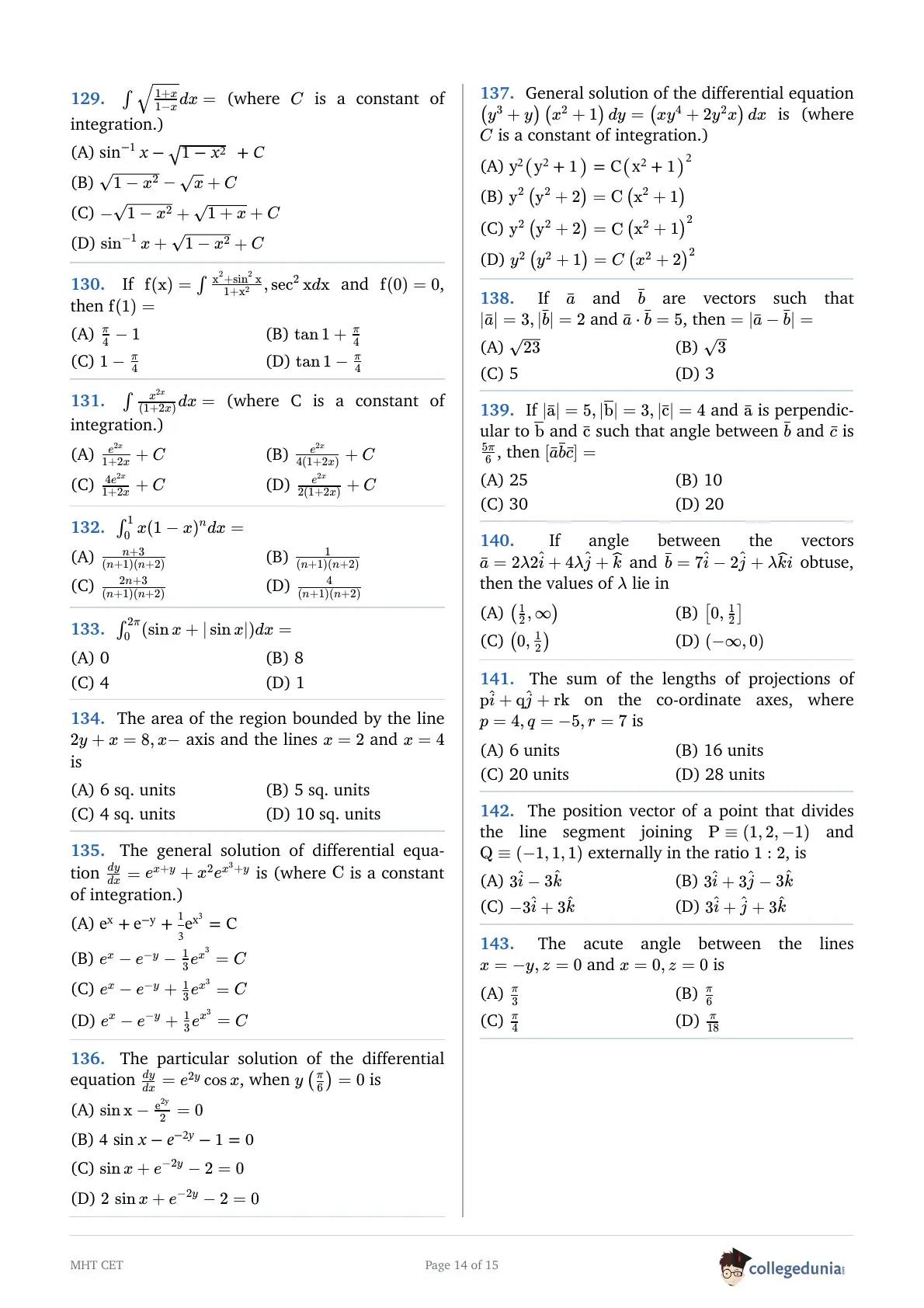
\(\int \sqrt{\frac{1+x}{1-x}}dx=\) (where \(C\) is a constant of integration.)
If \(\mathrm{f}(\mathrm{x})=\int \frac{\mathrm{x}^{2}+\sin ^{2}\mathrm{x}}{1+\mathrm{x}^{2}},\sec ^{2}\mathrm{x}d\mathrm{x}\) and \(\mathrm{f}(0)=0\), then \(\mathrm{f}(1)=\)
\(\int _{0}^{1}x(1-x)^{n}dx=\)
\(\int _{0}^{2\pi }(\sin x+|\sin x|)dx=\)
The area of the region bounded by the line \(2y+x=8,x-\) axis and the lines \(x=2\) and \(x=4\) is
The particular solution of the differential equation \(\frac{dy}{dx}=e^{2y}\cos x\), when \(y\left(\frac{\pi }{6}\right)=0\) is
General solution of the differential equation \(\left(y^{3}+y\right)\left(x^{2}+1\right)dy=\left(xy^{4}+2y^{2}x\right)dx\) is (where \(C\) is a constant of integration.)
If \(\bar{a}\) and \(\bar{b}\) are vectors such that \(|\bar{a}|=3,|\bar{b}|=2\) and \(\bar{a}\cdot \bar{b}=5\), then \(=\) \(|\bar{a}-\bar{b}|=\)
If \(|\bar{\mathrm{a}}|=5,|\overline{\mathrm{b}}|=3,|\bar{\mathrm{c}}|=4\) and \(\bar{\mathrm{a}}\) is perpendicular to \(\overline{\mathrm{b}}\) and \(\bar{\mathrm{c}}\) such that angle between \(\bar{b}\) and \(\bar{c}\) is \(\frac{5\pi }{6}\), then \([\bar{a}\bar{b}\bar{c}]=\)
If angle between the vectors \(\bar{a}=2\lambda 2\hat{i}+4\lambda \hat{j}+\widehat{k}\) and \(\bar{b}=7\hat{i}-2\hat{j}+\lambda \widehat{k}i\) obtuse, then the values of \(\lambda\) lie in
The sum of the lengths of projections of \(\mathrm{p}\hat{i}+\mathrm{q}\hat{j}+\mathrm{rk}\) on the co-ordinate axes, where \(p=4,q=-5,r=7\) is
The position vector of a point that divides the line segment joining \(\mathrm{P}\equiv (1,2,-1)\) and \(\mathrm{Q}\equiv (-1,1,1)\) externally in the ratio \(1:2\), is
The acute angle between the lines \(x=-y,z=0\) and \(x=0,z=0\) is
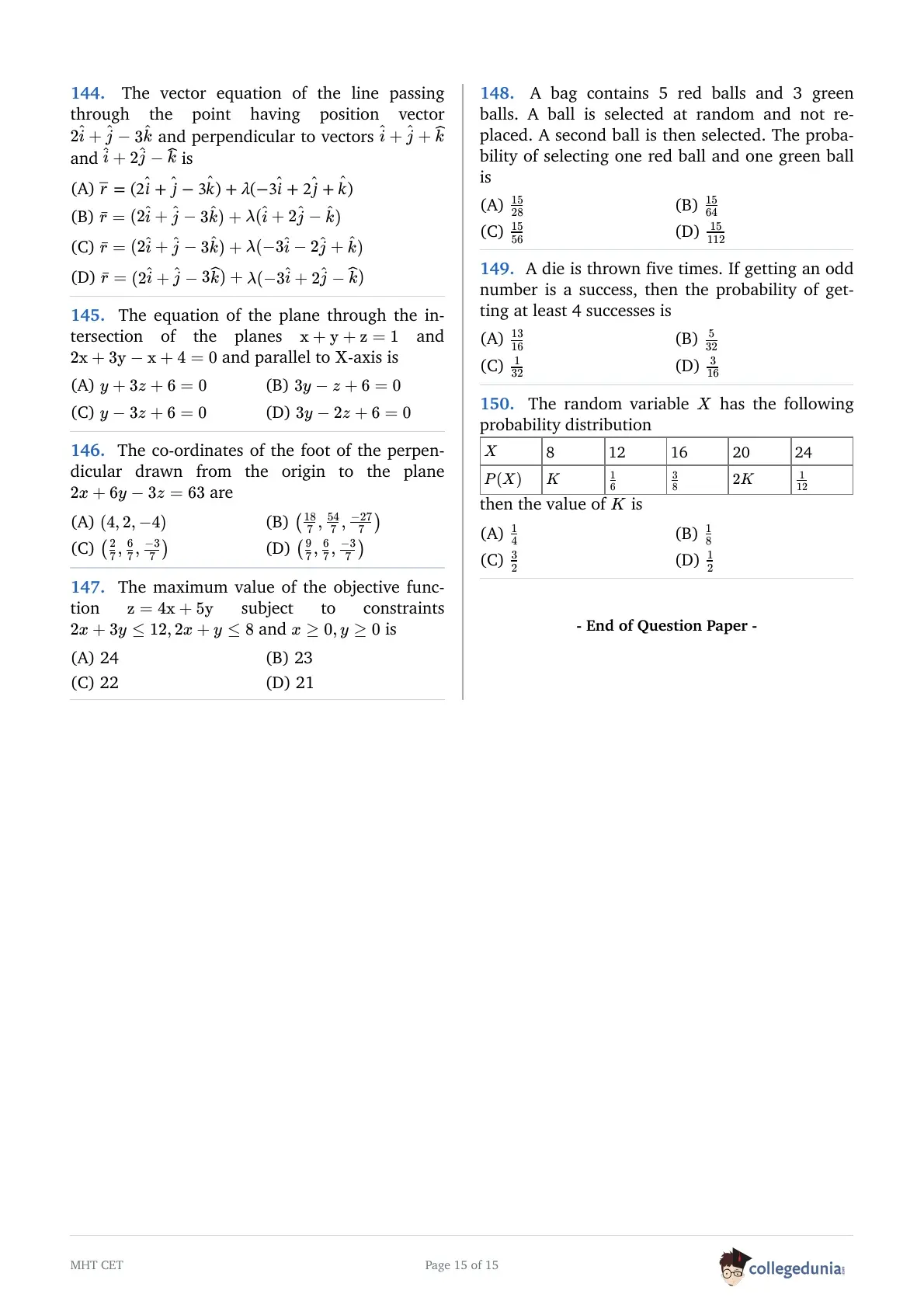
The vector equation of the line passing through the point having position vector \(2\hat{i}+\hat{j}-3\hat{k}\) and perpendicular to vectors \(\hat{i}+\hat{j}+\widehat{k}\) and \(\hat{i}+2\hat{j}-\widehat{k}\) is
The co-ordinates of the foot of the perpendicular drawn from the origin to the plane \(2x+6y-3z=63\) are
The maximum value of the objective function \(\mathrm{z}=4\mathrm{x}+5\mathrm{y}\) subject to constraints \(2x+3y\leq 12,2x+y\leq 8\) and \(x\geq 0,y\geq 0\) is
A bag contains 5 red balls and 3 green balls. A ball is selected at random and not replaced. A second ball is then selected. The probability of selecting one red ball and one green ball is
A die is thrown five times. If getting an odd number is a success, then the probability of getting at least 4 successes is
The random variable \(X\) has the following probability distribution
| \(X\) | 8 | 12 | 16 | 20 | 24 |
| \(P(X)\) | \(K\) | \(\frac{1}{6}\) | \(\frac{3}{8}\) | \(2K\) | \(\frac{1}{12}\) |
MHT CET 2022 PCM Exam Pattern and Marking Scheme
| Parameter | Details |
|---|---|
| Conducting Body | Maharashtra Common Entrance Test Cell (Maharashtra CET Cell) |
| Exam Mode | Online (Computer-Based Test) |
| Duration | 180 minutes (3 hours) |
| Groups / Subjects | PCM (Physics, Chemistry, Mathematics) for Engineering |
| Total Questions |
150 |
| Total Marks | 200 |
| Question Type | Multiple Choice Questions (MCQs) |
| Marks Distribution |
|
| Negative Marking | No |
| Syllabus Weightage |
|



Comments