




MHT CET 2022 Aug 6 Shift 1 PCM Question Paper is available for download here. Maharashtra State CET Cell conducted MHT CET 2022 PCM Exam on Aug 6 in Shift 1 from 9 AM to 12 PM in CBT mode.
The MHT CET 2022 PCM question paper includes the following:
- The MHT CET 2022 PCM Question Paper consists of 150 multiple-choice questions (MCQs) totalling 200 marks divided into 3 sections: Physics, Chemistry, and Mathematics, with 50 questions in each subject.
- Physics and Chemistry questions carry 1 mark each while Mathematics questions carry 2 marks each.
- There is no negative marking for incorrect answers.
MHT CET 2022 Aug 6 Shift 1 PCM Question Paper with Solution PDF
| CD PDF | CD PDF with Solutions |
|---|---|
| Download Collegedunia PDF 0.90 MB | - |
Also Check:
MHT CET 2022 Aug 6 Shift 1 PCM Questions with Solutions
Physics (Q1 - Q50)
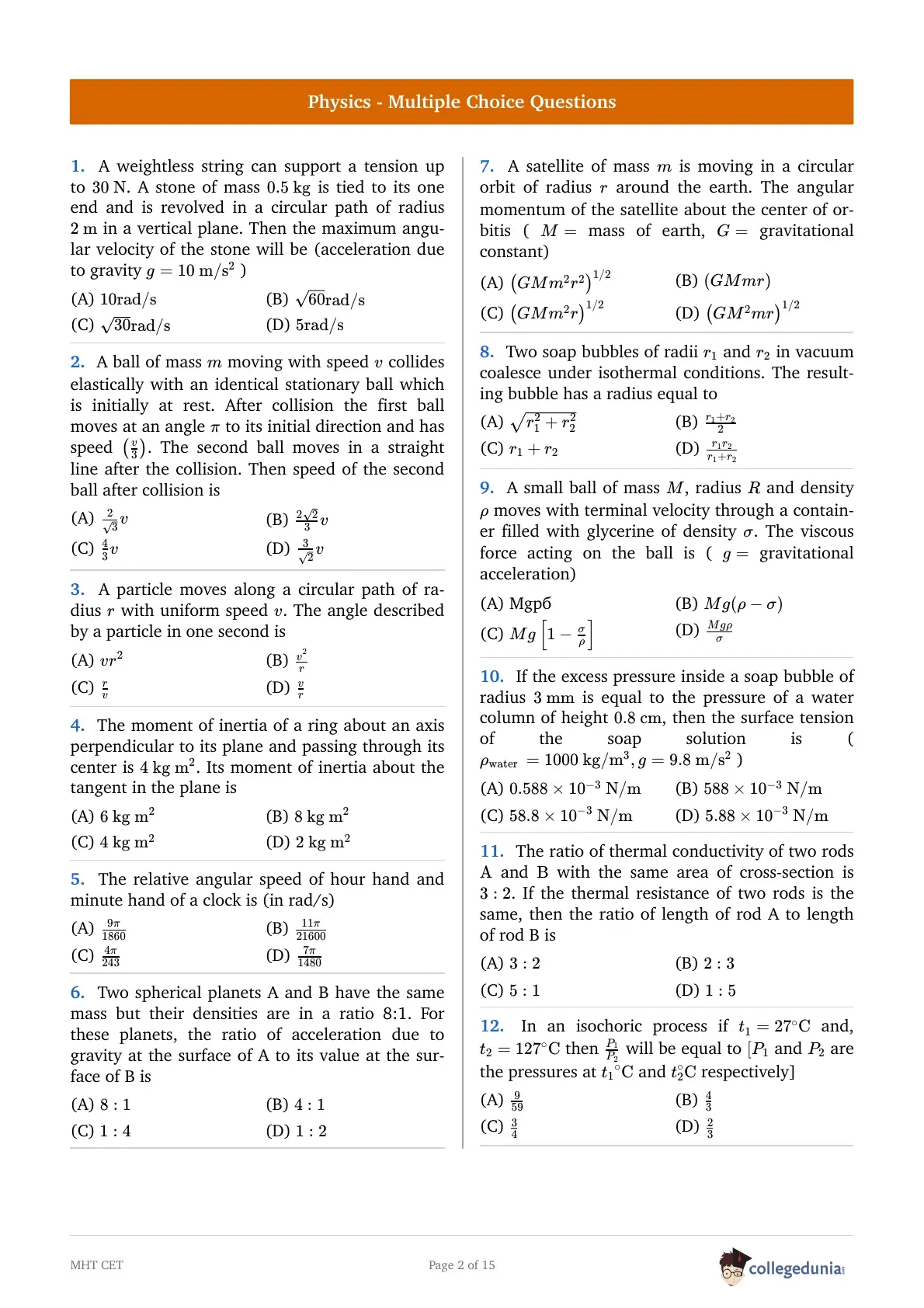
A weightless string can support a tension up to \(30\ \mathrm{N}\). A stone of mass \(0.5\ \mathrm{kg}\) is tied to its one end and is revolved in a circular path of radius \(2\ \mathrm{m}\) in a vertical plane. Then the maximum angular velocity of the stone will be (acceleration due to gravity \(g=10\ \mathrm{m}/\mathrm{s}^{2}\) )
A particle moves along a circular path of radius \(r\) with uniform speed \(v\). The angle described by a particle in one second is
The moment of inertia of a ring about an axis perpendicular to its plane and passing through its center is \(4\ \mathrm{kg}\ \mathrm{m}^{2}\). Its moment of inertia about the tangent in the plane is
The relative angular speed of hour hand and minute hand of a clock is (in rad/s)
Two spherical planets A and B have the same mass but their densities are in a ratio 8:1. For these planets, the ratio of acceleration due to gravity at the surface of A to its value at the surface of B is
A satellite of mass \(m\) is moving in a circular orbit of radius \(r\) around the earth. The angular momentum of the satellite about the center of orbitis ( \(M=\) mass of earth, \(G=\) gravitational constant)
Two soap bubbles of radii \(r_{1}\) and \(r_{2}\) in vacuum coalesce under isothermal conditions. The resulting bubble has a radius equal to
A small ball of mass \(M\), radius \(R\) and density \(\rho\) moves with terminal velocity through a container filled with glycerine of density \(\sigma\). The viscous force acting on the ball is ( \(g=\) gravitational acceleration)
If the excess pressure inside a soap bubble of radius \(3\ \mathrm{mm}\) is equal to the pressure of a water column of height \(0.8\ \mathrm{cm}\), then the surface tension of the soap solution is ( \(\rho _{\text{water }}=1000\ \mathrm{kg}/\mathrm{m}^{3},g=9.8\ \mathrm{m}/\mathrm{s}^{2}\) )
The ratio of thermal conductivity of two rods \(\mathrm{A}\) and \(\mathrm{B}\) with the same area of cross-section is \(3:2\). If the thermal resistance of two rods is the same, then the ratio of length of rod A to length of rod B is
In an isochoric process if \(t_{1}=27^{\circ }\mathrm{C}\) and, \(t_{2}=127^{\circ }\mathrm{C}\) then \(\frac{P_{1}}{P_{2}}\) will be equal to \([P_{1}\) and \(P_{2}\) are the pressures at \(t_{1}{}^{\circ }\mathrm{C}\) and \(t_{2}^{\circ }\mathrm{C}\) respectively]
Out of the following statements, which one is 'NOT' correct in the case of a thermodynamic process?
The r.m.s. speed of gas at temperature \(T\) is 2 times the r.m.s speed at \(320\ \mathrm{K}\). The value of the Temperature \(T\) is
The molar specific heat of an ideal gas at constant pressure and constant volume is \(C_{p}\) and \(C_{v}\) respectively. If \(R\) is the universal gas constant and the ratio of \(C_{p}\) to \(C_{v}\) is \(\gamma\) then. \(C_{v}=\)
According to the kinetic theory of gases, when two molecules of gas collide with each other then
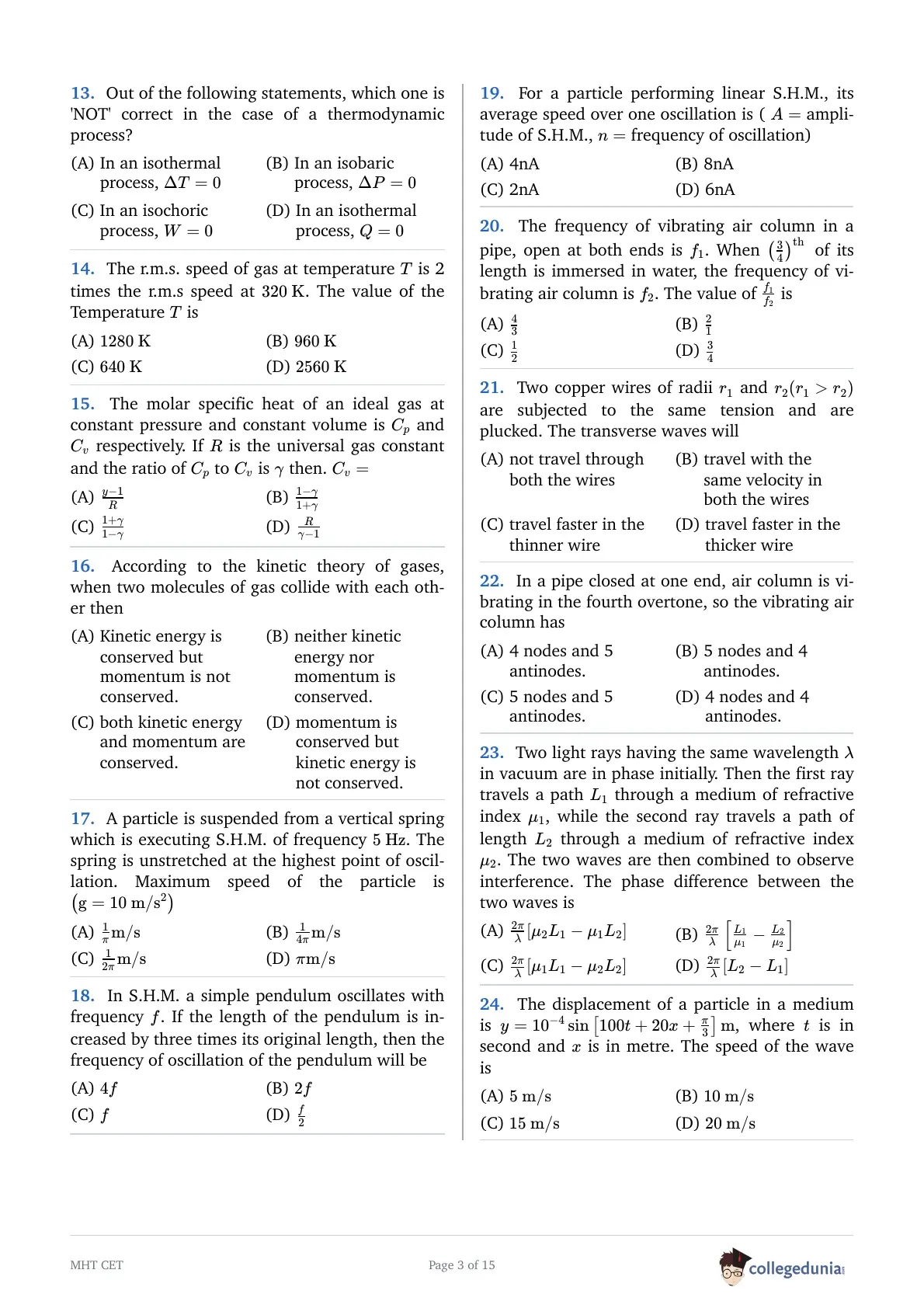
A particle is suspended from a vertical spring which is executing S.H.M. of frequency \(5\ \mathrm{Hz}\). The spring is unstretched at the highest point of oscillation. Maximum speed of the particle is \(\left(\mathrm{g}=10\ \mathrm{m}/\mathrm{s}^{2}\right)\)
In S.H.M. a simple pendulum oscillates with frequency \(f\). If the length of the pendulum is increased by three times its original length, then the frequency of oscillation of the pendulum will be
For a particle performing linear S.H.M., its average speed over one oscillation is ( \(A=\) amplitude of S.H.M., \(n=\) frequency of oscillation)
The frequency of vibrating air column in a pipe, open at both ends is \(f_{1}\). When \(\left(\frac{3}{4}\right)^{\text{th }}\) of its length is immersed in water, the frequency of vibrating air column is \(f_{2}\). The value of \(\frac{f_{1}}{f_{2}}\) is
Two copper wires of radii \(r_{1}\) and \(r_{2}(r_{1}>r_{2})\) are subjected to the same tension and are plucked. The transverse waves will
In a pipe closed at one end, air column is vibrating in the fourth overtone, so the vibrating air column has
Two light rays having the same wavelength \(\lambda\) in vacuum are in phase initially. Then the first ray travels a path \(L_{1}\) through a medium of refractive index \(\mu _{1}\), while the second ray travels a path of length \(L_{2}\) through a medium of refractive index \(\mu _{2}\). The two waves are then combined to observe interference. The phase difference between the two waves is
The displacement of a particle in a medium is \(y=10^{-4}\sin \left[100t+20x+\frac{\pi }{3}\right]\mathrm{m}\), where \(t\) is in second and \(x\) is in metre. The speed of the wave is
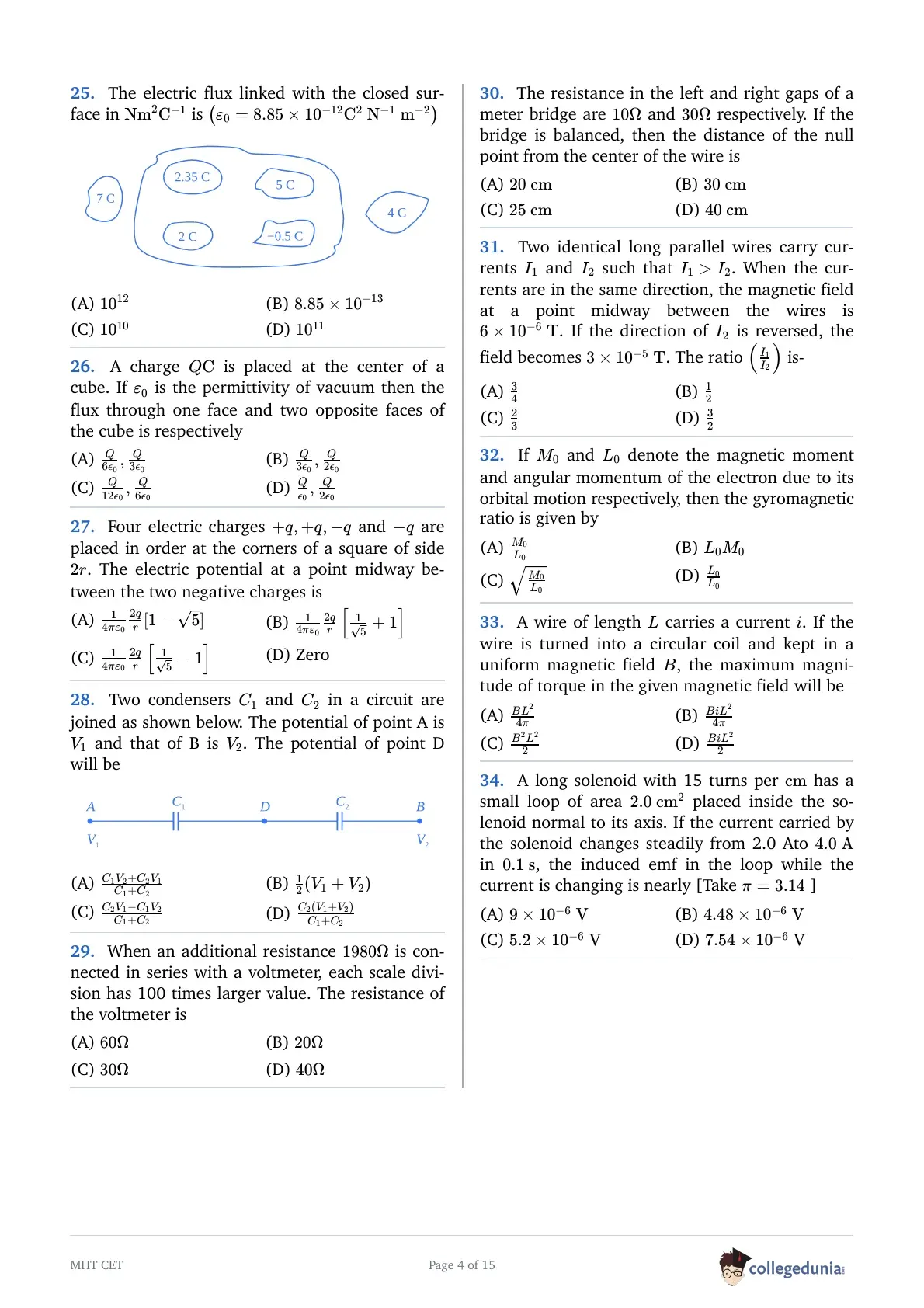
The electric flux linked with the closed surface in \(\mathrm{Nm}^{2}\mathrm{C}^{-1}\) is \(\left(\varepsilon _{0}=8.85\times 10^{-12}\mathrm{C}^{2}\ \mathrm{N}^{-1}\ \mathrm{m}^{-2}\right)\)

A charge \(Q\mathrm{C}\) is placed at the center of a cube. If \(\varepsilon _{0}\) is the permittivity of vacuum then the flux through one face and two opposite faces of the cube is respectively
Four electric charges \(+q,+q,-q\) and \(-q\) are placed in order at the corners of a square of side \(2r\). The electric potential at a point midway between the two negative charges is
When an additional resistance \(1980\Omega\) is connected in series with a voltmeter, each scale division has 100 times larger value. The resistance of the voltmeter is
The resistance in the left and right gaps of a meter bridge are \(10\Omega\) and \(30\Omega\) respectively. If the bridge is balanced, then the distance of the null point from the center of the wire is
Two identical long parallel wires carry currents \(I_{1}\) and \(I_{2}\) such that \(I_{1}>I_{2}\). When the currents are in the same direction, the magnetic field at a point midway between the wires is \(6\times 10^{-6}\ \mathrm{T}\). If the direction of \(I_{2}\) is reversed, the field becomes \(3\times 10^{-5}\ \mathrm{T}\). The ratio \(\left(\frac{I_{1}}{I_{2}}\right)\) is-
If \(M_{0}\) and \(L_{0}\) denote the magnetic moment and angular momentum of the electron due to its orbital motion respectively, then the gyromagnetic ratio is given by
A wire of length \(L\) carries a current \(i\). If the wire is turned into a circular coil and kept in a uniform magnetic field \(B\), the maximum magnitude of torque in the given magnetic field will be
A long solenoid with 15 turns per \(\mathrm{cm}\) has a small loop of area \(2.0\ \mathrm{cm}^{2}\) placed inside the solenoid normal to its axis. If the current carried by the solenoid changes steadily from 2.0 Ato \(4.0\ \mathrm{A}\) in \(0.1\ \mathrm{s}\), the induced emf in the loop while the current is changing is nearly [Take \(\pi =3.14\) ]
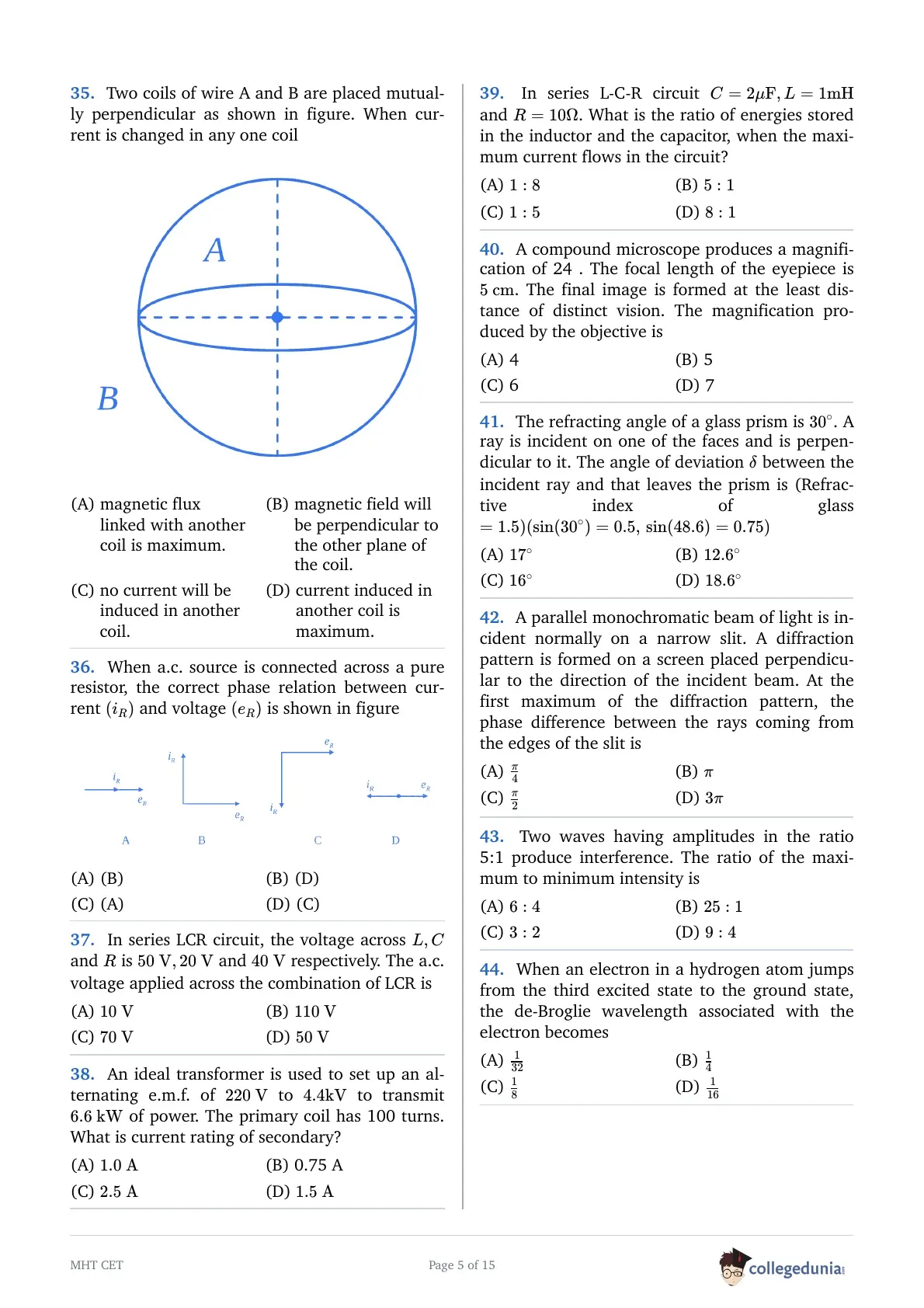
Two coils of wire A and B are placed mutually perpendicular as shown in figure. When current is changed in any one coil

When a.c. source is connected across a pure resistor, the correct phase relation between current \((i_{R})\) and voltage \((e_{R})\) is shown in figure

In series LCR circuit, the voltage across \(L,C\) and \(R\) is \(50\ \mathrm{V},20\ \mathrm{V}\) and \(40\ \mathrm{V}\) respectively. The a.c. voltage applied across the combination of LCR is
An ideal transformer is used to set up an alternating e.m.f. of \(220\ \mathrm{V}\) to \(4.4\mathrm{kV}\) to transmit \(6.6\ \mathrm{kW}\) of power. The primary coil has 100 turns. What is current rating of secondary?
A compound microscope produces a magnification of 24 . The focal length of the eyepiece is \(5\ \mathrm{cm}\). The final image is formed at the least distance of distinct vision. The magnification produced by the objective is
The refracting angle of a glass prism is \(30^{\circ }\). A ray is incident on one of the faces and is perpendicular to it. The angle of deviation \(\delta\) between the incident ray and that leaves the prism is (Refractive index of glass \(=1.5)(\sin (30^{\circ })=0.5,\,\sin (48.6)=0.75)\)
A parallel monochromatic beam of light is incident normally on a narrow slit. A diffraction pattern is formed on a screen placed perpendicular to the direction of the incident beam. At the first maximum of the diffraction pattern, the phase difference between the rays coming from the edges of the slit is
Two waves having amplitudes in the ratio 5:1 produce interference. The ratio of the maximum to minimum intensity is
When an electron in a hydrogen atom jumps from the third excited state to the ground state, the de-Broglie wavelength associated with the electron becomes
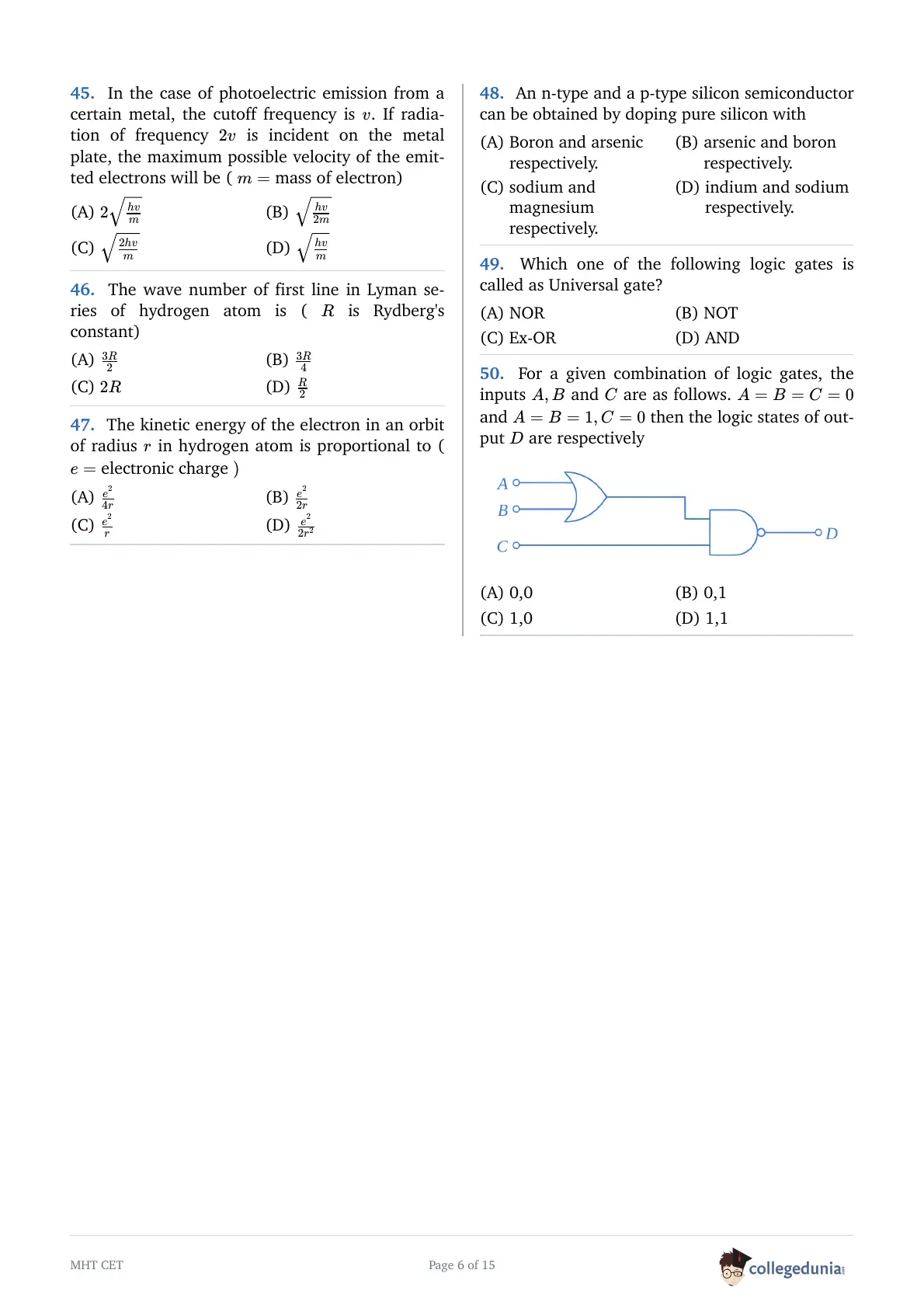
In the case of photoelectric emission from a certain metal, the cutoff frequency is \(v\). If radiation of frequency \(2v\) is incident on the metal plate, the maximum possible velocity of the emitted electrons will be ( \(m=\) mass of electron)
The wave number of first line in Lyman series of hydrogen atom is ( \(R\) is Rydberg's constant)
The kinetic energy of the electron in an orbit of radius \(r\) in hydrogen atom is proportional to ( \(e=\) electronic charge \()\)
An n-type and a p-type silicon semiconductor can be obtained by doping pure silicon with
Which one of the following logic gates is called as Universal gate?
For a given combination of logic gates, the inputs \(A,B\) and \(C\) are as follows. \(A=B=C=0\) and \(A=B=1,C=0\) then the logic states of output \(D\) are respectively

Chemistry (Q51 - Q100)
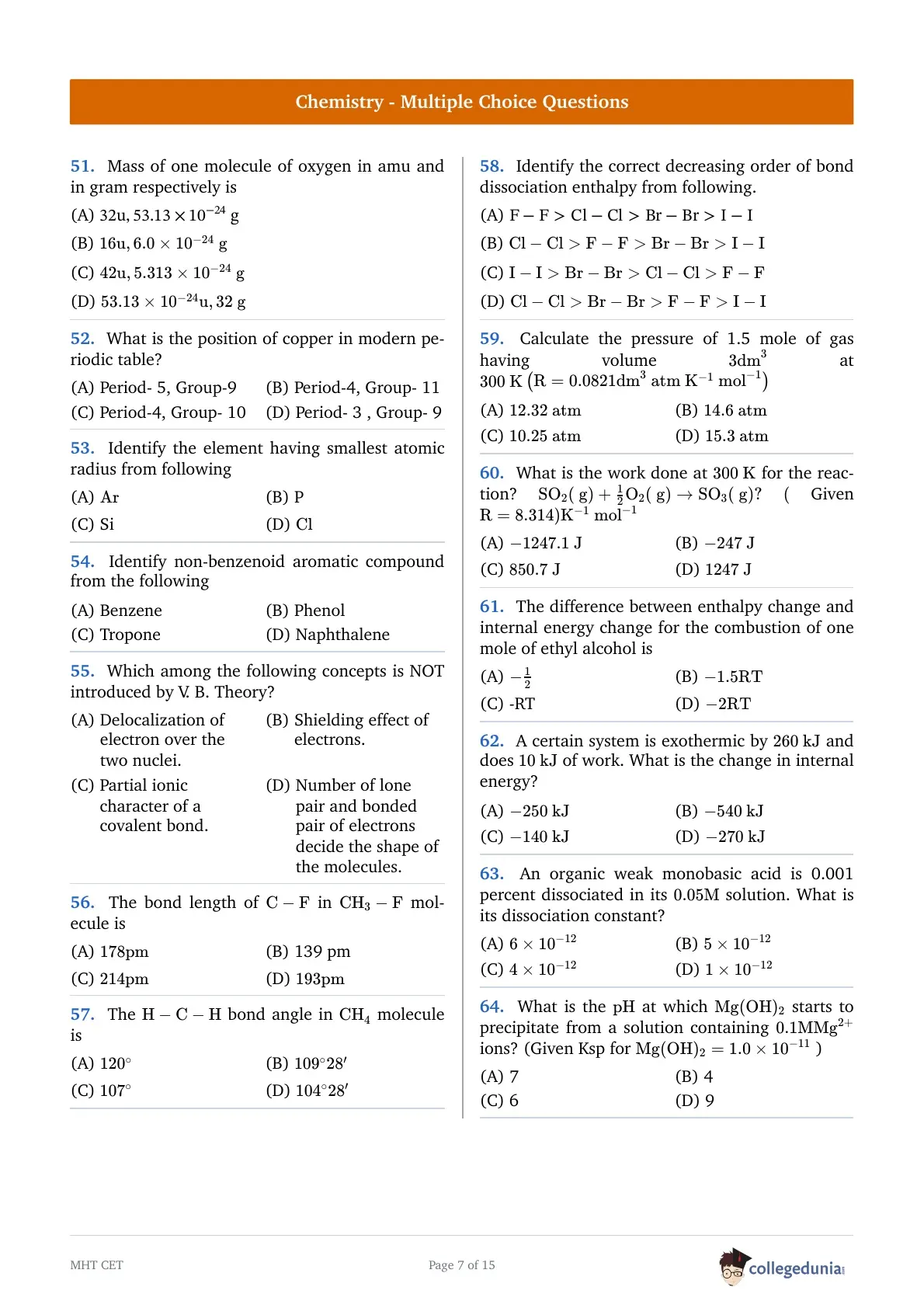
Mass of one molecule of oxygen in amu and in gram respectively is
What is the position of copper in modern periodic table?
Identify the element having smallest atomic radius from following
Identify non-benzenoid aromatic compound from the following
The bond length of \(\mathrm{C}-\mathrm{F}\) in \(\mathrm{CH}_{3}-\mathrm{F}\) molecule is
The \(\mathrm{H}-\mathrm{C}-\mathrm{H}\) bond angle in \(\mathrm{CH}_{4}\) molecule is
Identify the correct decreasing order of bond dissociation enthalpy from following.
Calculate the pressure of 1.5 mole of gas having volume \(3\mathrm{dm}^{3}\) at \(300\ \mathrm{K}\left(\mathrm{R}=0.0821\mathrm{dm}^{3}\ \mathrm{atm}\ \mathrm{K}^{-1}\ \mathrm{mol}^{-1}\right)\)
What is the work done at \(300\ \mathrm{K}\) for the reaction? \(\mathrm{SO}_{2}(\ \mathrm{g})+\frac{1}{2}\mathrm{O}_{2}(\ \mathrm{g})\rightarrow \mathrm{SO}_{3}(\ \mathrm{g})?\) \((\) Given \(\mathrm{R}=8.314)\mathrm{K}^{-1}\ \mathrm{mol}^{-1}\)
The difference between enthalpy change and internal energy change for the combustion of one mole of ethyl alcohol is
A certain system is exothermic by \(260\ \mathrm{kJ}\) and does \(10\ \mathrm{kJ}\) of work. What is the change in internal energy?
An organic weak monobasic acid is 0.001 percent dissociated in its \(0.05\mathrm{M}\) solution. What is its dissociation constant?
What is the \(\mathrm{pH}\) at which \(\mathrm{Mg}(\mathrm{OH})_{2}\) starts to precipitate from a solution containing \(0.1\mathrm{M}\mathrm{Mg}^{2+}\) ions? (Given Ksp for \(\mathrm{Mg}(\mathrm{OH})_{2}=1.0\times 10^{-11}\) )
What is oxidation state of \(\mathrm{Mn}\) in \(\mathrm{MnO}_{4}^{-1}\) ?
Which element from following forms a chlorophyll complex?

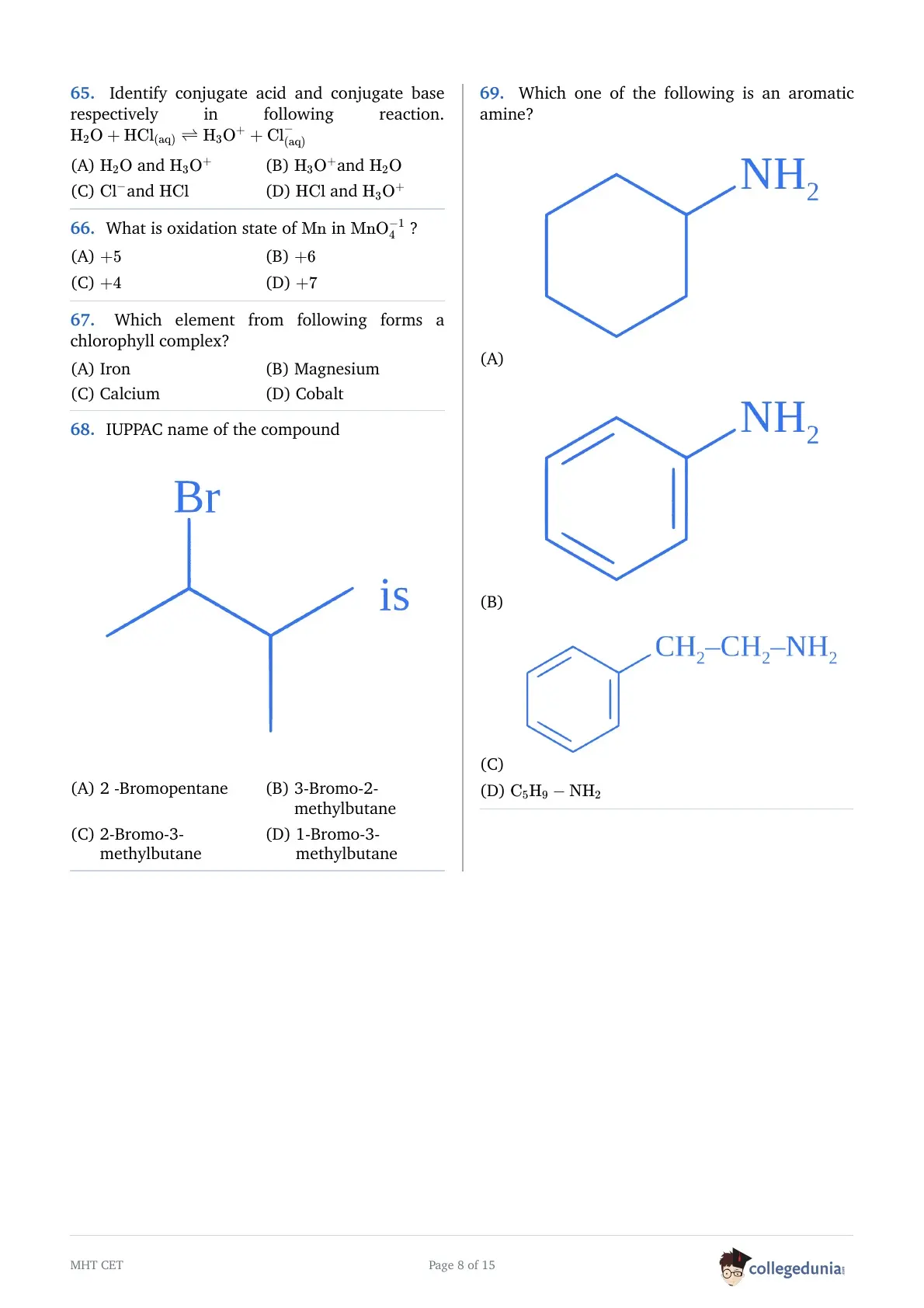
Which one of the following is an aromatic amine?
- (A)
![]()
- (B)
![]()
- (C)
![]()
- (D) \(\mathrm{C}_{5}\mathrm{H}_{9}-\mathrm{NH}_{2}\)


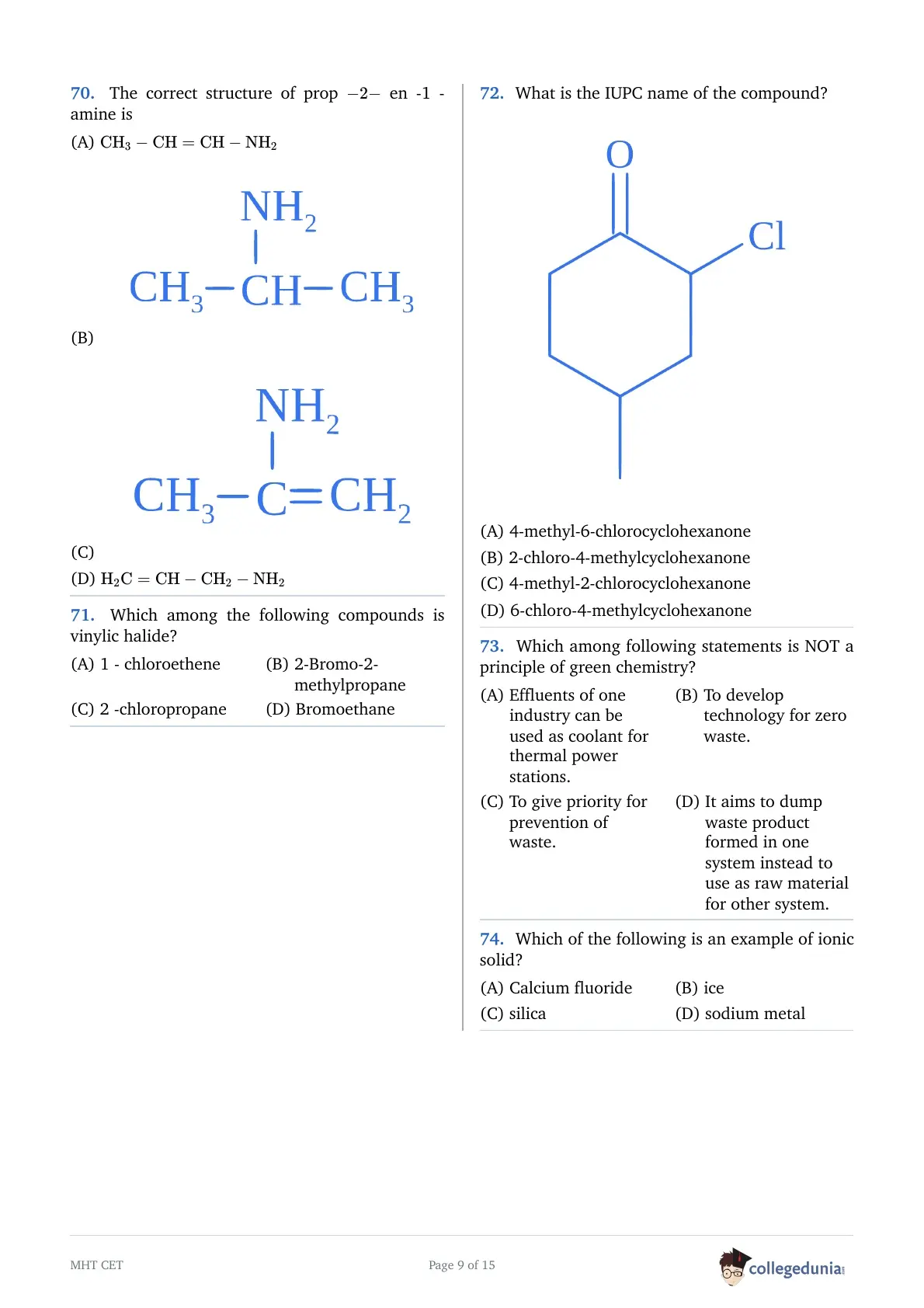
The correct structure of prop \(-2-\) en -1 - amine is
- (A) \(\mathrm{CH}_{3}-\mathrm{CH}=\mathrm{CH}-\mathrm{NH}_{2}\)
- (B)
![]()
- (C)
![]()
- (D) \(\mathrm{H}_{2}\mathrm{C}=\mathrm{CH}-\mathrm{CH}_{2}-\mathrm{NH}_{2}\)


Which among the following compounds is vinylic halide?

Which among following statements is NOT a principle of green chemistry?
Which of the following is an example of ionic solid?
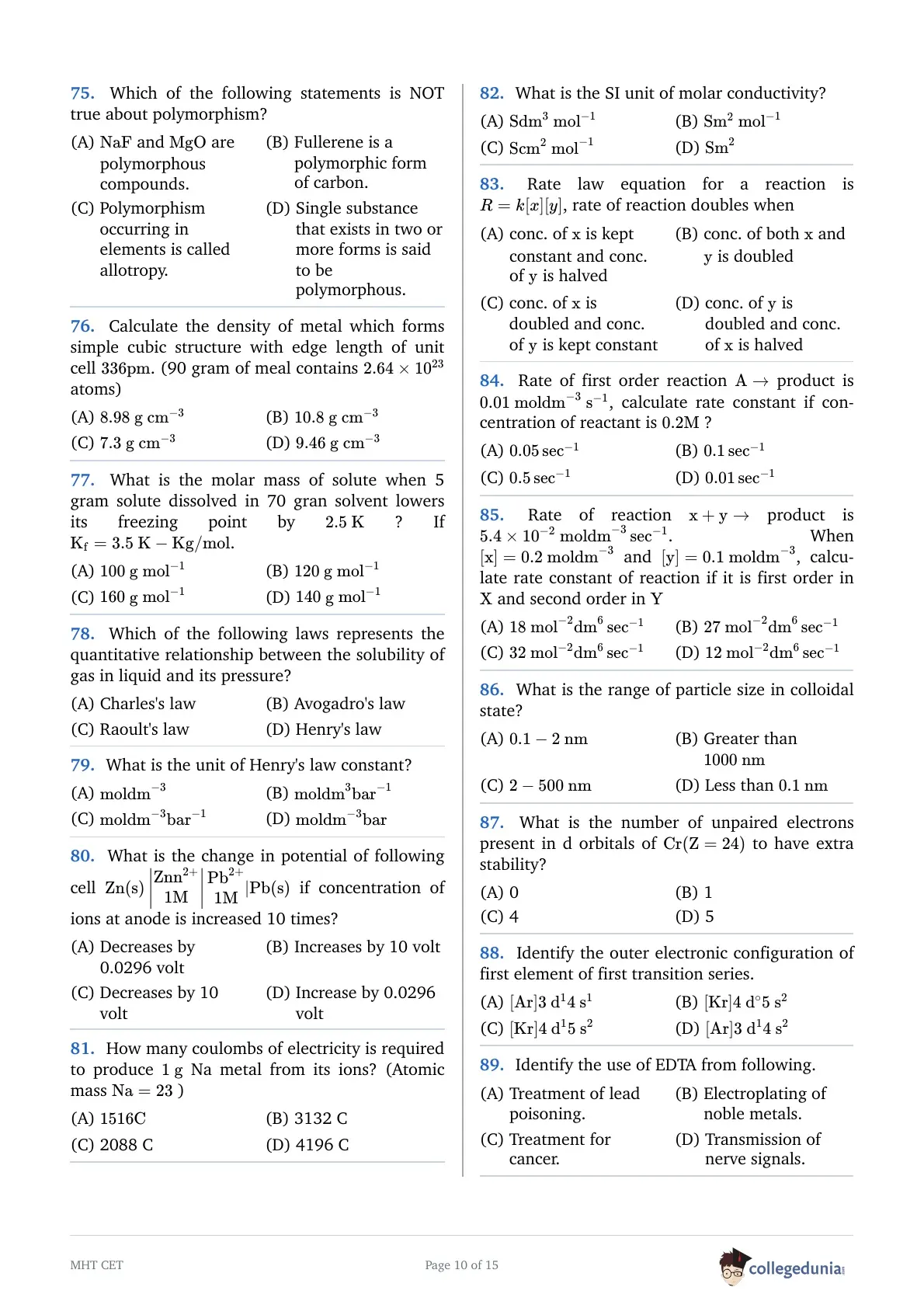
Which of the following statements is NOT true about polymorphism?
Calculate the density of metal which forms simple cubic structure with edge length of unit cell \(336\mathrm{pm}\). (90 gram of meal contains \(2.64\times 10^{23}\) atoms)
What is the molar mass of solute when 5 gram solute dissolved in 70 gran solvent lowers its freezing point by \(2.5\ \mathrm{K}\) ? If \(\mathrm{K}_{\mathrm{f}}=3.5\ \mathrm{K}-\mathrm{Kg}/\mathrm{mol}\).
Which of the following laws represents the quantitative relationship between the solubility of gas in liquid and its pressure?
What is the unit of Henry's law constant?
What is the change in potential of following cell \(\mathrm{Zn}(\mathrm{s})\begin{vmatrix} \mathrm{Zn}\mathrm{n}^{2+} \\ 1\mathrm{M} \end{vmatrix}\begin{matrix} \mathrm{Pb}^{2+} \\ 1\mathrm{M} \end{matrix}|\mathrm{Pb}(\mathrm{s})\) if concentration of ions at anode is increased 10 times?
How many coulombs of electricity is required to produce \(1\ \mathrm{g}\) Na metal from its ions? (Atomic mass \(\mathrm{Na}=23\) )
What is the SI unit of molar conductivity?
Rate law equation for a reaction is \(R=k[x][y]\), rate of reaction doubles when
Rate of first order reaction \(\mathrm{A}\rightarrow\) product is \(0.01\ \mathrm{mol}\mathrm{dm}^{-3}\ \mathrm{s}^{-1}\), calculate rate constant if concentration of reactant is \(0.2\mathrm{M}\) ?
Rate of reaction \(\mathrm{x}+\mathrm{y}\rightarrow\) product is \(5.4\times 10^{-2}\ \mathrm{mol}\mathrm{dm}^{-3}\sec ^{-1}\). When \([\mathrm{x}]=0.2\ \mathrm{mol}\mathrm{dm}^{-3}\) and \([\mathrm{y}]=0.1\ \mathrm{mol}\mathrm{dm}^{-3}\), calculate rate constant of reaction if it is first order in \(\mathrm{X}\) and second order in \(\mathrm{Y}\)
What is the range of particle size in colloidal state?
What is the number of unpaired electrons present in d orbitals of \(\mathrm{Cr}(\mathrm{Z}=24)\) to have extra stability?
Identify the outer electronic configuration of first element of first transition series.
Identify the use of EDTA from following.
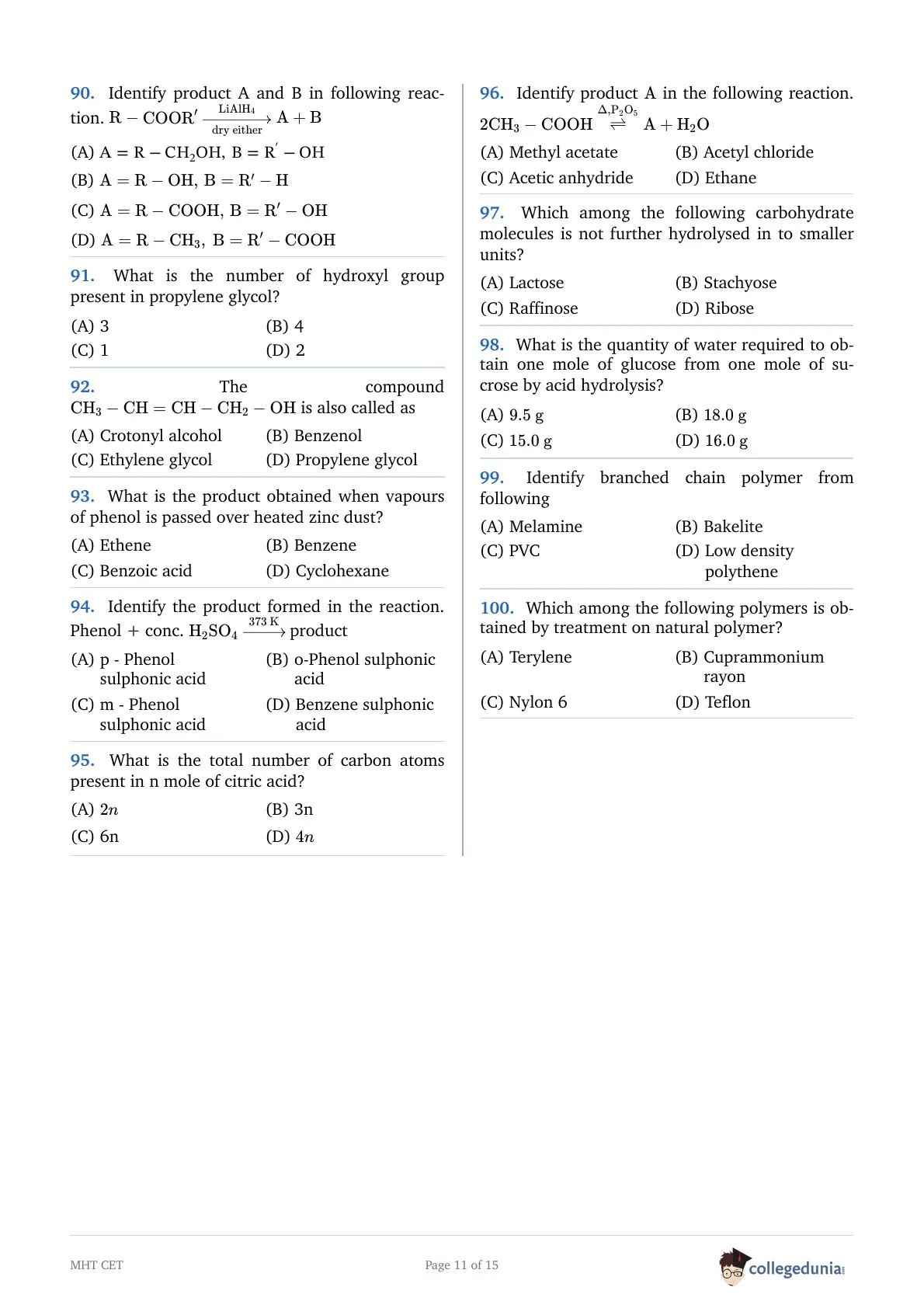
Identify product A and B in following reaction. \(\mathrm{R}-\mathrm{COOR}'\xrightarrow[\text{ dry either }]{\mathrm{LiAlH}_{4}}\mathrm{A}+\mathrm{B}\)
What is the number of hydroxyl group present in propylene glycol?
The compound \(\mathrm{CH}_{3}-\mathrm{CH}=\mathrm{CH}-\mathrm{CH}_{2}-\mathrm{OH}\) is also called as
What is the product obtained when vapours of phenol is passed over heated zinc dust?
Identify the product formed in the reaction. Phenol + conc. \(\mathrm{H}_{2}\mathrm{SO}_{4}\xrightarrow{373\ \mathrm{K}}\) product
What is the total number of carbon atoms present in n mole of citric acid?
Identify product \(\mathrm{A}\) in the following reaction. \(2\mathrm{CH}_{3}-\mathrm{COOH}\overset{\Delta ,\mathrm{P}_{2}\mathrm{O}_{5}}{\rightleftharpoons}\mathrm{A}+\mathrm{H}_{2}\mathrm{O}\)
Which among the following carbohydrate molecules is not further hydrolysed in to smaller units?
What is the quantity of water required to obtain one mole of glucose from one mole of sucrose by acid hydrolysis?
Identify branched chain polymer from following
Which among the following polymers is obtained by treatment on natural polymer?
Mathematics (Q101 - Q150)
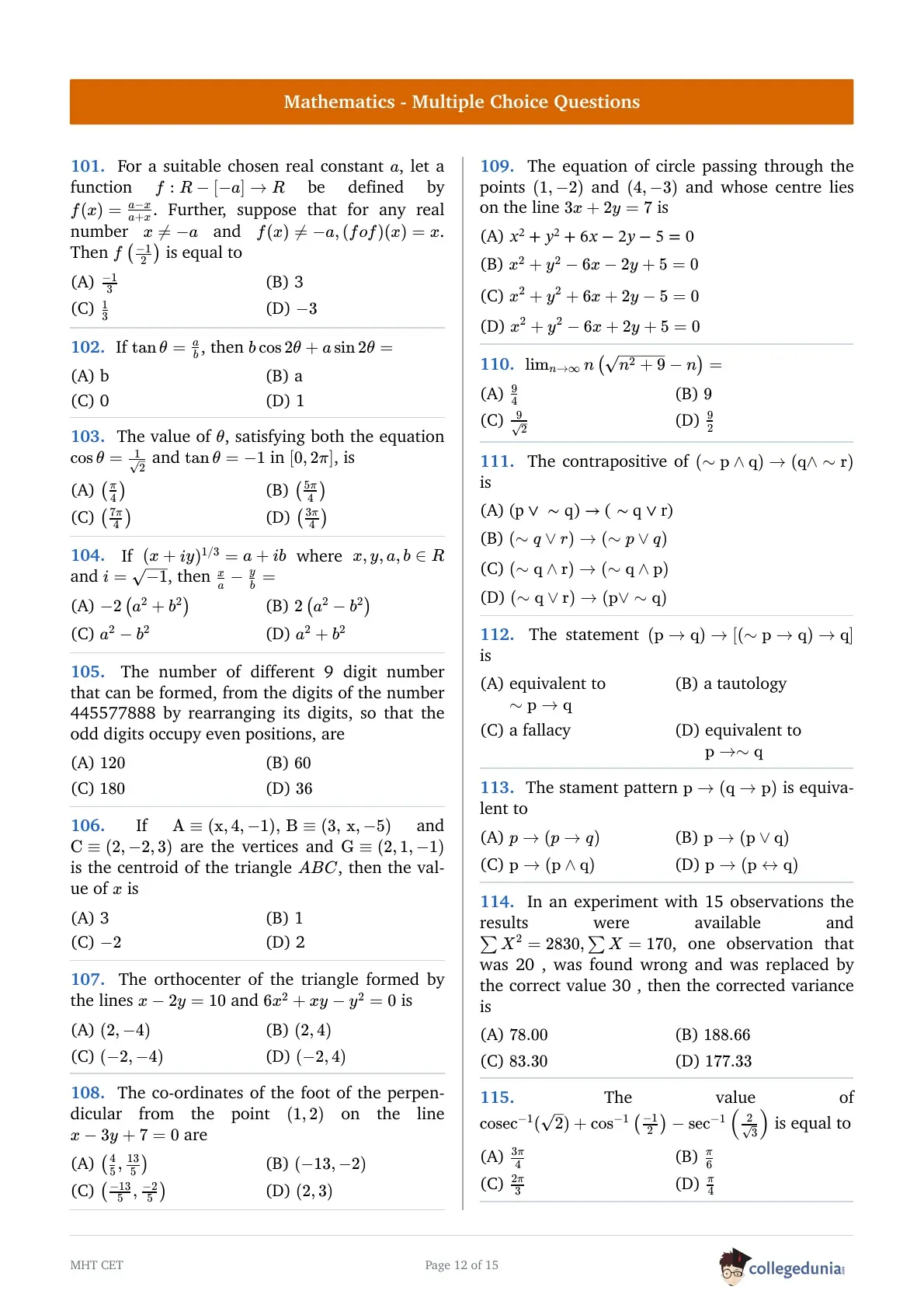
For a suitable chosen real constant \(a\), let a function \(f:R-[-a]\rightarrow R\) be defined by \(f(x)=\frac{a-x}{a+x}\). Further, suppose that for any real number \(x\neq -a\) and \(f(x)\neq -a,(fof)(x)=x\). Then \(f\left(\frac{-1}{2}\right)\) is equal to
If \(\tan \theta =\frac{a}{b}\), then \(b\cos 2\theta +a\sin 2\theta =\)
The value of \(\theta\), satisfying both the equation \(\cos \theta =\frac{1}{\sqrt{2}}\) and \(\tan \theta =-1\) in \([0,2\pi ]\), is
If \((x+iy)^{1/3}=a+ib\) where \(x,y,a,b\in R\) and \(i=\sqrt{-1}\), then \(\frac{x}{a}-\frac{y}{b}=\)
The number of different 9 digit number that can be formed, from the digits of the number 445577888 by rearranging its digits, so that the odd digits occupy even positions, are
If \(\mathrm{A}\equiv (\mathrm{x},4,-1),\,\mathrm{B}\equiv (3,\,\mathrm{x},-5)\) and \(\mathrm{C}\equiv (2,-2,3)\) are the vertices and \(\mathrm{G}\equiv (2,1,-1)\) is the centroid of the triangle \(ABC\), then the value of \(x\) is
The orthocenter of the triangle formed by the lines \(x-2y=10\) and \(6x^{2}+xy-y^{2}=0\) is
The co-ordinates of the foot of the perpendicular from the point \((1,2)\) on the line \(x-3y+7=0\) are
The equation of circle passing through the points \((1,-2)\) and \((4,-3)\) and whose centre lies on the line \(3x+2y=7\) is
\(\lim _{n\rightarrow \infty }n\left(\sqrt{n^{2}+9}-n\right)=\)
The contrapositive of \((\sim \mathrm{p}\wedge \mathrm{q})\rightarrow (\mathrm{q}\wedge \sim \mathrm{r})\) is
The statement \((\mathrm{p}\rightarrow \mathrm{q})\rightarrow [(\sim \mathrm{p}\rightarrow \mathrm{q})\rightarrow \mathrm{q}]\) is
The stament pattern \(\mathrm{p}\rightarrow (\mathrm{q}\rightarrow \mathrm{p})\) is equivalent to
In an experiment with 15 observations the results were available and \(\sum X^{2}=2830,\sum X=170\), one observation that was 20 , was found wrong and was replaced by the correct value 30 , then the corrected variance is
The value of \(\operatorname{cosec}^{-1}(\sqrt{2})+\cos ^{-1}\left(\frac{-1}{2}\right)-\sec ^{-1}\left(\frac{2}{\sqrt{3}}\right)\) is equal to
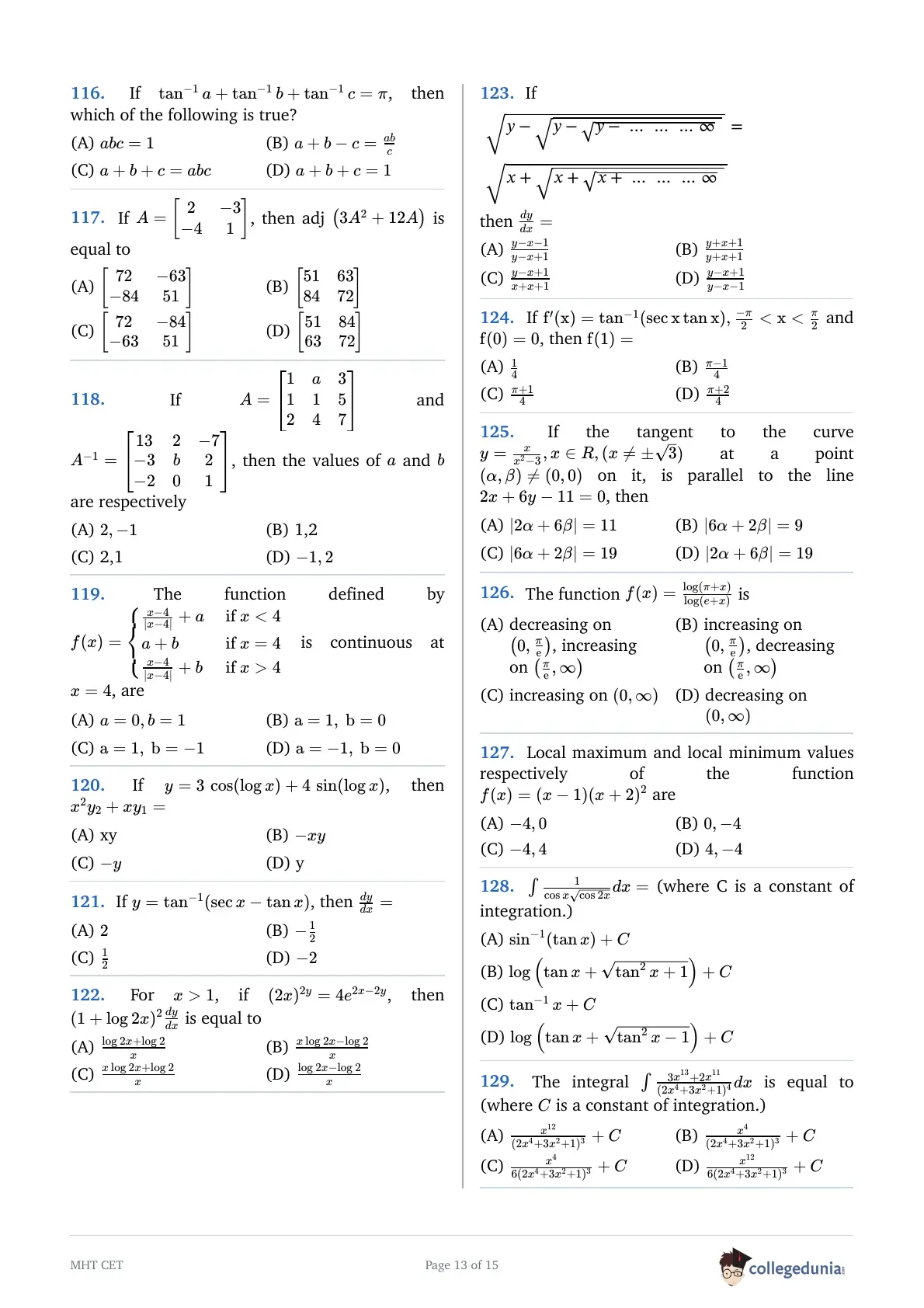
If \(\tan ^{-1}a+\tan ^{-1}b+\tan ^{-1}c=\pi\), then which of the following is true?
If \(A=\begin{bmatrix} 2 & -3 \\ -4 & 1 \end{bmatrix}\), then adj \(\left(3A^{2}+12A\right)\) is equal to
If \(A=\begin{bmatrix} 1 & a & 3 \\ 1 & 1 & 5 \\ 2 & 4 & 7 \end{bmatrix}\) and \(A^{-1}=\begin{bmatrix} 13 & 2 & -7 \\ -3 & b & 2 \\ -2 & 0 & 1 \end{bmatrix}\), then the values of \(a\) and \(b\) are respectively
The function defined by \(f(x)=\begin{cases} \frac{x-4}{|x-4|}+a & \text{ if }x\lt 4 \\ a+b & \text{ if }x=4 \\ \frac{x-4}{|x-4|}+b & \text{ if }x>4 \end{cases}\) is continuous at \(x=4\), are
If \(y=3\,\cos (\log x)+4\,\sin (\log x)\), then \(x^{2}y_{2}+xy_{1}=\)
If \(y=\tan ^{-1}(\sec x-\tan x)\), then \(\frac{dy}{dx}=\)
For \(x>1\), if \((2x)^{2y}=4e^{2x-2y}\), then \((1+\log 2x)^{2}\frac{dy}{dx}\) is equal to
If \(\sqrt{y-\sqrt{y-\sqrt{y-\ldots \ldots \ldots \infty }}}=\sqrt{x+\sqrt{x+\sqrt{x+\ldots \ldots \ldots \infty }}}\) then \(\frac{dy}{dx}=\)
If the tangent to the curve \(y=\frac{x}{x^{2}-3},x\in R,(x\neq \pm \sqrt{3})\) at a point \((\alpha ,\beta )\neq (0,0)\) on it, is parallel to the line \(2x+6y-11=0\), then
The function \(f(x)=\frac{\log (\pi +x)}{\log (e+x)}\) is
Local maximum and local minimum values respectively of the function \(f(x)=(x-1)(x+2)^{2}\) are
\(\int \frac{1}{\cos x\sqrt{\cos 2x}}dx=\) (where C is a constant of integration.)
The integral \(\int \frac{3x^{13}+2x^{11}}{(2x^{4}+3x^{2}+1)^{4}}dx\) is equal to (where \(C\) is a constant of integration.)
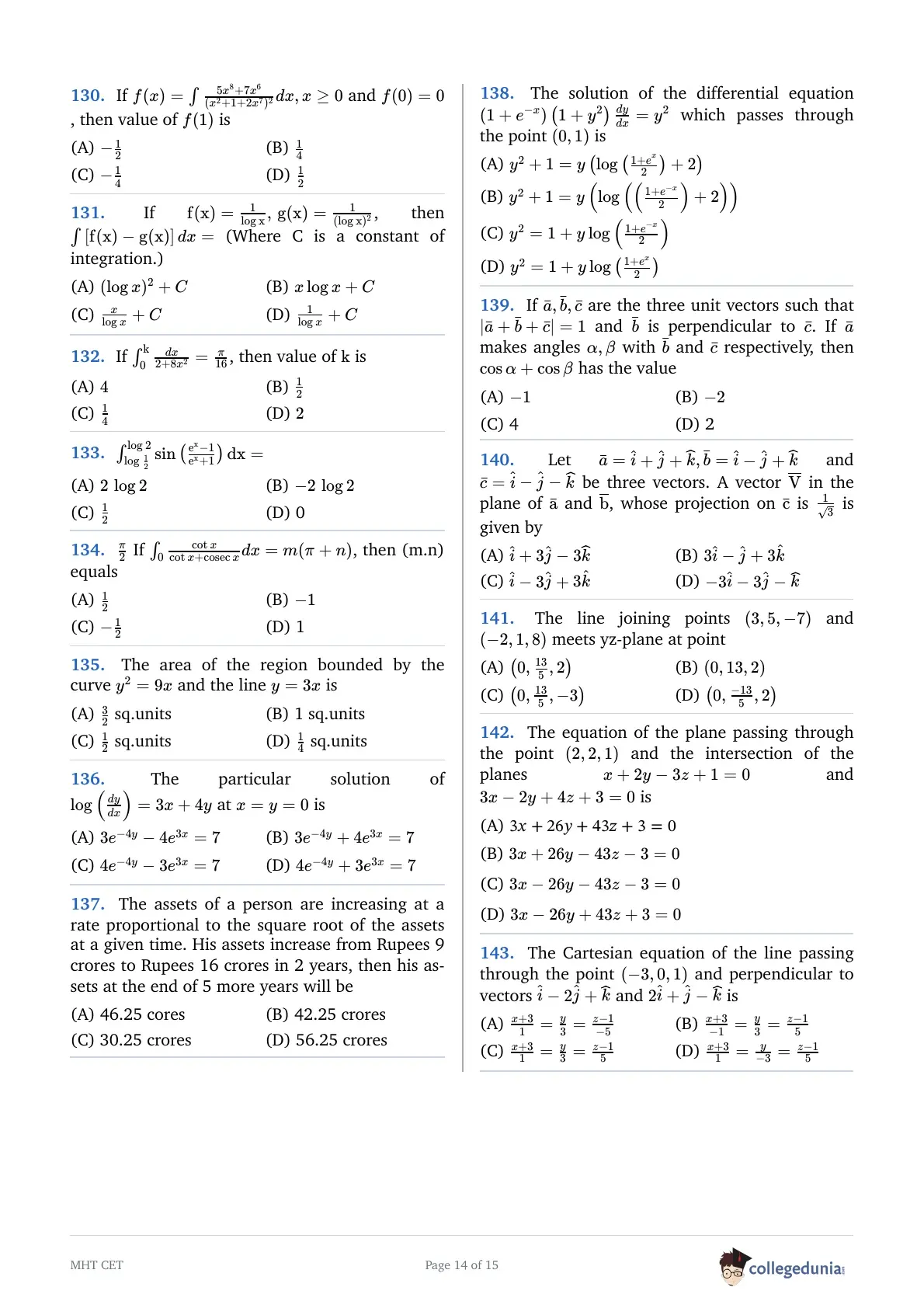
If \(f(x)=\int \frac{5x^{8}+7x^{6}}{(x^{2}+1+2x^{7})^{2}}dx,x\geq 0\) and \(f(0)=0\), then value of \(f(1)\) is
If \(\mathrm{f}(\mathrm{x})=\frac{1}{\log \mathrm{x}},\,\mathrm{g}(\mathrm{x})=\frac{1}{(\log \mathrm{x})^{2}}\), then \(\int \left[\mathrm{f}(\mathrm{x})-\mathrm{g}(\mathrm{x})\right]dx=\) (Where C is a constant of integration.)
If \(\int _{0}^{\mathrm{k}}\frac{dx}{2+8x^{2}}=\frac{\pi }{16}\), then value of \(\mathrm{k}\) is
\(\int _{\log \frac{1}{2}}^{\log 2}\sin \left(\frac{\mathrm{e}^{\mathrm{x}}-1}{\mathrm{e}^{\mathrm{x}}+1}\right)\mathrm{dx}=\)
\(\frac{\pi }{2}\) If \(\int _{0}\frac{\cot x}{\cot x+\operatorname{cosec} x}dx=m(\pi +n)\), then (m.n) equals
The area of the region bounded by the curve \(y^{2}=9x\) and the line \(y=3x\) is
The particular solution of \(\log \left(\frac{dy}{dx}\right)=3x+4y\) at \(x=y=0\) is
The assets of a person are increasing at a rate proportional to the square root of the assets at a given time. His assets increase from Rupees 9 crores to Rupees 16 crores in 2 years, then his assets at the end of 5 more years will be
The solution of the differential equation \((1+e^{-x})\left(1+y^{2}\right)\frac{dy}{dx}=y^{2}\) which passes through the point \((0,1)\) is
If \(\bar{a},\bar{b},\bar{c}\) are the three unit vectors such that \(|\bar{a}+\bar{b}+\bar{c}|=1\) and \(\bar{b}\) is perpendicular to \(\bar{c}\). If \(\bar{a}\) makes angles \(\alpha ,\beta\) with \(\bar{b}\) and \(\bar{c}\) respectively, then \(\cos \alpha +\cos \beta\) has the value
Let \(\bar{a}=\hat{i}+\hat{j}+\widehat{k},\bar{b}=\hat{i}-\hat{j}+\widehat{k}\) and \(\bar{c}=\hat{i}-\hat{j}-\widehat{k}\) be three vectors. A vector \(\overline{\mathrm{V}}\) in the plane of \(\bar{\mathrm{a}}\) and \(\overline{\mathrm{b}}\), whose projection on \(\bar{\mathrm{c}}\) is \(\frac{1}{\sqrt{3}}\) is given by
The line joining points \((3,5,-7)\) and \((-2,1,8)\) meets yz-plane at point
The equation of the plane passing through the point \((2,2,1)\) and the intersection of the planes \(x+2y-3z+1=0\) and \(3x-2y+4z+3=0\) is
The Cartesian equation of the line passing through the point \((-3,0,1)\) and perpendicular to vectors \(\hat{i}-2\hat{j}+\widehat{k}\) and \(2\hat{i}+\hat{j}-\widehat{k}\) is
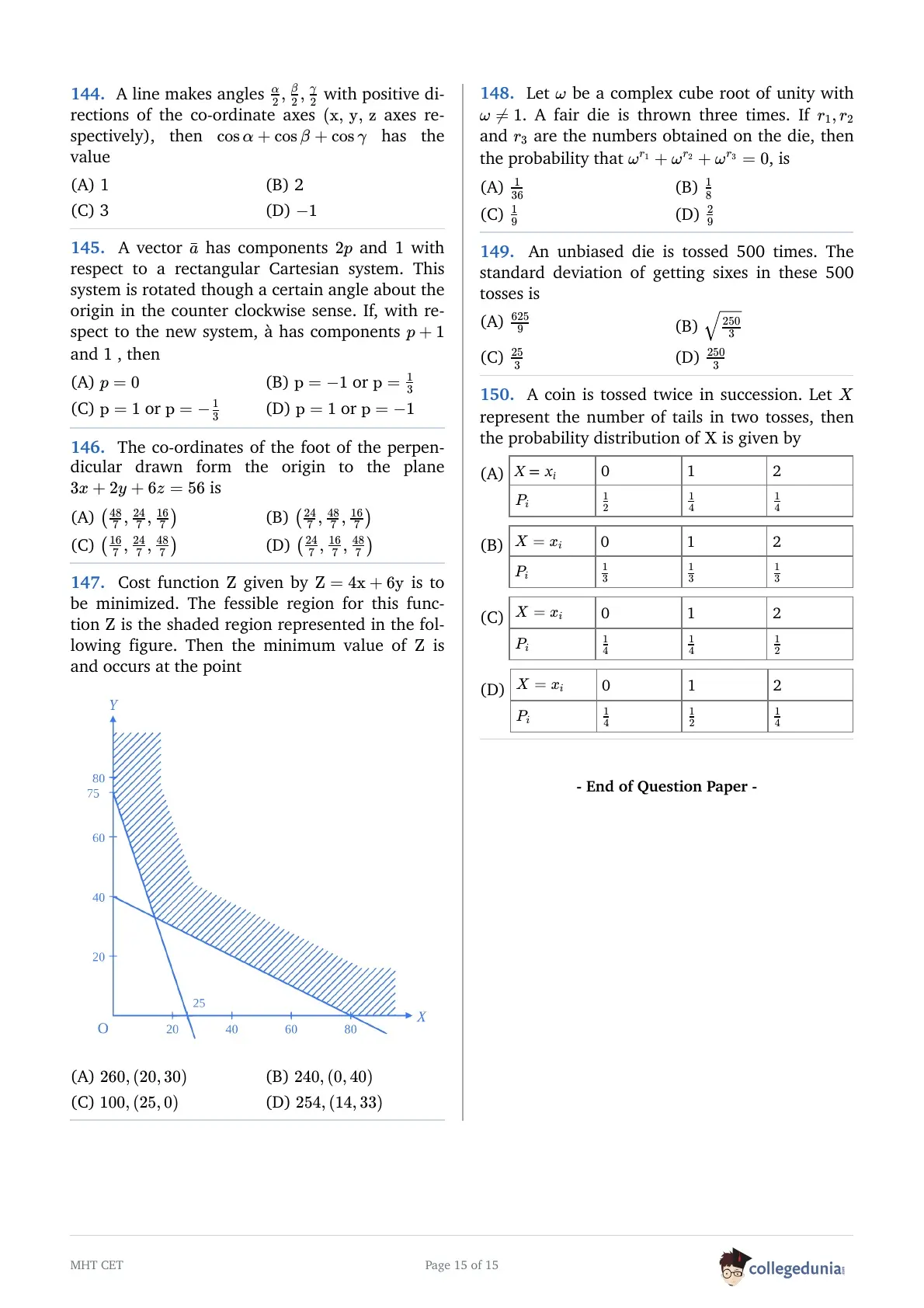
A line makes angles \(\frac{\alpha }{2},\frac{\beta }{2},\frac{\gamma }{2}\) with positive directions of the co-ordinate axes \((\mathrm{x},\,\mathrm{y},\,\mathrm{z}\) axes respectively), then \(\cos \alpha +\cos \beta +\cos \gamma\) has the value
A vector \(\bar{a}\) has components \(2p\) and 1 with respect to a rectangular Cartesian system. This system is rotated though a certain angle about the origin in the counter clockwise sense. If, with respect to the new system, à has components \(p+1\) and 1 , then
The co-ordinates of the foot of the perpendicular drawn form the origin to the plane \(3x+2y+6z=56\) is
Cost function \(\mathrm{Z}\) given by \(\mathrm{Z}=4\mathrm{x}+6\mathrm{y}\) is to be minimized. The fessible region for this function \(\mathrm{Z}\) is the shaded region represented in the following figure. Then the minimum value of \(\mathrm{Z}\) is and occurs at the point

Let \(\omega\) be a complex cube root of unity with \(\omega \neq 1\). A fair die is thrown three times. If \(r_{1},r_{2}\) and \(r_{3}\) are the numbers obtained on the die, then the probability that \(\omega ^{r_{1}}+\omega ^{r_{2}}+\omega ^{r_{3}}=0\), is
An unbiased die is tossed 500 times. The standard deviation of getting sixes in these 500 tosses is
A coin is tossed twice in succession. Let \(X\) represent the number of tails in two tosses, then the probability distribution of \(\mathrm{X}\) is given by
MHT CET 2022 PCM Exam Pattern and Marking Scheme
| Parameter | Details |
|---|---|
| Conducting Body | Maharashtra Common Entrance Test Cell (Maharashtra CET Cell) |
| Exam Mode | Online (Computer-Based Test) |
| Duration | 180 minutes (3 hours) |
| Groups / Subjects | PCM (Physics, Chemistry, Mathematics) for Engineering |
| Total Questions |
150 |
| Total Marks | 200 |
| Question Type | Multiple Choice Questions (MCQs) |
| Marks Distribution |
|
| Negative Marking | No |
| Syllabus Weightage |
|



Comments