




MHT CET 2022 Aug 6 Shift 2 PCM Question Paper is available for download here. Maharashtra State CET Cell conducted MHT CET 2022 PCM Exam on Aug 6 in Shift 2 from 2 PM to 5 PM in CBT mode.
The MHT CET 2022 PCM question paper includes the following:
- The MHT CET 2022 PCM Question Paper consists of 150 multiple-choice questions (MCQs) totalling 200 marks divided into 3 sections: Physics, Chemistry, and Mathematics, with 50 questions in each subject.
- Physics and Chemistry questions carry 1 mark each while Mathematics questions carry 2 marks each.
- There is no negative marking for incorrect answers.
MHT CET 2022 Aug 6 Shift 2 PCM Question Paper with Solution PDF
| CD PDF | CD PDF with Solutions |
|---|---|
| Download Collegedunia PDF 1.58 MB | - |
Also Check:
MHT CET 2022 Aug 6 Shift 2 PCM Questions with Solutions
Physics (Q1 - Q50)
\(10^{23}\) molecules of a gas, each having a mass of \(3\times 10^{-27}\ \mathrm{kg}\) strike per second per sq.cm of a rigid wall at an angle of \(60^{\circ }\) with the normal and rebound with a velocity of \(500\ \mathrm{m}/\mathrm{s}\). The pressure exerted by the gas molecules on the wall is
Two masses \(m_{1}\) and \(m_{2}\) moving with velocities \(v_{1}\) and \(v_{2}\) in opposite directions collide elastically and after collision masses \(m_{1}\) and \(m_{2}\) move with velocity \(v_{2}\) and \(v_{1}\) respectively. The ratio \(\left(\frac{m_{2}}{m_{1}}\right)\) is
The angular velocity of the minute hand of a clock in degrees per second is
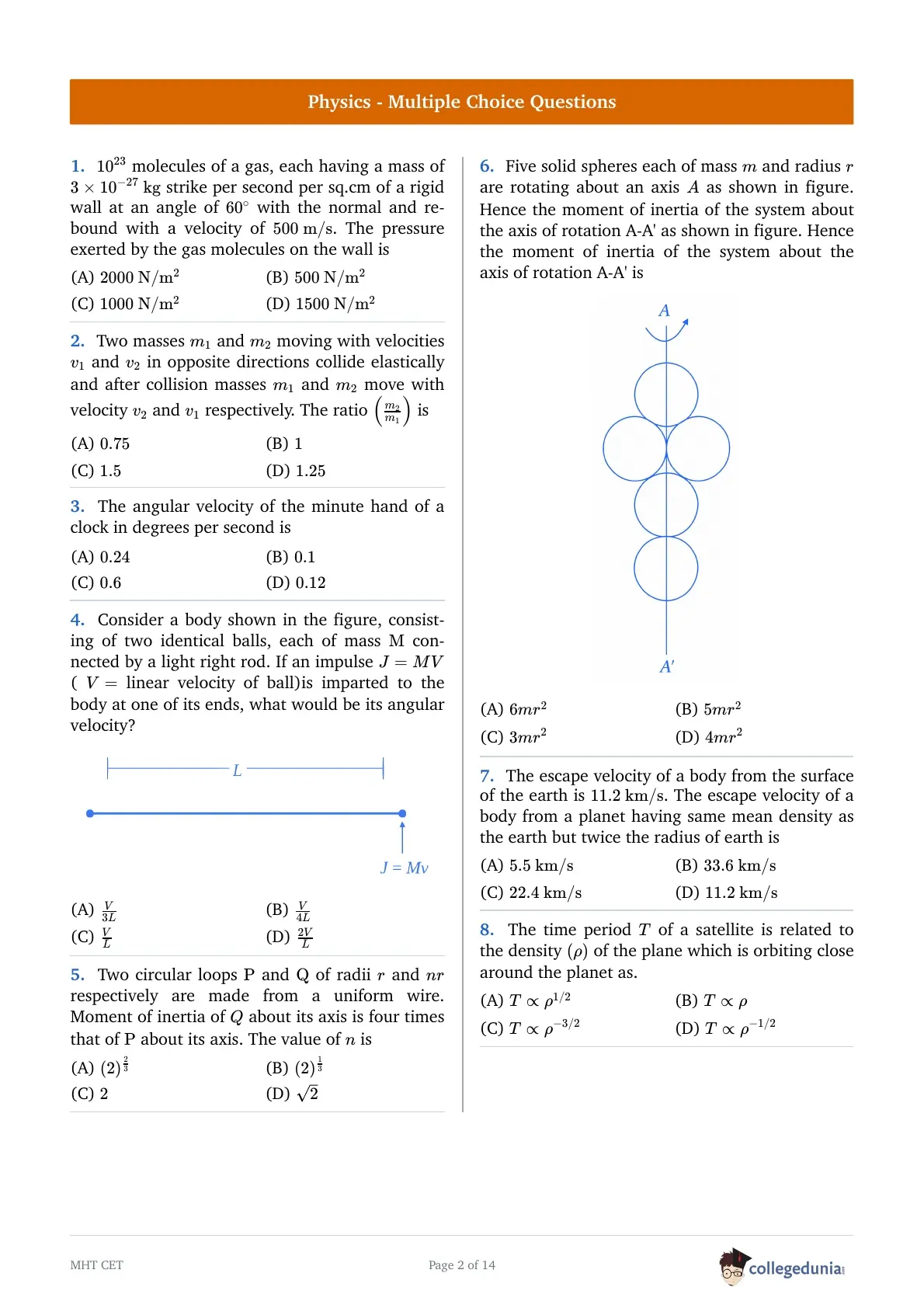
Consider a body shown in the figure, consisting of two identical balls, each of mass \(\mathrm{M}\) connected by a light right rod. If an impulse \(J=MV\) ( \(V=\) linear velocity of ball)is imparted to the body at one of its ends, what would be its angular velocity?

Two circular loops \(\mathrm{P}\) and \(\mathrm{Q}\) of radii \(r\) and \(nr\) respectively are made from a uniform wire. Moment of inertia of \(Q\) about its axis is four times that of \(\mathrm{P}\) about its axis. The value of \(n\) is
Five solid spheres each of mass \(m\) and radius \(r\) are rotating about an axis \(A\) as shown in figure. Hence the moment of inertia of the system about the axis of rotation A-A' as shown in figure. Hence the moment of inertia of the system about the axis of rotation A-A' is

The escape velocity of a body from the surface of the earth is \(11.2\ \mathrm{km}/\mathrm{s}\). The escape velocity of a body from a planet having same mean density as the earth but twice the radius of earth is
The time period \(T\) of a satellite is related to the density \((\rho )\) of the plane which is orbiting close around the planet as.
Two narrow tube of diameters \(d_{1}\) and \(d_{2}\) are joined together to form a Utube open at both ends. If U-tube contains water, the difference in water levels in the limbs is ( \(T\) is the surface tension of water, angle of contact is zero and density of water is \(\rho ,g\) is the acceleration due to gravity)
When a liquid flows through a tube, the Reynold's number is 900 , the flow of a liquid is
Eight identical small drops of water are falling down vertically through a medium, each with terminal velocity \(v\). If they combine to form a single drop, then its terminal velocity will be
The radiation energy density per unit wavelength at temperature \(T\) is maximum at a wavelength \(\lambda _{0}\). At temperature \(2T\), it will have a maximum at a wavelength
An object is cooled from \(75^{\circ }\mathrm{C}\) to \(65^{\circ }\mathrm{Cin}2\ \min\). The time, it takes to cool from \(55^{\circ }\mathrm{C}\) to \(45^{\circ }\mathrm{Cis}\) [The temperature of surrounding is \(30^{\circ }\mathrm{C}\) ]
If the temperature of back body is doubled, the frequency at which the spectral intensity becomes maximum, will be
At thermodynamics process of uncontrolled change satisfying the equation \(Q=W=0\), is \([Q=\) heat supplied, \(W=\) work done \(]\)
A monoatomic ideal gas, initially at temperature \(T_{1}\) is enclosed in a cylinder fitted with a frictionless piston. The gas is allowed to expand adiabatically to a temperature \(T_{2}\) by releasing the piston suddenly. If \(L_{1}\) and \(L_{2}\) are the lengths of the gas column before and after expansion respectively then \(\frac{T_{1}}{T_{2}}\) is given by
A rectangular block of mas \(M\) and cross-sectional area \(A\) floats on a liquid of density \(\rho\). It is given a small vertical displacement from equilibrium; it starts oscillating with frequency \(n\) then
The equation of motion of a particle performing linear S.H.M is \(x=5\,\sin \left[4t-\frac{\pi }{6}\right]\), where \(x\) is its displacement in \(\mathrm{cm}\). The velocity of the particle when its displacement is \(3\ \mathrm{cm}\), is
A wave travelling along uniform string represented by \(Y=A\sin (\omega t-kx)\) is superimposed on another wave travelling along the same string represented by \(Y=A\sin (\omega t+kx)\). The resultant is
If the ratio of the intensities of two waves producing interference is \(49:16\), then the ratio of the resultant maximum intensity to minimum intensity will be
A car sounding a horn of frequency \(1000\ \mathrm{Hz}\) passes an observer. The ratio of frequencies of the both noted by the observer before and after passing of the car is 11:9. If the speed of sound is \(V\), the speed of the car is
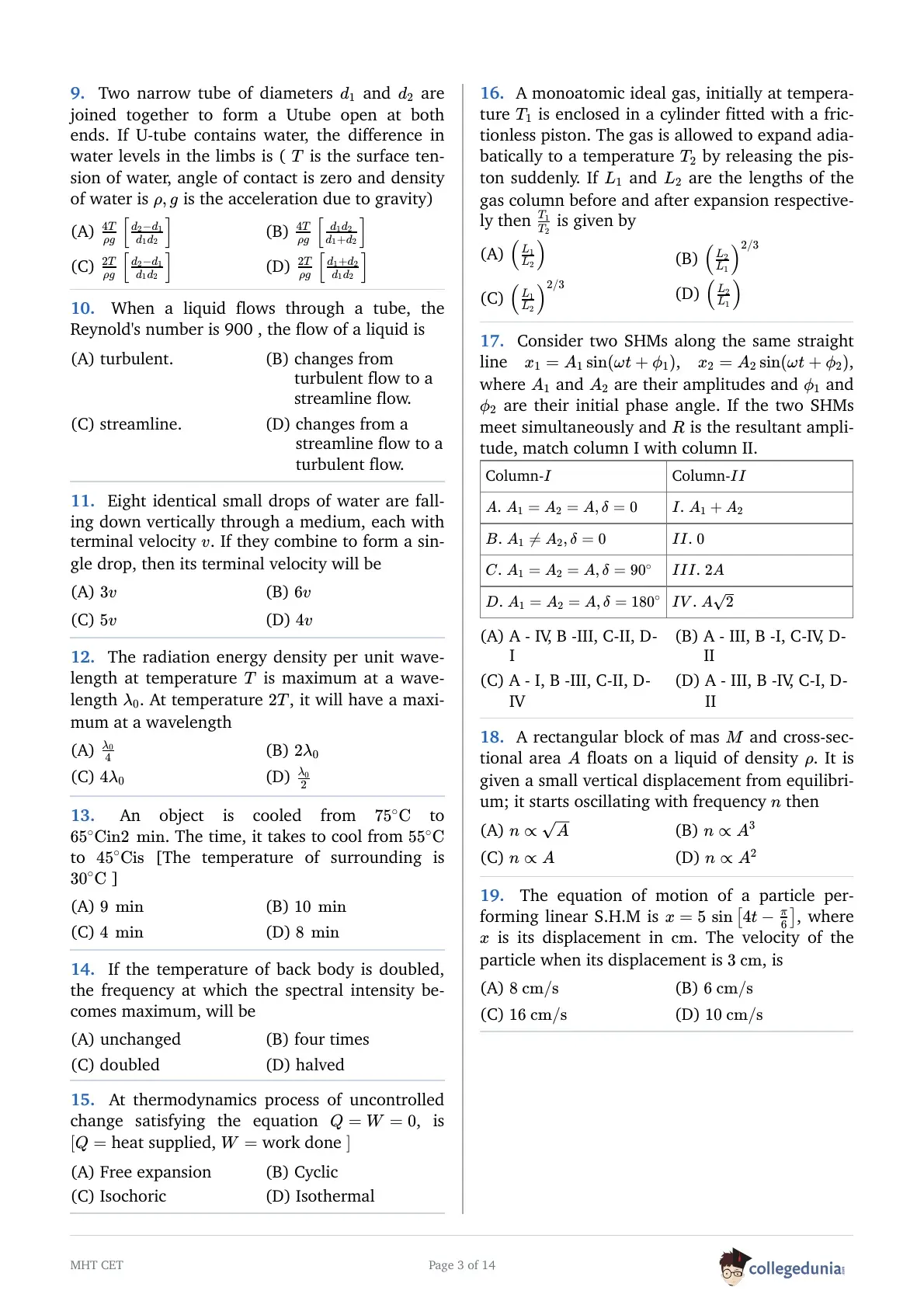
The optical path difference between two identical light waves arriving at a point is \(31.5\lambda\), where \(\lambda\) is the wavelength of light used. The point is [Given: Two light sources are coherent]
For a stationary wave, \(Y=10\,\sin \left(\frac{\pi x}{15}\right)\cos (48\pi t)\mathrm{cm}\), the distance between a node and the successive antinode is
A pipe closed at one end length \(0.8\ \mathrm{m}\). At its open end a \(0.5\mathrm{mlong}\) uniform string is vibrating in its second harmonic and it resonates with the fundamental frequency of the pipe. If the tension in the wire in \(50\ \mathrm{N}\) and the speed of sound is \(320\ \mathrm{m}/\mathrm{s}\), the mass of the string used is
Identify the WRONG statement in the case of electric field lines.
A parallel plate air filled capacitor of capacitance \(C\) has plate area \(A\) and the distance between the plates \(d\). When a metal sheet of thickness \(\left(\frac{d}{2}\right)\) and of the same area \(A\) is introduced between the plates, its capacitance becomes \(C_{2}\). The ratio \(C_{2}:C_{1}\) is
An uncharged capacitor is connected to a battery. While charging the capacitor, how much is the energy lost, from the energy supplied by the battery?
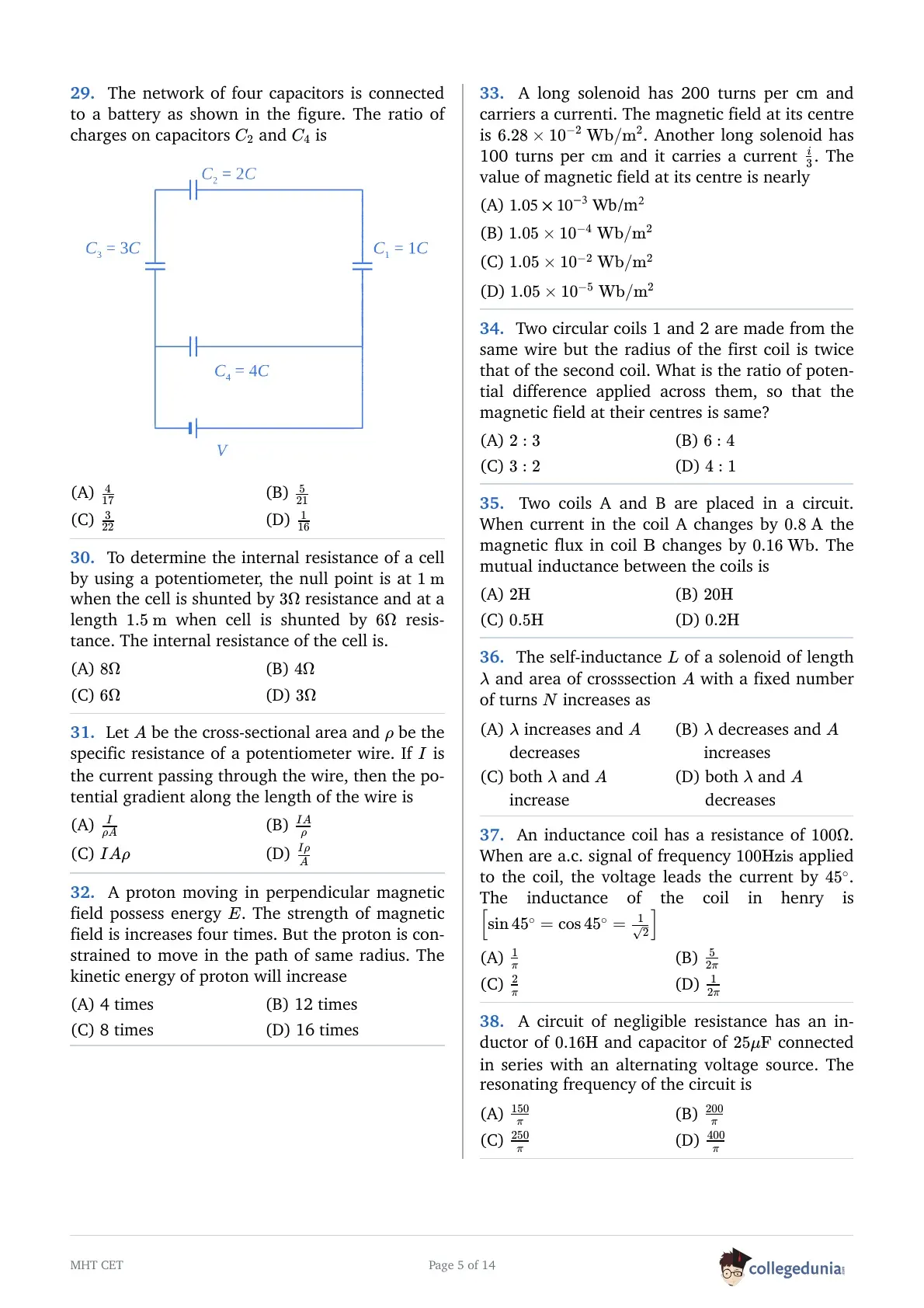
The network of four capacitors is connected to a battery as shown in the figure. The ratio of charges on capacitors \(C_{2}\) and \(C_{4}\) is

To determine the internal resistance of a cell by using a potentiometer, the null point is at \(1\ \mathrm{m}\) when the cell is shunted by \(3\Omega\) resistance and at a length \(1.5\ \mathrm{m}\) when cell is shunted by \(6\Omega\) resistance. The internal resistance of the cell is.
Let \(A\) be the cross-sectional area and \(\rho\) be the specific resistance of a potentiometer wire. If \(I\) is the current passing through the wire, then the potential gradient along the length of the wire is
A proton moving in perpendicular magnetic field possess energy \(E\). The strength of magnetic field is increases four times. But the proton is constrained to move in the path of same radius. The kinetic energy of proton will increase
A long solenoid has 200 turns per cm and carriers a currenti. The magnetic field at its centre is \(6.28\times 10^{-2}\ \mathrm{Wb}/\mathrm{m}^{2}\). Another long solenoid has 100 turns per \(\mathrm{cm}\) and it carries a current \(\frac{i}{3}\). The value of magnetic field at its centre is nearly
Two circular coils 1 and 2 are made from the same wire but the radius of the first coil is twice that of the second coil. What is the ratio of potential difference applied across them, so that the magnetic field at their centres is same?
Two coils A and B are placed in a circuit. When current in the coil A changes by \(0.8\ \mathrm{A}\) the magnetic flux in coil \(\mathrm{B}\) changes by \(0.16\ \mathrm{Wb}\). The mutual inductance between the coils is
The self-inductance \(L\) of a solenoid of length \(\lambda\) and area of crosssection \(A\) with a fixed number of turns \(N\) increases as
An inductance coil has a resistance of \(100\Omega\). When are a.c. signal of frequency \(100\mathrm{Hzis}\) applied to the coil, the voltage leads the current by \(45^{\circ }\). The inductance of the coil in henry is \(\left[\sin 45^{\circ }=\cos 45^{\circ }=\frac{1}{\sqrt{2}}\right]\)
A circuit of negligible resistance has an inductor of \(0.16\mathrm{H}\) and capacitor of \(25\mu \mathrm{F}\) connected in series with an alternating voltage source. The resonating frequency of the circuit is
The instantaneous values of current and voltage in an AC circuit are given by \(I=6\,\sin \left(100\pi t+\frac{\pi }{4}\right)\) and \(V=5\,\sin \left(100\pi t-\frac{\pi }{4}\right)\), then
The intermediate image formed by an objective lens of a compound microscope is
A glass convex lens is of refractive index 1.55 with both faces of same radius of curvature. What is the radius of curvature required if focal length is to be \(20\ \mathrm{cm}\) ?
In Young's double slit experiment, the two slits are \(d\) distance apart. Interference pattern is observed on the screen at a distance \(D\) from the slits. Fist dark fringe is observed on the screen directly opposite to one of the slits. The wavelength of the light is.
The de-Broglie wavelength of an electron moving in the \(n^{\text{th }}\) Bohr orbit of radius \(r\) is
In photoelectric experiment the stopping potential was measured to be \(V_{1}\) and \(V_{2}\) volt with incident light of wavelength \(\lambda\) and \(\frac{\lambda }{2}\) respectively the value of \(V_{2}\) is [ \((\phi =\) work function, \(e=\) electronic charge \(]\)
For wavelength of visible radiation of hydrogen spectrum Balmer gave an equation as \(\lambda =\frac{\left(\mathrm{km}^{2}\right)}{(\mathrm{m}^{2}-4)}\), where \(m\) is the integer value. The value of \(k\) in terms of Rydberg's constant \(R\) is
Assuming the atom is in the ground state, the expression for the magnetic field at a point nucleus in hydrogen atom due to circular motion of electron is \(\begin{bmatrix} \mu _{0}\rightarrow \text{ permeability of free space, }m\rightarrow \text{ mass of electron } \\ \varepsilon _{0}\rightarrow \text{ permittivity of free space, }h\rightarrow \text{ Planck’s constant } \end{bmatrix}\)
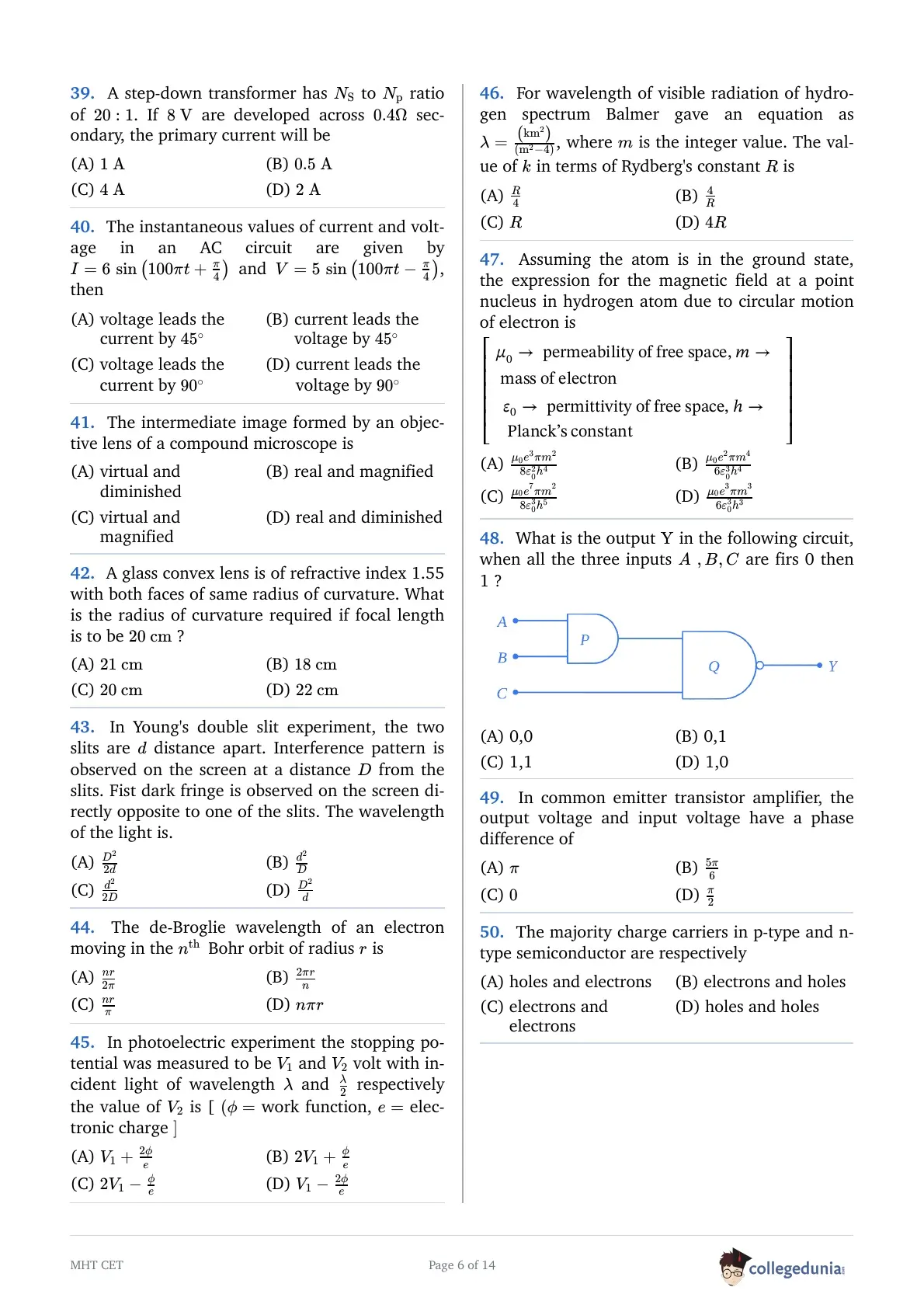
What is the output \(\mathrm{Y}\) in the following circuit, when all the three inputs \(A\) \(,B,C\) are firs 0 then 1 ?

In common emitter transistor amplifier, the output voltage and input voltage have a phase difference of
The majority charge carriers in p-type and n-type semiconductor are respectively
Chemistry (Q51 - Q100)
Find the formula weight of reactant if the formula weight of product is \(54\mathrm{u}\) and the percent atom economy is 75 .
What quantity of carbon dioxide is produced when 2 mole of carbon is burnt in \(16\ \mathrm{g}\) of dioxygen?
Which among the following is group 16 element?
Which among the following elements has only one electron in valence shell?
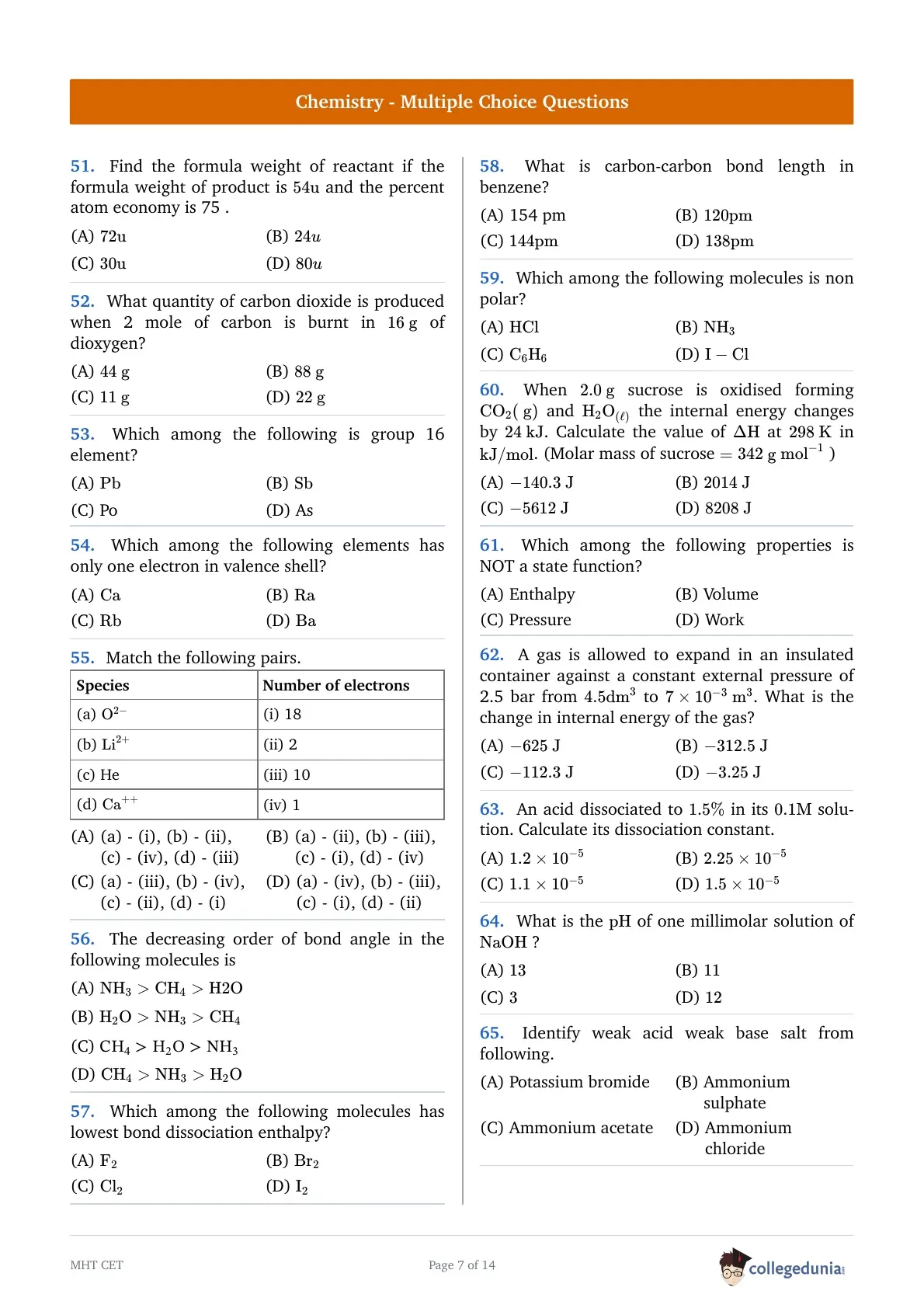
Match the following pairs.
| Species | Number of electrons |
|---|---|
| (a) \(\mathrm{O}^{2-}\) | (i) 18 |
| (b) \(\mathrm{Li}^{2+}\) | (ii) 2 |
| (c) He | (iii) 10 |
| (d) \(\mathrm{Ca}^{++}\) | (iv) 1 |
The decreasing order of bond angle in the following molecules is
Which among the following molecules has lowest bond dissociation enthalpy?
What is carbon-carbon bond length in benzene?
Which among the following molecules is non polar?
Which among the following properties is NOT a state function?
A gas is allowed to expand in an insulated container against a constant external pressure of 2.5 bar from \(4.5\mathrm{dm}^{3}\) to \(7\times 10^{-3}\ \mathrm{m}^{3}\). What is the change in internal energy of the gas?
An acid dissociated to \(1.5\%\) in its \(0.1\mathrm{M}\) solution. Calculate its dissociation constant.
What is the \(\mathrm{pH}\) of one millimolar solution of \(\mathrm{NaOH}\) ?
Identify weak acid weak base salt from following.
What is the oxidation state of oxygen in \(\mathrm{O}_{2}^{2-}\) ion?
Which among the following is electron deficient compound?
Identify optically active substance from the following.
Identify simple ether from the following.
Which among the following compounds is a primary alcohol?
Identify tertiary alkyl halide from the following.
How many \(\pi\) electrons are present in naphthalene to decide it's aromaticity?
Identify the product obtained when bromoethane is heated with excess of alcoholic ammonia under pressure.
Which among the following statement is NOT true about covalent network solid?
Which among the following statements is NOT true about Frenkel defect?
Calculate the number of unit cells in 3 grams metal that crystallises to simple cubic unit cell having edge length \(336\mathrm{pm}\). (density of metal \(=9.4\ \mathrm{g}\ \mathrm{cm}^{-3}\) )
Calculate the molality of a solution having freezing point depression \(3.6\ \mathrm{K}\) and freezing point depression constant \(4.8\ \mathrm{K}\ \mathrm{kg}\ \mathrm{mol}^{-1}\).
Which among the following colligative properties is useful to determine molar masses of very expensive solutes?
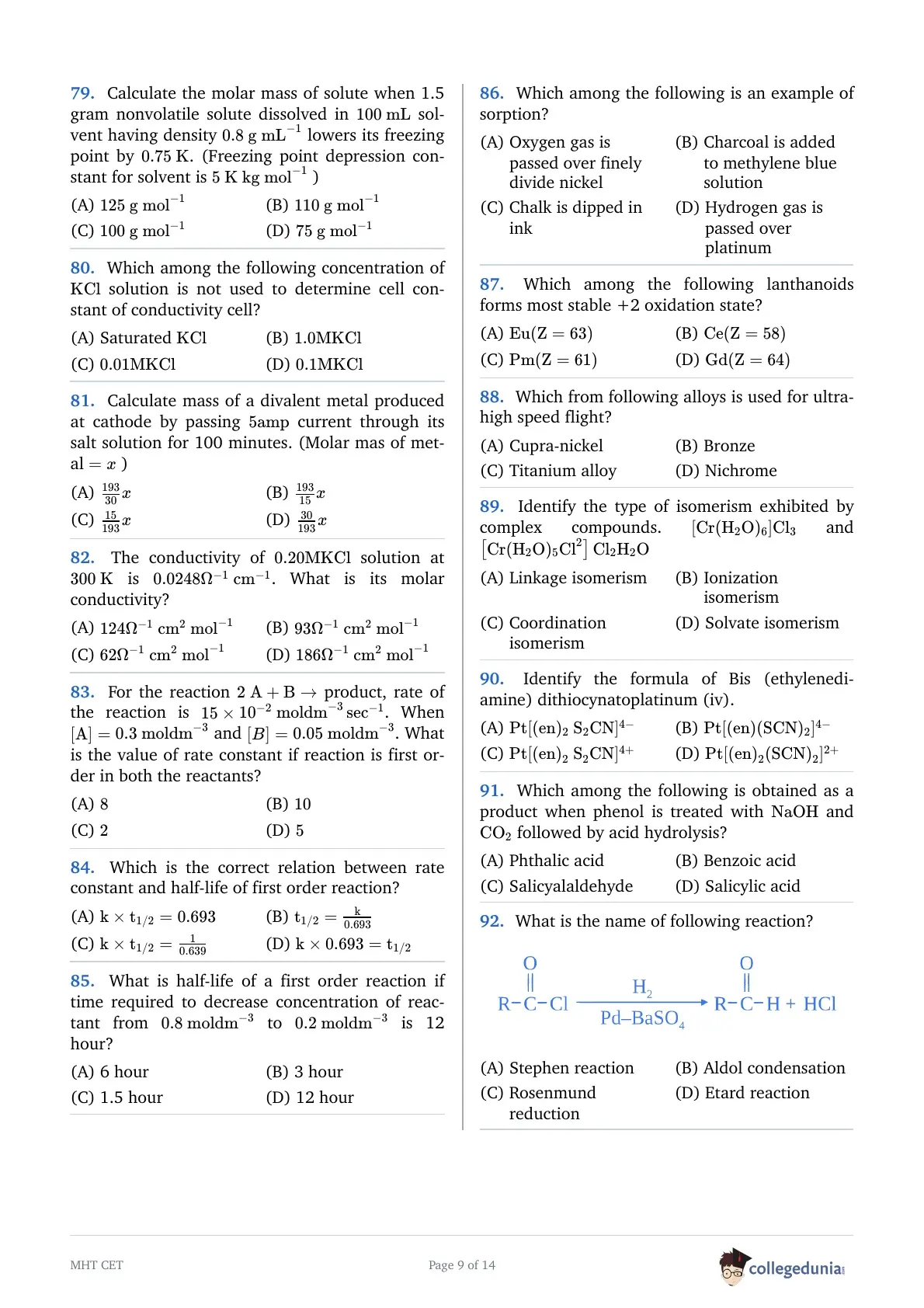
Calculate the molar mass of solute when 1.5 gram nonvolatile solute dissolved in \(100\ \mathrm{mL}\) solvent having density \(0.8\ \mathrm{g}\ \mathrm{mL}^{-1}\) lowers its freezing point by \(0.75\ \mathrm{K}\). (Freezing point depression constant for solvent is \(5\ \mathrm{K}\ \mathrm{kg}\ \mathrm{mol}^{-1}\) )
Which among the following concentration of \(\mathrm{KCl}\) solution is not used to determine cell constant of conductivity cell?
Calculate mass of a divalent metal produced at cathode by passing \(5\mathrm{amp}\) current through its salt solution for 100 minutes. (Molar mas of metal \(=x\) )
The conductivity of \(0.20\mathrm{MKCl}\) solution at \(300\ \mathrm{K}\) is \(0.0248\Omega ^{-1}\ \mathrm{cm}^{-1}\). What is its molar conductivity?
For the reaction \(2\ \mathrm{A}+\mathrm{B}\rightarrow\) product, rate of the reaction is \(15\times 10^{-2}\ \mathrm{mol}\mathrm{dm}^{-3}\sec ^{-1}\). When \([\mathrm{A}]=0.3\ \mathrm{mol}\mathrm{dm}^{-3}\) and \([B]=0.05\ \mathrm{mol}\mathrm{dm}^{-3}\). What is the value of rate constant if reaction is first order in both the reactants?
Which is the correct relation between rate constant and half-life of first order reaction?
What is half-life of a first order reaction if time required to decrease concentration of reactant from \(0.8\ \mathrm{mol}\mathrm{dm}^{-3}\) to \(0.2\ \mathrm{mol}\mathrm{dm}^{-3}\) is 12 hour?
Which among the following is an example of sorption?
Which among the following lanthanoids forms most stable +2 oxidation state?
Which from following alloys is used for ultra-high speed flight?
Identify the type of isomerism exhibited by complex compounds. \([\mathrm{Cr}(\mathrm{H}_{2}\mathrm{O})_{6}]\mathrm{Cl}_{3}\) and \(\left[\mathrm{Cr}(\mathrm{H}_{2}\mathrm{O})_{5}\mathrm{Cl}^{2}\right]\mathrm{Cl}_{2}\mathrm{H}_{2}\mathrm{O}\)
Identify the formula of Bis (ethylenediamine) dithiocynatoplatinum (iv).
Which among the following is obtained as a product when phenol is treated with \(\mathrm{NaOH}\) and \(\mathrm{CO}_{2}\) followed by acid hydrolysis?

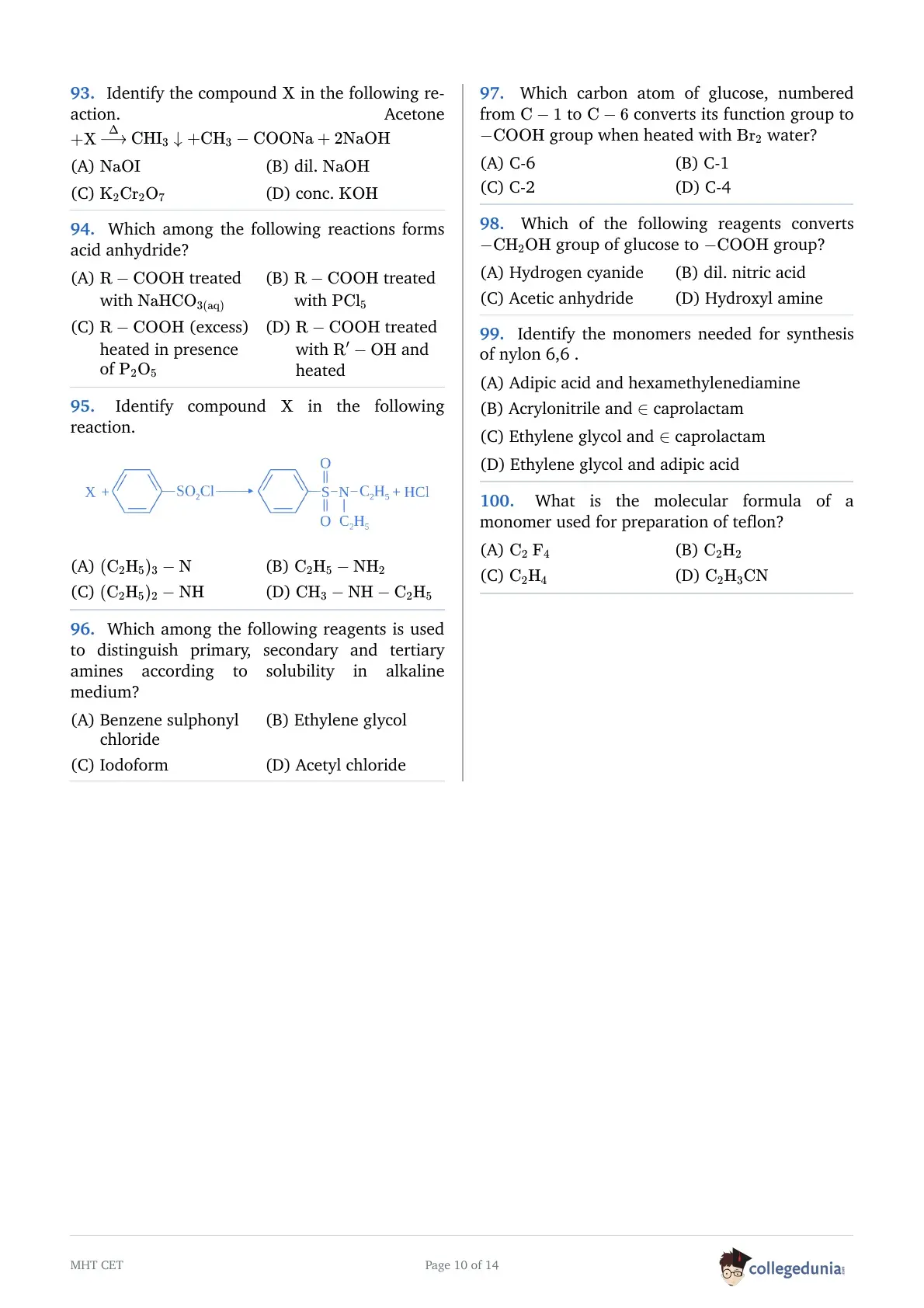
Identify the compound \(\mathrm{X}\) in the following reaction. Acetone \(+\mathrm{X}\xrightarrow{\Delta }\mathrm{CHI}_{3}\downarrow +\mathrm{CH}_{3}-\mathrm{COONa}+2\mathrm{NaOH}\)
Which among the following reactions forms acid anhydride?

Which among the following reagents is used to distinguish primary, secondary and tertiary amines according to solubility in alkaline medium?
Which carbon atom of glucose, numbered from \(\mathrm{C}-1\) to \(\mathrm{C}-6\) converts its function group to \(-\mathrm{COOH}\) group when heated with \(\mathrm{Br}_{2}\) water?
Which of the following reagents converts \(-\mathrm{CH}_{2}\mathrm{OH}\) group of glucose to \(-\mathrm{COOH}\) group?
Identify the monomers needed for synthesis of nylon 6,6 .
What is the molecular formula of a monomer used for preparation of teflon?
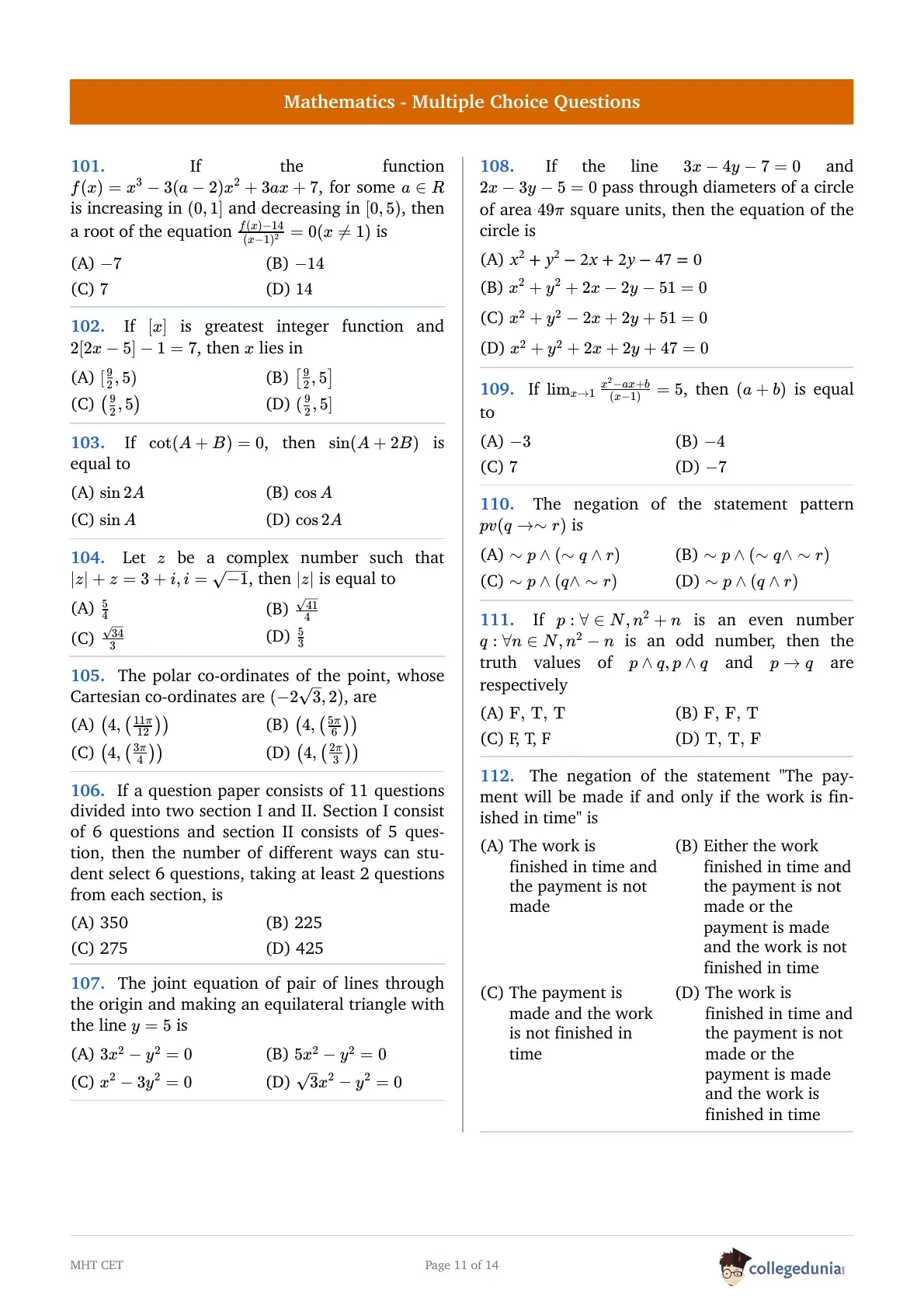
If \([x]\) is greatest integer function and \(2[2x-5]-1=7\), then \(x\) lies in
If \(\cot (A+B)=0\), then \(\sin (A+2B)\) is equal to
Let \(z\) be a complex number such that \(|z|+z=3+i,i=\sqrt{-1}\), then \(|z|\) is equal to
The polar co-ordinates of the point, whose Cartesian co-ordinates are \((-2\sqrt{3},2)\), are
If a question paper consists of 11 questions divided into two section I and II. Section I consist of 6 questions and section II consists of 5 question, then the number of different ways can student select 6 questions, taking at least 2 questions from each section, is
The joint equation of pair of lines through the origin and making an equilateral triangle with the line \(y=5\) is
If the line \(3x-4y-7=0\) and \(2x-3y-5=0\) pass through diameters of a circle of area \(49\pi\) square units, then the equation of the circle is
If \(\lim _{x\rightarrow 1}\frac{x^{2}-ax+b}{(x-1)}=5\), then \((a+b)\) is equal to
The negation of the statement pattern \(pv(q\rightarrow \sim r)\) is
The negation of the statement "The payment will be made if and only if the work is finished in time" is
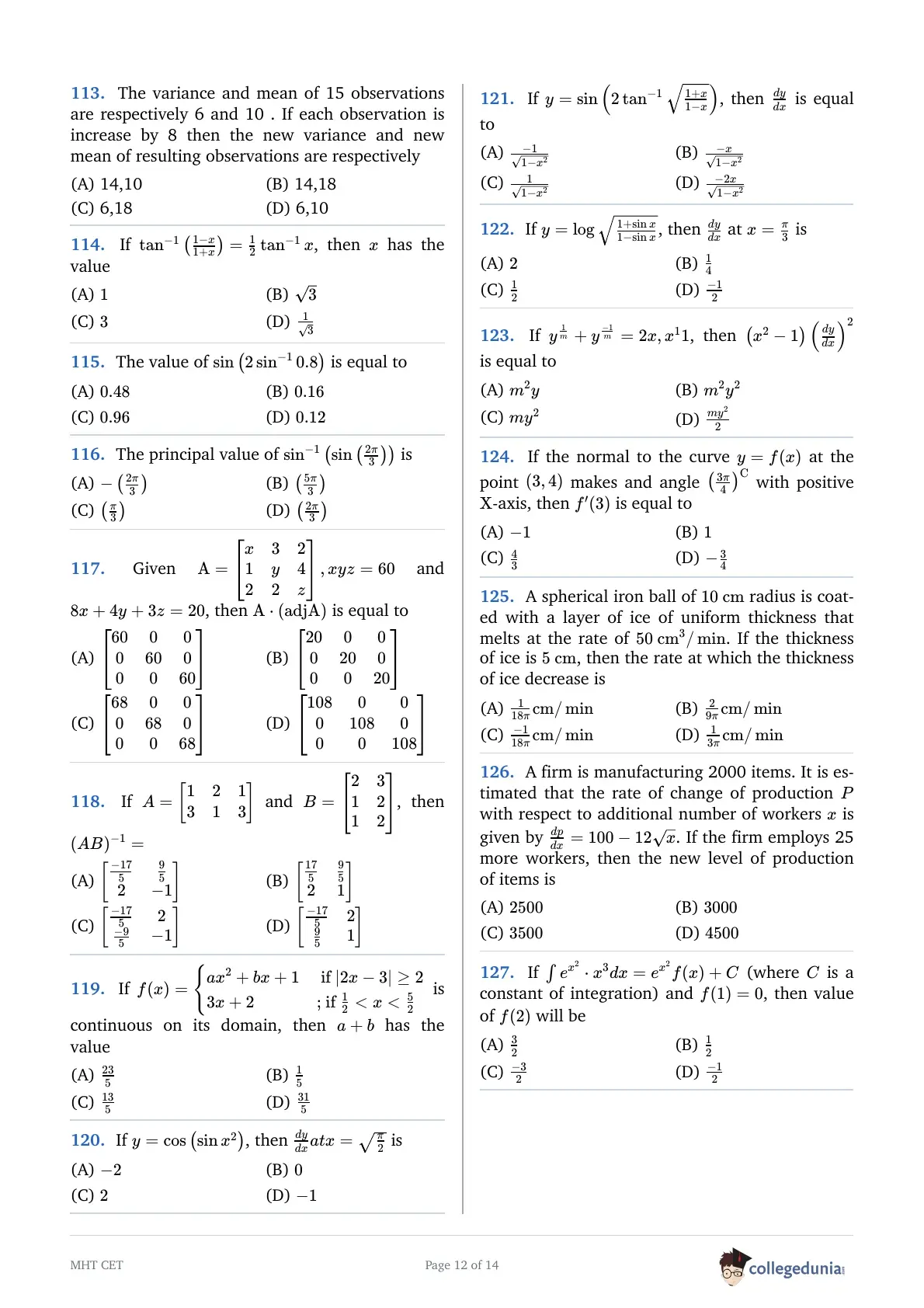
The variance and mean of 15 observations are respectively 6 and 10 . If each observation is increase by 8 then the new variance and new mean of resulting observations are respectively
If \(\tan ^{-1}\left(\frac{1-x}{1+x}\right)=\frac{1}{2}\tan ^{-1}x\), then \(x\) has the value
The value of \(\sin \left(2\sin ^{-1}0.8\right)\) is equal to
The principal value of \(\sin ^{-1}\left(\sin \left(\frac{2\pi }{3}\right)\right)\) is
Given \(\mathrm{A}=\begin{bmatrix} x & 3 & 2 \\ 1 & y & 4 \\ 2 & 2 & z \end{bmatrix},xyz=60\) and \(8x+4y+3z=20\), then \(\mathrm{A}\cdot (\mathrm{adjA})\) is equal to
If \(A=\begin{bmatrix} 1 & 2 & 1 \\ 3 & 1 & 3 \end{bmatrix}\) and \(B=\begin{bmatrix} 2 & 3 \\ 1 & 2 \\ 1 & 2 \end{bmatrix}\), then \((AB)^{-1}=\)
If \(f(x)=\begin{cases} ax^{2}+bx+1 & \text{ if }|2x-3|\geq 2 \\ 3x+2 & \text{; if }\frac{1}{2}\lt x\lt \frac{5}{2} \end{cases}\) is continuous on its domain, then \(a+b\) has the value
If \(y=\cos \left(\sin x^{2}\right)\), then \(\frac{dy}{dx}atx=\sqrt{\frac{\pi }{2}}\) is
If \(y=\sin \left(2\tan ^{-1}\sqrt{\frac{1+x}{1-x}}\right)\), then \(\frac{dy}{dx}\) is equal to
If \(y=\log \sqrt{\frac{1+\sin x}{1-\sin x}}\), then \(\frac{dy}{dx}\) at \(x=\frac{\pi }{3}\) is
If \(y^{\frac{1}{m}}+y^{\frac{-1}{m}}=2x,x^{1}1\), then \(\left(x^{2}-1\right)\left(\frac{dy}{dx}\right)^{2}\) is equal to
If the normal to the curve \(y=f(x)\) at the point \((3,4)\) makes and angle \(\left(\frac{3\pi }{4}\right)^{\mathrm{C}}\) with positive \(\mathrm{X}\)-axis, then \(f'(3)\) is equal to
A spherical iron ball of \(10\ \mathrm{cm}\) radius is coated with a layer of ice of uniform thickness that melts at the rate of \(50\ \mathrm{cm}^{3}/\min\). If the thickness of ice is \(5\ \mathrm{cm}\), then the rate at which the thickness of ice decrease is
A firm is manufacturing 2000 items. It is estimated that the rate of change of production \(P\) with respect to additional number of workers \(x\) is given by \(\frac{dp}{dx}=100-12\sqrt{x}\). If the firm employs 25 more workers, then the new level of production of items is
If \(\int e^{x^{2}}\cdot x^{3}dx=e^{x^{2}}f(x)+C\) (where \(C\) is a constant of integration) and \(f(1)=0\), then value of \(f(2)\) will be
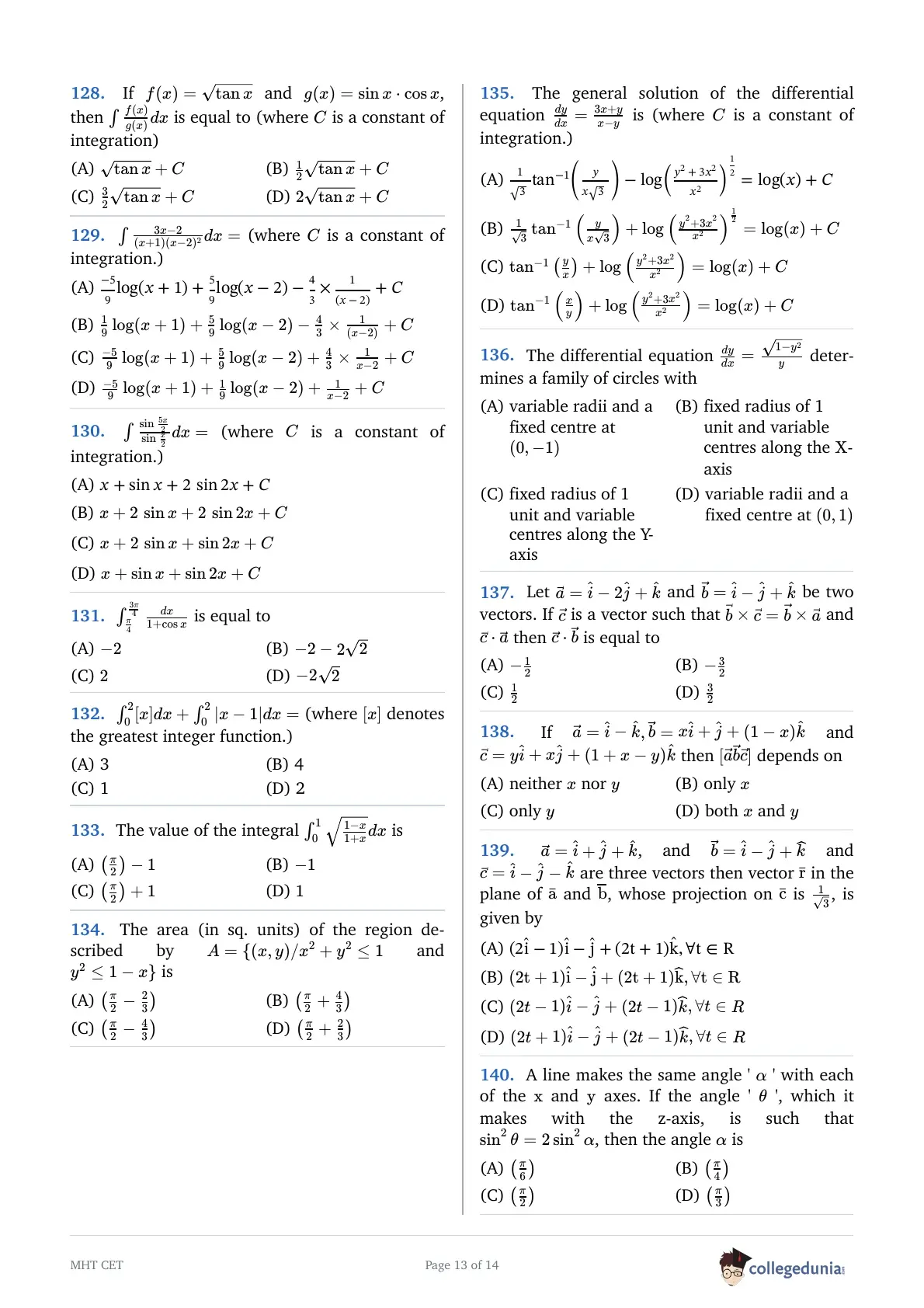
If \(f(x)=\sqrt{\tan x}\) and \(g(x)=\sin x\cdot \cos x\), then \(\int \frac{f(x)}{g(x)}dx\) is equal to (where \(C\) is a constant of integration)
\(\int \frac{3x-2}{(x+1)(x-2)^{2}}dx=\) (where \(C\) is a constant of integration.)
\(\int \frac{\sin \frac{5x}{2}}{\sin \frac{x}{2}}dx=\) (where \(C\) is a constant of integration.)
\(\int _{\frac{\pi }{4}}^{\frac{3\pi }{4}}\frac{dx}{1+\cos x}\) is equal to
\(\int _{0}^{2}[x]dx+\int _{0}^{2}|x-1|dx=\) (where \([x]\) denotes the greatest integer function.)
The value of the integral \(\int _{0}^{1}\sqrt{\frac{1-x}{1+x}}dx\) is
The area (in sq. units) of the region described by \(A=\{(x,y)/x^{2}+y^{2}\leq 1\) and \(y^{2}\leq 1-x\}\) is
The general solution of the differential equation \(\frac{dy}{dx}=\frac{3x+y}{x-y}\) is (where \(C\) is a constant of integration.)
The differential equation \(\frac{dy}{dx}=\frac{\sqrt{1-y^{2}}}{y}\) determines a family of circles with
If \(\vec{a}=\hat{i}-\hat{k},\vec{b}=x\hat{i}+\hat{j}+(1-x)\hat{k}\) and \(\vec{c}=y\hat{i}+x\hat{j}+(1+x-y)\hat{k}\) then \([\vec{a}\vec{b}\vec{c}]\) depends on
\(\vec{a}=\hat{i}+\hat{j}+\hat{k}\), and \(\vec{b}=\hat{i}-\hat{j}+\widehat{k}\) and \(\vec{c}=\hat{i}-\hat{j}-\hat{k}\) are three vectors then vector \(\bar{\mathrm{r}}\) in the plane of \(\bar{\mathrm{a}}\) and \(\overline{\mathrm{b}}\), whose projection on \(\bar{\mathrm{c}}\) is \(\frac{1}{\sqrt{3}}\), is given by
A line makes the same angle ' \(\alpha\) ' with each of the \(\mathrm{x}\) and \(\mathrm{y}\) axes. If the angle ' \(\theta\) ', which it makes with the z-axis, is such that \(\sin ^{2}\theta =2\sin ^{2}\alpha\), then the angle \(\alpha\) is
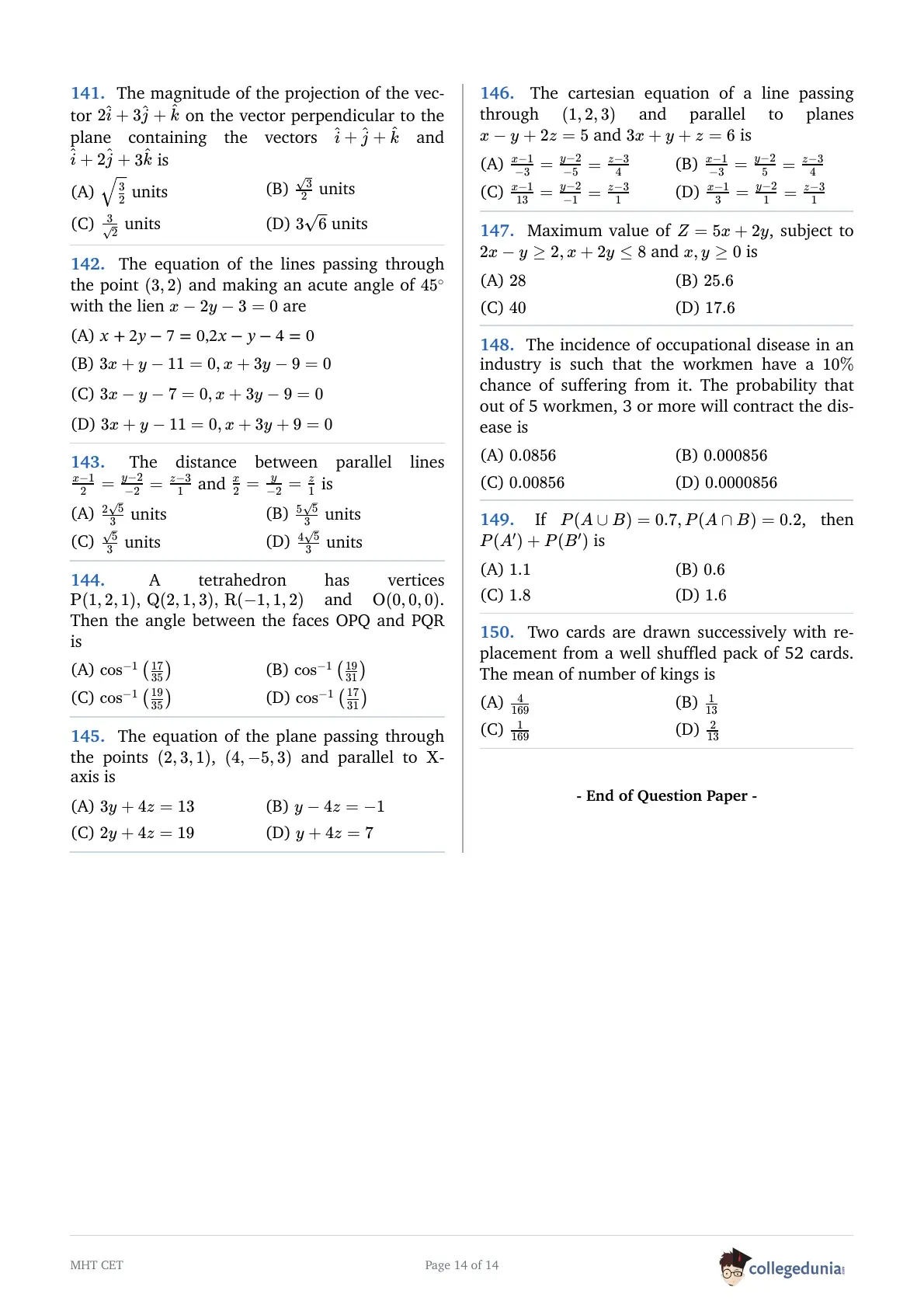
The magnitude of the projection of the vector \(2\hat{i}+3\hat{j}+\hat{k}\) on the vector perpendicular to the plane containing the vectors \(\hat{i}+\hat{j}+\hat{k}\) and \(\hat{i}+2\hat{j}+3\hat{k}\) is
The equation of the lines passing through the point \((3,2)\) and making an acute angle of \(45^{\circ }\) with the lien \(x-2y-3=0\) are
The distance between parallel lines \(\frac{x-1}{2}=\frac{y-2}{-2}=\frac{z-3}{1}\) and \(\frac{x}{2}=\frac{y}{-2}=\frac{z}{1}\) is
A tetrahedron has vertices \(\mathrm{P}(1,2,1),\,\mathrm{Q}(2,1,3),\,\mathrm{R}(-1,1,2)\) and \(\mathrm{O}(0,0,0)\). Then the angle between the faces OPQ and PQR is
The equation of the plane passing through the points \((2,3,1)\), \((4,-5,3)\) and parallel to \(\mathrm{X}\)-axis is
The cartesian equation of a line passing through \((1,2,3)\) and parallel to planes \(x-y+2z=5\) and \(3x+y+z=6\) is
Maximum value of \(Z=5x+2y\), subject to \(2x-y\geq 2,x+2y\leq 8\) and \(x,y\geq 0\) is
The incidence of occupational disease in an industry is such that the workmen have a \(10\%\) chance of suffering from it. The probability that out of 5 workmen, 3 or more will contract the disease is
If \(P(A\cup B)=0.7,P(A\cap B)=0.2\), then \(P(A')+P(B')\) is
Two cards are drawn successively with replacement from a well shuffled pack of 52 cards. The mean of number of kings is
MHT CET 2022 PCM Exam Pattern and Marking Scheme
| Parameter | Details |
|---|---|
| Conducting Body | Maharashtra Common Entrance Test Cell (Maharashtra CET Cell) |
| Exam Mode | Online (Computer-Based Test) |
| Duration | 180 minutes (3 hours) |
| Groups / Subjects | PCM (Physics, Chemistry, Mathematics) for Engineering |
| Total Questions |
150 |
| Total Marks | 200 |
| Question Type | Multiple Choice Questions (MCQs) |
| Marks Distribution |
|
| Negative Marking | No |
| Syllabus Weightage |
|



Comments