




MHT CET 2022 Aug 7 Shift 1 PCM Question Paper is available for download here. Maharashtra State CET Cell conducted MHT CET 2022 PCM Exam on Aug 7 in Shift 1 from 9 AM to 12 PM in CBT mode.
The MHT CET 2022 PCM question paper includes the following:
- The MHT CET 2022 PCM Question Paper consists of 150 multiple-choice questions (MCQs) totalling 200 marks divided into 3 sections: Physics, Chemistry, and Mathematics, with 50 questions in each subject.
- Physics and Chemistry questions carry 1 mark each while Mathematics questions carry 2 marks each.
- There is no negative marking for incorrect answers.
MHT CET 2022 Aug 7 Shift 1 PCM Question Paper with Solution PDF
| CD PDF | CD PDF with Solutions |
|---|---|
| Download Collegedunia PDF 0.77 MB | - |
Also Check:
MHT CET 2022 Aug 7 Shift 1 PCM Questions with Solutions
Physics (Q1 - Q50)
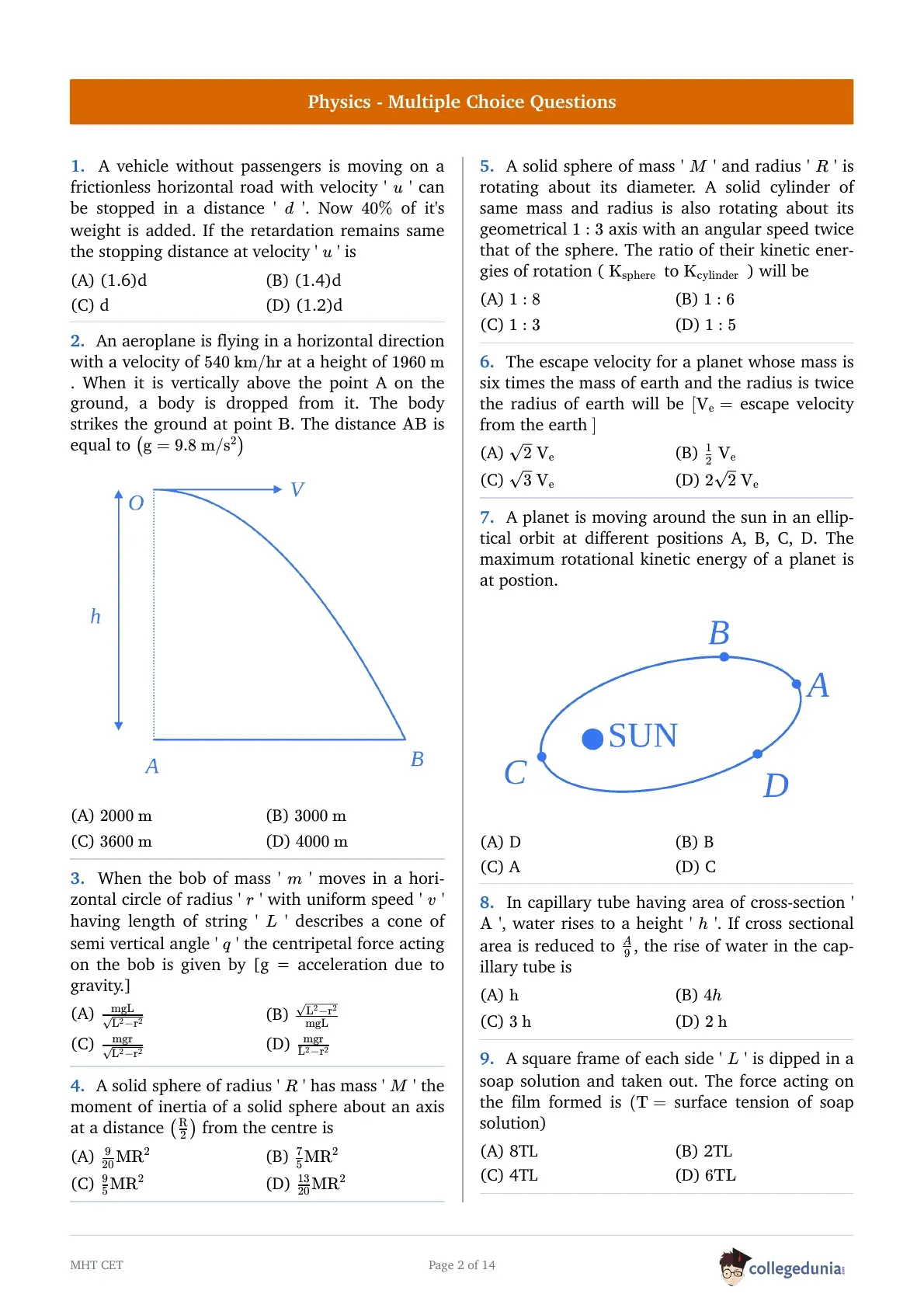
A vehicle without passengers is moving on a frictionless horizontal road with velocity ' \(u\) ' can be stopped in a distance ' \(d\) '. Now \(40\%\) of it's weight is added. If the retardation remains same the stopping distance at velocity ' \(u\) ' is
An aeroplane is flying in a horizontal direction with a velocity of \(540\ \mathrm{km}/\mathrm{hr}\) at a height of \(1960\ \mathrm{m}\). When it is vertically above the point A on the ground, a body is dropped from it. The body strikes the ground at point \(\mathrm{B}\). The distance \(\mathrm{AB}\) is equal to \(\left(\mathrm{g}=9.8\ \mathrm{m}/\mathrm{s}^{2}\right)\)

When the bob of mass ' \(m\) ' moves in a horizontal circle of radius ' \(r\) ' with uniform speed ' \(v\) ' having length of string ' \(L\) ' describes a cone of semi vertical angle ' \(q\) ' the centripetal force acting on the bob is given by [g = acceleration due to gravity.]
A solid sphere of radius ' \(R\) ' has mass ' \(M\) ' the moment of inertia of a solid sphere about an axis at a distance \(\left(\frac{\mathrm{R}}{2}\right)\) from the centre is
A solid sphere of mass ' \(M\) ' and radius ' \(R\) ' is rotating about its diameter. A solid cylinder of same mass and radius is also rotating about its geometrical \(1:3\) axis with an angular speed twice that of the sphere. The ratio of their kinetic energies of rotation ( \(\mathrm{K}_{\text{sphere }}\) to \(\mathrm{K}_{\text{cylinder }}\) ) will be
The escape velocity for a planet whose mass is six times the mass of earth and the radius is twice the radius of earth will be \([\mathrm{V}_{\mathrm{e}}=\) escape velocity from the earth \(]\)
A planet is moving around the sun in an elliptical orbit at different positions A, B, C, D. The maximum rotational kinetic energy of a planet is at postion.

In capillary tube having area of cross-section ' \(\mathrm{A}\) ', water rises to a height ' \(h\) '. If cross sectional area is reduced to \(\frac{A}{9}\), the rise of water in the capillary tube is
A square frame of each side ' \(L\) ' is dipped in a soap solution and taken out. The force acting on the film formed is \((\mathrm{T}=\) surface tension of soap solution)
A water drop of radius ' \(r\) ' and volume ' \(\mathrm{V}\) ' is kept in between the two identical glass plates such that it forms a thin layer of area ' \(\mathrm{A}\) ' between the plates. A force ' \(\mathrm{F}\) ' is applied such that the two plates separate from each other. The surface tension ' \(\mathrm{T}\) ' of the liquid is
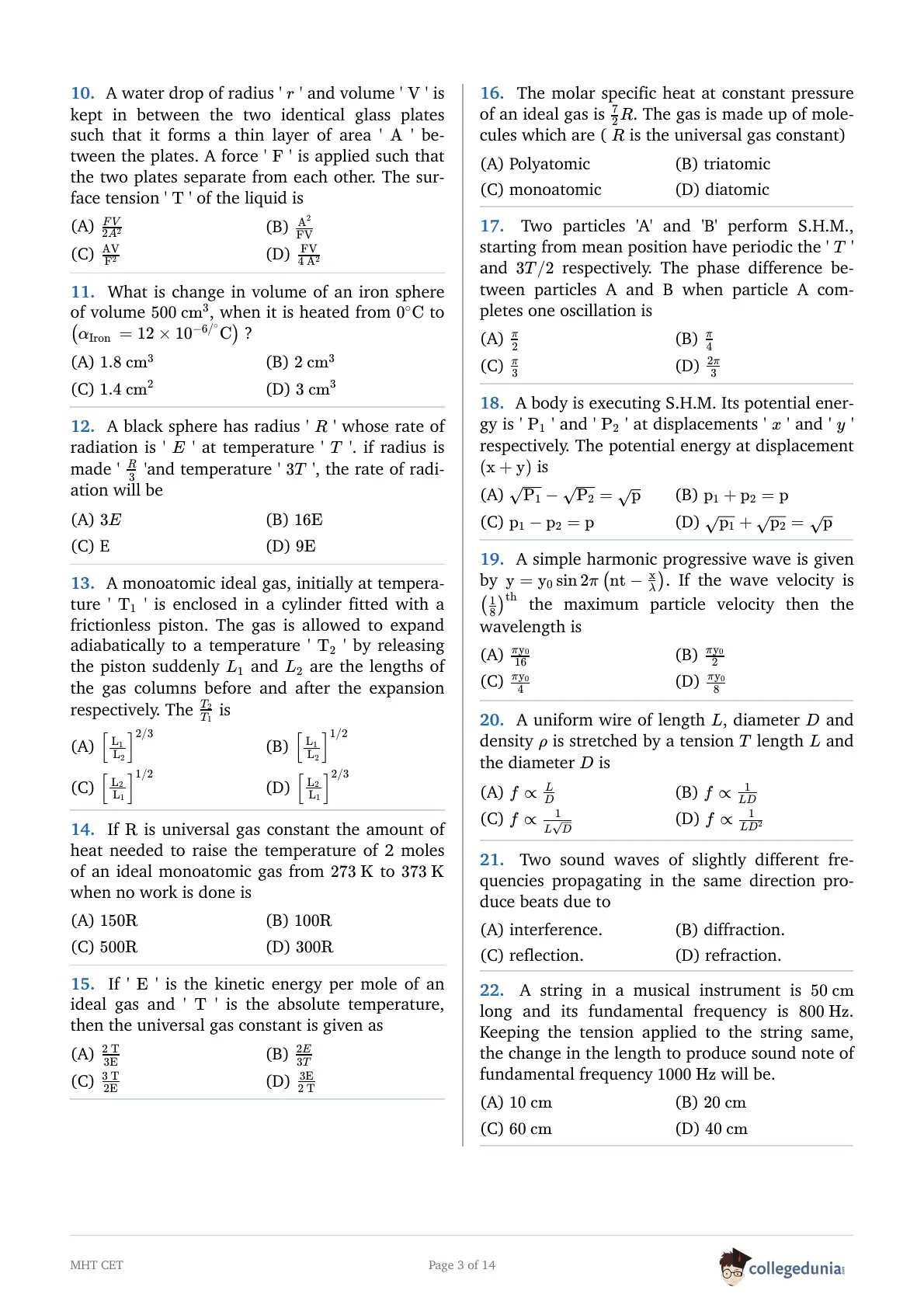
A black sphere has radius ' \(R\) ' whose rate of radiation is ' \(E\) ' at temperature ' \(T\) '. if radius is made ' \(\frac{R}{3}\) 'and temperature ' \(3T\) ', the rate of radiation will be
A monoatomic ideal gas, initially at temperature ' \(\mathrm{T}_{1}\) ' is enclosed in a cylinder fitted with a frictionless piston. The gas is allowed to expand adiabatically to a temperature ' \(\mathrm{T}_{2}\) ' by releasing the piston suddenly \(L_{1}\) and \(L_{2}\) are the lengths of the gas columns before and after the expansion respectively. The \(\frac{T_{2}}{T_{1}}\) is
If \(\mathrm{R}\) is universal gas constant the amount of heat needed to raise the temperature of 2 moles of an ideal monoatomic gas from \(273\ \mathrm{K}\) to \(373\ \mathrm{K}\) when no work is done is
If ' \(\mathrm{E}\) ' is the kinetic energy per mole of an ideal gas and ' \(\mathrm{T}\) ' is the absolute temperature, then the universal gas constant is given as
The molar specific heat at constant pressure of an ideal gas is \(\frac{7}{2}R\). The gas is made up of molecules which are ( \(R\) is the universal gas constant)
Two particles 'A' and 'B' perform S.H.M., starting from mean position have periodic the ' \(T\) ' and \(3T/2\) respectively. The phase difference between particles A and B when particle A completes one oscillation is
A body is executing S.H.M. Its potential energy is ' \(\mathrm{P}_{1}\) ' and ' \(\mathrm{P}_{2}\) ' at displacements ' \(x\) ' and ' \(y\) ' respectively. The potential energy at displacement \((\mathrm{x}+\mathrm{y})\) is
A simple harmonic progressive wave is given by \(\mathrm{y}=\mathrm{y}_{0}\sin 2\pi \left(\mathrm{nt}-\frac{\mathrm{x}}{\lambda }\right)\). If the wave velocity is \(\left(\frac{1}{8}\right)^{\mathrm{th}}\) the maximum particle velocity then the wavelength is
Two sound waves of slightly different frequencies propagating in the same direction produce beats due to
A string in a musical instrument is \(50\ \mathrm{cm}\) long and its fundamental frequency is \(800\ \mathrm{Hz}\). Keeping the tension applied to the string same, the change in the length to produce sound note of fundamental frequency \(1000\ \mathrm{Hz}\) will be.
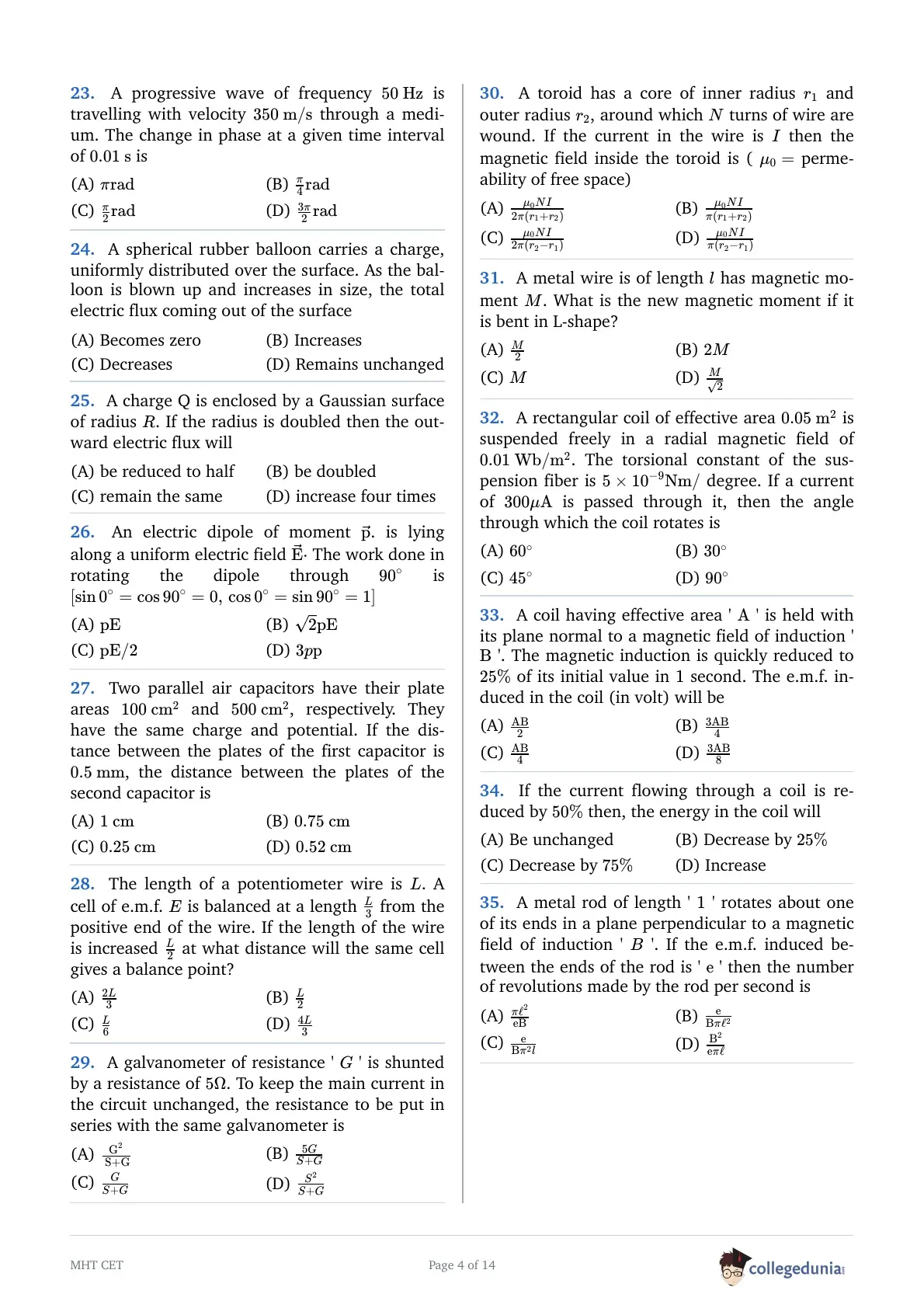
A progressive wave of frequency \(50\ \mathrm{Hz}\) is travelling with velocity \(350\ \mathrm{m}/\mathrm{s}\) through a medium. The change in phase at a given time interval of \(0.01\ \mathrm{s}\) is
A spherical rubber balloon carries a charge, uniformly distributed over the surface. As the balloon is blown up and increases in size, the total electric flux coming out of the surface
A charge Q is enclosed by a Gaussian surface of radius \(R\). If the radius is doubled then the outward electric flux will
An electric dipole of moment \(\vec{\mathrm{p}}\). is lying along a uniform electric field \(\vec{\mathrm{E}}\cdot\) The work done in rotating the dipole through \(90^{\circ }\) is \([\sin 0^{\circ }=\cos 90^{\circ }=0,\,\cos 0^{\circ }=\sin 90^{\circ }=1]\)
Two parallel air capacitors have their plate areas \(100\ \mathrm{cm}^{2}\) and \(500\ \mathrm{cm}^{2}\), respectively. They have the same charge and potential. If the distance between the plates of the first capacitor is \(0.5\ \mathrm{mm}\), the distance between the plates of the second capacitor is
The length of a potentiometer wire is \(L\). A cell of e.m.f. \(E\) is balanced at a length \(\frac{L}{3}\) from the positive end of the wire. If the length of the wire is increased \(\frac{L}{2}\) at what distance will the same cell gives a balance point?
A galvanometer of resistance ' \(G\) ' is shunted by a resistance of \(5\Omega\). To keep the main current in the circuit unchanged, the resistance to be put in series with the same galvanometer is
A toroid has a core of inner radius \(r_{1}\) and outer radius \(r_{2}\), around which \(N\) turns of wire are wound. If the current in the wire is \(I\) then the magnetic field inside the toroid is ( \(\mu _{0}=\) permeability of free space)
A metal wire is of length \(l\) has magnetic moment \(M\). What is the new magnetic moment if it is bent in L-shape?
A rectangular coil of effective area \(0.05\ \mathrm{m}^{2}\) is suspended freely in a radial magnetic field of \(0.01\ \mathrm{Wb}/\mathrm{m}^{2}\). The torsional constant of the suspension fiber is \(5\times 10^{-9}\mathrm{Nm}/\) degree. If a current of \(300\mu \mathrm{A}\) is passed through it, then the angle through which the coil rotates is
A coil having effective area ' \(\mathrm{A}\) ' is held with its plane normal to a magnetic field of induction ' \(\mathrm{B}\) '. The magnetic induction is quickly reduced to \(25\%\) of its initial value in 1 second. The e.m.f. induced in the coil (in volt) will be
If the current flowing through a coil is reduced by \(50\%\) then, the energy in the coil will
A metal rod of length ' 1 ' rotates about one of its ends in a plane perpendicular to a magnetic field of induction ' \(B\) '. If the e.m.f. induced between the ends of the rod is ' \(\mathrm{e}\) ' then the number of revolutions made by the rod per second is
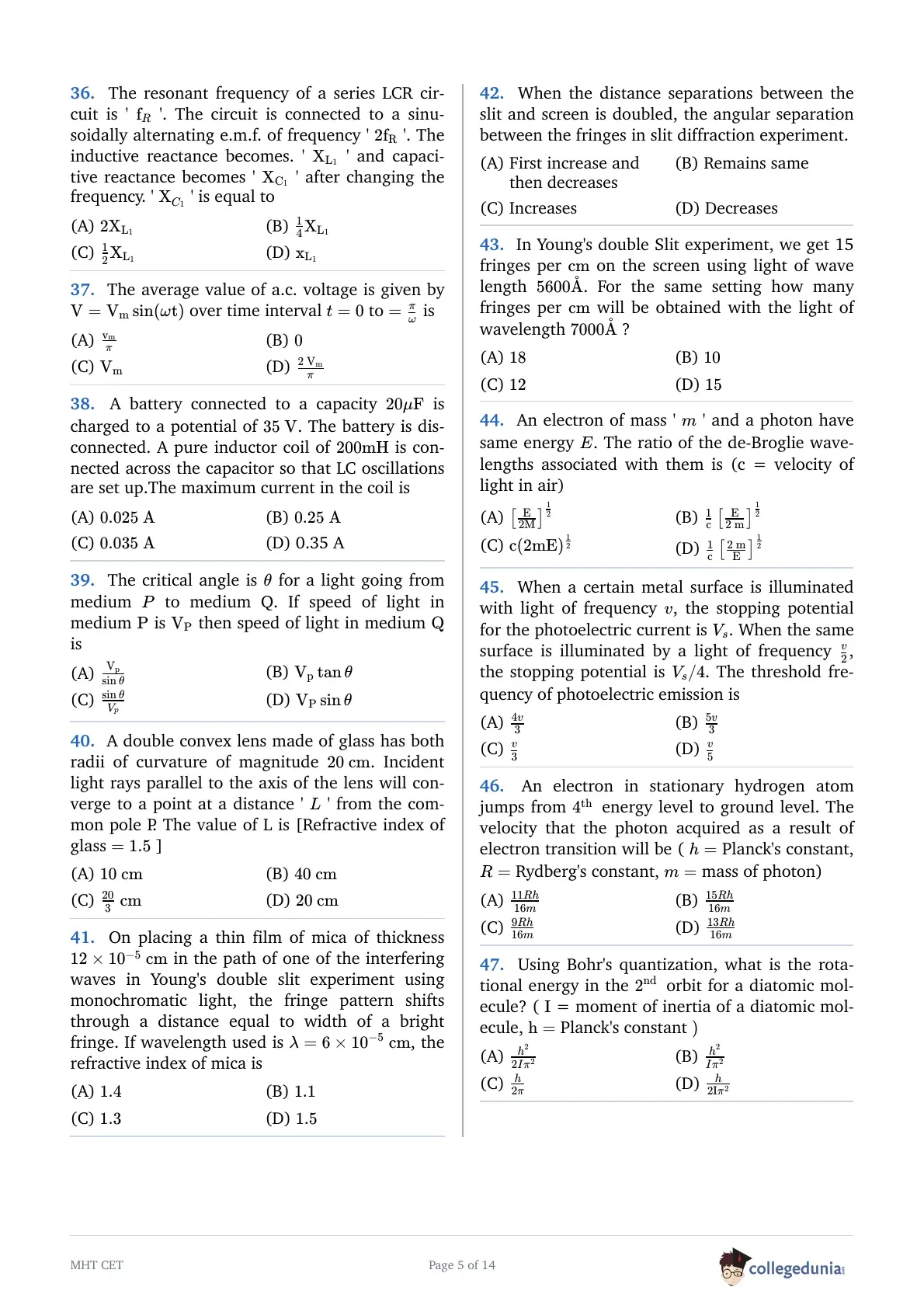
The resonant frequency of a series LCR circuit is ' \(\mathrm{f}_{R}\) '. The circuit is connected to a sinusoidally alternating e.m.f. of frequency ' \(2\mathrm{f}_{\mathrm{R}}\) '. The inductive reactance becomes. ' \(\mathrm{X}_{\mathrm{L}_{1}}\) ' and capacitive reactance becomes ' \(\mathrm{X}_{\mathrm{C}_{1}}\) ' after changing the frequency. ' \(\mathrm{X}_{C_{1}}\) ' is equal to
The average value of a.c. voltage is given by \(\mathrm{V}=\mathrm{V}_{\mathrm{m}}\sin (\omega \mathrm{t})\) over time interval \(t=0\) to \(=\frac{\pi }{\omega }\) is
A battery connected to a capacity \(20\mu \mathrm{F}\) is charged to a potential of \(35\ \mathrm{V}\). The battery is disconnected. A pure inductor coil of \(200\mathrm{mH}\) is connected across the capacitor so that LC oscillations are set up.The maximum current in the coil is
The critical angle is \(\theta\) for a light going from medium \(P\) to medium Q. If speed of light in medium \(\mathrm{P}\) is \(\mathrm{V}_{\mathrm{P}}\) then speed of light in medium \(\mathrm{Q}\) is
A double convex lens made of glass has both radii of curvature of magnitude \(20\ \mathrm{cm}\). Incident light rays parallel to the axis of the lens will converge to a point at a distance ' \(L\) ' from the common pole P. The value of L is [Refractive index of glass \(=1.5\) ]
On placing a thin film of mica of thickness \(12\times 10^{-5}\ \mathrm{cm}\) in the path of one of the interfering waves in Young's double slit experiment using monochromatic light, the fringe pattern shifts through a distance equal to width of a bright fringe. If wavelength used is \(\lambda =6\times 10^{-5}\ \mathrm{cm}\), the refractive index of mica is
When the distance separations between the slit and screen is doubled, the angular separation between the fringes in slit diffraction experiment.
In Young's double Slit experiment, we get 15 fringes per \(\mathrm{cm}\) on the screen using light of wave length \(5600\text{Å}\). For the same setting how many fringes per \(\mathrm{cm}\) will be obtained with the light of wavelength \(7000\text{Å}\) ?
An electron of mass ' \(m\) ' and a photon have same energy \(E\). The ratio of the de-Broglie wavelengths associated with them is (c = velocity of light in air)
When a certain metal surface is illuminated with light of frequency \(v\), the stopping potential for the photoelectric current is \(V_{s}\). When the same surface is illuminated by a light of frequency \(\frac{v}{2}\), the stopping potential is \(V_{s}/4\). The threshold frequency of photoelectric emission is
An electron in stationary hydrogen atom jumps from \(4^{\text{th }}\) energy level to ground level. The velocity that the photon acquired as a result of electron transition will be ( \(h=\) Planck's constant, \(R=\) Rydberg's constant, \(m=\) mass of photon)
Using Bohr's quantization, what is the rotational energy in the \(2^{\text{nd }}\) orbit for a diatomic molecule? ( \(\mathrm{I}\) = moment of inertia of a diatomic molecule, \(\mathrm{h}=\) Planck's constant \()\)
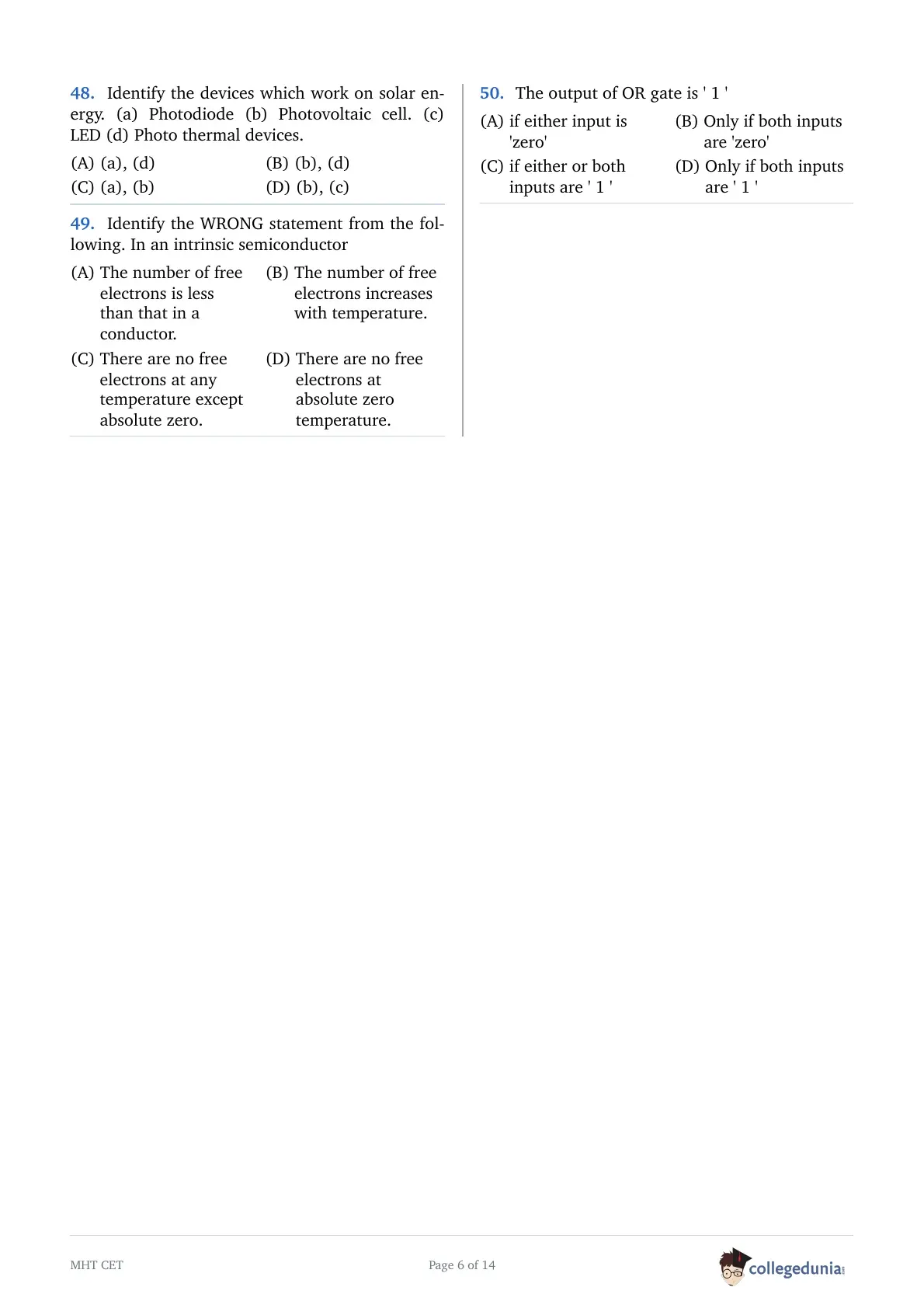
Identify the devices which work on solar energy. (a) Photodiode (b) Photovoltaic cell. (c) LED (d) Photo thermal devices.
Identify the WRONG statement from the following. In an intrinsic semiconductor
The output of OR gate is ' 1 '
Chemistry (Q51 - Q100)
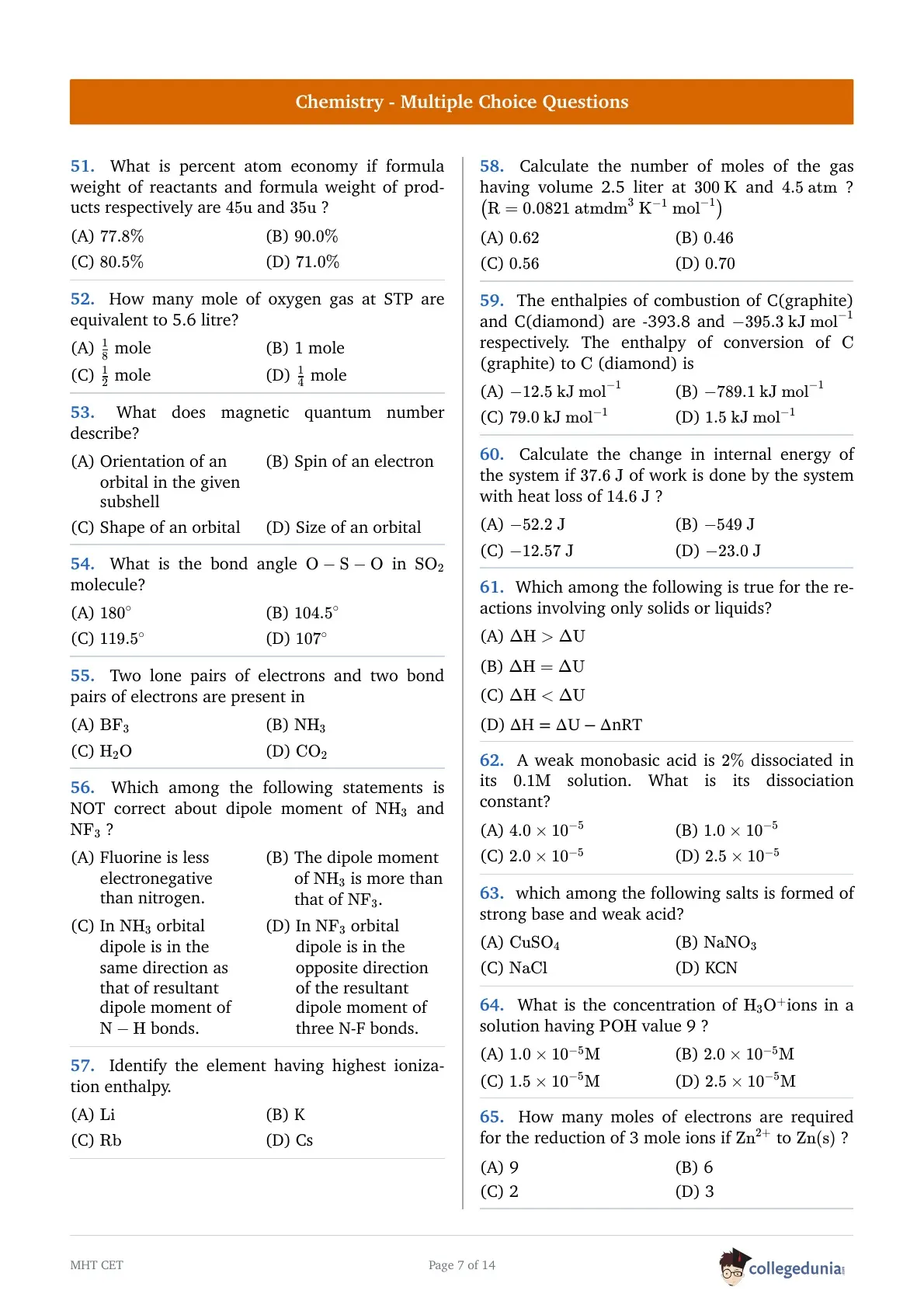
What is percent atom economy if formula weight of reactants and formula weight of products respectively are \(45\mathrm{u}\) and \(35\mathrm{u}\) ?
How many mole of oxygen gas at STP are equivalent to 5.6 litre?
What does magnetic quantum number describe?
What is the bond angle \(\mathrm{O}-\mathrm{S}-\mathrm{O}\) in \(\mathrm{SO}_{2}\) molecule?
Two lone pairs of electrons and two bond pairs of electrons are present in
Which among the following statements is NOT correct about dipole moment of \(\mathrm{NH}_{3}\) and \(\mathrm{NF}_{3}\) ?
Identify the element having highest ionization enthalpy.
Calculate the number of moles of the gas having volume 2.5 liter at \(300\ \mathrm{K}\) and \(4.5\ \mathrm{atm}\) ? \(\left(\mathrm{R}=0.0821\ \mathrm{atm}\mathrm{dm}^{3}\ \mathrm{K}^{-1}\ \mathrm{mol}^{-1}\right)\)
The enthalpies of combustion of C(graphite) and C(diamond) are -393.8 and \(-395.3\ \mathrm{kJ}\ \mathrm{mol}^{-1}\) respectively. The enthalpy of conversion of \(\mathrm{C}\) (graphite) to \(\mathrm{C}\) (diamond) is
Calculate the change in internal energy of the system if \(37.6\ \mathrm{J}\) of work is done by the system with heat loss of \(14.6\ \mathrm{J}\) ?
Which among the following is true for the reactions involving only solids or liquids?
A weak monobasic acid is \(2\%\) dissociated in its \(0.1\mathrm{M}\) solution. What is its dissociation constant?
which among the following salts is formed of strong base and weak acid?
What is the concentration of \(\mathrm{H}_{3}\mathrm{O}^{+}\)ions in a solution having \(\mathrm{POH}\) value 9 ?
How many moles of electrons are required for the reduction of 3 mole ions if \(\mathrm{Zn}^{2+}\) to \(\mathrm{Zn}(\mathrm{s})\) ?
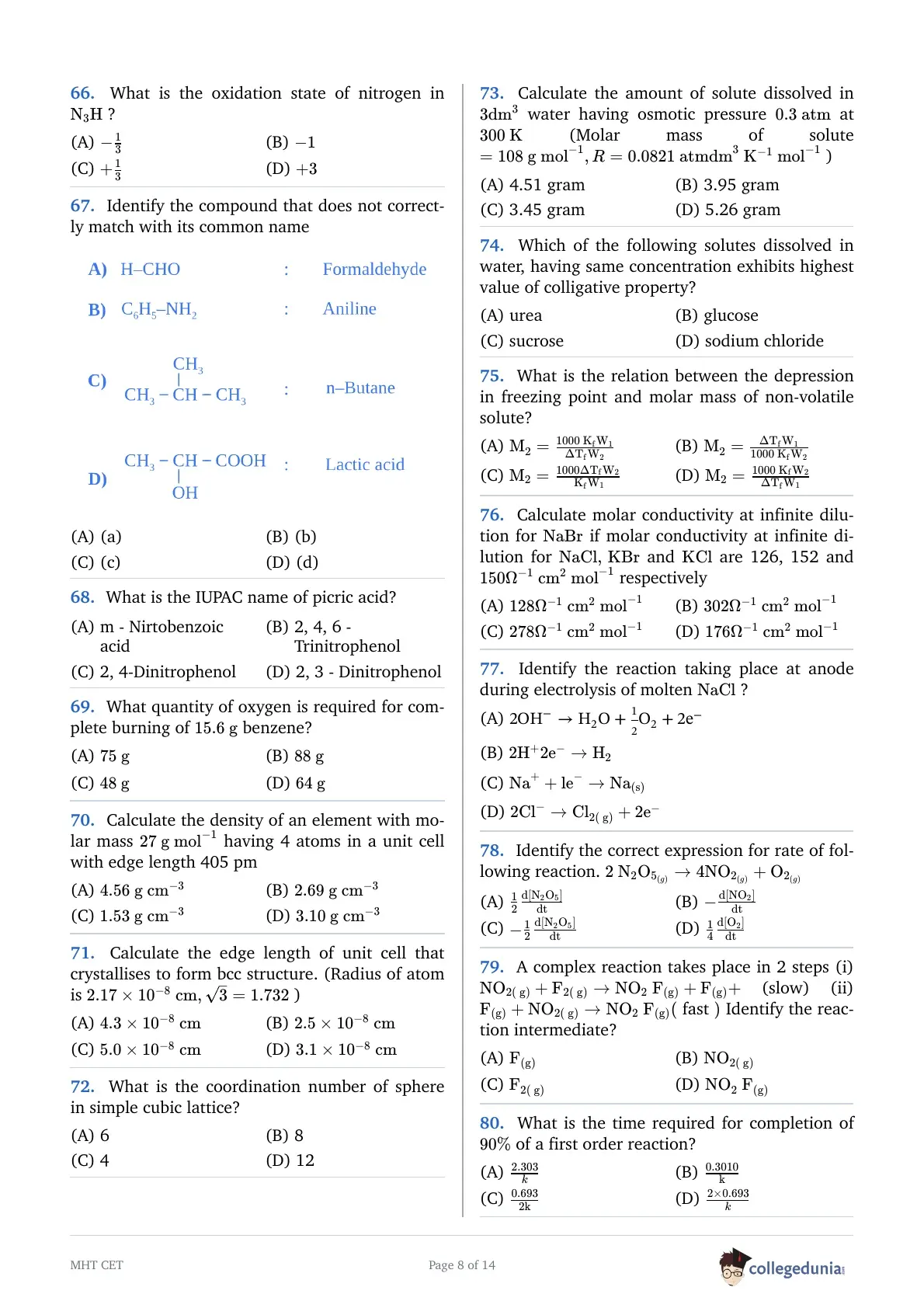
What is the oxidation state of nitrogen in \(\mathrm{N}_{3}\mathrm{H}\) ?
Identify the compound that does not correctly match with its common name

What is the IUPAC name of picric acid?
What quantity of oxygen is required for complete burning of \(15.6\ \mathrm{g}\) benzene?
Calculate the density of an element with molar mass \(27\ \mathrm{g}\ \mathrm{mol}^{-1}\) having 4 atoms in a unit cell with edge length 405 pm
Calculate the edge length of unit cell that crystallises to form bcc structure. (Radius of atom is \(2.17\times 10^{-8}\ \mathrm{cm},\sqrt{3}=1.732\) )
What is the coordination number of sphere in simple cubic lattice?
Calculate the amount of solute dissolved in \(3\mathrm{dm}^{3}\) water having osmotic pressure \(0.3\ \mathrm{atm}\) at \(300\ \mathrm{K}\) (Molar mass of solute \(=108\ \mathrm{g}\ \mathrm{mol}^{-1},R=0.0821\ \mathrm{atm}\mathrm{dm}^{3}\ \mathrm{K}^{-1}\ \mathrm{mol}^{-1}\) )
Which of the following solutes dissolved in water, having same concentration exhibits highest value of colligative property?
What is the relation between the depression in freezing point and molar mass of non-volatile solute?
Calculate molar conductivity at infinite dilution for \(\mathrm{NaBr}\) if molar conductivity at infinite dilution for \(\mathrm{NaCl},\,\mathrm{KBr}\) and \(\mathrm{KCl}\) are 126, 152 and \(150\Omega ^{-1}\ \mathrm{cm}^{2}\ \mathrm{mol}^{-1}\) respectively
Identify the reaction taking place at anode during electrolysis of molten \(\mathrm{NaCl}\) ?
Identify the correct expression for rate of following reaction. \(2\ \mathrm{N}_{2}\mathrm{O}_{5_{(g)}}\rightarrow 4\mathrm{NO}_{2_{(g)}}+\mathrm{O}_{2_{(g)}}\)
A complex reaction takes place in 2 steps (i) \(\mathrm{NO}_{2(\ \mathrm{g})}+\mathrm{F}_{2(\ \mathrm{g})}\rightarrow \mathrm{NO}_{2}\ \mathrm{F}_{(\mathrm{g})}+\mathrm{F}_{(\mathrm{g})}+\) (slow) (ii) \(\mathrm{F}_{(\mathrm{g})}+\mathrm{NO}_{2(\ \mathrm{g})}\rightarrow \mathrm{NO}_{2}\ \mathrm{F}_{(\mathrm{g})}(\) fast \()\) Identify the reaction intermediate?
What is the time required for completion of \(90\%\) of a first order reaction?
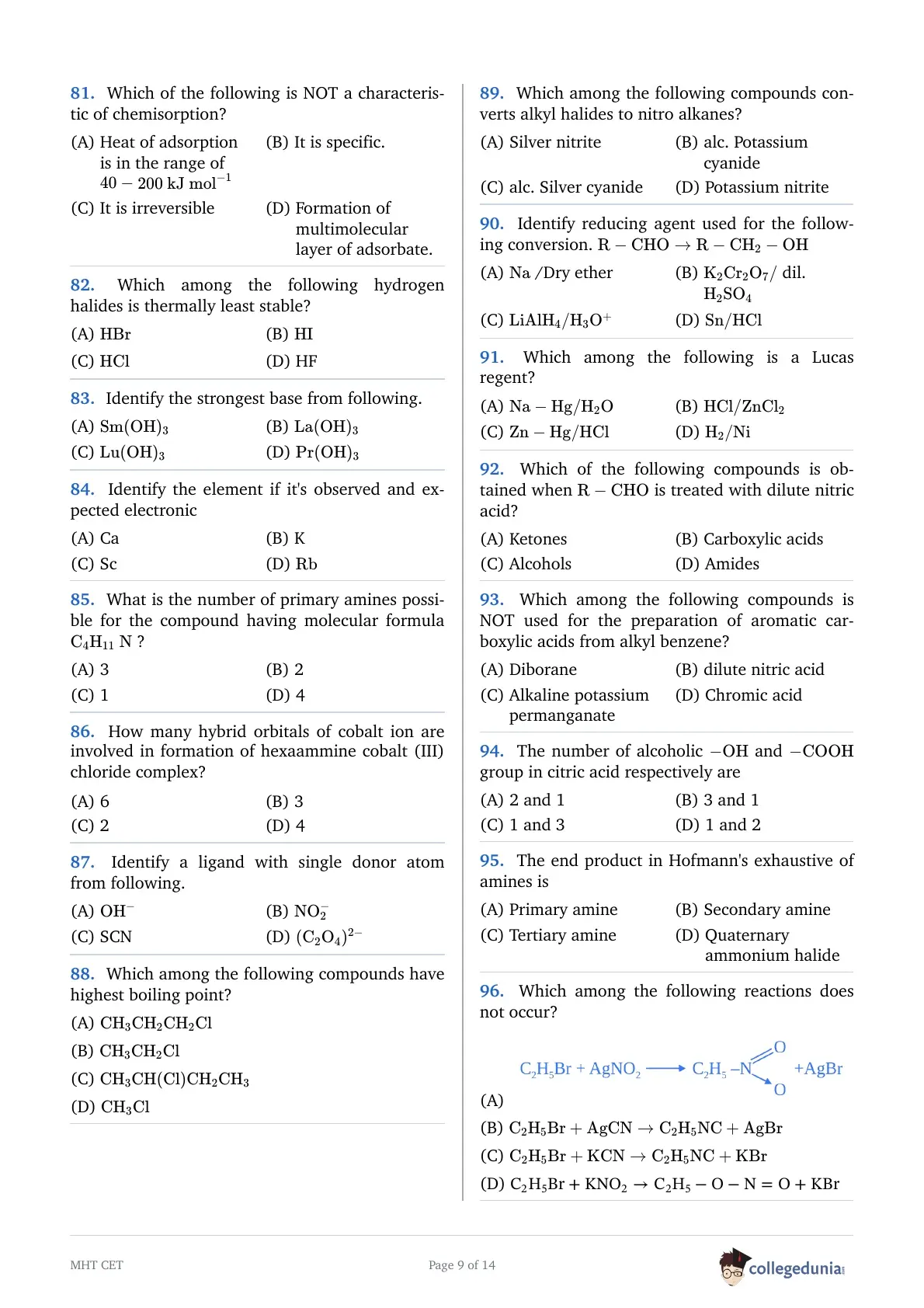
Which of the following is NOT a characteristic of chemisorption?
Which among the following hydrogen halides is thermally least stable?
Identify the strongest base from following.
What is the number of primary amines possible for the compound having molecular formula \(\mathrm{C}_{4}\mathrm{H}_{11}\ \mathrm{N}\) ?
How many hybrid orbitals of cobalt ion are involved in formation of hexaammine cobalt (III) chloride complex?
Identify a ligand with single donor atom from following.
Which among the following compounds have highest boiling point?
Which among the following compounds converts alkyl halides to nitro alkanes?
Identify reducing agent used for the following conversion. \(\mathrm{R}-\mathrm{CHO}\rightarrow \mathrm{R}-\mathrm{CH}_{2}-\mathrm{OH}\)
Which among the following is a Lucas regent?
Which of the following compounds is obtained when \(\mathrm{R}-\mathrm{CHO}\) is treated with dilute nitric acid?
Which among the following compounds is NOT used for the preparation of aromatic carboxylic acids from alkyl benzene?
The number of alcoholic \(-\mathrm{OH}\) and \(-\mathrm{COOH}\) group in citric acid respectively are
The end product in Hofmann's exhaustive of amines is
Which among the following reactions does not occur?
- (A)
![]()
- (B) \(\mathrm{C}_{2}\mathrm{H}_{5}\mathrm{Br}+\mathrm{AgCN}\rightarrow \mathrm{C}_{2}\mathrm{H}_{5}\mathrm{NC}+\mathrm{AgBr}\)
- (C) \(\mathrm{C}_{2}\mathrm{H}_{5}\mathrm{Br}+\mathrm{KCN}\rightarrow \mathrm{C}_{2}\mathrm{H}_{5}\mathrm{NC}+\mathrm{KBr}\)
- (D) \(\mathrm{C}_{2}\mathrm{H}_{5}\mathrm{Br}+\mathrm{KNO}_{2}\rightarrow \mathrm{C}_{2}\mathrm{H}_{5}-\mathrm{O}-\mathrm{N}=\mathrm{O}+\mathrm{KBr}\)

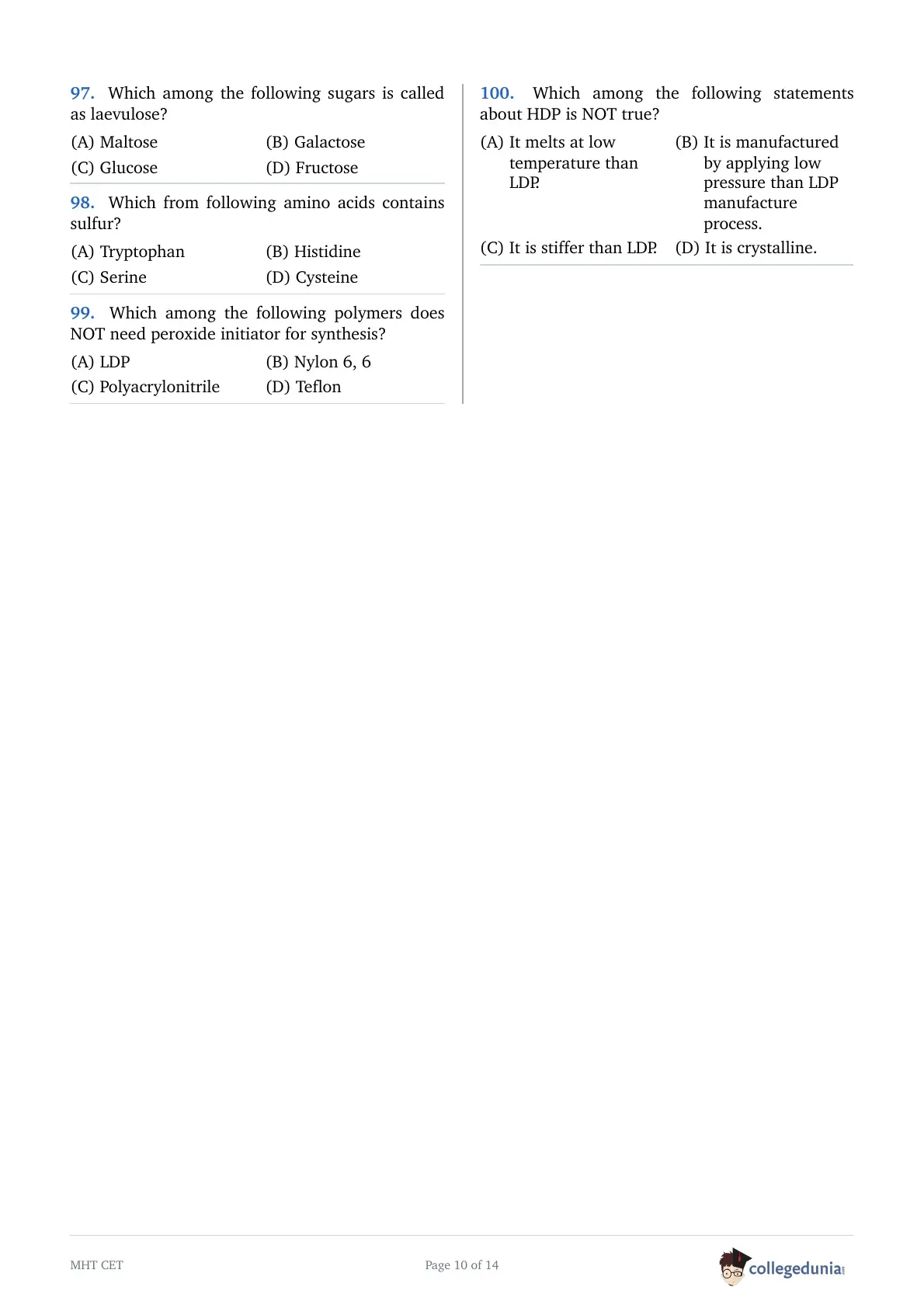
Which among the following sugars is called as laevulose?
Which from following amino acids contains sulfur?
Which among the following polymers does NOT need peroxide initiator for synthesis?
Which among the following statements about HDP is NOT true?
Mathematics (Q101 - Q150)
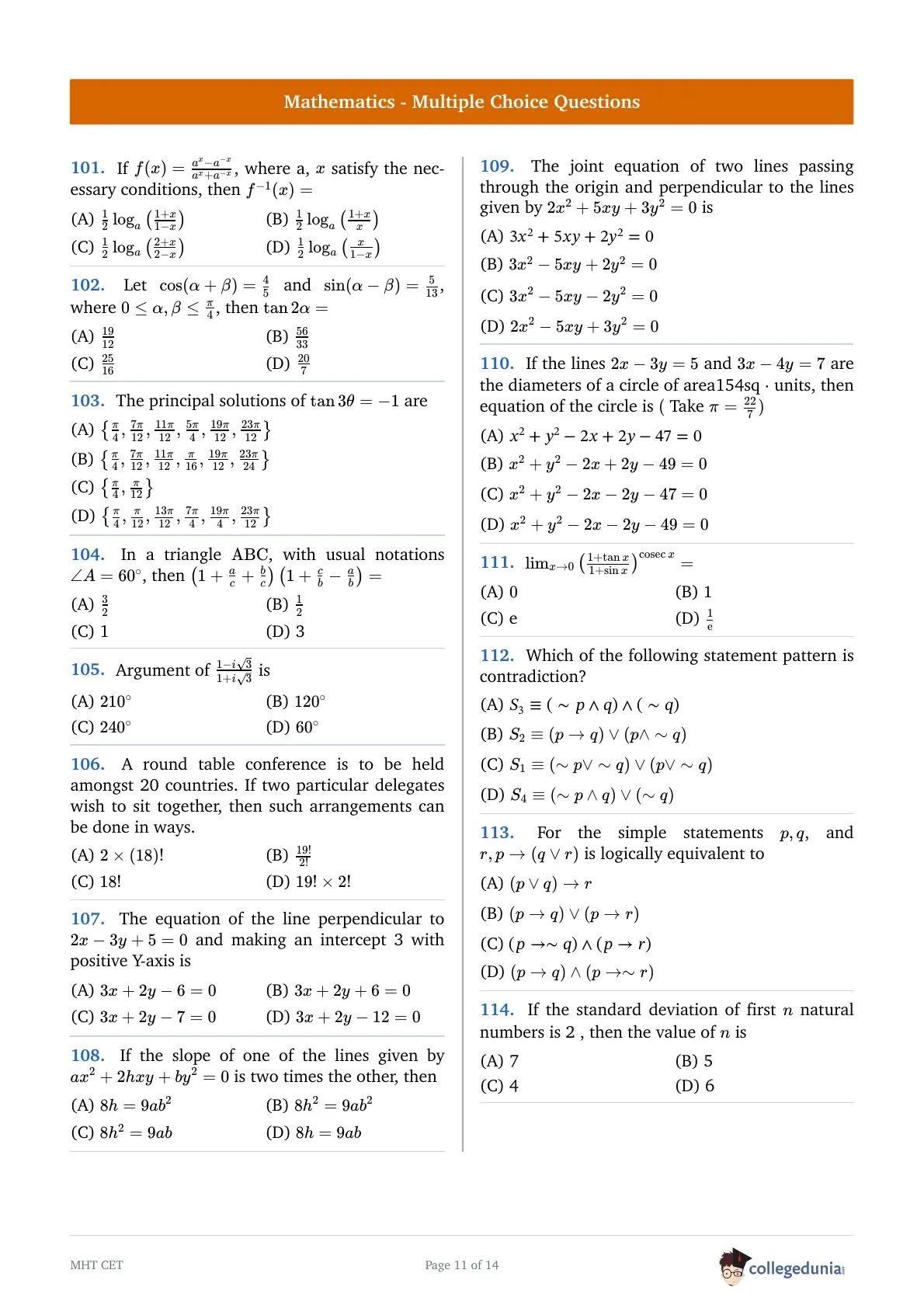
If \(f(x)=\frac{a^{x}-a^{-x}}{a^{x}+a^{-x}}\), where a, \(x\) satisfy the necessary conditions, then \(f^{-1}(x)=\)
Let cos (α + β) = \(\frac {4}{5}\) and sin (α - β) = \(\frac {5}{13}\), where 0 < α, β < \(\frac {π}{4}\) , then tan 2α=?
In a triangle ABC, with usual notations ∠A = 60°, then (1 + \(\frac {a}{c}\) + \(\frac {b}{c}\))(1 + \(\frac {c}{b}\) - \(\frac {a}{b}\)) = ?
A round table conference is to be held among 20 countries. If two particular delegates wish to sit together, then such arrangements can be done in __________ways.
The equation of the line perpendicular to 2x – 3y + 5 = 0 and making an intercept 3 with positive Y-axis is
If the slope of one of the lines given by ax2 + 2hxy + by2 = 0 is two times the other, then
The joint equation of two lines passing through the origin and perpendicular to the lines given by \(2x^{2}+5xy+3y^{2}=0\) is
If the lines 2x – 3y = 5 and 3x – 4y = 7 are the diameters of a circle of area 154 sq. units, then equation of the circle is (Taken π=\(\frac {22}{7}\))
\(\lim _{x\rightarrow 0}\left(\frac{1+\tan x}{1+\sin x}\right)^{\operatorname{cosec} x}=\)
For three simple statements p, q, and r, p → (q ˅ r) is logically equivalent to
If the standard deviation of first n natural numbers is 2, then the value of n is
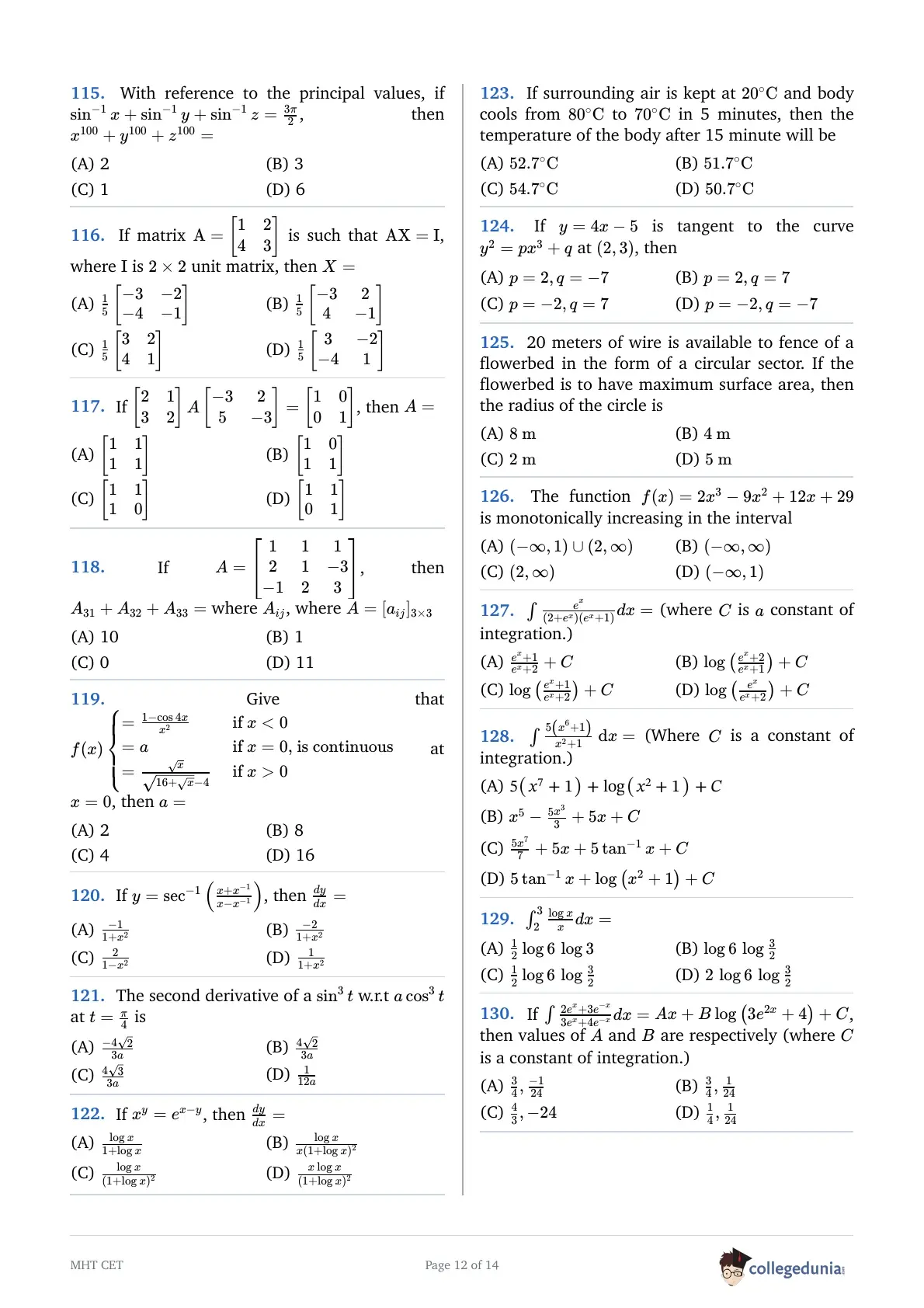
With reference to the principal values, if sin-1x + sin-1y + sin-1z = \(\frac {3π}{2}\), then x100 + y100 + z100 =?
If matrix A =\(\begin{bmatrix} 1 & 2 \\ 4 & 3 \end{bmatrix}\) is such that AX = I, where I is 2 x 2 unit matrix, then X =
If \(\begin{bmatrix} 2 & 1 \\ 3 & 2\end{bmatrix}\) A \(\begin{bmatrix} -3 & 2 \\ 5 & -3\end{bmatrix}\) =\(\begin{bmatrix} 1 & 0 \\ 0 & 1\end{bmatrix}\), then A =?
If \(A=\begin{bmatrix} 1 & 1 & 1 \\ 2 & 1 & -3 \\ -1 & 2 & 3 \end{bmatrix}\), then \(A_{31}+A_{32}+A_{33}=\) where \(A_{ij}\), where \(A=[a_{ij}]_{3\times 3}\)
Give that f(x) =\(\frac {1-cos4x}{x^2}\) if x < 0 ,f(x) = a if x = 0 , f(x) =\(\frac {\sqrt {x}}{\sqrt {16 + \sqrt {x} }- 4}\) if x > 0, is continuous at x = 0, then a will be
If y = sec–1\((\frac {x + x^{-1}}{x - x^{-1}})\), then \(\frac {dy}{dx}\) =?
If surrounding air is kept at 20 °C and body cools from 80 °C to 70 °C in 5 minutes, then the temperature of the body after 15 minutes will be
20 meters of wire is available to fence of a flowerbed in the form of a circular sector. If the flowerbed is to have maximum surface area, then the radius of the circle is
The function f(x) = 2x3 – 9x2 + 12x +29 is monotonically increasing in the interval.
∫\(\frac {e^x}{(2+e^x)(e^x +1)}\)dx = (where C is a constant of integration.)
∫\(\frac {5(x^6+1)}{X+1}\)dx = (where C is a constant of integration.)
\(\int _{2}^{3}\frac{\log x}{x}dx=\)
If \(\int \frac {2e^x + e^x}{3e^x + 4e^{-x}} \,dx\) = Ax + Blog( 3e2x + 4) + C, then values of A and B are respectively (where C is a constant of integration.)
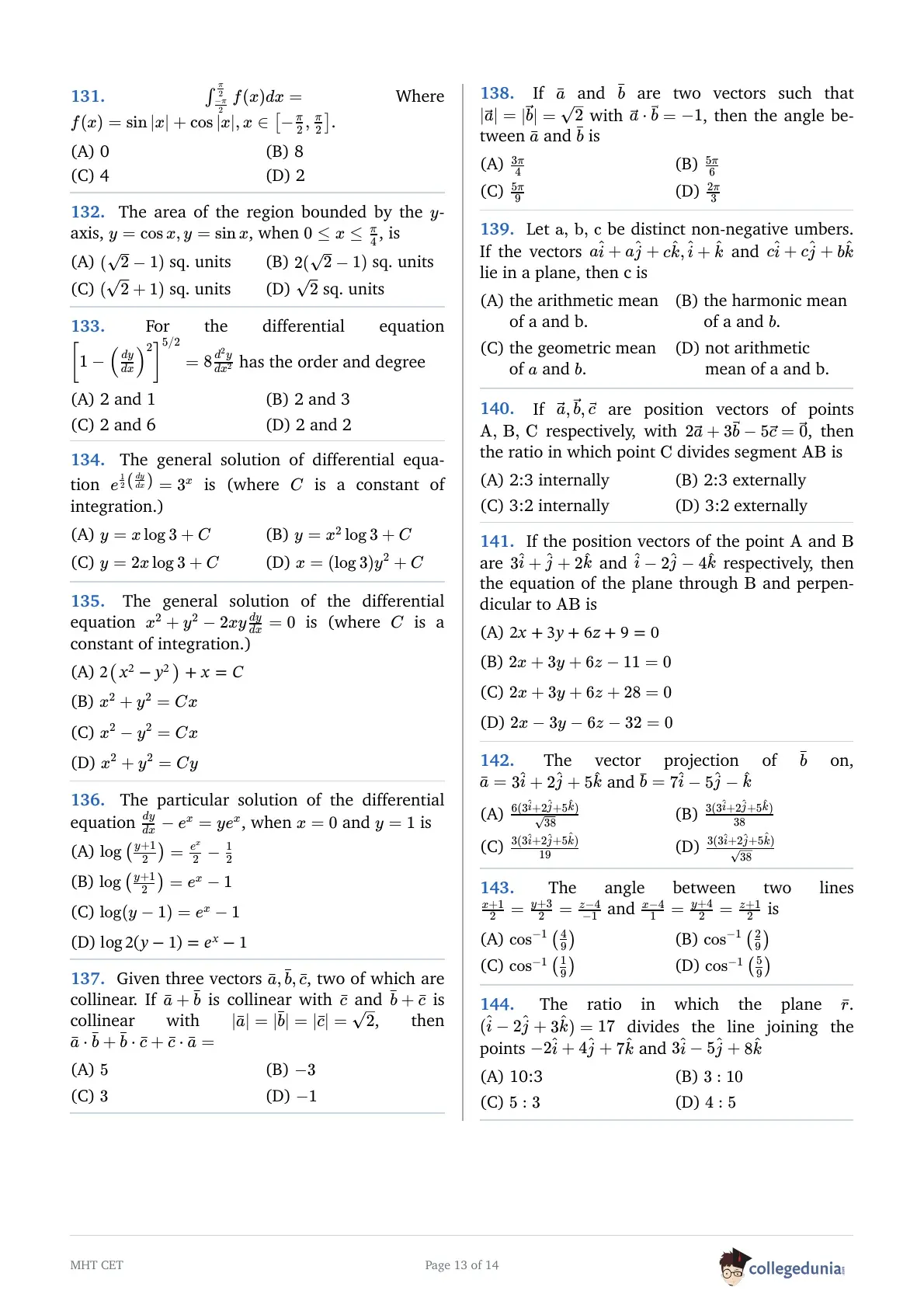
\(\int_{-π/2}^{π/2} f(x) \,dx\) =?
Where f(x) = sin |x| + cos |x|, x ∈ \((-\frac {π}{2}, \frac {π}{2})\)
The area of the region bounded by the y-axis, y = cos x, y = sin x, when 0 ≤ x ≤\(\frac {π}{4}\), is
For the differential equation [1 + \((\frac {dy}{dx})^2\)]5/2 = 8 \((\frac {d^2y}{dx^2})\) has the order and degree_________respectively.
The general solution of differential equation \(e^{\frac {1}{2} (\frac {dy}{dx})}\) = 3x is (where C is a constant of integration.)
The general solution of the differential equation x2 + y2 – 2xy \(\frac {dy}{dx}\) = 0 is (where C is a constant of integration.)
The particular solution of the differential equation \(\frac{dy}{dx}-e^{x}=ye^{x}\), when \(x=0\) and \(y=1\) is
If a and b are two vectors such that I\(\vec {a}\)I + I\(\vec {b}\)I = \(\sqrt 2\) with \(\vec {a}\).\(\vec {b}\) = –1, then the angle between \(\vec {a}\) and \(\vec {b}\) is
Let \(\mathrm{a},\,\mathrm{b},\,\mathrm{c}\) be distinct non-negative umbers. If the vectors \(a\hat{i}+a\hat{j}+c\hat{k},\hat{i}+\hat{k}\) and \(c\hat{i}+c\hat{j}+b\hat{k}\) lie in a plane, then c is
If a, b, c are position vectors of points A, B, C respectively, with 2a + 3b -5c = 0 , then the ratio in which point C divides segment AB is
If the position vectors of the points A and B are 3\(\hat {i}\) + \(\hat {j}\) + 2\(\hat {k}\) and \(\hat {i}\) -2\(\hat {j}\) -4\(\hat {k}\) respectively, then the equation of the plane through B and perpendicular to AB is
The vector projection of b on a , where a = 3\(\hat {i}\) + 2\(\hat {j}\) + 5\(\hat {k}\) and b = 7\(\hat {i}\) - 5\(\hat {j}\) - \(\hat {k}\) is
The angle between two lines x +1 =y + 3 =z - 4 and \(\frac {x-4}{1}\) = \(\frac {y+2}{2}\) = \(\frac {z+1}{2}\) is
The ratio in which the plane r.(\(\hat i\) -2\(\hat j\) + 3\(\hat k\) ) =17 divides the line joining the points -2\(\hat i\)+4\(\hat j\)+7\(\hat k\) and 3\(\hat i\)-5\(\hat j\)+8\(\hat k\) is
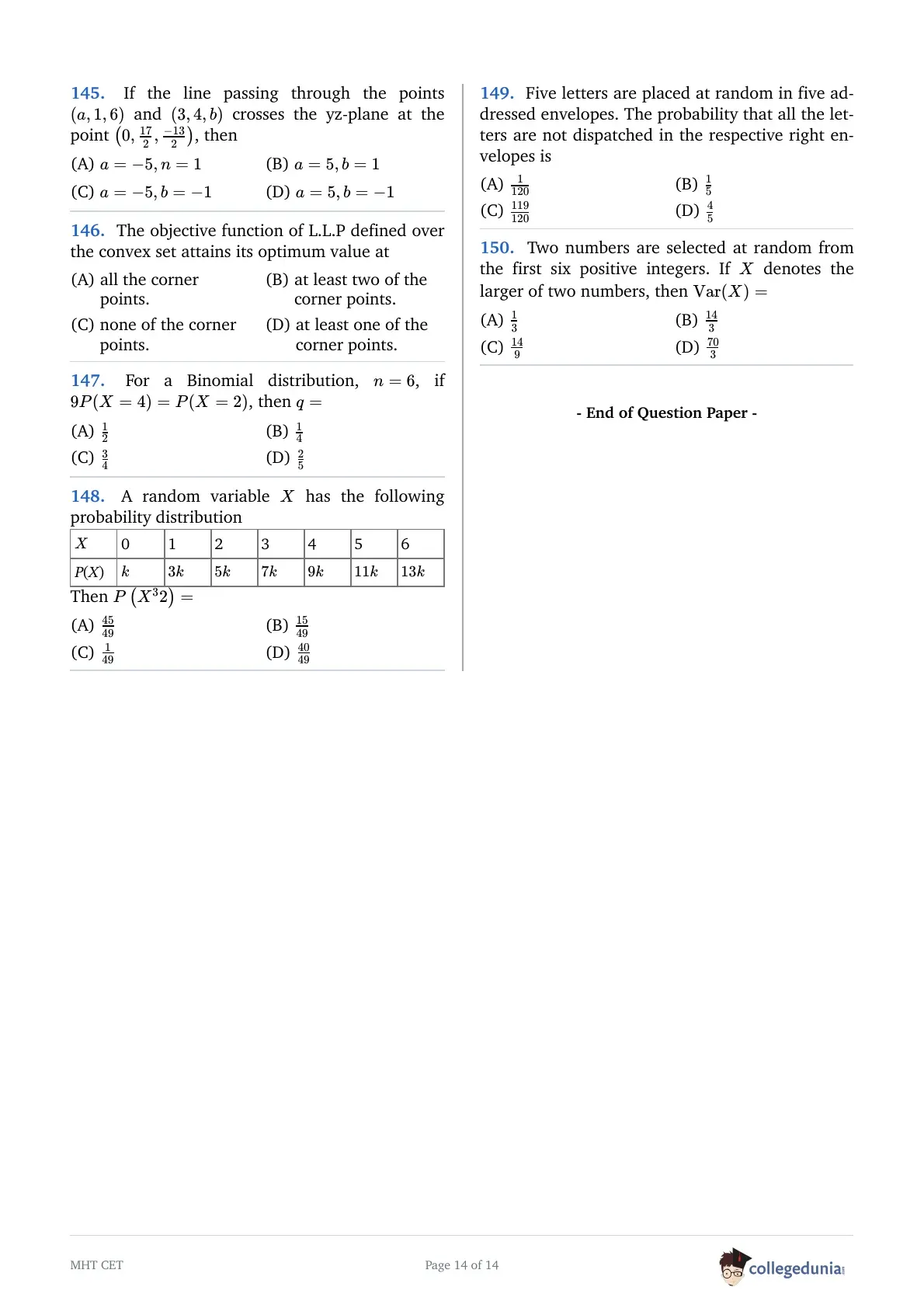
If the line passing through the points \((a,1,6)\) and \((3,4,b)\) crosses the yz-plane at the point \(\left(0,\frac{17}{2},\frac{-13}{2}\right)\), then
The objective function of L.L.P. defined over the convex set attains its optimum value at
For a Binomial distribution, \(n=6\), if \(9P(X=4)=P(X=2)\), then \(q=\)
Five letters are placed at random in five addressed envelopes. The probability that all the letters are not dispatched in the respective right envelopes is
Two numbers are selected at random from the first six positive integers. If X denotes the larger of two numbers, then Var (X) =?
MHT CET 2022 PCM Exam Pattern and Marking Scheme
| Parameter | Details |
|---|---|
| Conducting Body | Maharashtra Common Entrance Test Cell (Maharashtra CET Cell) |
| Exam Mode | Online (Computer-Based Test) |
| Duration | 180 minutes (3 hours) |
| Groups / Subjects | PCM (Physics, Chemistry, Mathematics) for Engineering |
| Total Questions |
150 |
| Total Marks | 200 |
| Question Type | Multiple Choice Questions (MCQs) |
| Marks Distribution |
|
| Negative Marking | No |
| Syllabus Weightage |
|



Comments