




MHT CET 2022 Aug 7 Shift 2 PCM Question Paper is available for download here. Maharashtra State CET Cell conducted MHT CET 2022 PCM Exam on Aug 7 in Shift 2 from 2 PM to 5 PM in CBT mode.
The MHT CET 2022 PCM question paper includes the following:
- The MHT CET 2022 PCM Question Paper consists of 150 multiple-choice questions (MCQs) totalling 200 marks divided into 3 sections: Physics, Chemistry, and Mathematics, with 50 questions in each subject.
- Physics and Chemistry questions carry 1 mark each while Mathematics questions carry 2 marks each.
- There is no negative marking for incorrect answers.
MHT CET 2022 Aug 7 Shift 2 PCM Question Paper with Solution PDF
| CD PDF | CD PDF with Solutions |
|---|---|
| Download Collegedunia PDF 0.92 MB | - |
Also Check:
MHT CET 2022 Aug 7 Shift 2 PCM Questions with Solutions
Physics (Q1 - Q50)
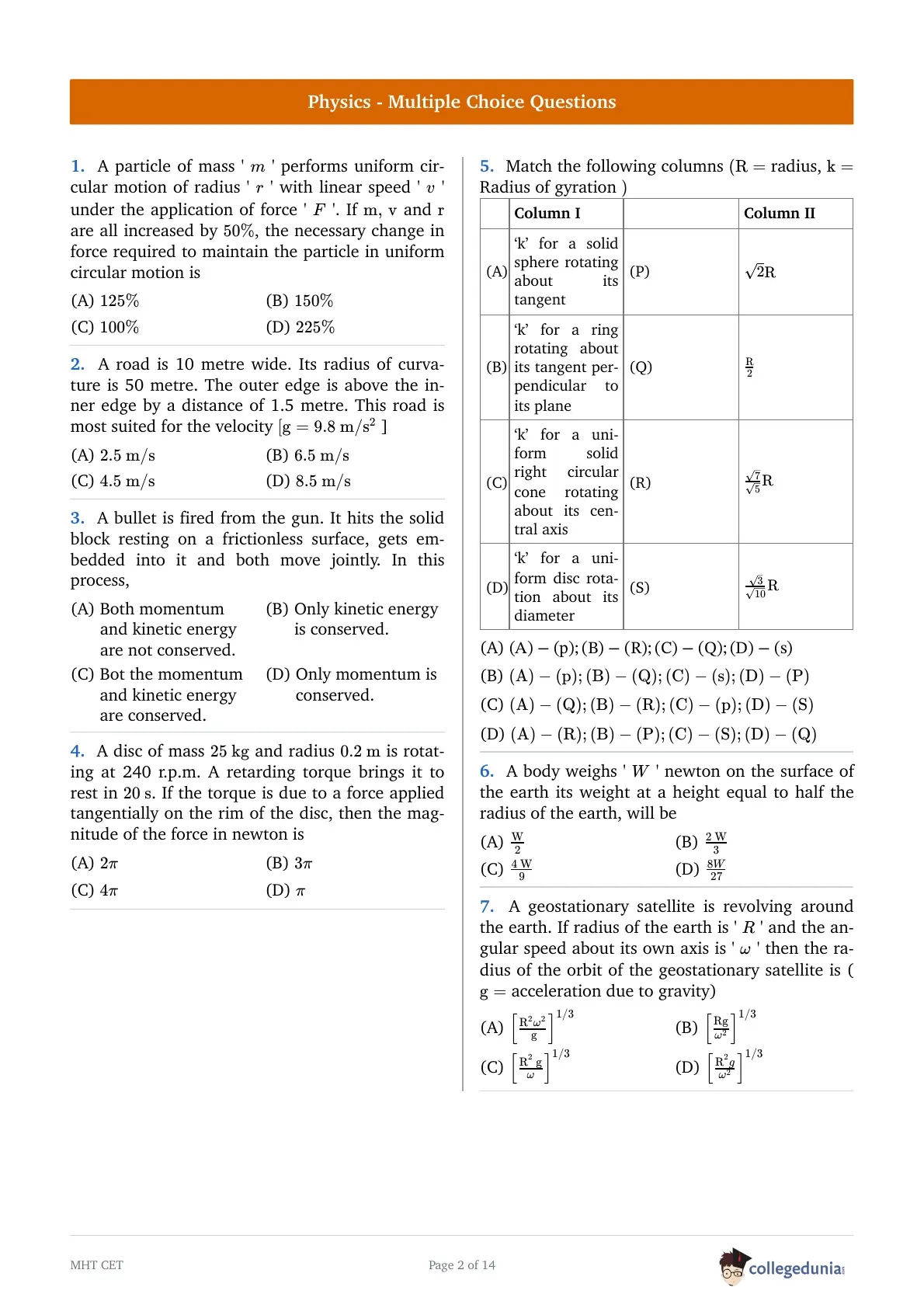
A particle of mass ' \(m\) ' performs uniform circular motion of radius ' \(r\) ' with linear speed ' \(v\) ' under the application of force ' \(F\) '. If \(\mathrm{m},\,\mathrm{v}\) and \(\mathrm{r}\) are all increased by \(50\%\), the necessary change in force required to maintain the particle in uniform circular motion is
A road is 10 metre wide. Its radius of curvature is 50 metre. The outer edge is above the inner edge by a distance of 1.5 metre. This road is most suited for the velocity \([\mathrm{g}=9.8\ \mathrm{m}/\mathrm{s}^{2}\) ]
A bullet is fired from the gun. It hits the solid block resting on a frictionless surface, gets embedded into it and both move jointly. In this process,
A disc of mass \(25\ \mathrm{kg}\) and radius \(0.2\ \mathrm{m}\) is rotating at 240 r.p.m. A retarding torque brings it to rest in \(20\ \mathrm{s}\). If the torque is due to a force applied tangentially on the rim of the disc, then the magnitude of the force in newton is
Match the following columns \((\mathrm{R}=\) radius, \(\mathrm{k}=\) Radius of gyration \()\)
| Column I | Column II | ||
|---|---|---|---|
| (A) | ‘k’ for a solid sphere rotating about its tangent | (P) | \(\sqrt{2}\mathrm{R}\) |
| (B) | ‘k’ for a ring rotating about its tangent perpendicular to its plane | (Q) | \(\frac{\mathrm{R}}{2}\) |
| (C) | ‘k’ for a uniform solid right circular cone rotating about its central axis | (R) | \(\frac{\sqrt{7}}{\sqrt{5}}\mathrm{R}\) |
| (D) | ‘k’ for a uniform disc rotation about its diameter | (S) | \(\frac{\sqrt{3}}{\sqrt{10}}\mathrm{R}\) |
A body weighs ' \(W\) ' newton on the surface of the earth its weight at a height equal to half the radius of the earth, will be
A geostationary satellite is revolving around the earth. If radius of the earth is ' \(R\) ' and the angular speed about its own axis is ' \(\omega\) ' then the radius of the orbit of the geostationary satellite is ( \(\mathrm{g}=\) acceleration due to gravity)
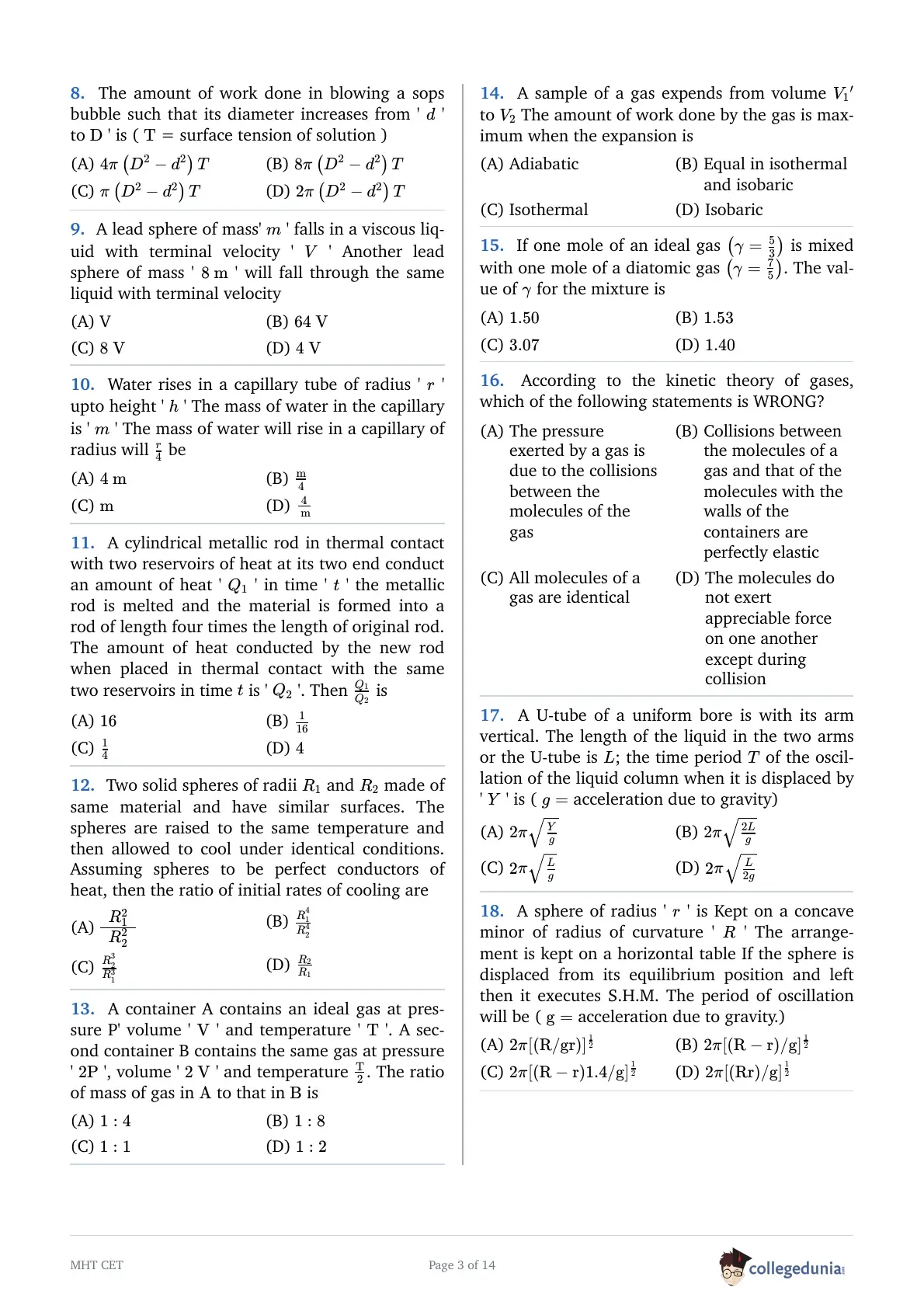
The amount of work done in blowing a sops bubble such that its diameter increases from ' \(d\) ' to \(\mathrm{D}\) ' is ( \(\mathrm{T}\) = surface tension of solution )
A lead sphere of mass' \(m\) ' falls in a viscous liquid with terminal velocity ' \(V\) ' Another lead sphere of mass ' \(8\ \mathrm{m}\) ' will fall through the same liquid with terminal velocity
Water rises in a capillary tube of radius ' \(r\) ' upto height ' \(h\) ' The mass of water in the capillary is ' \(m\) ' The mass of water will rise in a capillary of radius will \(\frac{r}{4}\) be
A cylindrical metallic rod in thermal contact with two reservoirs of heat at its two end conduct an amount of heat ' \(Q_{1}\) ' in time ' \(t\) ' the metallic rod is melted and the material is formed into a rod of length four times the length of original rod. The amount of heat conducted by the new rod when placed in thermal contact with the same two reservoirs in time \(t\) is ' \(Q_{2}\) '. Then \(\frac{Q_{1}}{Q_{2}}\) is
Two solid spheres of radii \(R_{1}\) and \(R_{2}\) made of same material and have similar surfaces. The spheres are raised to the same temperature and then allowed to cool under identical conditions. Assuming spheres to be perfect conductors of heat, then the ratio of initial rates of cooling are
A container A contains an ideal gas at pressure P' volume ' \(\mathrm{V}\) ' and temperature ' \(\mathrm{T}\) '. A second container B contains the same gas at pressure ' \(2\mathrm{P}\) ', volume ' \(2\ \mathrm{V}\) ' and temperature \(\frac{\mathrm{T}}{2}\). The ratio of mass of gas in \(\mathrm{A}\) to that in \(\mathrm{B}\) is
A sample of a gas expends from volume \(V_{1}{}'\) to \(V_{2}\) The amount of work done by the gas is maximum when the expansion is
If one mole of an ideal gas \(\left(\gamma =\frac{5}{3}\right)\) is mixed with one mole of a diatomic gas \(\left(\gamma =\frac{7}{5}\right)\). The value of \(\gamma\) for the mixture is
According to the kinetic theory of gases, which of the following statements is WRONG?
A U-tube of a uniform bore is with its arm vertical. The length of the liquid in the two arms or the U-tube is \(L\); the time period \(T\) of the oscillation of the liquid column when it is displaced by ' \(Y\) ' is ( \(g=\) acceleration due to gravity)
For a particle performing S.H.M., which of the following statement is INCORRECT?
Two waves \(y_{1}=0.35\,\sin (316t)\) and \(y_{2}=0.35\,\sin (310t)\) are propagating along the same direction. The number of beats produced per second are
A pipe open at both ends and a pipe closed at one end have save same length. The ratio of frequencies of air columns in their \(\mathrm{p}^{\text{th }}\) overtone respectively is
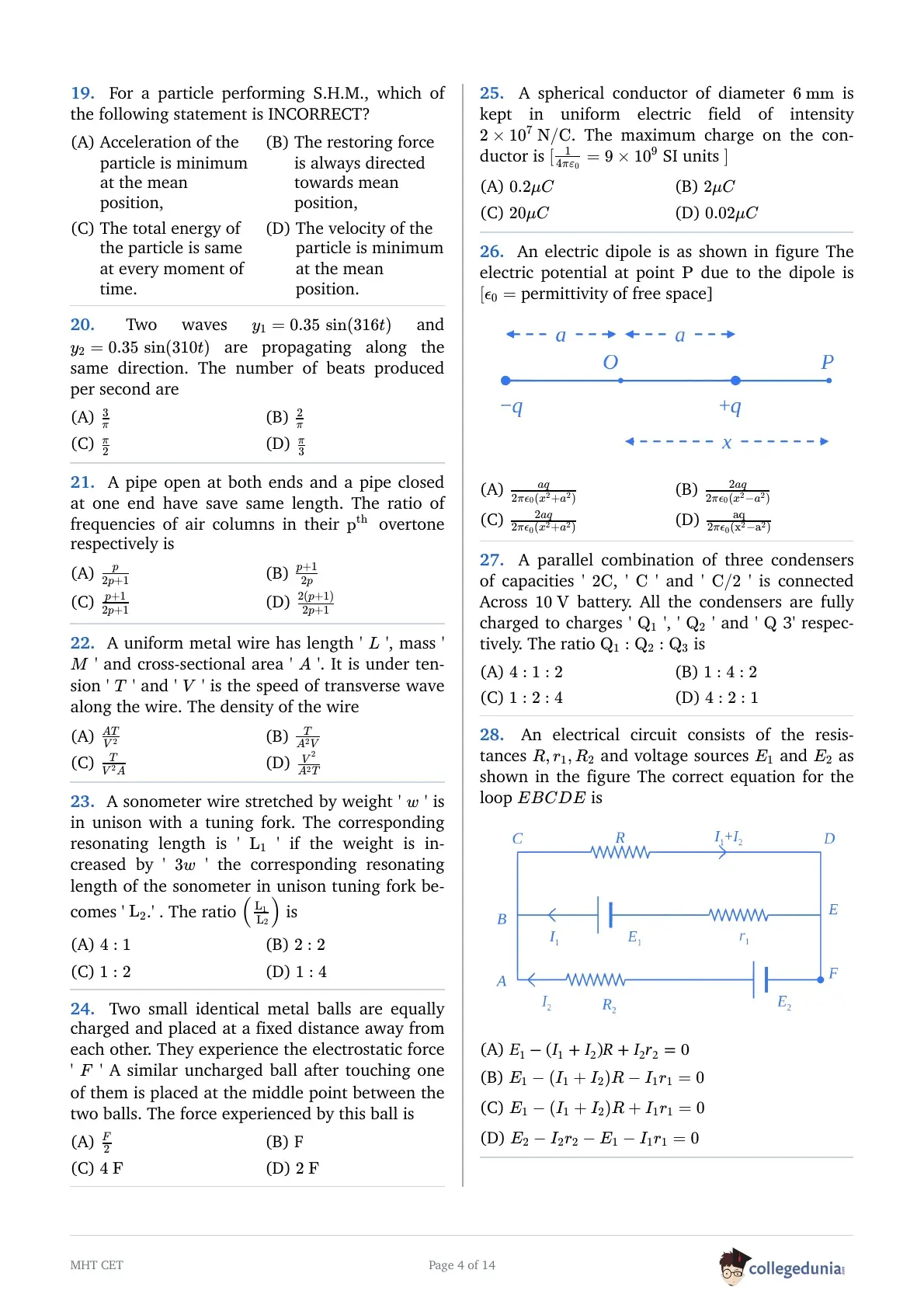
A uniform metal wire has length ' \(L\) ', mass ' \(M\) ' and cross-sectional area ' \(A\) '. It is under tension ' \(T\) ' and ' \(V\) ' is the speed of transverse wave along the wire. The density of the wire
A sonometer wire stretched by weight ' \(w\) ' is in unison with a tuning fork. The corresponding resonating length is ' \(\mathrm{L}_{1}\) ' if the weight is increased by ' \(3w\) ' the corresponding resonating length of the sonometer in unison tuning fork becomes ' \(\mathrm{L}_{2}\).' . The ratio \(\left(\frac{\mathrm{L}_{1}}{\ \mathrm{L}_{2}}\right)\) is
Two small identical metal balls are equally charged and placed at a fixed distance away from each other. They experience the electrostatic force ' \(F\) ' A similar uncharged ball after touching one of them is placed at the middle point between the two balls. The force experienced by this ball is
A spherical conductor of diameter \(6\ \mathrm{mm}\) is kept in uniform electric field of intensity \(2\times 10^{7}\ \mathrm{N}/\mathrm{C}\). The maximum charge on the conductor is \([\frac{1}{4\pi \varepsilon _{0}}=9\times 10^{9}\) SI units \(]\)
An electric dipole is as shown in figure The electric potential at point \(\mathrm{P}\) due to the dipole is \([\epsilon _{0}=\) permittivity of free space]

A parallel combination of three condensers of capacities ' \(2\mathrm{C}\), ' \(\mathrm{C}\) ' and ' \(\mathrm{C}/2\) ' is connected Across \(10\ \mathrm{V}\) battery. All the condensers are fully charged to charges ' \(\mathrm{Q}_{1}\) ', ' \(\mathrm{Q}_{2}\) ' and ' \(\mathrm{Q}\) 3' respectively. The ratio \(\mathrm{Q}_{1}:\mathrm{Q}_{2}:\mathrm{Q}_{3}\) is
An electrical circuit consists of the resistances \(R,r_{1},R_{2}\) and voltage sources \(E_{1}\) and \(E_{2}\) as shown in the figure The correct equation for the loop \(EBCDE\) is

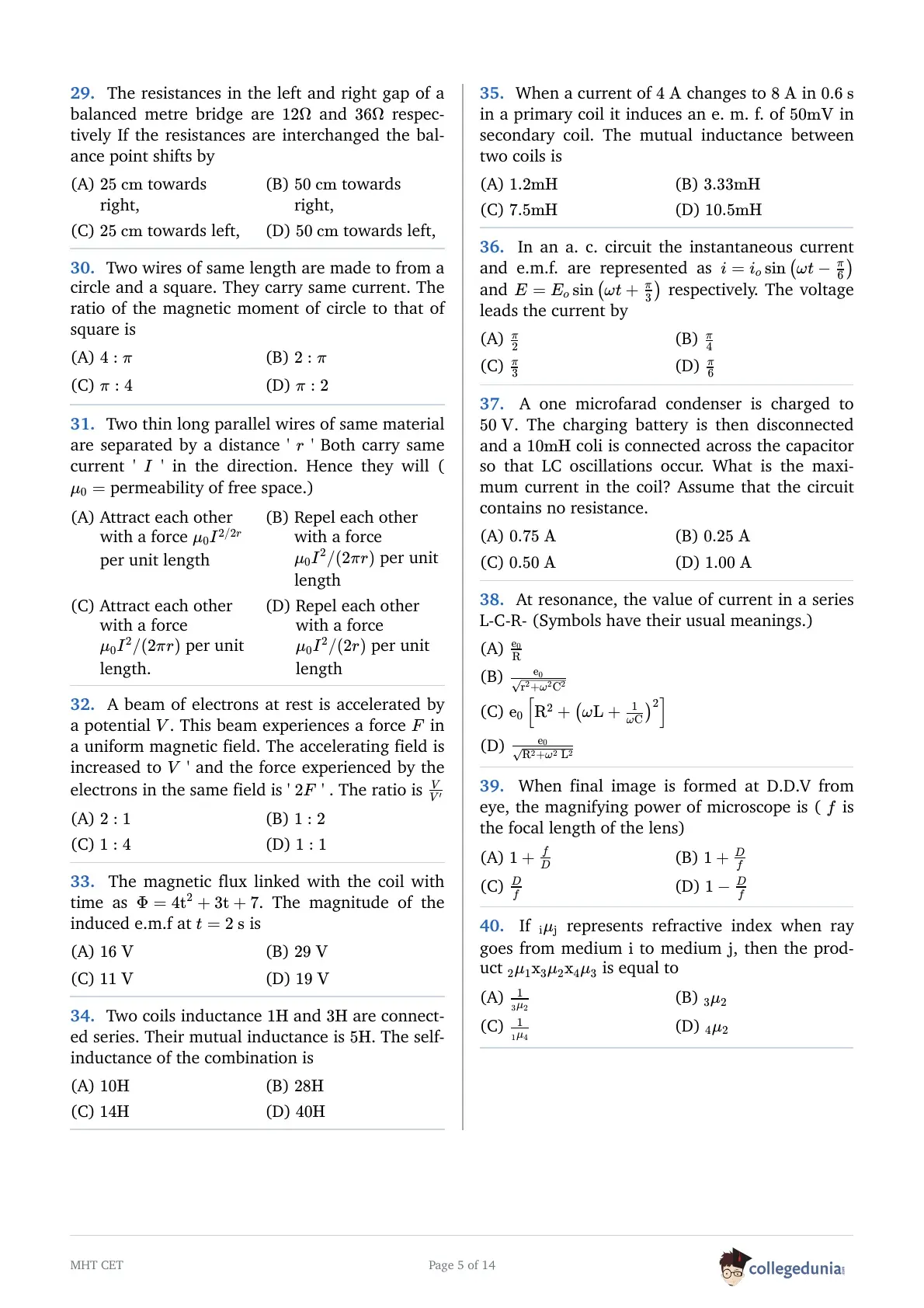
The resistances in the left and right gap of a balanced metre bridge are \(12\Omega\) and \(36\Omega\) respectively If the resistances are interchanged the balance point shifts by
Two wires of same length are made to from a circle and a square. They carry same current. The ratio of the magnetic moment of circle to that of square is
Two thin long parallel wires of same material are separated by a distance ' \(r\) ' Both carry same current ' \(I\) ' in the direction. Hence they will ( \(\mu _{0}=\) permeability of free space.)
A beam of electrons at rest is accelerated by a potential \(V\). This beam experiences a force \(F\) in a uniform magnetic field. The accelerating field is increased to \(V\) ' and the force experienced by the electrons in the same field is ' \(2F\) ' . The ratio is \(\frac{V}{V'}\)
The magnetic flux linked with the coil with time as \(\Phi =4\mathrm{t}^{2}+3\mathrm{t}+7\). The magnitude of the induced e.m.f at \(t=2\ \mathrm{s}\) is
Two coils inductance \(1\mathrm{H}\) and \(3\mathrm{H}\) are connected series. Their mutual inductance is \(5\mathrm{H}\). The self-inductance of the combination is
When a current of \(4\ \mathrm{A}\) changes to \(8\ \mathrm{A}\) in \(0.6\ \mathrm{s}\) in a primary coil it induces an e. m. f. of \(50\mathrm{mV}\) in secondary coil. The mutual inductance between two coils is
In an a. c. circuit the instantaneous current and e.m.f. are represented as \(i=i_{o}\sin \left(\omega t-\frac{\pi }{6}\right)\) and \(E=E_{o}\sin \left(\omega t+\frac{\pi }{3}\right)\) respectively. The voltage leads the current by
A one microfarad condenser is charged to \(50\ \mathrm{V}\). The charging battery is then disconnected and a \(10\mathrm{mH}\) coli is connected across the capacitor so that LC oscillations occur. What is the maximum current in the coil? Assume that the circuit contains no resistance.
At resonance, the value of current in a series L-C-R- (Symbols have their usual meanings.)
When final image is formed at D.D.V from eye, the magnifying power of microscope is ( \(f\) is the focal length of the lens)
If \({}_{\mathrm{i}}\mu _{\mathrm{j}}\) represents refractive index when ray goes from medium \(\mathrm{i}\) to medium \(\mathrm{j}\), then the product \({}_{2}\mu _{1}\mathrm{x}_{3}\mu _{2}\mathrm{x}_{4}\mu _{3}\) is equal to
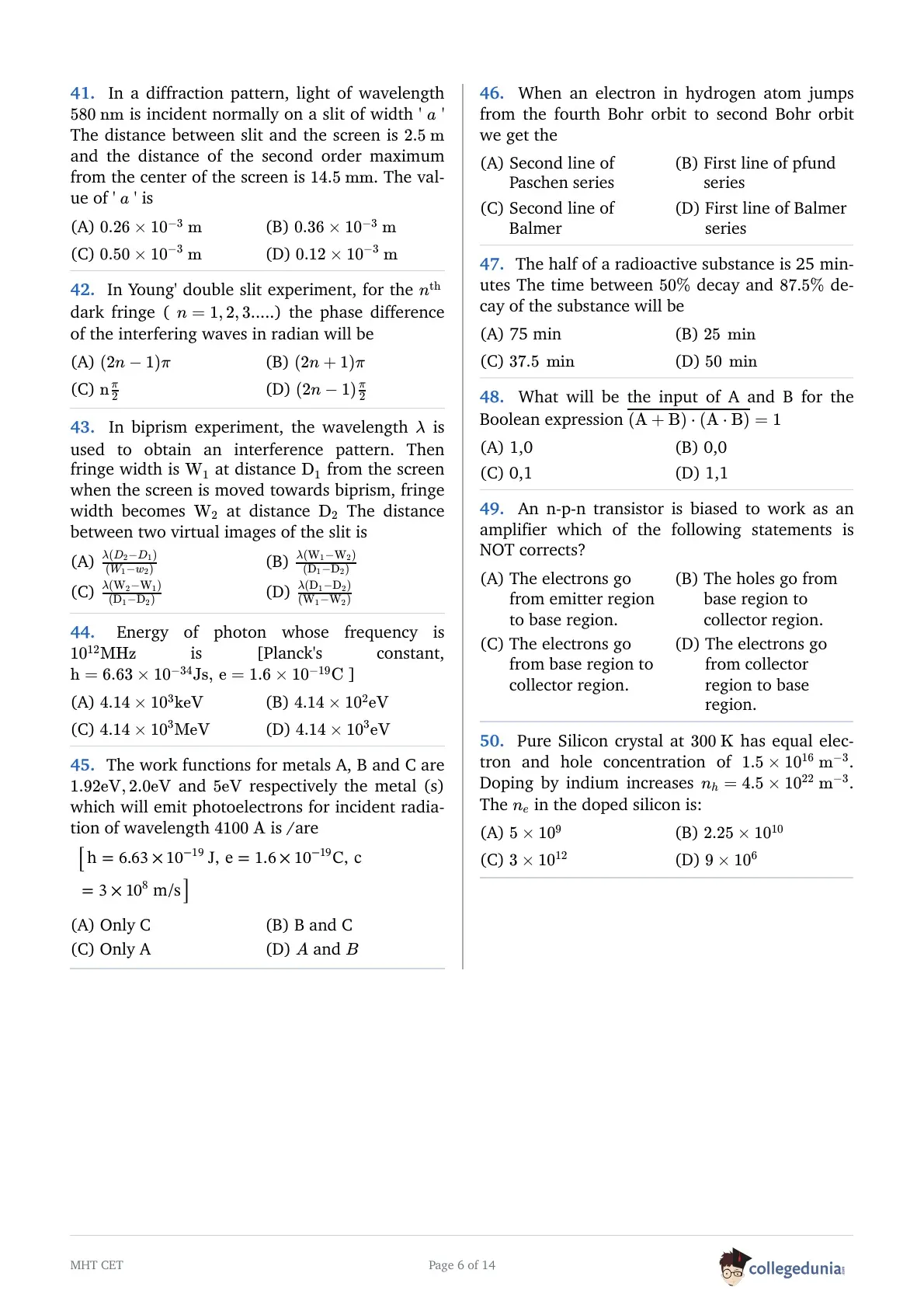
In a diffraction pattern, light of wavelength \(580\ \mathrm{nm}\) is incident normally on a slit of width ' \(a\) ' The distance between slit and the screen is \(2.5\ \mathrm{m}\) and the distance of the second order maximum from the center of the screen is \(14.5\ \mathrm{mm}\). The value of ' \(a\) ' is
In Young' double slit experiment, for the \(n^{\text{th }}\) dark fringe ( \(n=1,2,3\).....) the phase difference of the interfering waves in radian will be
In biprism experiment, the wavelength \(\lambda\) is used to obtain an interference pattern. Then fringe width is \(\mathrm{W}_{1}\) at distance \(\mathrm{D}_{1}\) from the screen when the screen is moved towards biprism, fringe width becomes \(\mathrm{W}_{2}\) at distance \(\mathrm{D}_{2}\) The distance between two virtual images of the slit is
Energy of photon whose frequency is \(10^{12}\mathrm{MHz}\) is [Planck's constant, \(\mathrm{h}=6.63\times 10^{-34}\mathrm{Js},\,\mathrm{e}=1.6\times 10^{-19}\mathrm{C}\) ]
The work functions for metals A, B and C are \(1.92\mathrm{eV},2.0\mathrm{eV}\) and \(5\mathrm{eV}\) respectively the metal (s) which will emit photoelectrons for incident radiation of wavelength \(4100\ \mathrm{A}\) is /are \(\left[\mathrm{h}=6.63\times 10^{-19}\ \mathrm{J},\,\mathrm{e}=1.6\times 10^{-19}\mathrm{C},\,\mathrm{c}=3\times 10^{8}\ \mathrm{m}/\mathrm{s}\right]\)
When an electron in hydrogen atom jumps from the fourth Bohr orbit to second Bohr orbit we get the
The half of a radioactive substance is 25 minutes The time between \(50\%\) decay and \(87.5\%\) decay of the substance will be
Pure Silicon crystal at \(300\ \mathrm{K}\) has equal electron and hole concentration of \(1.5\times 10^{16}\ \mathrm{m}^{-3}\). Doping by indium increases \(n_{h}=4.5\times 10^{22}\ \mathrm{m}^{-3}\). The \(n_{e}\) in the doped silicon is:
Chemistry (Q51 - Q100)
What is the value of percent atom economy if molar mass of reactants is \(36u\) and the mass of product is \(27\mathrm{u}\) ?
Which of the following species has highest mass?
Which among the following elements develops noble gas configuration in +1 state?
Which among the following statement is TRUE about isotones?
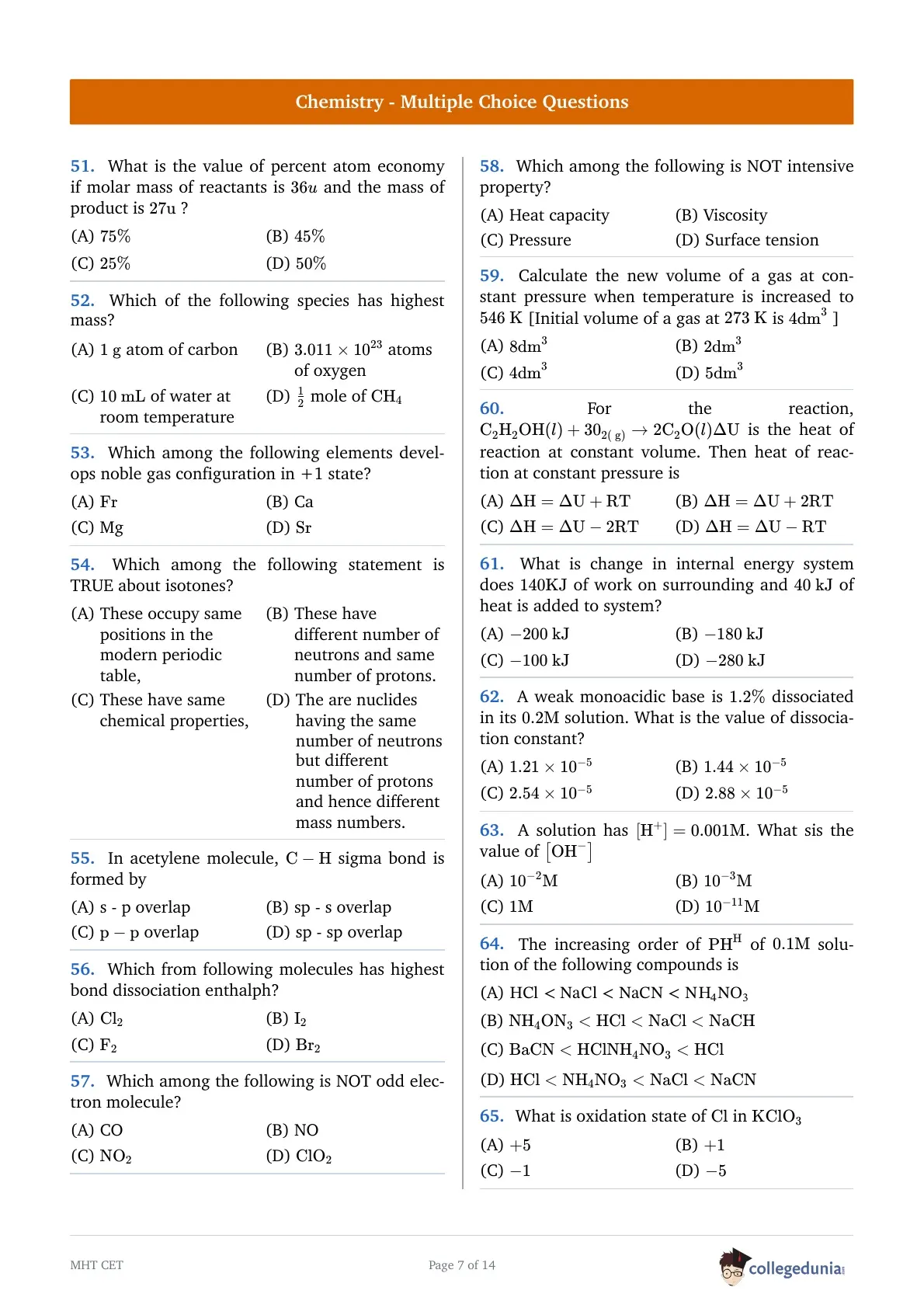
In acetylene molecule, \(\mathrm{C}-\mathrm{H}\) sigma bond is formed by
Which from following molecules has highest bond dissociation enthalph?
Which among the following is NOT odd electron molecule?
Which among the following is NOT intensive property?
Calculate the new volume of a gas at constant pressure when temperature is increased to \(546\ \mathrm{K}\) [Initial volume of a gas at \(273\ \mathrm{K}\) is \(4\mathrm{dm}^{3}\) ]
For the reaction, \(\mathrm{C}_{2}\mathrm{H}_{2}\mathrm{OH}(l)+30_{2(\ \mathrm{g})}\rightarrow 2\mathrm{C}_{2}\mathrm{O}(l)\Delta \mathrm{U}\) is the heat of reaction at constant volume. Then heat of reaction at constant pressure is
What is change in internal energy system does \(140\mathrm{KJ}\) of work on surrounding and \(40\ \mathrm{kJ}\) of heat is added to system?
A weak monoacidic base is \(1.2\%\) dissociated in its \(0.2\mathrm{M}\) solution. What is the value of dissociation constant?
A solution has \([\mathrm{H}^{+}]=0.001\mathrm{M}\). What sis the value of \(\left[\mathrm{OH}^{-}\right]\)
The increasing order of \(\mathrm{PH}^{\mathrm{H}}\) of \(0.1\mathrm{M}\) solution of the following compounds is
What is oxidation state of \(\mathrm{Cl}\) in \(\mathrm{KClO}_{3}\)
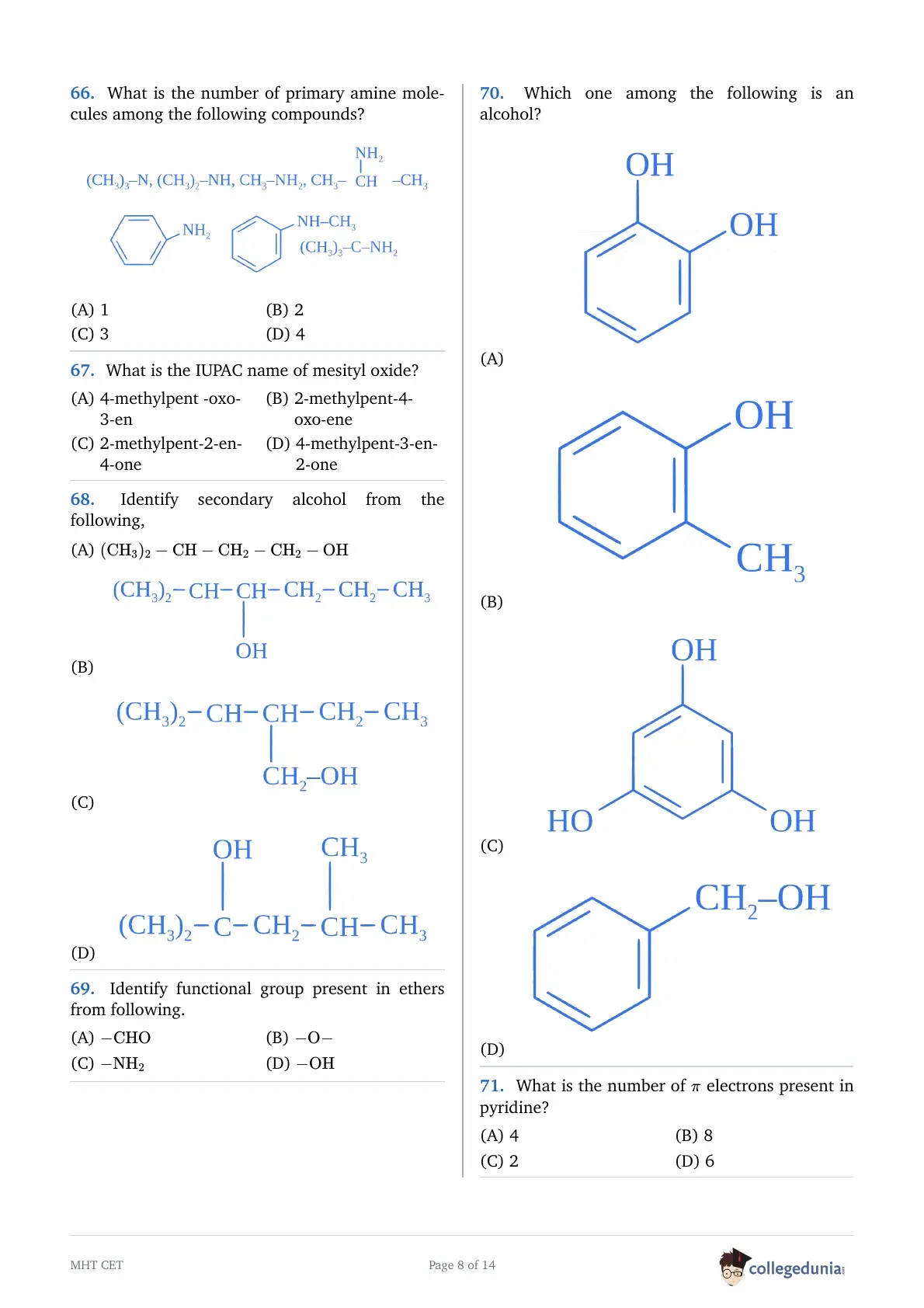
What is the number of primary amine molecules among the following compounds?

What is the IUPAC name of mesityl oxide?
Identify secondary alcohol from the following,
- (A) \((\mathrm{CH}_{3})_{2}-\mathrm{CH}-\mathrm{CH}_{2}-\mathrm{CH}_{2}-\mathrm{OH}\)
- (B)
![]()
- (C)
![]()
- (D)
![]()


Identify functional group present in ethers from following.


What is the number of \(\pi\) electrons present in pyridine?
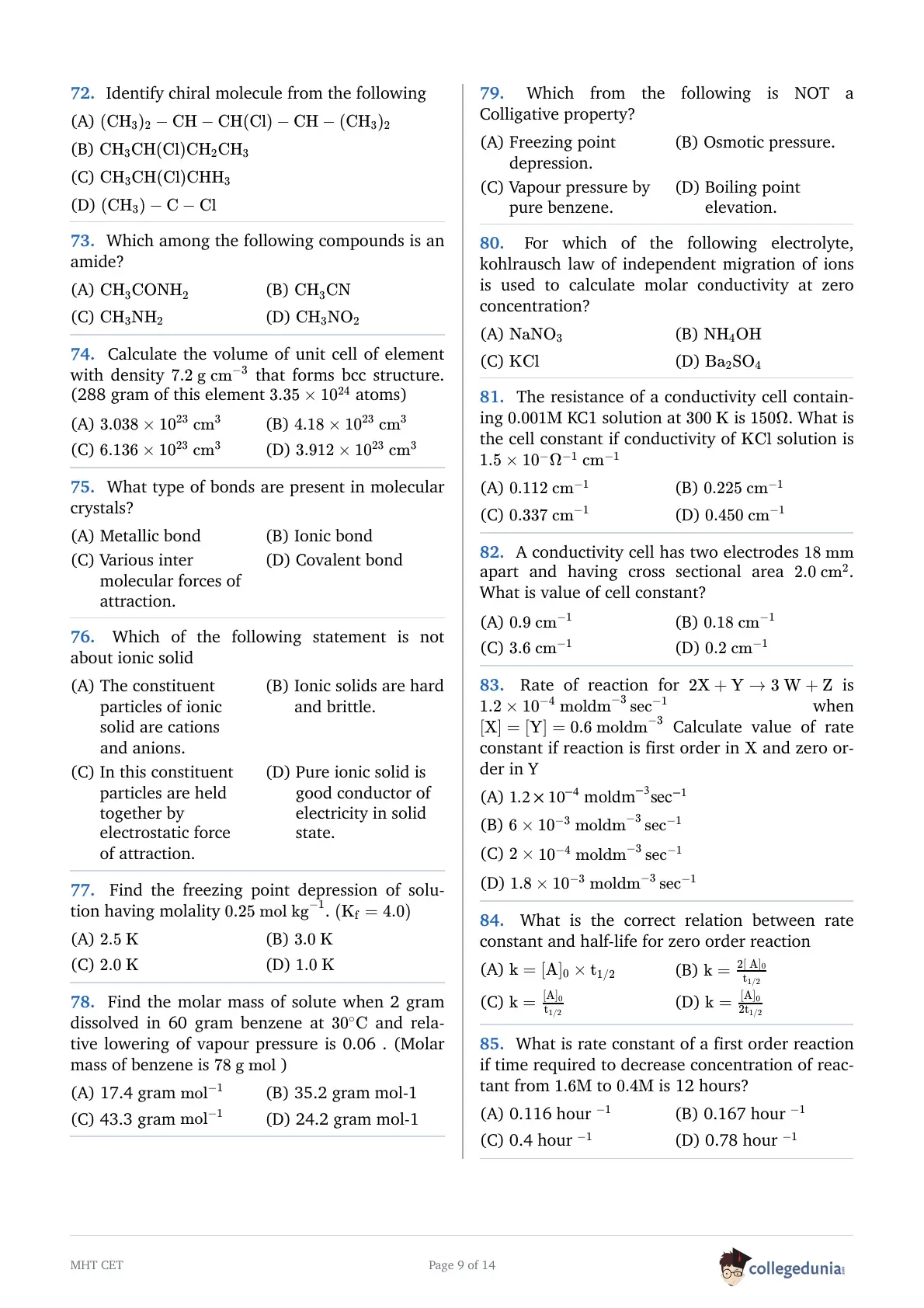
Identify chiral molecule from the following
Which among the following compounds is an amide?
What type of bonds are present in molecular crystals?
Which of the following statement is not about ionic solid
Find the freezing point depression of solution having molality \(0.25\ \mathrm{mol}\ \mathrm{kg}^{-1}\). \((\mathrm{K}_{\mathrm{f}}=4.0)\)
Find the molar mass of solute when 2 gram dissolved in 60 gram benzene at \(30^{\circ }\mathrm{C}\) and relative lowering of vapour pressure is 0.06 . (Molar mass of benzene is \(78\ \mathrm{g}\ \mathrm{mol}\) )
Which from the following is NOT a Colligative property?
For which of the following electrolyte, kohlrausch law of independent migration of ions is used to calculate molar conductivity at zero concentration?
A conductivity cell has two electrodes \(18\ \mathrm{mm}\) apart and having cross sectional area \(2.0\ \mathrm{cm}^{2}\). What is value of cell constant?
Rate of reaction for \(2\mathrm{X}+\mathrm{Y}\rightarrow 3\ \mathrm{W}+\mathrm{Z}\) is \(1.2\times 10^{-4}\ \mathrm{mol}\mathrm{dm}^{-3}\sec ^{-1}\) when \([\mathrm{X}]=[\mathrm{Y}]=0.6\ \mathrm{mol}\mathrm{dm}^{-3}\) Calculate value of rate constant if reaction is first order in \(\mathrm{X}\) and zero order in Y
What is the correct relation between rate constant and half-life for zero order reaction
What is rate constant of a first order reaction if time required to decrease concentration of reactant from \(1.6\mathrm{M}\) to \(0.4\mathrm{M}\) is 12 hours?
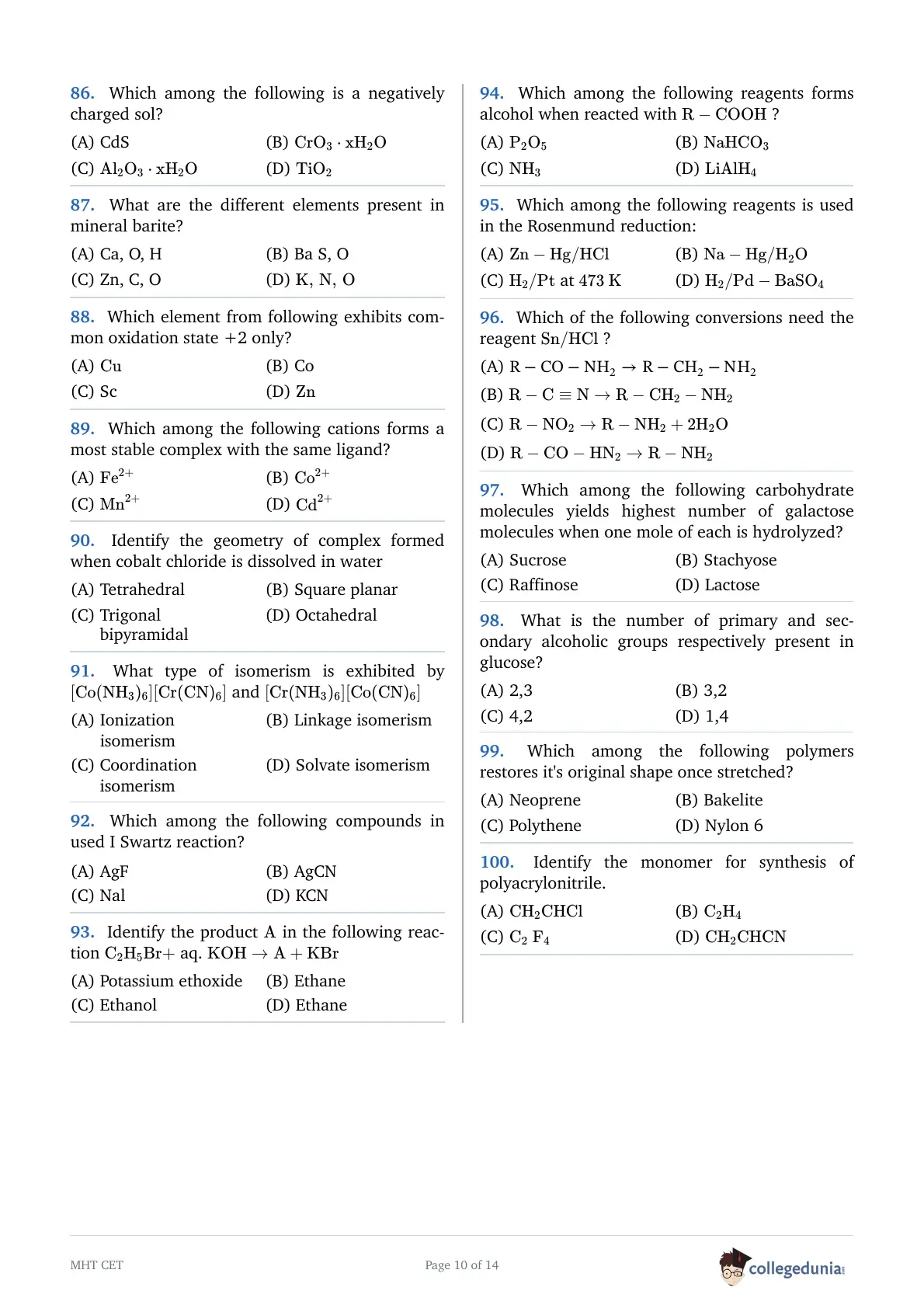
Which among the following is a negatively charged sol?
What are the different elements present in mineral barite?
Which element from following exhibits common oxidation state +2 only?
Which among the following cations forms a most stable complex with the same ligand?
Identify the geometry of complex formed when cobalt chloride is dissolved in water
What type of isomerism is exhibited by \([\mathrm{Co}(\mathrm{NH}_{3})_{6}][\mathrm{Cr}(\mathrm{CN})_{6}]\) and \([\mathrm{Cr}(\mathrm{NH}_{3})_{6}][\mathrm{Co}(\mathrm{CN})_{6}]\)
Which among the following compounds in used I Swartz reaction?
Which among the following reagents forms alcohol when reacted with \(\mathrm{R}-\mathrm{COOH}\) ?
Which among the following reagents is used in the Rosenmund reduction:
Which of the following conversions need the reagent \(\mathrm{Sn}/\mathrm{HCl}\) ?
Which among the following carbohydrate molecules yields highest number of galactose molecules when one mole of each is hydrolyzed?
What is the number of primary and secondary alcoholic groups respectively present in glucose?
Which among the following polymers restores it's original shape once stretched?
Identify the monomer for synthesis of polyacrylonitrile.
Mathematics (Q101 - Q150)
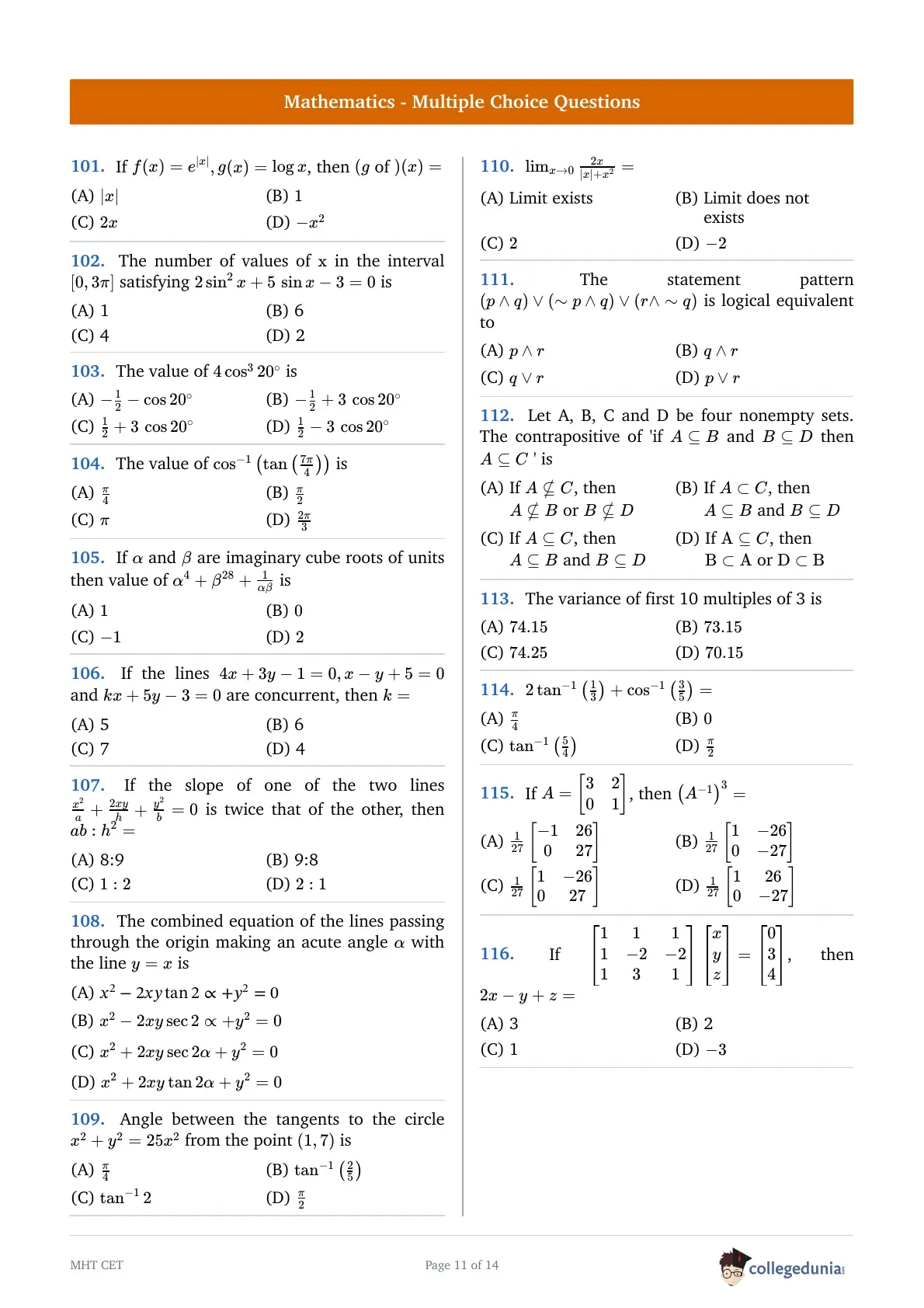
If \(f(x)=e^{|x|},g(x)=\log x\), then \((g\) of \()(x)=\)
The number of values of \(\mathrm{x}\) in the interval \([0,3\pi ]\) satisfying \(2\sin ^{2}x+5\,\sin x-3=0\) is
The value of \(4\cos ^{3}20^{\circ }\) is
The value of \(\cos ^{-1}\left(\tan \left(\frac{7\pi }{4}\right)\right)\) is
If \(\alpha\) and \(\beta\) are imaginary cube roots of units then value of \(\alpha ^{4}+\beta ^{28}+\frac{1}{\alpha \beta }\) is
If the lines \(4x+3y-1=0,x-y+5=0\) and \(kx+5y-3=0\) are concurrent, then \(k=\)
If the slope of one of the two lines \(\frac{x^{2}}{a}+\frac{2xy}{h}+\frac{y^{2}}{b}=0\) is twice that of the other, then \(ab:h^{2}=\)
The combined equation of the lines passing through the origin making an acute angle \(\alpha\) with the line \(y=x\) is
\(\lim _{x\rightarrow 0}\frac{2x}{|x|+x^{2}}=\)
The statement pattern \((p\wedge q)\vee (\sim p\wedge q)\vee (r\wedge \sim q)\) is logical equivalent to
Let A, B, C and D be four nonempty sets. The contrapositive of 'if \(A\subseteq B\) and \(B\subseteq D\) then \(A\subseteq C\) ' is
The variance of first 10 multiples of 3 is
\(2\tan ^{-1}\left(\frac{1}{3}\right)+\cos ^{-1}\left(\frac{3}{5}\right)=\)
If \(A=\begin{bmatrix} 3 & 2 \\ 0 & 1 \end{bmatrix}\), then \(\left(A^{-1}\right)^{3}=\)
If \(\begin{bmatrix} 1 & 1 & 1 \\ 1 & -2 & -2 \\ 1 & 3 & 1 \end{bmatrix}\begin{bmatrix} x \\ y \\ z \end{bmatrix}=\begin{bmatrix} 0 \\ 3 \\ 4 \end{bmatrix}\), then \(2x-y+z=\)
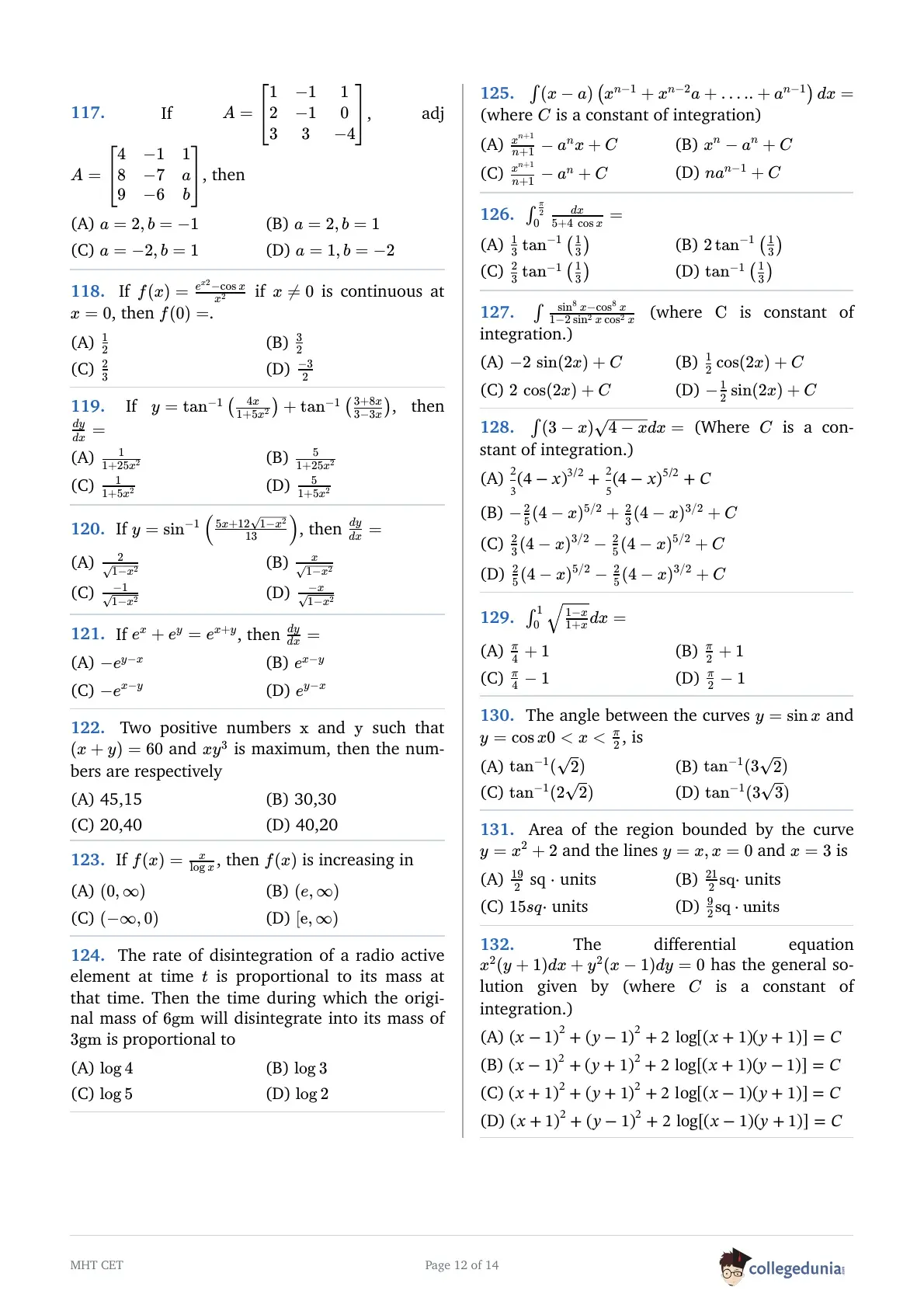
If \(A=\begin{bmatrix} 1 & -1 & 1 \\ 2 & -1 & 0 \\ 3 & 3 & -4 \end{bmatrix}\), adj \(A=\begin{bmatrix} 4 & -1 & 1 \\ 8 & -7 & a \\ 9 & -6 & b \end{bmatrix}\), then
If \(f(x)=\frac{e^{x2}-\cos x}{x^{2}}\) if \(x\neq 0\) is continuous at \(x=0\), then \(f(0)=\).
If \(e^{x}+e^{y}=e^{x+y}\), then \(\frac{dy}{dx}=\)
The rate of disintegration of a radio active element at time \(t\) is proportional to its mass at that time. Then the time during which the original mass of \(6\mathrm{gm}\) will disintegrate into its mass of \(3\mathrm{gm}\) is proportional to
\(\int (x-a)\left(x^{n-1}+x^{n-2}a+\ldots ..+a^{n-1}\right)dx=\) (where \(C\) is a constant of integration)
\(\int _{0}^{\frac{\pi }{2}}\frac{dx}{5+4\,\cos x}=\)
\(\int \frac{\sin ^{8}x-\cos ^{8}x}{1-2\sin ^{2}x\cos ^{2}x}\) (where \(\mathrm{C}\) is constant of integration.)
\(\int _{0}^{1}\sqrt{\frac{1-x}{1+x}}dx=\)
The angle between the curves \(y=\sin x\) and \(y=\cos x0\lt x\lt \frac{\pi }{2}\), is
Area of the region bounded by the curve \(y=x^{2}+2\) and the lines \(y=x,x=0\) and \(x=3\) is
The differential equation \(x^{2}(y+1)dx+y^{2}(x-1)dy=0\) has the general solution given by (where \(C\) is a constant of integration.)
The general solution of differential equation \(xdy-ydx=0\) represents
The particular solution of \(\frac{dy}{dx}=1+x+y^{2}+xy^{2}\), when \(y(0)=0\). is
The order and degree of the differential equation \(\left(1+\frac{\mathrm{d}y}{\ \mathrm{d}x}\right)^{\frac{1}{3}}=\sqrt{\frac{\mathrm{d}^{2}y}{\ \mathrm{d}x^{2}}}\) are respectively.
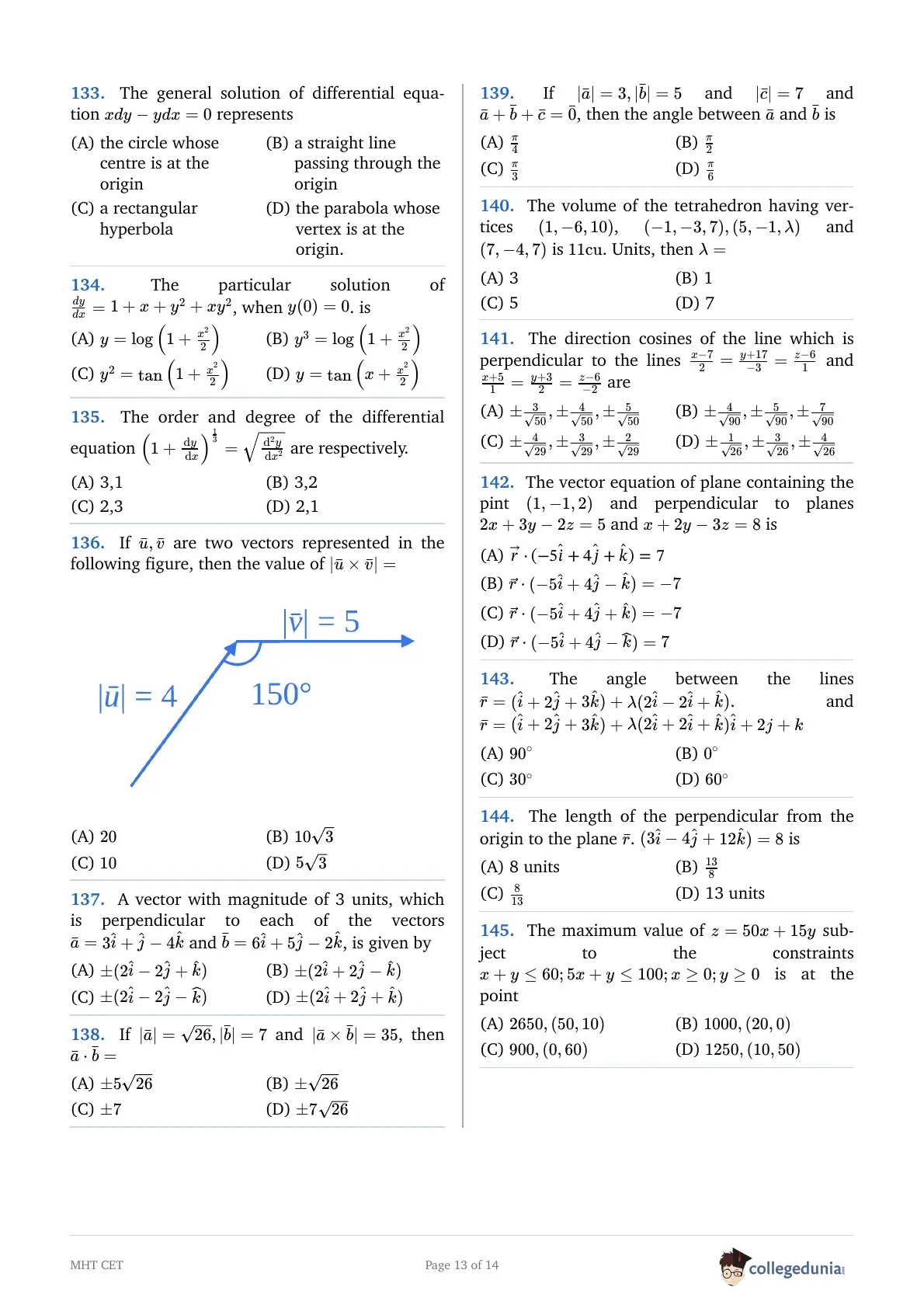
If \(\bar{u},\bar{v}\) are two vectors represented in the following figure, then the value of \(|\bar{u}\times \bar{v}|=\)

A vector with magnitude of 3 units, which is perpendicular to each of the vectors \(\bar{a}=3\hat{i}+\hat{j}-4\hat{k}\) and \(\bar{b}=6\hat{i}+5\hat{j}-2\hat{k}\), is given by
If \(|\bar{a}|=\sqrt{26},|\bar{b}|=7\) and \(|\bar{a}\times \bar{b}|=35\), then \(\bar{a}\cdot \bar{b}=\)
If \(|\bar{a}|=3,|\bar{b}|=5\) and \(|\bar{c}|=7\) and \(\bar{a}+\bar{b}+\bar{c}=\bar{0}\), then the angle between \(\bar{a}\) and \(\bar{b}\) is
The direction cosines of the line which is perpendicular to the lines \(\frac{x-7}{2}=\frac{y+17}{-3}=\frac{z-6}{1}\) and \(\frac{x+5}{1}=\frac{y+3}{2}=\frac{z-6}{-2}\) are
The vector equation of plane containing the pint \((1,-1,2)\) and perpendicular to planes \(2x+3y-2z=5\) and \(x+2y-3z=8\) is
The length of the perpendicular from the origin to the plane \(\bar{r}\). \((3\hat{i}-4\hat{j}+12\hat{k})=8\) is
The maximum value of \(z=50x+15y\) subject to the constraints \(x+y\leq 60;5x+y\leq 100;x\geq 0;y\geq 0\) is at the point
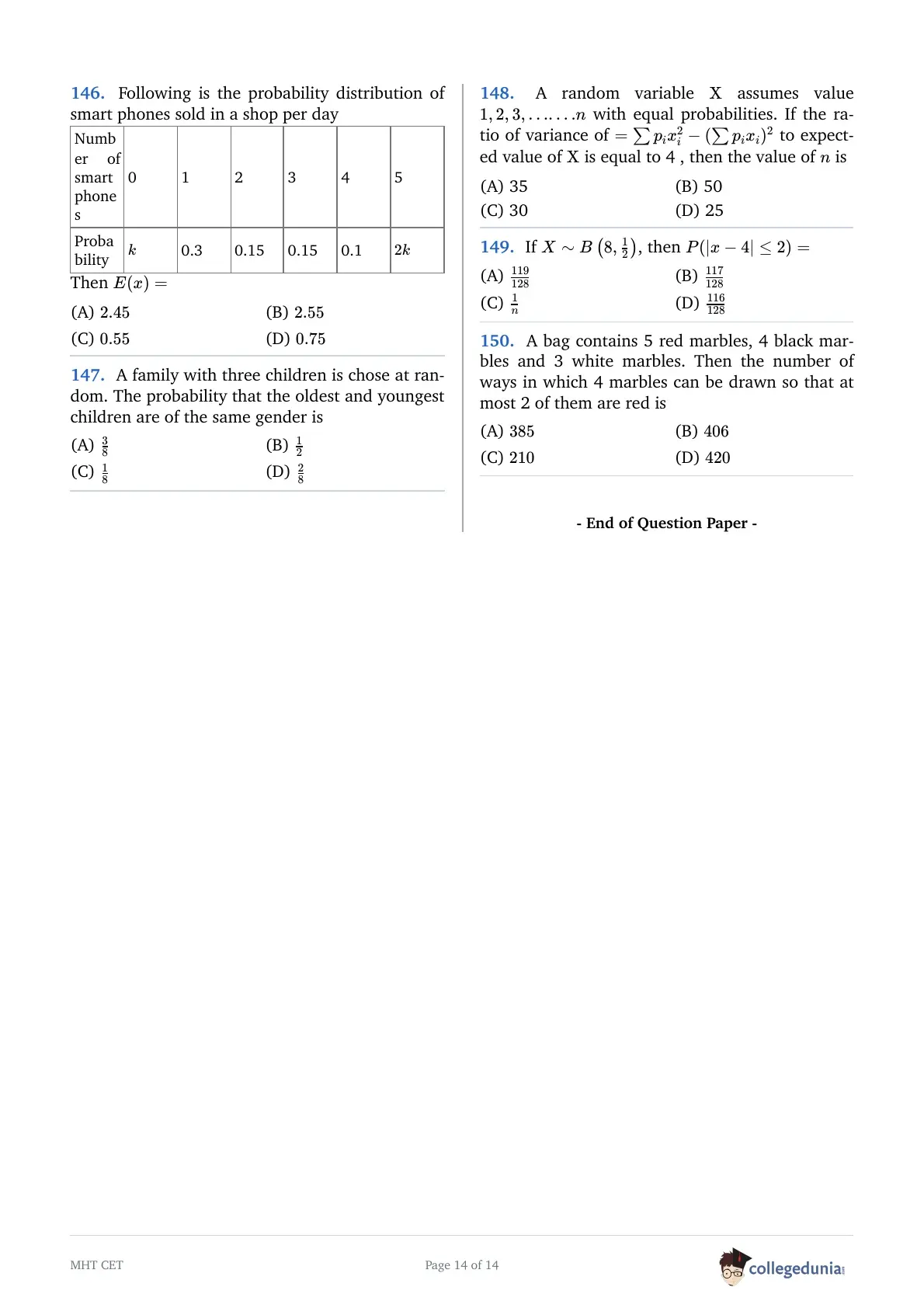
Following is the probability distribution of smart phones sold in a shop per day
| Number of smart phones | 0 | 1 | 2 | 3 | 4 | 5 |
| Probability | \(k\) | 0.3 | 0.15 | 0.15 | 0.1 | \(2k\) |
A family with three children is chose at random. The probability that the oldest and youngest children are of the same gender is
A random variable \(\mathrm{X}\) assumes value \(1,2,3,\ldots \ldots .n\) with equal probabilities. If the ratio of variance of \(=\sum p_{i}x_{i}^{2}-(\sum p_{i}x_{i})^{2}\) to expected value of \(\mathrm{X}\) is equal to 4 , then the value of \(n\) is
If \(X\sim B\left(8,\frac{1}{2}\right)\), then \(P(|x-4|\leq 2)=\)
A bag contains 5 red marbles, 4 black marbles and 3 white marbles. Then the number of ways in which 4 marbles can be drawn so that at most 2 of them are red is
MHT CET 2022 PCM Exam Pattern and Marking Scheme
| Parameter | Details |
|---|---|
| Conducting Body | Maharashtra Common Entrance Test Cell (Maharashtra CET Cell) |
| Exam Mode | Online (Computer-Based Test) |
| Duration | 180 minutes (3 hours) |
| Groups / Subjects | PCM (Physics, Chemistry, Mathematics) for Engineering |
| Total Questions |
150 |
| Total Marks | 200 |
| Question Type | Multiple Choice Questions (MCQs) |
| Marks Distribution |
|
| Negative Marking | No |
| Syllabus Weightage |
|



Comments