




MHT CET 2022 Aug 8 Shift 1 PCM Question Paper is available for download here. Maharashtra State CET Cell conducted MHT CET 2022 PCM Exam on Aug 8 in Shift 1 from 9 AM to 12 PM in CBT mode.
The MHT CET 2022 PCM question paper includes the following:
- The MHT CET 2022 PCM Question Paper consists of 150 multiple-choice questions (MCQs) totalling 200 marks divided into 3 sections: Physics, Chemistry, and Mathematics, with 50 questions in each subject.
- Physics and Chemistry questions carry 1 mark each while Mathematics questions carry 2 marks each.
- There is no negative marking for incorrect answers.
MHT CET 2022 Aug 8 Shift 1 PCM Question Paper with Solution PDF
| CD PDF | CD PDF with Solutions |
|---|---|
| Download Collegedunia PDF 0.93 MB | - |
Also Check:
MHT CET 2022 Aug 8 Shift 1 PCM Questions with Solutions
Physics (Q1 - Q50)
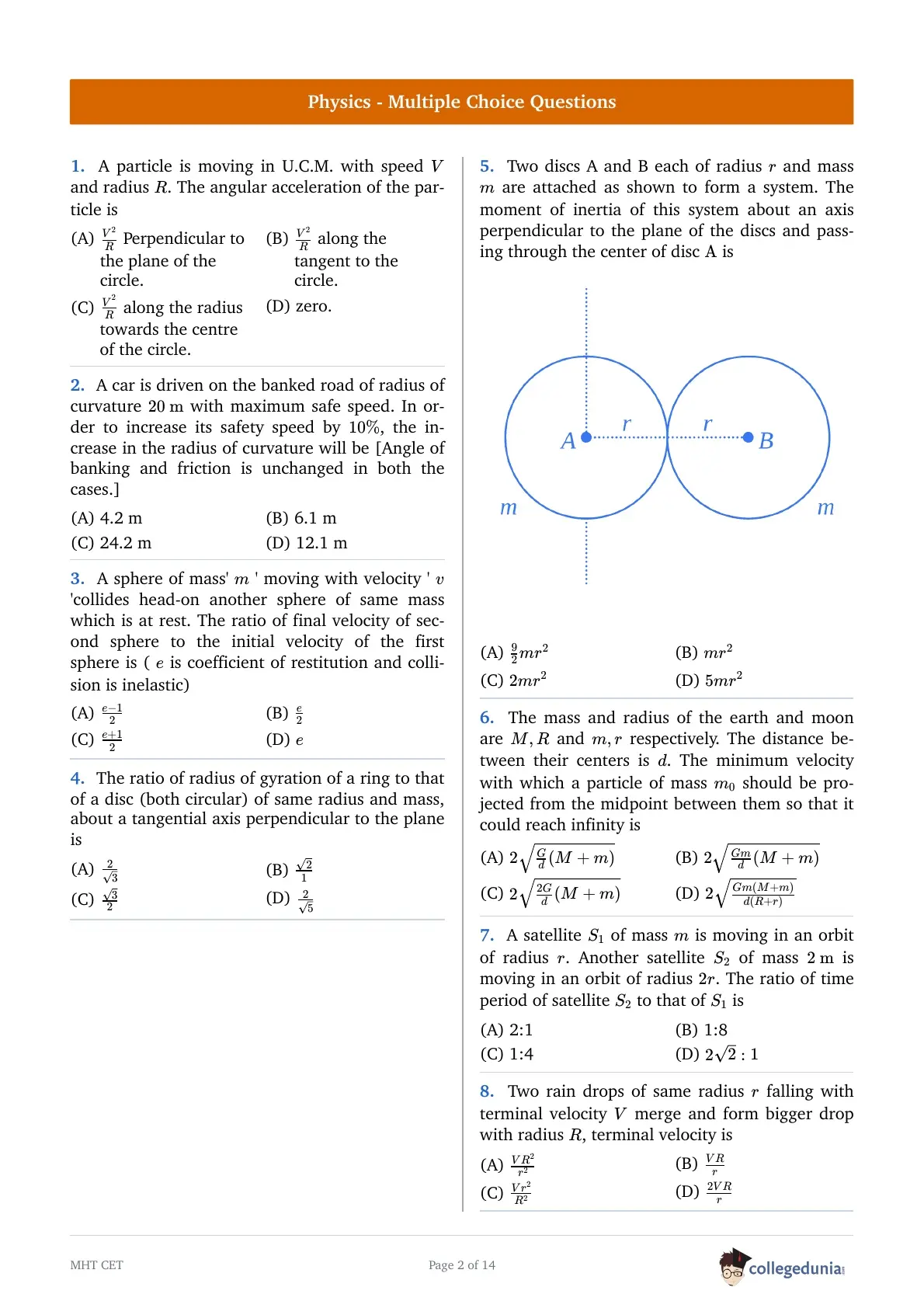
A particle is moving in U.C.M. with speed \(V\) and radius \(R\). The angular acceleration of the particle is
A car is driven on the banked road of radius of curvature \(20\ \mathrm{m}\) with maximum safe speed. In order to increase its safety speed by \(10\%\), the increase in the radius of curvature will be [Angle of banking and friction is unchanged in both the cases.]
A sphere of mass' \(m\) ' moving with velocity ' \(v\) 'collides head-on another sphere of same mass which is at rest. The ratio of final velocity of second sphere to the initial velocity of the first sphere is ( \(e\) is coefficient of restitution and collision is inelastic)
The ratio of radius of gyration of a ring to that of a disc (both circular) of same radius and mass, about a tangential axis perpendicular to the plane is
Two discs A and B each of radius \(r\) and mass \(m\) are attached as shown to form a system. The moment of inertia of this system about an axis perpendicular to the plane of the discs and passing through the center of disc \(\mathrm{A}\) is

The mass and radius of the earth and moon are \(M,R\) and \(m,r\) respectively. The distance between their centers is \(d\). The minimum velocity with which a particle of mass \(m_{0}\) should be projected from the midpoint between them so that it could reach infinity is
A satellite \(S_{1}\) of mass \(m\) is moving in an orbit of radius \(r\). Another satellite \(S_{2}\) of mass \(2\ \mathrm{m}\) is moving in an orbit of radius \(2r\). The ratio of time period of satellite \(S_{2}\) to that of \(S_{1}\) is
Two rain drops of same radius \(r\) falling with terminal velocity \(V\) merge and form bigger drop with radius \(R\), terminal velocity is
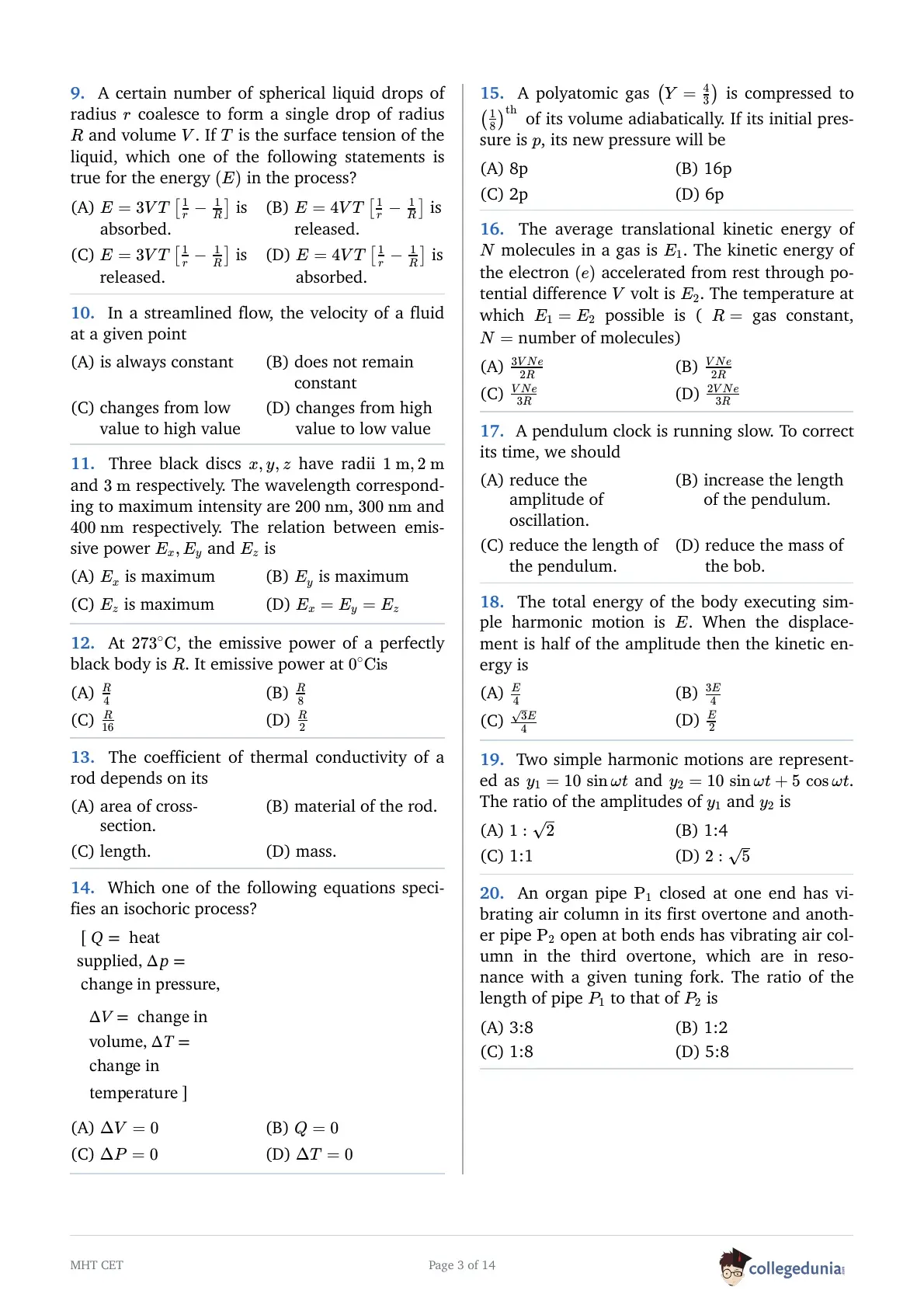
A certain number of spherical liquid drops of radius \(r\) coalesce to form a single drop of radius \(R\) and volume \(V\). If \(T\) is the surface tension of the liquid, which one of the following statements is true for the energy \((E)\) in the process?
In a streamlined flow, the velocity of a fluid at a given point
Three black discs \(x,y,z\) have radii \(1\ \mathrm{m},2\ \mathrm{m}\) and \(3\ \mathrm{m}\) respectively. The wavelength corresponding to maximum intensity are \(200\ \mathrm{nm}\), \(300\ \mathrm{nm}\) and \(400\ \mathrm{nm}\) respectively. The relation between emissive power \(E_{x},E_{y}\) and \(E_{z}\) is
At \(273^{\circ }\mathrm{C}\), the emissive power of a perfectly black body is \(R\). It emissive power at \(0^{\circ }\mathrm{Cis}\)
The coefficient of thermal conductivity of a rod depends on its
Which one of the following equations specifies an isochoric process? \(\begin{aligned} & \text{ [ }Q=\text{ heat supplied, }\Delta p=\text{ change in pressure, } \\ & \Delta V=\text{ change in volume, }\Delta T=\text{ change in temperature }] \end{aligned}\)
A polyatomic gas \(\left(Y=\frac{4}{3}\right)\) is compressed to \(\left(\frac{1}{8}\right)^{\text{th }}\) of its volume adiabatically. If its initial pressure is \(p\), its new pressure will be
The average translational kinetic energy of \(N\) molecules in a gas is \(E_{1}\). The kinetic energy of the electron \((e)\) accelerated from rest through potential difference \(V\) volt is \(E_{2}\). The temperature at which \(E_{1}=E_{2}\) possible is ( \(R=\) gas constant, \(N=\) number of molecules)
A pendulum clock is running slow. To correct its time, we should
The total energy of the body executing simple harmonic motion is \(E\). When the displacement is half of the amplitude then the kinetic energy is
Two simple harmonic motions are represented as \(y_{1}=10\,\sin \omega t\) and \(y_{2}=10\,\sin \omega t+5\,\cos \omega t\). The ratio of the amplitudes of \(y_{1}\) and \(y_{2}\) is
An organ pipe \(\mathrm{P}_{1}\) closed at one end has vibrating air column in its first overtone and another pipe \(\mathrm{P}_{2}\) open at both ends has vibrating air column in the third overtone, which are in resonance with a given tuning fork. The ratio of the length of pipe \(P_{1}\) to that of \(P_{2}\) is
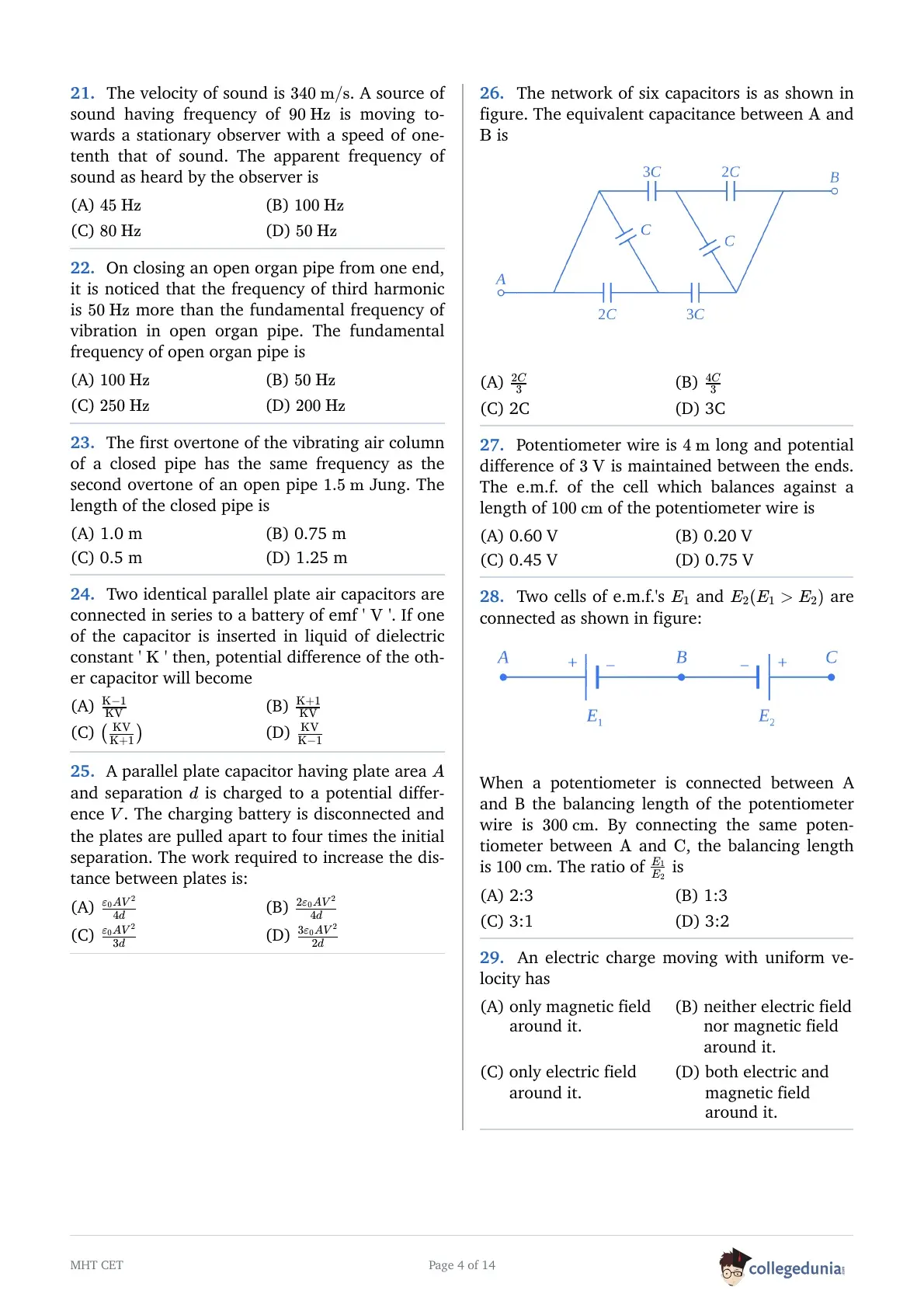
The velocity of sound is \(340\ \mathrm{m}/\mathrm{s}\). A source of sound having frequency of \(90\ \mathrm{Hz}\) is moving towards a stationary observer with a speed of one-tenth that of sound. The apparent frequency of sound as heard by the observer is
On closing an open organ pipe from one end, it is noticed that the frequency of third harmonic is \(50\ \mathrm{Hz}\) more than the fundamental frequency of vibration in open organ pipe. The fundamental frequency of open organ pipe is
The first overtone of the vibrating air column of a closed pipe has the same frequency as the second overtone of an open pipe \(1.5\ \mathrm{m}\) Jung. The length of the closed pipe is
Two identical parallel plate air capacitors are connected in series to a battery of emf ' \(\mathrm{V}\) '. If one of the capacitor is inserted in liquid of dielectric constant ' \(\mathrm{K}\) ' then, potential difference of the other capacitor will become
A parallel plate capacitor having plate area \(A\) and separation \(d\) is charged to a potential difference \(V\). The charging battery is disconnected and the plates are pulled apart to four times the initial separation. The work required to increase the distance between plates is:
The network of six capacitors is as shown in figure. The equivalent capacitance between \(\mathrm{A}\) and \(\mathrm{B}\) is

Potentiometer wire is \(4\ \mathrm{m}\) long and potential difference of \(3\ \mathrm{V}\) is maintained between the ends. The e.m.f. of the cell which balances against a length of \(100\ \mathrm{cm}\) of the potentiometer wire is
Two cells of e.m.f.'s \(E_{1}\) and \(E_{2}(E_{1}>E_{2})\) are connected as shown in figure:

An electric charge moving with uniform velocity has
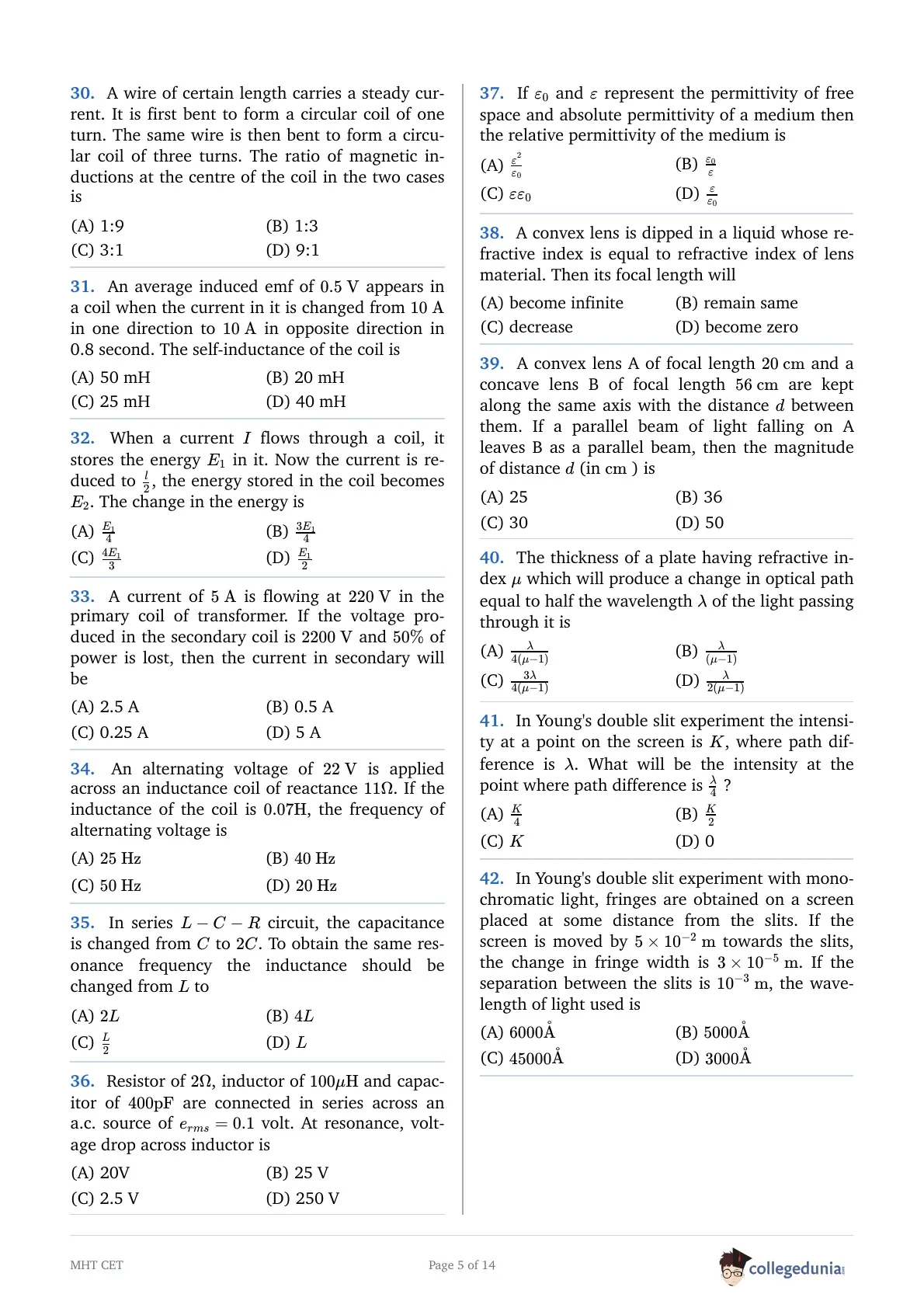
A wire of certain length carries a steady current. It is first bent to form a circular coil of one turn. The same wire is then bent to form a circular coil of three turns. The ratio of magnetic inductions at the centre of the coil in the two cases is
An average induced emf of \(0.5\ \mathrm{V}\) appears in a coil when the current in it is changed from \(10\ \mathrm{A}\) in one direction to \(10\ \mathrm{A}\) in opposite direction in 0.8 second. The self-inductance of the coil is
When a current \(I\) flows through a coil, it stores the energy \(E_{1}\) in it. Now the current is reduced to \(\frac{l}{2}\), the energy stored in the coil becomes \(E_{2}\). The change in the energy is
A current of \(5\ \mathrm{A}\) is flowing at \(220\ \mathrm{V}\) in the primary coil of transformer. If the voltage produced in the secondary coil is \(2200\ \mathrm{V}\) and \(50\%\) of power is lost, then the current in secondary will be
An alternating voltage of \(22\ \mathrm{V}\) is applied across an inductance coil of reactance \(11\Omega\). If the inductance of the coil is \(0.07\mathrm{H}\), the frequency of alternating voltage is
In series \(L-C-R\) circuit, the capacitance is changed from \(C\) to \(2C\). To obtain the same resonance frequency the inductance should be changed from \(L\) to
Resistor of \(2\Omega\), inductor of \(100\mu \mathrm{H}\) and capacitor of \(400\mathrm{pF}\) are connected in series across an a.c. source of \(e_{rms}=0.1\) volt. At resonance, voltage drop across inductor is
If \(\varepsilon _{0}\) and \(\varepsilon\) represent the permittivity of free space and absolute permittivity of a medium then the relative permittivity of the medium is
A convex lens is dipped in a liquid whose refractive index is equal to refractive index of lens material. Then its focal length will
A convex lens A of focal length \(20\ \mathrm{cm}\) and a concave lens B of focal length \(56\ \mathrm{cm}\) are kept along the same axis with the distance \(d\) between them. If a parallel beam of light falling on A leaves B as a parallel beam, then the magnitude of distance \(d\) (in \(\mathrm{cm}\) ) is
The thickness of a plate having refractive index \(\mu\) which will produce a change in optical path equal to half the wavelength \(\lambda\) of the light passing through it is
In Young's double slit experiment the intensity at a point on the screen is \(K\), where path difference is \(\lambda\). What will be the intensity at the point where path difference is \(\frac{\lambda }{4}\) ?
In Young's double slit experiment with monochromatic light, fringes are obtained on a screen placed at some distance from the slits. If the screen is moved by \(5\times 10^{-2}\ \mathrm{m}\) towards the slits, the change in fringe width is \(3\times 10^{-5}\ \mathrm{m}\). If the separation between the slits is \(10^{-3}\ \mathrm{m}\), the wavelength of light used is
In a photoelectric emission experiment, the stopping potential for a given metal is \(V\) volt, when radiation of wavelength \(\lambda\) is used. If radiation of wavelength \(2\lambda\) is used with the same metal, then the stopping potential (in volt) will be \(\text{ [ }c\text{ = velocity of light, }e=\text{ charge on electron, }h=\text{ Planck’s constant }]\)
Electrons of mass \(m\) with de-Broglie wavelength \(\lambda\) fall on the target. The cut-off wavelength \(\lambda _{0}\) is equal to [ \(h=\) Planck's constant, \(C=\) velocity of light \(]\)
If the potential difference used to accelerate electrons is doubled, by what factor does the de-Broglie wavelength associated with the electrons change?
An electron is moving in an orbit around the nucleus in an atom. Let \(m\), b orbital magnetic moment and \(L\) be angular momentum of the electron, then
If \(E\) and \(L\) denote the magnitudes of total energy and of angular momentum of electron in Bohr orbit then the true relation between them is
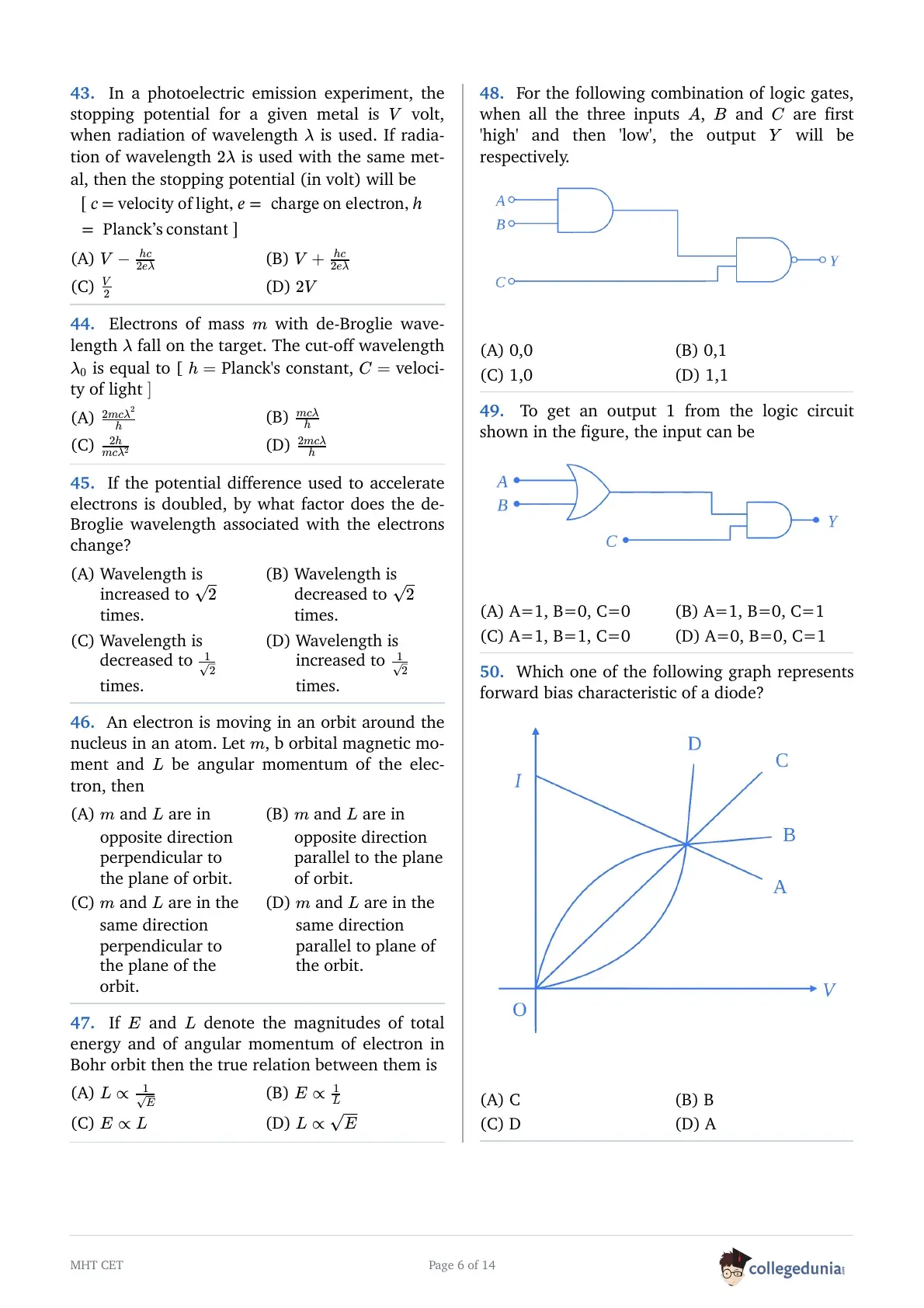
For the following combination of logic gates, when all the three inputs \(A\), \(B\) and \(C\) are first 'high' and then 'low', the output \(Y\) will be respectively.

To get an output 1 from the logic circuit shown in the figure, the input can be

Which one of the following graph represents forward bias characteristic of a diode?

Chemistry (Q51 - Q100)
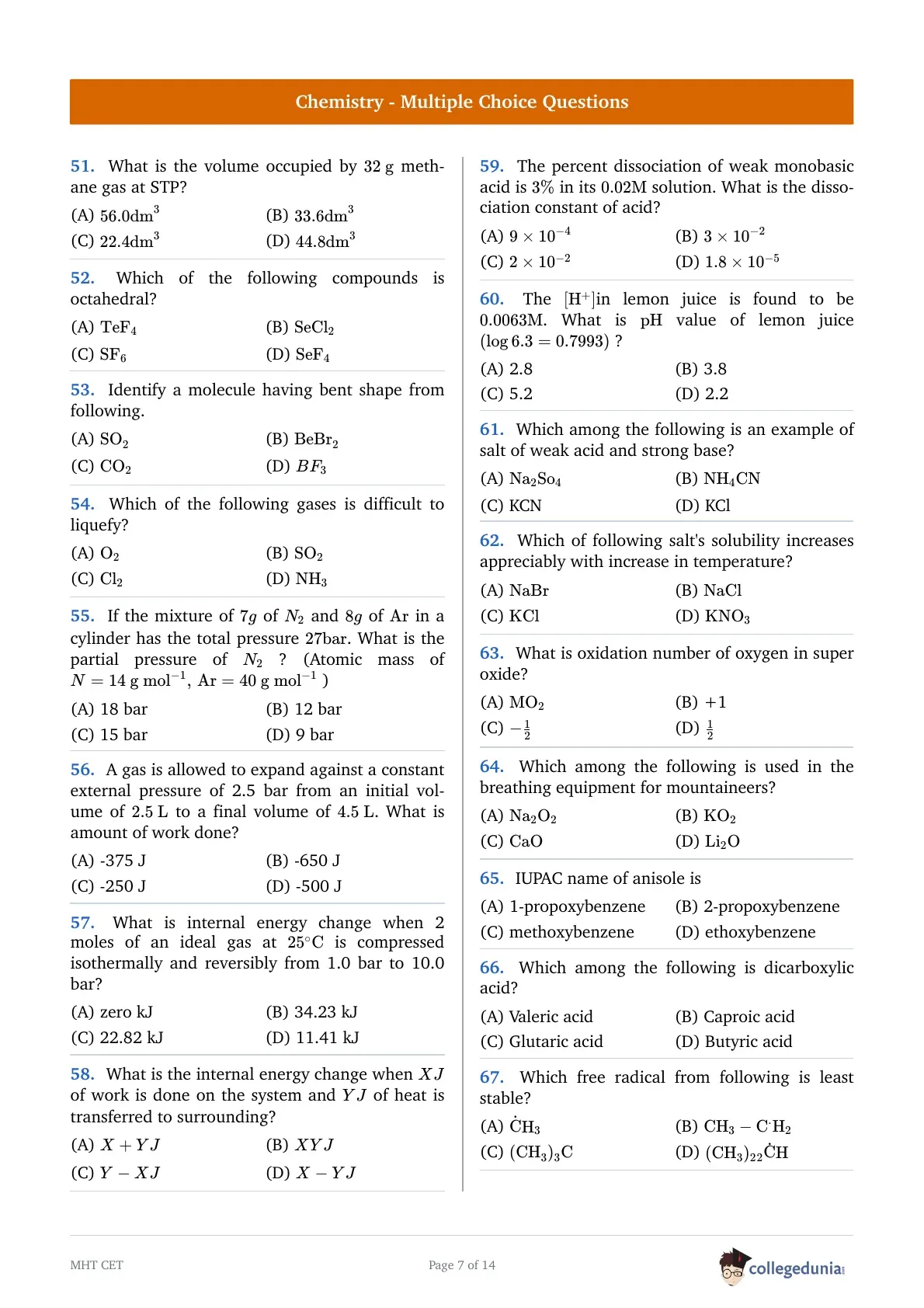
What is the volume occupied by \(32\ \mathrm{g}\) methane gas at STP?
Which of the following compounds is octahedral?
Identify a molecule having bent shape from following.
Which of the following gases is difficult to liquefy?
If the mixture of \(7g\) of \(N_{2}\) and \(8g\) of \(\mathrm{Ar}\) in a cylinder has the total pressure \(27\mathrm{bar}\). What is the partial pressure of \(N_{2}\) ? (Atomic mass of \(N=14\ \mathrm{g}\ \mathrm{mol}^{-1},\,\mathrm{Ar}=40\ \mathrm{g}\ \mathrm{mol}^{-1}\) )
A gas is allowed to expand against a constant external pressure of 2.5 bar from an initial volume of \(2.5\ \mathrm{L}\) to a final volume of \(4.5\ \mathrm{L}\). What is amount of work done?
What is internal energy change when 2 moles of an ideal gas at \(25^{\circ }\mathrm{C}\) is compressed isothermally and reversibly from 1.0 bar to 10.0 bar?
What is the internal energy change when \(XJ\) of work is done on the system and \(YJ\) of heat is transferred to surrounding?
The percent dissociation of weak monobasic acid is \(3\%\) in its \(0.02\mathrm{M}\) solution. What is the dissociation constant of acid?
The \([\mathrm{H}^{+}]\)in lemon juice is found to be \(0.0063\mathrm{M}\). What is \(\mathrm{pH}\) value of lemon juice \((\log 6.3=0.7993)\) ?
Which among the following is an example of salt of weak acid and strong base?
Which of following salt's solubility increases appreciably with increase in temperature?
What is oxidation number of oxygen in super oxide?
Which among the following is used in the breathing equipment for mountaineers?
IUPAC name of anisole is
Which among the following is dicarboxylic acid?
Which free radical from following is least stable?
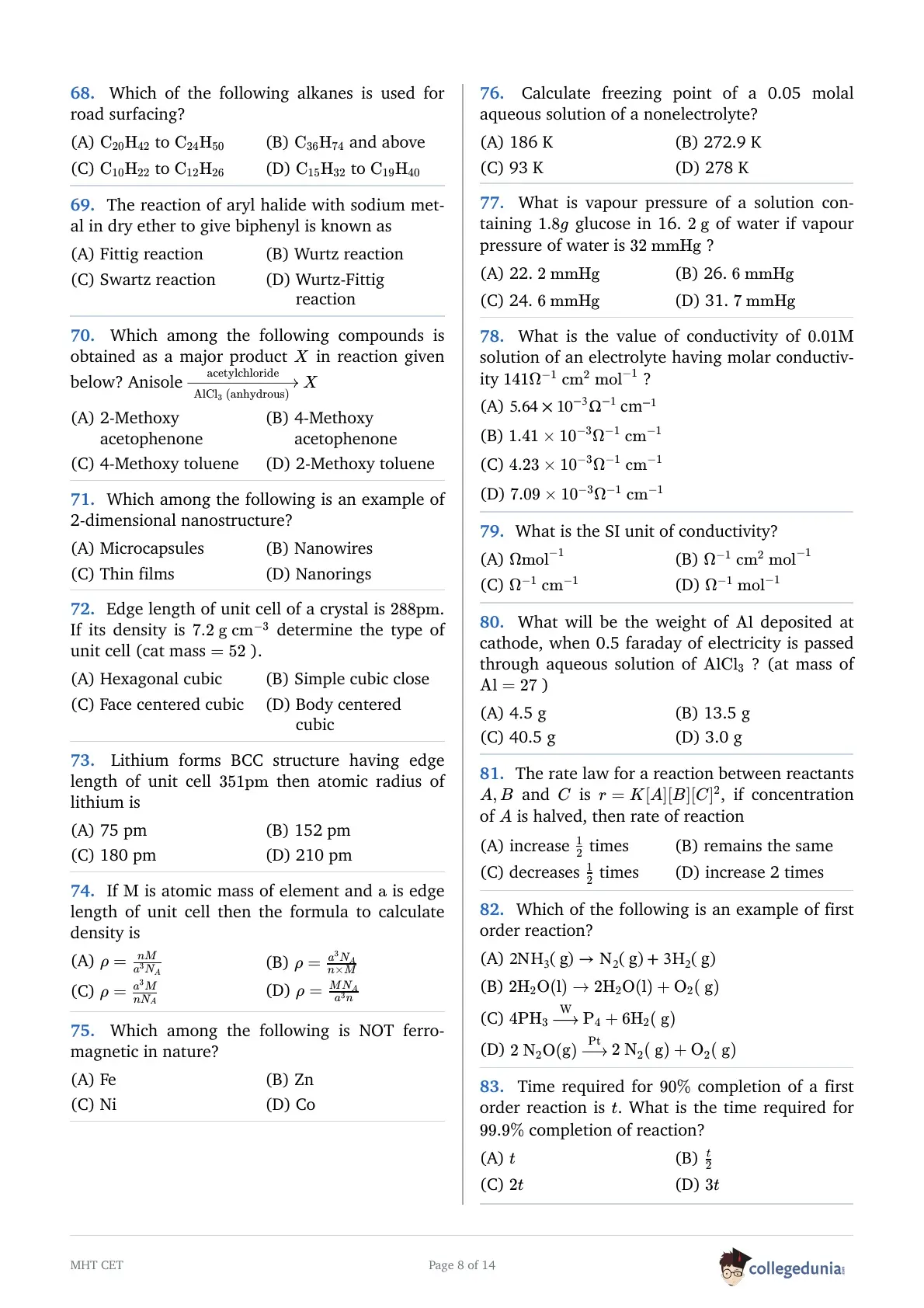
Which of the following alkanes is used for road surfacing?
The reaction of aryl halide with sodium metal in dry ether to give biphenyl is known as
Which among the following compounds is obtained as a major product \(X\) in reaction given below? Anisole \(\xrightarrow[\mathrm{AlCl}_{3}\text{ (anhydrous) }]{\text{ acetylchloride }}X\)
Which among the following is an example of 2-dimensional nanostructure?
Edge length of unit cell of a crystal is \(288\mathrm{pm}\). If its density is \(7.2\ \mathrm{g}\ \mathrm{cm}^{-3}\) determine the type of unit cell (cat mass \(=52\) ).
Lithium forms BCC structure having edge length of unit cell \(351\mathrm{pm}\) then atomic radius of lithium is
If \(\mathrm{M}\) is atomic mass of element and \(\mathrm{a}\) is edge length of unit cell then the formula to calculate density is
Which among the following is NOT ferromagnetic in nature?
Calculate freezing point of a 0.05 molal aqueous solution of a nonelectrolyte?
What is vapour pressure of a solution containing \(1.8g\) glucose in 16. \(2\ \mathrm{g}\) of water if vapour pressure of water is \(32\ \mathrm{mm}\mathrm{Hg}\) ?
What is the value of conductivity of \(0.01\mathrm{M}\) solution of an electrolyte having molar conductivity \(141\Omega ^{-1}\ \mathrm{cm}^{2}\ \mathrm{mol}^{-1}\) ?
What is the SI unit of conductivity?
What will be the weight of \(\mathrm{Al}\) deposited at cathode, when 0.5 faraday of electricity is passed through aqueous solution of \(\mathrm{AlCl}_{3}\) ? (at mass of \(\mathrm{Al}=27\) )
The rate law for a reaction between reactants \(A,B\) and \(C\) is \(r=K[A][B][C]^{2}\), if concentration of \(A\) is halved, then rate of reaction
Time required for \(90\%\) completion of a first order reaction is \(t\). What is the time required for \(99.9\%\) completion of reaction?
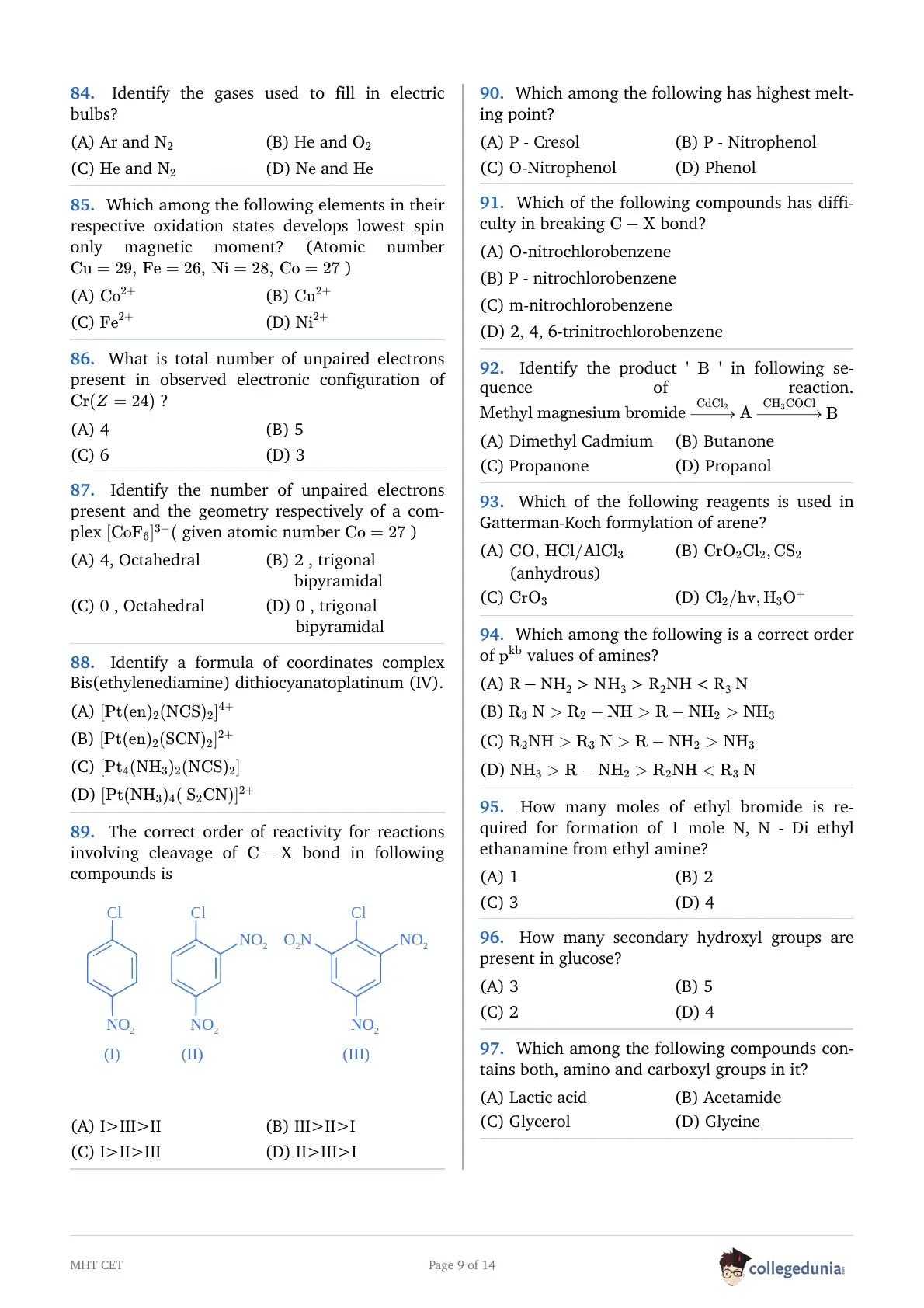
Identify the gases used to fill in electric bulbs?
Which among the following elements in their respective oxidation states develops lowest spin only magnetic moment? (Atomic number \(\mathrm{Cu}=29,\,\mathrm{Fe}=26,\,\mathrm{Ni}=28,\,\mathrm{Co}=27\) )
What is total number of unpaired electrons present in observed electronic configuration of \(\mathrm{Cr}(Z=24)\) ?
Identify the number of unpaired electrons present and the geometry respectively of a complex \([\mathrm{CoF}_{6}]^{3-}(\) given atomic number \(\mathrm{Co}=27\) )
Identify a formula of coordinates complex Bis(ethylenediamine) dithiocyanatoplatinum (IV).
The correct order of reactivity for reactions involving cleavage of \(\mathrm{C}-\mathrm{X}\) bond in following compounds is

Which among the following has highest melting point?
Which of the following compounds has difficulty in breaking \(\mathrm{C}-\mathrm{X}\) bond?
Identify the product ' \(\mathrm{B}\) ' in following sequence of reaction.
\(\text{Methyl magnesium bromide}\xrightarrow{\mathrm{CdCl}{}_{2}}\mathrm{A}\xrightarrow{\mathrm{CH}{}_{3}\mathrm{COCl}}\mathrm{B}\)
Which of the following reagents is used in Gatterman-Koch formylation of arene?
Which among the following is a correct order of \(\mathrm{p}^{\mathrm{kb}}\) values of amines?
How many moles of ethyl bromide is required for formation of 1 mole N, N - Di ethyl ethanamine from ethyl amine?
How many secondary hydroxyl groups are present in glucose?
Which among the following compounds contains both, amino and carboxyl groups in it?
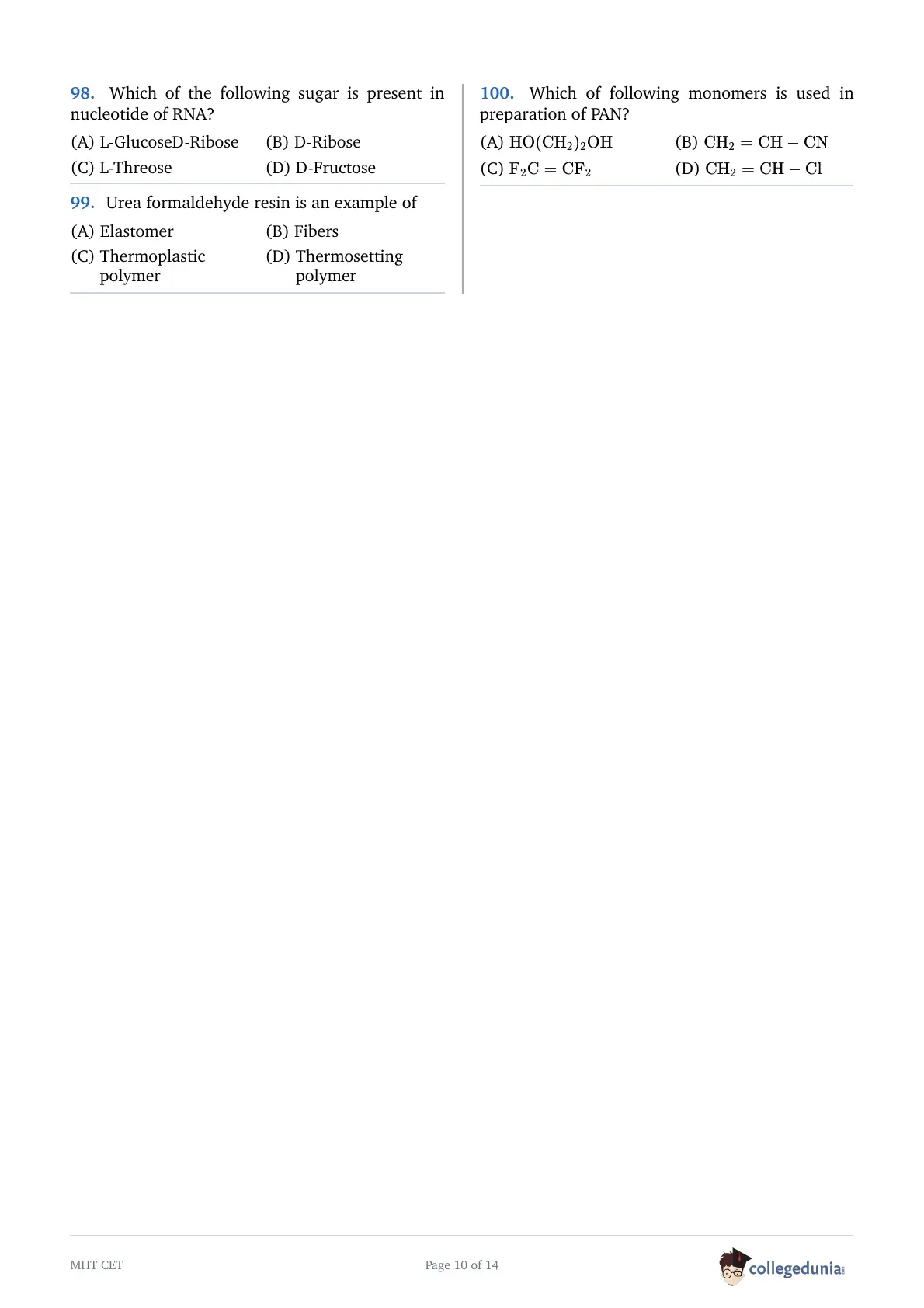
Urea formaldehyde resin is an example of
Which of following monomers is used in preparation of PAN?
Mathematics (Q101 - Q150)
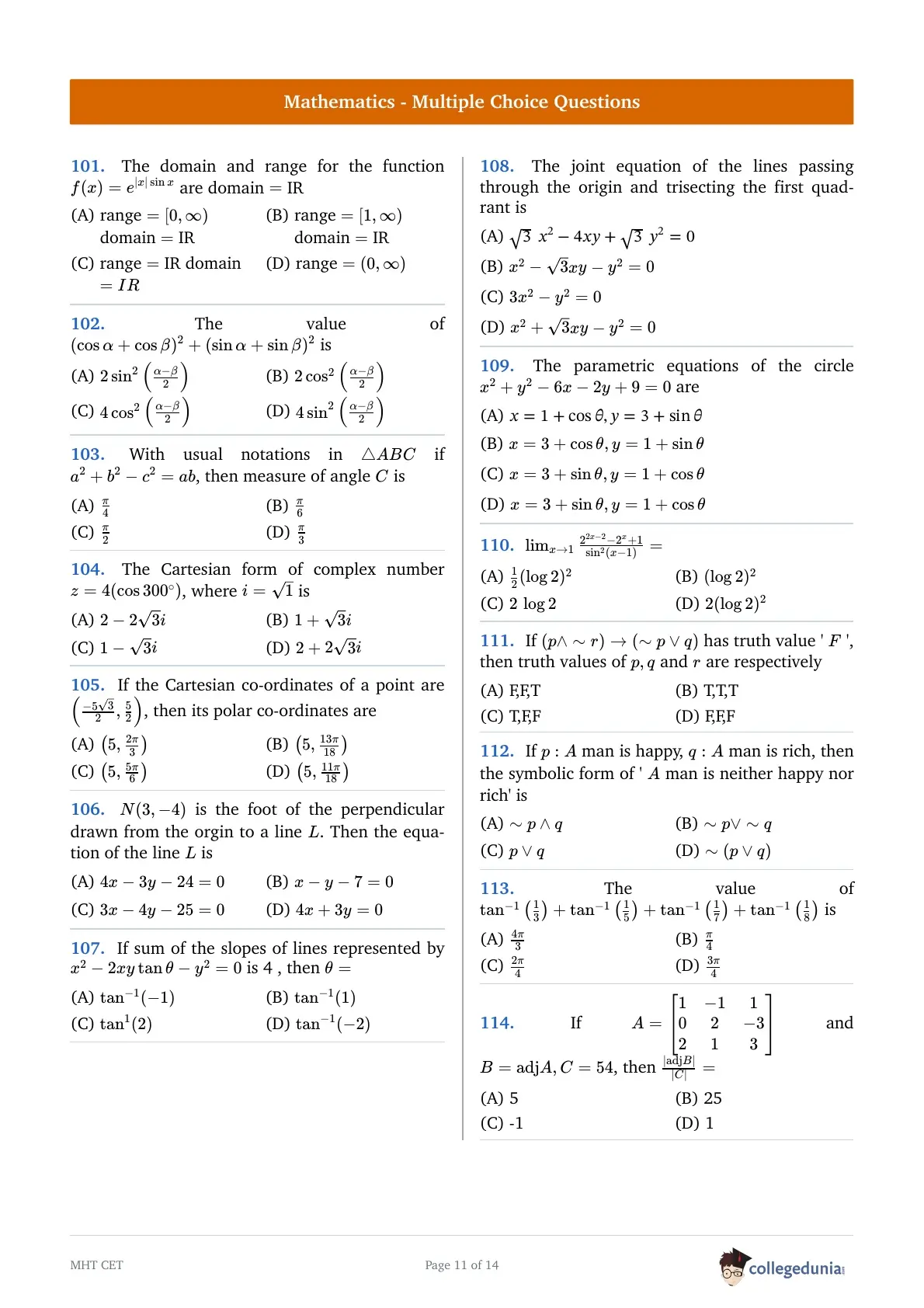
The domain and range for the function \(f(x)=e^{|x|\sin x}\) are domain \(=\) IR
The value of \((\cos \alpha +\cos \beta )^{2}+(\sin \alpha +\sin \beta )^{2}\) is
With usual notations in \(\triangle ABC\) if \(a^{2}+b^{2}-c^{2}=ab\), then measure of angle \(C\) is
If the Cartesian co-ordinates of a point are \(\left(\frac{-5\sqrt{3}}{2},\frac{5}{2}\right)\), then its polar co-ordinates are
\(N(3,-4)\) is the foot of the perpendicular drawn from the orgin to a line \(L\). Then the equation of the line \(L\) is
If sum of the slopes of lines represented by \(x^{2}-2xy\tan \theta -y^{2}=0\) is 4 , then \(\theta =\)
The joint equation of the lines passing through the origin and trisecting the first quadrant is
\(\lim _{x\rightarrow 1}\frac{2^{2x-2}-2^{x}+1}{\sin ^{2}(x-1)}=\)
If \((p\wedge \sim r)\rightarrow (\sim p\vee q)\) has truth value ' \(F\) ', then truth values of \(p,q\) and \(r\) are respectively
If \(p:A\) man is happy, \(q:A\) man is rich, then the symbolic form of ' \(A\) man is neither happy nor rich' is
The value of \(\tan ^{-1}\left(\frac{1}{3}\right)+\tan ^{-1}\left(\frac{1}{5}\right)+\tan ^{-1}\left(\frac{1}{7}\right)+\tan ^{-1}\left(\frac{1}{8}\right)\) is
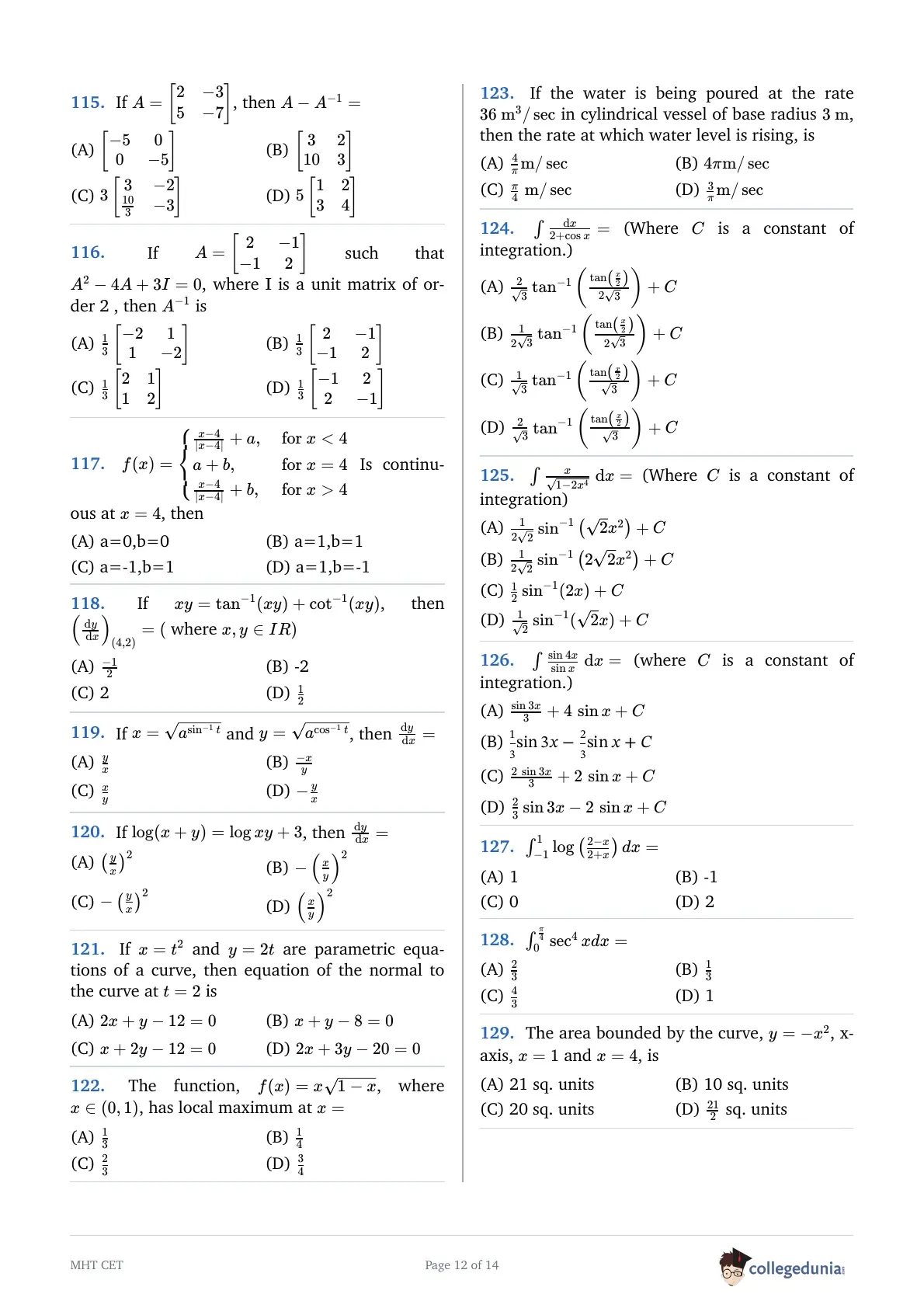
If \(A=\begin{bmatrix} 2 & -3 \\ 5 & -7 \end{bmatrix}\), then \(A-A^{-1}=\)
If \(A=\begin{bmatrix} 2 & -1 \\ -1 & 2 \end{bmatrix}\) such that \(A^{2}-4A+3I=0\), where \(\mathrm{I}\) is a unit matrix of order 2 , then \(A^{-1}\) is
\(f(x)=\begin{cases} \frac{x-4}{|x-4|}+a, & \text{ for }x\lt 4 \\ a+b, & \text{ for }x=4 \\ \frac{x-4}{|x-4|}+b, & \text{ for }x>4 \end{cases}\) Is continuous at \(x=4\), then
If \(x=\sqrt{a^{\sin ^{-1}t}}\) and \(y=\sqrt{a^{\cos ^{-1}t}}\), then \(\frac{\mathrm{d}y}{\ \mathrm{d}x}=\)
If \(\log (x+y)=\log xy+3\), then \(\frac{\mathrm{d}y}{\ \mathrm{d}x}=\)
If \(x=t^{2}\) and \(y=2t\) are parametric equations of a curve, then equation of the normal to the curve at \(t=2\) is
The function, \(f(x)=x\sqrt{1-x}\), where \(x\in (0,1)\), has local maximum at \(x=\)
If the water is being poured at the rate \(36\ \mathrm{m}^{3}/\sec\) in cylindrical vessel of base radius \(3\ \mathrm{m}\), then the rate at which water level is rising, is
\(\int \frac{\mathrm{d}x}{2+\cos x}=\) (Where \(C\) is a constant of integration.)
\(\int \frac{x}{\sqrt{1-2x^{4}}}\ \mathrm{d}x=\) (Where \(C\) is a constant of integration)
\(\int \frac{\sin 4x}{\sin x}\ \mathrm{d}x=\) (where \(C\) is a constant of integration.)
\(\int _{-1}^{1}\log \left(\frac{2-x}{2+x}\right)dx=\)
\(\int _{0}^{\frac{\pi }{4}}\sec ^{4}xdx=\)
The area bounded by the curve, \(y=-x^{2}\), x-axis, \(x=1\) and \(x=4\), is
Water at \(100^{\circ }\mathrm{C}\) cools in 10 minutes to \(80^{\circ }\mathrm{C}\) in a room temperature of \(25^{\circ }\mathrm{C}\), then the temperature of water after 20 minutes will be
The differential equation whose solution is \(y=c^{2}+\frac{c}{x}\), where \(c\) is constant, is
The particular solution of the differential equation \((2x-2y+3)\mathrm{d}x-(x-y+1)\mathrm{d}y=0\) when \(x=0,y=1\) is
The differential equation \(y'=\frac{y}{x+\sqrt{xy}}\) has general solution given by (Where \(C\) is a constant of integration.)
The general solution of the differential equation \(\frac{\mathrm{d}y}{\ \mathrm{d}x}=1-x+y-xy\) is (where \(C\) is a constant of integration)
If \(\bar{a}=\hat{i}+\hat{j}+\hat{k},\bar{b}=\hat{i}-\hat{j}+2\hat{k},\bar{c}=x\hat{i}+(x-2)\hat{j}-\hat{k}\) and \(\bar{c}\) is linear combination of \(\bar{a}\) and \(\bar{b}\), then \(x\) has the value
The position vectors of vertices of \(\triangle ABC\) are \(4\hat{i}-2\hat{j}\); \(\hat{i}+4\hat{j}-3\hat{k}\) and \(-\hat{i}+5\hat{j}+\hat{k}\) respectively, then \(m\angle ABC=\)
If the area of the triangle with vertices \(\hat{i}+y\hat{j},\hat{i}+2\hat{k}\) and \(3\hat{j}+\hat{k}\) is \(\sqrt{6}\) sq. units, then the values of \(y\) are
If \(\overline{AB}=(2\hat{i}+3\hat{j}-\hat{k})\) and \(A(1,2,-1)\) is the given point, then the coordinates of \(B\) are
The Cartesian equation of a line is \(\frac{x+2}{3}=\frac{y-4}{2}=\frac{z-5}{5}\), then the vector equation of the line is
If the planes \(\bar{r}\cdot (2\hat{i}-\lambda \hat{j}+\hat{k})=3\) and \(\bar{r}\cdot (4\hat{i}-\hat{j}+\mu \hat{k})=5\) are paralle, then values of \(\lambda\) and \(\mu\) are respectively

A player tosses 2 fair coins. He with Rs. 5 if 2 heads appear, Rs. 2 if 1 head appears and Rs. 1 if no head appear, then the variance of his winning amount is
In a certain examination, a candidate has to pass in each of the 5 subjects. Hence, the number of ways he can fail is
In a Binomial distribution, \(n=4\) and \(2P(X=3)=3P(X=2)\), then \(q=\)
There are 2 shelves. One shelf has 5 Physics and 3 Bilogy books and other has 4 Physics and 2 Biology books. Then probability of drawing a Physics book is
If the function \(P[X=x]=\begin{cases} \frac{K\cdot 2^{x}}{x!}, & x=0,1,2,3 \\ 0, & \text{ otherwise } \end{cases}\) Forms p.m.f., then value of \(K\) is
MHT CET 2022 PCM Exam Pattern and Marking Scheme
| Parameter | Details |
|---|---|
| Conducting Body | Maharashtra Common Entrance Test Cell (Maharashtra CET Cell) |
| Exam Mode | Online (Computer-Based Test) |
| Duration | 180 minutes (3 hours) |
| Groups / Subjects | PCM (Physics, Chemistry, Mathematics) for Engineering |
| Total Questions |
150 |
| Total Marks | 200 |
| Question Type | Multiple Choice Questions (MCQs) |
| Marks Distribution |
|
| Negative Marking | No |
| Syllabus Weightage |
|



Comments